THE SHROOMVERSE JOURNAL ✳ 14 MIN READ
DMT entity encounters: what researchers have recorded
Topic: DMT
Published Updated
Listen: the 3-minute version
AI-narrated summary of this article
Short answer, checked 20 October 2026
DMT entity encounters are experiences in which people report meeting beings, most often described as guides, aliens, deities or feminine figures, and only rarely as “machine elves”. Encounters appeared in 45.5% of 3,778 coded online reports and in 94% of 36 field-study interviews, and a survey of 2,561 people who had one found most called the being benevolent, though 41% reported fear. Brain-imaging studies link the visuals that come first to changes in brain rhythms and network activity. None of this shows what the entities are, and most of the evidence is self-reported.
THE SHORT VERSION · SWIPE
On this page 8 sections
People who search for DMT entity encounters usually want two things: what others say they met, and what science makes of it. Researchers have surveyed thousands of people, coded thousands of online trip reports, interviewed people minutes after the experience and scanned volunteers’ brains. This page is the research overview: what the main studies recorded, how they measured changes in belief, how the reports compare with near-death experiences, and where the evidence runs out. For a type-by-type breakdown of the beings and the theories behind them, see our field guide to DMT entity types.
Research summary, not advice
This article describes published studies of reported experiences. It gives no amounts, methods or guidance, and it does not present any effect as a benefit. DMT is a controlled substance in Canada, and the experiences described here can be frightening. Our safety page covers risks and where to get help. Evidence labels used below: established (shown in peer-reviewed studies and not seriously disputed), preliminary (early, small, self-selected or indirect) and unresolved (an open question).
What do people see before an entity encounter?
The earliest systematic descriptions in modern research come from a study led by Rick Strassman, published in 1994. Twelve experienced volunteers were given DMT intravenously and interviewed after the effects ended. At the higher levels tested, the effects included “a rapidly moving, brightly colored visual display of images”. A brief, overwhelming rush and a sense of losing control led into a dissociated state, in which euphoria and anxiety alternated or existed together. Volunteers called the effects more vivid and compelling than dreams or waking awareness, and they had almost completely resolved within 30 minutes (Strassman et al., 1994). Evidence: established for this early lab description, from 12 people.
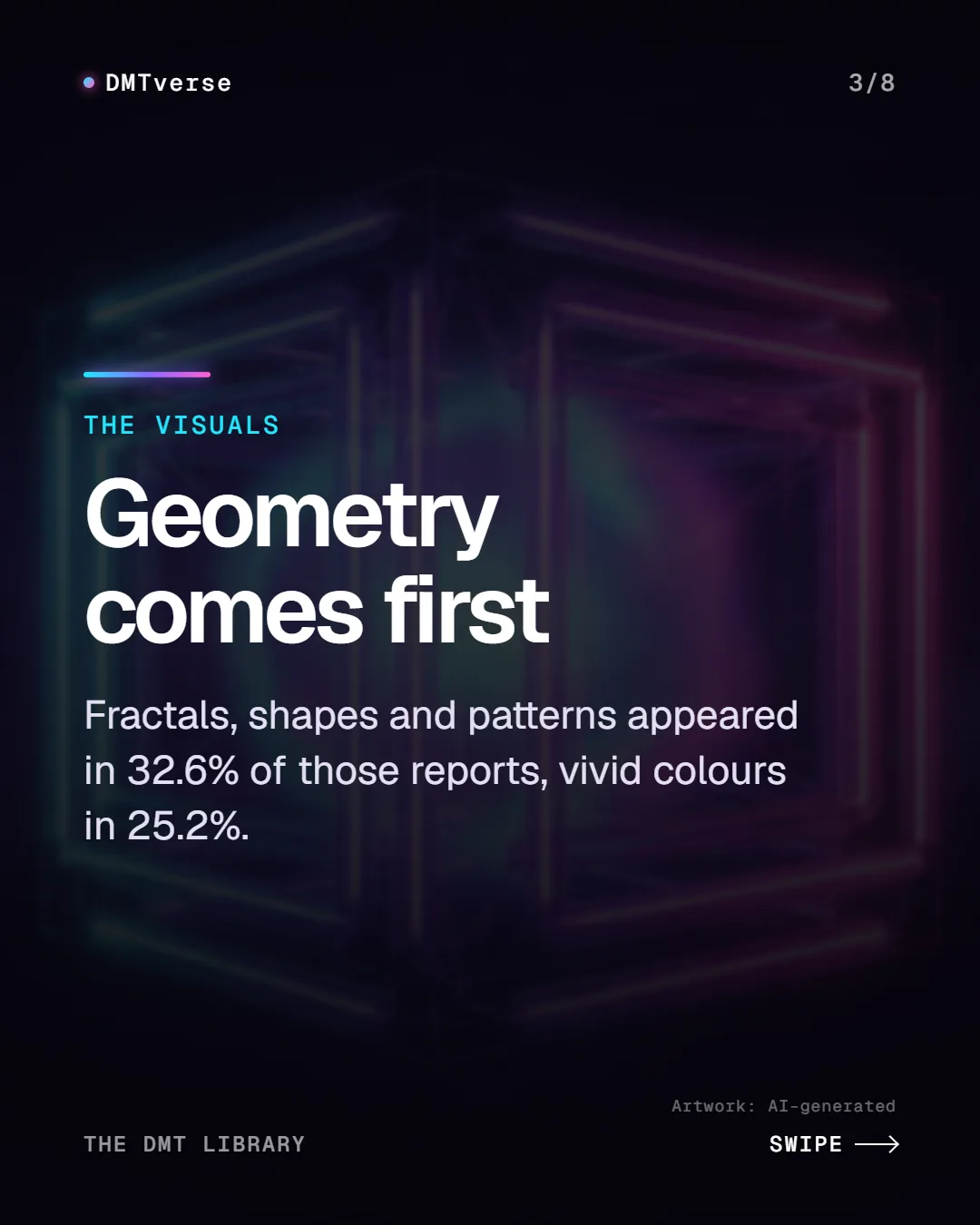
Later work put numbers on the imagery. A team led by David Lawrence of the University of Toronto, with researchers from Imperial College London and Johns Hopkins, coded every DMT experience posted to one online forum from 2009 to 2018: 3,778 experiences in 3,305 posts. The most common visuals were fractals, shapes and patterns (32.6% of experiences) and vivid colours (25.2%). Alternate or higher dimensions appeared in 25.2%, rooms in 15.4% (including a so-called “waiting room” in 2.8%), and a tunnel in 10.3% (Lawrence et al., 2022). Evidence: preliminary; self-selected posts.
So the research does not describe one image. It describes a family of reported experiences: geometry and colour first, then for some people a sense of being somewhere else, and for some of those, a sense of meeting someone. Our guide to the waiting room, the dome and the chrysanthemum covers the vocabulary people use for those places.
What did the main entity-encounter studies find?
Three studies are cited most often. They used very different methods, which is useful: where they agree, the pattern is less likely to be an artefact of one method. The table compares them.
| Study | Design | Who took part | Main entity findings | Key limits |
|---|---|---|---|---|
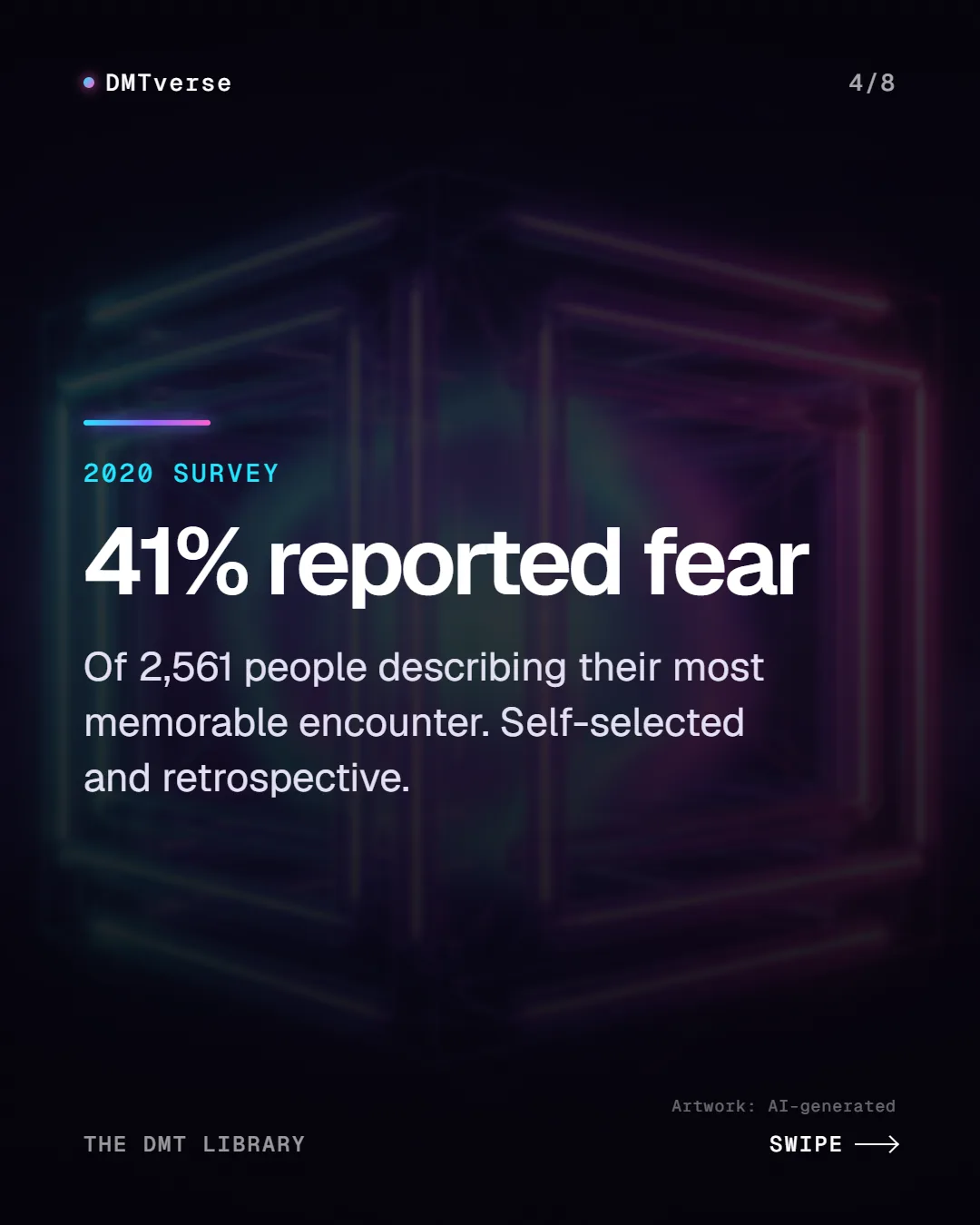
| Davis et al., 2020 (Johns Hopkins) | Online survey about a single most memorable entity encounter | 2,561 people; mean age 32; 77% male | Most described the entity as conscious, intelligent and benevolent; 41% reported fear; 69% reported receiving a message | Self-selected; retrospective; no control group; only people who had an encounter |
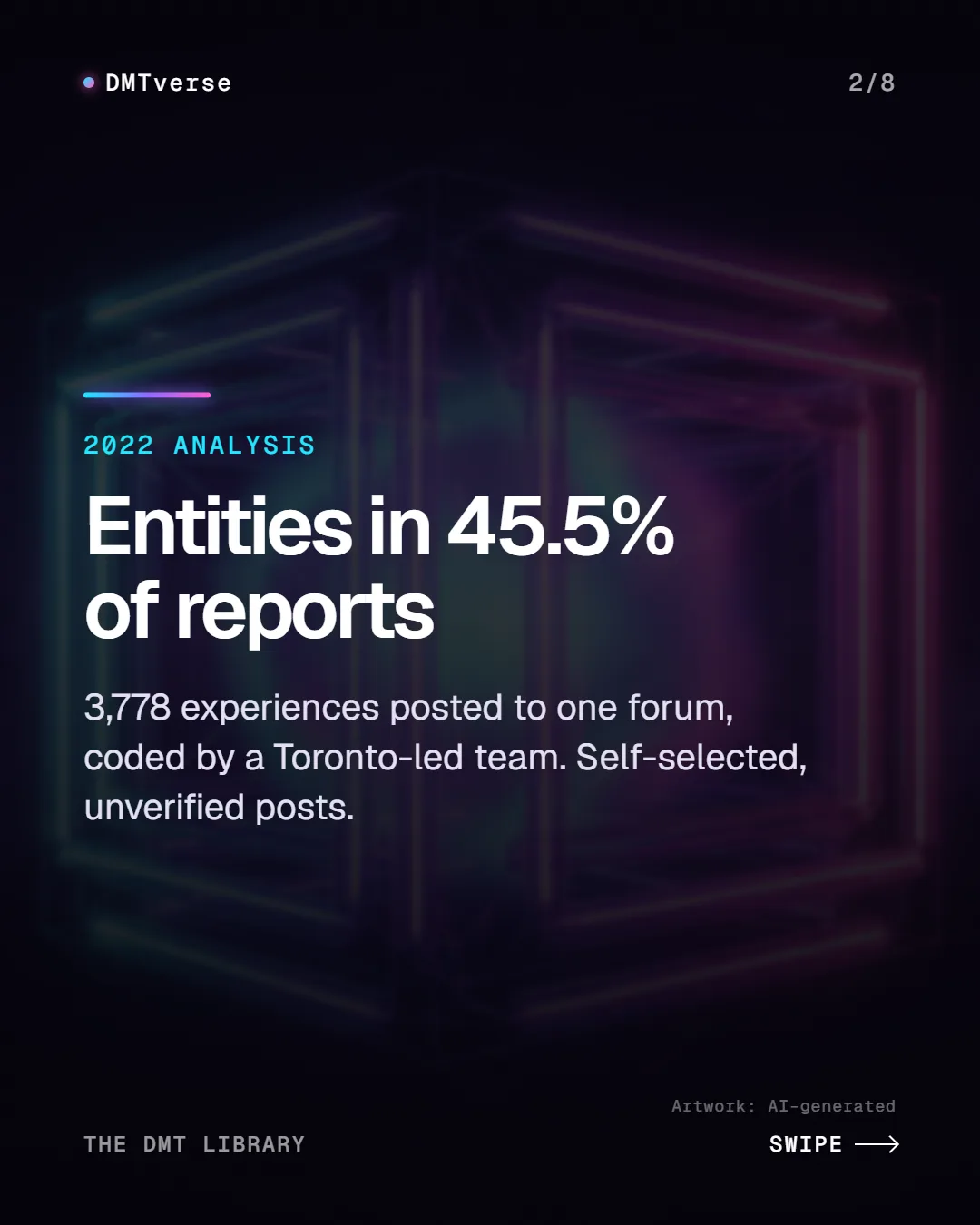
| Lawrence et al., 2022 (Toronto-led) | Qualitative coding of public online reports, 2009 to 2018 | 3,778 experiences in 3,305 posts | Entities in 45.5% of experiences; interactions mostly positive; machine elves in 2.9% of encounters | Unverified anonymous posts; people may post striking trips; forum language may shape reports |
| Michael et al., 2021 (UK field study) | Observed non-clinical use, then in-depth interviews straight afterwards | 36 interviews with screened, experienced users (8 female; average age 37) | Beings in 94% of reports; other worlds in 100%; communication mostly described as telepathic | Small, convenience sample of experienced users; no control group |
The 2020 Johns Hopkins survey
Alan Davis and colleagues asked 2,561 people to describe their single most memorable entity encounter after inhaling DMT. The senses most involved were visual and “extrasensory”, such as a feeling of telepathy. The most common labels for the entity were being, guide, spirit, alien and helper. Although 41% reported fear during the encounter, the most prominent emotions, both their own and those they attributed to the entity, were love, kindness and joy (Davis et al., 2020). Evidence: preliminary; a self-selected, retrospective survey.
Most respondents said the entity was conscious, intelligent and benevolent, existed in some real but different dimension, and continued to exist afterwards. Sixty-nine percent said they received a message, and 19% a prediction about the future (Davis et al., 2020). Why those encounters felt so convincing is the subject of our article on why DMT feels more real than reality. Evidence: preliminary.
The 2022 analysis of online trip reports
In the Lawrence analysis, 1,719 of the 3,778 experiences (45.5%) included an entity encounter. The most common types were feminine figures (24.2% of encounters), deities (17.0%) and aliens (16.3%), followed by creature-like beings (9.2%), mythological beings including elves (8.4%), robots or machines (6.7%) and jesters (6.5%). Interactions were most often coded as positive (34.9%), about a third involved a guide, teacher or companion role (32.4%), and communication was recorded in 74.4% of encounters. Negative or difficult interactions were coded in 11.4% (Lawrence et al., 2022). Our field guide to DMT entity types breaks these categories down. Evidence: preliminary; self-selected posts.
The 2021 field study
Pascal Michael, David Luke and Oliver Robinson describe theirs as the first naturalistic field study of DMT use with qualitative analysis. They screened 64 people, included 39, and observed sessions in participants’ homes in south-east England; 36 interviews met the criteria for analysis. Interviews took place immediately afterwards, so the reports were fresh rather than recalled months later (Michael et al., 2021). Evidence: established for the design.
Thirty-four of 36 reports (94%) included an encounter with beings experienced as beyond the self, and every report described emerging into other “worlds”. The most common demeanours were charming and inviting, “benevolent” was a frequent description, and a smaller number described beings as mischievous or jester-like. Communication was mostly described as intuitive or telepathic (Michael et al., 2021). Evidence: preliminary; a small sample of experienced users.
How common are “machine elves” in DMT entity encounters?
Less common than their fame suggests. The phrase is usually credited to the American writer Terence McKenna, and the 2021 field study links its most often reported texture of beings, “self-transforming”, to his label (Michael et al., 2021). In the 2022 analysis, machine elves appeared in 50 experiences, 2.9% of those with an entity encounter. The authors also flagged a problem: forum users repeatedly applied ready-made labels such as “machine elves” to otherwise novel experiences, which suggests earlier reports may shape later ones (Lawrence et al., 2022). Our article on machine elves traces the phrase’s history. Evidence: preliminary.
What do brain scans show about the visuals?
Imaging studies cannot show what a person saw, but they can show what changed in the brain at the same time. In a placebo-controlled EEG study of 13 volunteers at Imperial College London, intravenous DMT markedly reduced alpha and beta brain rhythms and increased the diversity of brain signals. As the experience peaked, delta and theta rhythms emerged, and this correlated with the peak of the experience, particularly its eyes-closed visual component (Timmermann et al., 2019). Evidence: established for the alpha and beta drop; preliminary for the rest, from 13 people.
A 2023 study recorded EEG and functional MRI at the same time in 20 healthy volunteers, comparing DMT with placebo. It found large increases in connectivity across the brain and a breakdown of the usual separation between networks, with the strongest effects in high-level “transmodal association” regions, which carry many serotonin 2A receptors. Signal diversity was correlated with how rich participants rated their conscious experience (Timmermann et al., 2023). Evidence: preliminary; 20 people.
A 2026 paper from the same research programme interviewed 23 participants in detail after DMT during combined fMRI and EEG. Bodily effects usually came before visual and auditory ones, and perceived presences emerged only after the experience had become multisensory and three-dimensional. The presences varied widely in how they were sensed and how complex they seemed (Sanders et al., 2026). That ordering fits the trip reports: geometry first, then a world, then sometimes someone in it. Evidence: preliminary.
These are small samples of healthy volunteers in a scanner, and they show correlations, not explanations. The visuals track measurable brain changes. The studies do not explain why people see beings, or what those beings are.
How did researchers measure changes in belief?
Mostly by asking people afterwards. In the 2020 survey, respondents reported their religious identity before and after the encounter in the same questionnaire. More than half of those who identified as atheist before no longer did afterwards. Respondents rated the experience among the most meaningful, spiritual and psychologically insightful of their lives, and attributed lasting changes in life satisfaction, purpose and meaning to it (Davis et al., 2020). An earlier survey by the same group, of “God encounter” experiences, included 606 people whose encounter came with DMT. Across all groups, more than two-thirds of those who identified as atheist before no longer did afterwards (Griffiths et al., 2019). Evidence: preliminary.
Both designs share a weakness. The “before” answer is given after the event, from memory, by people who chose to answer a survey about a memorable experience. That can exaggerate change.
A stronger design asks people before and after. In 2021, Imperial College researchers built a 13-item Metaphysical Beliefs Questionnaire and used it in online surveys of people planning to attend a ceremony or guided session involving a psychedelic. Beliefs were measured a week before, then four weeks and six months after, with 866 respondents taking part at different time points. Beliefs shifted away from “physicalist” or materialist views and towards panpsychism and fatalism. Except for fatalism, the shifts lasted at least six months, and a separate psilocybin depression trial showed similar shifts (Timmermann et al., 2021). Evidence: preliminary.
That work covered psychedelics in general, not DMT entity encounters. It supports the idea that beliefs can shift, but it cannot say how much an entity encounter itself contributes.
How do these reports compare with near-death experiences?
Researchers have compared them directly. In a 2018 placebo-controlled study, 13 healthy volunteers given DMT scored significantly higher on a standard near-death experience scale than after placebo. Their scores overlapped with nearly all features reported by a matched group of people who had actually had a near-death experience (Timmermann et al., 2018). The 2020 survey authors likewise noted similarities with entity encounters described in religious, alien-abduction and near-death contexts (Davis et al., 2020). Evidence: preliminary; 13 people in the lab study.
The similarities are not the whole story. A 2025 analysis compared the 36 field-study interviews with 34 written near-death accounts. In 95% of the DMT reports, at least one classic near-death theme appeared, such as bright light, a tunnel-like structure, a sense of dying or deceased family members. But five classic near-death features never appeared with DMT, and the DMT accounts were more kaleidoscopic, “extraterrestrial” and overwhelming. The authors concluded that the two experiences diverge when compared in detail (Michael et al., 2025). Evidence: preliminary.
A 2024 survey of 31 people who had experienced both found overlap in mystical-like features, but the near-death experiences involved more sense of leaving the body and the psychedelic experiences more visual imagery (Martial et al., 2024). Evidence: preliminary.
Whether the brain releases DMT at death is a separate question, and the comparisons above do not answer it. Our articles on DMT and near-death experiences and whether the brain releases DMT when you die cover that debate.
What the research cannot tell us
- What the entities are. Studies record what people report and believe. None tests whether the beings exist independently, and the papers do not claim to.
- How common encounters are overall. The 2020 survey only included people who had an encounter, and the 2022 forum data overrepresents striking experiences, so neither gives a true rate.
- How much culture shapes the content. Shared vocabulary, such as “machine elves” or the “waiting room”, may spread through online communities and colour later reports.
- Whether belief changes last, and why. The DMT-specific evidence is retrospective self-report. The one prospective study covered psychedelics in general.
- How the findings apply to anyone outside the studies. Lab and field participants were screened and supervised, and most survey respondents were experienced users who chose to take part.
Difficult experiences are part of the record too. In the 2020 survey, 41% reported fear during the encounter (Davis et al., 2020). In the 2022 analysis, about one in nine encounters (11.4%) involved a negative or difficult interaction (Lawrence et al., 2022). Positive accounts dominate the data, but they are not the only kind.
If someone is in crisis
In immediate danger or if urgent medical support is needed, call 9-1-1. The Government of Canada says anyone thinking about suicide, or worried about someone, can call or text 9-8-8, 24 hours a day, 7 days a week (Government of Canada). For poisoning advice, Health Canada lists a toll-free poison centre number, 1-844-764-7669 (1-844 POISON-X) (Health Canada). More numbers are on our safety page, and our guide on how to help someone having a bad trip explains what supporters can do.
The honest summary: DMT entity encounters are broadly consistent across surveys, forums and field interviews, and the visuals that come first line up with measurable brain changes. What the encounters mean is still open. For the competing explanations, read our field guide to DMT entity types; for how setting and expectation shape psychedelic experiences, see our explainer on set and setting.
Common questions
What does DMT look like, according to research?
Studies record what people report seeing, not what is really there. Common reports are fractals, shapes, patterns and vivid colours, then a sense of entering another world or dimension, and sometimes rooms or tunnels. In one analysis of 3,778 online reports, geometric visuals appeared in about a third and vivid colours in a quarter.
How common are entity encounters in DMT stories?
It depends on the sample. They appeared in 45.5% of 3,778 online reports and in 94% of 36 interviews from a field study of experienced users. Neither figure is a true population rate, because both samples were self-selected.
What are “machine elves”?
A phrase usually credited to Terence McKenna, describing small, constantly self-transforming beings. A 2021 field study links it to a 1993 recorded talk by McKenna. In a 2022 analysis of online reports, machine elves appeared in 2.9% of entity encounters.
Do DMT entity encounters change people’s beliefs?
Many people say so. In a 2020 survey of 2,561 people, more than half of those who identified as atheist before the encounter no longer did afterwards. That was measured by asking people after the event, which can exaggerate change. A prospective 2021 study found shifts away from materialist beliefs after psychedelic use generally.
Is a DMT experience the same as a near-death experience?
They share features. Volunteers given DMT scored high on a near-death experience scale, and most field-study reports contained at least one near-death theme. But detailed comparisons find clear differences, with DMT more visual and kaleidoscopic and some classic near-death features absent.
Are DMT encounters always positive?
No. In the 2020 survey, 41% reported fear during the encounter, and in the 2022 analysis 11.4% of encounters involved a negative or difficult interaction, most often a menacing being. Positive accounts were more common, but difficult ones are well documented.
Shroomverse sells mushroom products. This article is general information about published research on reported DMT experiences. It is not medical, legal or purchasing advice, and it does not recommend any product.
SOURCES
- Survey of entity encounter experiences occasioned by inhaled N,N-dimethyltryptamine: Phenomenology, interpretation, and enduring effects (Davis AK, Clifton JM, Weaver EG, Hurwitz ES, Johnson MW, Griffiths RR, Journal of Psychopharmacology 34(9):1008–1020, 2020), SAGE (peer-reviewed). Accessed . Abstract read via Europe PMC; full text not open. Supports n = 2,561, mean age 32, 77% male; entity labels; 41% fear; love, kindness, joy; entity attributes; 69% message, 19% prediction; more than half of prior atheists no longer atheist; similarities to religious, alien-abduction and near-death encounters.
- Phenomenology and content of the inhaled N,N-dimethyltryptamine (N,N-DMT) experience (Lawrence DW, Carhart-Harris R, Griffiths R, Timmermann C, Scientific Reports 12:8562, 2022), Springer Nature (peer-reviewed, open access); full text via PubMed Central, PMC9130218. Accessed . Full text read. Supports 3,778 experiences in 3,305 posts (2009–2018); visuals, dimensions, rooms, waiting room and tunnel percentages; entity rate 45.5% and types; 34.9% positive and 32.4% guide-type interactions; robots or machines 6.7%; communication 74.4% (1,279 of 1,719); negative or difficult interactions 11.4%; machine elves 50 (2.9%); the forum-terminology limitation; first author’s University of Toronto affiliation. Study dose figures deliberately not reproduced.
- An Encounter With the Other: A Thematic and Content Analysis of DMT Experiences From a Naturalistic Field Study (Michael P, Luke D, Robinson O, Frontiers in Psychology 12:720717, 2021), Frontiers (peer-reviewed, open access); full text via PubMed Central, PMC8716686. Accessed . Full text read. Supports 64 screened, 39 included, 36 interviews analysed (8 female, average age 37); 94% beings, 100% worlds; demeanours; telepathic communication; the “self-transforming” texture linked to McKenna’s “machine elves” (McKenna, 1993 talk). Study dose range deliberately not reproduced.
- An encounter with death: a comparative thematic and content analysis of naturalistic DMT experiences and the near-death experience (Michael P, Luke D, Robinson O, Frontiers in Psychology 16:1532937, 2025), Frontiers (peer-reviewed, open access); PMC11920758. Accessed . Abstract read via Europe PMC. Supports 36 DMT interviews vs 34 near-death narratives; 95% with at least one canonical NDE theme; five classic NDE features absent; divergence in detailed content.
- Dose-response study of N,N-dimethyltryptamine in humans. II. Subjective effects and preliminary results of a new rating scale (Strassman RJ, Qualls CR, Uhlenhuth EH, Kellner R, Archives of General Psychiatry 51(2):98–108, 1994), American Medical Association (peer-reviewed). Accessed . Abstract read via Europe PMC. Supports 12 volunteers, post-session interviews, the quoted visual description, rush, loss of control, euphoria and anxiety, vividness compared with dreams, resolution by 30 minutes. Doses deliberately not reproduced.
- Neural correlates of the DMT experience assessed with multivariate EEG (Timmermann C, et al., Scientific Reports 9:16324, 2019), Springer Nature (peer-reviewed, open access); full text via PubMed Central, PMC6864083. Accessed . Abstract and full text read. Supports 13 volunteers, placebo comparison; reduced alpha and beta power; increased signal diversity; delta and theta emergence correlating with the peak and its eyes-closed visual component.
- Human brain effects of DMT assessed via EEG-fMRI (Timmermann C, et al., PNAS 120(13):e2218949120, 2023), National Academy of Sciences (peer-reviewed); full text via PubMed Central, PMC10068756. Accessed . Abstract and full text read. Supports 20 healthy volunteers, within-subjects placebo design; increased global functional connectivity; network disintegration; effects on the transmodal association pole with high 5-HT2A expression; signal diversity correlated with rated richness of experience (r = 0.7).
- Micro-phenomenology of immersion and perceived presences under DMT (Sanders JW, Millière R, Demšar E, Daily ZG, Erritzoe D, Carhart-Harris R, Timmermann C, Neuroscience of Consciousness, niag015, 2026), Oxford University Press (peer-reviewed, open access); PMC13366535. Accessed . Abstract read via Europe PMC. Supports 23 participants with fMRI-EEG and micro-phenomenological interviews; bodily effects before visual and auditory; presences emerging after multisensory integration and 3D space; wide variation in presences.
- Psychedelics alter metaphysical beliefs (Timmermann C, Kettner H, Letheby C, Roseman L, Rosas FE, Carhart-Harris RL, Scientific Reports 11:22166, 2021), Springer Nature (peer-reviewed, open access); full text via PubMed Central, PMC8611059. Accessed . Abstract and full text read. Supports the 13-item Metaphysical Beliefs Questionnaire, 866 respondents in prospective surveys, shifts away from physicalism towards panpsychism and fatalism, persistence for at least six months except fatalism, and corroboration in a psilocybin depression trial.
- Survey of subjective “God encounter experiences”: Comparisons among naturally occurring experiences and those occasioned by the classic psychedelics psilocybin, LSD, ayahuasca, or DMT (Griffiths RR, Hurwitz ES, Davis AK, Johnson MW, Jesse R, PLoS One 14:e0214377, 2019), PLOS (peer-reviewed, open access); PMC6478303. Accessed . Abstract read via Europe PMC. Supports the DMT group of 606 and the finding that more than two-thirds of prior atheists no longer identified as atheist afterwards (all groups).
- DMT Models the Near-Death Experience (Timmermann C, et al., Frontiers in Psychology 9:1424, 2018), Frontiers (peer-reviewed, open access); PMC6107838. Accessed . Abstract read via Europe PMC. Supports 13 healthy participants, placebo-controlled, higher NDE scale scores after DMT, and overlap with a matched group of actual NDE experiencers.
- Within-subject comparison of near-death and psychedelic experiences: acute and enduring effects (Martial C, Carhart-Harris R, Timmermann C, Neuroscience of Consciousness 2024(1):niae033), Oxford University Press (peer-reviewed, open access); PMC11363954. Accessed . Abstract read via Europe PMC. Supports 31 adults who had both experiences; overlap in mystical-like effects; NDEs higher in disembodiment, psychedelic experiences higher in visual imagery.
- Mental health support: Get help, Government of Canada (Public Health Agency of Canada). Accessed . Page fetched 20 October 2026. Supports calling 9-1-1 in immediate danger and calling or texting 9-8-8, 24 hours a day, 7 days a week.
- Canada launches new toll-free 1-844 POISON-X number for poison centres, Health Canada news release (20 March 2023, modified 3 September 2025). Accessed . Page fetched 20 October 2026. Supports the toll-free poison centre number 1-844 POISON-X (1-844-764-7669).
CHANGES
- : Linked glossary definitions.
- : Published.
- : Editorial review: summary and intro rewritten around the primary keyword; evidence labels added to every factual paragraph; long paragraphs split; machine-elves section trimmed and retitled to avoid duplicating the dedicated article; Lawrence 2022 communication figure aligned to 74.4% and robot category added; cross-links to the entity-types, machine-elves, waiting-room, realness and near-death articles.
- : Added source links beside figures and legal statements.



