THE SHROOMVERSE JOURNAL ✳ 13 MIN READ
DMT and near-death experiences: the same outline, with different contents
Topic: DMT
Published Updated
Short answer, checked 20 October 2026
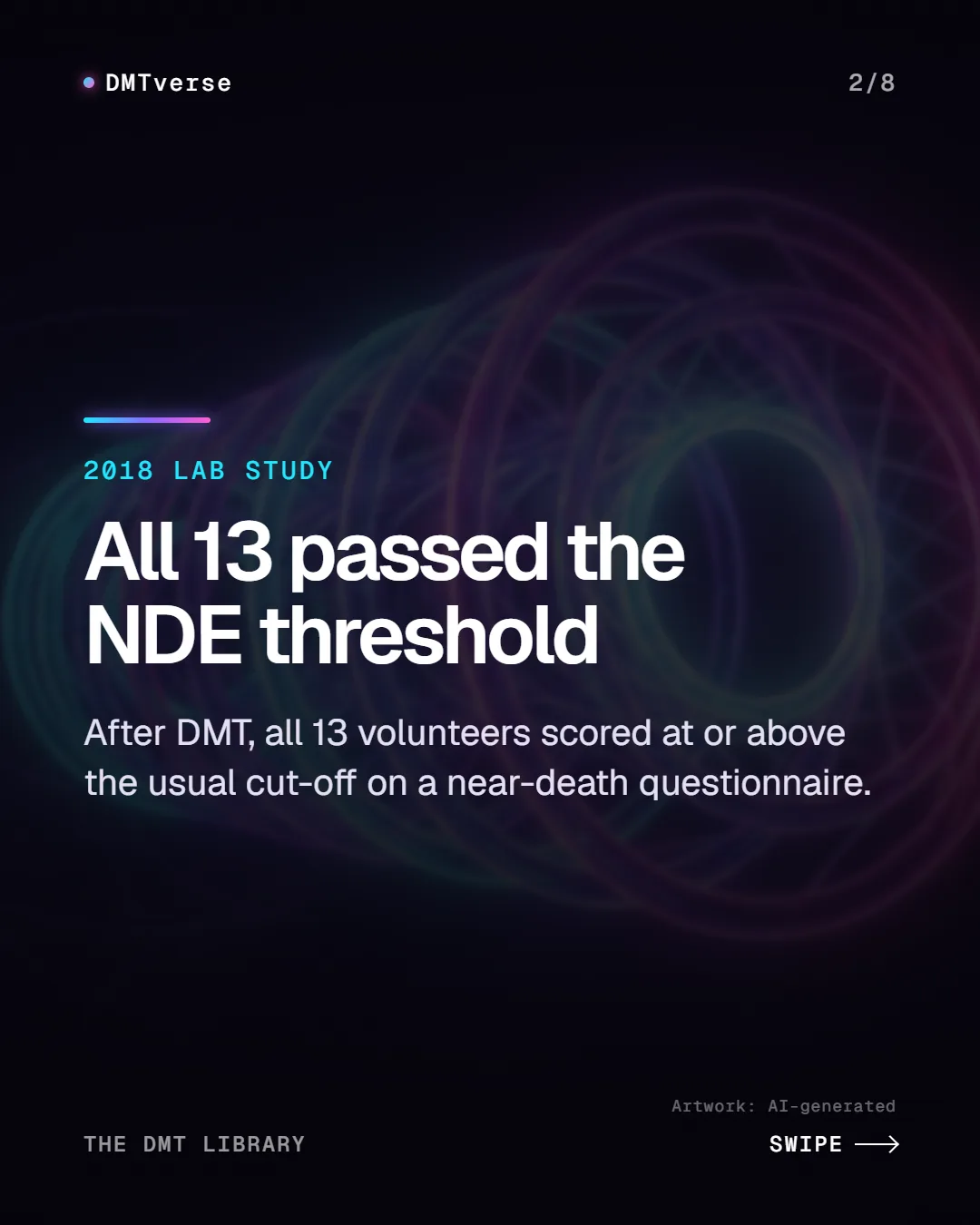
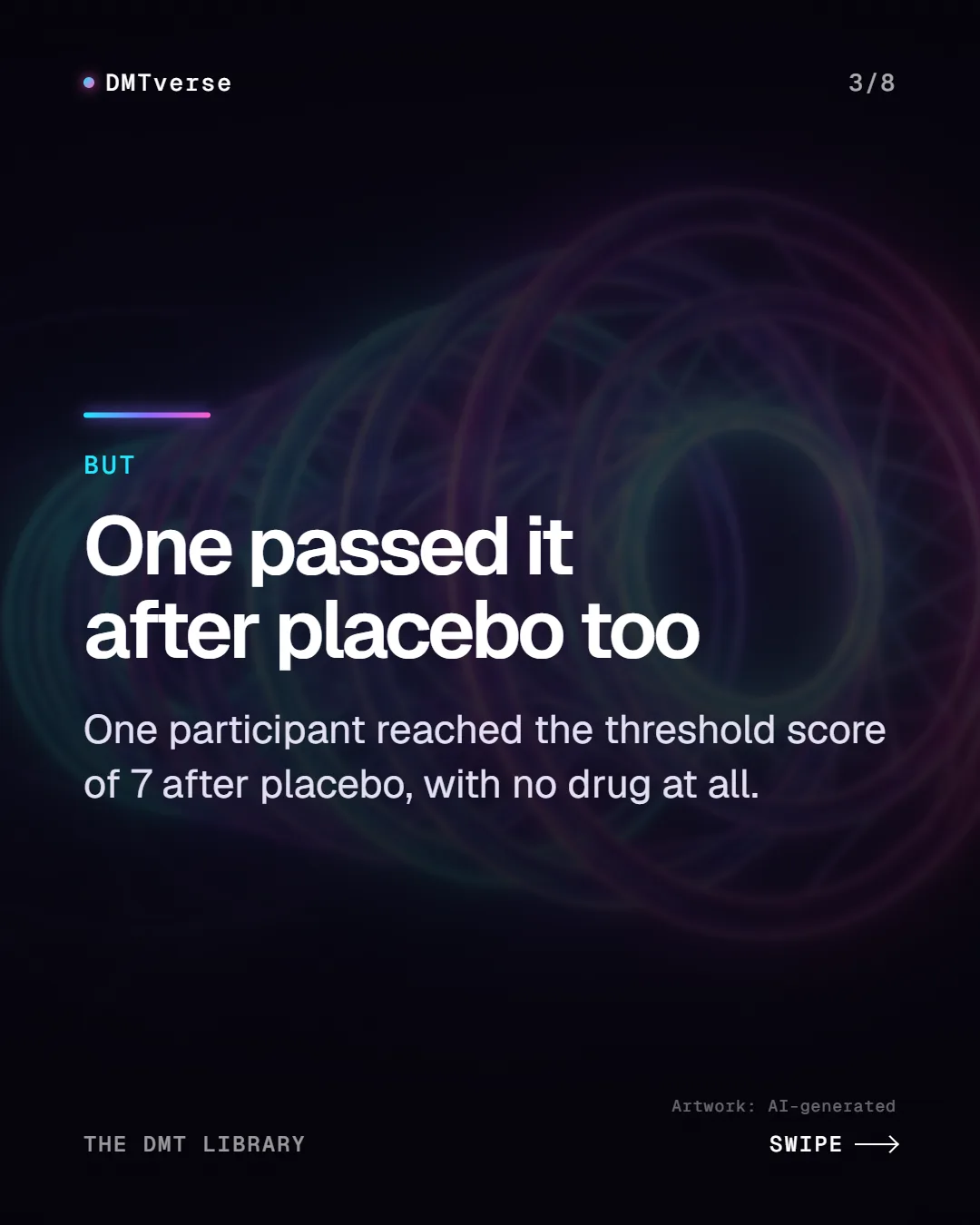
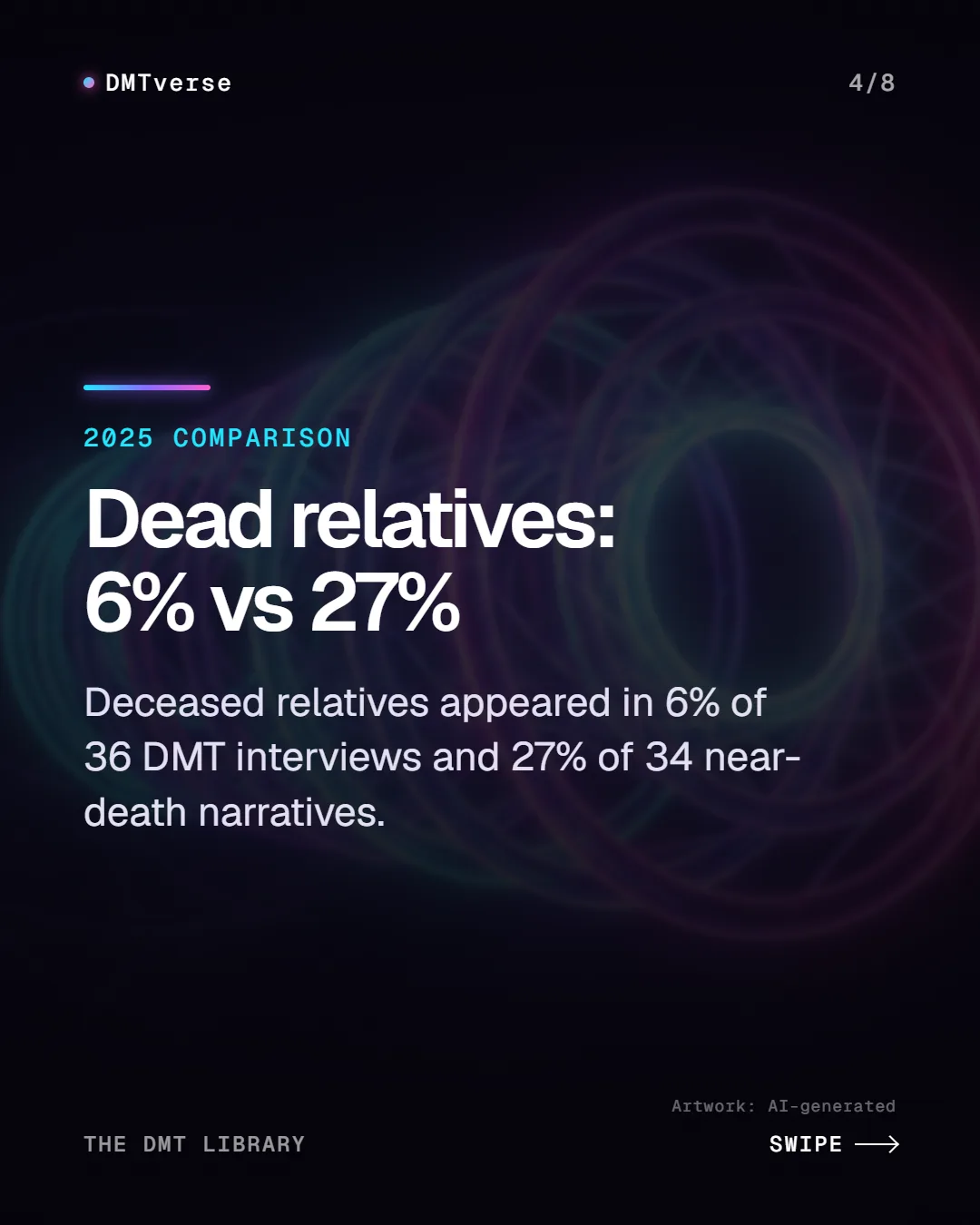
On a standard near-death questionnaire, DMT experiences score like near-death experiences: in a 2018 lab study, all 13 volunteers passed the usual threshold. But when researchers compared what people actually described, the contents diverged. In a 2025 comparison, deceased relatives appeared in 6% of DMT interviews and 27% of near-death narratives, and several classic features, such as being sent back, were absent from DMT. In a large text analysis, ketamine reports were the most near-death-like, not DMT. Brain recordings show surges of fast activity in some dying brains, but whether anyone experiences them is unknown and the signal is debated. In a hospital study with hidden targets, no cardiac-arrest survivor identified the visual image.
THE SHORT VERSION · SWIPE
On this page 10 sections
People who come close to death sometimes describe leaving their body, a tunnel, bright light, meeting beings and a border they could not cross. People who take DMT sometimes describe something similar. That overlap has fed one of the best-known claims about DMT: that it is what the brain produces at death. This article looks at the narrower, testable question. How alike are the two experiences, measured carefully? What do recordings of dying brains show? And what happened when researchers hid targets that only someone outside their body could see?
Whether the brain actually releases DMT when you die is a separate question, with its own rat studies and fact-checks. We cover it in does the brain release DMT when you die? and do not repeat it here.
Research summary, not medical advice
This article describes published research. It gives no amounts, no instructions and no advice on use, and it does not describe any effect as a benefit. It says nothing about what any person’s death is like, because no study can tell us that. Evidence labels used below: established (shown in peer-reviewed studies and not seriously disputed), preliminary (early, small, self-selected or indirect) and unresolved (an open question). Descriptions of experiences are reports, not findings about the world.
What counts as a near-death experience?
A near-death experience (NDE) is an unusual state of consciousness reported by some people who were, or believed they were, close to death. A large 2019 study lists its typical features as the perception of leaving the body, feelings of peace, bliss and timelessness, a life review, the sensation of travelling through a tunnel and an irreversible threshold. These reports are broadly comparable across cultures (Martial et al., 2019). That NDEs are reported is well documented; what causes them is not. Evidence: established.
Researchers usually measure NDEs with the Greyson Near-Death Experience Scale, a 16-item questionnaire with cognitive, affective, “transcendental” and “paranormal” subscales; a total of 7 or more is the conventional threshold for an NDE (Timmermann et al., 2018). Because it is a questionnaire, it records whether broad features are present, not what exactly was seen or felt.
DMT on a near-death questionnaire: the 2018 study
At Imperial College London, 13 healthy volunteers received placebo in one session and intravenous DMT in a later one, then completed the Greyson scale. All 13 scored at or above the threshold after DMT, and their scores were compared with 13 age- and sex-matched people who had reported an actual NDE (Timmermann et al., 2018). Three details from the paper matter for the comparison:
- One participant scored exactly 7, the threshold, after placebo. A questionnaire threshold can be reached without any drug.
- The item that differed most was “Did you come to a border or point of no return?”: near-death survivors averaged 1.00 out of 2, the DMT group 0.23. This difference was significant only before correction for multiple comparisons.
- On “Did you see deceased or religious spirits?”, survivors averaged 0.92 and the DMT group 0.46.
Higher NDE scores went with stronger ego dissolution and mystical-type ratings, and with two traits measured beforehand, absorption and delusional ideation (Timmermann et al., 2018). The authors list the limits themselves: placebo always came first, the near-death group had to pass the threshold to be included while the DMT group did not, and the samples were small. Evidence: preliminary.
Same outline, different contents: the 2025 interview comparison
A questionnaire asks whether a feature was there. A 2025 study asked what was actually there. Researchers coded 36 interviews from a field study of people using DMT at home and compared them, theme by theme, with 34 written near-death narratives (Michael et al., 2025). The broad outline matched: 95% of DMT participants reported at least one “canonical NDE theme”, such as a bright light, a sense of dying, a void, leaving the body, tunnel-like structures or beings of light. The contents did not:
| Feature | DMT interviews (%) | Near-death narratives (%) |
|---|---|---|
| Deceased relatives | 6 | 27 |
| Disembodiment (DMT) / out-of-body perception (NDE) | 53 | 35 |
| Unity | 25 | 9 |
| Profound love | 28 | 9 |
| Being sent back to life (the “returning” theme) | 0 | 21 |
Several classic NDE features, including light at the end of the tunnel, out-of-body experiences in the classic sense and dramatised returns to life, were entirely absent from the DMT accounts, while life reviews and deceased people were almost absent. DMT accounts had many features of their own, including fantastical other worlds and beings that were neither human nor animal, and no recognisable sequence of stages. The authors call DMT “NDE-mimetic”: it shares a basic structure with NDEs but differs in content (Michael et al., 2025). The participants were experienced users and the near-death narratives were written, not interviewed, so the two sets are not perfectly comparable. Evidence: preliminary.
Deceased relatives in DMT interviews
2 of 36 accounts (Michael et al., 2025).
Deceased people in near-death narratives
9 of 34 narratives (Michael et al., 2025).
Percent of accounts. Michael et al., 2025: 36 DMT interviews, 34 near-death narratives.
Which drug reports read most like near-death experiences?
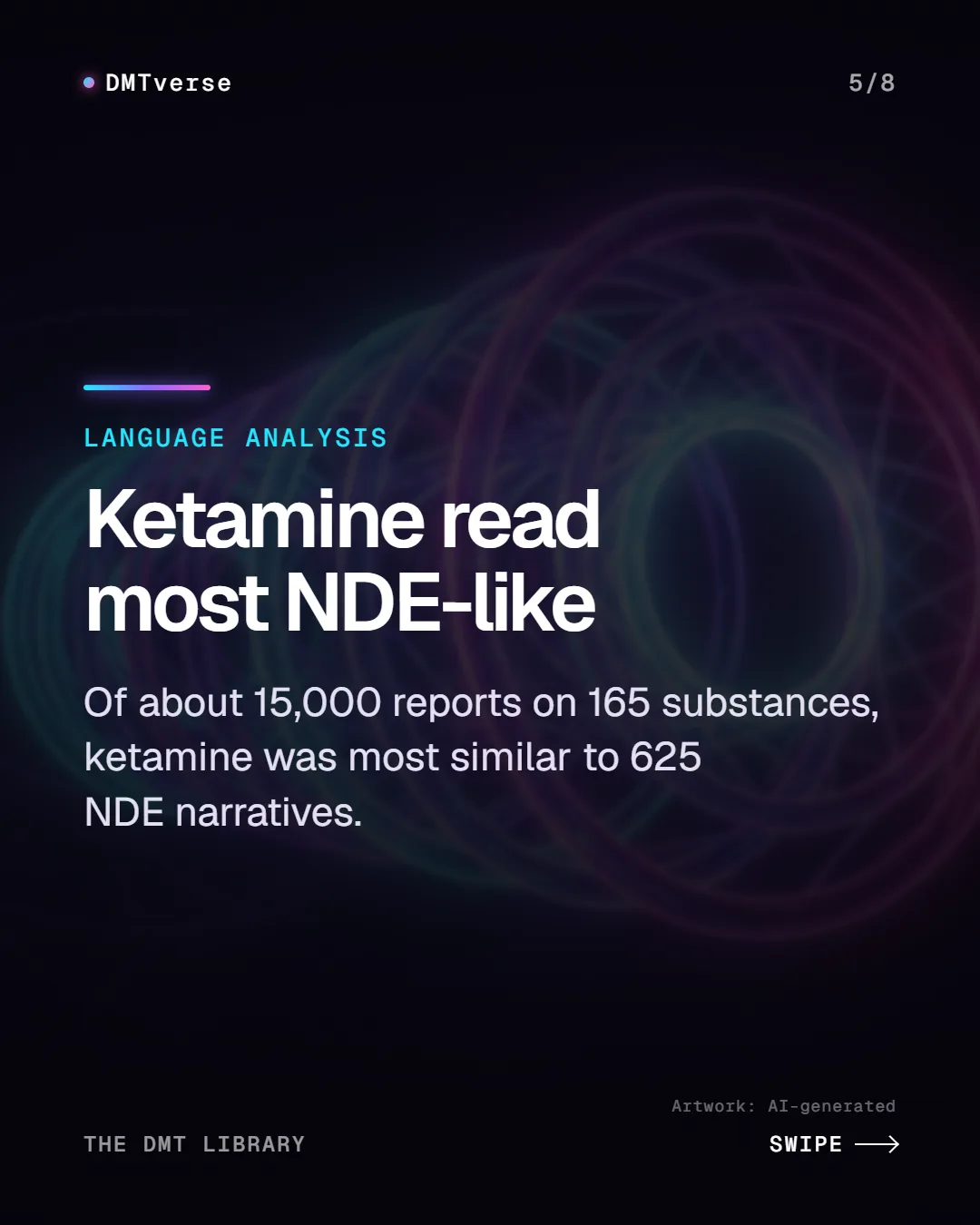
If DMT were the near-death molecule, its reports might be expected to read most like NDEs. A 2019 study tested this with language analysis, measuring the semantic similarity between about 15,000 drug-experience reports covering 165 substances and 625 NDE narratives. Ketamine, an anaesthetic that blocks NMDA receptors, came out most similar, followed by salvia and then a series of serotonergic psychedelics including DMT (Martial et al., 2019). The authors suggest ketamine as a reversible experimental model of NDE phenomenology. Evidence: preliminary; self-selected online reports.
A 2024 online survey of 31 people who had had both an NDE and a psychedelic experience found the two overlapped in mystical-type features but differed in sensory ones: NDEs scored higher for disembodiment and psychedelic experiences higher for visual imagery. That survey covered several psychedelics, not DMT alone (Martial et al., 2024). Evidence: preliminary.
What happens in a dying brain? The gamma surge debate
In 2013, a University of Michigan team recorded brain activity in rats during experimentally induced cardiac arrest. Within the first 30 seconds they found a brief, global surge of synchronised gamma (fast) oscillations before the recording went flat, with activity levels exceeding those of the waking state (Borjigin et al., 2013). Evidence: preliminary, in rats.
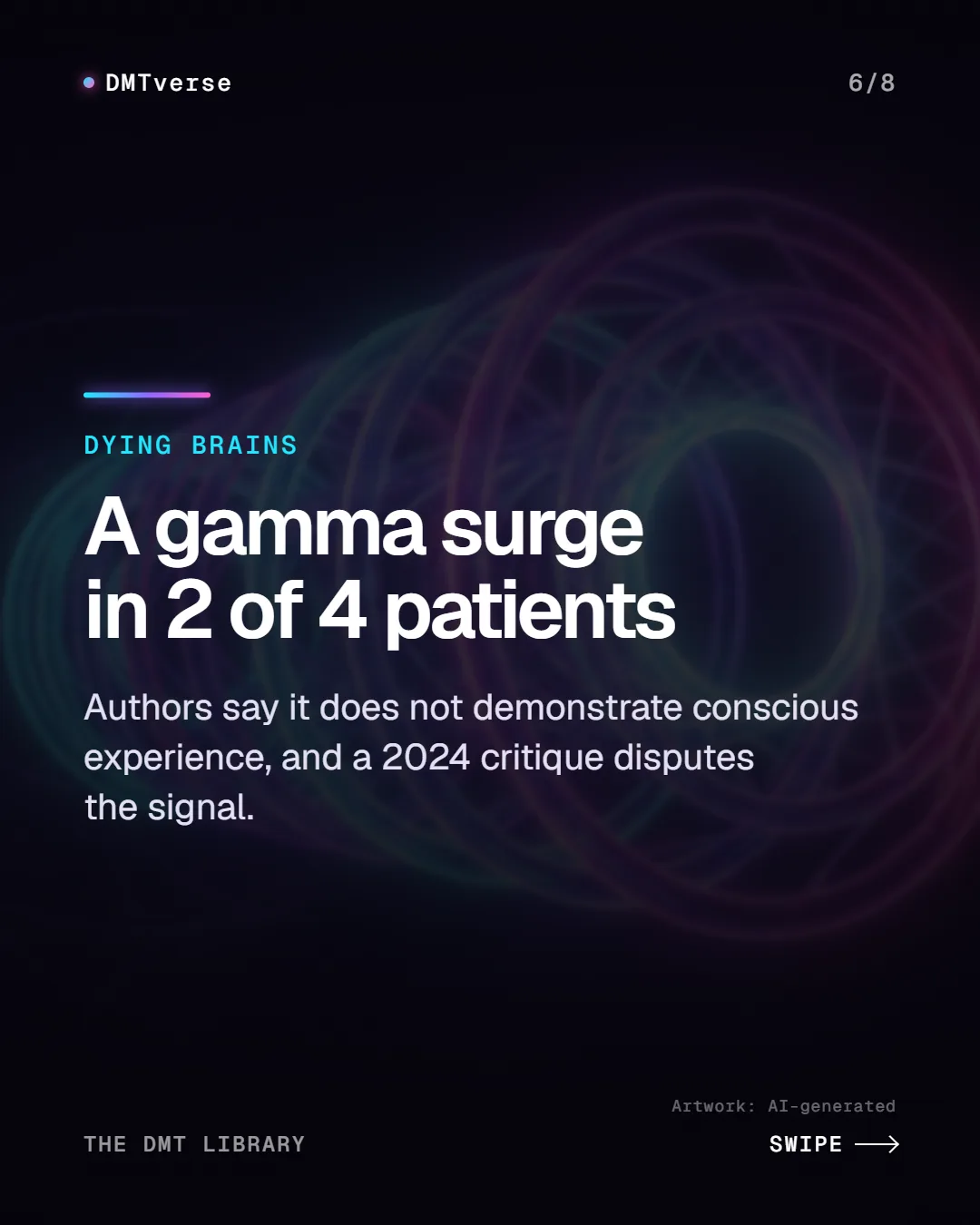
In 2023, the same group analysed recordings from four comatose patients as ventilator support was withdrawn. Two of the four showed a rapid surge of gamma power and of connectivity, including in a posterior “hot zone” proposed as important for conscious experience (Xu et al., 2023). The authors are explicit that this activity is suggestive of conscious processing but “does not demonstrate it”, that they cannot know what, if anything, the patients experienced, and that the surge may be a sign of a dying process unrelated to consciousness. They judged muscle contamination of the recordings unlikely. Evidence: preliminary, from two patients.
Not everyone accepts the signal as it stands. A 2024 critical review argues that gamma recorded at the scalp is easily contaminated by muscle activity, and that the perimortem surge, while genuine activity, may arise deep in the brain, in the amygdala, and reach the cortex by volume conduction, mimicking cortical gamma. Its author concludes there is little evidence the surge could underlie NDEs (Shaw, 2024). This is a single-author review published on an open peer-review platform. Neither recording study measured DMT. Evidence: unresolved.
The hidden-target test: what AWARE-II found
Some NDE accounts describe seeing the room from above. AWARE-II tested whether such perception could be verified. Across 25 hospitals, researchers built independent audiovisual tests of awareness into resuscitation, using a computer and headphones, alongside brain monitoring. Of 567 in-hospital cardiac arrests, 53 people survived and 28 completed interviews. Eleven of those 28 reported memories or perceptions suggestive of consciousness, and 6 described a transcendent “recalled experience of death” (Parnia et al., 2023).
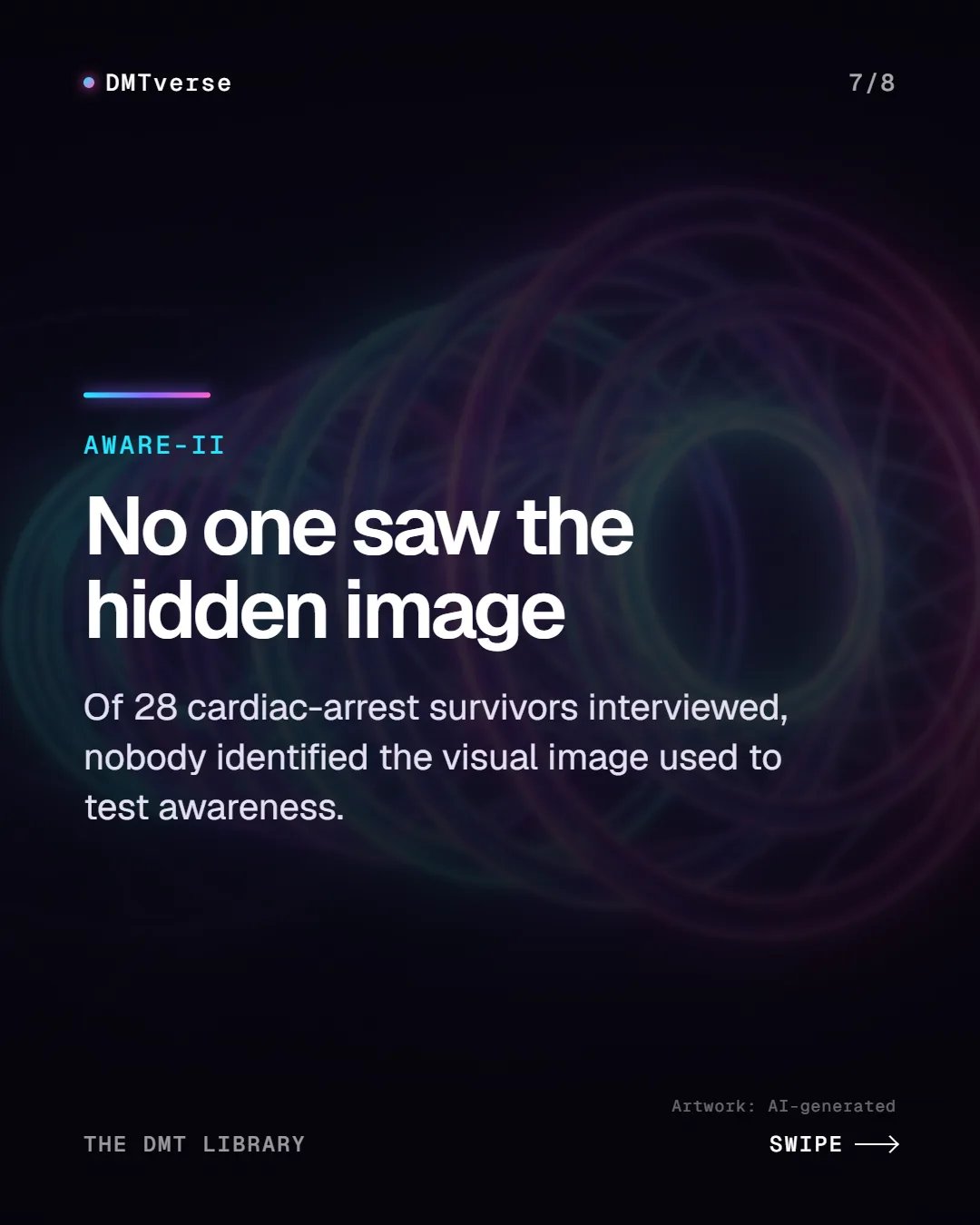
The result for the hidden test was stated plainly in the paper’s abstract: nobody identified the visual image, and 1 of 28 identified the auditory stimulus. Low survival limited what the study could test (Parnia et al., 2023). This is a null result from a small number of survivors, not proof that out-of-body perception never happens, and it says nothing directly about DMT. It does show that the claim can be tested with targets, and that so far the targets were not found. Evidence: preliminary.
Why do near-death memories feel so real?
People often describe near-death memories as unusually vivid. A 2013 memory study compared eight coma survivors’ NDE memories with their memories of real and imagined events, using a standard memory-characteristics questionnaire. The NDE memories carried more characteristics than memories of real events, including more self-referential and emotional detail (Thonnard et al., 2013). Vivid memory shows how intense and salient an experience was; it does not show that its contents were accurate. Evidence: preliminary, from eight people. The same question for DMT is covered in why DMT can feel more real than reality.
Common claims, rated
| Claim | Verdict | Main source |
|---|---|---|
| DMT experiences can score like NDEs on a questionnaire | Supported, small study | Timmermann et al., 2018 |
| DMT experiences have the same contents as NDEs | Not supported: same outline, different contents | Michael et al., 2025 |
| DMT reports are the most NDE-like of all drug reports | Not supported: ketamine ranked first | Martial et al., 2019 |
| Dying brains can show a gamma surge | Preliminary: rats and two patients; signal debated | Borjigin, 2013; Xu, 2023; Shaw, 2024 |
| Scientists recorded a near-death experience | Not supported: no one could report what they experienced | Xu et al., 2023 |
| Cardiac-arrest survivors saw hidden targets | Not supported in AWARE-II: none identified the visual image | Parnia et al., 2023 |
| DMT is what the brain makes at death | Unsupported; see our separate fact-check | Nichols, 2018 |
On the last row, a 2018 review argues that the tiny amounts of DMT detected in the brain are not enough to produce psychoactive effects and offers explanations of how stress and nearness to death can alter consciousness without DMT (Nichols, 2018). Similar experiences can have different causes. Evidence: unresolved.
If someone is in danger
Call 911 for immediate danger or urgent medical help, including if someone is unconscious, not breathing or having a seizure. In Ontario, the Ontario Poison Centre is at 1-800-268-9017; every province has a poison centre, listed by SickKids (AboutKidsHealth). If you or someone you know is thinking about suicide, call or text 9-8-8, 24 hours a day (Government of Canada). See also our safety page.
What we still don’t know
- Whether the shared outline reflects a shared brain mechanism, or simply that any overwhelming, body-dissolving experience gets described in similar words (unresolved).
- Why deceased relatives and being sent back are common in NDEs but rare or absent with DMT; context, expectation and real danger are all candidate explanations (unresolved).
- Whether the perimortem gamma surge is cortical, subcortical or partly artefact, and whether anyone experiences it (unresolved).
- Whether hidden-target studies with more survivors would change the AWARE-II result (unresolved).
- Whether DMT plays any role in the human dying brain; it has never been measured there (unresolved).
The fair summary: DMT can produce experiences with the outline of a near-death experience, and that makes it a useful laboratory model for some of its features. But the contents differ in ways that matter, other drugs match NDE language as well or better, and nothing measured so far links DMT to the dying brain. For more, read what is DMT, DMT entity encounters and DMT time dilation.
Common questions
Is a DMT experience the same as a near-death experience?
No. They share an outline: in a 2018 study all 13 DMT volunteers passed the threshold of a standard near-death questionnaire. But a 2025 content comparison found clear differences, such as deceased relatives in 6% of DMT interviews versus 27% of near-death narratives, and several classic near-death features absent from DMT.
What did the 2018 “DMT models the near-death experience” study find?
Thirteen volunteers given intravenous DMT all scored at or above the near-death threshold on the Greyson scale. Compared with 13 matched near-death survivors, the clearest difference was on coming to “a border or point of no return”, rated higher by survivors. One participant also reached the threshold after placebo.
Do people meet dead relatives on DMT?
Rarely, in the research so far. In 36 DMT field-study interviews, 2 (6%) described deceased relatives, compared with 9 of 34 (27%) near-death narratives. DMT accounts more often describe non-human beings and other worlds. These are reports, not evidence about who or what was met.
Which drug produces reports most like near-death experiences?
In a 2019 language analysis of about 15,000 reports covering 165 substances, ketamine reports were the most similar to 625 near-death narratives, followed by salvia and several serotonergic psychedelics including DMT.
Does the brain have a burst of activity at death?
Some recordings show one. A surge of fast gamma activity was seen in rats within 30 seconds of cardiac arrest, and in two of four dying patients. The authors say this does not demonstrate conscious experience, and a 2024 critique argues the signal may come from deep brain structures rather than the cortex. DMT was not measured.
What was the AWARE-II hidden-target result?
Across 567 in-hospital cardiac arrests, 28 survivors were interviewed. Nobody identified the visual image used to test awareness, and 1 of 28 identified the auditory stimulus. Low survival limited the test, so it is a small null result, not a final answer.
Does the brain release DMT when you die?
Nobody knows, because DMT has never been measured in a dying human brain. One rat study found brain DMT rose after induced cardiac arrest, but its authors said it is unknown whether this happens in humans or whether the levels could affect experience. Our separate fact-check covers the rat studies and the pineal gland in detail.
Shroomverse sells mushroom products. This article is general information about research comparing DMT and near-death experiences. It is not medical, legal or purchasing advice, and it does not recommend any product.
SOURCES
- DMT Models the Near-Death Experience (Timmermann C, Roseman L, Williams L, et al., Frontiers in Psychology 9:1424, 2018), Frontiers (peer-reviewed, open access); full text via Europe PMC, PMC6107838. Accessed . Full text read. 13 participants, placebo then DMT; all at or above the threshold of 7; one participant scored 7 after placebo; point-of-no-return item 1.00 vs 0.23 (uncorrected p=0.018, not surviving correction); deceased-spirits item 0.92 vs 0.46; associations with absorption and delusional ideation; limits as stated by the authors.
- An encounter with death: a comparative thematic and content analysis of naturalistic DMT experiences and the near-death experience (Michael P, Luke D, Robinson O, Frontiers in Psychology 16:1532937, 2025), Frontiers (peer-reviewed, open access); full text via Europe PMC, PMC11920758. Accessed . Full text read. 36 DMT interviews vs 34 NDE narratives; 95% at least one canonical theme; deceased relatives 2/36 (6%) vs deceased 9/34 (27%); disembodiment 53% vs OBE 35%; unity 25% vs 9%; profound love 28% vs 9%; being sent back 21% of NDEs, absent in DMT; light at the end of the tunnel, OBEs and dramatised returns absent; no linear sequence; “NDE-mimetic”.
- Neurochemical models of near-death experiences: A large-scale study based on the semantic similarity of written reports (Martial C, Cassol H, Charland-Verville V, et al., Consciousness and Cognition 69:52–69, 2019), Elsevier (peer-reviewed). Accessed . Abstract read via Europe PMC. Typical NDE features; about 15,000 reports, 165 substances, 625 NDE narratives; ketamine most similar, then salvia and serotonergic psychedelics including DMT.
- Within-subject comparison of near-death and psychedelic experiences: acute and enduring effects (Martial C, Carhart-Harris R, Timmermann C, Neuroscience of Consciousness 2024(1):niae033), Oxford University Press (peer-reviewed, open access). Accessed . Abstract read via Europe PMC. Online survey of 31 adults with both experiences; overlap in mystical-like effects; NDEs higher for disembodiment, psychedelic experiences higher for visual imagery.
- Surge of neurophysiological coherence and connectivity in the dying brain (Borjigin J, Lee U, Liu T, et al., PNAS 110(35):14432–14437, 2013), National Academy of Sciences (peer-reviewed). Accessed . Abstract read via Europe PMC. Rats under experimental cardiac arrest; transient global gamma surge within the first 30 s; activity exceeding waking levels.
- Surge of neurophysiological coupling and connectivity of gamma oscillations in the dying human brain (Xu G, Mihaylova T, Li D, et al., PNAS 120(19):e2216268120, 2023), National Academy of Sciences (peer-reviewed); full text via Europe PMC, PMC10175832. Accessed . Full text read. Four comatose patients; surge in two; posterior hot zone; activity suggestive of but “does not demonstrate” conscious processing; EMG contamination judged unlikely; may reflect a pathological dying process.
- The gamma-band activity model of the near-death experience: a critique and a reinterpretation (Shaw N, F1000Research 13:674, version 2, 2024), F1000Research (open peer review); full text via Europe PMC, PMC11375408. Accessed . Abstract and conclusions read. Myogenic contamination of scalp gamma; proposes a subcortical (amygdaloid) origin recorded via volume conduction; little evidence the surge underlies NDEs.
- AWAreness during REsuscitation - II: A multi-center study of consciousness and awareness in cardiac arrest (Parnia S, et al., Resuscitation 191:109903, 2023), Elsevier (peer-reviewed). Accessed . Abstract read via Europe PMC. 25 sites; 567 arrests, 53 survived, 28 interviewed, 11 with memories suggestive of consciousness, 6 recalled experience of death; nobody identified the visual image; 1/28 identified the auditory stimulus; low survival limited testing.
- Characteristics of near-death experiences memories as compared to real and imagined events memories (Thonnard M, et al., PLoS One 8(3):e57620, 2013), PLOS (peer-reviewed, open access). Accessed . Abstract read via Europe PMC. 8 coma survivors with NDEs; NDE memories had more characteristics than real-event memories, with more self-referential and emotional information.
- N,N-dimethyltryptamine and the pineal gland: Separating fact from myth (Nichols DE, Journal of Psychopharmacology 32(1):30–36, 2018), SAGE (peer-reviewed). Accessed . Abstract read via Europe PMC. Minute brain concentrations of DMT not sufficient for psychoactive effects; alternative explanations for near-death altered states.
- Mental health support: get help, Government of Canada, Public Health Agency of Canada. Accessed . Page read. Call 9-1-1 if in immediate danger or needing urgent medical support; call or text 9-8-8, 24 hours a day, 7 days a week.
- Poison information centres in Canada, AboutKidsHealth, The Hospital for Sick Children (SickKids). Accessed . Page read. Ontario toll-free 1-800-268-9017; call 911 if someone is unconscious, not breathing or having a seizure.
CHANGES
- : Linked glossary definitions.
- : Published. Every source opened and checked on this date via Europe PMC abstracts and full text and the two Canadian help pages.
- : Editorial review: this article is now the single home for the DMT-versus-NDE comparison (the death-release fact-check summarises and links here); memory H2 narrowed to near-death memories with a link to the DMT realness article; self-contained FAQ answer on death release; one evidence label per paragraph.



