THE SHROOMVERSE JOURNAL ✳ 11 MIN READ
The waiting room, the dome and the chrysanthemum: DMT’s vocabulary explained
Topic: DMT
Published Updated
Short answer, checked 20 October 2026
The DMT waiting room is a community name for a room-like space some people say they arrive in during a DMT experience. It belongs to a small shared vocabulary: “the dome” (a vaulted space), “the chrysanthemum” (a flower-like geometric pattern), “the carrier wave” (a buzzing or ringing sound) and “hyperspace” (a sense of other dimensions). When researchers coded 3,778 online reports in 2022, the waiting room appeared in 2.8%, hyperspace in 17.1%, the chrysanthemum in 0.8% and a domed space in 0.6%. They warn that recurring labels may shape later reports, so the words map how people talk, not shared places.
THE SHORT VERSION · SWIPE
On this page 10 sections
Read enough DMT trip reports and the same handful of phrases keep coming back. People say they reached “the waiting room”, saw “the chrysanthemum”, heard “the carrier wave” or entered “hyperspace”. To a newcomer it can sound like a guidebook to a real place. This article treats these words as what they are: vocabulary. For each term it explains what people describe, where the word is documented, and how often it appeared when scientists systematically coded thousands of reports. It ends with the most important caveat: shared labels may shape what people later report.
Education only, not guidance
This article describes reported experiences and published research. It gives no amounts, no instructions and no advice on use, and it does not describe any effect as a benefit. DMT is a controlled substance in Canada. Evidence labels used below: established (shown in peer-reviewed studies and not seriously disputed), preliminary (early, small, self-selected or indirect) and unresolved (an open question). Descriptions of what an experience was like are reports, not facts about the world.
Where does DMT vocabulary come from?
Mostly from users talking to each other: in talks, books, forums and music. The anthropologist Graham St John, who has studied DMT culture, describes the breakthrough into “hyperspace” as a private passage that is nonetheless “ritual like”, and he traced the vocabulary through online user reports and other cultural sources (St John, 2018). Evidence: established as a description of user culture.
In a 2017 essay he identifies Terence McKenna as the lead commentator on two of the best-known images: McKenna, in a 1994 talk, described a vaulted, domed space that he said aficionados call “the dome”, and he named a recurring pattern “the chrysanthemum”. Recordings of McKenna’s voice were widely sampled in psychedelic electronic music, which spread the words further (St John, 2017). We paraphrase McKenna rather than quoting him, and St John does not say McKenna coined either word. Evidence: established for McKenna’s role in popularising these terms; their first use is unresolved.
For “the waiting room” and “the carrier wave” we could not find a documented first use in the sources we checked on 20 October 2026. Both appear in coded research data (Lawrence et al., 2022), as described below, so we can say how often people use them, but not who used them first.
How often do the terms appear in reports?
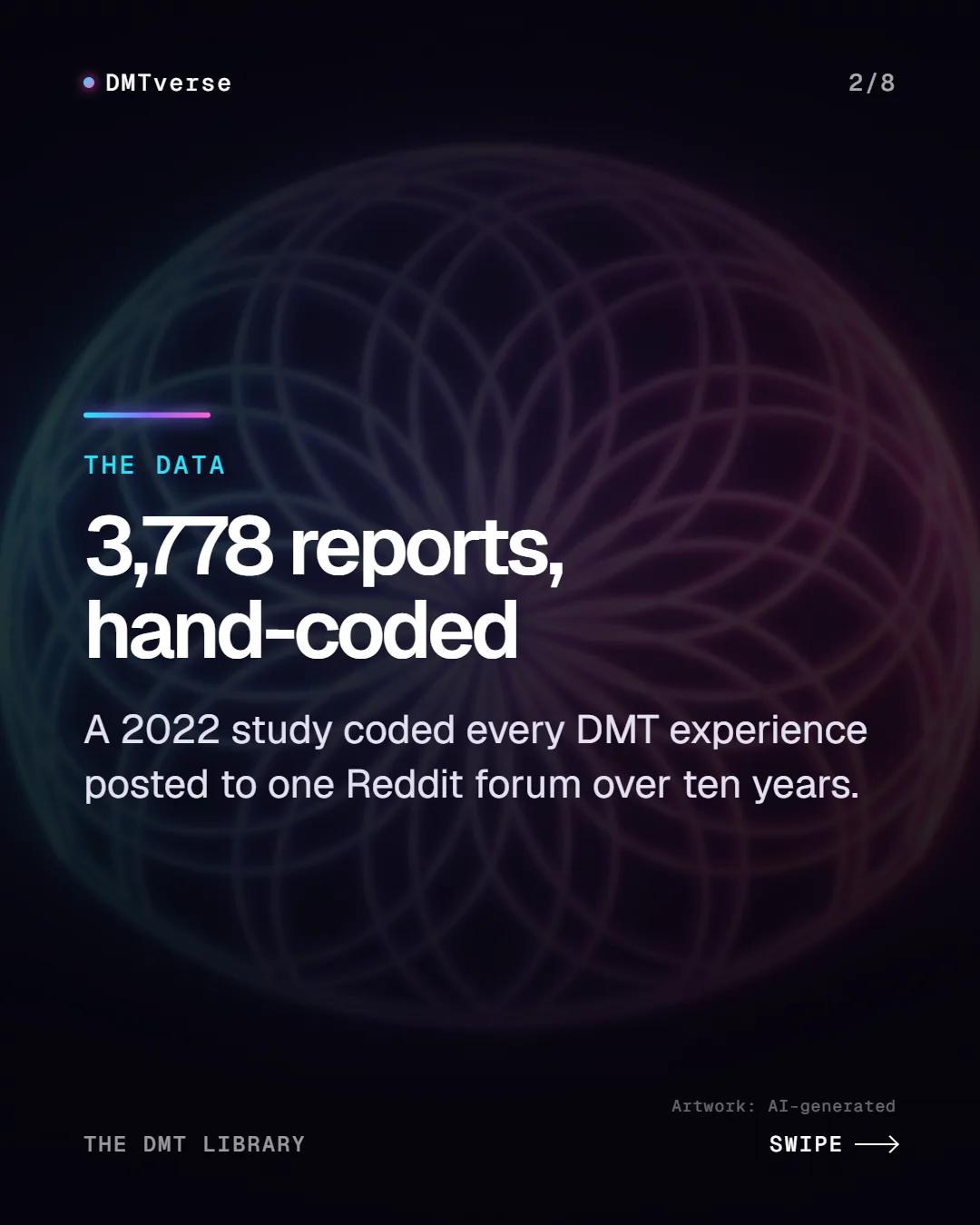
The best numbers come from a 2022 study that manually coded every DMT experience posted to the r/DMT Reddit community over ten years, 3,778 experiences from 3,305 posts (Lawrence et al., 2022). The table sets each term beside the wider category it belongs to. Percentages are of all 3,778 experiences. Evidence: preliminary; the posters were self-selected, and the counts measure what people chose to write, not what everyone experiences.
| Term | What people describe | Coded share | Wider category |
|---|---|---|---|
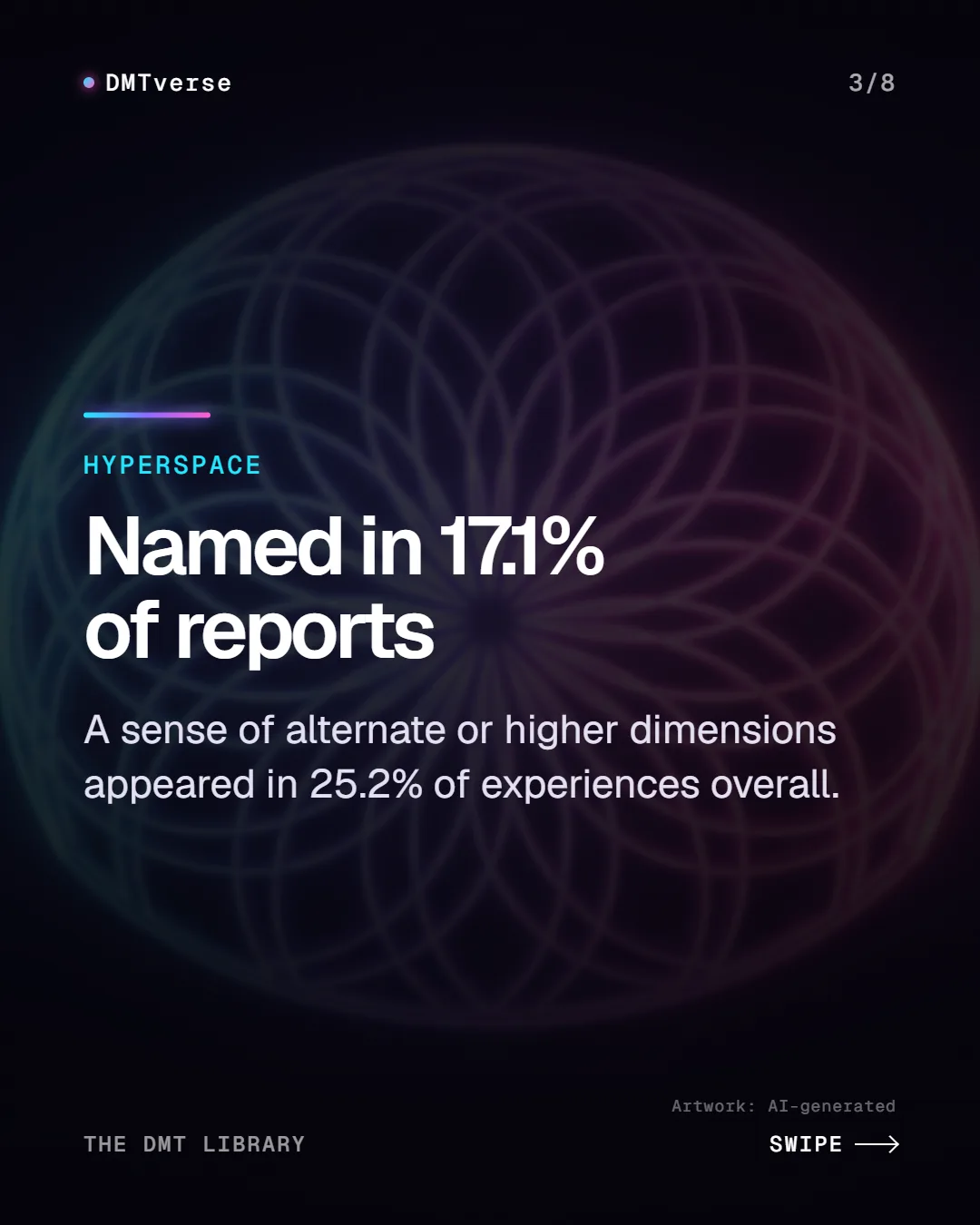
| Hyperspace | A sense of other or higher dimensions | 17.1% (646) | Alternate or higher dimensions, 25.2% |
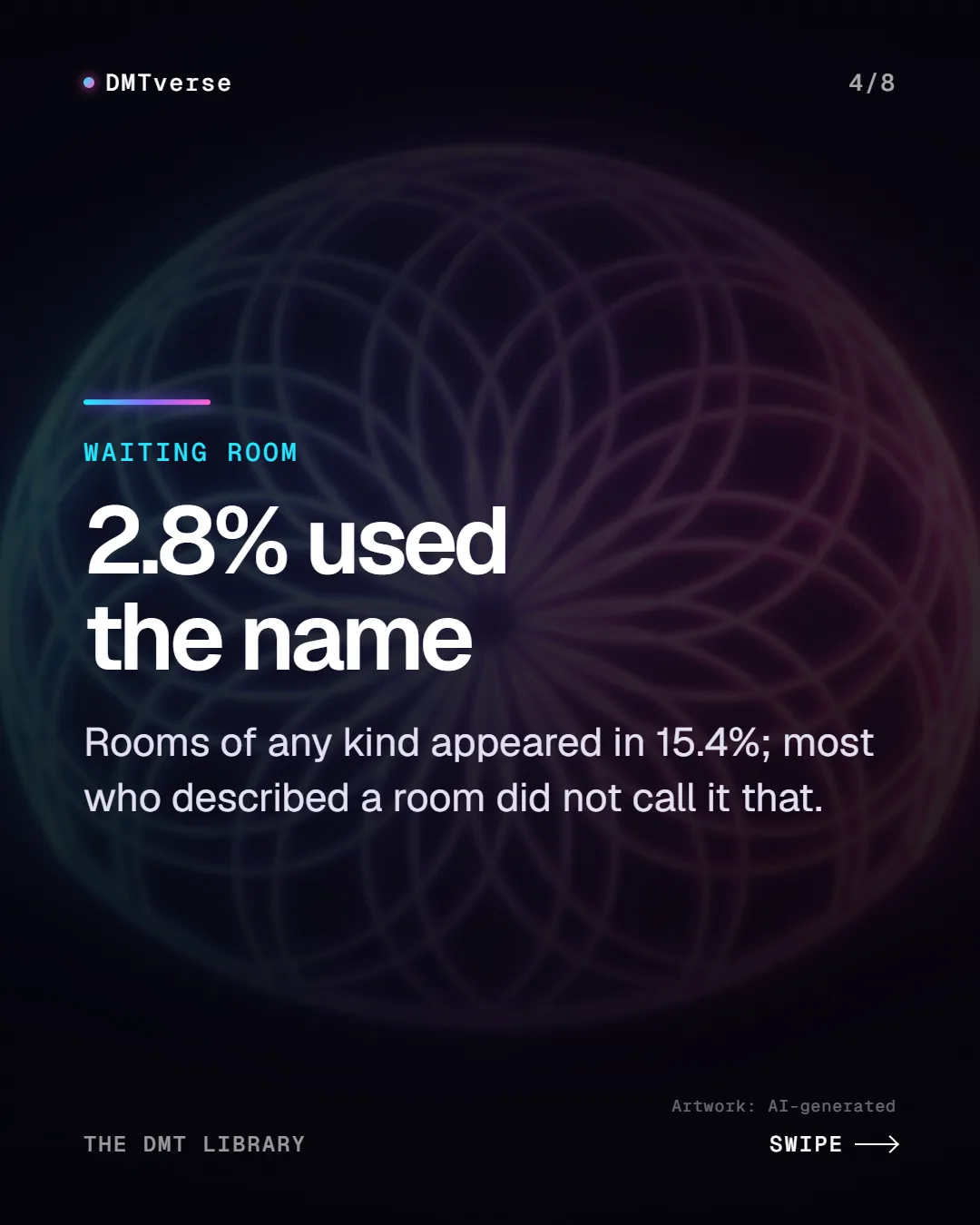
| The waiting room | Being inside a particular room-like space | 2.8% (105) | Any room or rooms, 15.4% |
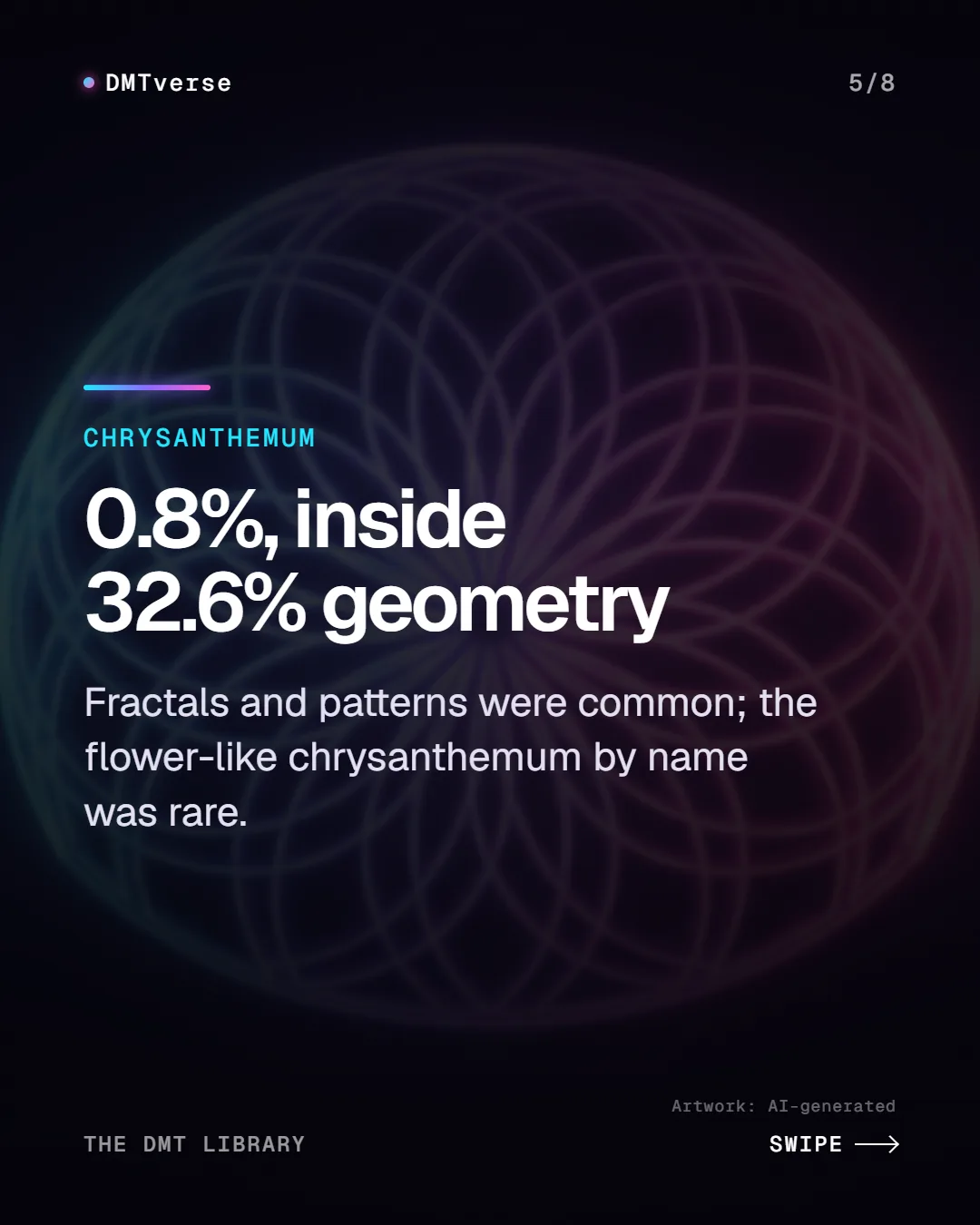
| The chrysanthemum | A flower-like, radiating geometric pattern | 0.8% (32) | Fractals, shapes or patterns, 32.6% |
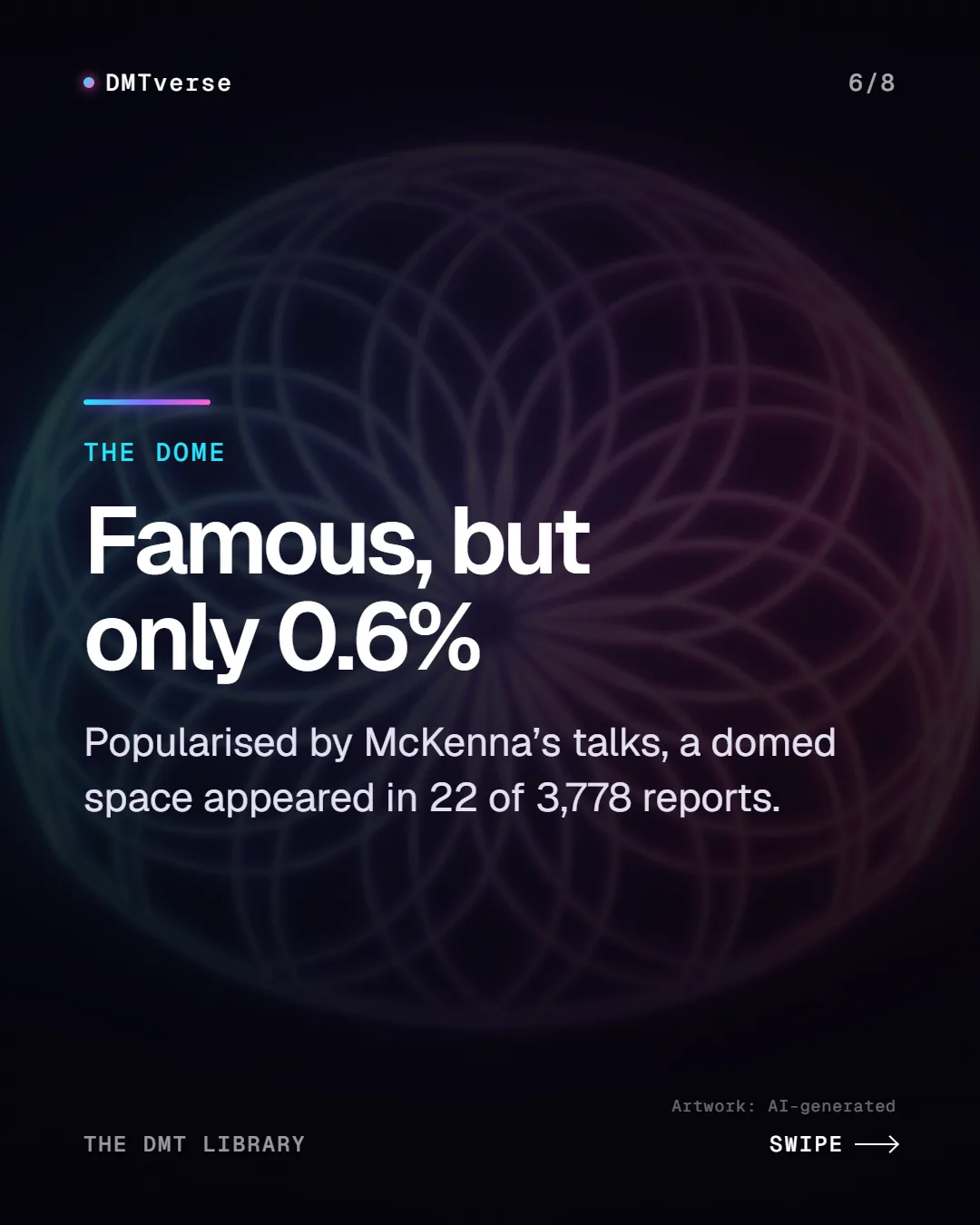
| The dome | A domed or large spherical space | 0.6% (22) | Typology and architecture of the “DMT world” |
| The carrier wave | A buzzing, ringing or humming sound | Named among descriptors | Ringing-type sound, 15.4% (583) |
Hyperspace, 17.1%
646 of 3,778 experiences named hyperspace (Lawrence et al., 2022).
Ringing-type sound, 15.4%
583 experiences described an auditory ringing-type sound; “carrier wave” was one of the descriptors.
The waiting room, 2.8%
105 experiences named the waiting room specifically, within 582 describing any room.
Chrysanthemum, 0.8%
32 experiences described a chrysanthemum, within 1,231 describing fractals, shapes or patterns.
Domed space, 0.6%
22 experiences described being inside a domed or large spherical space.
Restates Lawrence et al., 2022. Self-selected posts; a count of what people wrote, not of what everyone experiences.
What is the DMT waiting room?
In user accounts, “the waiting room” is a room-like space that some people say they arrive in, sometimes before or instead of a fuller scene. Rooms in general were common in the 2022 coding: 582 experiences (15.4%) described being inside a room, and 105 (2.8%) named “the waiting room” specifically. Other rooms were described as sterile, clean or functional, including medical, operating or examination rooms (88, 2.3%), and some as geometric, fractal or multi-coloured (Lawrence et al., 2022). So the waiting room is a well-known label, but most people who described a room did not use it. Evidence: preliminary; self-selected reports.
What is “the dome”?
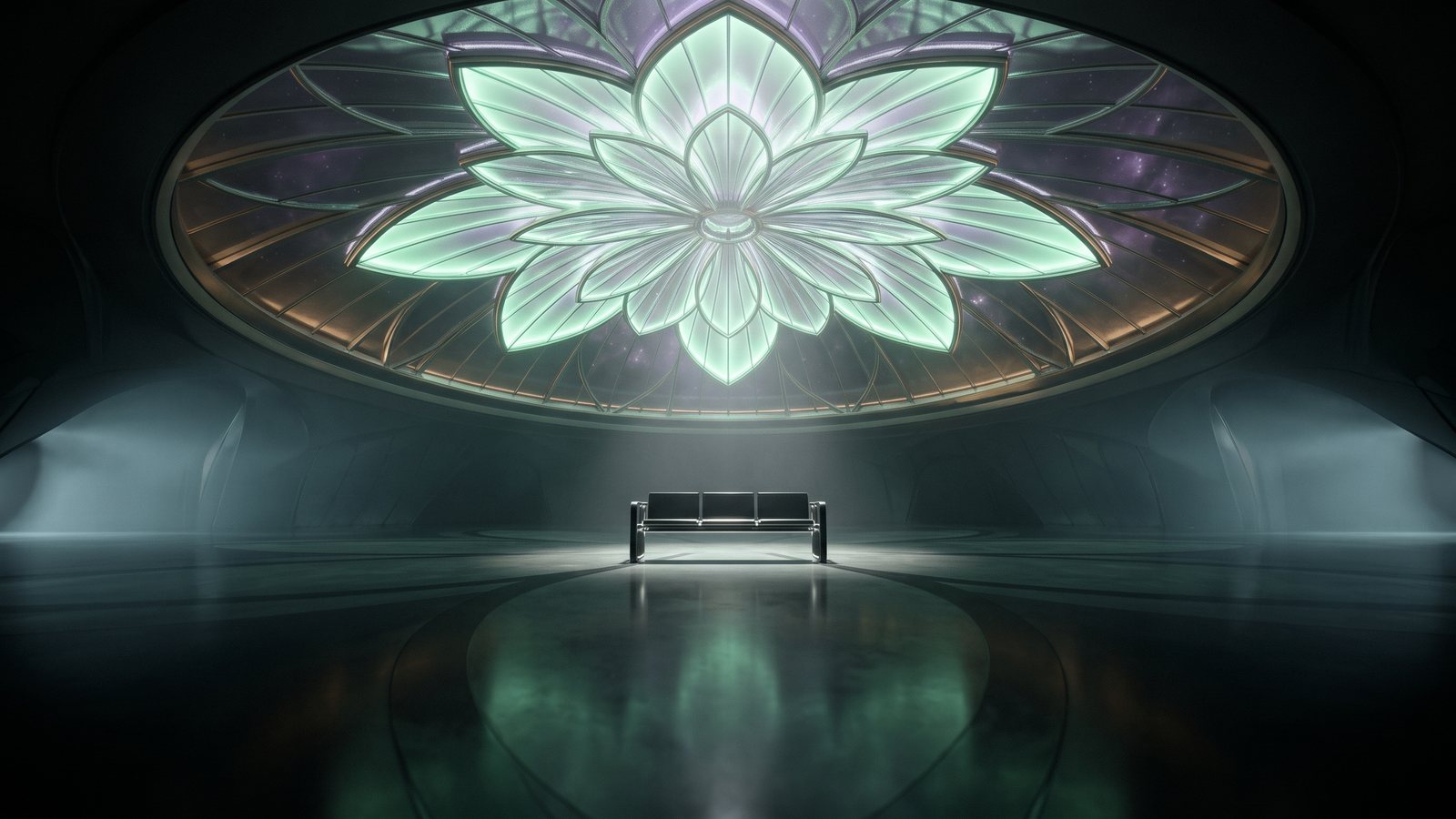
“The dome” refers to a vaulted, domed space. St John links the image to McKenna’s 1994 description and notes that it also appears in forum posts and in an account from a volunteer in Rick Strassman’s 1990s study (St John, 2017). In the 2022 coding it was rare: 22 experiences (0.6%) described being inside a domed or large spherical space (Lawrence et al., 2022). The gap between how famous the dome is and how seldom it was reported is a useful warning about relying on well-known stories. Evidence: preliminary.
What is the DMT chrysanthemum?
“The chrysanthemum” is a name for a flower-like, radiating geometric pattern, a name McKenna is credited with popularising (St John, 2017). Geometric imagery itself is one of the most common features of DMT reports: fractals, geometric shapes and patterns appeared in 1,231 experiences (32.6%), including kaleidoscopes (2.2%), mandalas (1.2%) and sacred geometry (0.6%), while the chrysanthemum by name appeared in 32 (0.8%) (Lawrence et al., 2022). Evidence: established that geometric imagery is common in reports; preliminary for the exact figures.
Why might geometry be so common? A mathematical model offers one idea. The neurologist Heinrich Klüver grouped geometric hallucinations into four “form constants”: lattices and honeycombs, cobwebs, tunnels and funnels, and spirals. A 2001 paper showed that when the primary visual cortex becomes unstable, the cortex’s own wiring could produce exactly those shapes (Bressloff et al., 2001). It is a model, not a DMT experiment, and it covers simple geometry only, not scenes, rooms or beings. Evidence: preliminary, as a hypothesis.
What is the “carrier wave” or buzzing?
Many reports describe a sound or vibration early on. In the 2022 coding, an auditory ringing-type sound was described in 583 experiences (15.4%), with descriptors including ringing, buzzing, humming, static, droning and an “auditory carrier wave”. Separately, a bodily vibration, buzz or tingling appeared in 1,026 (27.2%) (Lawrence et al., 2022). Evidence: preliminary; self-selected reports.
Lab and text-mining studies point the same way. The 2026 lab interview study also distinguished abstract sounds “such as a buzzing, or ringing sound” from sounds of recognisable things, and found bodily effects typically came before visual and auditory ones (Sanders et al., 2026). A 2022 text-mining study of 6,850 drug reports found “buzz” among words on an auditory factor, beside ringing, tone and tinnitus (Ballentine et al., 2022). Evidence: established that sound and vibration are commonly reported; the reports are subjective.
What does “hyperspace” mean in DMT reports?
“Hyperspace” is the umbrella word for the sense of having entered other dimensions. In the 2022 coding, alternate or higher dimensions appeared in 952 experiences (25.2%), with hyperspace named in 646 (17.1%), four- or five-dimensional experience in 56 (1.5%) and one- or two-dimensional experience in 30 (0.8%) (Lawrence et al., 2022). Evidence: preliminary; self-selected reports.
Earlier research describes the same sense of replacement. A 2021 field study, reviewing earlier work, summarises one prior analysis in which ordinary experience was supplanted by “DMT hyperspace” (Michael et al., 2021). Strassman’s 1994 study described effects that completely replaced the volunteers’ ongoing mental experience and felt more vivid than dreams or waking awareness (Strassman et al., 1994). The word describes how the experience felt; it is not evidence that other dimensions exist. Evidence: established as common reported content; what it means is unresolved.
For how researchers measure the moment people call “breaking through” into this space, see what is a DMT breakthrough.
Do shared labels shape what people report?
Possibly, and the researchers who did the counting say so. Among their limitations, the 2022 authors write that previous reports on the platform may influence the experiences and reporting of other users, and that this is evident in “the recurrent invocation of specific terminology and labels” for novel phenomena, with “machine elves” as their example (Lawrence et al., 2022); our article on machine elves follows that label’s history. They also note that Reddit users are likely not representative of DMT users at large and may be more likely to post interesting or meaningful experiences. Evidence: established as a limitation; the size of the effect is unresolved.
Three lines of evidence from outside DMT research suggest why this matters:
- Culture and context. An 18-month ethnography at a shamanic centre in the Peruvian Amazon argues that cultural background and social interactions organise not only how people interpret visions but their very content, through the education of attention, categorising perceptions and shaping expectations (Dupuis, 2022). That was ayahuasca in one centre, not DMT on its own.
- Culture and sleep paralysis. In general-population samples, 25% of people in Denmark and 44% in Egypt reported sleep paralysis, and in Egypt believing it had a supernatural cause was linked to more fear and longer episodes (Jalal and Hinton, 2013). Causation could run either way.
- Expectation and noisy signals. In a preregistered study, people who expected more voices in noise reported detecting more of them, and the effect was strongest when the sound was unreliable (Szymanek et al., 2024). That was a hearing task, not a drug study.
Within DMT research itself, expectation has been shown to change intensity: identical doses were rated less intense when given open-label, step by step, than when given blind (Erne et al., 2026). That study did not look at content. We found no controlled study that has manipulated what people expect to see on DMT and measured whether they then report waiting rooms, domes or chrysanthemums. Evidence: preliminary for expectation effects in general; unresolved for DMT vocabulary.
Read the words as a map of talk, not of places
When many people use the same word, it is tempting to conclude they visited the same place. The research supports a narrower claim: people who post about DMT often reach for a shared vocabulary, and some features (geometry, sound, a sense of space) are common. Whether the labels reflect a common structure in the brain, a shared culture, or both is unresolved.
What we still don’t know
- Who first used “the waiting room” and “the carrier wave”; we found no documented origin (unresolved).
- How common these features are in people who do not post online; all the counts here come from self-selected reports (unresolved).
- Whether learning the vocabulary in advance changes what people experience or only how they describe it; no controlled DMT study has tested it (unresolved).
- Whether the form-constant model explains DMT geometry; it has not been tested with DMT (preliminary, as a hypothesis).
- Why some well-known images, like the dome, are rare in systematic counts (unresolved).
For the wider picture, read what is DMT and what researchers have recorded about entities, and see how psilocybin, LSD and DMT differ.
Common questions
What is the DMT waiting room?
A community name for a room-like space some people describe arriving in. In 3,778 coded Reddit reports, 15.4% described being in a room, and 2.8% named “the waiting room” specifically. It is a reported experience, not a verified place.
What is the DMT dome?
A vaulted, domed space described in some reports. Terence McKenna described it in a 1994 talk, according to the anthropologist Graham St John. In systematic coding of 3,778 reports, only 0.6% described a domed or large spherical space.
What is the DMT chrysanthemum?
A name for a flower-like, radiating geometric pattern, popularised by McKenna. Geometric patterns appeared in 32.6% of coded reports, but the chrysanthemum by name in only 0.8%.
What is the DMT carrier wave?
A term for a buzzing, ringing or humming sound. A ringing-type sound was coded in 15.4% of reports, with “carrier wave” among the descriptors, and bodily buzzing or tingling in 27.2%.
What does hyperspace mean on DMT?
It is the umbrella word for a sense of having entered other or higher dimensions. It was named in 17.1% of coded reports. It describes how the experience felt and is not evidence that other dimensions exist.
Does everyone see the same things on DMT?
No. Even the most common features appear in only a minority to a third of reports, and the researchers who coded them warn that shared labels on forums may influence later reports.
Did Terence McKenna invent these words?
He popularised “the dome” and “the chrysanthemum” in talks, according to St John, but St John does not say he coined them. We found no documented first use of “the waiting room” or “the carrier wave”.
Shroomverse sells mushroom products. This article is general information about the vocabulary people use to describe DMT experiences. It is not medical, legal or purchasing advice, and it does not recommend any product.
SOURCES
- Phenomenology and content of the inhaled N,N-dimethyltryptamine (N,N-DMT) experience (Lawrence DW, Carhart-Harris R, Griffiths R, Timmermann C, Scientific Reports 12:8562, 2022), Springer Nature (peer-reviewed, open access); PMC9130218. Accessed . Full text read via Europe PMC. 3,778 experiences from 3,305 r/DMT posts; hyperspace 17.1%; alternate dimensions 25.2%; rooms 15.4%; waiting room 2.8%; sterile rooms 2.3%; domed space 0.6%; fractals/patterns 32.6% incl. chrysanthemum 0.8%; ringing-type sound 15.4% with “auditory carrier wave” among descriptors; body buzz 27.2%; limitation on shared terminology and selection bias.
- Micro-phenomenology of immersion and perceived presences under DMT (Sanders JW, et al., Neuroscience of Consciousness, niag015, 2026), Oxford University Press (peer-reviewed, open access); PMC13366535. Accessed . Full text read via Europe PMC. Abstract sounds such as buzzing or ringing distinguished from sounds of things; bodily effects before visual and auditory.
- An Encounter With the Other: A Thematic and Content Analysis of DMT Experiences From a Naturalistic Field Study (Michael P, Luke D, Robinson O, Frontiers in Psychology 12:720717, 2021), Frontiers (peer-reviewed, open access); PMC8716686. Accessed . Full text read via Europe PMC. Its literature review summarises an earlier analysis in which ordinary experience was supplanted by “DMT hyperspace” (secondary for that earlier study).
- The DMT Trip and the Mysteries of Hyperspace Travel (St John G, 9 March 2017), Chacruna Institute for Psychedelic Plant Medicines. Accessed . Essay read. McKenna’s 1994 talk describing “the dome”; McKenna as lead commentator on “the chrysanthemum”; dome also in forum posts and a Strassman-study volunteer’s account; sampling of McKenna in electronic music. Does not say who coined either term. McKenna paraphrased only.
- The Breakthrough Experience: DMT Hyperspace and its Liminal Aesthetics (St John G, Anthropology of Consciousness 29(1):57–76, 2018), Wiley / American Anthropological Association (peer-reviewed). Accessed . Abstract read via the Crossref record. Study of online user reports and cultural sources; hyperspace as a private, “ritual like” passage.
- Trips and neurotransmitters: Discovering principled patterns across 6850 hallucinogenic experiences (Ballentine G, Friedman SF, Bzdok D, Science Advances 8(11):eabl6989, 2022), AAAS (peer-reviewed, open access); PMC8926331. Accessed . Full text read via Europe PMC. “Buzz” among terms on an auditory factor with ringing, tone and tinnitus.
- Geometric visual hallucinations, Euclidean symmetry and the functional architecture of striate cortex (Bressloff PC, Cowan JD, Golubitsky M, Thomas PJ, Wiener MC, Phil Trans R Soc B 356(1407):299–330, 2001), The Royal Society (peer-reviewed); PMC1088430. Accessed . Abstract read via Europe PMC. Klüver’s four form constants; mathematical model in which V1 wiring determines hallucination geometry. A model, not a DMT study.
- The socialization of hallucinations: Cultural priors, social interactions, and contextual factors in the use of psychedelics (Dupuis D, Transcultural Psychiatry 59(5):625–637, 2022), SAGE (peer-reviewed, open access); PMC9660275. Accessed . Abstract read via Europe PMC. Ethnography at a Peruvian Amazon shamanic centre; cultural background and social interaction shape the content of visions via attention, categorisation, emotions and expectations.
- Rates and characteristics of sleep paralysis in the general population of Denmark and Egypt (Jalal B, Hinton DE, Culture, Medicine, and Psychiatry 37(3):534–548, 2013), Springer (peer-reviewed). Accessed . Abstract read via Europe PMC. Lifetime sleep paralysis 25% (Denmark) vs 44% (Egypt); supernatural attribution linked to fear and longer immobility in Egypt.
- Effects of expectations and sensory unreliability on voice detection: A preregistered study (Szymanek P, Homan M, van Elk M, Hohol M, Consciousness and Cognition 123:103718, 2024), Elsevier (peer-reviewed). Accessed . Abstract read via Europe PMC. Expectations shifted voice detection toward liberal or conservative responding, more strongly with sensory noise.
- Dose-dependent pharmacokinetics and acute effects of intravenous bolus N,N-dimethyltryptamine (Erne L, et al., Translational Psychiatry 16:213, 2026), Springer Nature (peer-reviewed, open access); PMC13039932. Accessed . Abstract read via Europe PMC. Equivalent doses rated less intense under open-label escalation than blinded dosing; authors highlight blinding and expectancy. Not a test of content. Doses not reproduced.
- Dose-response study of N,N-dimethyltryptamine in humans. II. Subjective effects and preliminary results of a new rating scale (Strassman RJ, et al., Archives of General Psychiatry 51(2):98, 1994), American Medical Association (peer-reviewed). Accessed . Abstract read via Europe PMC. Effects completely replaced ongoing mental experience and were more vivid and compelling than dreams or waking awareness.
CHANGES
- : Linked glossary definitions.
- : Published. All sources opened and checked on this date.
- : Editorial review: summary now answers “what is the DMT waiting room” in its first sentence; long paragraphs on vocabulary origins, the carrier wave and hyperspace split with evidence labels; link to the machine-elves article added.
- : Added source links beside figures and legal statements.



