
THE SHROOMVERSE JOURNAL ✳ 13 MIN READ
Why does DMT feel “more real than real”? What the science of realness can and cannot explain
Topic: DMT
Published Updated
Short answer, checked 20 October 2026
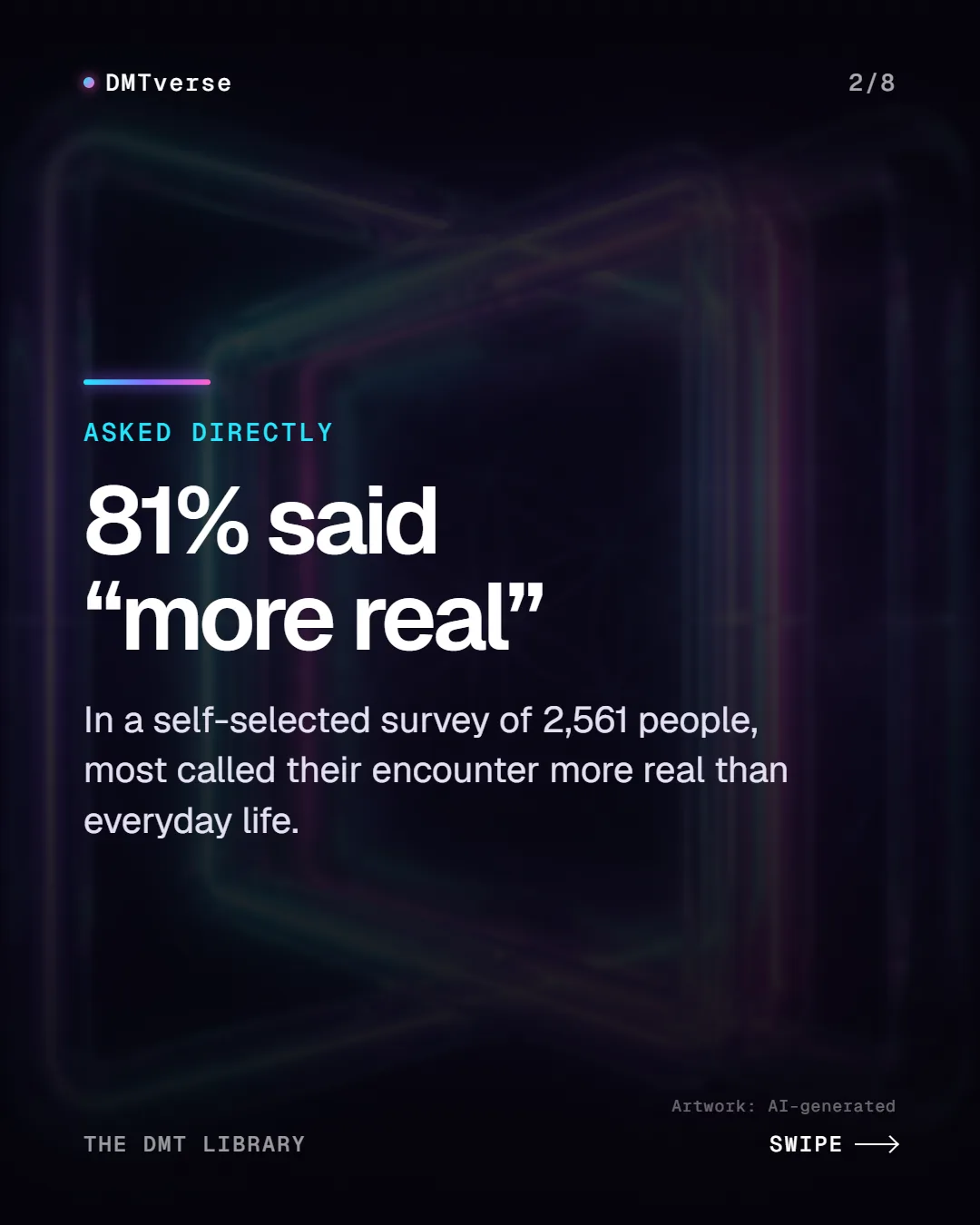
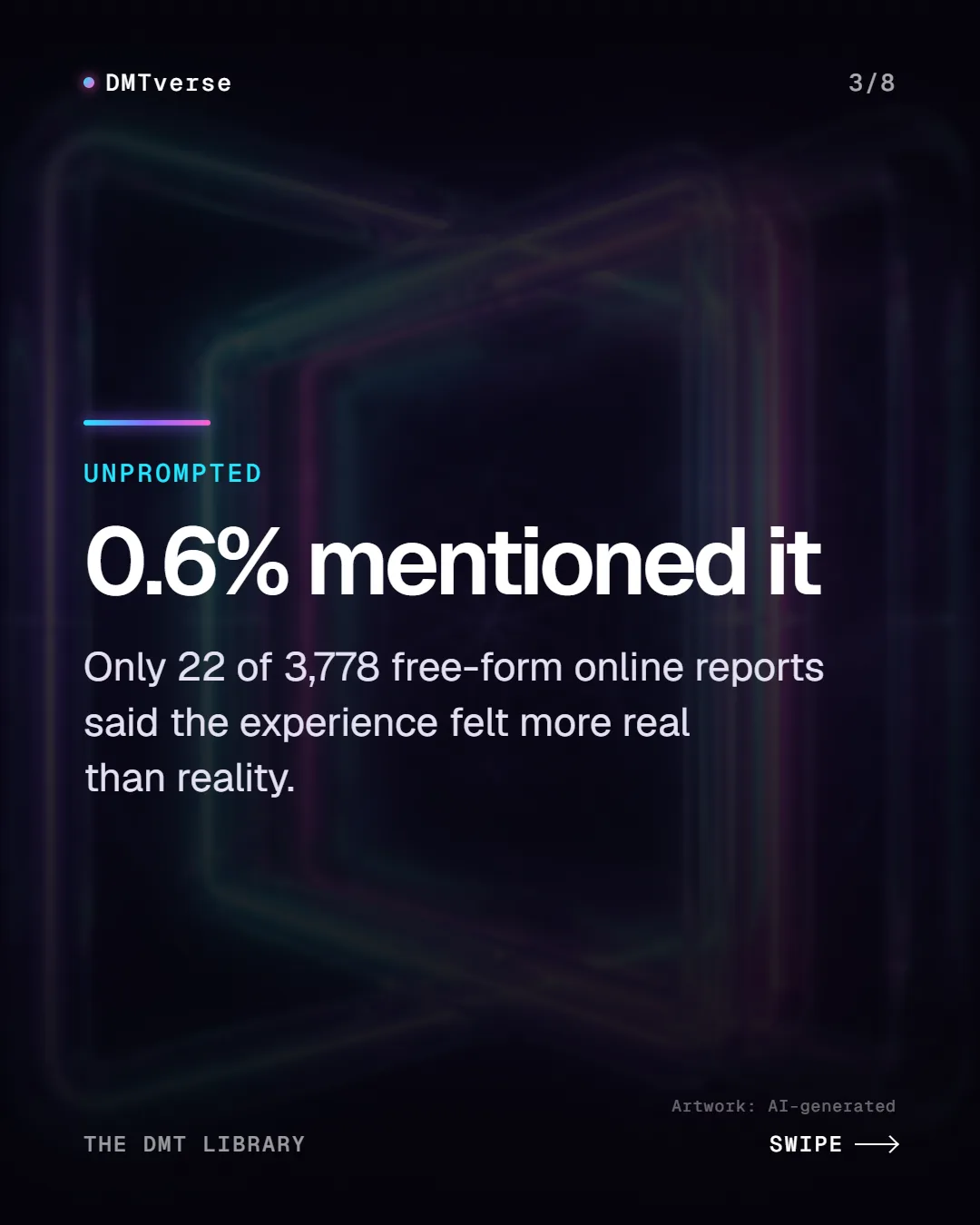
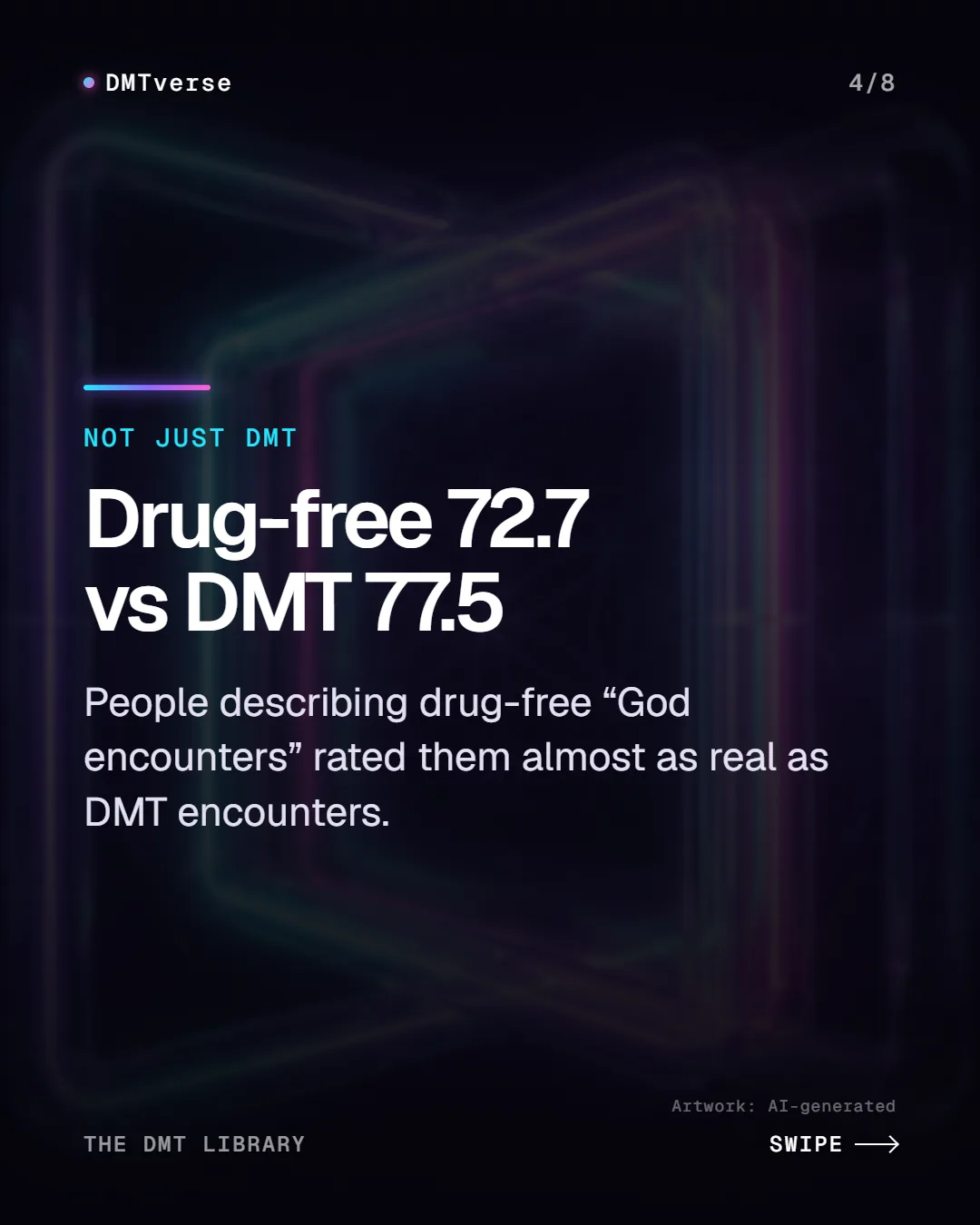
Nobody knows yet. When asked directly, 81% of 2,561 survey respondents said their DMT encounter felt more real than everyday reality, yet in 3,778 unprompted online reports only 0.6% said so. The feeling is not unique to DMT: people describing drug-free “God encounters” rated theirs almost as real. Brain research suggests “real” is a judgment the brain makes, based partly on how strong a signal is, and lab studies show the feeling that something is true can be triggered by the wrong cause. But no one has ever measured the brain’s reality judgment under DMT or any other psychedelic; a search on 20 October 2026 found no such study. A feeling of realness shows how intense an experience is, not whether its contents exist.
THE SHORT VERSION · SWIPE
On this page 10 sections
Of all the things people say about DMT, the most puzzling may be this: it felt more real than real. Not like a dream, not like a film, but realer than the room they woke up in. It is the reason many people take their experiences seriously for years afterwards, and the reason this question sits at the centre of our DMT section. This article sets out what researchers have measured about that feeling, what brain science says about how we tell real from imagined, and what has never been tested.
Education only, not guidance
This article describes published research. It gives no amounts, no instructions and no advice on use, and it does not describe any effect as a benefit. DMT is a controlled substance in Canada. Evidence labels used below: established (shown in peer-reviewed studies and not seriously disputed), preliminary (early, small, self-selected or indirect) and unresolved (an open question). Reports of experiences are labelled as reports.
How real do people say DMT feels?
Very real, when asked. In a 2020 Johns Hopkins online survey, 2,561 self-selected people described their single most memorable DMT entity encounter (see our overview of DMT entity encounters). Most said the entity existed in some real but different dimension of reality (Davis et al., 2020). According to a later field study that compared its results with the survey, 81% reported the encounter as “hyperreal”, more real than everyday reality (Michael et al., 2021). On a 0–100 scale, respondents rated the realness of the encounter 77.3 for the moment itself but 63.2 when thinking about it at the time of the survey (Davis et al., 2020). So remembered realness fades, though it stays high. Evidence: preliminary (self-selected, retrospective survey).
Unprompted, the picture changes. A team led by David Lawrence of the University of Toronto coded 3,778 DMT experiences posted to an online forum. Only 22 reports (0.6%) said the experience felt more real than everyday reality (Lawrence et al., 2022). That does not mean only 0.6% felt it; people describing a trip in their own words may simply not mention it. It means the number depends heavily on whether someone asks. Evidence: preliminary.
Careful lab interviews add nuance. In a 2026 study, 23 people were interviewed in fine detail after DMT given during brain scanning. A “feeling of reality” came up in 26% of interviews: some described the experience or its contents as real (22%), but others described parts as unreal (9%), seeming imagined or virtual. One participant said that, although they guessed it was an illusion, it felt very tangible (Sanders et al., 2026). Realness, in other words, is not all-or-nothing, and DMT can make things feel less real as well as more. Evidence: preliminary.
Survey with a direct question
81% of 2,561 survey respondents described their most memorable encounter as more real than everyday reality (Davis et al., 2020; figure as reported by Michael et al., 2021).
Detailed interview straight after
A felt sense of the experience being real came up in 22% of 23 interviews; “unreal” in 9% (Sanders et al., 2026).
Free online reports
0.6% of 3,778 forum reports said it felt more real than everyday reality (Lawrence et al., 2022).
Different samples and methods; the comparison shows a measurement effect, not a population rate.
Is the “more real than real” feeling unique to DMT?
No. In a 2019 survey of “God encounter” experiences, people whose encounter happened without any drug rated it 72.7 out of 100 for being more real than everyday consciousness. People describing a DMT encounter rated theirs 77.5, close behind (Griffiths et al., 2019). Both groups were self-selected. Evidence: preliminary.
Near-death experiences show something similar in memory. In a small study, eight coma survivors with near-death experiences rated those memories using a standard questionnaire for memory characteristics. Their near-death memories carried more of the features typical of real-event memories than their memories of actual real events did, and more than imagined ones (Thonnard et al., 2013). A memory can feel vividly real because of its emotional weight and intensity, which is a reason to treat vividness as a sign of intensity, not accuracy. Evidence: preliminary (eight people). For how DMT and near-death experiences compare, see does the brain release DMT when you die.
What do people mean by “real”?
The word does a lot of work. When people say DMT felt more real, they may mean at least five different things, and the science below mostly concerns the first. This list is our own framing for clarity, not a published scale:
- Perceptual realness: the sense that something is out there, not imagined.
- Presence: the felt solidity and aliveness of the world and of oneself.
- Conviction: the belief that the other world is the true one.
- The noetic feeling: the sense of having learned something true.
- Familiarity: the feeling of having always known the place or the beings.
How does the brain decide what is real?
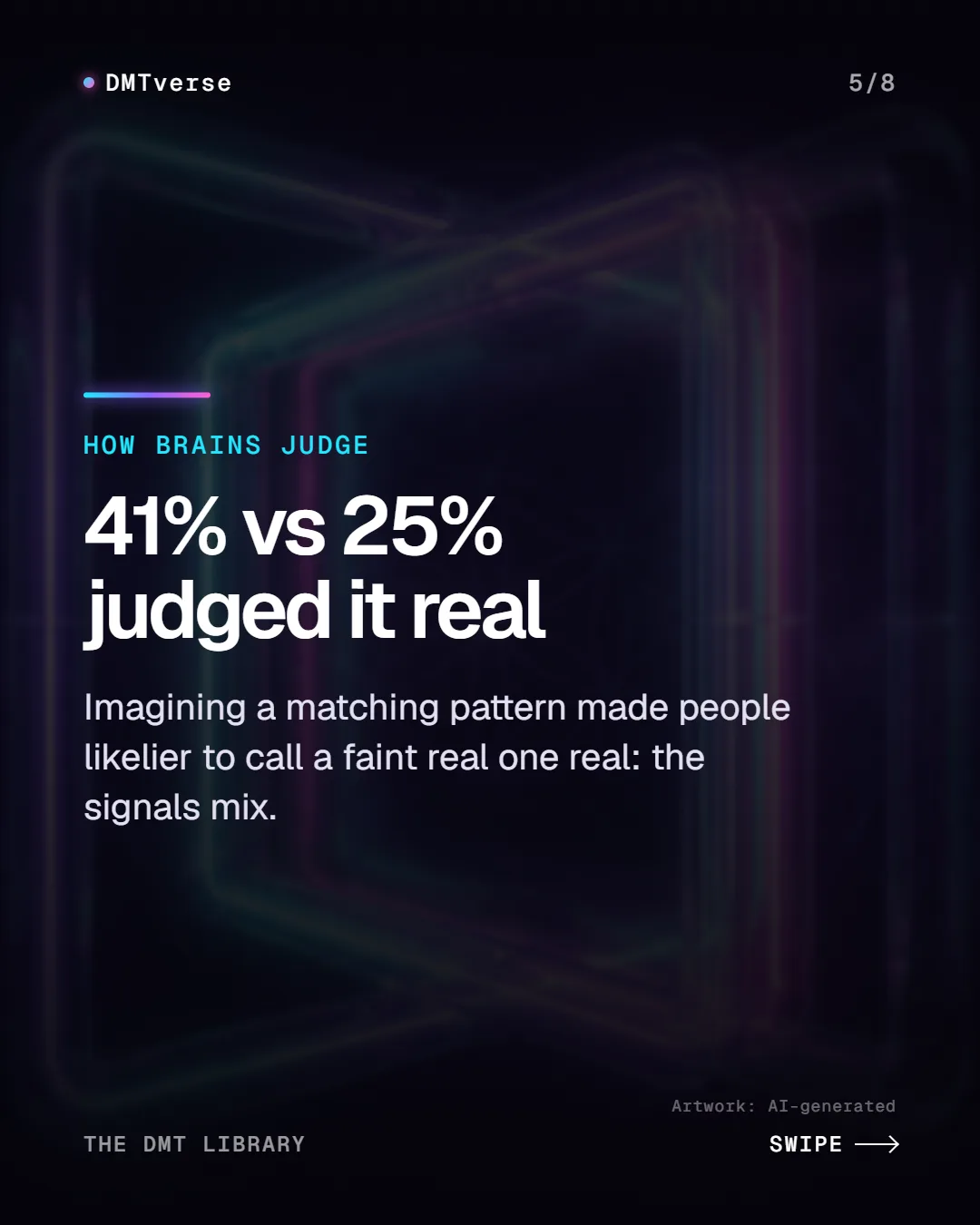
Neuroscientists call this reality monitoring: telling apart signals that come from the world from those the mind makes up. In 2023, Nadine Dijkstra and Stephen Fleming had people imagine a faint pattern while watching visual noise, then, on a single surprise trial, showed some of them a real faint pattern. When the real pattern matched what they were imagining, 41% judged it real; when it did not match, 25% did (272 participants) (Dijkstra and Fleming, 2023). Evidence: established in this paradigm, using simple visual patterns.
The authors’ conclusion: imagined and perceived signals mix together, and the brain calls something real when the combined signal crosses a threshold. When imagined signals are strong enough, they can become indistinguishable from reality (Dijkstra and Fleming, 2023). Evidence: preliminary as a general account of how the brain judges reality.
A 2025 brain-scanning study took this further. Judgments of reality tracked the combined strength of activity in the fusiform gyrus, a mid-level visual area, whether that activity came from imagining or seeing. Its moment-to-moment fluctuations predicted confusions between imagery and perception, and it interacted with a frontal network that encoded the yes-or-no judgment “real” (Dijkstra et al., 2025). Ordinary reality monitoring works well most of the time; these are subtle effects in careful experiments. Evidence: preliminary.
A different idea concerns presence, the second meaning above. Anil Seth and colleagues proposed in 2011 that the felt reality of the world and the self depends on the brain successfully predicting signals from inside the body, with the anterior insula acting as a comparator, and they linked failures of this process to depersonalisation (Seth et al., 2011). It is a theoretical model and has not been tested in psychedelic states. Evidence: unresolved.
Has reality monitoring been tested under DMT?
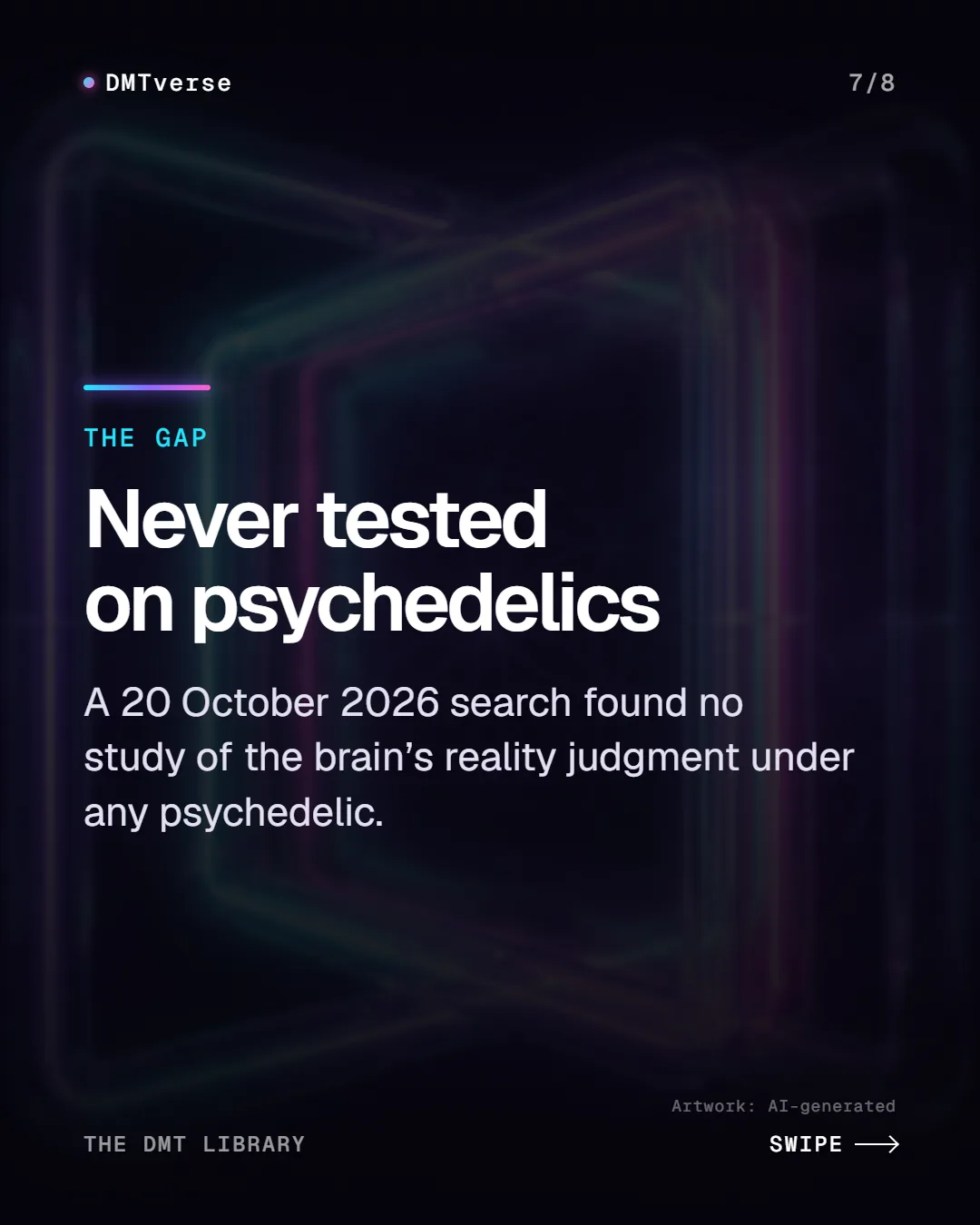
No. A 2024 psilocybin brain-imaging study of visual imagery suggested that reality monitoring may depend on top-down connections to early visual areas and that higher doses would give more reason to examine it, but its own participants received only a low to moderate dose (Stoliker et al., 2024). We re-ran a literature search in Europe PMC on 20 October 2026, combining reality-monitoring and reality-testing terms with DMT, psilocybin, LSD, ayahuasca and psychedelics. It returned 159 records: reviews, theory papers, clinical reports and the 2024 imaging study, but no experiment that measured reality monitoring while someone was under a psychedelic (Europe PMC search). Evidence: established that it has not been done, as far as indexed literature shows.
That gap matters. If DMT raises the brain’s internal signal strength, or lowers the threshold for calling it real, the Dijkstra framework would predict exactly the kind of “realer than real” verdict people report. That is our own hypothesis, built by joining two separate literatures, not a finding. It could be tested with the same tasks used in the lab. Evidence: unresolved.
The noetic quality: why it feels like knowledge
In 1902 the psychologist William James listed a “noetic quality” as one of two defining marks of mystical states: they seem to those who have them to be “states of knowledge”, and they tend to carry “a curious sense of authority for after-time” (James, 1902). Modern DMT reports echo that. In the 3,778 coded forum reports, 19.0% included the gain of insightful knowledge experienced at an intuitive level, and 8.9% expressed certainty of having encountered ultimate reality (Lawrence et al., 2022). Evidence: preliminary (reports).
A related feeling is familiarity: the sense of having been there before, or of knowing the beings. It appeared in 12.8% of the forum reports (Lawrence et al., 2022). In a 2026 online survey of 1,050 people, psychedelic experiences were rated higher on every familiarity item than autobiographical memories or déjà vu (Lawrence, Doss and O’Connor, 2026). A 2024 re-analysis of 10 memory datasets found that psychedelics given while memories form tend to impair detailed recollection while enhancing familiarity (Doss et al., 2024). Most of those datasets did not involve DMT. Evidence: preliminary.
Can the feeling of truth be wrong?
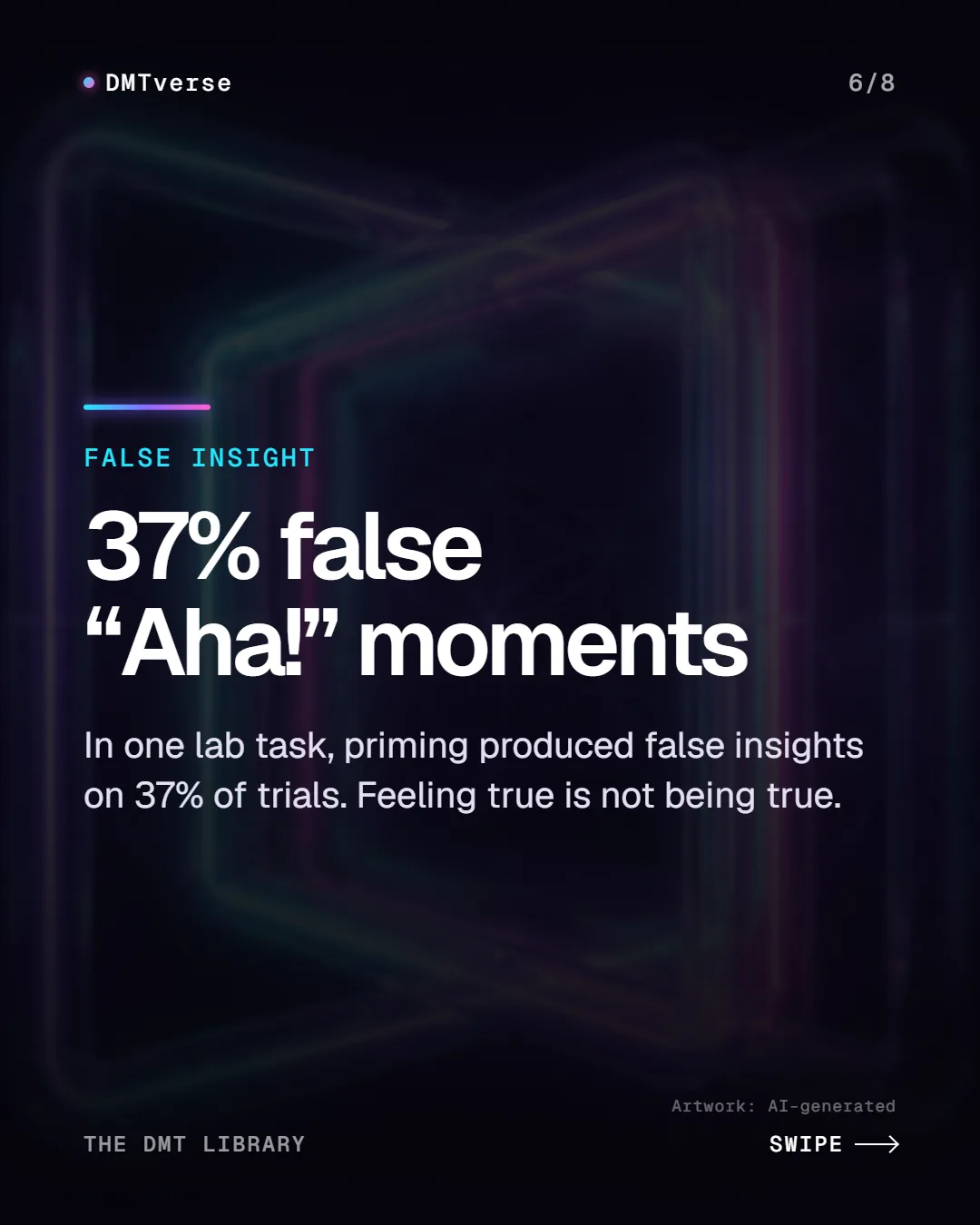
Yes, and lab work shows how. In a preregistered experiment with 300 people, statements shown just after solving an anagram were rated as more true, even when they were false, and especially when people reported an “Aha!” moment (Laukkonen et al., 2020). In a follow-up, priming people towards wrong answers produced false insights on 37% of the relevant anagram trials in one experiment; they felt weaker than correct insights but were common (Grimmer et al., 2022). The authors note that, normally, feelings of insight usually accompany correct ideas. Evidence: established in these lab tasks, with simple materials.
Psychedelics reliably increase the feeling of insight. A 2025 systematic review of 98 studies found insight was higher on a psychedelic than on placebo in 43 of the 46 studies that compared them, and was linked to clinical improvement in 25 of 29 studies that looked (Kugel et al., 2025). Whether the insights were accurate was not among the outcomes the review reports. A 2024 theory paper proposes that psychedelics increase both the number and the felt intensity of insights, false ones included (McGovern et al., 2024). Evidence: preliminary for the theory; the accuracy of psychedelic insights is unresolved.
When the real world stops feeling real
The sense of reality can also go down. In depersonalisation-derealisation disorder, people perceive the world correctly but feel it, or themselves, as unreal for months. A 2023 systematic review of 23 studies puts its prevalence at around 1% of the general population (Yang et al., 2023). In an internet survey of 394 adults with the condition, about half said a drug first set it off; cannabis and hallucinogens were the most common triggers. There were no DMT-specific data, and people may have been vulnerable beforehand (Simeon et al., 2009). Evidence: preliminary. It is tempting to see realness as one dial that DMT turns up and depersonalisation turns down; that is our framing, not a tested model.
If someone is in danger
Call 911 for immediate danger or urgent medical help, including if someone is unconscious, not breathing or having a seizure. In Ontario, the Ontario Poison Centre is at 1-800-268-9017; every province has a poison centre, listed by SickKids (AboutKidsHealth). If you or someone you know is thinking about suicide, call or text 9-8-8, 24 hours a day (Government of Canada). See also our safety page and how to help someone having a bad trip.
What the feeling does and does not show
The evidence supports a modest conclusion. The feeling that something is real, true or familiar is produced by the brain and can be strong without the contents being accurate; that is shown in ordinary lab tasks, in near-death memories and in drug-free spiritual experiences. It does not follow that DMT experiences are “just” hallucinations: the feeling of realness cannot prove them real, and it cannot prove them unreal either. That question is for other kinds of evidence. Evidence: preliminary.
- Whether DMT changes the brain’s reality threshold or signal strength: never measured (unresolved).
- Whether in-the-moment realness differs from remembered realness for the same person: only one survey has compared ratings, and retrospectively (unresolved).
- Whether people who rate an experience as more real later change their beliefs more (unresolved).
- Whether the insights people bring back are accurate: almost never assessed (unresolved).
For who people meet in these experiences, read DMT entity types explained and machine elves; for what dissolves along with the sense of reality, see DMT and ego death.
Common questions
Why does DMT feel real?
No one knows yet. One leading idea from brain research is that the brain labels an experience “real” when its internal signal is strong enough, and DMT may produce very strong signals. But that has never been measured under DMT or any other psychedelic.
Do most people say DMT feels more real than reality?
When asked directly, 81% of 2,561 self-selected survey respondents said their most memorable encounter felt more real than everyday reality. In 3,778 unprompted online reports, only 0.6% said so. The figure depends on how the question is asked.
Is “more real than real” unique to DMT?
No. People describing drug-free “God encounters” rated them almost as real (72.7 out of 100) as people describing DMT encounters (77.5), and near-death memories carry more hallmarks of real memories than memories of actual events.
Does the feeling of realness fade?
In one survey, respondents rated their encounter’s realness 77.3 out of 100 for the moment itself and 63.2 when looking back at the time of the survey. Still high, but lower.
Can a feeling of insight be false?
Yes. In lab experiments, an induced “Aha!” moment made unrelated false statements feel truer, and priming produced false insights on 37% of certain puzzle trials. Psychedelics raise the feeling of insight, but whether those insights are accurate has barely been studied.
Does feeling real mean the DMT world is real?
No, and it does not mean it is unreal either. The feeling of realness is something the brain produces and can be strong for things that are not out there. It is evidence of how intense an experience was, not of what exists.
Can DMT make things feel less real?
Sometimes. In a lab study, 9% of interviews described parts of the experience as unreal or virtual. Separately, hallucinogens are among the triggers people report for chronic depersonalisation, though no DMT-specific data exist.
Shroomverse sells mushroom products. This article is general information about published research on why DMT experiences are reported as feeling real. It is not medical, legal or purchasing advice, and it does not recommend any product.
SOURCES
- Survey of entity encounter experiences occasioned by inhaled N,N-dimethyltryptamine: Phenomenology, interpretation, and enduring effects (Davis AK, Clifton JM, Weaver EG, Hurwitz ES, Johnson MW, Griffiths RR, Journal of Psychopharmacology 34(9):1008–1020, 2020), SAGE (peer-reviewed). Accessed . Abstract read via Europe PMC on 20 October 2026 (full text closed to us today): 2,561 self-selected respondents, most memorable encounter, entity existing in a real but different dimension. The 81% figure is confirmed today via Michael et al. 2021 (full text). The 77.3 (during) vs 63.2 (now) realness ratings come from the paper’s full text as read for the DMTverse evidence ledger on 1 October 2026 (claim E6) and could not be re-read today.
- An Encounter With the Other: A Thematic and Content Analysis of DMT Experiences From a Naturalistic Field Study (Michael P, Luke D, Robinson O, Frontiers in Psychology 12:720717, 2021), Frontiers (peer-reviewed, open access); full text via Europe PMC, PMC8716686. Accessed . Full text read. Supports that Davis et al. 2020 respondents reported the encounter as “hyperreal” by a majority (81%).
- Phenomenology and content of the inhaled N,N-dimethyltryptamine (N,N-DMT) experience (Lawrence DW, Carhart-Harris R, Griffiths R, Timmermann C, Scientific Reports 12:8562, 2022), Springer Nature (peer-reviewed, open access); full text via Europe PMC, PMC9130218. Accessed . Full text read. Supports 3,778 experiences; “feels real or more real than everyday reality” in 22 (0.6%); gain of insightful knowledge at an intuitive level 19.0%; certainty of encounter with ultimate reality 8.9%; familiarity 12.8%. Study dose figures deliberately not reproduced.
- Micro-phenomenology of immersion and perceived presences under DMT (Sanders JW, Millière R, Demšar E, Daily ZG, Erritzoe D, Carhart-Harris R, Timmermann C, Neuroscience of Consciousness, niag015, 2026), Oxford University Press (peer-reviewed, open access); full text via Europe PMC, PMC13366535. Accessed . Full text read. Supports 23 interviews; feeling of reality 26%, real 22%, unreal 9%; the participant’s report that it felt tangible despite seeming an illusion (paraphrased).
- Survey of subjective “God encounter experiences”: Comparisons among naturally occurring experiences and those occasioned by the classic psychedelics psilocybin, LSD, ayahuasca, or DMT (Griffiths RR, Hurwitz ES, Davis AK, Johnson MW, Jesse R, PLoS One 14(4):e0214377, 2019), PLOS (peer-reviewed, open access); full text via Europe PMC, PMC6478303. Accessed . Full text read. “More real than everyday normal consciousness”: 72.7 (non-drug group, n = 809) vs 77.5 (DMT group, n = 606), adjusted table; self-selected online samples.
- Characteristics of near-death experiences memories as compared to real and imagined events memories (Thonnard M, et al., PLoS One 8(3):e57620, 2013), PLOS (peer-reviewed, open access); full text via Europe PMC, PMC3609762. Accessed . Abstract and full text read. 8 coma survivors with NDEs; Memory Characteristics Questionnaire; NDE memories had more characteristics than real and imagined event memories.
- Subjective signal strength distinguishes reality from imagination (Dijkstra N, Fleming SM, Nature Communications 14:1627, 2023), Springer Nature (peer-reviewed, open access); full text via PubMed Central, PMC10036541. Accessed . Abstract (Europe PMC) and full text (PubMed Central) read. Experiment 1, 272 participants: real judgments 0.41 congruent vs 0.25 incongruent; reality threshold account; strong imagined signals can become indistinguishable from reality.
- A neural basis for distinguishing imagination from reality (Dijkstra N, von Rein T, Kok P, Fleming SM, Neuron 113(15):2536–2542, 2025), Cell Press (peer-reviewed). Accessed . Abstract read via Europe PMC. Reality judgments track combined fusiform gyrus activity from imagery or perception; trial-by-trial fluctuations predict confusions; interaction with a frontal network encoding binary reality judgments.
- Neural mechanisms of psychedelic visual imagery (Stoliker D, et al., Molecular Psychiatry 30(4):1259–1266, 2025; online 2024), Springer Nature (peer-reviewed, open access); full text via Europe PMC, PMC11919690. Accessed . Full text read. Psilocybin fMRI study of 24 people; discussion links reality monitoring to top-down connectivity to early visual areas and says higher doses would give more reason to examine it; participants received a low to moderate dose (amount not reproduced here).
- Europe PMC search: reality monitoring or reality testing combined with psychedelic, psilocybin, DMT, dimethyltryptamine, LSD or ayahuasca, Europe PMC (EMBL-EBI). Accessed . Run through the Europe PMC REST API on 20 October 2026: 159 records; titles screened; none was an experiment measuring reality monitoring under a psychedelic. Indexed literature only.
- The Varieties of Religious Experience: A Study in Human Nature (William James, 1902), Lectures XVI and XVII, Mysticism, Project Gutenberg (public domain text). Accessed . Full text read (Project Gutenberg eBook 621). Source of the two short quotations defining the noetic quality.
- The dark side of Eureka: Artificially induced Aha moments make facts feel true (Laukkonen RE, Kaveladze BT, Tangen JM, Schooler JW, Cognition 196:104122, 2020), Elsevier (peer-reviewed). Accessed . Abstract read via Europe PMC. Preregistered, n = 300; higher truth ratings for statements paired with solved anagrams, even false ones, especially with an Aha! experience; insight usually accompanies correct ideas.
- Eliciting false insights with semantic priming (Grimmer H, Laukkonen R, Tangen J, von Hippel W, Psychonomic Bulletin & Review 29(3):954–970, 2022), Springer (peer-reviewed, open access); full text via Europe PMC, PMC9166882. Accessed . Full text read. Primed-lure anagrams produced false insights on 37% of trials (Experiment 2 mean 0.37); false insights relatively common but weaker than correct ones.
- Insights on psychedelics: A systematic review of therapeutic effects (Kugel J, Laukkonen RE, Yaden DB, Yücel M, Liknaitzky P, Neuroscience and Biobehavioral Reviews 173:106117, 2025), Elsevier (peer-reviewed). Accessed . Abstract read via Europe PMC. 98 studies; insight higher than placebo in 43 of 46; associated with therapeutic improvement in 25 of 29. The abstract reports no outcome on the accuracy of insights.
- An Integrated theory of false insights and beliefs under psychedelics (McGovern HT, et al., Communications Psychology 2:69, 2024), Springer Nature (peer-reviewed, open access); full text via Europe PMC, PMC11332244. Accessed . Abstract read. Theory: psychedelics increase the quantity and subjective intensity of insights, including false ones.
- Unique effects of sedatives, dissociatives, psychedelics, stimulants, and cannabinoids on episodic memory (Doss MK, et al., Psychological Review 131(2):523–562, 2024), American Psychological Association (peer-reviewed). Accessed . Abstract read via Europe PMC. Re-analysis of 10 datasets; psychedelics at encoding impaired recollection and tended to enhance familiarity.
- Characterizing Psychedelic-Evoked Familiarity: A Comparative Study with Autobiographical and Déjà Vu Experiences (Lawrence DW, Doss MK, O’Connor AR, Journal of Psychoactive Drugs, 2026), Taylor & Francis (peer-reviewed). Accessed . Abstract read via Europe PMC. Anonymous online survey of 1,050; psychedelic experiences rated higher on all familiarity items than autobiographical or déjà vu experiences.
- An interoceptive predictive coding model of conscious presence (Seth AK, Suzuki K, Critchley HD, Frontiers in Psychology 2:395, 2011), Frontiers (peer-reviewed, open access); PMC3254200. Accessed . Abstract read via Europe PMC. Theoretical model linking presence to interoceptive prediction, the anterior insula as comparator, and depersonalisation/derealisation. Untested in psychedelic states.
- The Prevalence of Depersonalization-Derealization Disorder: A Systematic Review (Yang J, Millman LSM, David AS, Hunter ECM, Journal of Trauma & Dissociation 24(1):8–41, 2023), Taylor & Francis (peer-reviewed). Accessed . Abstract read via Europe PMC. 23 studies; prevalence around 1% in the general population.
- Is depersonalization disorder initiated by illicit drug use any different? A survey of 394 adults (Simeon D, Kozin DS, Segal K, Lerch B, Journal of Clinical Psychiatry 70(10):1358–1364, 2009), Physicians Postgraduate Press (peer-reviewed). Accessed . Abstract read via Europe PMC. 394 adults; 196 drug-initiated; cannabis and hallucinogens the most common precipitants, then ecstasy. No DMT-specific data.
- Mental health support: get help, Government of Canada, Public Health Agency of Canada. Accessed . Page read 20 October 2026. Supports calling 9-1-1 in immediate danger or for urgent medical support, and calling or texting 9-8-8, 24 hours a day, 7 days a week.
- Poison information centres in Canada, AboutKidsHealth, The Hospital for Sick Children (SickKids). Accessed . Page read 20 October 2026. Supports Ontario toll-free 1-800-268-9017 and calling 911 if someone is unconscious, not breathing or having a seizure.
CHANGES
- : Linked glossary definitions.
- : Published. Sources opened and checked on this date; the reality-monitoring literature search was re-run in Europe PMC today. Two Davis et al. 2020 ratings are carried from the DMTverse ledger and flagged in the source note.
- : Editorial review: description rewritten; the 81% figure now worded as its secondary source reports it (“hyperreal”); Dijkstra paragraph split with separate evidence labels; an unsourced “some researchers” claim recast as our own framing; link to the entity-encounters overview added.



