THE SHROOMVERSE JOURNAL ✳ 14 MIN READ
The stoned ape theory: what it claims and what the evidence says
Topic: Mushrooms: history and science
Published Updated
Listen: the 3-minute version
AI-narrated summary of this article
Short answer, checked 4 October 2026
The stoned ape theory is Terence McKenna’s idea, published in 1992, that psilocybin mushrooms in the diet of early humans helped drive the growth of the human mind. It is a hypothesis, not an established finding. We found no direct evidence that early humans ate these mushrooms, no study showing that psilocybin sharpens vision, and a fossil record in which brain size grows gradually. The idea is untested rather than disproved.
On this page 10 sections
The stoned ape theory proposes that psilocybin mushrooms in the diet of our early ancestors helped push human brains, language and religion forward. The ethnobotanist Terence McKenna set it out in his 1992 book Food of the Gods. It has never been tested directly. This guide splits it into its parts, says what anthropology, palaeoanthropology and neuroscience tell us about each, and rates the evidence.
The short version: one part is plausible but unproven, one has no support in the studies we read, and the central claim, that mushrooms drove the growth of the human mind, is untested. McKenna asked a real question, and we treat it as one. For background on the mushrooms, see what magic mushrooms are; for the documented human record of their use, see the history of magic mushrooms.
How we rate each claim
Supported: several independent lines of evidence. Plausible, unproven: consistent with what is known, but no direct evidence. Untested: we found no study that has tried to test it. Not supported: the studies we read do not show it, or point the other way. These are our own labels, not a formal grading system, and we did not run a systematic review.
What is the stoned ape theory?
In its popular form, the stoned ape theory, also called the stoned ape hypothesis, says that early hominins began eating psilocybin mushrooms, that the effects gave them an edge, and that the edge helped produce larger brains, language and self-awareness. “Hominin” means humans and our close fossil relatives.
It is an evolutionary story, so it makes claims about the deep past, about what psilocybin does to perception and the brain, and about how natural selection could connect the two. Each of those can be checked against a different field.
What did Terence McKenna actually claim?
The book exists and is easy to confirm. A catalogue record lists Food of the Gods: The Search for the Original Tree of Knowledge: A Radical History of Plants, Drugs, and Human Evolution by Terence McKenna, published by Bantam Books in 1992 (Open Library catalogue record). We could not read the book itself, so we do not quote it. We describe its argument as a peer-reviewed paper describes it.
That 2021 paper says McKenna proposed that psilocybin’s effects on visual acuity, sexual activity and ecstatic or visionary experience influenced early humans’ foraging, sensitivity to community and religious concerns. It adds that he argued psilocybin in the early human diet drove a rapid reorganisation of the brain’s information-processing, catalysing self-reflective consciousness and language (Rodríguez Arce and Winkelman, 2021). Popular summaries, including Wikipedia’s entry, also tie the story to a mushroom that grows on the dung of grazing animals. We could not check that detail against the book, so we treat it as part of the wider debate, not as a quotation.
Broken into parts that can be tested, the argument has four:
- Exposure: early hominins met psilocybin mushrooms and ate them often enough to matter.
- Vision: the effects sharpened perception in ways that helped with foraging and hunting.
- Sex and community: the effects raised sexual activity and strengthened social bonds.
- Mind: all of this drove a fast reorganisation of the brain, producing language and self-reflective consciousness.
How do the claims hold up? A summary table
| Claim | What the evidence shows | Our rating |
|---|---|---|
| Early hominins were exposed to, and ate, psilocybin mushrooms | A close relative of the common cultivated species lived in Africa over a million years ago. No direct evidence of hominins eating psilocybin mushrooms. | Plausible, unproven |
| Psilocybin sharpened vision for hunting | Studies we read describe altered perception, not sharper vision. We found no study showing better acuity. | Not supported |
| Psilocybin raised sexual activity and strengthened bonds, to evolutionary effect | We found no study that tests this, in humans or in the fossil record. | Untested |
| Psilocybin drove a rapid reorganisation of the brain and the rise of language | Fossil brain size rises gradually, and several other explanations are on the table. Even sympathetic scientists call a simple one-cause version “most certainly false”. | Untested; the simple version is not supported |
Were early humans exposed to psilocybin mushrooms?
This is the part with the most new evidence. The widely held view is that Psilocybe cubensis, the species most often cultivated, reached the Americas with cattle after about 1500 CE, and that its ancestor lived in Africa. A 2026 study in Proceedings of the Royal Society B reports a cryptic species from sub-Saharan Africa, Psilocybe ochraceocentrata, as the closest wild relative of P. cubensis. DNA and molecular-clock analysis put their last common ancestor at about 1.5 million years ago, within a wide range of roughly 710,000 to 2.55 million years, long before cattle were domesticated (Bradshaw et al., 2026).
Both species are associated with the dung of large herbivores, and habitat modelling suggested that conditions suited their common ancestor across Africa, Asia and the Americas over the last 3 million years (Bradshaw et al., 2026). That makes the fungus’s family a plausible neighbour of early hominins. It does not show that any hominin ate it, and the abstract does not say whether the African relative contains psilocybin. Evidence: plausible, unproven.
The authors of the 2021 evolutionary model argue it is “highly unlikely” that ancestors ignored such conspicuous mushrooms, but they are open that incontrovertible direct evidence, such as psilocybin mushroom tissue or spores in ancient dental plaque, is lacking (Rodríguez Arce and Winkelman, 2021). The method exists. Ancient DNA in the dental plaque of Neanderthals at El Sidrón in Spain, where one individual’s microbial genome is around 48,000 years old, showed mushrooms, pine nuts and moss in their diet (Weyrich et al., 2017). The abstract does not say which mushrooms, and we found no study reporting psilocybin mushrooms in ancient remains.
The archaeological record of habitual drug use is also young next to the timescales involved. A 2026 study reports the earliest recorded evidence of habitual use of a neuroactive plant drug: betel nut sucking by foragers on Sulawesi, Indonesia, the earliest dated to 25,000 to 16,000 years ago (Brumm et al., 2026). That says nothing about mushrooms. It does show how little direct evidence of drug use survives.
Does psilocybin sharpen vision or raise sexual activity?
The vision claim is the easiest to compare with modern laboratory work, and the work we read points elsewhere. In a pilot randomised trial of six participants, peak psilocybin effects changed how contrast is perceived, strengthening a visual effect called surround suppression (Swanson et al., 2024). A 2025 study combining psychophysics, high-field brain imaging and modelling found that psilocybin altered contextual perception in a visual illusion and in cortical responses (Aqil et al., 2025). Both describe changed perception, not sharper perception.
A 2024 systematic review of 20 articles on psilocybin and cognitive function found mixed results: global cognitive function and processing speed mostly unchanged in healthy people, creative cognition and flexibility initially declining, some improvements in specific areas. Most of its studies used larger amounts than the low levels McKenna’s idea involves (Meshkat et al., 2024). That is a real gap, since low-level effects are less studied. Evidence: not supported by the studies we found, with that caveat.
For sexual activity and group bonding, we found no study that tests whether psilocybin changes reproduction or whether any such change would be inherited. Evidence: untested. The 2021 paper says McKenna’s hypotheses have received little attention and “still need to be examined further” (Rodríguez Arce and Winkelman, 2021).
Could psilocybin have driven brain growth and language?
What the fossil record shows
A 2018 analysis of fossil brain size found that, across the hominin family, the dominant signal is a gradual increase. It came mostly from change within lineages, helped by larger-brained Homo species appearing and smaller-brained Australopithecus and Paranthropus disappearing. The authors suggest episodes of directional selection separated by periods of stasis or drift, on timescales the fossil record cannot resolve (Du et al., 2018).
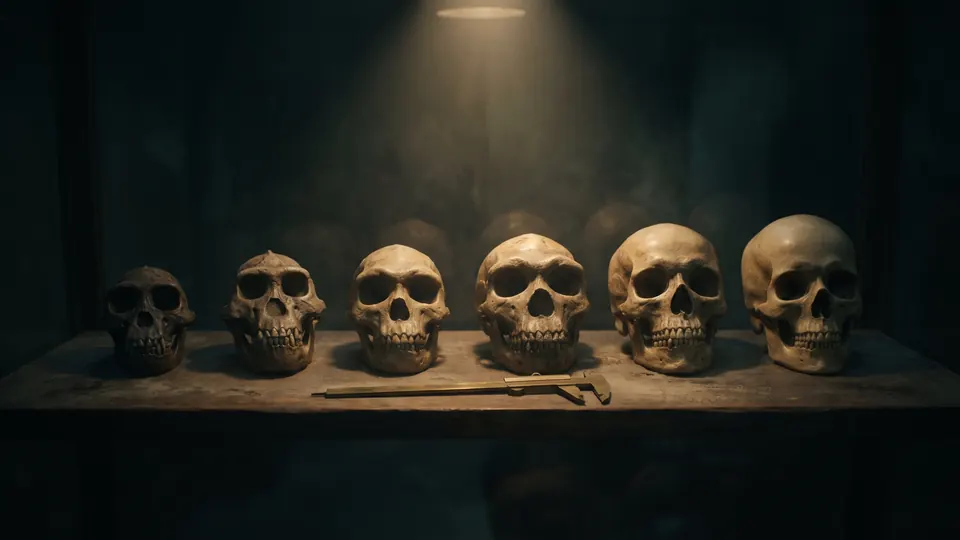
The earliest fossils of our own species show a similar piecemeal picture. Fossils from Jebel Irhoud in Morocco, dated to 315,000 years ago, give or take 34,000, combine facial, jaw and dental features aligned with early modern humans with more primitive braincase and endocranial features, and the authors say the processes behind the emergence of our species involved the whole African continent (Hublin et al., 2017). Neither study tests psilocybin. Together they describe a long, mosaic process, which sits awkwardly with a single sudden reorganisation. Evidence: the simple version is not supported.
Rival explanations for bigger brains
Other proposals compete for the same ground, and each is also a hypothesis. One holds that a cooked diet freed up the energy and feeding time a bigger brain needs, probably in Homo erectus (Fonseca-Azevedo and Herculano-Houzel, 2012). Another proposes that eating externally fermented foods was the initial metabolic trigger (Bryant et al., 2023). A 2026 review of explanations in human evolution develops a framework in which a shrinking prey size is one worked example (Ben-Dor and Barkai, 2026).
Even the authors of the 2021 evolutionary model, who argue psychedelics may have mattered, reject McKenna’s simple form. They write that a version implying psilocybin use alone led inevitably to modern cognition is “most certainly false”. They argue that hominin entry into the socio-cognitive niche cannot be explained by a single causal factor, whether walking upright, tool use, cooking or psychedelic use, and propose that psychedelics were at most an enabling factor in feedback loops with other changes (Rodríguez Arce and Winkelman, 2021). Their model is itself a proposal that, by their account, still needs testing.
A point of logic, which is our reasoning rather than a finding from a source: natural selection needs heritable differences that affect survival or reproduction. Taking a drug does not change genes. For psilocybin to shape evolution, people who ate the mushrooms would have to leave more descendants, through genetic differences or through cultural learning that was passed on. Nobody has shown either.
What does neuroscience say about psilocybin and the brain?
Psychedelics such as psilocybin act mainly on a serotonin receptor called 5-HT2A (Rodríguez Arce and Winkelman, 2021), and laboratory work shows brain-cell changes. In cell cultures and rodents, serotonergic psychedelics as a class increased the growth of neuron branches and spines and the number of synapses, through pathways that include the 5-HT2A receptor (Ly et al., 2018). That is early, preclinical work. It does not show that psilocybin improves thinking in people, and it says nothing about evolution. We cover the evidence in does psilocybin rewire the brain? and the basics in what is psilocybin?
A related open question concerns the fungi, not us. A 2026 study notes that remarkably little is known about how psilocybin evolved, and tested one idea, that it defends mushrooms against insects. Fruit-fly larvae exposed to Psilocybe extracts fared worse, but flies lacking the serotonin receptor that mediates psilocybin’s effects in humans responded in the same way (Matthews Nicholass et al., 2026). Why mushrooms make the compound is still unsettled, which makes any story about its effect on primates harder to ground.
Why does the stoned ape theory stay popular?
We found no measure of how widely the idea is held, so this section is our interpretation, not a sourced finding. It seems to us that the theory persists for a few understandable reasons. It answers a big question, why human minds are so unusual, with a vivid single image. It rides on a real renaissance of psilocybin research. And mushroom use is documented in human history, as in the history of magic mushrooms, which can make a far older use feel like a small step.
The step is not small. The documented record we cover there reaches back a few thousand years at most, and the hypothesis concerns well over a million. One-cause stories also appeal because they are easy to remember, and human evolution seldom works that way. The idea has been taken seriously enough that scientists published a revised, multi-factor model in a peer-reviewed journal (Rodríguez Arce and Winkelman, 2021). That is a reason to read the original with interest, not a reason to treat it as established.
What remains genuinely open?
- Whether any hominin ate psilocybin mushrooms. The question is testable in principle, for example through ancient dental plaque, but we found no such result.
- Whether the African relatives of the cultivated species contain psilocybin. The study we read does not say.
- What psilocybin does to perception and behaviour at the low levels the theory involves, since most trials we saw used larger amounts.
- Whether any effect on social learning or bonding could have mattered for selection. The 2021 model proposes this, and by its authors’ account it needs empirical tests.
- Why fungi make psilocybin at all.
Our overall verdict: the strong form, that mushrooms made us human, is not supported by anything we read. A weaker form, that ancestors were sometimes exposed to psilocybin mushrooms and that this could have been one small influence among many, is possible but unproven. Both are fair subjects for research, and neither is a reason to use any substance. Nothing here suggests psilocybin is good for thinking or health; for risks, see our safety page.
Common questions
What is the stoned ape theory?
It is the hypothesis that early humans ate psilocybin mushrooms and that this helped drive the growth of the human brain, language and self-awareness. It comes from Terence McKenna’s 1992 book Food of the Gods. It is untested, not an established scientific finding.
Who came up with the stoned ape theory?
Terence McKenna, in Food of the Gods: The Search for the Original Tree of Knowledge, published by Bantam Books in 1992 according to a catalogue record.
Is the stoned ape theory true?
Nobody knows, and the evidence we found does not support the strong version. There is no direct evidence that early humans ate psilocybin mushrooms, fossil brain size grows gradually, and several other explanations compete. Even sympathetic scientists call a simple one-cause version most certainly false.
Is there any evidence early humans ate magic mushrooms?
Not directly. A 2026 study shows a close relative of Psilocybe cubensis lived in Africa about 1.5 million years ago, with a wide margin of error. That makes exposure plausible. We found no ancient remains showing hominins ate psilocybin mushrooms.
Does psilocybin improve vision or intelligence?
The studies we read describe altered perception and mixed effects on cognition, not improvement. Results are early and mixed, and psilocybin has real risks. See our safety page before drawing any conclusions about personal use.
Where did Psilocybe cubensis come from?
The prevailing view is that it spread to the Americas with cattle after about 1500 CE, and that its ancestor was African. A 2026 study identified a cryptic African species as its closest wild relative, with a shared ancestor about 1.5 million years ago.
Shroomverse sells mushroom products. This article is general information about history. It is not medical, legal or purchasing advice, and it does not encourage anyone to use drugs.
SOURCES
- Food of the gods: the search for the original tree of knowledge: a radical history of plants, drugs, and human evolution (Terence McKenna), catalogue record, Open Library. Accessed . Confirms the book’s title, subtitle, author, Bantam Books and 1992. Used only for existence and bibliographic details; we did not read the book.
- Psychedelics, Sociality, and Human Evolution (Rodríguez Arce and Winkelman), Frontiers in Psychology 12:729425, 2021. Accessed . Describes McKenna’s proposal; states that a simplistic version is most certainly false; says direct evidence of psychedelic mushroom ingestion by ancient humans is lacking; notes the hypotheses need empirical testing. Full text read.
- Stoned ape theory, Wikipedia. Accessed . Orientation only, for the popular dung-habitat summary. Not relied on for any claim beyond that, and not checked against the book.
- Discovery of the closest free-living relative of the domesticated ‘magic mushroom’ Psilocybe cubensis in Africa (Bradshaw et al.), Proceedings of the Royal Society B 293:20252270, 2026. Accessed . Abstract read (Europe PMC record; Crossref record confirmed). Supports the common-ancestor date, the dung association and the niche-modelling statement.
- Neanderthal behaviour, diet, and disease inferred from ancient DNA in dental calculus (Weyrich et al.), Nature 544:357–361, 2017. Accessed . Abstract read. Supports mushrooms, pine nuts and moss in the El Sidrón diet and the age of the genome.
- Betel nut sucking is the earliest recorded evidence for the habitual use of a neuroactive plant drug (Brumm et al.), Science Advances 12:eaei1901, 2026. Accessed . Open-access abstract read. Supports the dating and the ‘earliest recorded’ claim.
- Enhanced visual contrast suppression during peak psilocybin effects: Psychophysical results from a pilot randomized controlled trial (Swanson et al.), Journal of Vision 24(12):5, 2024. Accessed . Abstract read. Supports the six-participant pilot and the surround-suppression finding.
- Psilocybin alters visual contextual computations (Aqil et al.), Nature Communications 16:10271, 2025. Accessed . Abstract read. Supports altered contextual perception and cortical responses.
- Impact of psilocybin on cognitive function: A systematic review (Meshkat et al.), Psychiatry and Clinical Neurosciences 78:744–764, 2024. Accessed . Abstract read. Supports the mixed cognitive findings and the note that most studies used larger amounts.
- Pattern and process in hominin brain size evolution are scale-dependent (Du et al.), Proceedings of the Royal Society B 285:20172738, 2018. Accessed . Abstract read. Supports the gradual-increase finding.
- New fossils from Jebel Irhoud, Morocco and the pan-African origin of Homo sapiens (Hublin et al.), Nature 546:289–292, 2017. Accessed . Abstract read (note that a 2018 author correction exists and does not alter the inferences). Supports the 315,000-year date and the mosaic of features.
- Metabolic constraint imposes tradeoff between body size and number of brain neurons in human evolution (Fonseca-Azevedo and Herculano-Houzel), PNAS 109:18571–18576, 2012. Accessed . Abstract read. Cited as one rival hypothesis (cooked diet).
- Fermentation technology as a driver of human brain expansion (Bryant et al.), Communications Biology 6:1190, 2023. Accessed . Abstract read. Cited as a rival hypothesis (external fermentation).
- Through Time and Across Traits: Evaluating Explanations of Human Evolution (Ben-Dor and Barkai), Evolutionary Anthropology 35:e70046, 2026. Accessed . Abstract read. Cited for the framework and the prey-size-decline example.
- Psychedelics Promote Structural and Functional Neural Plasticity (Ly et al.), Cell Reports 23:3170–3182, 2018. Accessed . Abstract read. Supports cell-culture and rodent findings on neuron growth; preclinical.
- Wherefore the Magic? The Evolutionary Role of Psilocybin in Nature (Matthews Nicholass et al.), Ecology and Evolution 16:e73522, 2026. Accessed . Abstract read. Supports the statement that little is known about psilocybin’s evolution in fungi and the fruit-fly result.
CHANGES
- : Added links to the DMT Library.
- : Published.



