THE SHROOMVERSE JOURNAL ✳ 14 MIN READ
Does the brain release DMT when you die? What the evidence shows
Topic: DMT
Published Updated
Listen: the 3-minute version
AI-narrated summary of this article
Short answer, checked 20 October 2026
Nobody knows whether your brain releases DMT when you die, because DMT has never been measured in a dying human brain. The idea traces to a 1990s hypothesis by psychiatrist Rick Strassman. What exists: trace amounts of DMT in human body fluids; one rat study that found DMT in the living brain and a rise after induced cardiac arrest; and one small study in which DMT experiences scored like near-death experiences on a questionnaire. There is no measured evidence that DMT drives dreams, and in rats the pineal gland was not needed for brain DMT.
THE SHORT VERSION · SWIPE
On this page 10 sections
It is one of the most repeated lines about psychedelics: when you die, your brain floods with DMT, and that is why people who come close to death describe tunnels, light and other worlds. A related version says the pineal gland releases DMT every night to make your dreams. This fact-check traces where the idea came from, sets out what experiments actually measured, and rates each claim. It says nothing about what any person’s death is like, because no study can tell us that.
Research summary, not medical advice
This article describes published studies. It gives no advice on using DMT or any other substance, and nothing here is a statement about the experience of anyone who has died. In Canada, DMT is a controlled substance. For risks and help, see our safety page.
Where does the idea that your brain releases DMT when you die come from?
DMT (N,N-dimethyltryptamine) is a short-acting psychedelic that many plants and animals also make naturally. It was first made in a lab in 1931, by the Canadian chemist Richard Manske, and its psychedelic effects were described in 1956 (Barker, 2018). For how it compares with psilocybin and LSD, see our guide to psilocybin, LSD and DMT.
The modern “DMT at death” story traces back to Rick Strassman, a psychiatrist at the University of New Mexico. In the early 1990s his group gave intravenous DMT to volunteers under supervision and recorded what they described. They reported that the effects were “more vivid and compelling than dreams or waking awareness” (Strassman et al., 1994).
Strassman later wrote a popular book, DMT: The Spirit Molecule, subtitled “A Doctor’s Revolutionary Research into the Biology of Near-Death and Mystical Experiences” (library catalogue record). We did not read the book itself, so we describe its hypothesis only as other researchers summarise it. A 2018 paper describes it as the idea “that endogenous DMT is released in significant concentrations during the dying process” (Timmermann et al., 2018). A critical review by pharmacologist David Nichols says recent versions of pineal-gland lore suggest DMT is secreted by the pineal gland at birth, during dreaming and near death (Nichols, 2018).
So there are really three claims bundled together: DMT is released when we die, DMT is released when we dream, and the pineal gland is the source. Each has a different evidence record.
Does the human body make DMT at all?
Yes, in small amounts, as far as careful measurements can tell. A 2012 review examined 69 published studies that looked for DMT and two related compounds in human blood, urine and cerebrospinal fluid between 1955 and 2010 (Barker et al., 2012). A later summary of that review says many early studies reporting fairly high levels were “most likely in error”, often because the lab methods could not reliably identify the compound. Where mass spectrometry was used, it concluded that DMT is endogenous (made by the body) and can often be measured in human body fluids (Barker, 2018). Evidence: established.
The amounts are tiny. A 2019 paper notes that studies of human body fluids have only reported DMT in trace amounts, “calling into question any physiological role” (Dean et al., 2019). Nichols says minute concentrations have been detected in the brain but that they are not sufficient to produce psychoactive effects (Nichols, 2018). Barker counters that brain levels have not yet been measured well enough to settle the question (Barker, 2018). Evidence: established for trace amounts.
What is missing matters just as much. As of 2018, no study had linked human DMT levels in blood, urine or saliva to body events such as daily rhythms, and most studies sampled only once or collected urine over a whole day (Barker, 2018). Nobody has measured DMT in a living human brain, let alone a dying one. Evidence: unresolved.
What did the rat studies find?
The strongest experimental evidence comes from one research group at the University of Michigan, working with rats. Two studies are often quoted together, but they found different things.
2013: DMT detected near the rat pineal gland
In 2013, a team including Steven Barker, Jimo Borjigin and Strassman developed a lab method to detect DMT and related compounds in tiny fluid samples. They applied it to fluid collected from the pineal gland area of living rats and reported, “for the first time”, the presence of DMT (Barker et al., 2013). It was a qualitative result: it showed DMT was there, but it did not measure how much. A later review adds that the samples were diluted fluid from the surrounding tissue, collected at a single point in time (Barker, 2018). This study did not involve death or dying. Evidence: preliminary.
2019: DMT in the rat cortex, and a rise after cardiac arrest
In 2019, Jon Dean and colleagues went further (Dean et al., 2019). Using microdialysis, they sampled fluid from the visual cortex of freely moving rats: 25 rats with the pineal gland intact and 11 with it surgically removed. They found:
- Baseline DMT levels in the rat cortex were in the same low range as the familiar brain chemicals serotonin, dopamine and noradrenaline measured the same way.
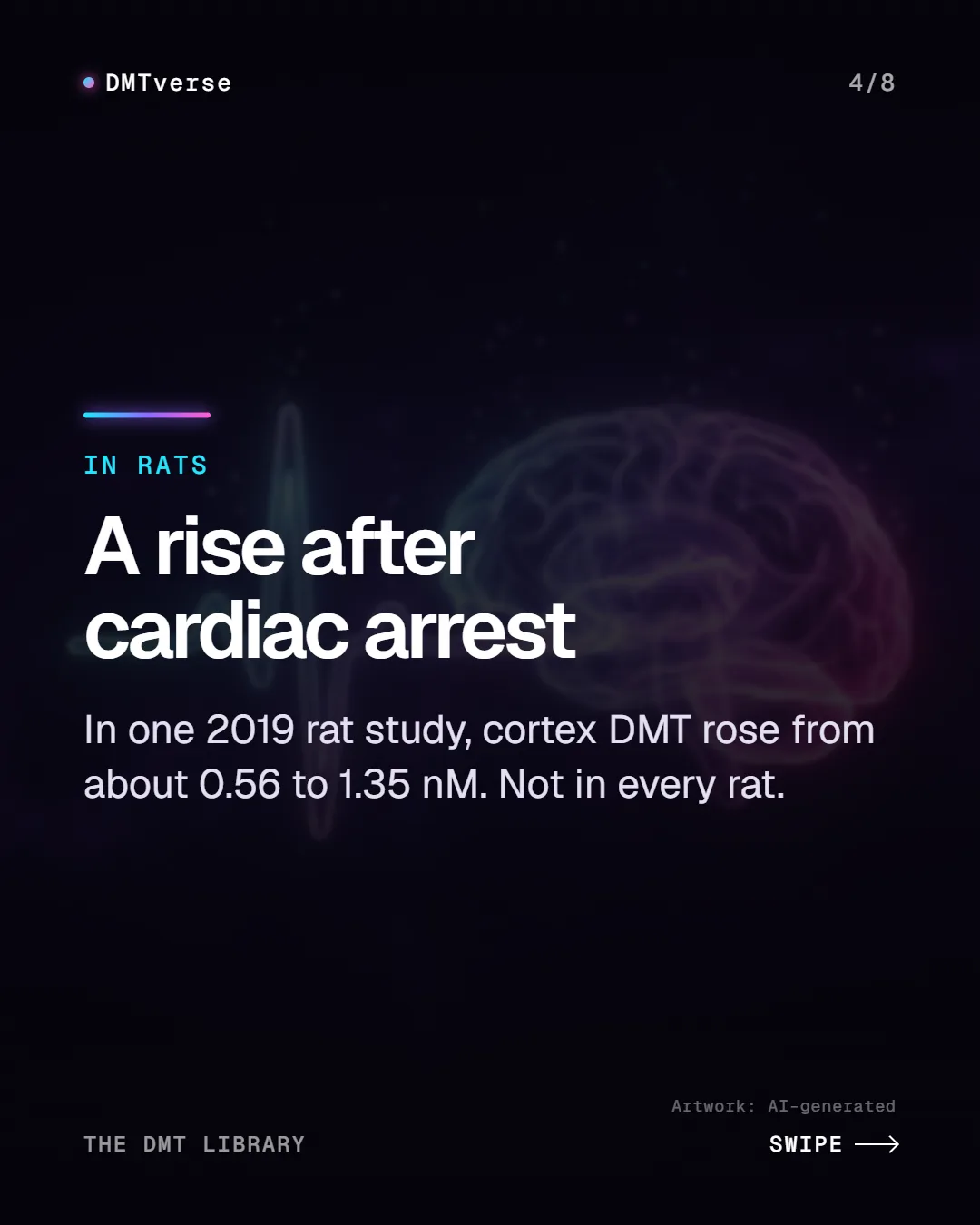
- After the researchers induced cardiac arrest, DMT levels rose significantly in both groups. In rats with a pineal gland, the average went from about 0.56 to 1.35 nanomolar.
- Not every rat showed a rise. The authors linked this to the fact that only a minority of people who survive cardiac arrest report near-death experiences.
- Removing the pineal gland did not lower brain DMT. Levels were similar with or without it.
The authors were careful about what this means. They wrote that it is unknown whether the concentrations seen at cardiac arrest could produce the effects of a psychedelic dose, or whether a similar surge happens in humans. They also noted that other brain chemicals surge at cardiac arrest in rats, and that these may contribute to near-death states (Dean et al., 2019). For a closer look at this study, see the DMT rat brain study, explained. Evidence: preliminary.
Related work: electrical surges in the dying brain
The same lab had earlier recorded a brief surge of fast (gamma) brain activity in rats within 30 seconds of induced cardiac arrest (Borjigin et al., 2013), and in 2023 a similar surge in two of four dying patients (Xu et al., 2023). These were electrical recordings; neither study measured DMT. What the surges might mean for near-death experiences, and the debate over the signal, is covered in DMT and near-death experiences. Evidence: preliminary.
Do DMT experiences resemble near-death experiences?
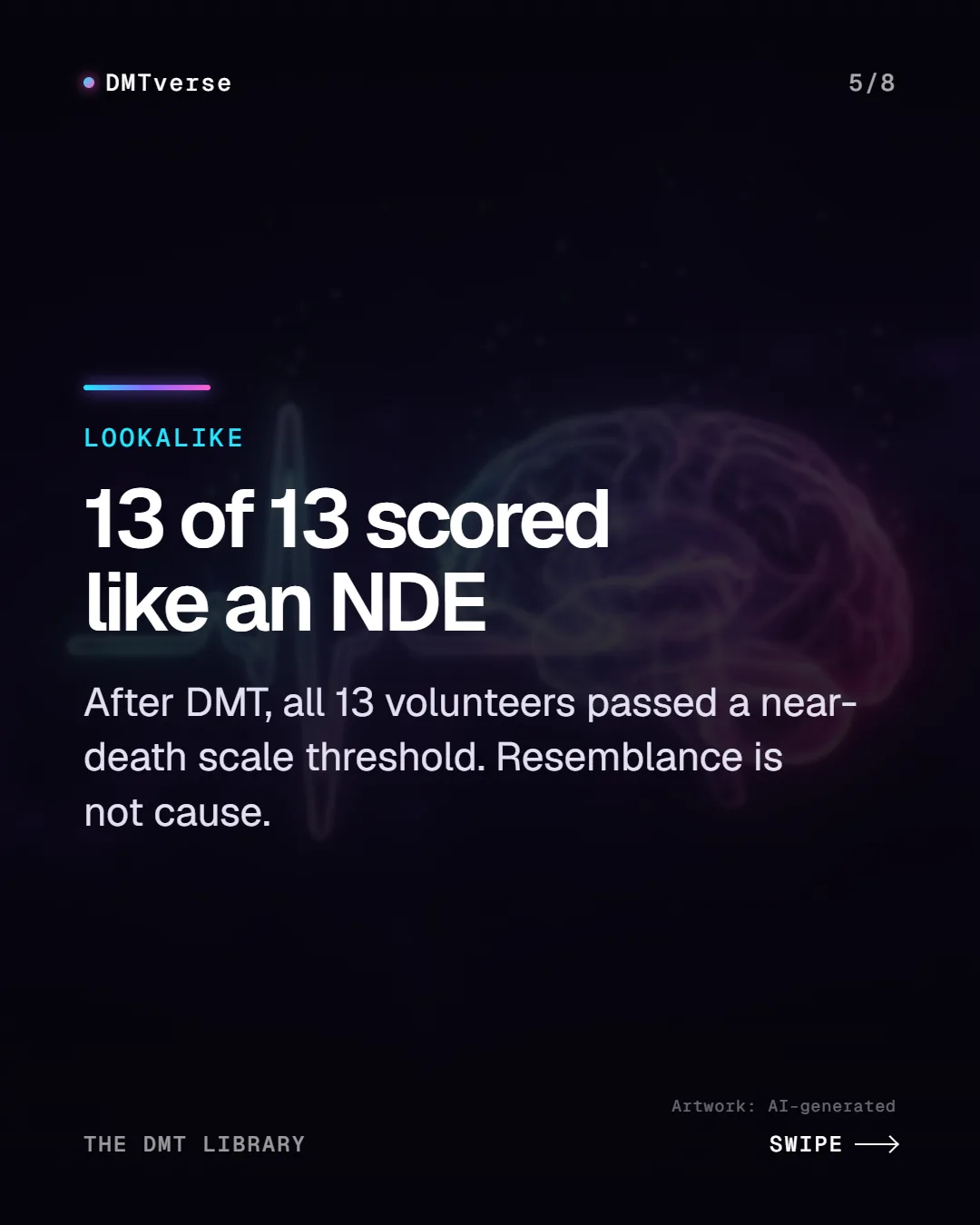
In part. In a 2018 study at Imperial College London, all 13 volunteers given intravenous DMT scored at or above the usual threshold on a standard near-death questionnaire, the Greyson Near-Death Experience Scale (Timmermann et al., 2018). The study was small, placebo always came first, and one participant reached the threshold after placebo alone. A 2024 survey of 31 people who had had both kinds of experience found overlap in mystical-type features but differences in sensory ones (Martial et al., 2024). Evidence: preliminary.
We compare the two experiences feature by feature, including the contents that differ, in DMT and near-death experiences. For this fact-check the point is narrower: showing that DMT can produce something like a near-death experience is not the same as showing that the dying brain produces DMT. Similar experiences can have different causes, and Nichols offers explanations of how stress and nearness to death can alter consciousness without DMT (Nichols, 2018). Evidence: unresolved.
Does your brain release DMT when you sleep or dream?
There is no measured evidence for this. A 2018 review describes DMT’s role in dreaming as a hypothesis dating to 1988 that has yet to be tested. It notes that only a few efforts have looked at DMT across sleep stages and that no circadian study of DMT release from the pineal gland had been done (Barker, 2018). No study we found has measured DMT in a human brain during sleep. Evidence: unresolved.
Resemblance is not evidence either. Psychedelic states and dreams share features such as vivid imagery and emotion, but differ in others, such as clarity of awareness (Kraehenmann, 2017). And in a study of 22 healthy men, daytime ayahuasca (a brew containing DMT) reduced later REM sleep, the stage most linked to vivid dreams (Barbanoj et al., 2008), which does not fit a simple “DMT makes dreams” story. Brain-wave and lucid-dream research is covered in DMT and dreams. Evidence: preliminary.
Is the pineal gland the source of DMT?
The pineal gland is a very small gland deep in the brain. Nichols notes that the adult gland weighs less than a fifth of a gram, and that its main known job is making melatonin, the hormone that helps set the body’s daily rhythm (Nichols, 2018). Evidence: established.
It does contain the machinery that could make DMT. Dean’s team found messenger RNA for INMT, an enzyme thought to make DMT, in the pineal gland, cerebral cortex and choroid plexus of both rats and humans (the human tissue came from autopsies) (Dean et al., 2019). An earlier study had found INMT protein in the monkey pineal gland (Barker, 2018). Evidence: preliminary.
But having the machinery is not the same as being the source:
- In rats, brain DMT levels were similar with and without the pineal gland, so the authors suggested the cortex may be a major source and said it is uncertain “to what extent, if any” the pineal contributes (Dean et al., 2019).
- The same team later made rats lacking the INMT gene. Their brain and lung tissue still showed the same tryptamine-processing activity, but the products were neither DMT nor its precursor, and rat INMT on its own was not enough to make DMT. The authors concluded there may be another pathway for DMT production in rats (Glynos et al., 2023).
- No study we found has measured DMT released by a human pineal gland.
For more on the gland itself, see is DMT in the pineal gland?
Each claim, rated
We use three labels. Established: shown directly in peer-reviewed studies and not seriously disputed. Preliminary: real data that point in a direction but are small, indirect or from animals. Unsupported: not shown by any measurement we found, or contradicted.
| Claim | Rating | Why |
|---|---|---|
| The human body makes DMT | Established | Detected with mass spectrometry in human body fluids, in trace amounts (Barker et al., 2012; Barker, 2018). |
| The rat brain releases DMT at levels similar to other brain chemicals | Preliminary | Measured in living rats by one research group (Dean et al., 2019). Not yet repeated by others or shown in humans. |
| DMT rises in the brain at cardiac arrest | Preliminary (rats only) | Significant rise in one rat study, not in every rat (Dean et al., 2019). Never measured in humans. |
| Your brain releases a flood of DMT when you die | Unsupported | No human measurement exists. Whether rat levels at cardiac arrest could cause psychedelic effects is unknown (Dean et al., 2019). |
| DMT experiences resemble near-death experiences | Preliminary | Similar questionnaire scores in 13 volunteers vs 13 matched people, with design limits (Timmermann et al., 2018). |
| DMT causes near-death experiences | Unsupported | Resemblance does not show cause; other explanations exist (Nichols, 2018). Other brain chemicals also surge (Dean et al., 2019). |
| The brain releases DMT when you sleep or dream | Unsupported | Never measured. Discussed as a hypothesis (Barker, 2018). Ayahuasca reduced REM sleep in one study (Barbanoj et al., 2008). |
| The pineal gland contains DMT-making enzymes | Established | INMT RNA found in rat and human pineal tissue (Dean et al., 2019); INMT may not be required in rats (Glynos et al., 2023). |
| The pineal gland is the brain’s DMT source | Unsupported | Removing it did not change cortical DMT in rats (Dean et al., 2019). Never measured in humans. |
What do we still not know?
- Whether DMT rises in the human brain at death. There is no method yet that has measured this.
- What DMT does in the body at all. Researchers have argued it can be considered a putative (proposed) neurotransmitter, but its natural role is unresolved (Barker, 2018).
- How the body makes it. The rat knockout study suggests the textbook enzyme may not be the whole story (Glynos et al., 2023).
- Whether brain levels ever get high enough to matter for experience. Nichols argues they do not; Dean and colleagues say it is unknown.
- Whether the rat results repeat. Most of the key data come from one group, and some of its authors also proposed the hypothesis being tested, which is common in science but is a reason to want independent replication.
If you are reading this because you are thinking about death, grief or a frightening experience, it may help to know that the studies above treat near-death experiences as complex experiences worth understanding, whatever their chemistry turns out to be, and that none of them can say what dying is like for any one person. For research on psilocybin and end-of-life distress, see our evidence summary on psilocybin for end-of-life distress. For another popular psychedelic theory checked against the sources, see our stoned ape theory fact-check.
If you or someone you know needs help now
The Government of Canada says that if you are in immediate danger or need urgent medical support, call 9-1-1. If you or someone you know is thinking about suicide, call or text 9-8-8, 24 hours a day, 7 days a week (Government of Canada). More numbers are on our safety page.
What is DMT’s legal status in Canada?
DMT is listed as item 7 in Schedule III of the Controlled Drugs and Substances Act, in the consolidation current to 30 September 2026 (Justice Laws). The research described in this article took place under licences in the United States and the United Kingdom. This is not legal advice. For background on the wider family of compounds, see what magic mushrooms are and does psilocybin rewire the brain?.
Common questions
Does your brain release DMT when you die?
Nobody knows, because it has never been measured in a human. One rat study found DMT levels in the brain rose after induced cardiac arrest, but not in every rat, and the authors said it is unknown whether that happens in humans or whether the levels are enough to cause psychedelic effects.
Does your brain release DMT when you sleep?
There is no measured evidence for it. The idea that DMT is involved in dreaming is a hypothesis. A 2018 review noted that DMT levels have barely been studied across sleep stages and that no circadian study of pineal DMT release had been done.
Does the pineal gland make DMT?
The pineal gland contains RNA for INMT, an enzyme thought to make DMT, in rats and humans, and DMT was detected in fluid from the rat pineal area. But in rats, brain DMT levels stayed the same when the pineal gland was removed, and no study has measured DMT release from a human pineal gland.
Does DMT cause near-death experiences?
There is no evidence that it does. DMT experiences can score like near-death experiences on a questionnaire, but resemblance does not show cause, and DMT has never been measured in a dying human. In rats, other brain chemicals also surge at cardiac arrest and may contribute.
Who came up with the idea that DMT is released at death?
It is mainly linked to psychiatrist Rick Strassman, who ran DMT studies at the University of New Mexico in the 1990s and later wrote the book DMT: The Spirit Molecule. Other researchers summarise his hypothesis as DMT being released in significant amounts during dying.
How much DMT is in the human body?
Only trace amounts have been reported in human blood, urine and cerebrospinal fluid. One pharmacology review says the minute concentrations detected in the brain are not sufficient to produce psychoactive effects.
Shroomverse sells mushroom products. This article is general information about published research on DMT. It is not medical, legal or purchasing advice, and it does not recommend any product.
SOURCES
- Biosynthesis and Extracellular Concentrations of N,N-dimethyltryptamine (DMT) in Mammalian Brain (Dean JG, Liu T, Huff S, et al., Scientific Reports 9:9333, 2019), Nature Portfolio; open full text via Europe PMC, PMC6597727. Accessed . Full text read. Supports INMT RNA in rat and human cortex, pineal and choroid plexus (human autopsy tissue); 25 pineal-intact and 11 pinealectomized rats; baseline 0.56 to 1.35 nM average after cardiac arrest in pineal-intact rats; no difference with or without pineal; not all rats showed a surge; unknown whether levels can cause psychedelic effects or occur in humans; trace amounts in human fluids.
- LC/MS/MS analysis of the endogenous dimethyltryptamine hallucinogens, their precursors, and major metabolites in rat pineal gland microdialysate (Barker SA, Borjigin J, Lomnicka I, Strassman R, Biomedical Chromatography 27(12):1690–1700, 2013), Wiley; abstract via Europe PMC, PMID 23881860. Accessed . Abstract read. Supports the first report of DMT in rat pineal gland microdialysate, with a qualitative (detection, not quantity) method.
- A critical review of reports of endogenous psychedelic N,N-dimethyltryptamines in humans: 1955–2010 (Barker SA, McIlhenny EH, Strassman R, Drug Testing and Analysis 4(7-8):617–635, 2012), Wiley; abstract via Europe PMC, PMID 22371425. Accessed . Abstract read. Supports the review of 69 studies of DMT and related compounds in human blood, urine and cerebrospinal fluid.
- N,N-Dimethyltryptamine (DMT), an Endogenous Hallucinogen: Past, Present, and Future Research to Determine Its Role and Function (Barker SA, Frontiers in Neuroscience 12:536, 2018), Frontiers; open full text via Europe PMC, PMC6088236. Accessed . Full text read. Supports Manske 1931 and Szara 1956; early high readings “most likely in error”; DMT endogenous where mass spectrometry was used; no study linking human fluid levels to physiological events; few sleep-stage studies and no circadian pineal studies; the 1988 dreaming hypothesis; INMT in monkey pineal; putative neurotransmitter.
- N,N-dimethyltryptamine and the pineal gland: Separating fact from myth (Nichols DE, Journal of Psychopharmacology 32(1):30–36, 2018), SAGE; abstract via Europe PMC, PMID 29095071. Accessed . Abstract read. Supports the summary of claims (pineal DMT at birth, dreaming and near death), the adult pineal weighing less than a fifth of a gram, melatonin as its main function, brain DMT levels not sufficient for psychoactive effects, and alternative explanations for near-death states.
- DMT Models the Near-Death Experience (Timmermann C, Roseman L, Williams L, et al., Frontiers in Psychology 9:1424, 2018), Frontiers; open full text via Europe PMC, PMC6107838. Accessed . Full text read. Supports 13 volunteers, fixed placebo-first order, Greyson NDE scale, all 13 above threshold, one of 16 items different vs 13 matched NDE experiencers, listed limitations, and its summary of Strassman’s hypothesis.
- Within-subject comparison of near-death and psychedelic experiences: acute and enduring effects (Martial C, Carhart-Harris R, Timmermann C, Neuroscience of Consciousness 2024(1):niae033), Oxford University Press; abstract via Europe PMC, PMID 39220326. Accessed . Abstract read. Supports the 31-person survey, overlap in mystical-type effects, and higher disembodiment for NDEs vs higher visual imagery for psychedelic experiences.
- Surge of neurophysiological coherence and connectivity in the dying brain (Borjigin J, Lee U, Liu T, et al., PNAS 110(35):14432–14437, 2013), National Academy of Sciences; abstract via Europe PMC, PMID 23940340. Accessed . Abstract read. Supports the gamma surge within 30 seconds of induced cardiac arrest in rats. Measured brain waves, not DMT.
- Surge of neurophysiological coupling and connectivity of gamma oscillations in the dying human brain (Xu G, Mihaylova T, Li D, et al., PNAS 120(19):e2216268120, 2023), National Academy of Sciences; abstract via Europe PMC, PMID 37126719. Accessed . Abstract read. Supports the gamma surge in two of four comatose dying patients after withdrawal of ventilatory support. Measured brain waves, not DMT.
- Indolethylamine N-methyltransferase (INMT) is not essential for endogenous tryptamine-dependent methylation activity in rats (Glynos NG, Carter L, Lee SJ, et al., Scientific Reports 13:280, 2023), Nature Portfolio; abstract via Europe PMC, PMID 36609666. Accessed . Abstract read. Supports the INMT-knockout rat finding and the suggestion of an alternative pathway for DMT biosynthesis.
- Daytime Ayahuasca administration modulates REM and slow-wave sleep in healthy volunteers (Barbanoj MJ, Riba J, Clos S, et al., Psychopharmacology 196(2):315–326, 2008), Springer; abstract via Europe PMC, PMID 18030450. Accessed . Abstract read. Supports 22 healthy male volunteers and ayahuasca reducing REM sleep duration. Dose details deliberately omitted.
- Dreams and Psychedelics: Neurophenomenological Comparison and Therapeutic Implications (Kraehenmann R, Current Neuropharmacology 15(7):1032–1042, 2017), Bentham Science; abstract via Europe PMC, PMID 28625125. Accessed . Abstract read. Supports the shared features (imagery, emotion) and differences (clarity of consciousness, meta-cognition) between psychedelic states and dreams.
- Dose-response study of N,N-dimethyltryptamine in humans. II. Subjective effects and preliminary results of a new rating scale (Strassman RJ, Qualls CR, Uhlenhuth EH, Kellner R, Archives of General Psychiatry 51:98–108, 1994), American Medical Association; abstract via Europe PMC, PMID 8297217. Accessed . Abstract read. Supports Strassman’s University of New Mexico affiliation, the intravenous volunteer study, and the quote “more vivid and compelling than dreams or waking awareness”. Doses deliberately omitted.
- DMT: The Spirit Molecule. A Doctor’s Revolutionary Research into the Biology of Near-Death and Mystical Experiences (Strassman R, Park Street Press), Open Library catalogue record. Accessed . Catalogue record only; the book was not read. Supports the title, subtitle and publisher. The hypothesis is described through Timmermann et al. (2018) and Nichols (2018).
- Controlled Drugs and Substances Act (S.C. 1996, c. 19), Schedule III, Government of Canada, Justice Laws Website. Accessed . Supports DMT as item 7 of Schedule III, in the consolidation current to 30 September 2026.
- Mental health support: Get help, Government of Canada (Canada.ca). Accessed . Supports calling 9-1-1 for immediate danger or urgent medical support, and calling or texting 9-8-8 for suicidal thoughts, 24 hours a day, 7 days a week.
CHANGES
- : Linked glossary definitions.
- : Published.
- : Editorial review: summary and first H2 now use the search question; the near-death comparison, gamma-surge and dream sections cut back to short summaries that link to the dedicated articles instead of repeating them; fixed the 2018 study wording (all 13 at or above the threshold; the one differing item was significant only before correction, per the full text, so that claim was dropped); claim ratings now use the house label “preliminary”; evidence labels added; Barker’s counterpoint on brain levels added; keywords that belong to sibling articles removed.



