THE SHROOMVERSE JOURNAL ✳ 13 MIN READ
DMT entity types explained: a field guide to the beings people report, and the theories behind them
Topic: DMT
Published Updated
Listen: the 3-minute version
AI-narrated summary of this article
Short answer, checked 20 October 2026
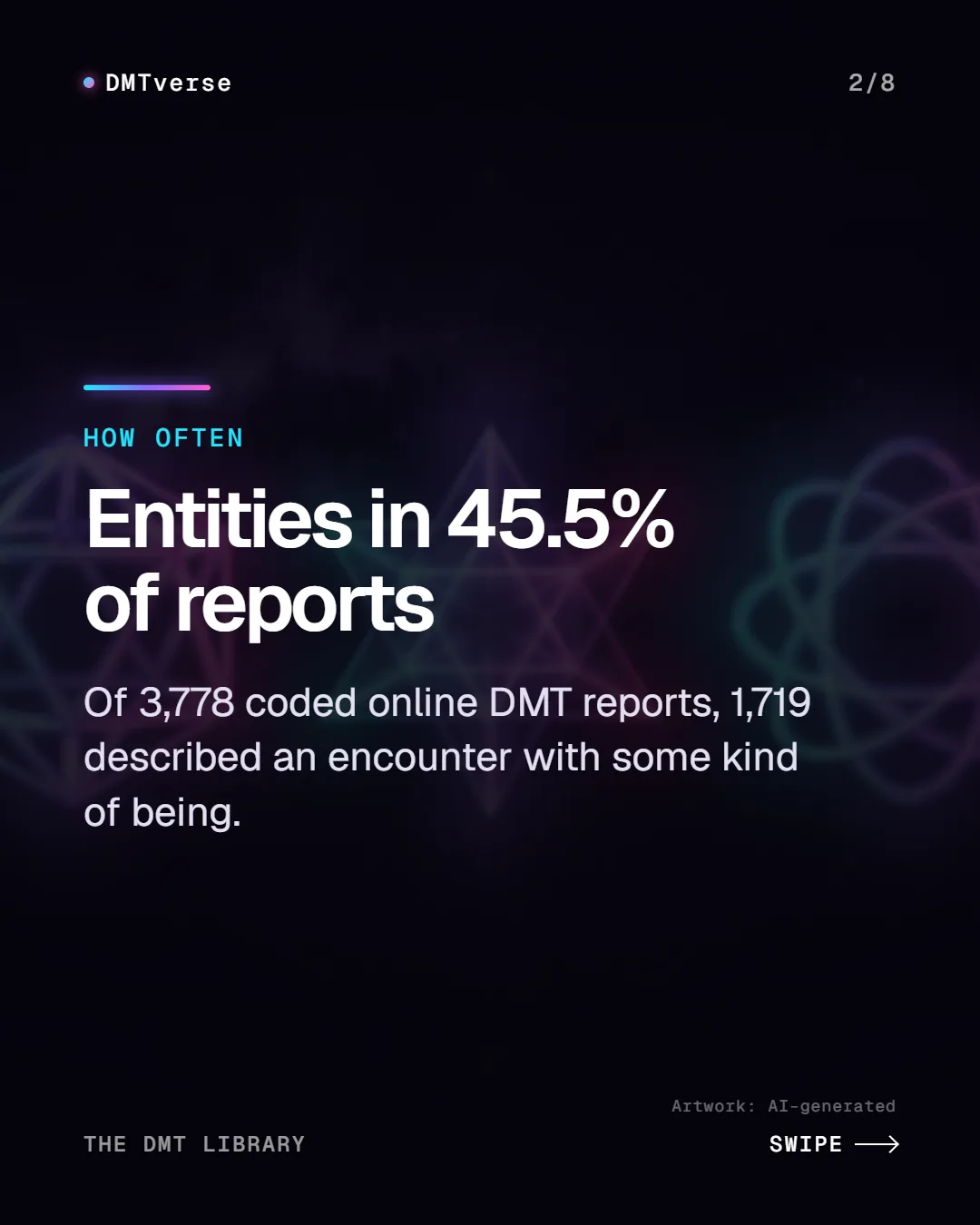
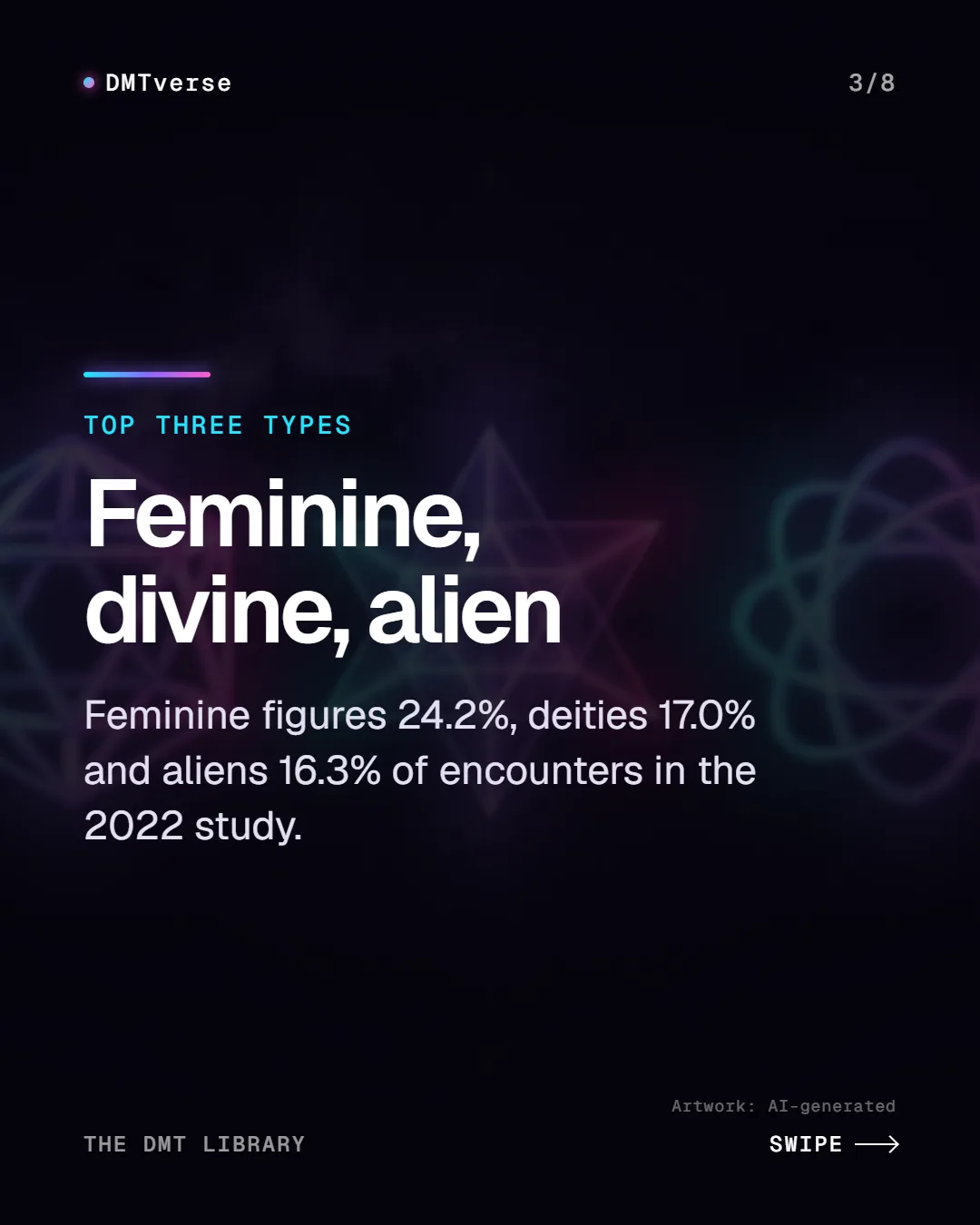
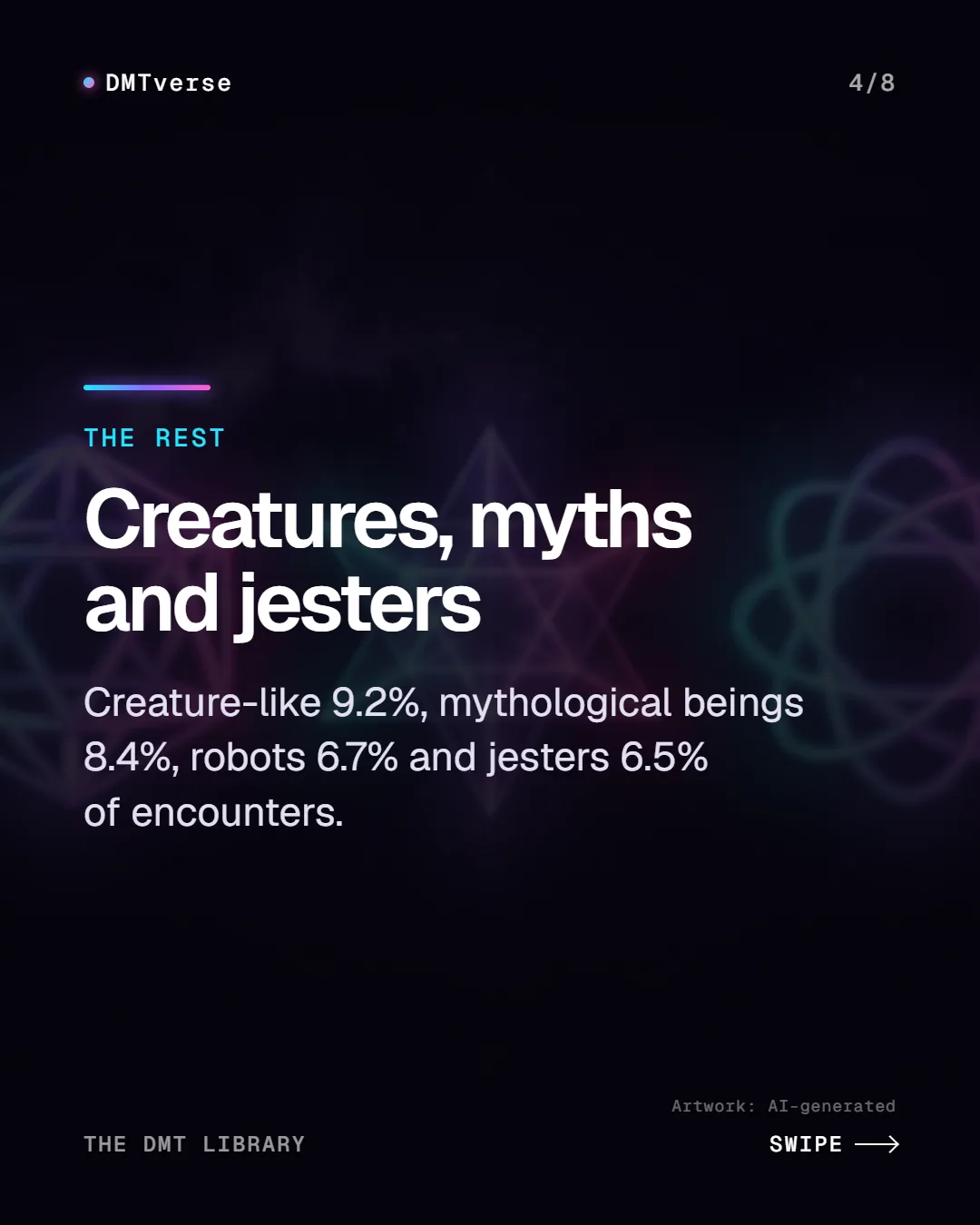
DMT entities are the beings people report meeting during a DMT experience. In the largest coded sample, 3,778 online reports, they appeared in 45.5% of experiences, and the most common types were feminine figures (24.2% of encounters), deities (17.0%) and aliens (16.3%), followed by creature-like beings, mythological beings including elves, robots and jesters. Survey and interview studies give different figures because they ask differently, and content follows culture. Science has several partial explanations, from felt-presence illusions to theories of how the brain attributes agency. None has been tested with DMT, and no study shows what the beings are.
THE SHORT VERSION · SWIPE
On this page 7 sections
People who report meeting beings on DMT rarely describe the same one. Some meet a mother figure, some a god, some a crowd of jesters, insects or light-beings. This field guide sorts the reported DMT entities by type, gives the best figures for how often each turns up, explains why those figures depend on who is asked and how, and sets out the main explanations side by side. It builds on our overview of DMT entity encounters and our pillar, what is DMT.
Field guide to reports, not to reality
Everything below describes what people report. It takes no position on whether the beings exist outside the experience: the studies cited do not test that, and neither do we. This article gives no amounts, methods or advice, and it does not describe any effect as a benefit. DMT is a controlled substance in Canada. Evidence labels: established (shown in peer-reviewed studies and not seriously disputed), preliminary (early, small, self-selected or indirect) and unresolved (an open question).
What counts as a DMT entity?
Researchers use “entity” or “presence” for anything a person experiences as a separate someone with a mind of its own. That can be a fully seen figure who speaks, or a presence that is only felt. In a 2026 lab study in which 23 people were interviewed in fine detail after DMT given during brain scanning, presences featured in 17 interviews. Some were seen, heard or felt on the body; others were sensed through feeling alone, with no sight or sound, a category found in 26% of interviews (Sanders et al., 2026). Evidence: preliminary.
Across the coded online reports, the person almost always described the entity as making first contact (97.8% of encounters), and some communication occurred in 74.4%, most often one-way from entity to person (48.0%) (Lawrence et al., 2022). These are features of the accounts, not facts about who started anything. Evidence: preliminary (reports).
Bodily effects first
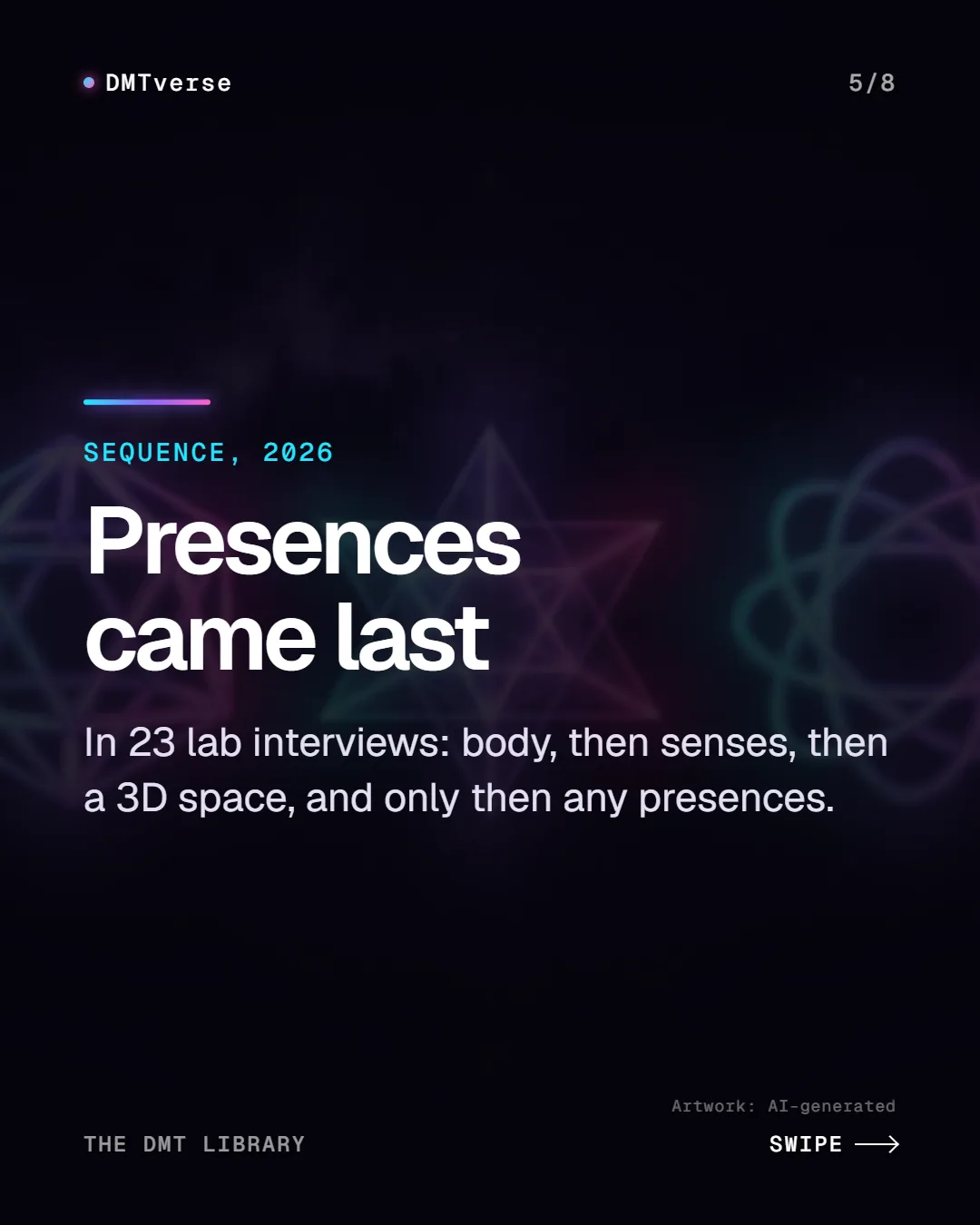
Bodily sensations typically came before anything seen or heard.
Vision and sound
Visual and auditory effects followed, often blending together.
A three-dimensional world
A sense of a 3D space or landscape formed from the multisensory field.
Someone in the space
Perceived presences emerged only after that space had developed; for 82% of those who met presences, the beings inhabited a perceived landscape.
From [Sanders et al., 2026](https://doi.org/10.1093/nc/niag015), 23 participants. A typical order, not every person’s.
The field guide: the main reported types of DMT entities
The most detailed breakdown comes from a team led by David Lawrence of the University of Toronto, who coded all DMT experiences posted to one online forum from 2009 to 2018: 3,778 experiences, 1,719 of them with an entity (Lawrence et al., 2022). Percentages below are of those 1,719 encounters; one encounter can include several types. Evidence: preliminary, from self-selected public posts.
| Type | Share of encounters | What it includes in the reports |
|---|---|---|
| Feminine figures | 24.2% | A goddess or feminine deity (2.5%); Gaia, Mother Ayahuasca or Mother Nature (2.0%); an unspecified female entity or feminine presence (19.7%). |
| Deities and divine beings | 17.0% | Most often the Devil, Satan, demons or death-type figures (3.2%), then “God” (2.8%); also Hindu, Buddhist and ancient Egyptian deities, angels, Jesus or Mary Magdalene. |
| Aliens and celestial beings | 16.3% | Beings of light or energy and jewelled beings (4.2%); geometric, fractal or hyperdimensional entities (3.5%); grey aliens (1.0%). |
| Creature-like beings | 9.2% | Reptilian or serpent-like (3.0%); tentacled, octopus- or jellyfish-like (2.4%); insect, mantis or spider-like (2.3%); feline (1.5%). |
| Mythological beings | 8.4% | Machine elves (2.9%); other elves (1.7%); faeries, sprites and wisps (1.2%); giants, trolls, gnomes, imps or goblins (0.8%); dragons (0.6%). |
| Robots or machine entities | 6.7% | Robot or machine beings, counted separately from machine elves. |
| Jesters, jokers or clowns | 6.5% | A jester, joker or clown figure. |
| Culture-specific entities | 4.4% | Most often ancient Egyptian (1.9%) or Indigenous Meso- or South American figures (1.5%). |
How those beings behave matters as much as what they look like. Interactions were coded as positive (benevolent, comforting, protecting or caring) in 34.9% of encounters, and as a guide, teacher or companion role in 32.4%. A negative or difficult interaction appeared in 11.4%, most often a menacing or threatening being (5.4%). A “medical” scene, an entity examining or scanning the person, appeared in 9.0% (Lawrence et al., 2022). Evidence: preliminary (reports).
The famous elves are a small slice. For the history of that label and why it may shape reports, see machine elves: where the phrase came from.
Why do studies give different figures for DMT entities?
Because they sample different people and ask in different ways. The share of experiences with any entity was 45.5% in the forum reports (Lawrence et al., 2022), 94% in a home field study of 36 experienced users interviewed immediately afterwards (Michael et al., 2021), 17 of 23 interviews in the lab (Sanders et al., 2026), and effectively 100% in a 2020 survey that recruited only people who had had an encounter (Davis et al., 2020). None of these is a population rate. Evidence: preliminary.
Labels move too. In the 2020 survey of 2,561 people, who chose from ready-made labels, the most common were guide (43%), alien (39%), spirit (39%) and helper (34%), then angel (16%), elf (14%), religious figure (11%), plant spirit (10%), faerie (8%), chemical spirit (8%), animal spirit (7%), clown (6%) and demon (6%), as summarised by the 2021 field study (Michael et al., 2021; Davis et al., 2020). Evidence: preliminary.
In the field study’s free-form interviews, helping roles were common (53%) and menacing beings rare (8%), while elf- or faerie-looking beings were only 3% and clown-like characters 11%. The authors stress that the survey used mostly fixed, pre-set answers while their participants used their own words (Michael et al., 2021). A ready-made list makes some labels easier to pick. Evidence: preliminary.
Does ritual and culture shape which entities appear?
The best evidence is ethnographic, and it comes from ayahuasca rather than pure DMT. The anthropologist David Dupuis spent 18 months between 2008 and 2013 at Takiwasi, a ceremonial centre in the Peruvian Amazon whose rituals draw on Catholic as well as Amazonian traditions. Foreign participants frequently reported “demons”, often fighting protective spirits of nature or Christian figures. Dupuis found that recognising a demon often rested less on any particular image than on the fear or disgust that came with it, and that the next day’s group discussions taught people how to name what they had seen. He argues that cultural background and social interaction shape not just how people interpret visions but what the visions contain (Dupuis, 2022). Evidence: preliminary, from one centre.
That was ayahuasca at one centre, with its own Catholic and Amazonian imagery. It shows how a setting can steer content; it does not tell us how often demons appear with DMT elsewhere.
A 2026 theory paper on entity encounters makes the same point across substances: depending on the cultural milieu, entities appear as spirits, elves, ancestors or fragments of the self. It cites a study in which almost half of white Westerners who took ibogaine reported television screens, a feature rare in traditional African accounts, which centre on ancestors (Mago et al., 2026). The forum study’s authors likewise suspect that earlier posts shape later reports (Lawrence et al., 2022). No controlled DMT study has yet varied what people are told beforehand and measured who they meet. Evidence: preliminary for culture shaping content; unresolved for DMT specifically.
What could explain DMT entities? The main hypotheses
Several lines of research explain parts of the picture. None explains all of it, and none has been tested with DMT. They are set out here as hypotheses, with what each can and cannot account for.
1. The felt presence: the brain misplacing its own body
In 2006, doctors stimulating one spot of the brain, the left temporoparietal junction, in a patient being assessed for epilepsy surgery repeatedly produced the feeling of a person close behind her, a “shadow” that copied her posture (Arzy et al., 2006). In 2014, a team mapped brain lesions in patients who felt such presences and then built a robot that delayed the touch of a person’s own movement on their back; the mismatch made healthy volunteers feel someone nearby. The authors concluded the illusion comes from misattributing signals from one’s own body (Blanke et al., 2014). Evidence: preliminary.
Pooling 25 of the same lab’s experiments with 561 people, the robot effect was reliable and medium-sized, and stronger in people with schizotypal traits, a personality style marked by unusual perceptions and beliefs (Dhanis et al., 2026). Evidence: established within this one research group.
Felt presences are also common in illness. In 216 people with Parkinson’s disease, “minor” hallucinations, including a sense of a presence, affected 25.5% (Fénelon et al., 2000). In a sample of 40 people with first-episode psychosis, 21 reported a felt presence (Alderson-Day et al., 2025). What this explains: a vivid sense of someone there, from a disturbance of self-processing. What it does not: the seen, speaking, teaching beings in rich worlds that DMT reports describe.
2. Charles Bonnet figures: a visual brain making people
In Charles Bonnet syndrome, people with failing eyesight but no mental illness see complex hallucinations. Of 505 visually impaired patients screened in a 1996 study, 60 met the criteria. All 60 knew their hallucinations were not real, and for 77% the hallucinations had no personal meaning (Teunisse et al., 1996). Brain scans of such patients found that hallucinated colours, faces, textures and objects matched activity in the specialised visual areas that normally process those features (ffytche et al., 1998). Evidence: established that a deprived visual brain can generate figures. What it does not explain: DMT reports usually describe beings as meaningful, communicative and real, the opposite of these patients’ experience.
3. Expectation and culture
Expectation can bias perception. In a preregistered study, people led to expect more voices in noise reported more voices, especially when the sound was unclear (Szymanek et al., 2024). Culture affects even involuntary experiences: in general-population samples, 25% of people in Denmark and 44% in Egypt reported at least one episode of sleep paralysis, an experience often accompanied by a sense of an intruder, and Egyptian experiencers had episodes more often and feared them more (Jalal and Hinton, 2013). Evidence: preliminary as an explanation of DMT entities, which no one has tested this way.
4. “Computational spirits”: losing the I-made-this stamp
A 2026 paper by researchers including Christopher Timmermann and David Dupuis proposes that psychedelics make the brain’s own sensations less predictable, which inclines it to infer that they come from someone else, a non-self agent. The model aims to explain both how varied entities are across cultures and why they are similar (Mago et al., 2026). Its authors acknowledge a puzzle: 5-MeO-DMT, a close chemical relative, more often produces non-dual or ego-dissolving states than autonomous entities. Evidence: unresolved; a theory with testable predictions, not yet tested. See also 5-MeO-DMT vs DMT and DMT and ego death.
5. The realist proposal
Some researchers take seriously the possibility that the beings are more than hallucinations. A 2026 preprint by Andrew Gallimore and colleagues, built on a philosophical framework in which reality consists of interacting conscious agents, says it does not assert that DMT entities are real but derives testable predictions and proposes experiments that could distinguish internally generated hallucinations from contact with something else (Gallimore et al., 2026, preprint). It is not peer reviewed, and we found no published result from such a test. Evidence: unresolved.
| Hypothesis | Best evidence | Explains | Leaves out |
|---|---|---|---|
| Felt presence | Case report; robot experiments, 561 people pooled | A sensed someone nearby | Seen, talking, teaching beings |
| Charles Bonnet figures | 60 patients; brain scans | The visual brain generating figures | Meaning, communication, conviction |
| Expectation and culture | Lab detection studies; ethnography; sleep paralysis surveys | Why content varies by setting | Why the structure is so consistent |
| Computational spirits | Theory paper | Why one’s own experience feels like another mind | Untested; 5-MeO-DMT contrast |
| Realist tests | Preprint | Proposes how to tell the options apart | No results; not peer reviewed |
What we still don’t know about DMT entities
- What the entities are. No study has tested whether they exist outside the experience (unresolved).
- How common each type is among everyone who uses DMT, rather than among self-selected posters, survey takers or experienced volunteers (unresolved).
- Whether being told about entities beforehand changes who appears. No controlled DMT study has tested it (unresolved).
- Whether felt-presence mechanisms, visual-cortex mechanisms or agency attribution are actually engaged during DMT entity encounters. None has been measured together with DMT (unresolved).
- Why the order in which a DMT world assembles is so consistent while its inhabitants vary so much (preliminary observation, unexplained).
Difficult encounters are part of the record: about one in nine coded encounters involved a negative interaction, and fear was reported by 41% of the 2020 survey. If an experience has left someone distressed, our guide to how to help someone having a bad trip explains what supporters can do. For why these encounters feel so convincing, read why DMT feels more real than reality.
Common questions
What are the most common DMT entities?
In 1,719 coded encounters from online reports, the most common were feminine figures (24.2%), deities (17.0%) and aliens (16.3%), followed by creature-like beings (9.2%), mythological beings including elves (8.4%), robots or machines (6.7%) and jesters (6.5%).
Does everyone meet entities on DMT?
No. Entities appeared in 45.5% of 3,778 online reports, 17 of 23 lab interviews and 94% of 36 field interviews with experienced users. All are self-selected or small samples, so none is a true rate.
Are DMT entities usually friendly?
Mostly, in the reports. Interactions were positive in 34.9% of coded encounters and negative in 11.4%. In a 2020 survey most respondents called the entity benevolent, yet 41% reported fear during the encounter.
Why do people at some ceremonies see demons?
An ethnographic study at a Catholic-inflected ayahuasca centre in Peru found participants often reported demons, and argued that ritual, shared stories and group discussion shape what people see. That was ayahuasca at one centre, not DMT in general.
Is a DMT entity the same as a felt presence?
Not exactly. A felt presence, the sense that someone is nearby, can be produced by brain stimulation or a robot that creates a mismatch in bodily signals, and is common in Parkinson’s disease. DMT entities are often seen, heard and interactive, which those findings do not explain.
Are DMT entities real?
Science has not answered this. Studies record reports; several hypotheses explain parts of the experience; a realist preprint proposes tests. No published experiment has tested whether the beings exist independently.
What is the DMT jester?
A jester, joker or clown figure that some people describe meeting on DMT. In 1,719 entity encounters coded from online reports, jesters made up 6.5%, behind feminine figures, deities, aliens, creature-like beings, mythological beings and robots. Research records how people describe these figures; it cannot say what they are.
Shroomverse sells mushroom products. This article is general information about published research on the beings people report during DMT experiences. It is not medical, legal or purchasing advice, and it does not recommend any product.
SOURCES
- Phenomenology and content of the inhaled N,N-dimethyltryptamine (N,N-DMT) experience (Lawrence DW, Carhart-Harris R, Griffiths R, Timmermann C, Scientific Reports 12:8562, 2022), Springer Nature (peer-reviewed, open access); full text via Europe PMC, PMC9130218. Accessed . Full text read. Supports the 3,778 experiences and 1,719 encounters (45.5%); every type and sub-type percentage in the field-guide table; entity-initiated contact 97.8%; communication 74.4%, one-way 48.0%; positive 34.9%, guide-type 32.4%, negative 11.4%, menacing 5.4%, medical-type 9.0%; the earlier-posts limitation. Study dose figures deliberately not reproduced.
- Survey of entity encounter experiences occasioned by inhaled N,N-dimethyltryptamine: Phenomenology, interpretation, and enduring effects (Davis AK, Clifton JM, Weaver EG, Hurwitz ES, Johnson MW, Griffiths RR, Journal of Psychopharmacology 34(9):1008–1020, 2020), SAGE (peer-reviewed). Accessed . Abstract read via Europe PMC (full text not open to us today). Supports 2,561 respondents, most memorable encounter, 41% fear, benevolent and conscious attributes. Label percentages (guide 43%, alien 39%, spirit 39%, helper 34%, angel 16%, elf 14%, etc.) are as reported in Michael et al. 2021.
- An Encounter With the Other: A Thematic and Content Analysis of DMT Experiences From a Naturalistic Field Study (Michael P, Luke D, Robinson O, Frontiers in Psychology 12:720717, 2021), Frontiers (peer-reviewed, open access); full text via Europe PMC, PMC8716686. Accessed . Full text read. Supports 36 interviews immediately after home sessions; beings in 94%; helping roles 53%, menacing 8%, clown-like 11%, elf or faerie looks 3%; the summary of Davis et al. 2020 label percentages; fixed-choice versus free description. Study dose range deliberately not reproduced.
- Micro-phenomenology of immersion and perceived presences under DMT (Sanders JW, Millière R, Demšar E, Daily ZG, Erritzoe D, Carhart-Harris R, Timmermann C, Neuroscience of Consciousness, niag015, 2026), Oxford University Press (peer-reviewed, open access); full text via Europe PMC, PMC13366535. Accessed . Abstract and full text read. Supports 23 participants; presences in 17 interviews; felt presence through feeling alone in 26% of interviews; 82% of those meeting presences placed them in a landscape; the body, senses, space, presences sequence. Study dose deliberately not reproduced.
- The socialization of hallucinations: Cultural priors, social interactions, and contextual factors in the use of psychedelics (Dupuis D, Transcultural Psychiatry 59(5):625–637, 2022), SAGE (peer-reviewed, open access); full text via Europe PMC, PMC9660275. Accessed . Full text read. Supports 18 months of fieldwork 2008–2013 at Takiwasi, Peru; frequent demon reports among seminar participants; recognition carried by fear or disgust; group discussions; the argument that culture shapes content. Ayahuasca, one centre.
- Computational spirits: a neuroscientific account of psychedelic entity encounters (Mago J, Deane G, Sandved-Smith L, Safron A, Timmermann C, Ramstead M, Dupuis D, Carhart-Harris R, Greenway KT, Lifshitz M, Neuroscience of Consciousness 2026(1):niaf069), Oxford University Press (peer-reviewed, open access); full text via Europe PMC, PMC13240852. Accessed . Abstract and full text read. Supports the active-inference model (reduced predictability inclining attribution to non-self agents), culturally varying entity forms, the cited ibogaine television-screen finding (Heink et al. 2017), and the 5-MeO-DMT contrast. A theory paper.
- Induction of an illusory shadow person (Arzy S, Seeck M, Ortigue S, Spinelli L, Blanke O, Nature 443:287, 2006), Springer Nature (peer-reviewed). Accessed . Abstract read via Europe PMC. Single patient in presurgical epilepsy evaluation; stimulation of the left temporoparietal junction produced a felt person shadowing her posture.
- Neurological and robot-controlled induction of an apparition (Blanke O, et al., Current Biology 24(22):2681–2686, 2014), Cell Press (peer-reviewed). Accessed . Abstract read via Europe PMC. Lesion analysis in patients; robotic sensorimotor conflict induced a feeling of presence in healthy participants; attributed to misperceiving one’s own bodily signals.
- Presence hallucination induction through robotically mediated somatomotor conflicts: A pooled analysis of 25 experiments (Dhanis H, Potheegadoo J, Faivre N, Hara M, Bernasconi F, Blanke O, Cortex 199:202–220, 2026), Elsevier (peer-reviewed). Accessed . Abstract read via Europe PMC. 25 in-house experiments, 561 individuals; reliable, medium effect; greater sensitivity with schizotypal traits. All from one research group.
- Hallucinations in Parkinson’s disease: prevalence, phenomenology and risk factors (Fénelon G, Mahieux F, Huon R, Ziégler M, Brain 123(4):733–745, 2000), Oxford University Press (peer-reviewed). Accessed . Abstract read via Europe PMC. 216 consecutive patients; minor hallucinations, including a sensation of a presence, in 25.5%.
- Experiences of felt presence in first episode psychosis (Alderson-Day B, Moseley P, Woods A, Dodgson G, Common S, Fernyhough C, Schizophrenia 11:143, 2025), Springer Nature (peer-reviewed, open access); full text via Europe PMC, PMC12657941. Accessed . Abstract and full text read. Felt presence in 21 of 40 participants (comparison table: felt presence n = 21, none n = 19).
- Visual hallucinations in psychologically normal people: Charles Bonnet’s syndrome (Teunisse RJ, Cruysberg JR, Hoefnagels WH, Verbeek AL, Zitman FG, Lancet 347(9004):794–797, 1996), Elsevier (peer-reviewed). Accessed . Abstract read via Europe PMC. 505 visually impaired patients screened, 60 with the syndrome; all had full insight; hallucinations lacked personal meaning for 46 (77%).
- The anatomy of conscious vision: an fMRI study of visual hallucinations (ffytche DH, et al., Nature Neuroscience 1(8):738–742, 1998), Springer Nature (peer-reviewed). Accessed . Abstract read via Europe PMC. In Charles Bonnet patients, hallucinations of colour, faces, textures and objects correlated with ventral extrastriate activity matching each region’s specialisation.
- Effects of expectations and sensory unreliability on voice detection – A preregistered study (Szymanek P, Homan M, van Elk M, Hohol M, Consciousness and Cognition 123:103718, 2024), Elsevier (peer-reviewed). Accessed . Abstract read via Europe PMC. Expectations shifted voice detection, especially with noisy input. Not a DMT study.
- Rates and characteristics of sleep paralysis in the general population of Denmark and Egypt (Jalal B, Hinton DE, Culture, Medicine and Psychiatry 37(3):534–548, 2013), Springer (peer-reviewed). Accessed . Abstract read via Europe PMC. Lifetime sleep paralysis 25% (56/223) in Denmark vs 44% (207/470) in Egypt; more frequent episodes and greater fear in Egypt.
- Traces of the Other – Are DMT Entities Real? DMT Phenomenology in the Framework of Conscious Realism (Gallimore AR, Hermansson N, Hoffman DD, 2026), PsyArXiv preprint (not peer reviewed). Accessed . Preprint record, author list and abstract read through the OSF API. Supports the conscious-realism framework and that the authors, rather than asserting the reality of entities, derive testable predictions and propose experiments. Not peer reviewed.
CHANGES
- : Added an FAQ on the DMT jester (search demand), from the article's existing coded-report figures.
- : Linked glossary definitions.
- : Published. Sources opened and checked on this date.
- : Editorial review: summary now opens with a direct definition and names robots (6.7%) alongside jesters; unsupported description of jesters removed from the field-guide table; long paragraphs split; schizotypal defined; Dupuis finding scoped to its setting; link to the ego-death article added.



