
THE SHROOMVERSE JOURNAL ✳ 11 MIN READ
Does DMT change you? What studies of lasting effects measured, and how much they can tell us
Topic: DMT
Published Updated
Short answer, checked 20 October 2026
Studies report that some people describe lasting changes after DMT or ayahuasca, but the strength of that evidence depends on design. Surveys that ask people to look back report large shifts in belief; studies that measure before and after find smaller ones. Controlled trials have measured short-term changes in mood scores, and a minority of people report lasting difficulties.
THE SHORT VERSION · SWIPE
On this page 8 sections
“It changed me” is one of the most common things people say about DMT. This article does not try to say whether that is good or bad. It sets out what researchers actually measured, how they measured it, and what each design can and cannot show. Each factual paragraph ends with an evidence label.
Education only, not guidance
This article describes published research. It gives no amounts, no instructions and no advice on use, and it does not describe any effect as a benefit. DMT is a controlled substance in Canada. In an emergency, call 911. Evidence labels: established (shown in peer-reviewed studies and not seriously disputed), preliminary (early, small, self-selected or indirect) and unresolved (an open question).
Does DMT change you, according to research?
Researchers have looked for lasting change in four places: beliefs about the world, personality traits, mental health scores, and lasting difficulties. Most studies are of inhaled or injected DMT, or of ayahuasca, the Amazonian brew that contains DMT. They range from online surveys of self-selected people to small placebo-controlled trials. No single study answers the question for everyone. Evidence: established that change is reported; how much, in whom and why is unresolved.
| Study | Design | Who | What was measured |
|---|---|---|---|
| Davis et al., 2020 | Retrospective online survey | 2,561 self-selected people, inhaled DMT | Beliefs, meaning and life satisfaction attributed to one encounter |
| Timmermann et al., 2021 | Prospective online survey plus a trial analysis | 866 respondents attending psychedelic ceremonies | Metaphysical beliefs before and after |
| Nayak et al., 2025 | Prospective survey | 657 people planning to use psilocybin | Atheist–believer status, metaphysical beliefs |
| Timmermann et al., 2024 | Placebo-controlled sample plus a before–after sample | 13 and 17 healthy volunteers, IV DMT | Depression, anxiety, neuroticism, wellbeing |
| Erritzoe et al., 2026 | Double-blind RCT, then open-label | 34 adults with major depression, IV DMT | Depression rating (MADRS) at 2 weeks |
| Bouso et al., 2012 | Users vs controls, followed 1 year | 127 church ayahuasca users, 115 controls | Personality, psychopathology, cognition |
| Pagni et al., 2026 | Prospective, no control group described | 66 first-time ayahuasca ceremony attendees | Mental health, personality, spirituality to 12 months |
Why does it matter how a study asks?
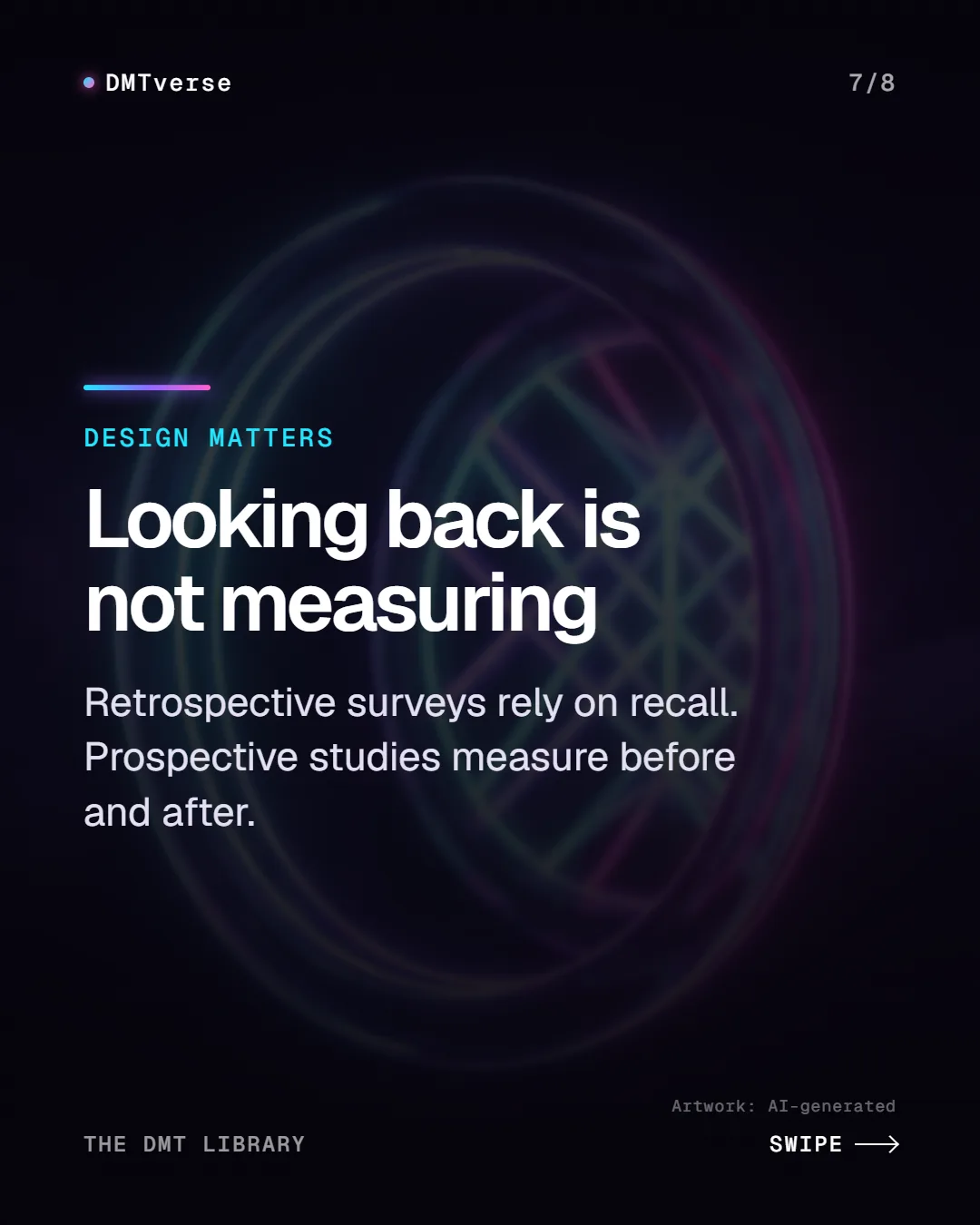
A retrospective study asks people after the event to describe both what they are like now and what they were like before. A prospective study measures people before the event and again afterwards. The difference matters because memory of a past self is reconstructed, and people who chose to answer a survey about a memorable experience may differ from those who did not. Prospective designs remove the recall problem but still lack a control group unless one is built in. Evidence: established as a general principle of study design.
- Retrospective survey: one questionnaire, after the fact. Shows what people believe changed. Cannot separate change from recall.
- Prospective survey: questionnaires before and after. Measures change directly, but people who drop out may differ from those who stay.
- Controlled trial: before and after, compared with a placebo or other group. The strongest design, but usually small, short and in screened volunteers.
Does DMT change what people believe?
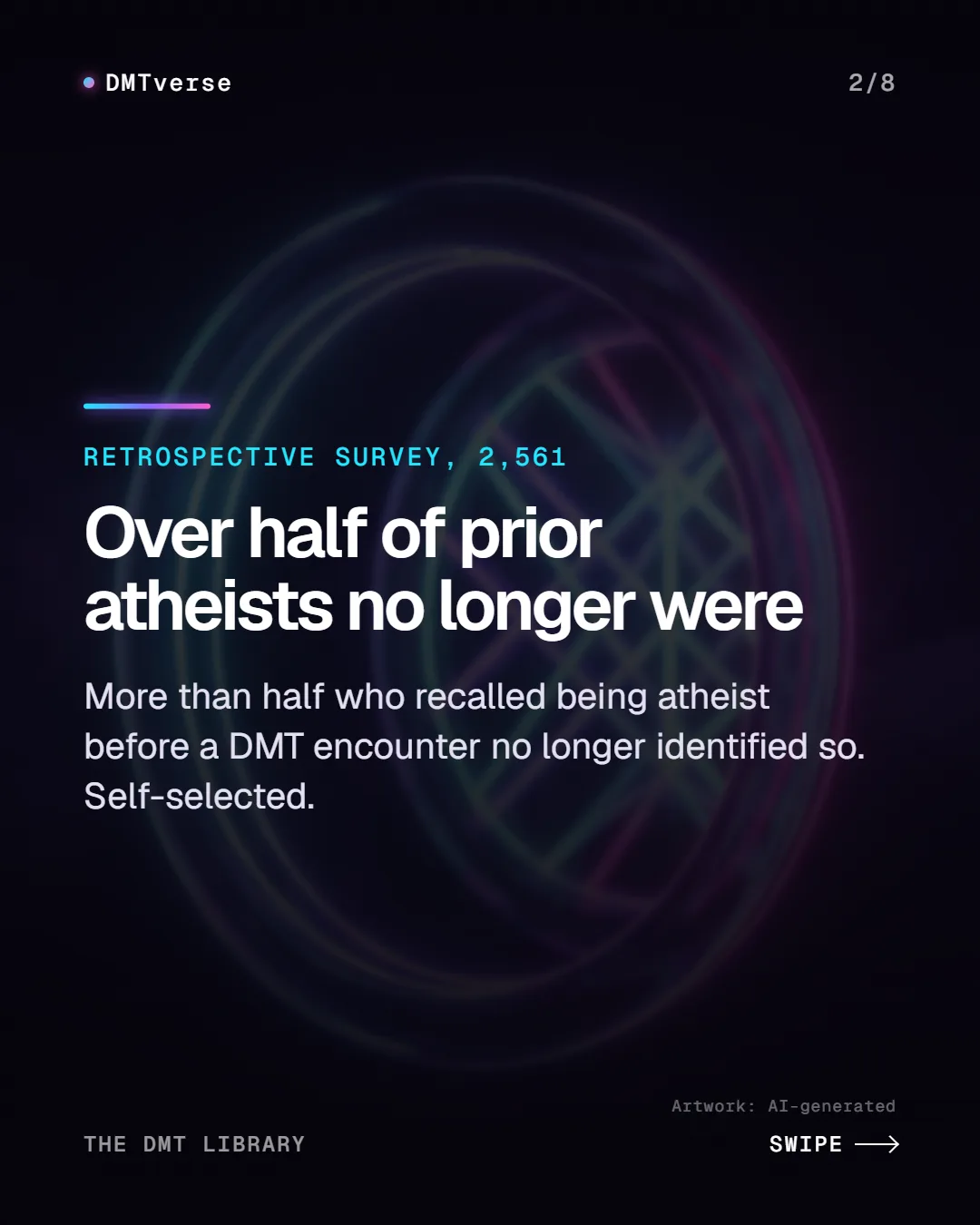
The best-known DMT finding is retrospective. In 2020, 2,561 people completed an online survey about their single most memorable entity encounter after inhaled DMT. More than half of those who said they had identified as atheist before the experience no longer did afterwards. Respondents rated it among their most meaningful lifetime experiences and attributed lasting changes in life satisfaction, purpose and meaning to it (Davis et al., 2020). Evidence: preliminary. We read the abstract only.
Its limits are built in. The sample selected itself and was 77% male, the encounter was chosen as the most memorable one, and the “before” identity was recalled after the fact (Davis et al., 2020). For more on what people describe during those encounters, see DMT entity encounters: what the research says. Evidence: established that these are design limits.
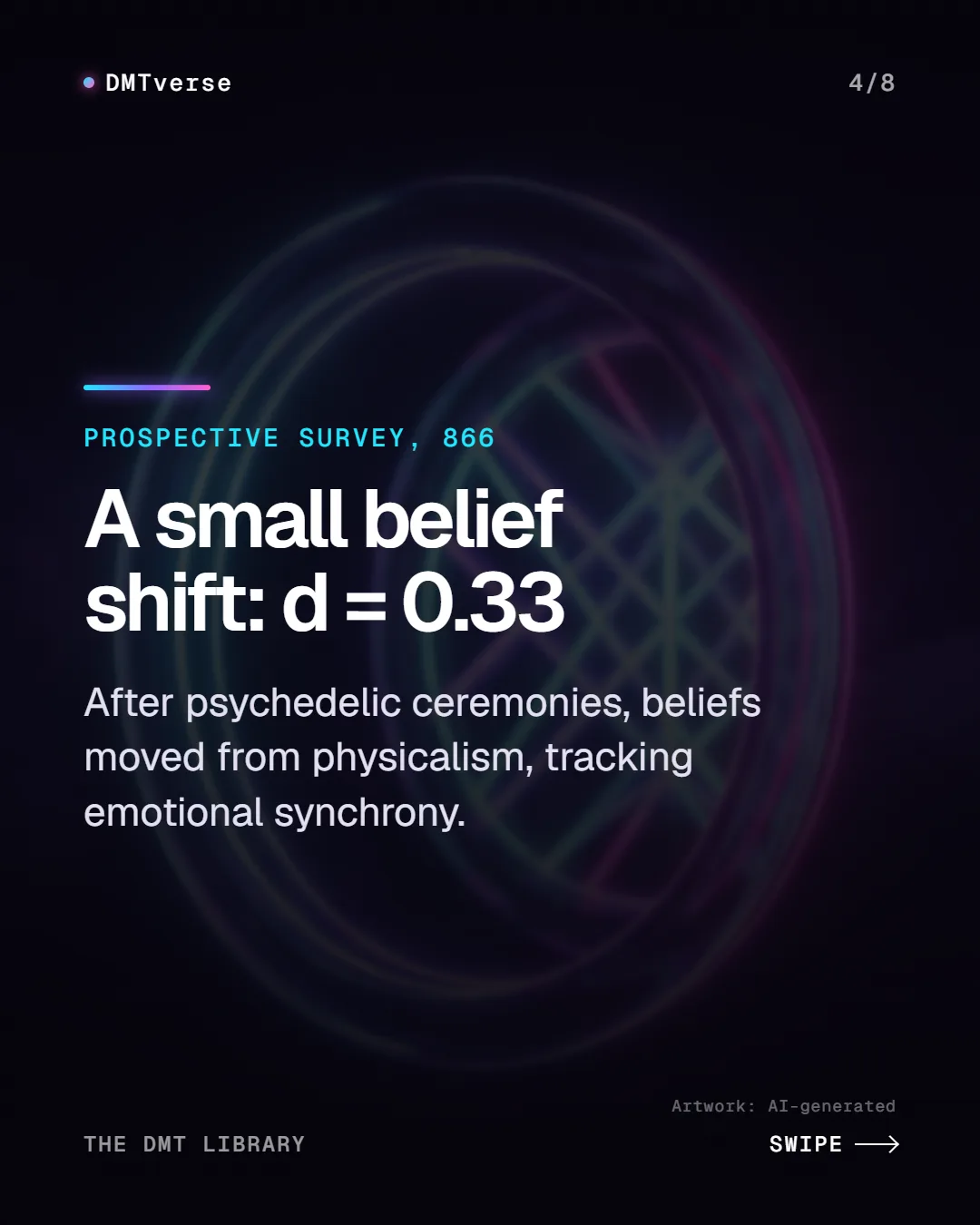
A 2021 study took the prospective route. It recruited people planning to attend a ceremony with a psychedelic, including psilocybin, ayahuasca, DMT, San Pedro or LSD, and measured their metaphysical beliefs before and after; 866 answered at some point. Beliefs shifted away from physicalism (the view that only the physical exists) by a modest amount four weeks after the ceremony (Cohen’s d = 0.33, a small effect) and by d = 0.46 at six months (Timmermann et al., 2021). Evidence: preliminary.
Two details matter. The shift was predicted by how impressionable people were at baseline and mediated by how much emotional synchrony, a felt closeness with others, they reported during the ceremony. And the sample mixed several drugs, so it is not a DMT-specific result. A belief measure added to a separate trial showed a shift after psilocybin but not after the antidepressant escitalopram (Timmermann et al., 2021). Evidence: preliminary.
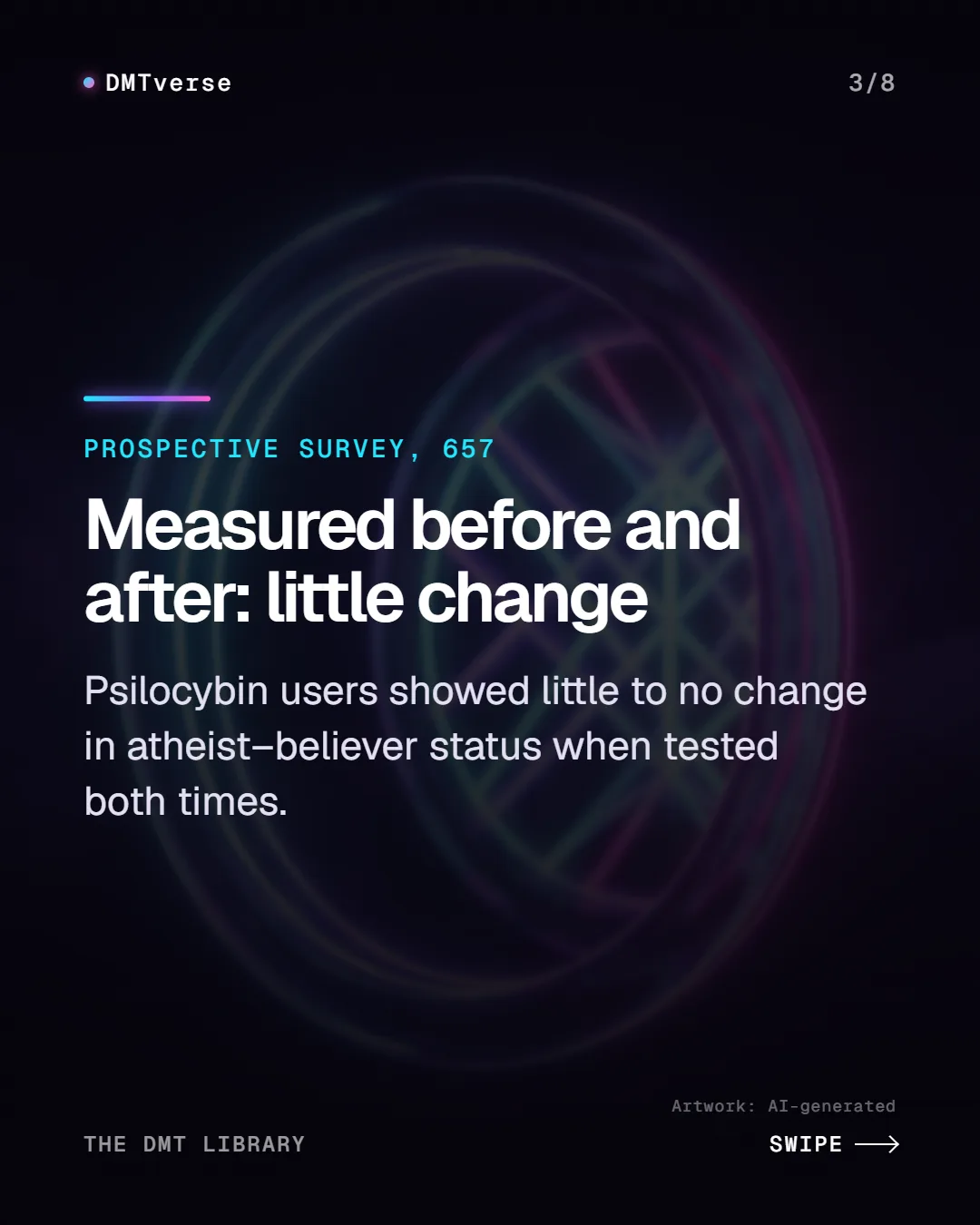
The 2025 prospective study is the sharpest test of the atheist claim. Among 657 people planning a psilocybin experience outside a lab, researchers measured beliefs before and after. They found increases in mind perception, the tendency to attribute minds to things such as plants and rocks, but little to no change in metaphysical beliefs or atheist–believer status (Nayak et al., 2025). It studied psilocybin, not DMT, so it does not settle the DMT question; it shows that the retrospective result shrinks when measured prospectively. Evidence: preliminary.
Does DMT or ayahuasca change personality?
Personality is usually measured with trait questionnaires, such as neuroticism (a tendency toward negative emotion) or self-transcendence (a tendency toward spiritual experience). A Brazilian study compared 127 regular ayahuasca church members with 115 people active in other religions, and followed both groups for a year. Users scored higher on self-transcendence and reward dependence and lower on harm avoidance and self-directedness, and the differences held a year later (Bouso et al., 2012). Evidence: preliminary.
That design compares groups; it cannot show that ayahuasca caused the differences, since people who join an ayahuasca church may already differ. A 2026 cross-sectional study found the same pattern: in 69 regular ayahuasca users against 94 non-users, personality, not cognition, best distinguished the groups. The authors stress their self-selected sample (Bouso et al., 2026). Evidence: preliminary.
Prospective data are scarcer. In 66 people attending neo-shamanic ayahuasca ceremonies for the first time, questionnaires at baseline and up to 12 months showed lower scores on depression, anxiety, stress and negative emotionality, a personality trait. The study, as its abstract describes it, had no control group (Pagni et al., 2026). In a lab study of injected DMT in healthy volunteers, trait neuroticism fell only in the placebo-controlled sample of 13, not in the separate before–after sample of 17 (Timmermann et al., 2024). Evidence: preliminary.
What did clinical trials actually measure?
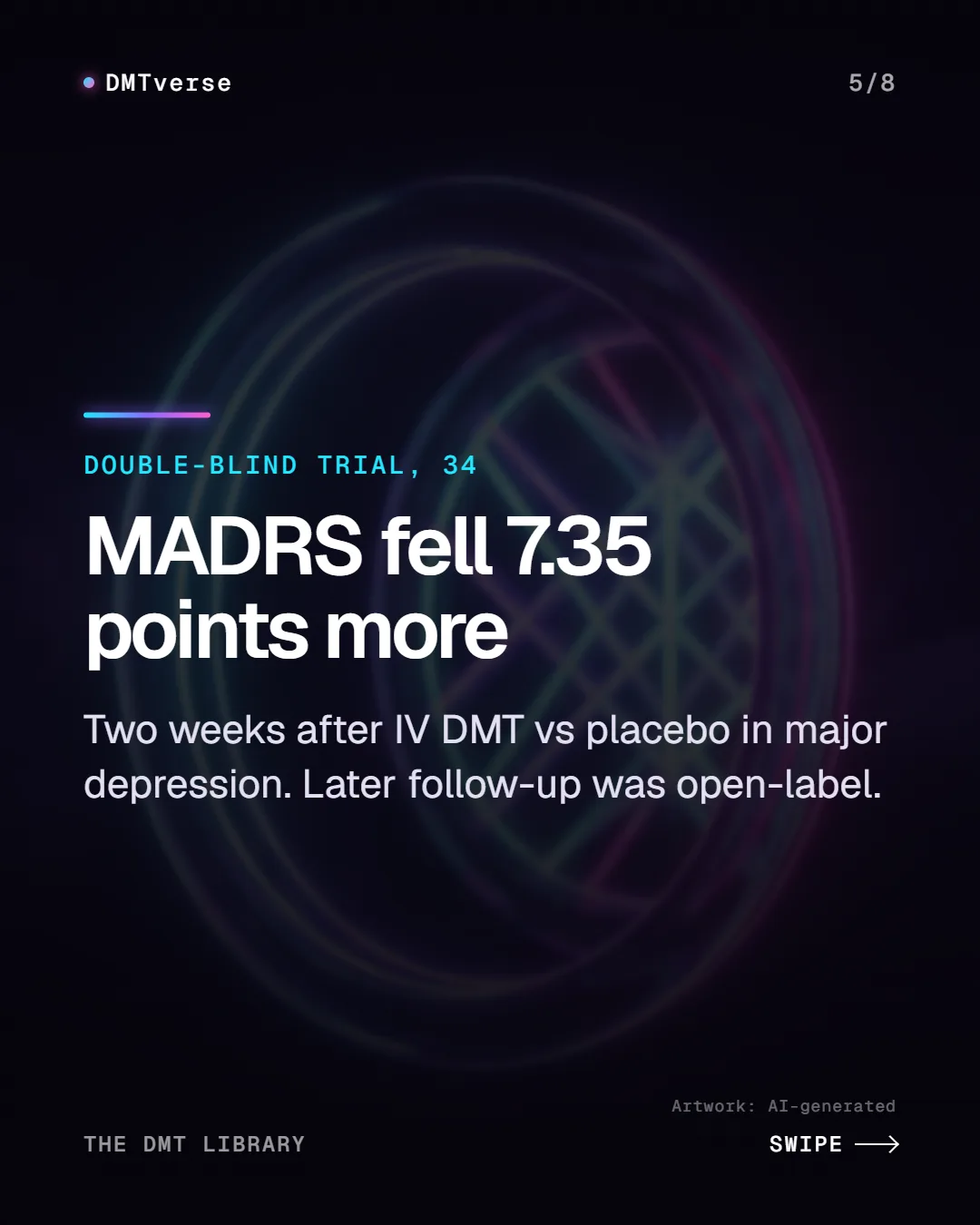
Trials measure symptoms with rating scales, most often the Montgomery–Åsberg Depression Rating Scale (MADRS), a clinician-rated depression score. In a phase IIa double-blind trial, 34 adults with major depression received intravenous DMT or placebo with psychological support. At two weeks, MADRS scores fell 7.35 points more in the DMT group. A later open-label phase, with no placebo group, followed participants to three months (Erritzoe et al., 2026). Evidence: preliminary.
In an ayahuasca trial in 29 people with treatment-resistant depression, MADRS scores were lower than placebo at days 1, 2 and 7 (Palhano-Fontes et al., 2019). Most registered DMT and ayahuasca trials are phase I studies whose primary outcomes are acute safety and physiological monitoring, not lasting change (Stojanović et al., 2026). The details are in DMT therapy research. Evidence: preliminary.
In healthy volunteers, depression scores were lower one to two weeks after injected DMT, and changes in depression and trait anxiety correlated with a measure of peak experience. The authors note that pooling two cohorts limits how far the correlations generalize (Timmermann et al., 2024). A change in a rating scale in a small, screened sample over weeks is not the same as a lasting change in a person. Evidence: preliminary.
Can DMT leave lasting difficulties?
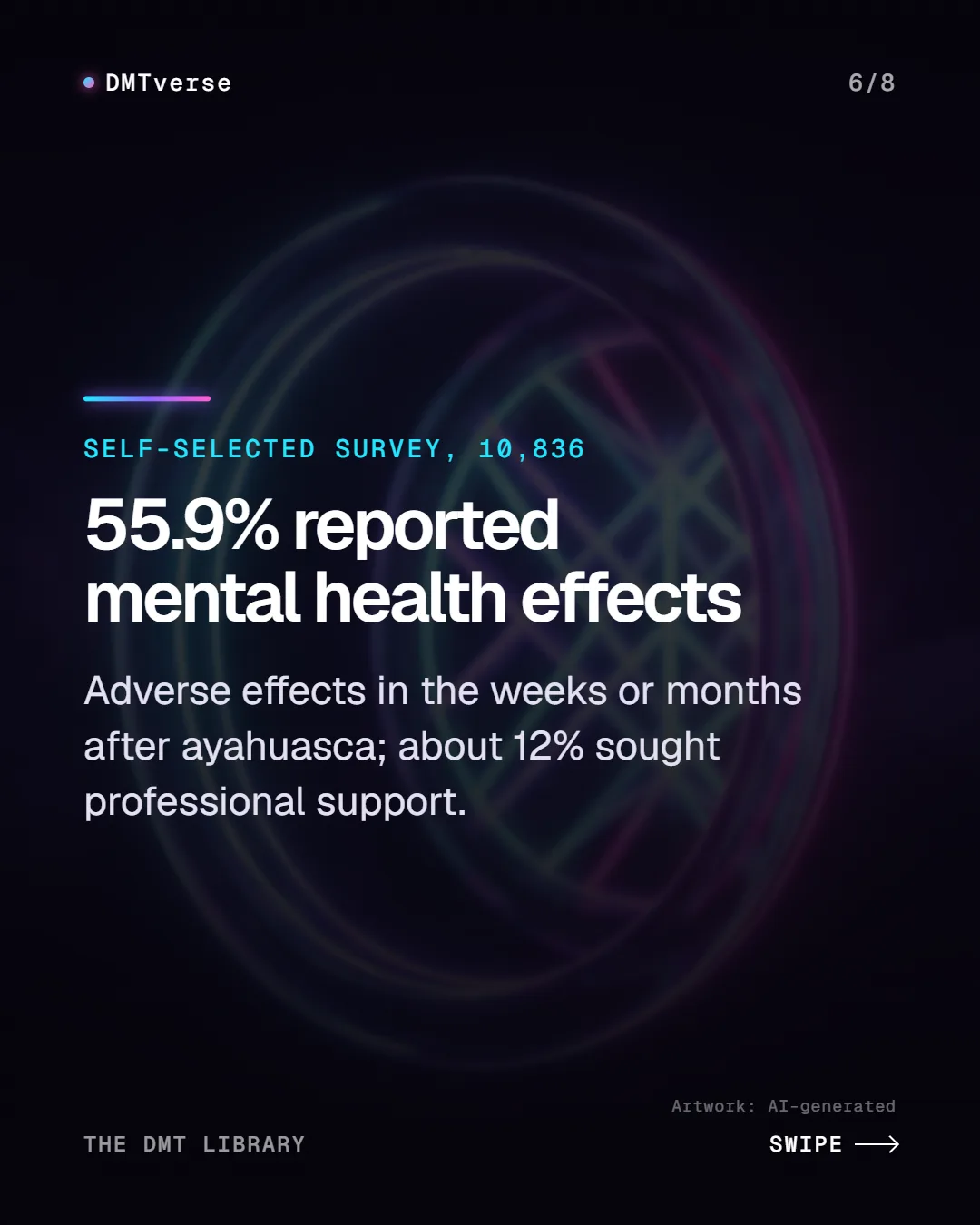
Change is not always welcome. In the 2020 encounter survey, 41% reported fear during the experience (Davis et al., 2020). In the Global Ayahuasca Survey of 10,836 self-selected people, 55.9% reported adverse mental health effects in the weeks or months after drinking, and about 12% sought professional support for them; most respondents described these effects as part of a process of growth or integration (Bouso et al., 2022). Evidence: preliminary.
Depersonalization–derealization disorder is a condition in which the self or the world feels persistently unreal. In an internet survey of 394 adults with chronic symptoms, about half said drug use first triggered them; the two most common triggers were cannabis and hallucinogens, followed by ecstasy. Most had modest use histories before onset. There is no DMT-specific figure (Simeon et al., 2009). For the experience of losing the sense of self during DMT itself, see DMT and ego death. Evidence: preliminary.
If someone is in danger
Call 911 for immediate danger or urgent medical help, including if someone is unconscious, not breathing or having a seizure. In Ontario, the Ontario Poison Centre is at 1-800-268-9017; every province has a poison centre, listed by SickKids (AboutKidsHealth). If you or someone you know is thinking about suicide, call or text 9-8-8, 24 hours a day (Government of Canada). See also our safety page and how to help someone having a bad trip.
What we still don’t know
- Whether belief changes after DMT itself, rather than mixed psychedelics or psilocybin, hold up when measured prospectively.
- Whether personality differences in ayahuasca users come from ayahuasca, from the religious community, or were there before.
- Whether short-term changes in rating scales last beyond the few months any controlled DMT study has followed.
- How often lasting difficulties follow DMT specifically; existing figures come from self-selected surveys or other drugs.
- How much setting, group bonding and expectation shape the changes people report, independently of the drug.
For why the experience itself feels so convincing, read why does DMT feel more real than reality. For the molecule and its biology, start with what is DMT.
Common questions
Does DMT change you permanently?
No study has followed people long enough to say. Retrospective surveys report lasting changes that people attribute to DMT; prospective and controlled studies have measured changes over weeks or months, in small or self-selected samples. Whether any change is permanent is unknown.
Does DMT turn atheists into believers?
A retrospective survey of 2,561 people found that more than half of those who recalled being atheist before their DMT encounter no longer identified as atheist. But a prospective study of 657 people using psilocybin, which measured belief before and after, found little to no change in atheist–believer status. Recall may inflate the effect.
Does ayahuasca change your personality?
Regular ayahuasca church members score differently on some personality traits than comparison groups, but those studies cannot show cause. One prospective study of 66 first-time ceremony attendees found lower negative emotionality over 12 months; no control group is described.
What is the difference between a retrospective and a prospective study?
A retrospective study asks people afterwards what they were like before and what changed. A prospective study measures them before and again after. Prospective designs avoid errors of memory but can lose participants along the way; controlled trials add a comparison group.
What did the DMT depression trial measure?
A phase IIa trial in 34 adults with major depression measured the Montgomery–Åsberg Depression Rating Scale two weeks after intravenous DMT or placebo, with psychological support. Scores fell 7.35 points more with DMT. Follow-up to three months was open-label, without a placebo group.
Can DMT cause lasting problems?
Some people report them. In a large self-selected ayahuasca survey, 55.9% reported adverse mental health effects in the weeks or months afterwards and about 12% sought professional support. Hallucinogens are among the most commonly reported triggers of chronic depersonalization, though no DMT-specific figure exists.
Why do beliefs change after psychedelic ceremonies?
In one prospective study, belief shifts after psychedelic ceremonies were linked to how impressionable people were beforehand and to how much emotional synchrony they felt with others, more than to the drug alone. That study mixed several psychedelics.
Shroomverse sells mushroom products. This article is general information about research on lasting changes after DMT and ayahuasca. It is not medical, legal or purchasing advice, and it does not recommend any product.
SOURCES
- Survey of entity encounter experiences occasioned by inhaled N,N-dimethyltryptamine: Phenomenology, interpretation, and enduring effects (Davis AK, et al., Journal of Psychopharmacology 34(9):1008–1020, 2020), SAGE (peer-reviewed). Accessed . Abstract only (full text not open). Online survey, 2,561 respondents, 77% male, most memorable encounter; 41% fear; more than half of prior atheists no longer identified as atheist; persisting changes in life satisfaction, purpose and meaning attributed to the experience.
- Psychedelics alter metaphysical beliefs (Timmermann C, Kettner H, Letheby C, Roseman L, Rosas FE, Carhart-Harris RL, Scientific Reports 11, 2021), Springer Nature (peer-reviewed, open access); PMC8611059. Accessed . Full text read. Prospective online survey of people attending ceremonies with psilocybin, ayahuasca, DMT, San Pedro or LSD; 866 respondents; shift away from physicalism d = 0.33 at 4 weeks and d = 0.46 at 6 months; moderated by baseline impressionability and mediated by emotional synchrony; psilocybin vs escitalopram trial analysis.
- Psychedelic Experiences Increase Mind Perception but do not Change Atheist-Believer Status: A Prospective Longitudinal Study (Nayak SM, et al., Journal of Psychoactive Drugs 57(3):275–284, 2025), Taylor & Francis (peer-reviewed). Accessed . Abstract read via Europe PMC. Prospective, n = 657 planning psilocybin outside a lab; mind perception increased; little to no change in metaphysical beliefs or atheist–believer status.
- Effects of DMT on mental health outcomes in healthy volunteers (Timmermann C, Zeifman RJ, Erritzoe D, Nutt DJ, Carhart-Harris RL, Scientific Reports 14, 2024), Springer Nature (peer-reviewed, open access); PMC10850177. Accessed . Abstract read via Europe PMC. Placebo-controlled sample (n = 13) and prospective sample (n = 17); depression scores lower 1–2 weeks after IV DMT; neuroticism lower only in the placebo-controlled sample; correlations with peak experience; pooling limits generalizability. Doses not reproduced.
- A short-acting psychedelic intervention for major depressive disorder: a phase IIa randomized placebo-controlled trial (Erritzoe D, et al., Nature Medicine 32(2):591–598, 2026), Springer Nature (peer-reviewed); PMC12920121. Accessed . Abstract read via Europe PMC. Double-blind RCT, 34 adults with MDD; primary outcome MADRS at 2 weeks, mean difference −7.35 (95% CI −13.62 to −1.08); open-label follow-up to 3 months. Dose not reproduced.
- Rapid antidepressant effects of the psychedelic ayahuasca in treatment-resistant depression: a randomized placebo-controlled trial (Palhano-Fontes F, et al., Psychological Medicine 49(4):655–663, 2019), Cambridge University Press (peer-reviewed); PMC6378413. Accessed . Abstract read via Europe PMC. 29 patients; MADRS lower than placebo at days 1, 2 and 7.
- Registered Clinical Trials of Ayahuasca and DMT: A Scoping Review (Stojanović T, et al., Clinical Pharmacology and Therapeutics 120(1):94–108, 2026), Wiley (peer-reviewed); PMC13264465. Accessed . Abstract read via Europe PMC. 26 registered trials, mostly phase I; primary outcomes prioritized acute safety and physiological monitoring.
- Personality, psychopathology, life attitudes and neuropsychological performance among ritual users of Ayahuasca: a longitudinal study (Bouso JC, et al., PLoS One 7(8):e42421, 2012), PLOS (peer-reviewed, open access); PMC3414465. Accessed . Abstract read via Europe PMC. 127 regular users vs 115 controls active in other religions, baseline and 1 year; higher reward dependence and self-transcendence, lower harm avoidance and self-directedness in users; differences maintained.
- Personality, not cognition, distinguishes chronic ayahuasca and cannabis users from non-users (Bouso JC, et al., European Neuropsychopharmacology 106:112782, 2026), Elsevier (peer-reviewed). Accessed . Abstract read via Europe PMC. Cross-sectional; 69 ayahuasca users, 56 cannabis users, 94 non-users; personality best distinguished groups; self-selected sample.
- Long-Term Mental Health and Wellbeing Outcomes Associated with Naturalistic Ayahuasca Consumption (Pagni BA, et al., Journal of Psychoactive Drugs 58(4):441–451, 2026), Taylor & Francis (peer-reviewed); PMC12353293. Accessed . Abstract read via Europe PMC. 66 ayahuasca-naive adults at neo-shamanic ceremonies; baseline, 7 days, 1, 6 and 12 months; decreases in depression, anxiety, stress and negative emotionality; no control group (none described in the abstract).
- Adverse effects of ayahuasca: Results from the Global Ayahuasca Survey (Bouso JC, et al., PLOS Global Public Health 2(11):e0000438, 2022), PLOS (peer-reviewed, open access); PMC10021266. Accessed . Abstract read via Europe PMC. n = 10,836; adverse mental health effects in following weeks or months 55.9%; around 88% saw them as part of growth or integration; around 12% sought professional support.
- Is depersonalization disorder initiated by illicit drug use any different? A survey of 394 adults (Simeon D, Kozin DS, Segal K, Lerch B, Journal of Clinical Psychiatry 70(10):1358–1364, 2009), Physicians Postgraduate Press (peer-reviewed). Accessed . Abstract read via Europe PMC. Internet survey; 196 drug-initiated vs 198 non-drug-initiated; cannabis and hallucinogens most common precipitants, then ecstasy; modest use histories. No DMT-specific data.
- Mental health support: get help, Government of Canada, Public Health Agency of Canada. Accessed . Source for calling 9-1-1 in immediate danger or for urgent medical support, and the 9-8-8 Suicide Crisis Helpline (call or text, 24/7).
- Poison information centres in Canada, AboutKidsHealth, The Hospital for Sick Children (SickKids). Accessed . Source for the provincial poison centre list, including Ontario toll-free 1-800-268-9017, and for calling 911 if someone is unconscious, not breathing or having a seizure.
CHANGES
- : Linked glossary definitions.
- : Published. Sources opened and checked on this date via Europe PMC and Crossref. Davis 2020 cited at abstract level only.



