THE SHROOMVERSE JOURNAL ✳ 11 MIN READ
DMT and dreams: is the DMT state like dreaming, and does your body release it in sleep?
Topic: DMT
Published Updated
Short answer, checked 20 October 2026
DMT and dreams have features in common: vivid imagery, emotion and the sense of being somewhere else. In a 2019 EEG study, slow delta and theta rhythms rose at the peak of the DMT experience, and the authors linked those rhythms to dreaming, but no sleep recordings were compared, so the link is an analogy. The popular claim that your body releases DMT while you sleep or dream is unsupported: it began as a 1988 hypothesis, and no study has measured DMT in the human brain during sleep. Dream science itself has moved on: dreaming happens outside REM sleep too, and lucid dreamers have answered researchers’ questions in real time, a method that has never been used with DMT.
THE SHORT VERSION · SWIPE
On this page 8 sections
The idea that DMT is what makes you dream is one of the most repeated claims about the molecule. It sounds plausible, because both states produce vivid worlds that feel real at the time. But resemblance is not mechanism. This article separates three questions: how alike the DMT state and dreaming really are, whether the body releases DMT during sleep, and what modern sleep science, including two-way conversations with lucid dreamers, could add.
Education only, not guidance
This article describes published research. It gives no amounts, no instructions and no advice on use, and it does not describe any effect as a benefit. DMT is a controlled substance in Canada. For risks, see our safety page. Evidence labels used below: established (shown in peer-reviewed studies and not seriously disputed), preliminary (early, small, self-selected or indirect) and unresolved (an open question).
Where does the idea that DMT makes dreams come from?
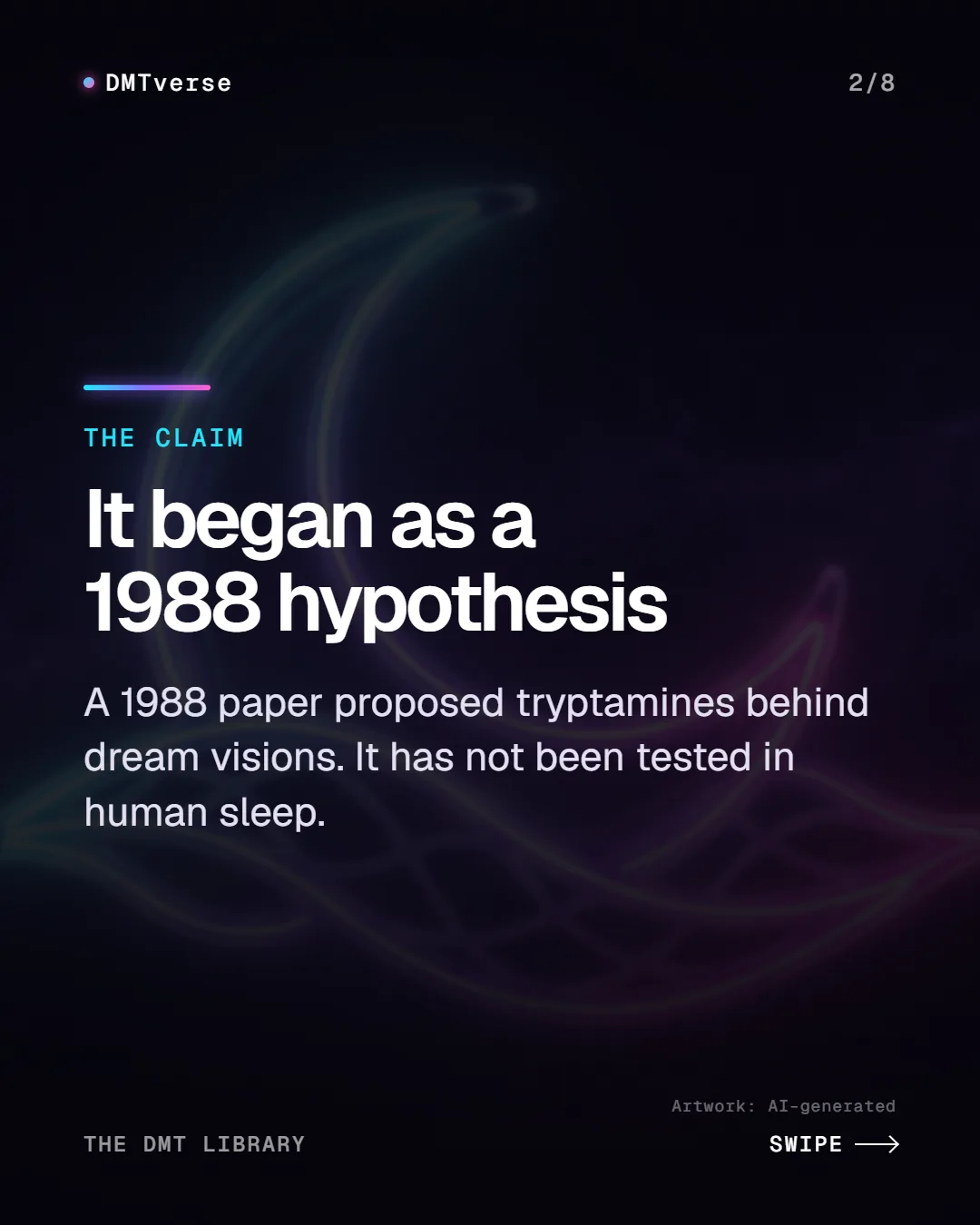
The scientific version dates to 1988, when J.C. Callaway proposed that the visions of dream sleep occur through a mechanism involving tryptamine derivatives acting as the body’s own psychedelics, and suggested a protocol to test it (Callaway, 1988). A 2018 review by Steven Barker describes this as a hypothesis that remains to be tested (Barker, 2018). Evidence: unresolved.
The comparison also comes from people who took DMT. In Rick Strassman’s 1994 study, volunteers described effects that completely replaced their ongoing mental experience and were “more vivid and compelling than dreams or waking awareness” (Strassman et al., 1994). That is a description of how DMT felt compared with dreams, and it points to a difference in intensity as much as a similarity.
Is DMT released when you sleep or dream?
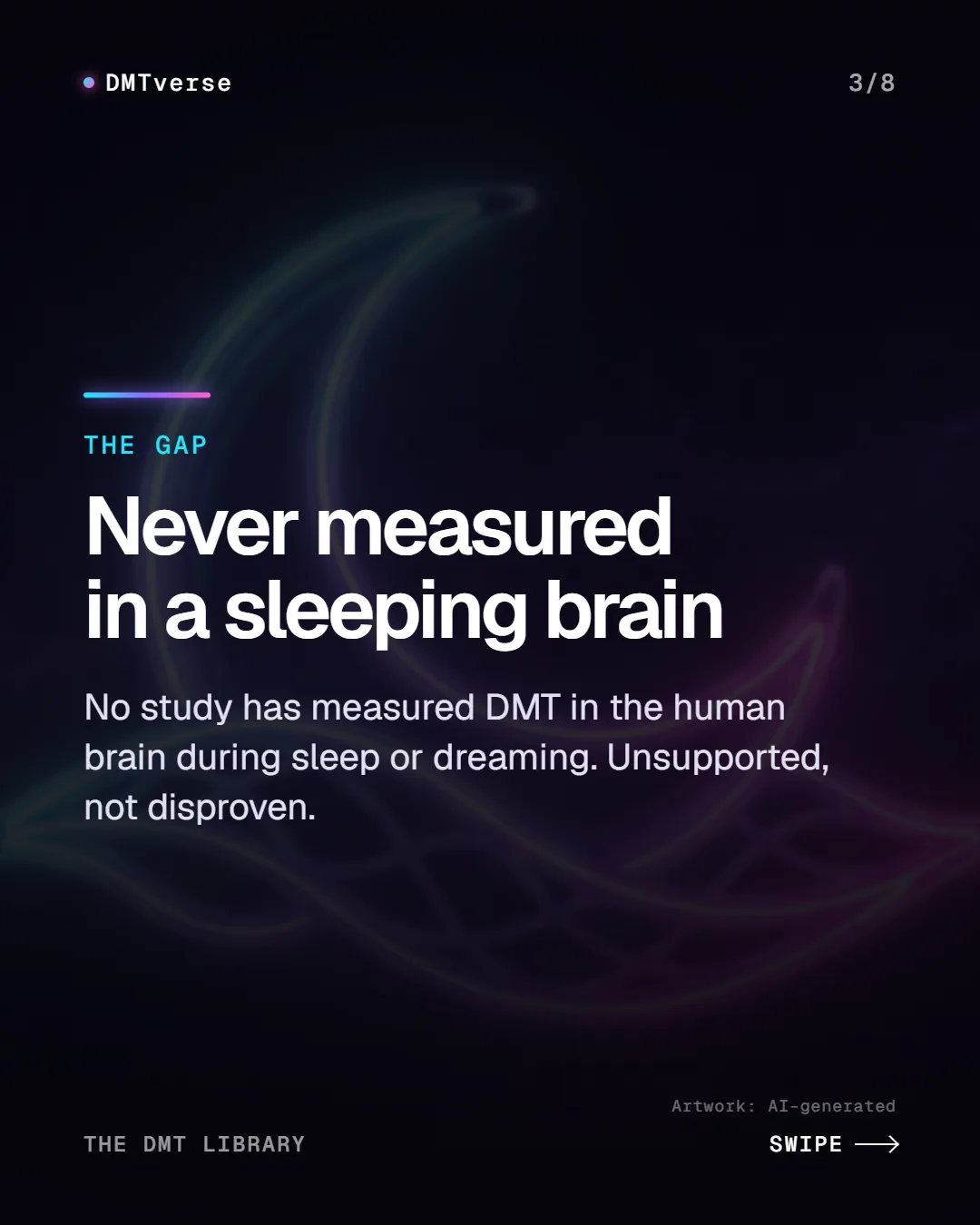
There is no measured evidence that it is. Barker’s review notes that only a few efforts have looked at how DMT levels vary with sleep stages, that most studies sampled a single time point or a 24-hour urine collection, and that no circadian study of DMT release from the pineal gland has ever been done (Barker, 2018). A separate 2018 review by David Nichols lists release “during dreaming” among the pineal-gland ideas that scientific evidence does not support, and notes that the tiny amounts of DMT detected in the brain are not enough to produce psychoactive effects (Nichols, 2018). Barker, for his part, argues that brain levels have not been measured well enough to dismiss a role. So the claim is unsupported, which is not the same as disproven. Evidence: unresolved.
In short, nobody has measured DMT in a human brain during sleep, so the claim cannot be confirmed or ruled out. The rat studies, the pineal gland question and the related claim about death are covered in our fact-check, does the brain release DMT when you die?
Does dreaming only happen in REM sleep?
REM sleep was first described in 1953, when Eugene Aserinsky and Nathaniel Kleitman reported “regularly occurring periods of eye motility” during sleep (Aserinsky and Kleitman, 1953). For decades afterwards, dreaming was closely identified with REM (rapid eye movement) sleep, a stage with wake-like, fast brain activity. Evidence: established.
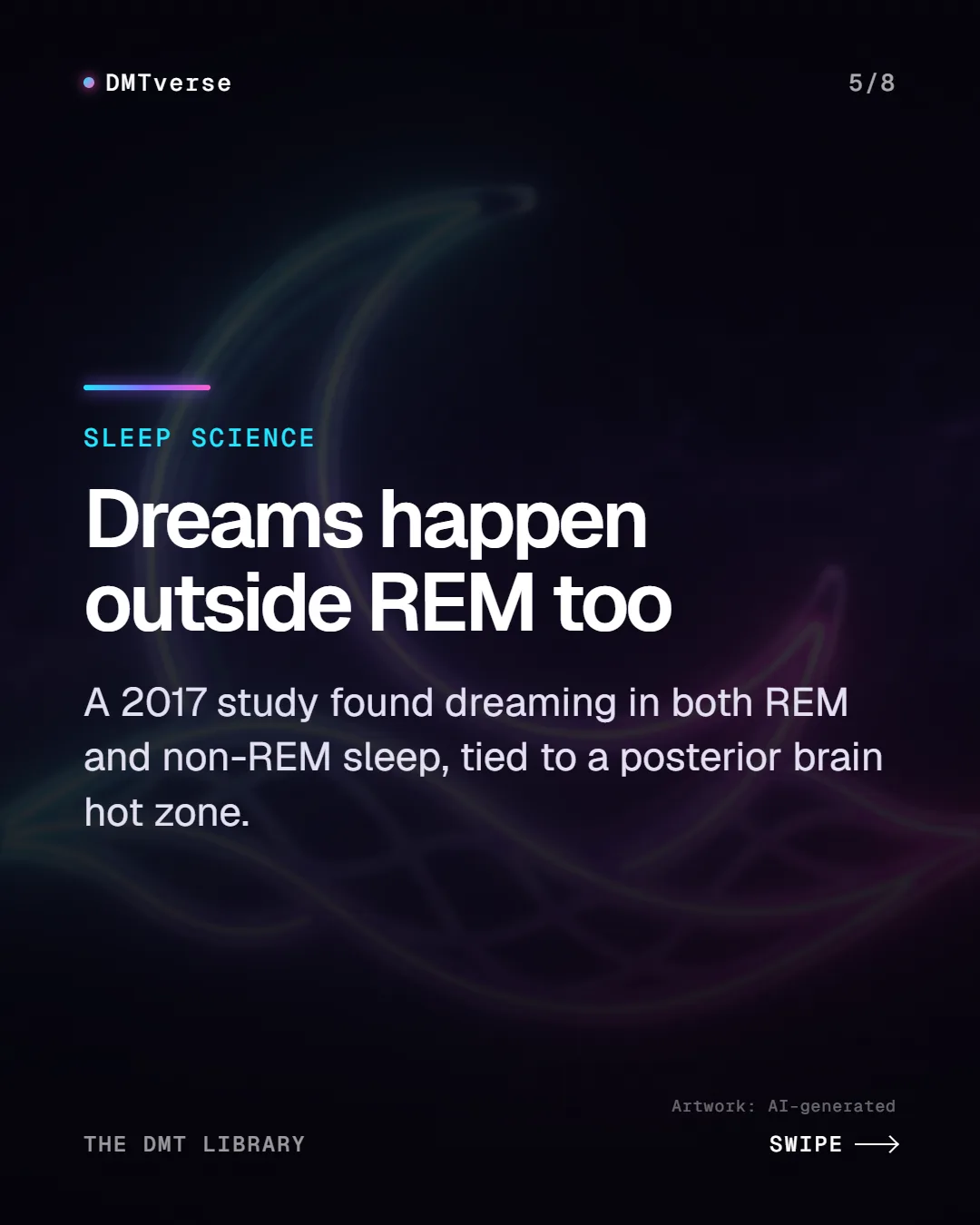
That picture has since been revised. A 2017 high-density EEG study found that dreaming also occurs in non-REM sleep, and that in both REM and non-REM sleep, dream reports went with a local drop in slow activity in posterior brain regions, a “hot zone”. Monitoring that zone in real time predicted whether a person would report dreaming when woken from non-REM sleep (Siclari et al., 2017). So “DMT is like REM sleep” and “DMT is like dreaming” are no longer the same claim. Evidence: preliminary.
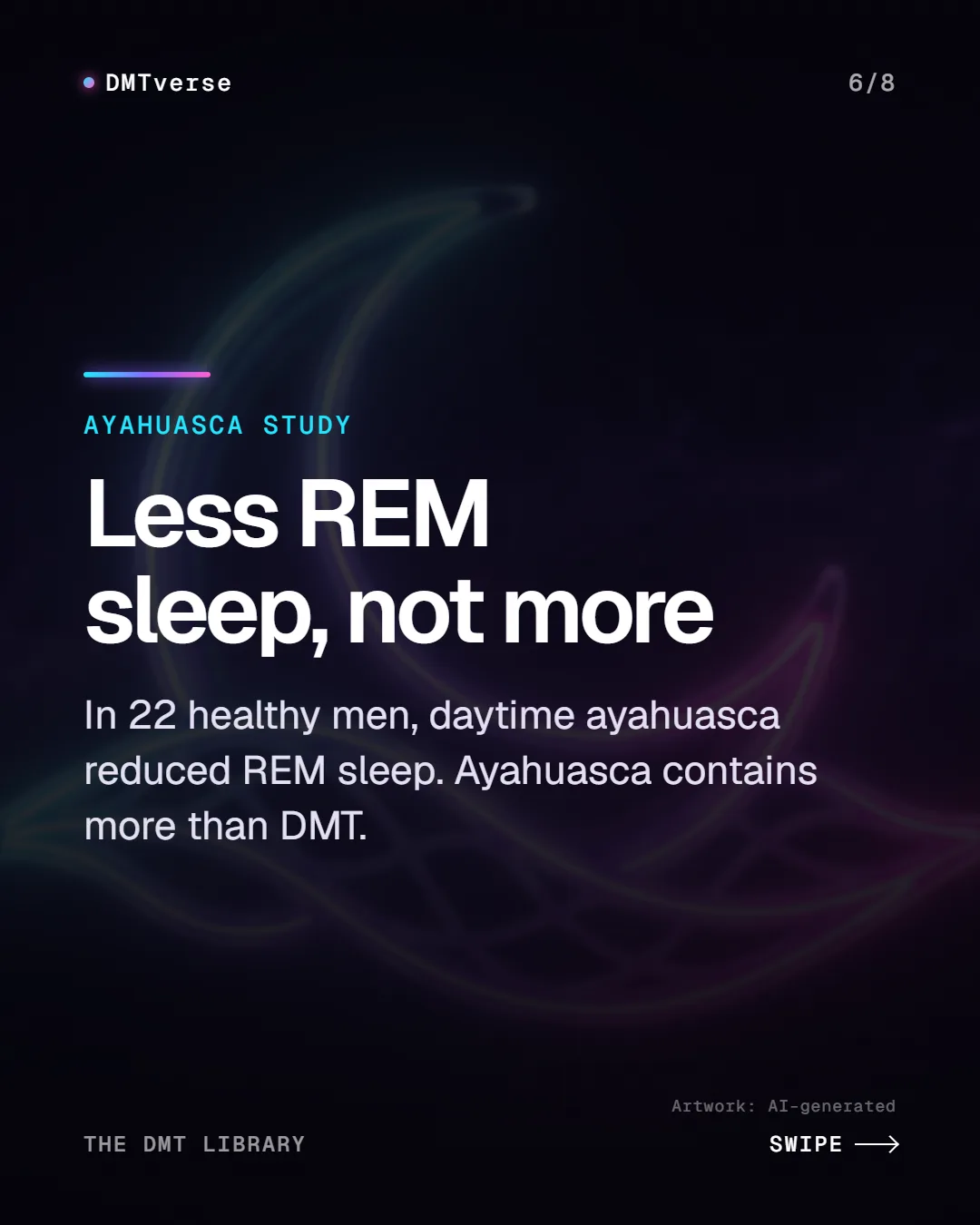
One study did look at a DMT-containing brew and sleep. In 22 healthy men, a daytime dose of ayahuasca, compared with placebo and with amphetamine as a control, did not worsen subjective sleep quality but reduced REM sleep and showed a trend towards delaying it, while increasing slow-wave sleep power in the first cycle (Barbanoj et al., 2008). Ayahuasca contains other active compounds, so this is not a DMT result, and it concerns a drug taken from outside, not the body’s own DMT. It does not fit a simple “DMT makes dreams” story. Evidence: preliminary.
Does the brain on DMT look like a dreaming brain?
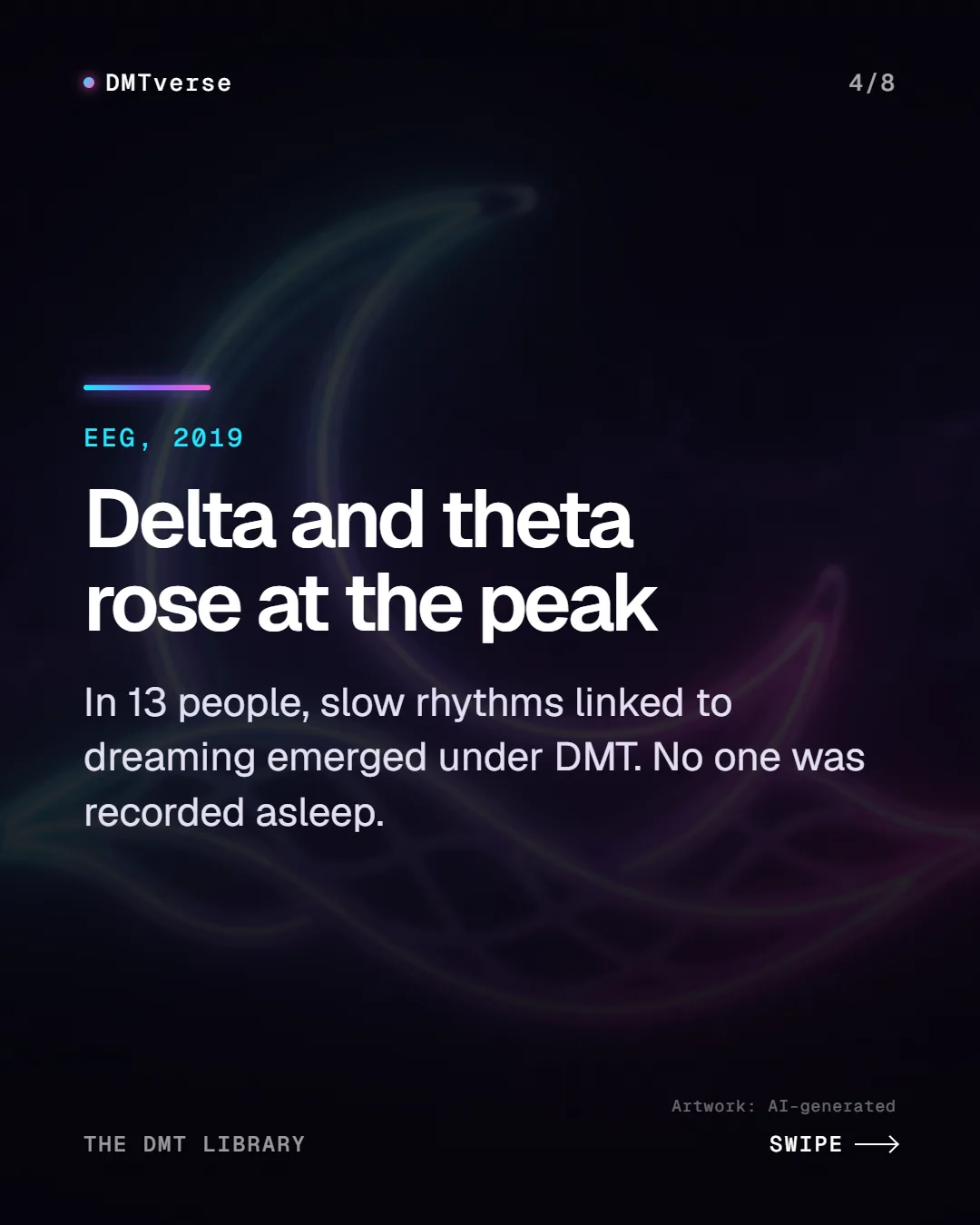
In a 2019 Imperial College study, 13 volunteers had EEG recorded with eyes closed while receiving intravenous DMT and, on another day, placebo. DMT markedly reduced alpha and beta power and increased signal diversity. Slower delta and theta rhythms emerged, and their emergence correlated with the peak of the experience, particularly its eyes-closed visual component (Timmermann et al., 2019). Evidence: preliminary, a small single-blind study.
The authors noted that theta and delta rhythms, especially from deep temporal-lobe sources, have classically been associated with REM-sleep dreaming, and speculated that DMT may recruit similar circuitry (Timmermann et al., 2019). That is a proposal. The study recorded people awake under DMT and did not record anyone asleep, so the DMT and dream signals were never compared directly. And dreaming is not tied to REM alone (see above). Evidence: the analogy is unresolved.
DMT and dreams: how alike are the experiences?
Language analysis gives one answer. A 2018 study compared the semantic similarity of reports of many psychoactive substances with dream reports of high and low lucidity. Hallucinogens as a class produced the reports most similar to dreams; LSD ranked highest for similarity to lucid dreams, while deliriant drugs ranked highest for dreams of low lucidity. Words about perception, emotion such as fear, places and family members were common to both (Sanz et al., 2018). This study ranked LSD, not DMT, at the top. Evidence: preliminary; self-selected online reports.
A 2017 review lists shared features of psychedelic states and night dreams, including perception, mental imagery, emotion and changes in the sense of self and body, and differences in sensory input from the environment, clarity of consciousness and the ability to reflect on one’s own state. It concludes that psychedelic states are closest to lucid dreaming (Kraehenmann, 2017). The review covers several psychedelics, not DMT alone. Evidence: preliminary.
| Feature | Dreaming | DMT state | Source |
|---|---|---|---|
| When it happens | During sleep, REM and non-REM | Awake, minutes after the drug in lab studies | Siclari 2017; Strassman 1994 |
| Brain rhythm finding | Less slow activity in a posterior hot zone during dreams | Alpha and beta collapse; delta and theta emerge at the peak | Siclari 2017; Timmermann 2019 |
| Awareness of the state | Usually absent; present in lucid dreams | Often retained, closer to lucid dreaming | Kraehenmann 2017 |
| Vividness | Often vivid | Described as more vivid and compelling than dreams | Strassman 1994 |
| Shared language in reports | Perception, fear, places, family | Hallucinogens most dream-like overall; LSD ranked top | Sanz 2018 |
One shared feature deserves its own mention: both states can feel completely real while they last. The 2021 lucid-dream researchers open their paper by describing dreams as a hallucinatory world that feels as real as any waking experience (Konkoly et al., 2021), and Strassman’s volunteers described DMT as more compelling than either dreams or waking life (Strassman et al., 1994). A sense of realness during an experience, then, is not unique to DMT, and it is not evidence that the experience reflects something outside the brain. Why some states carry such a strong feeling of reality is an open question in consciousness research. Evidence: unresolved.
Talking to dreamers: a method DMT research has not tried
Most of what we know about both dreams and DMT comes from reports given afterwards, which are open to forgetting and distortion. In 2021, four independent labs showed a way around this for dreams. Thirty-six people, in REM sleep verified by recordings, were asked questions, such as simple maths problems, while they signalled from inside a lucid dream with eye movements or facial muscle twitches (Konkoly et al., 2021).
- Before sleep, participants learned to signal with specific eye movements or facial muscle contractions.
- During REM sleep, confirmed by polysomnography, a dreamer signalled that they had become lucid.
- Researchers presented a question or task, such as a spoken maths problem, or tones, lights or touches to count or tell apart.
- The dreamer answered with the trained signals, recorded and scored by independent raters.
- The dreamer was woken and gave a dream report, which researchers compared with the recorded answers.
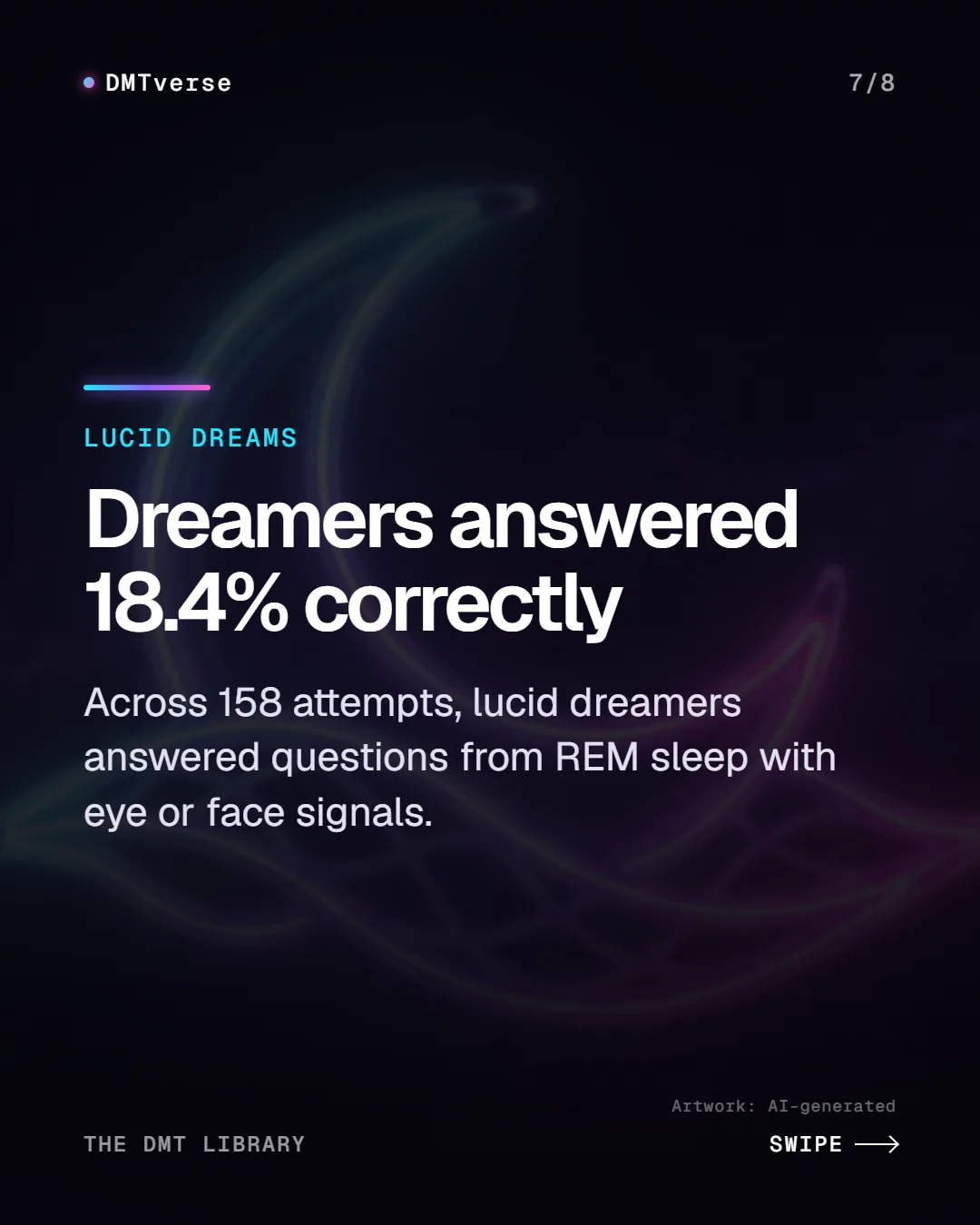
Across 158 attempts during signal-verified lucid dreams, researchers recorded a correct answer on 18.4%, an incorrect one on 3.2%, an unclear one on 17.7% and no response on about 60%. Correct answers came from six participants. When dreamers were woken, their reports sometimes diverged from what had been recorded, for example describing a different maths problem from the one presented (Konkoly et al., 2021). Two-way communication during REM sleep is possible, but the success rate was low. Evidence: preliminary.
For DMT research, the lesson is methodological. Reports collected after a DMT session may differ from what happened during it, just as morning dream reports differed from in-dream signals. Real-time signalling during a DMT state has not been published. It is an idea, not a result. A 2026 preprint has proposed in-state experiments during extended DMT sessions; see Andrew Gallimore’s reality switch theory. Evidence: unresolved.
What we still don’t know
- Whether DMT levels in the human brain change across sleep stages; no one has measured them (unresolved).
- Whether the delta and theta rhythms under DMT resemble those of dreaming when both are recorded and compared in the same people (unresolved).
- Whether DMT affects sleep on its own, apart from ayahuasca’s other ingredients (unresolved).
- Whether people could signal from inside a DMT state as lucid dreamers can, and whether their in-state signals would match later reports (unresolved).
- Why the DMT state and dreams feel real at the time, and whether the same brain judgment of reality is involved (unresolved).
The fair summary: DMT experiences resemble dreams in some ways, especially lucid dreams, and one EEG study found dream-associated rhythms at the peak of the experience. But no study has measured DMT during human sleep, and the idea that the body releases it to make dreams remains an untested hypothesis from 1988. For more, read what is DMT, DMT time dilation and DMT and near-death experiences.
Common questions
Does your brain release DMT when you dream?
There is no measured evidence for it. The idea was proposed as a hypothesis in 1988, and no study has measured DMT in the human brain during sleep or dreaming. Reviews describe it as untested or unsupported, which is not the same as disproven.
Is a DMT experience like a dream?
In some ways. Both involve vivid imagery, emotion and a sense of being elsewhere. A 2017 review concluded that psychedelic states are closest to lucid dreams, because awareness and reflection are often kept. Strassman’s 1994 volunteers described DMT as more vivid and compelling than dreams.
Does DMT make your brain waves look like REM sleep?
In a 2019 EEG study of 13 people, delta and theta rhythms emerged at the peak of the DMT experience, and the authors linked these rhythms to REM dreaming. But nobody was recorded asleep, so the comparison is an analogy, not a measured match.
Is dreaming only in REM sleep?
No. A 2017 study found dreaming in both REM and non-REM sleep, and linked dream reports to reduced slow activity in posterior brain regions in both stages. REM sleep itself was first described in 1953.
Does ayahuasca affect sleep?
In one study of 22 healthy men, daytime ayahuasca reduced REM sleep without worsening subjective sleep quality, and increased slow-wave sleep power. Ayahuasca contains more than DMT, so this is not a DMT result.
Can scientists talk to people while they dream?
Yes, sometimes. In a 2021 study across four labs, lucid dreamers in verified REM sleep answered questions with eye or face signals. Correct answers came on 18.4% of 158 attempts, and later dream reports sometimes differed from what was recorded.
Could the lucid-dream method be used for DMT?
In principle, as a way to collect reports during the experience instead of afterwards. No such DMT study has been published. It remains a research idea.
Shroomverse sells mushroom products. This article is general information about DMT, sleep and dream research. It is not medical, legal or purchasing advice, and it does not recommend any product.
SOURCES
- Neural correlates of the DMT experience assessed with multivariate EEG (Timmermann C, et al., Scientific Reports 9:16324, 2019), Springer Nature (peer-reviewed, open access); full text via Europe PMC, PMC6864083. Accessed . Full text read. 13 participants, eyes closed; alpha and beta reduced, signal diversity increased; delta/theta emergence correlated with the peak, especially eyes-closed visuals; authors’ speculation linking theta/delta to REM-sleep dreaming circuitry. No sleep recordings.
- Dose-response study of N,N-dimethyltryptamine in humans. II. Subjective effects and preliminary results of a new rating scale (Strassman RJ, Qualls CR, Uhlenhuth EH, Kellner R, Archives of General Psychiatry 51(2):98–108, 1994), American Medical Association (peer-reviewed). Accessed . Abstract read via Europe PMC. Effects completely replaced ongoing mental experience and were “more vivid and compelling than dreams or waking awareness”. Doses deliberately not reproduced.
- A proposed mechanism for the visions of dream sleep (Callaway JC, Medical Hypotheses 26(2):119–124, 1988), Elsevier (Medical Hypotheses). Accessed . Abstract read via Europe PMC. Proposes tryptamine derivatives as endogenous psychedelics behind dream visions; suggests a verification protocol. A hypothesis paper.
- N,N-Dimethyltryptamine (DMT), an Endogenous Hallucinogen: Past, Present, and Future Research to Determine Its Role and Function (Barker SA, Frontiers in Neuroscience 12:536, 2018), Frontiers (peer-reviewed, open access); full text via Europe PMC, PMC6088236. Accessed . Full text read. Dream involvement hypothesised (Callaway 1988); few efforts on sleep stages or circadian variation; no circadian study of pineal DMT release; argues brain levels are not yet well measured.
- N,N-dimethyltryptamine and the pineal gland: Separating fact from myth (Nichols DE, Journal of Psychopharmacology 32(1):30–36, 2018), SAGE (peer-reviewed). Accessed . Abstract read via Europe PMC. Claims of pineal DMT release during dreaming not consistent with evidence; minute brain concentrations not sufficient for psychoactive effects.
- Regularly Occurring Periods of Eye Motility, and Concomitant Phenomena, During Sleep (Aserinsky E, Kleitman N, Science 118(3062):273–274, 1953), American Association for the Advancement of Science. Accessed . Bibliographic record checked on Crossref; cited for title, authors and date only.
- The neural correlates of dreaming (Siclari F, Baird B, Perogamvros L, et al., Nature Neuroscience 20(6):872–878, 2017), Springer Nature (peer-reviewed). Accessed . Abstract read via Europe PMC. Dreaming in REM and NREM sleep; reduced low-frequency activity in a posterior hot zone with dream reports; real-time prediction of dreaming in NREM.
- Daytime Ayahuasca administration modulates REM and slow-wave sleep in healthy volunteers (Barbanoj MJ, Riba J, Clos S, et al., Psychopharmacology 196(2):315–326, 2008), Springer (peer-reviewed). Accessed . Abstract read via Europe PMC. 22 healthy men; placebo and amphetamine controls; no worse subjective sleep; REM reduced with a trend to later onset; slow-wave power increased. Doses deliberately not reproduced.
- Dreams and Psychedelics: Neurophenomenological Comparison and Therapeutic Implications (Kraehenmann R, Current Neuropharmacology 15(7):1032–1042, 2017), Bentham Science (peer-reviewed, open access). Accessed . Abstract read via Europe PMC. Shared features and differences between psychedelic states and dreams; psychedelic states closest to lucid dreaming. Its therapeutic conclusions are not used here.
- The Experience Elicited by Hallucinogens Presents the Highest Similarity to Dreaming within a Large Database of Psychoactive Substance Reports (Sanz C, Zamberlan F, Erowid E, Erowid F, Tagliazucchi E, Frontiers in Neuroscience 12:7, 2018), Frontiers (peer-reviewed, open access). Accessed . Abstract read via Europe PMC. Hallucinogens most similar to dream reports; LSD top for high-lucidity dreams, deliriants for low-lucidity dreams; shared word categories.
- Real-time dialogue between experimenters and dreamers during REM sleep (Konkoly KR, et al., Current Biology 31(7):1417–1427, 2021), Cell Press (peer-reviewed, open access); full text via Europe PMC, PMC8162929. Accessed . Full text read (rechecked 20 October 2026). 36 individuals, four labs; 158 attempts in signal-verified lucid dreams: 18.4% correct, 3.2% incorrect, 17.7% ambiguous, 60.1% no response (60.8% in Table 2); correct answers from six participants; dream reports sometimes diverged from recordings.
CHANGES
- : Linked glossary definitions.
- : Published. Every source opened and checked on this date via Europe PMC abstracts and full text and a Crossref record.
- : Editorial review: primary keyword now in the summary and an H2; REM H2 rephrased as a question; evidence labels reduced to one house-style label per paragraph (lucid-dream communication now preliminary, as a single multi-lab study); ambiguous-response share added from the full text; the extended-DMT pointer now names the 2026 preprint.



