THE SHROOMVERSE JOURNAL ✳ 13 MIN READ
DMT time dilation: why minutes can feel like ages, and what research actually measured
Topic: DMT
Published
Short answer, checked 20 October 2026
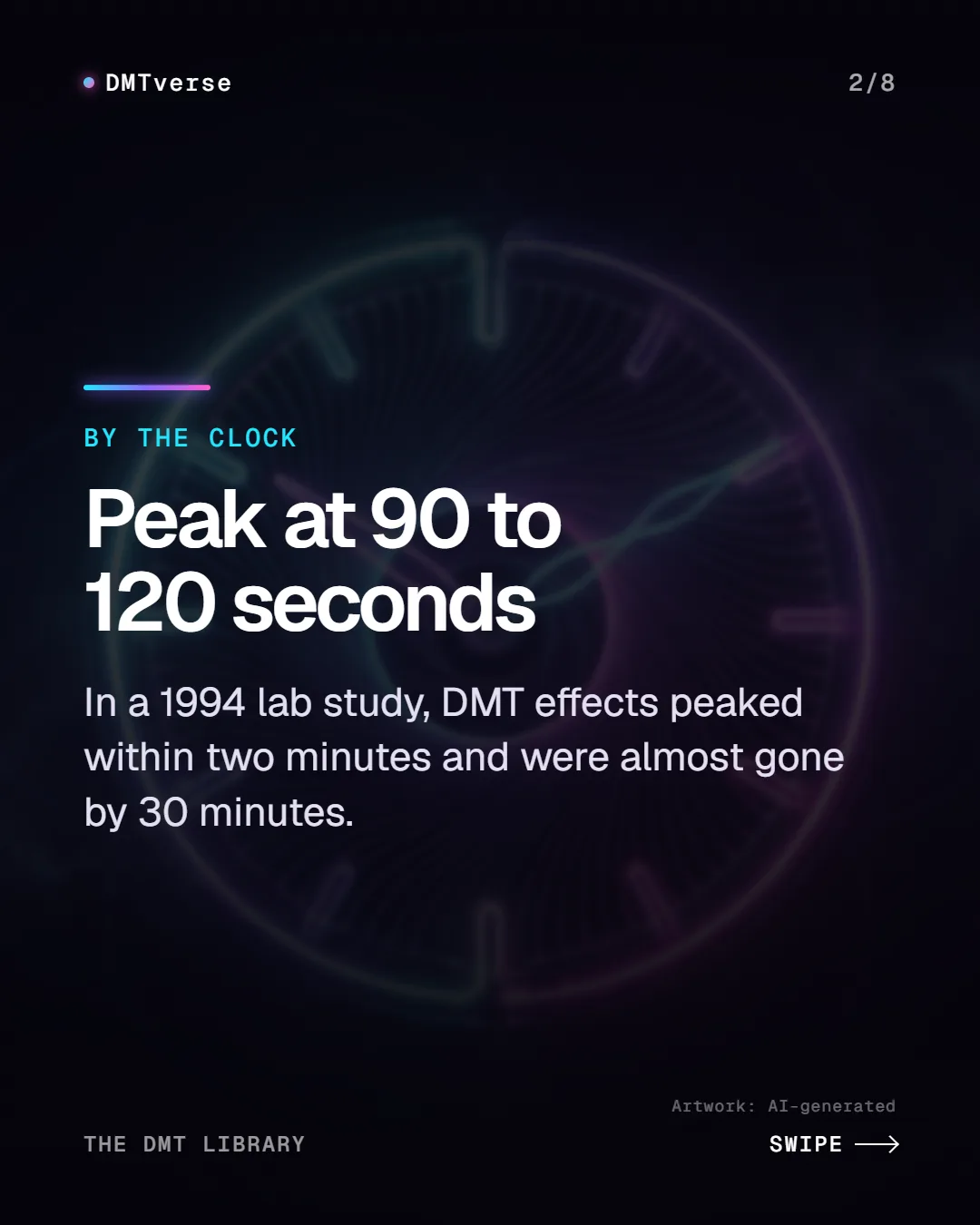
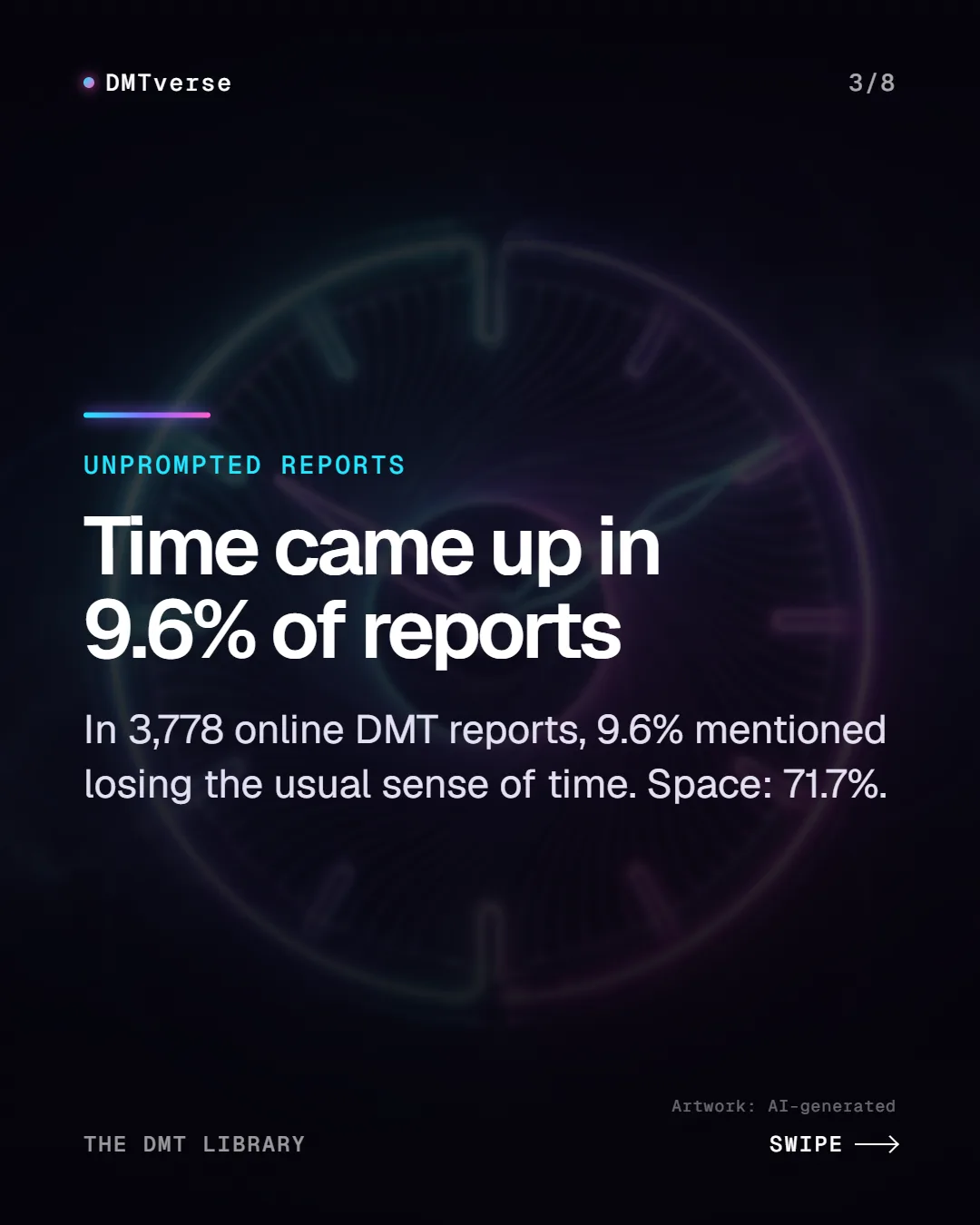
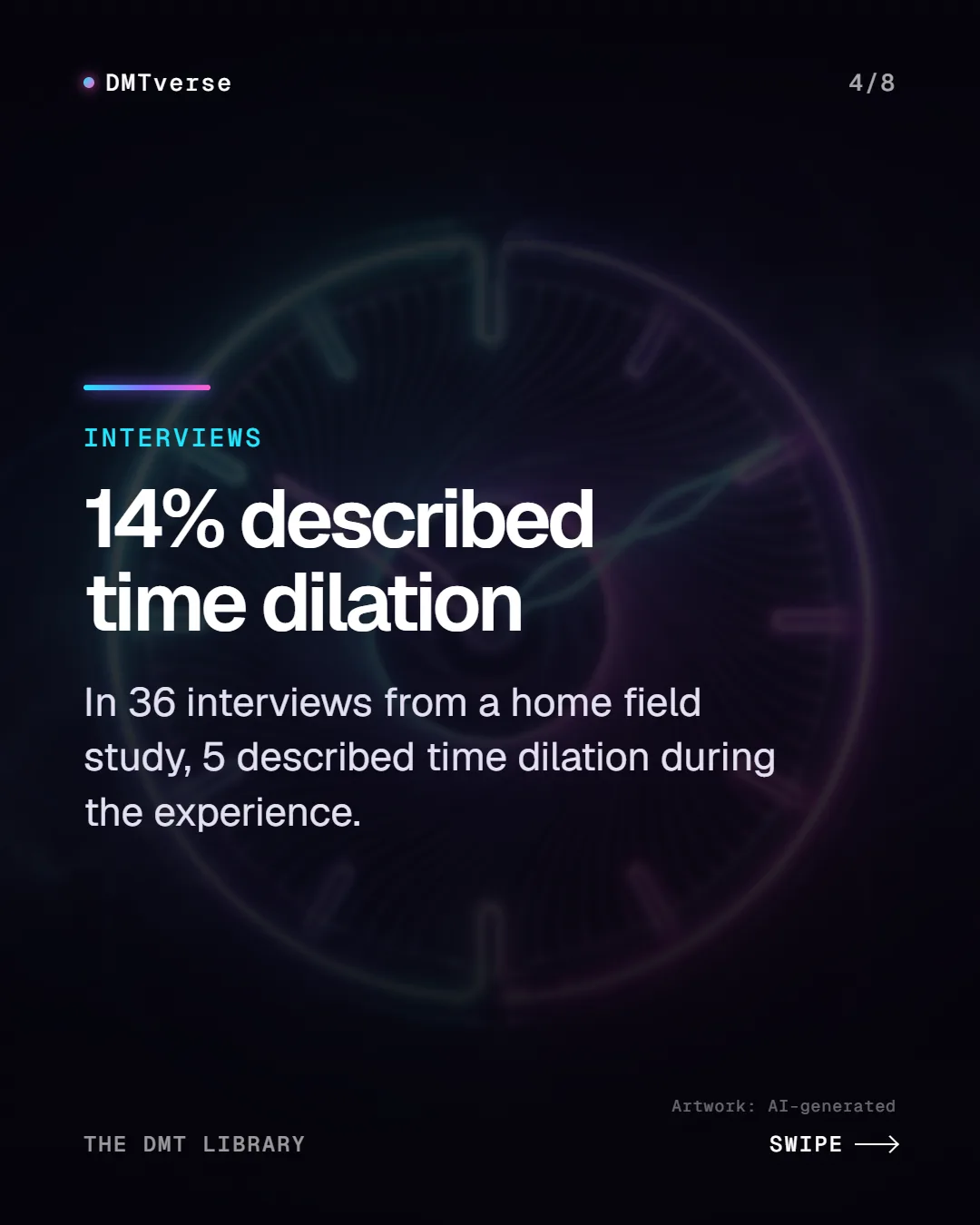
DMT time dilation is the common report that a DMT experience felt far longer than it was, or stepped outside time altogether. By the clock, effects in laboratory studies peak within about two minutes and are almost gone by thirty minutes. The DMT-specific data on time are thin: when people write about their experiences unprompted, only about one report in ten mentions losing the usual sense of time, and in one interview study about one person in six described time dilation. Nobody has measured time perception with timing tasks during DMT. The best experimental evidence comes from psilocybin and LSD studies, which found that judgments of intervals longer than about two seconds shift, probably through effects on attention and working memory.
THE SHORT VERSION · SWIPE
On this page 8 sections
A few minutes on the clock that felt like years: some version of that description turns up again and again in accounts of DMT. It is one of the most quoted features of the experience, and one of the least studied. This article separates three things that often get blurred: what people report about time, what the clock says, and what timing experiments have measured, most of them with other psychedelics.
Education only, not guidance
This article describes published research. It gives no amounts, no instructions and no advice on use, and it does not describe any effect as a benefit. DMT is a controlled substance in Canada. For risks, see our safety page. Evidence labels used below: established (shown in peer-reviewed studies and not seriously disputed), preliminary (early, small, self-selected or indirect) and unresolved (an open question). Quotes from people describing their own experiences are reports, not findings.
What is DMT time dilation?
In everyday writing about DMT, “time dilation” covers at least three different reports: that much more seemed to happen than the clock allowed; that time slowed down or stopped; and that time stopped meaning anything, a sense of being outside past and future. These are descriptions of experience. They say how time felt, not how a person’s internal clock performed, and they are usually written down after the event.
The largest set of written reports shows how varied this is. In a 2022 analysis of 3,778 DMT experiences posted to an online forum, researchers coded each report for themes, including items taken from the Mystical Experience Questionnaire. “Loss of usual sense of time” appeared in 9.6% of reports, a sense of being “outside of” time, beyond past and future, in 4.6%, and an “experience of timelessness” in 4.0%. By contrast, “loss of usual sense of space” appeared in 71.7% (Lawrence et al., 2022). These are unprompted mentions by self-selected posters, so they undercount anything people did not think to write down. Evidence: preliminary.
Loss of usual sense of space
Mentioned in 71.7% of reports (Lawrence et al., 2022).
Loss of usual sense of time
Mentioned in 9.6% of reports (Lawrence et al., 2022).
Being “outside of” time, beyond past and future
Mentioned in 4.6% of reports (Lawrence et al., 2022).
Experience of timelessness
Mentioned in 4.0% of reports (Lawrence et al., 2022).
Percent of reports mentioning each theme. Self-selected forum posts, coded by researchers; not a random sample.
Interviews give a slightly higher figure. In a 2025 analysis of 36 interviews from a field study of people using DMT in their own homes, researchers coded “time dilation” during the experience in 5 of 36 accounts (14%) and at its onset in 6 of 36 (17%), and “time–space transcendence” in 8 of 36 (22%) (Michael et al., 2025). The participants were experienced users and a researcher was present, so the sample says little about anyone else. Evidence: preliminary.
How long does a DMT experience last by the clock?
Clock time is the part we know well. In Rick Strassman’s 1994 study of intravenous DMT, psychological effects began almost immediately, peaked at 90 to 120 seconds and were almost completely resolved by 30 minutes, tracking blood levels (Strassman et al., 1994). A 2023 Swiss study found the same speed in reverse: when an infusion was stopped, all drug effects rapidly decreased and subsided within 15 minutes (Vogt et al., 2023). Evidence: established.
That gap between minutes on the clock and the “ages” people describe is what makes DMT interesting for time research. It is also why the reports need care. An intense, unfamiliar experience leaves a lot to describe afterwards, and a long description is not the same as a long measured duration. For the full time course in research settings, see how long does DMT last.
What DMT-specific data exist on time?
| Study | Design | What it measured about time | Finding |
|---|---|---|---|
| Strassman et al., 1994 | Lab, intravenous, 12 experienced volunteers | Clock time course of effects | Peak at 90–120 seconds; almost completely resolved by 30 minutes |
| Timmermann et al., 2018 | Lab, intravenous, 13 healthy volunteers vs 13 matched near-death survivors | One questionnaire item: “Did time seem to speed up or slow down?” (scored 0–2) | Mean 1.15 after DMT vs 1.54 in near-death survivors; not reported as a significant difference |
| Lawrence et al., 2022 | 3,778 online reports, coded by researchers | Unprompted mentions of time themes | Loss of usual sense of time 9.6%; timelessness 4.0% |
| Michael et al., 2025 | 36 interviews, home field study | Coded time themes | Time dilation during 14%, at onset 17%; time–space transcendence 22% |
The 2018 Imperial College study gave 13 volunteers placebo and then intravenous DMT and asked them to complete the Greyson Near-Death Experience Scale, which includes a question on whether time seemed to speed up or slow down. On that item, the DMT group averaged 1.15 out of 2 and a matched group of people who had had near-death experiences averaged 1.54; of all 16 items, only “a border or point of no return” differed at an uncorrected level (Timmermann et al., 2018). A single questionnaire item cannot tell us whether time sped up, slowed down or simply felt strange. Evidence: preliminary.
The measurement gap
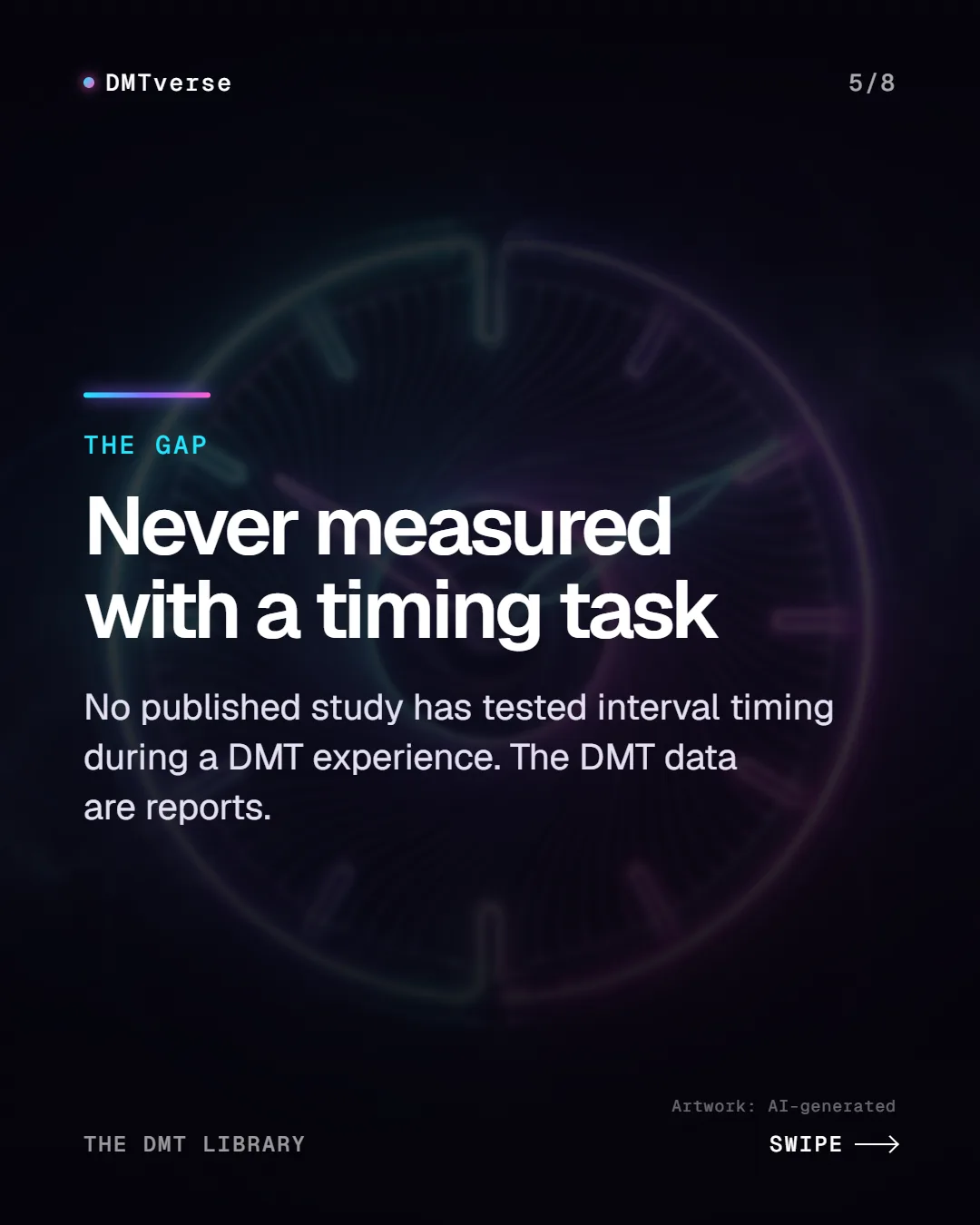
A Europe PMC search on 20 October 2026 found no published study that tested time perception with an objective timing task, such as reproducing an interval or tapping in time, during a DMT experience. Every DMT-specific figure above is a report, an interview code or a single rating made after the event. Evidence: unresolved.
What do timing experiments with other psychedelics show?
Because DMT itself has not been tested this way, the closest evidence comes from psilocybin and LSD. These are different drugs with much longer effects, so their results are a guide to what psychedelics can do to timing, not a description of DMT.
Psilocybin, 2007: longer intervals go wrong
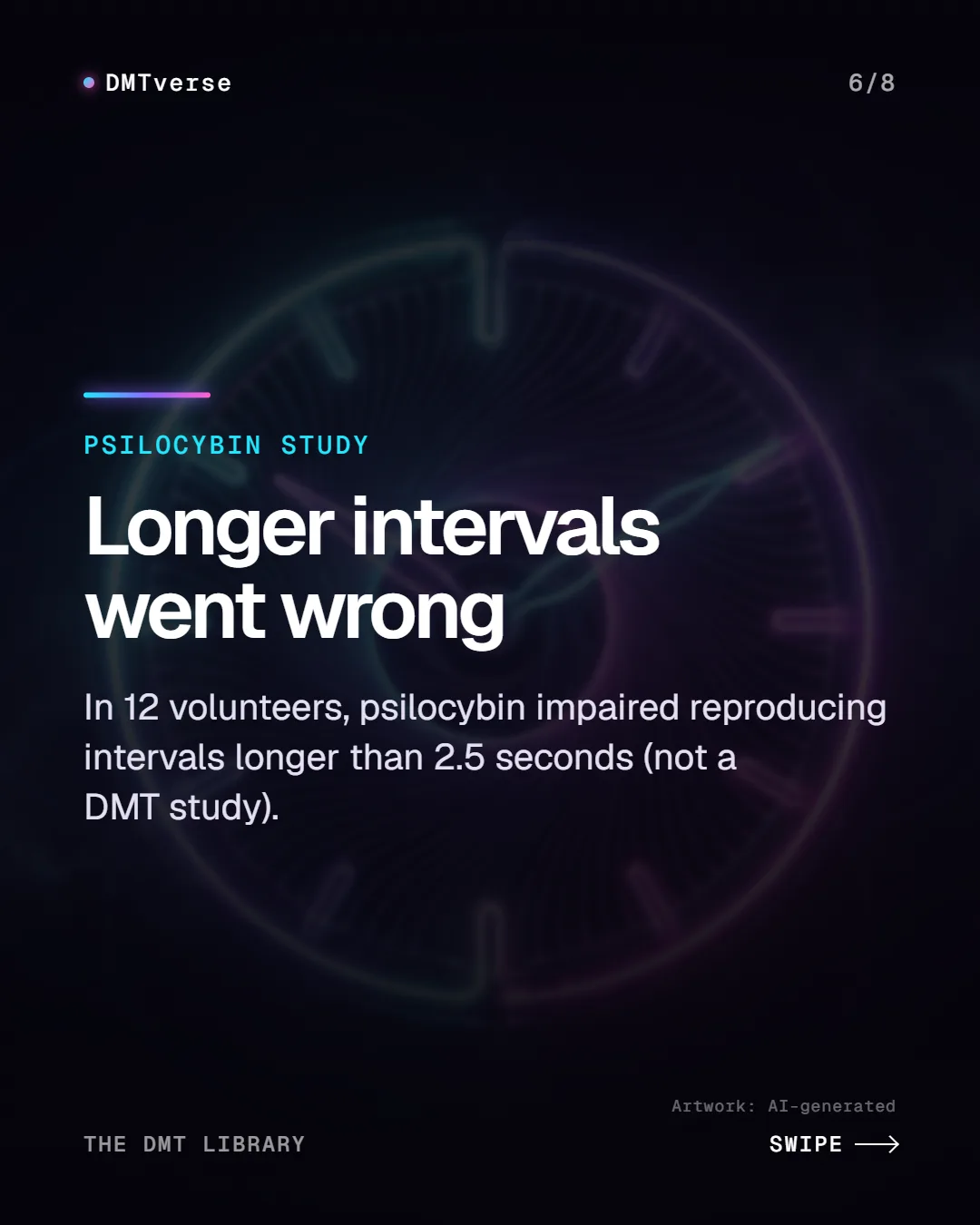
In a double-blind study, 12 healthy volunteers were tested under placebo and two doses of psilocybin (doses not reproduced here). Psilocybin significantly impaired their ability to reproduce intervals longer than 2.5 seconds and to tap in time with beats more than 2 seconds apart, and it slowed their preferred tapping rate. The timing changes came with working-memory problems and with feelings of unreality about the self and the world (depersonalisation and derealisation), including a disturbed sense of time. The authors concluded that serotonin seems selectively involved in timing intervals longer than about 2 to 3 seconds (Wittmann et al., 2007). Evidence: preliminary, from one small study of psilocybin.
Psilocybin, 2026: time slows, precision drops
A 2026 double-blind, placebo-controlled study of 24 healthy volunteers used a temporal bisection task, in which people judge whether an interval is closer to a short or a long reference. Under psilocybin, participants needed a longer interval before calling it “long”, a shift that matched their reports of subjective time slowing down on two rating scales. Their judgments also became less precise. As in 2007, the effects were significant for durations longer than 2 seconds. The authors argue that psilocybin alters time perception mainly by disrupting working memory and attention (Scholle et al., 2026). Evidence: preliminary.
LSD, 2019: dilation without feeling different
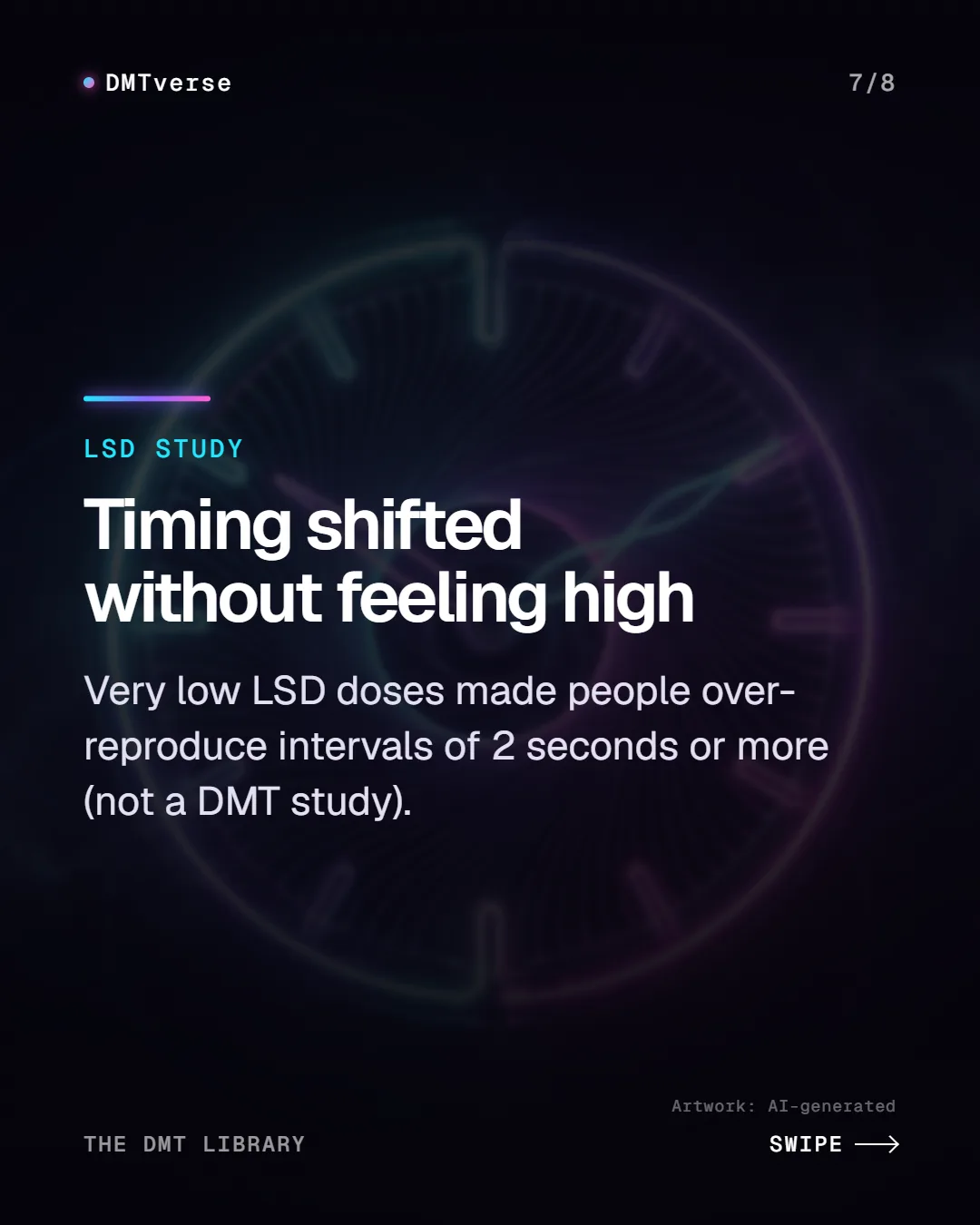
A randomised, double-blind, placebo-controlled trial gave older adults placebo or one of three very low doses of LSD (doses not reproduced here). LSD reliably made people over-reproduce intervals of 2 seconds and longer, in other words their reproductions ran long, even though the doses produced no robust changes in self-reported perception, thinking or concentration (Yanakieva et al., 2019). The authors describe this as temporal dilation of intervals over a second without a noticeably altered state. It suggests that a drug’s effect on timing and a person’s feeling of being altered can come apart. Evidence: preliminary, one trial of LSD.
Two reviews set these studies in context. A 2024 systematic review of 60 studies (10 in humans, 50 in animals) found consistent evidence that serotonin plays a role in timing, with increased serotonergic activation appearing to speed up an internal clock, though some findings did not fit that model (Akhmirov et al., 2024). A 2026 review of 32 placebo-controlled studies of LSD, DMT and psilocybin on cognition noted that many had small samples and that it is hard to find a convincing placebo for drugs with such obvious effects (Kase et al., 2026). The direction of the drug studies is consistent, but each is small and the mechanism is not settled. Evidence: preliminary.
| Study | Drug | People | Main timing finding |
|---|---|---|---|
| Wittmann et al., 2007 | Psilocybin | 12, double-blind, placebo | Worse reproduction of intervals over 2.5 s; slower tapping |
| Yanakieva et al., 2019 | LSD (very low doses) | Older adults, double-blind, placebo | Over-reproduction of intervals of 2 s and longer |
| Scholle et al., 2026 | Psilocybin | 24, double-blind, placebo | Intervals judged shorter; less precise; matched reports of time slowing |
Why might time feel stretched? The leading ideas
None of these explanations has been tested with DMT. Each is a hypothesis drawn from the studies above.
- Working memory and attention. Judging a few seconds means holding the interval in mind. Psilocybin impaired working memory alongside timing in 2007, and the 2026 authors attribute the timing changes to disrupted attention and working memory (Wittmann et al., 2007; Scholle et al., 2026). Hypothesis.
- A faster internal clock. Some animal and human work suggests serotonergic activation speeds an internal accumulator, which would make more “ticks” fit into the same clock time (Akhmirov et al., 2024). Hypothesis, with exceptions in the literature.
- Drug effect versus felt state. The LSD trial found timing shifts without a felt altered state, so the stretch may be partly a direct effect on timing circuits rather than a by-product of an intense experience (Yanakieva et al., 2019). Hypothesis.
- Remembering, not perceiving. DMT reports are written afterwards. A brief experience packed with unfamiliar content may be remembered as long. This is a reasonable interpretation of how retrospective reports work, not a tested DMT finding. Unresolved.
Each idea predicts something different. If working memory is the bottleneck, timing of intervals beyond a few seconds should fail while very short intervals stay accurate, which is the pattern seen with psilocybin. If memory after the event drives the reports, people timed during the experience might judge time normally and still describe it later as endless. Only a study that measures timing during DMT, not afterwards, can tell these apart. Evidence: unresolved.
Is DMT time distortion like near-death time distortion?
Altered time is a classic feature of near-death experiences too; a large study comparing written reports lists timelessness among their typical features (Martial et al., 2019). In the 2018 lab comparison, the DMT group and the near-death group did not differ significantly on the time item (Timmermann et al., 2018). In the 2025 interview comparison, time-related themes appeared in both the DMT accounts and the near-death narratives, though the two sets of codes were not identical (Michael et al., 2025). We look at the overall comparison in DMT and near-death experiences. Evidence: preliminary.
What we still don’t know
- Whether DMT changes timing performance at all; no objective timing task has been run during a DMT experience (unresolved).
- Whether time feels slower, faster or simply absent for most people; unprompted reports and questionnaires give different pictures (unresolved).
- Whether the psilocybin and LSD findings, which concern intervals of a few seconds, say anything about the feeling that “years” passed (unresolved).
- How much of reported time dilation is formed in memory afterwards rather than felt in the moment (unresolved).
- Whether expectation shapes time reports; people may have read that DMT “stretches time” before they try it, and no study has tested this (unresolved).
The fair summary: DMT time dilation is a common way of describing the experience, but it is less common in unprompted reports than its reputation suggests, and it has never been measured as a change in timing. Experiments with psilocybin and LSD show that serotonergic psychedelics can shift how people judge intervals of a few seconds. For the wider picture, see what is DMT, DMT entity encounters and how psilocybin, LSD and DMT differ.
Common questions
What is DMT time dilation?
It is the common report that a DMT experience felt far longer than it was, or that time slowed, stopped or stopped mattering. It is a description of experience, usually given afterwards. No study has measured it as a change in timing during DMT.
How long does a DMT experience actually last?
In Strassman’s 1994 intravenous study, effects peaked at 90 to 120 seconds and were almost completely resolved by 30 minutes. In a 2023 infusion study, effects subsided within 15 minutes of stopping. These describe research settings, not predictions or guidance.
Do most people report time distortion on DMT?
Not in unprompted reports. In 3,778 online accounts, 9.6% mentioned losing the usual sense of time and 4.0% described timelessness, while 71.7% mentioned losing the usual sense of space. In 36 interviews, 14% described time dilation during the experience. How you ask changes the answer.
Has anyone measured time perception during DMT?
Not with objective timing tasks, as far as a Europe PMC search on 20 October 2026 could find. The DMT data are reports, interview codes and one questionnaire item. The timing experiments that exist used psilocybin or LSD.
What did psilocybin and LSD studies find about time?
Psilocybin impaired reproduction of intervals longer than about 2.5 seconds in a 2007 study, and in a 2026 study made intervals feel shorter and judgments less precise, matching reports of time slowing. In a 2019 trial, very low doses of LSD made people over-reproduce intervals of 2 seconds and longer without a noticeably altered state.
Why might time feel stretched under psychedelics?
Leading ideas are that psychedelics disrupt working memory and attention, which longer intervals depend on, and that serotonin activation speeds an internal clock. A third possibility is that brief, unfamiliar experiences are remembered as long. None has been tested with DMT.
Is DMT time distortion the same as in near-death experiences?
Both involve reports of altered time. In a 2018 lab study, DMT volunteers and near-death survivors did not differ significantly on the questionnaire’s time item, but one item is a blunt tool, and the two experiences differ in many of their contents.
Shroomverse sells mushroom products. This article is general information about DMT and time perception research. It is not medical, legal or purchasing advice, and it does not recommend any product.
SOURCES
- Phenomenology and content of the inhaled N,N-dimethyltryptamine (N,N-DMT) experience (Lawrence DW, Carhart-Harris R, Griffiths R, Timmermann C, Scientific Reports 12:8562, 2022), Springer Nature (peer-reviewed, open access); full text via Europe PMC, PMC9130218. Accessed . Full text read, Table 7. Of 3,778 forum reports: loss of usual sense of time 362 (9.6%); outside of time 174 (4.6%); timelessness 151 (4.0%); loss of usual sense of space 2,710 (71.7%). Self-selected posts coded by researchers.
- An encounter with death: a comparative thematic and content analysis of naturalistic DMT experiences and the near-death experience (Michael P, Luke D, Robinson O, Frontiers in Psychology 16:1532937, 2025), Frontiers (peer-reviewed, open access); full text via Europe PMC, PMC11920758. Accessed . Full text read, comparison table. Of 36 DMT interviews: time dilation during 5 (14%), at onset 6 (17%), time–space transcendence 8 (22%). Home field study of experienced users.
- DMT Models the Near-Death Experience (Timmermann C, Roseman L, Williams L, et al., Frontiers in Psychology 9:1424, 2018), Frontiers (peer-reviewed, open access); full text via Europe PMC, PMC6107838. Accessed . Full text read, Table 1. Time item mean 1.15 (DMT) vs 1.54 (matched near-death group); only the point-of-no-return item differed (uncorrected). 13 participants, placebo always first.
- Dose-response study of N,N-dimethyltryptamine in humans. II. Subjective effects and preliminary results of a new rating scale (Strassman RJ, Qualls CR, Uhlenhuth EH, Kellner R, Archives of General Psychiatry 51(2):98–108, 1994), American Medical Association (peer-reviewed). Accessed . Abstract read via Europe PMC. 12 volunteers; effects began almost immediately, peaked at 90–120 seconds, almost completely resolved by 30 minutes. Doses deliberately not reproduced.
- Acute effects of intravenous DMT in a randomized placebo-controlled study in healthy participants (Vogt SB, et al., Translational Psychiatry 13:172, 2023), Springer Nature (peer-reviewed, open access). Accessed . Abstract read via Europe PMC. 27 participants; after stopping the infusion, all drug effects rapidly decreased and subsided within 15 minutes. Doses deliberately not reproduced.
- Effects of psilocybin on time perception and temporal control of behaviour in humans (Wittmann M, et al., Journal of Psychopharmacology 21(1):50–64, 2007), SAGE (peer-reviewed). Accessed . Abstract read via Europe PMC. Psilocybin study, not DMT. 12 volunteers, double-blind; impaired reproduction of intervals over 2.5 s and synchronisation over 2 s; slower tapping; working-memory deficits; serotonin implicated in intervals over 2–3 s. Doses not reproduced.
- The effects of psilocybin on time perception in humans: A comparative analysis of subjective and objective measures (Scholle P, et al., Journal of Psychopharmacology 40(5):818–830, 2026), SAGE (peer-reviewed). Accessed . Abstract read via Europe PMC. Psilocybin study, not DMT. 24 volunteers, double-blind, placebo-controlled; rightward shift of bisection point matching reported time slowing; reduced precision; effects for durations over 2 s; attributed to working memory and attention.
- The effects of microdose LSD on time perception: a randomised, double-blind, placebo-controlled trial (Yanakieva S, et al., Psychopharmacology 236(4):1159–1170, 2019), Springer (peer-reviewed, open access). Accessed . Abstract read via Europe PMC. LSD study, not DMT. Older adults; over-reproduction of intervals of 2,000 ms and longer; no robust changes in self-reported perception. Doses deliberately not reproduced.
- The Role of the Serotonergic System in Time Perception: A Systematic Review (Akhmirov R, et al., International Journal of Molecular Sciences 25(24):13305, 2024), MDPI (peer-reviewed, open access). Accessed . Abstract read via Europe PMC. 60 papers (10 human, 50 animal); consistent evidence for serotonin in timing; increased serotonergic activation appears to accelerate internal time speed; some findings challenge this.
- Neurochemical models of near-death experiences: A large-scale study based on the semantic similarity of written reports (Martial C, et al., Consciousness and Cognition 69:52–69, 2019), Elsevier (peer-reviewed). Accessed . Abstract read via Europe PMC. Cited only for its list of typical near-death features, which includes timelessness.
- Effects of LSD, DMT and psilocybin on cognitive and psychological functions: A systematic review of the literature (Kase M, Kaup KK, Aru J, Journal of Psychopharmacology 40(8):1166–1186, 2026), SAGE (peer-reviewed). Accessed . Abstract read via Europe PMC. 32 placebo-controlled studies; many small samples; reliable placebos are hard to find. Cited for these limits only.
CHANGES
- : Published. Every source opened and checked on this date via Europe PMC abstracts and full text; a Europe PMC search for DMT time-perception studies found no objective timing study.
- : Editorial review: summary now opens with a direct definition; H2 renamed to match the search question; plain-English definitions for depersonalisation and derealisation; evidence label on the review paragraph made single and downgraded to preliminary.



