THE SHROOMVERSE JOURNAL ✳ 13 MIN READ
What is a DMT “breakthrough”? The word, the rating scales and the research
Topic: DMT
Published Updated
Short answer, checked 20 October 2026
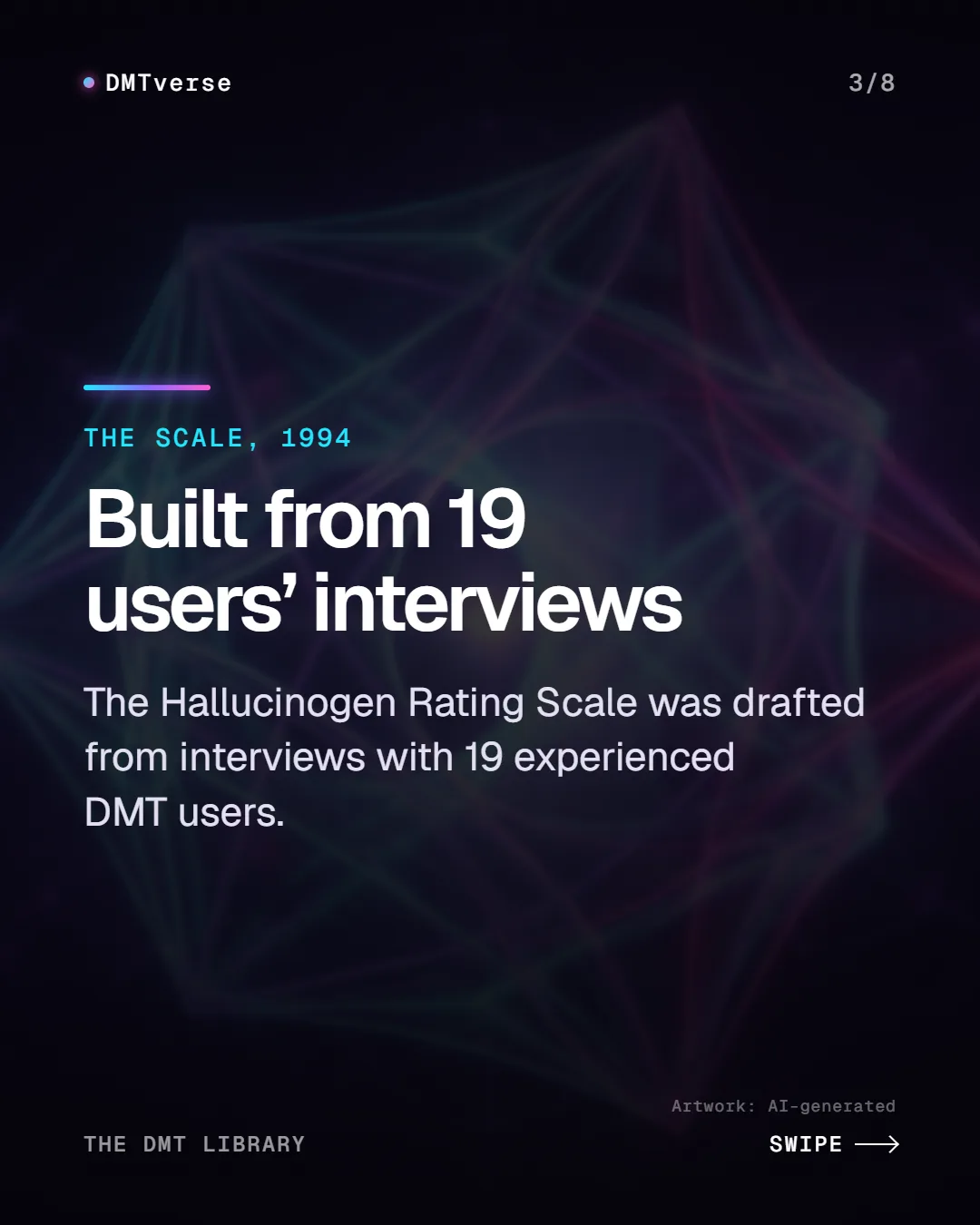
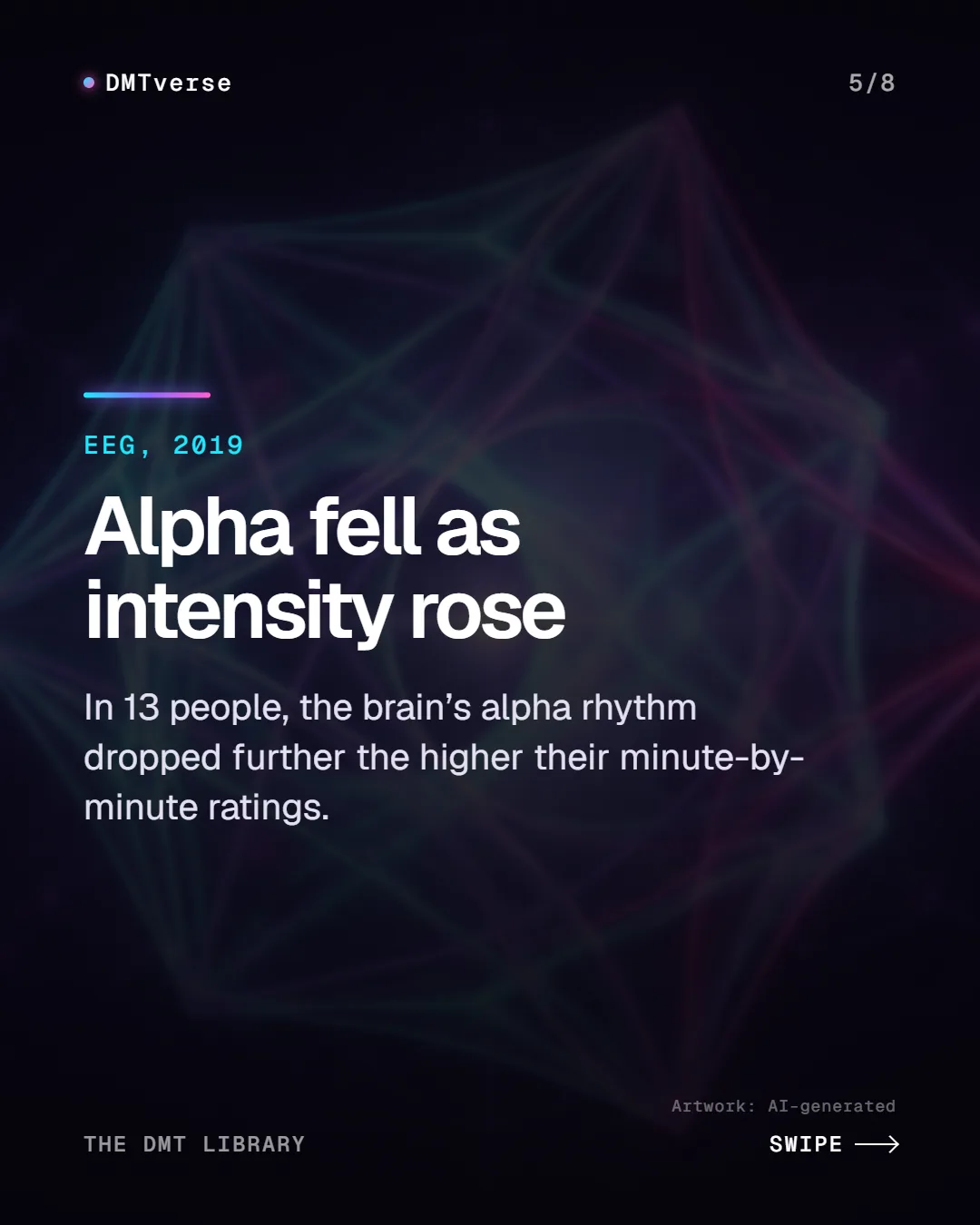
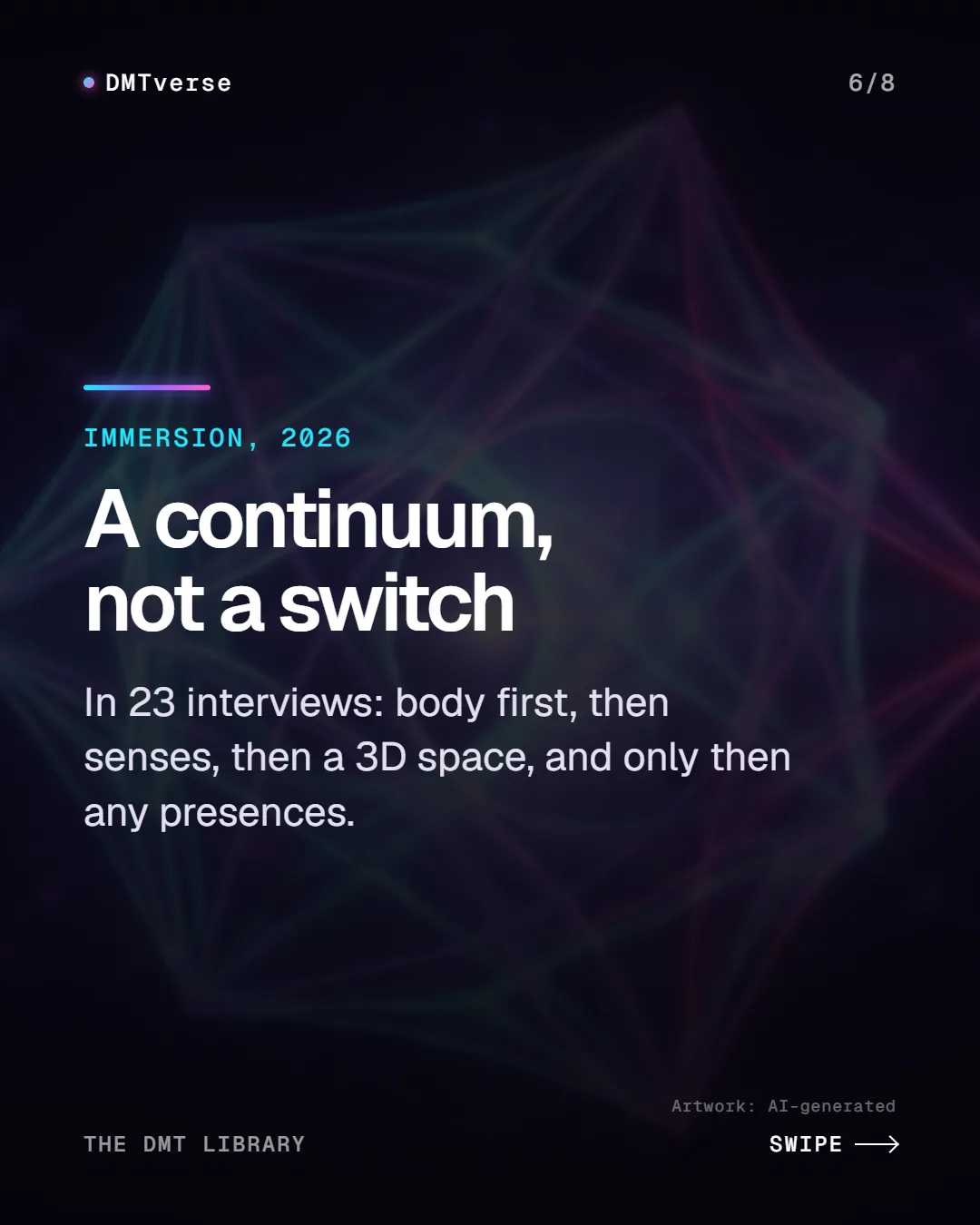
A DMT “breakthrough” is a community term, not a medical one. People use it for the point at which ordinary experience is replaced by a sense of having arrived somewhere else entirely, often described as “hyperspace” and sometimes with encounters. Researchers do not measure “breakthrough” directly. They rate intensity, for example with the Hallucinogen Rating Scale (built in the early 1990s from interviews with experienced users) and with minute-by-minute intensity ratings, as in a 2019 EEG study where the brain’s alpha rhythm fell further as ratings rose. A 2026 interview study describes immersion as a continuum rather than an on/off switch: bodily effects first, then senses, then a 3D space, and only then any presences.
THE SHORT VERSION · SWIPE
On this page 10 sections
“Did you break through?” is one of the most common questions in online DMT discussion. The phrase sounds precise, as if there were a line that is either crossed or not. In practice it is a piece of user vocabulary that researchers have borrowed carefully, usually in quotation marks. This guide explains what people mean by it, where the word turns up in research, how scientists actually measure how intense a DMT experience is, and what a 2026 study found when it looked closely at how “immersion” builds up. It does not explain how to reach any particular state, and it gives no amounts.
Education only, not guidance
This article describes published research and reported experiences. It gives no amounts, no instructions and no advice on use, and it does not describe any effect as a benefit. DMT is a controlled substance in Canada. In an emergency, call 911. Evidence labels used below: established (shown in peer-reviewed studies and not seriously disputed), preliminary (early, small, self-selected or indirect) and unresolved (an open question). Reports of what an experience felt like are labelled as reports.
What do people mean by a DMT breakthrough?
In user accounts, “breaking through” names a passage: the moment when ordinary perception gives way to what feels like a separate world. The anthropologist Graham St John, who studied online reports and other cultural sources, describes the breakthrough as the event “commonly associated with the DMT trance”, and links it to perceived contact with “entities” and to information received “often in the form of visual language”. He describes reported travel in “hyperspace” as a private, individual passage that is “ritual like” (St John, 2018). In a 2017 essay he notes that the passage can be disturbing or exhilarating (St John, 2017). These describe what users report, not what is objectively happening. Evidence: established as a description of user vocabulary; the experiences themselves are reports.
Researchers who recruit people with this kind of experience have had to turn the word into a working definition. A 2020 online survey of entity encounters asked about a “breakthrough” experience, defined as one that produced very strong psychoactive effects (as described by Michael et al., 2021, summarising Davis et al., 2020). A 2021 field study required each participant to have had at least one breakthrough experience before, which its authors describe as typically highly intense and perceptually immersive (Michael et al., 2021). Notice that both definitions are about intensity and immersion, not a fixed threshold. Evidence: established for how these studies defined the term.
Where does the word “breakthrough” appear in research?
Mostly as a borrowed term. An Imperial College London EEG study of DMT describes the experience at higher doses as rapidly progressing into a deep and profound immersion “sometimes described as a ‘breakthrough’”, often with a sense of entering another but no less real world (Timmermann et al., 2019). Evidence: established for how these authors use the word.
A large text-mining study of 6,850 written drug-experience reports about 27 substances found “breakthrough” among the words that loaded on its dominant factor, beside words such as universe, space, consciousness and dimension, and again on a factor about body load and somatic intensity (Ballentine et al., 2022). In other words, the word travels with descriptions of intensity, space and expansion. Evidence: established for word use in these corpora; the reports are self-selected.
How do researchers measure DMT intensity?
There is no “breakthrough meter”. Instead, studies use questionnaires after the experience, ratings given during it, and brain recordings that can be compared with both. The main tools are summarised below.
| Measure | What it captures | Key source |
|---|---|---|
| Hallucinogen Rating Scale (HRS) | A questionnaire filled in afterwards, covering bodily feelings, mood, perception, thinking, sense of control and overall intensity | Strassman et al., 1994 |
| Real-time intensity ratings | A single number spoken aloud every minute during the session | Timmermann et al., 2019 |
| Visual analogue scales | Afterwards, sliders for specific features such as visual intensity or bodily effects | Timmermann et al., 2019 |
| Micro-phenomenological interview | A guided, detailed interview about how the experience unfolded moment by moment | Sanders et al., 2026 |
The Hallucinogen Rating Scale
The Hallucinogen Rating Scale was developed by Rick Strassman’s team at the University of New Mexico for their 1990s DMT studies. It was drafted from interviews with an independent sample of 19 experienced DMT users and modified in the early stages of the study. In the dose-response study of 12 experienced volunteers, clustering of HRS items separated dose effects better than heart rate, blood pressure and the other biological measures did (Strassman et al., 1994). A later analysis describes six HRS domains: somaesthesia (bodily feelings), affect, perception, cognition, volition and intensity (Lawrence et al., 2022). Evidence: established.
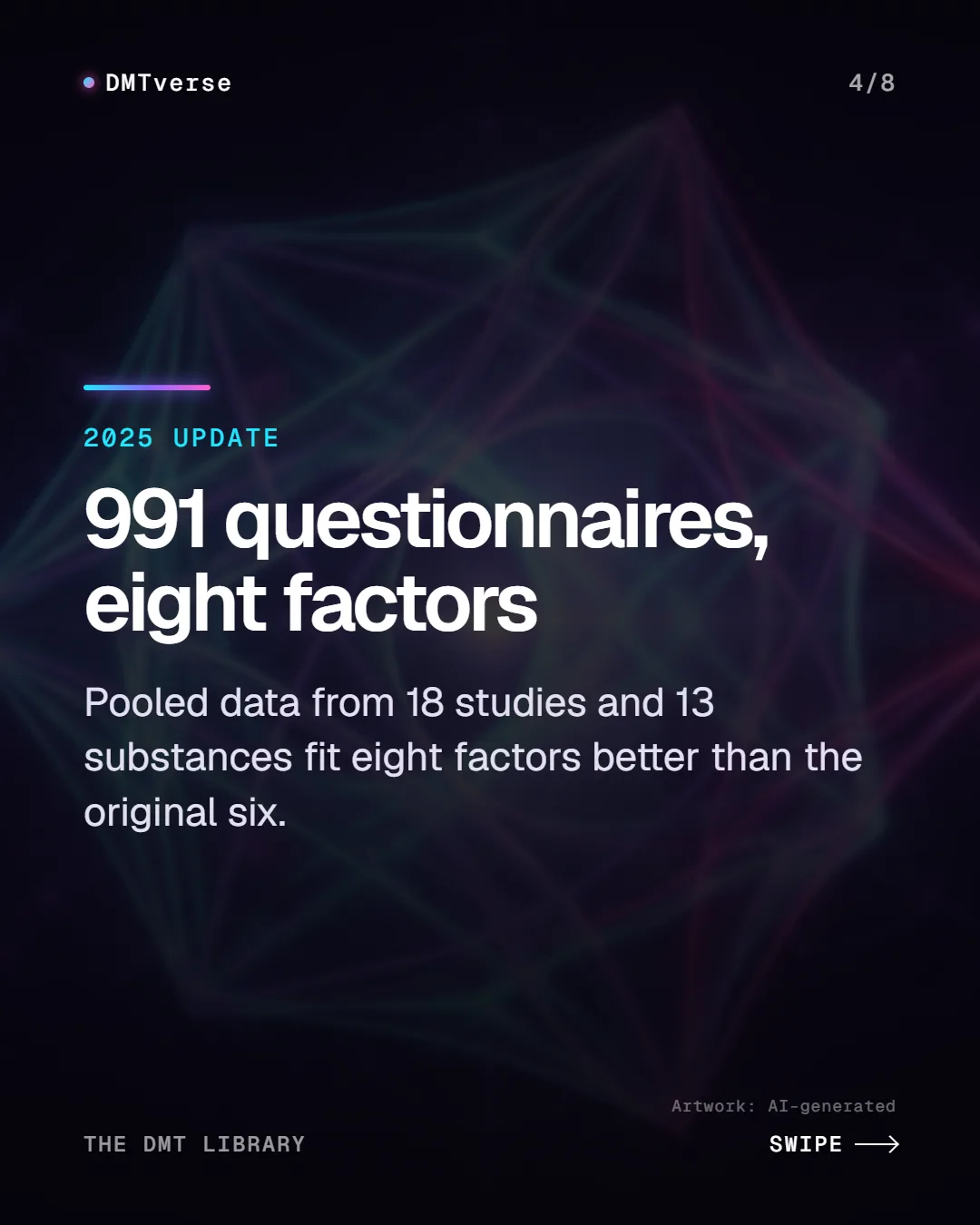
The scale has been tested beyond DMT. A Spanish version assessed in 75 ayahuasca users and 56 people recalling past hallucinogen use found that four of its six scales had acceptable internal consistency (Riba et al., 2001). In 2025, researchers pooled 991 HRS questionnaires from 18 publications covering 13 substances. The items resolved into eight factors rather than the original six, and patterns on those factors separated classic psychedelics such as psilocybin and DMT from dissociatives, empathogens, stimulants and THC (Calder et al., 2025). Evidence: established that the HRS is widely used and reasonably reliable; its best factor structure is still being refined.
Minute-by-minute intensity ratings
Questionnaires are filled in afterwards, from memory. To get closer to the moment, the 2019 Imperial study asked 13 participants for an intensity rating every minute while EEG was recorded. Peak subjective effects came 2–3 minutes after the injection, and effects differed significantly from placebo for 17 minutes (Timmermann et al., 2019). The ratings were later used to guide detailed interviews about how each experience progressed. The design had limits that the authors discuss: it was single-blind with a fixed order (placebo at the first visit, DMT a week later), and participants received different doses for safety and dose-finding reasons. Evidence: established for the time course in this setting; small sample.
What happens in the brain as intensity rises?
In the same study, DMT markedly reduced the brain’s alpha and beta rhythms compared with placebo, and the higher a person’s intensity rating, the lower their alpha and beta power. Signal diversity, a measure of how varied the EEG signal is, rose with intensity. Slower delta and theta rhythms emerged at the peak of the experience, particularly its eyes-closed visual component (Timmermann et al., 2019). Evidence: established for the alpha collapse tracking intensity; preliminary for delta and theta, from 13 people.
The authors go one step further and propose that the emergence of delta and theta together with the collapse of alpha may relate to the “DMT breakthrough experience”, as the brain switches from processing incoming information to an internally driven state (Timmermann et al., 2019). That is their hypothesis, not a finding: nobody has recorded a brain signal that marks the moment someone “breaks through”. Evidence: unresolved.
Is a breakthrough a switch or a continuum?
A 2026 study suggests the second. Researchers interviewed 23 participants in fine detail after they received DMT during combined fMRI and EEG scanning, using micro-phenomenology, a method that walks people slowly back through the moment-by-moment unfolding of an experience. The team extracted 125 categories and describe immersion as “a structured continuum from subtle to gross forms”: from single sensations up to whole configurations such as feeling located in an emerging environment (Sanders et al., 2026). Agreement between coders on the key results was rated almost perfect (κ = 0.82). Evidence: preliminary, from one lab study of 23 people.
The order in which things appeared was surprisingly regular (Sanders et al., 2026):
- Bodily effects usually came first, such as tingling or pressure.
- Visual and auditory effects followed, such as geometric patterns or a ringing sound.
- The senses combined and a three-dimensional space formed.
- Only after that space had formed did perceived presences appear, for those who reported them.
Some participants described being in two places at once: 35% reported a sense of multiple contexts, such as being aware of a strange environment and of the scanner room at the same time. The feeling that the experience was real came up in 26%, split between feeling real (22%) and unreal (9%) (Sanders et al., 2026). For a popular idea of “breaking through”, this matters: in this study, people did not jump from nothing to another world. Immersion built up in stages, and partial states were common. The setting was a scanner, the participants were experienced, and accounts were given afterwards, so the pattern may differ elsewhere. Evidence: preliminary.
Bodily effects first
Tingling, vibration or pressure typically came before anything seen or heard (Sanders et al., 2026).
Visual and auditory effects
Geometric patterns and sounds such as ringing or buzzing followed the bodily effects.
A 3D space forms
Senses combined into a sense of a three-dimensional environment.
Presences, if any, came last
Perceived presences emerged only after multisensory integration and 3D space had developed.
Restates Sanders et al., 2026. A description of reports from 23 participants in a scanner, not a prediction.
What did a field study of breakthrough experiences find?
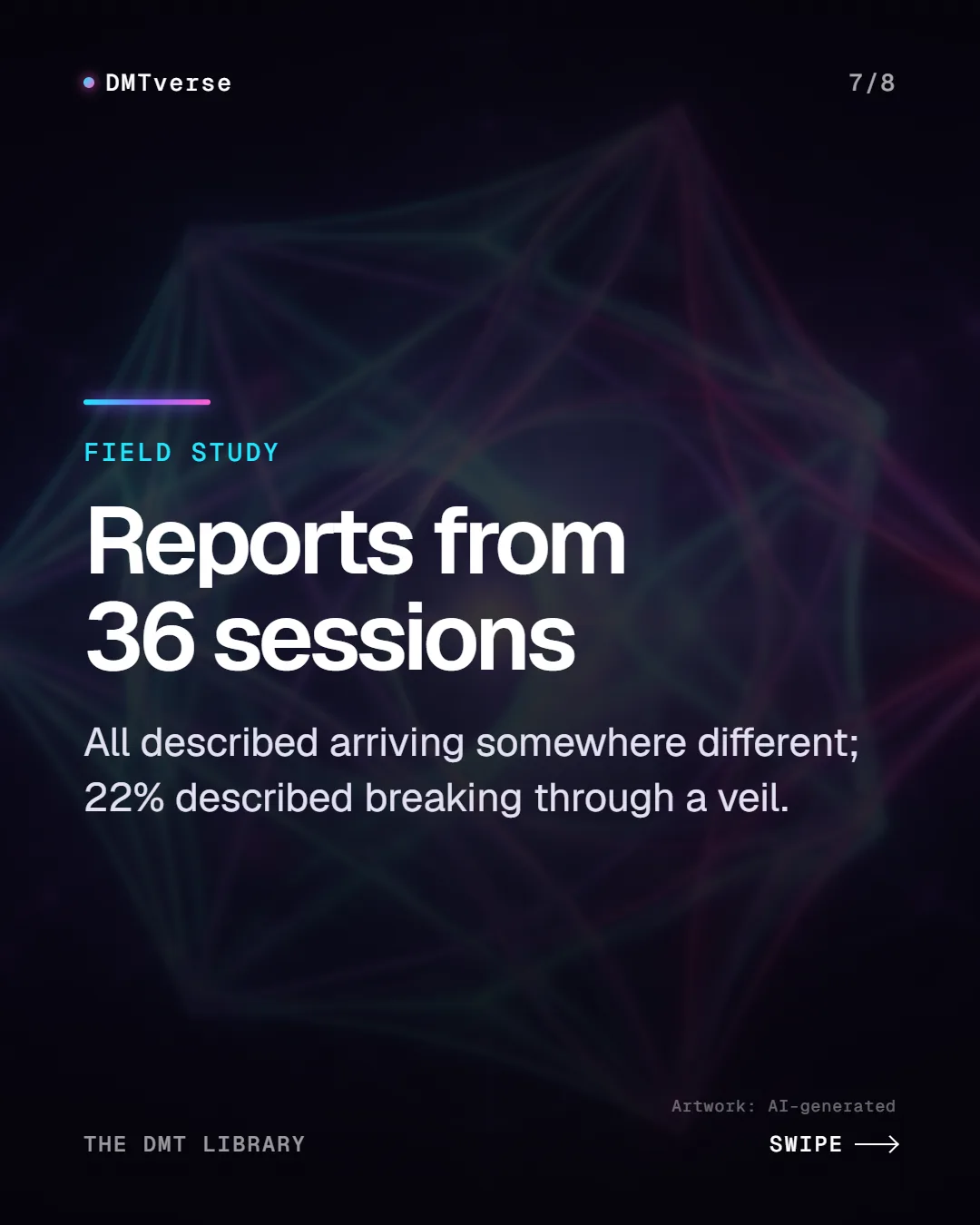
A 2021 naturalistic study observed experienced users in a home setting and interviewed them straight afterwards, yielding 36 interviews. Every participant described arriving at a qualitatively different space of consciousness or reality, which the authors call characteristic of the so-called breakthrough. Smaller proportions described “breaking through the veil” (22%) or emerging into a novel reality (58%) (Michael et al., 2021). The authors point out a selection bias: participants were experienced, screened and likely to volunteer because their experiences tended to be elaborate and meaningful. Evidence: preliminary; these are reports from a small convenience sample.
Large online samples show the same themes. In 3,778 experiences posted to a Reddit forum, alternate or higher dimensions were described in 25.2%, with “hyperspace” named in 17.1% (Lawrence et al., 2022). Our guide to the waiting room, the dome and the chrysanthemum explains this vocabulary and its limits. Evidence: preliminary; self-selected reports.
Is a more intense experience a “better” one?
Not according to the controlled studies. In a 2026 Basel study, peak subjective effects reached a ceiling partway up the range of doses tested (dose not reproduced here), and identical doses were rated less intense when given open-label, step by step, than when given blind (Erne et al., 2026). In a Basel infusion study of 22 people, “good drug effect” hit a ceiling, while the highest rate tested produced more anxious ego dissolution and significant anxiety compared with placebo (Erne et al., 2025). Evidence: preliminary; small samples, and none of this is advice.
Outside the lab, 41% of 2,561 self-selected survey respondents reported fear during their most memorable encounter (Davis et al., 2020). The 1994 study described a brief, overwhelming “rush” with “loss of control”, in which euphoria alternated or coexisted with anxiety (Strassman et al., 1994). Our article on DMT and ego death looks at that loss of self in more detail. Evidence: preliminary.
Risks, and where to get help in Canada
Canada’s Centre for Addiction and Mental Health (CAMH) warns that most hallucinogens are illegal and unregulated, may contain toxins or not contain the drug they are sold as, and can leave people disoriented, with poor judgment and more likely to take risks (CAMH). Intense, frightening states are part of the record above. If you are worried about yourself or someone else, help is available.
If someone is in danger
Call 911 for immediate danger or urgent medical help, including if someone is unconscious, not breathing or having a seizure. In Ontario, the Ontario Poison Centre is at 1-800-268-9017; every province has a poison centre, listed by SickKids (AboutKidsHealth). If you or someone you know is thinking about suicide, call or text 9-8-8, 24 hours a day (Government of Canada). See also our safety page and how to help someone having a bad trip.
What we still don’t know
- Whether “breakthrough” picks out a distinct state at all, or just the high end of a continuum (unresolved).
- Whether any brain signal marks the transition; the delta and theta link is a hypothesis from 13 people (unresolved).
- How far lab findings, gathered in scanners and hospital rooms with screened volunteers, apply to experiences elsewhere (unresolved).
- How much expectation and shared vocabulary shape what people report; open-label dosing changed intensity ratings in one study (preliminary).
- Which of the eight newer HRS factors best tracks what users call a breakthrough; no study has tested this (unresolved).
The fair summary: a breakthrough is a word people use for the far end of a scale that researchers measure in other ways. For the bigger picture, start with what is DMT, read how long DMT lasts, and see what researchers have recorded about entities.
Common questions
What is a DMT breakthrough?
It is a community term for the point at which ordinary experience is replaced by a sense of being in another world, often called “hyperspace”. Researchers do not treat it as a clinical category; studies that use it define it loosely as an experience with very strong effects.
Is “breakthrough” a scientific term?
No. Scientists borrow it in quotation marks. What they measure is intensity, using tools such as the Hallucinogen Rating Scale and minute-by-minute ratings, and immersion, using detailed interviews.
What is the Hallucinogen Rating Scale?
A questionnaire developed in the early 1990s for Rick Strassman’s DMT studies, drafted from interviews with 19 experienced DMT users. It covers bodily feelings, mood, perception, thinking, sense of control and intensity. A 2025 analysis of 991 questionnaires suggested eight factors fit better than the original six.
Does the brain show when someone breaks through?
Not directly. In a 2019 EEG study of 13 people, the alpha rhythm fell further as intensity ratings rose, and slower rhythms appeared at the peak. The authors proposed a link to the “breakthrough”, but that remains a hypothesis.
Is breaking through all or nothing?
A 2026 interview study of 23 participants describes immersion as a continuum: bodily effects first, then senses, then a 3D space, and only then any presences. Partial states, and being aware of two places at once, were common.
Does everyone who takes DMT break through?
The research does not answer that. Studies of breakthrough experiences often recruited people who already reported them, which builds in selection bias. Intensity also varies with dose, expectation and setting.
Is a stronger DMT experience better?
Controlled studies do not support that idea. Peak effects reached a ceiling, the highest infusion rate tested in one study produced significant anxiety, and 41% of a self-selected survey reported fear. This article gives no advice on use.
Shroomverse sells mushroom products. This article is general information about the DMT “breakthrough” and how researchers measure the intensity of DMT experiences. It is not medical, legal or purchasing advice, and it does not recommend any product.
SOURCES
- Dose-response study of N,N-dimethyltryptamine in humans. II. Subjective effects and preliminary results of a new rating scale (Strassman RJ, Qualls CR, Uhlenhuth EH, Kellner R, Archives of General Psychiatry 51(2):98, 1994), American Medical Association (peer-reviewed). Accessed . Abstract read via Europe PMC. HRS drafted from interviews with 19 experienced DMT users; 12 volunteers; HRS clustering resolved dose effects better than biological variables; “rush”, “loss of control”, euphoria with anxiety. Doses deliberately not reproduced.
- Psychometric assessment of the Hallucinogen Rating Scale (Riba J, Rodríguez-Fornells A, Strassman RJ, Barbanoj MJ, Drug and Alcohol Dependence 62(3):215–223, 2001), Elsevier (peer-reviewed). Accessed . Abstract read via Europe PMC. Spanish HRS in 75 ayahuasca users and 56 polydrug users; four of six scales had acceptable internal consistency; reasonable convergent validity.
- The Hallucinogen Rating Scale: Updated Factor Structure in a Large, Multistudy Sample (Calder AE, Qualls C, Hasler G, Elmiger D, Strassman R, Biological Psychiatry Global Open Science 5(2):100436, 2025), Elsevier (peer-reviewed, open access); PMC11804565. Accessed . Abstract read via Europe PMC. 991 questionnaires from 18 publications and 13 substances; eight factors; classic psychedelics distinguished from other drug classes.
- Neural correlates of the DMT experience assessed with multivariate EEG (Timmermann C, et al., Scientific Reports 9:16324, 2019), Springer Nature (peer-reviewed, open access); PMC6864083. Accessed . Full text read via Europe PMC. 13 participants; single-blind, fixed order; real-time intensity ratings each minute; peak at 2–3 minutes; effects differed from placebo for 17 minutes; alpha and beta fell with intensity; delta/theta at peak; “breakthrough” used in quotation marks and the authors’ hypothesis linking it to delta/theta.
- Micro-phenomenology of immersion and perceived presences under DMT (Sanders JW, Millière R, Demšar E, Daily ZG, Erritzoe D, Carhart-Harris R, Timmermann C, Neuroscience of Consciousness, niag015, 2026), Oxford University Press (peer-reviewed, open access); PMC13366535. Accessed . Full text read via Europe PMC. 23 participants in fMRI-EEG; 125 categories; immersion as a continuum from subtle to gross; body before senses, 3D space before presences; κ = 0.82; multiple contexts 35%; feeling of reality 26% (real 22%, unreal 9%).
- An Encounter With the Other: A Thematic and Content Analysis of DMT Experiences From a Naturalistic Field Study (Michael P, Luke D, Robinson O, Frontiers in Psychology 12:720717, 2021), Frontiers (peer-reviewed, open access); PMC8716686. Accessed . Full text read via Europe PMC. 36 post-experience interviews; inclusion required a prior breakthrough experience (typically highly intense and perceptually immersive); 100% arrival in a different space; breaking through the veil 22%; emergence into a novel reality 58%; selection-bias limits; summary of the Davis 2020 breakthrough definition.
- Phenomenology and content of the inhaled N,N-dimethyltryptamine (N,N-DMT) experience (Lawrence DW, Carhart-Harris R, Griffiths R, Timmermann C, Scientific Reports 12:8562, 2022), Springer Nature (peer-reviewed, open access); PMC9130218. Accessed . Full text read via Europe PMC. 3,778 r/DMT experiences; alternate or higher dimensions 25.2%; hyperspace 17.1%; description of the six HRS domains.
- Survey of entity encounter experiences occasioned by inhaled N,N-dimethyltryptamine (Davis AK, Clifton JM, Weaver EG, Hurwitz ES, Johnson MW, Griffiths RR, Journal of Psychopharmacology 34(9):1008–1020, 2020), SAGE (peer-reviewed). Accessed . Abstract read via Europe PMC: 2,561 self-selected respondents; 41% reported fear. Its breakthrough definition is cited as summarised in Michael et al. 2021 (secondary).
- The Breakthrough Experience: DMT Hyperspace and its Liminal Aesthetics (St John G, Anthropology of Consciousness 29(1):57–76, 2018), Wiley / American Anthropological Association (peer-reviewed). Accessed . Abstract read via the Crossref record. Breakthrough as an event commonly associated with the DMT trance; perceived contact with entities and visual language; hyperspace as a private, individualised, “ritual like” passage.
- The DMT Trip and the Mysteries of Hyperspace Travel (St John G, 9 March 2017), Chacruna Institute for Psychedelic Plant Medicines. Accessed . Essay read. Breakthrough as a passage that may be disturbing or exhilarating. Cultural commentary, not research data.
- Trips and neurotransmitters: Discovering principled patterns across 6850 hallucinogenic experiences (Ballentine G, Friedman SF, Bzdok D, Science Advances 8(11):eabl6989, 2022), AAAS (peer-reviewed, open access); PMC8926331. Accessed . Full text read via Europe PMC. 6,850 testimonials about 27 drugs; “breakthrough” among terms on the dominant (mental expansion) factor and on a body-load factor.
- Acute dose-dependent effects and self-guided titration of continuous N,N-dimethyltryptamine infusions (Erne L, et al., Neuropsychopharmacology 50(6):1008–1016, 2025), Springer Nature (peer-reviewed); PMC12032411. Accessed . Abstract read via Europe PMC. 22 participants, double-blind crossover; ceiling for “good drug effect”; highest rate produced more anxious ego dissolution and significant anxiety. Rates not reproduced.
- Dose-dependent pharmacokinetics and acute effects of intravenous bolus N,N-dimethyltryptamine: double-blind, randomized versus open-label dose-escalation (Erne L, et al., Translational Psychiatry 16:213, 2026), Springer Nature (peer-reviewed, open access); PMC13039932. Accessed . Abstract read via Europe PMC. 20 blinded + 16 open-label participants; ceiling for peak effects; equivalent doses rated less intense and better tolerated open-label. Doses not reproduced.
- Hallucinogens, Centre for Addiction and Mental Health (CAMH). Accessed . Page read. Hallucinogens illegal and unregulated, may include toxins or other drugs; disorientation, poor judgment, risk-taking.
- Mental health support: get help, Government of Canada, Public Health Agency of Canada. Accessed . Page read. Call 9-1-1 in immediate danger; call or text 9-8-8, 24/7.
- Poison information centres in Canada, AboutKidsHealth, The Hospital for Sick Children (SickKids). Accessed . Page read. Ontario toll-free 1-800-268-9017; call 911 if someone is unconscious, not breathing or having a seizure.
CHANGES
- : Linked glossary definitions.
- : Published. All sources opened and checked on this date.
- : Editorial review: two long paragraphs split with separate evidence labels; link to the ego-death article added. Figures re-checked against the Lawrence 2022, Michael 2021 and Sanders 2026 full texts.



