THE SHROOMVERSE JOURNAL ✳ 13 MIN READ
Machine elves: where the phrase came from, and how rare elves really are in DMT reports
Topic: DMT
Published Updated
Listen: the 3-minute version
AI-narrated summary of this article
Short answer, checked 20 October 2026
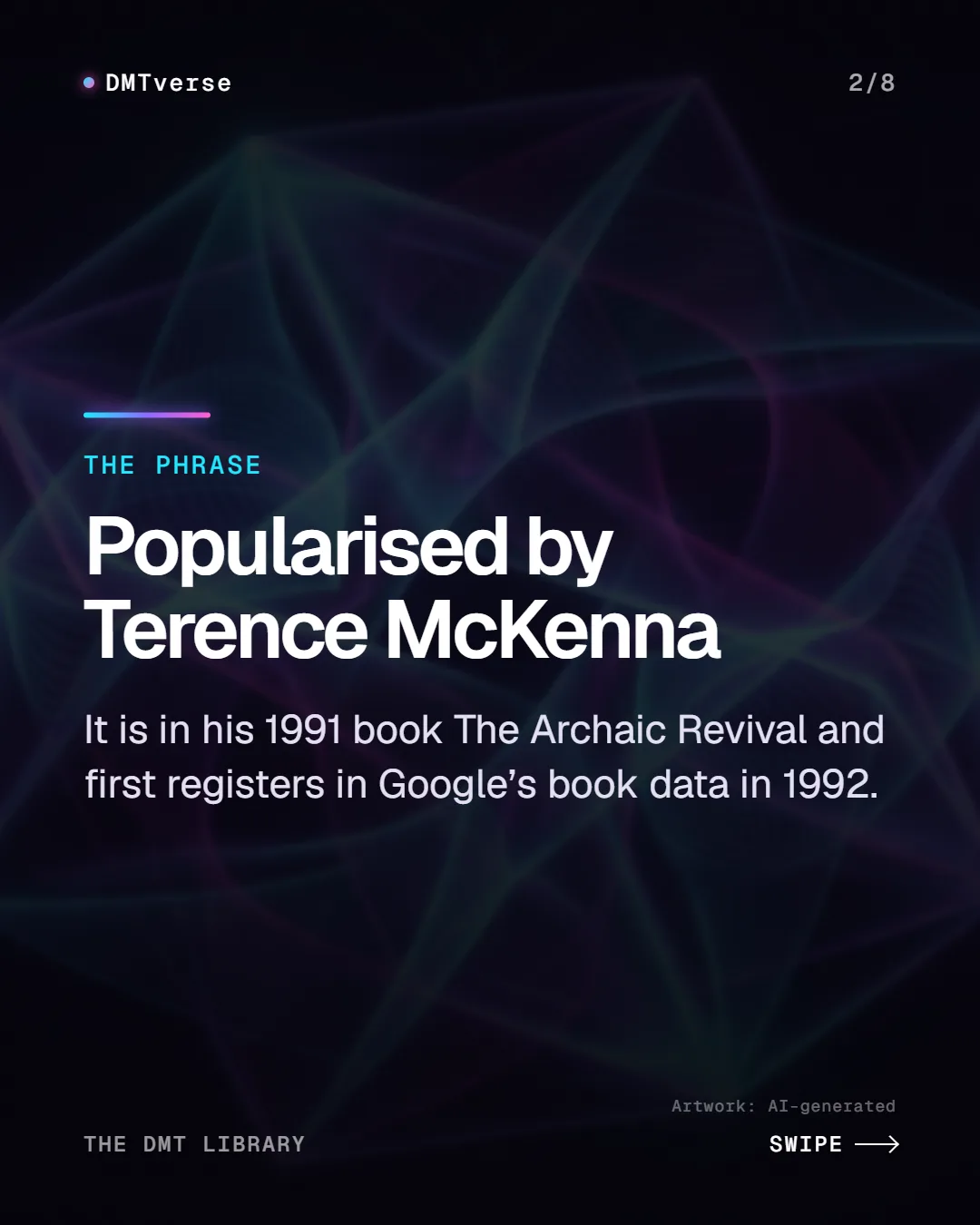
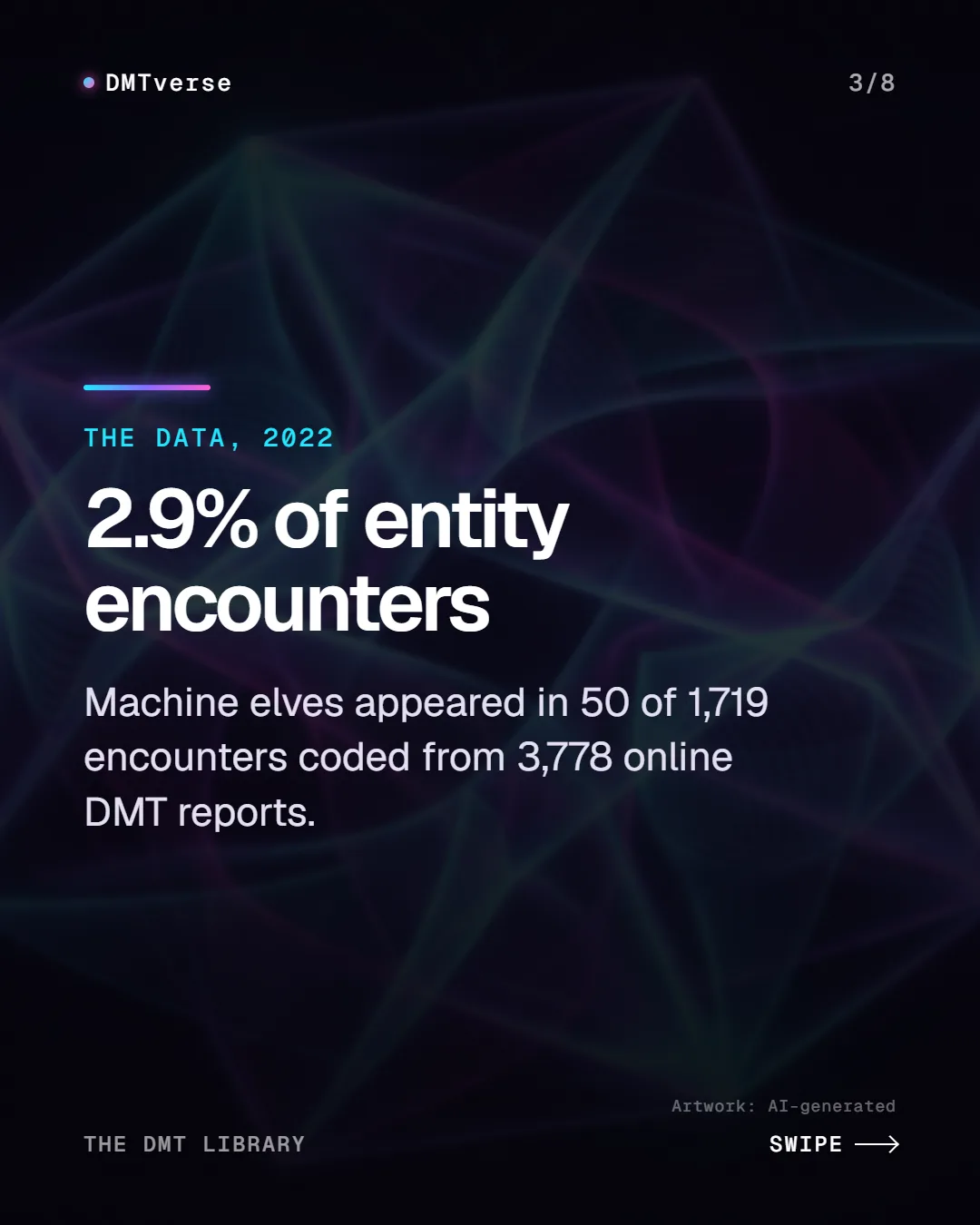
“Machine elves” is a phrase popularised by the American writer Terence McKenna for small, endlessly shape-shifting, mechanical-seeming beings that some people describe meeting on DMT. It first appears in his books in 1991 and registers in Google’s book data from 1992. Despite its fame, it describes a small minority of reports: in a study of 3,778 online DMT accounts, machine elves made up 2.9% of the 1,719 entity encounters, and in a home field study elf- or faerie-like beings were among the least common types, at 3%. The study authors also warn that a famous label can colour how later experiences are described. None of this tells us what, if anything, the beings are.
THE SHORT VERSION · SWIPE
On this page 9 sections
Few phrases are as closely tied to DMT as “machine elves”. It turns up in podcasts, comics, memes and novels, and many people meet it before they read any research. This guide traces where the phrase came from, what the studies actually counted, and why researchers think a catchy label may shape the very reports it is used to describe. For the broader research picture, start with our pillar, what is DMT, and DMT entity encounters: what the research says.
Education only, not guidance
This article describes published research and cultural history. It gives no amounts, no instructions and no advice on use, and it does not describe any effect as a benefit. DMT is a controlled substance in Canada. Evidence labels used below: established (shown in peer-reviewed studies and not seriously disputed), preliminary (early, small, self-selected or indirect) and unresolved (an open question). Reports of experiences are labelled as reports.
What are machine elves?
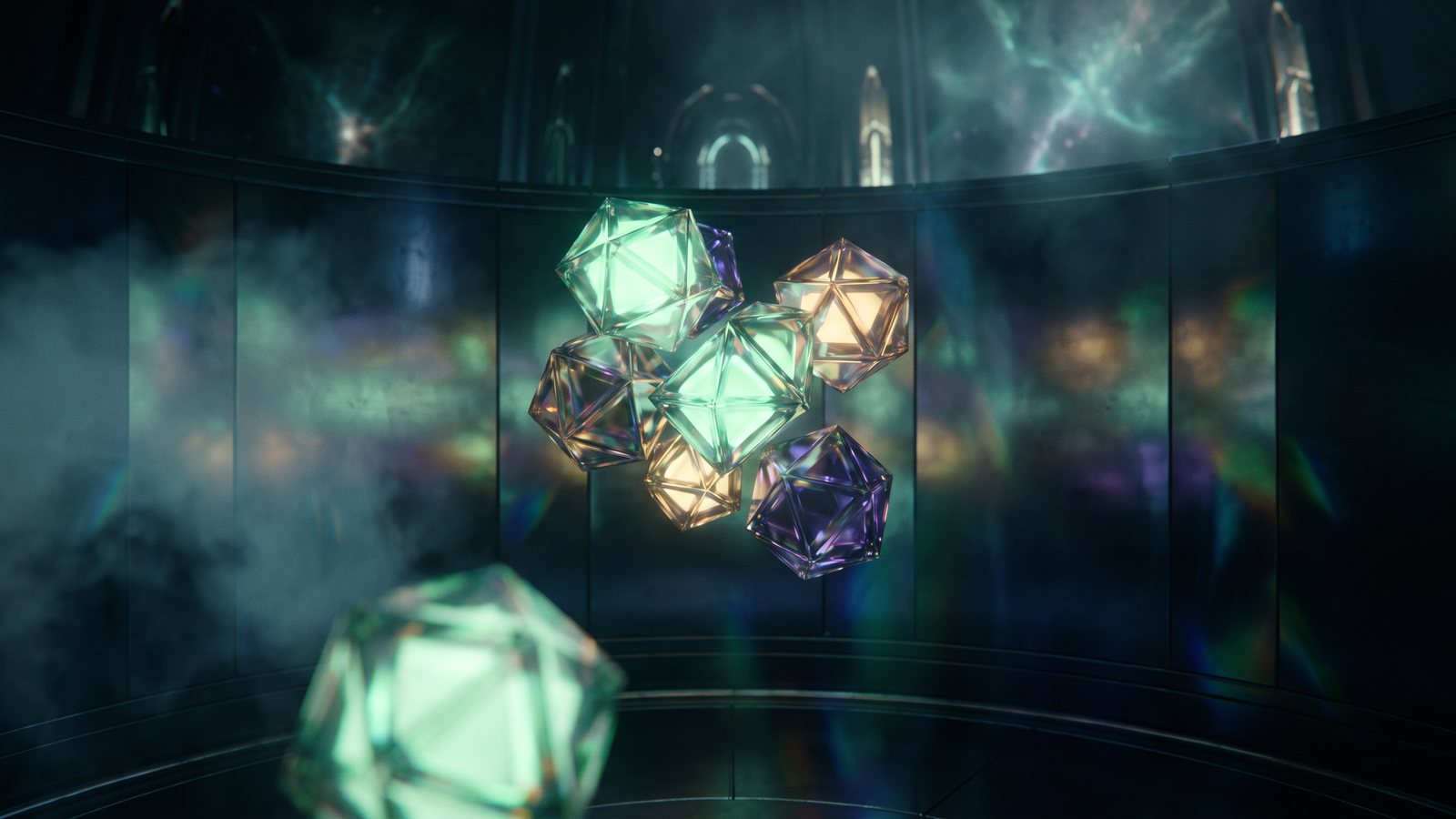
In the reports that use the phrase, machine elves are small, playful or mischievous beings that seem to be made of shifting, mechanical or geometric material, constantly folding and rebuilding themselves. A 2021 field study of 36 interviews with experienced users found that the single most common “texture” people gave to the beings they met was “self-transforming”, a tendency to morph in constant flux. The authors explicitly link that description to McKenna’s machine elves, citing a 1993 recorded talk of his (Michael et al., 2021). One participant described a spinning, cog-like, self-transforming machine world inhabited by beings with an elf-like mischievousness. These are reports of experiences. Evidence: preliminary.
So the phrase names a recognisable style of description: part machine, part sprite, part living geometry. It is not a scientific category, and no study defines “machine elf” as a measured type with fixed criteria. Coders who sort online reports simply count the times authors use the label or describe something that clearly fits it.
Where does the phrase “machine elves” come from?
The phrase is credited to Terence McKenna, an American writer and lecturer on psychedelics. We paraphrase rather than quote him. According to the cultural historian Graham St John, McKenna first took DMT in the fall of 1965 in Berkeley, California, and later described the experience as overturning his intellectual world. St John calls him a talkative front man for the “machine elves of hyperspace” (St John, excerpt via Chacruna). Evidence: established that McKenna popularised the phrase.
When was it first used? Our earlier reading of St John’s 2015 cultural history dated the earliest spoken use to a McKenna lecture of 2 October 1987. St John’s published excerpt does cite a McKenna lecture of that date, for his account of his first DMT experience, but it does not show the phrase itself in that talk. We could not open a recording or transcript, so treat the 1987 date as provisional. Evidence: unresolved.
The printed record is easier to check. A full-text search of the Open Library and Internet Archive book collection for the exact phrase returned 142 matches, and the earliest dated book among them is McKenna’s own 1991 collection, The Archaic Revival (Open Library full-text search). In Google’s Books Ngram data, the phrase is absent from 1960 to 1991 and first registers in 1992 (Google Books Ngram). Evidence: established for the 1991 book use.
- Fall 1965Terence McKenna first takes DMT, in Berkeley, according to St John’s history.Source St John (Chacruna excerpt)
- 2 Oct 1987Possible earliest dated spoken use, from our reading of St John’s history. Not confirmed.Source St John 2015 (not re-checked)
- 1991The phrase appears in McKenna’s book The Archaic Revival.Source Open Library full-text search
- 1992First year the phrase registers in Google’s Books Ngram data.Source Google Books Ngram
- 1994–2008The phrase spreads into books on cyberculture, science journalism, fiction, comics and a 2008 book co-written by DMT researcher Rick Strassman.Source Open Library full-text search
- 2011, 2015, 2018The three highest points of the phrase in Ngram data to date.Source Google Books Ngram
- 2021A field study links the most common entity texture, “self-transforming”, to McKenna’s phrase.Source Michael et al., 2021
- 2022A study of 3,778 online reports counts machine elves in 2.9% of entity encounters and flags the label as a possible influence on later reports.Source Lawrence et al., 2022
How common are machine elves in DMT studies?
Much less common than their fame suggests. The largest count comes from a team led by David Lawrence of the University of Toronto, which coded every DMT experience posted to one online forum from 2009 to 2018: 3,778 experiences in 3,305 posts. Entities appeared in 1,719 experiences (45.5%). Machine elves appeared in 50 of those encounters (2.9%), and other elves in 30 (1.7%). Both sit inside a broader “mythological beings” group (8.4% of encounters) that also includes faeries, sprites, trolls, gnomes and dragons (Lawrence et al., 2022). Evidence: preliminary.
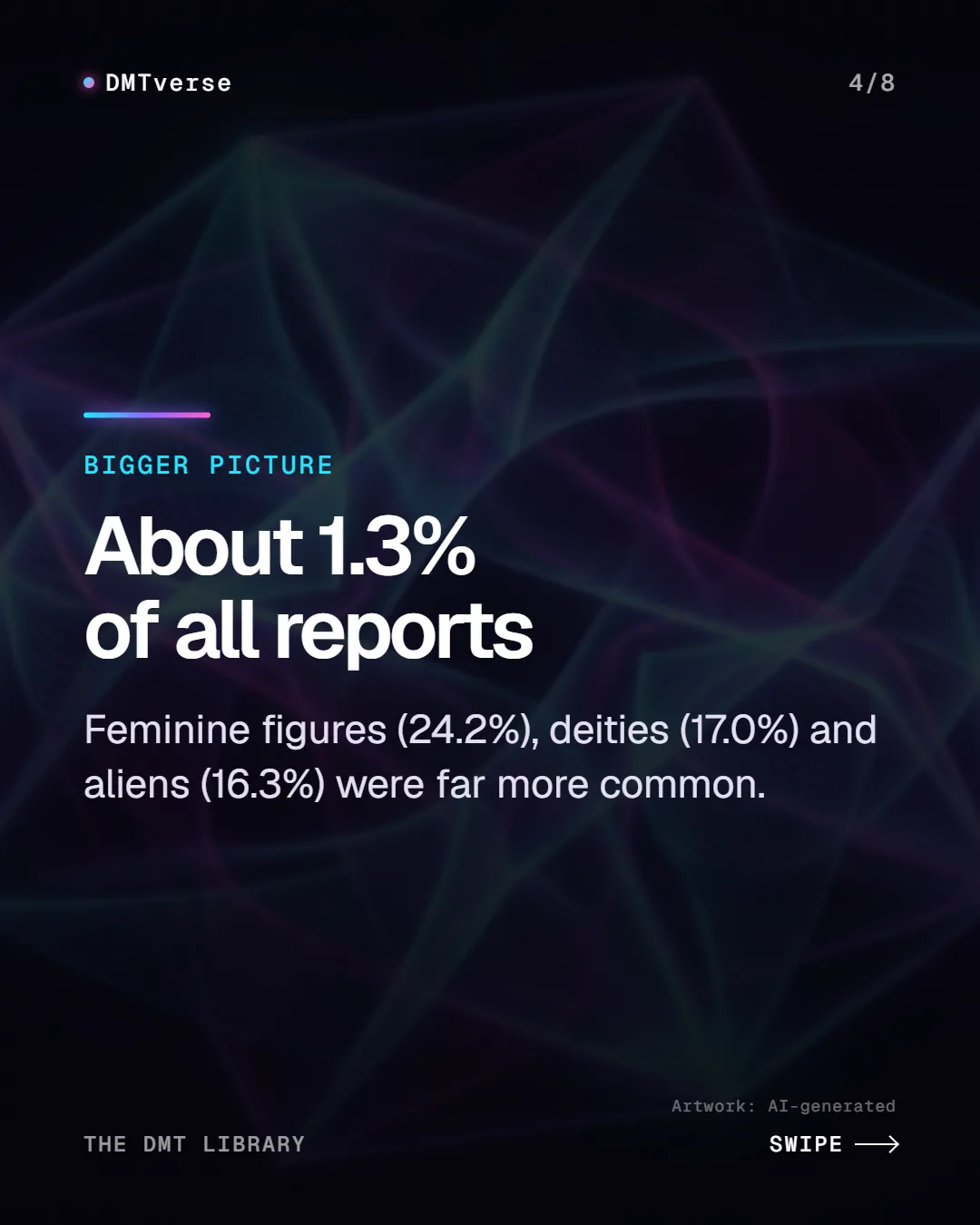
Put another way, 50 machine-elf reports among 3,778 experiences is about 1.3% of all experiences in the sample. The most common entity types were feminine figures (24.2% of encounters), deities (17.0%) and aliens (16.3%). A separate “robot or machine entity” category, without the elf element, was itself more frequent than machine elves, at 6.7% (Lawrence et al., 2022). These are self-selected public posts, which favour striking trips. Evidence: preliminary.
Survey with a ready-made list of labels
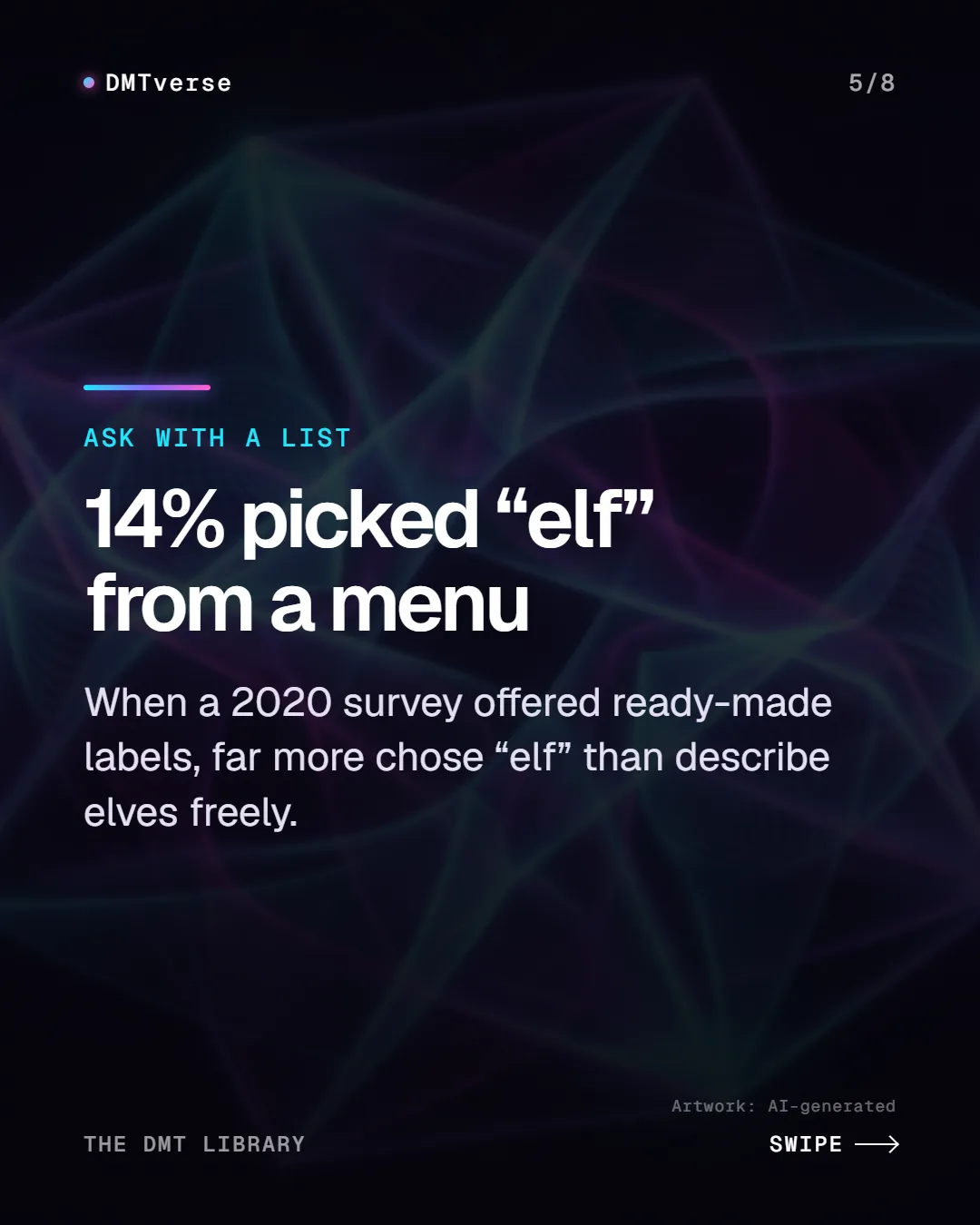
In a 2020 survey of 2,561 people describing their most memorable encounter, 14% picked “elf” and 8% “faerie” from a list of labels, as reported by Michael et al., 2021, comparing their results with Davis et al., 2020.
Coded online reports
Among 1,719 entity encounters in 3,778 forum reports, machine elves were 2.9% and other elves 1.7% (Lawrence et al., 2022).
Home field study, interviews straight afterwards
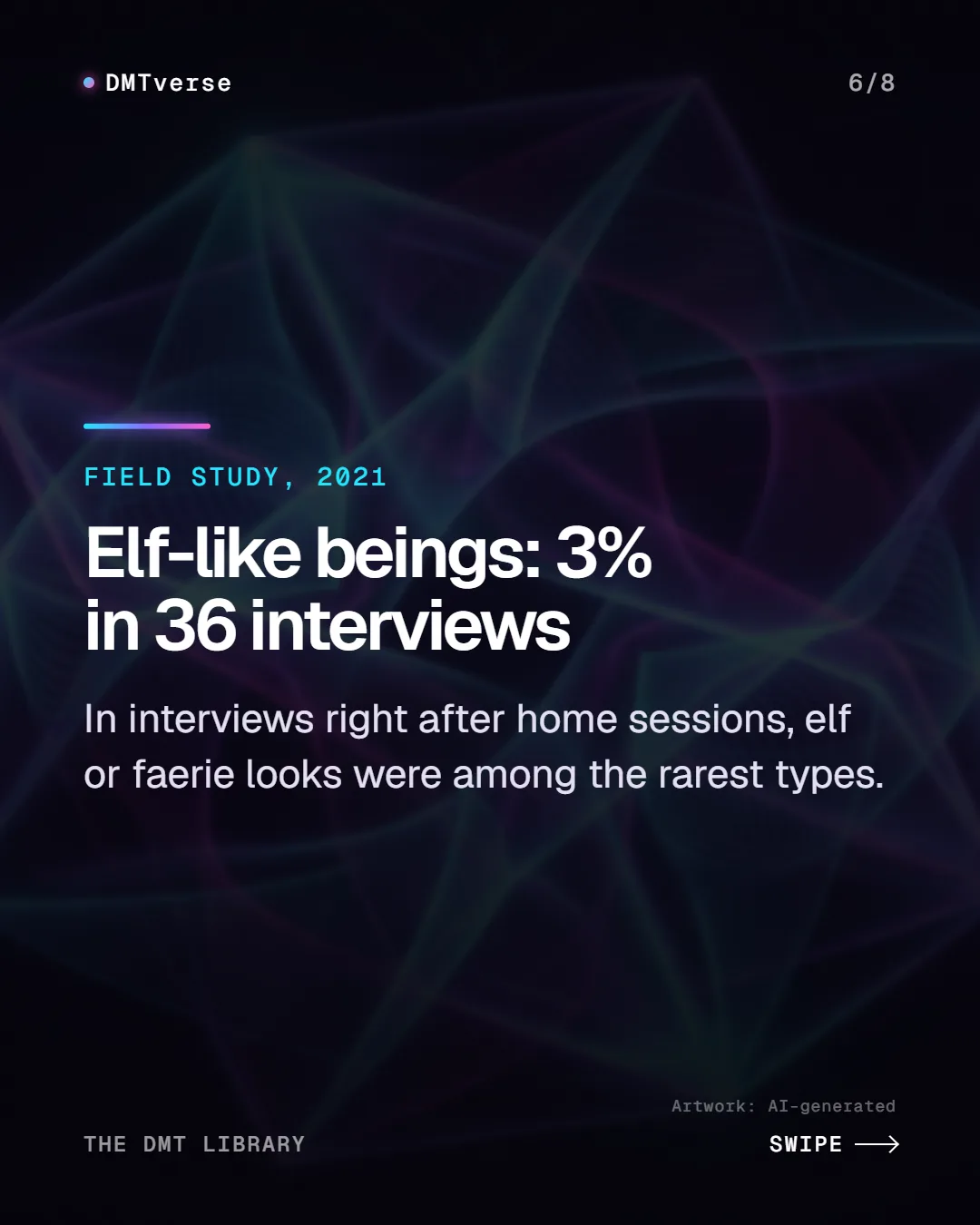
In 36 interviews, beings that looked like elves or faeries were among the least common types, at 3% (Michael et al., 2021).
Different samples and denominators: the bars show how much the figure moves with the method, not a true population rate.
Why does the share of elves change with the method?
Because a list puts words in people’s mouths. The 2021 field study points out that the 2020 survey mostly used fixed, pre-set answer options, while its own participants described what they met in their own words (Michael et al., 2021). When “elf” is on the menu, some people who met something small, quick and strange will tick it. When nobody suggests the word, far fewer reach for it. The same pattern shows up for other features, which is why our article on DMT entity types gives figures by method. Evidence: preliminary.
The 2021 paper also cites an earlier content analysis of 149 online reports, by Lyke (2019), subtitled “Not everyone gets machine elves”, which put elves and faeries together at about 7% of encounters (Michael et al., 2021). We could not open that analysis directly, so we report it only as described by the 2021 paper. Across every sample we found, elf-type beings were a minority. Evidence: preliminary, from self-selected samples.
How did the label spread?
Through books first, then the internet. The Open Library full-text search for the exact phrase returned matches across very different kinds of book: cyberculture writing from 1994, popular science and spirituality titles in the 2000s, a superhero comic in 2007, short fiction, poetry, and a 2008 book on DMT and alien encounters co-written by Rick Strassman (Open Library full-text search). That search covers only scanned books in one library, so it shows that the phrase travelled widely, not how many people used it. Evidence: established for the printed record.
Google’s book data show the same rise in outline: nothing before 1992, then growth with peaks in 2011, 2015 and 2018 (Google Books Ngram). Ngram counts only phrases that appear in enough books, so the first year it registers is not the first use. It also leaves out podcasts, forums and video, where much of the later spread happened. No study we found has measured how media shaped the vocabulary of DMT reports over time. Evidence: established that the phrase spread in print; unresolved how much media drove later reports.
Can a famous label shape what people report?
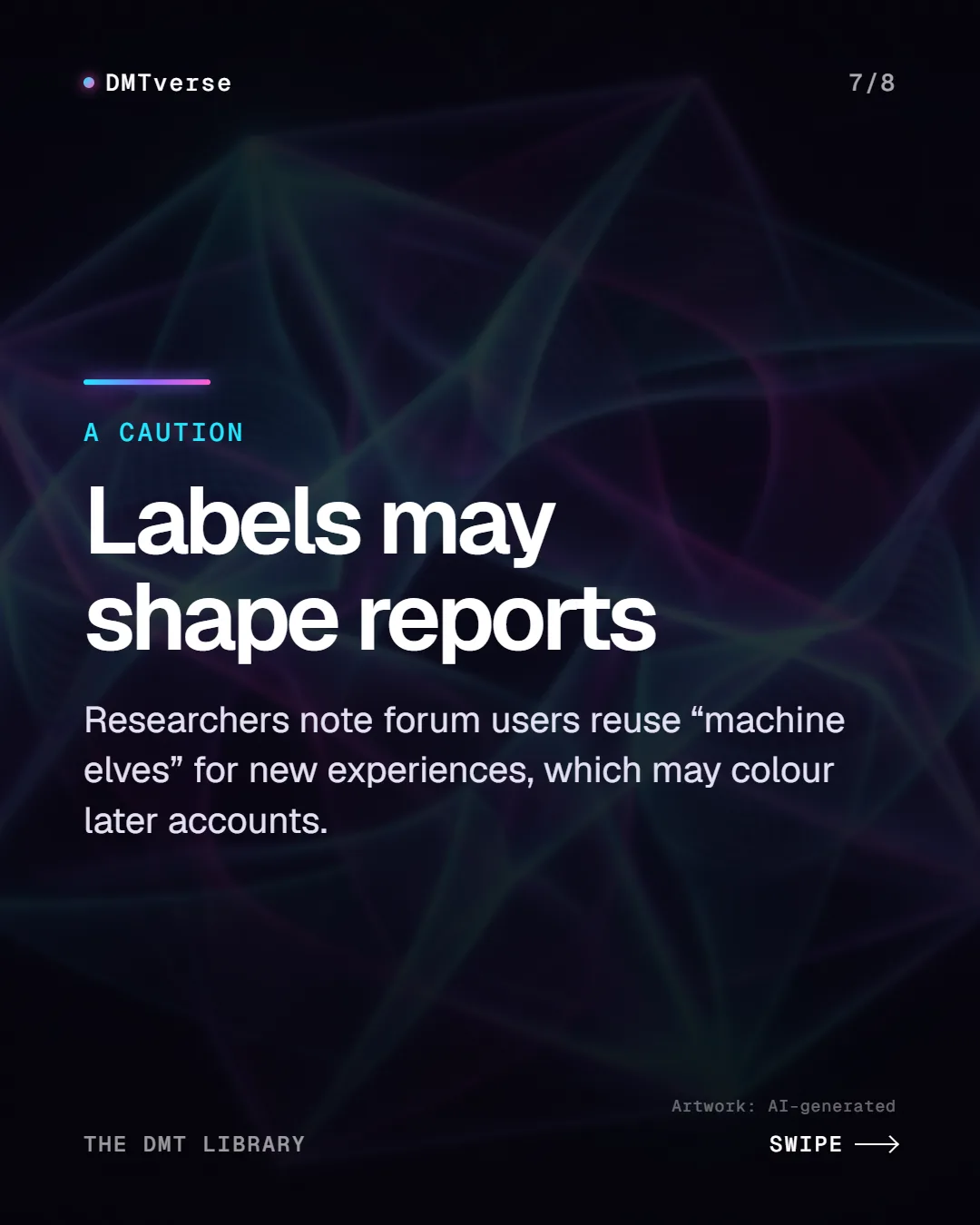
The researchers who counted the elves think it may. In their list of limitations, the 2022 authors note that earlier posts on the forum may influence later users’ experiences and the way they report them, and they give the repeated use of ready-made terms such as “machine elves” for otherwise new experiences as the evidence (Lawrence et al., 2022). The 2021 field team designed their interviews partly to avoid this, encouraging people to describe what they noticed in their own words rather than sort it into cultural categories such as “alien”, which they say can spread like memes (Michael et al., 2021).
There are two separate ways a label could matter, and the evidence differs for each:
- Shaping the report. Someone meets something hard to describe and reaches for the nearest famous word. This is close to certain for some reports, because the label is so often used for experiences that do not closely match it (preliminary).
- Shaping the experience itself. Expectations and shared stories change what people actually perceive. This is plausible and has support outside DMT (see below), but no controlled DMT study has tested it (unresolved).
Outside DMT, there is support for the second idea. An anthropologist who spent 18 months at a ceremonial ayahuasca centre in the Peruvian Amazon describes how group discussion, ritual songs and the centre’s Christian-inflected cosmology shaped not only how participants interpreted their visions but what they reported seeing, including frequent “demons” (Dupuis, 2022). Evidence: preliminary, from one centre.
A 2026 theory paper on entity encounters notes that entities take culturally specific forms, including spirits, elves and ancestors, and cites a study in which almost half of white Westerners who took ibogaine reported visions of television screens, which are rare in accounts from traditional African users (Mago et al., 2026). In a preregistered lab study, telling people to expect more voices in noise made them report more voices, especially when the sound was unclear (Szymanek et al., 2024). None of these studies involved DMT entities. Evidence: preliminary.
What do machine elves tell us about the DMT experience?
Mostly, they tell us about the gap between a famous story and the data. The features that are common across studies are less quotable: the beings are usually described as conscious, intelligent and benevolent, communication is reported in most encounters, and fear is also common, reported by 41% of the 2020 survey (Davis et al., 2020). A 2026 lab study that interviewed 23 people in fine detail found that perceived presences arrived only after a sense of a three-dimensional space had formed, and varied widely in form (Sanders et al., 2026). That structure looks more consistent than any single cast of characters. Evidence: preliminary.
Elf reports also do not settle what the beings are. Some people take them as contact with independent intelligences; most neuroscientists treat them as products of the brain in an unusual state. The studies on this page record what people say. None tests whether anything exists outside the experience, and the authors do not claim to. We stay neutral on that question here; our DMT entity types guide sets out the competing explanations side by side. Evidence: unresolved.
What we still don’t know
- The exact date of the first spoken use of the phrase. A 1987 lecture is a candidate; we could not check a recording (unresolved).
- Whether the share of elf reports has changed over time, or tracks media moments such as books, films and podcasts. The dated forum posts exist, but no one has analysed them this way (unresolved).
- Whether hearing about machine elves beforehand changes what people experience, rather than just how they describe it. No controlled DMT study has tested expectation and entity content (unresolved).
- How common elf-type reports are among all people who use DMT. Every sample so far is self-selected (unresolved).
The fair summary: “machine elves” is a vivid phrase from 1980s and 1990s psychedelic writing that became the internet’s shorthand for DMT, while the beings it names appear in only a few percent of recorded encounters. For what people more often report, see DMT entity types explained; for why these meetings feel so convincing, see why DMT feels more real than reality.
Common questions
What are machine elves?
A phrase popularised by Terence McKenna for small, constantly shape-shifting beings that seem part machine, part sprite, described in some DMT reports. It is a cultural label, not a scientific category.
Are “mechanical elves” the same as machine elves?
Yes, in everyday use. “Mechanical elves” and “DMT elves” are looser wordings for the same idea. The phrase found in McKenna’s 1991 book and in the research literature is “machine elves”, and studies count it as one small group of entity reports.
What do people say machine elves look like?
Reports describe small, playful or mischievous beings that seem made of shifting, mechanical or geometric material, constantly folding and rebuilding themselves. In a 2021 field study, “self-transforming” was the texture people most often gave to the beings they met, and one participant described elf-like beings in a spinning, cog-like machine world. These are reports of experiences, not descriptions of anything verified.
What other creatures do people report on DMT?
Far more varied ones than elves. In 1,719 entity encounters coded from online reports, the most common types were feminine figures (24.2%), deities (17.0%) and aliens (16.3%), and robot or machine entities (6.7%) were more common than machine elves (2.9%). Our guide to DMT entity types sets out the full range.
Who coined the term machine elves?
It is credited to the American writer Terence McKenna. Graham St John’s 2015 history points to a 1987 lecture as a possible earliest spoken use, which we could not confirm. The phrase appears in McKenna’s 1991 book The Archaic Revival and registers in Google’s book data from 1992.
Does everyone who takes DMT see machine elves?
No. In 3,778 coded online reports, entities appeared in 45.5% of experiences, and machine elves in only 2.9% of those encounters, about 1.3% of all experiences. In a field study of 36 interviews, elf- or faerie-like beings were among the least common types, at 3%.
Why do some surveys find more elves?
Because of how they ask. When a 2020 survey offered a list of labels, 14% picked “elf”. When people describe encounters in their own words, the share is far lower. A ready-made option makes a label easier to choose.
Can the phrase machine elves influence DMT experiences?
Researchers think it may at least shape how experiences are reported: one study notes forum users repeatedly applying the label to otherwise new experiences. Whether it changes the experience itself has not been tested in a controlled DMT study.
Are machine elves real?
Studies record what people report and believe, not whether the beings exist. Interpretations range from independent intelligences to products of the brain. No published study has tested the question directly.
Shroomverse sells mushroom products. This article is general information about the history of the phrase “machine elves” and published research on reported DMT experiences. It is not medical, legal or purchasing advice, and it does not recommend any product.
SOURCES
- Phenomenology and content of the inhaled N,N-dimethyltryptamine (N,N-DMT) experience (Lawrence DW, Carhart-Harris R, Griffiths R, Timmermann C, Scientific Reports 12:8562, 2022), Springer Nature (peer-reviewed, open access); full text via Europe PMC, PMC9130218. Accessed . Full text read. Supports 3,778 experiences in 3,305 posts (2009–2018); entities in 1,719 (45.5%); machine elves 50 (2.9% of encounters), elves NOS 30 (1.7%), mythological beings 8.4%, robot or machine entity 6.7%; feminine 24.2%, deities 17.0%, aliens 16.3%; first author at the University of Toronto; the limitation that earlier posts may influence later reports, shown by recurrent labels such as “machine elves”. Study dose figures deliberately not reproduced.
- An Encounter With the Other: A Thematic and Content Analysis of DMT Experiences From a Naturalistic Field Study (Michael P, Luke D, Robinson O, Frontiers in Psychology 12:720717, 2021), Frontiers (peer-reviewed, open access); full text via Europe PMC, PMC8716686. Accessed . Full text read. Supports 36 interviews; “self-transforming” as the most often reported texture, linked to McKenna’s “machine elves” (citing a 1993 talk); the elf-like machine-world account; elf- or faerie-looking beings 3%; the comparison with Davis et al. 2020 (fixed-choice labels: elf 14%, faerie 8%); Lyke (2019) “Not everyone gets machine elves”, elves/faeries 7% (secondary); interviews designed to avoid cultural categories spreading like memes. Study dose range deliberately not reproduced.
- Survey of entity encounter experiences occasioned by inhaled N,N-dimethyltryptamine: Phenomenology, interpretation, and enduring effects (Davis AK, Clifton JM, Weaver EG, Hurwitz ES, Johnson MW, Griffiths RR, Journal of Psychopharmacology 34(9):1008–1020, 2020), SAGE (peer-reviewed). Accessed . Abstract read via Europe PMC (full text not open to us today). Supports 2,561 self-selected respondents describing their most memorable encounter; 41% fear; entity attributes conscious, intelligent, benevolent. The 14% “elf” and 8% “faerie” label figures are as reported by Michael et al. 2021.
- When Terence McKenna First Smoked DMT (Graham St John; excerpt from Mystery School in Hyperspace: A Cultural History of DMT, North Atlantic Books, 2015), Chacruna Institute for Psychedelic Plant Medicines. Accessed . Page read in full. Supports fall 1965 in Berkeley as McKenna’s first DMT experience (citing Dennis McKenna, 2012), St John’s description of him as a front man for the “machine elves of hyperspace”, and a citation of a McKenna lecture dated 2 October 1987. The excerpt does not itself show which lecture first used the phrase; that dating comes from the DMTverse ledger’s reading of the book (claim H7, 1 October 2026).
- Open Library full-text search inside books: “machine elves”, Open Library / Internet Archive. Accessed . Search API queried 20 October 2026 (no personal data sent): 142 matches; earliest dated hit The Archaic Revival (Terence McKenna, 1991); later hits include Cyberia (1994), Rational Mysticism (2003), Extremis (2007) and Inner Paths to Outer Space (2008). Covers scanned books only.
- Google Books Ngram Viewer: “machine elves”, English corpus, 1960–2022, Google. Accessed . JSON data read 20 October 2026: zero 1960–1991, first nonzero year 1992, highest years 2018, 2011 and 2015. Ngram includes only phrases above a frequency threshold, so first registration is not first use.
- The socialization of hallucinations: Cultural priors, social interactions, and contextual factors in the use of psychedelics (Dupuis D, Transcultural Psychiatry 59(5):625–637, 2022), SAGE (peer-reviewed, open access); full text via Europe PMC, PMC9660275. Accessed . Full text read. Supports 18 months of ethnographic fieldwork (2008–2013) at a Peruvian Amazon ayahuasca centre; participants frequently reporting “demons”; the argument that cultural background and social interaction shape the content of the experience, not only its interpretation. Ayahuasca, one centre.
- Computational spirits: a neuroscientific account of psychedelic entity encounters (Mago J, et al., Neuroscience of Consciousness 2026(1):niaf069), Oxford University Press (peer-reviewed, open access); full text via Europe PMC, PMC13240852. Accessed . Abstract and full text read. Supports entities taking culturally varying forms (spirits, elves, ancestors, fragments of self) and the cited ibogaine finding (Heink et al. 2017: almost half of white Westerners reporting television screens, rare in traditional accounts). A theory paper.
- Effects of expectations and sensory unreliability on voice detection – A preregistered study (Szymanek P, Homan M, van Elk M, Hohol M, Consciousness and Cognition 123:103718, 2024), Elsevier (peer-reviewed). Accessed . Abstract read via Europe PMC. Supports expectation shifting voice detection, especially with noisy input. Not a DMT study.
- Micro-phenomenology of immersion and perceived presences under DMT (Sanders JW, Millière R, Demšar E, Daily ZG, Erritzoe D, Carhart-Harris R, Timmermann C, Neuroscience of Consciousness, niag015, 2026), Oxford University Press (peer-reviewed, open access); full text via Europe PMC, PMC13366535. Accessed . Abstract and full text read. Supports 23 lab participants; presences emerging only after multisensory integration and 3D space; wide variation in presences.
CHANGES
- : Added search wordings (mechanical elves, DMT elf, DMT creatures) to keywords and three FAQs answered from the article’s existing sources (Michael et al. 2021, Lawrence et al. 2022); no new claims.
- : Linked glossary definitions.
- : Published. Sources opened and checked on this date; the 1987 first-use date is carried from the DMTverse evidence ledger (claim H7) and flagged as not re-verified.
- : Editorial review: internal ledger wording and an unsourced claim about the McKenna estate removed from the text; route wording removed from the 1965 history; the 1987 date relabelled unresolved after re-reading the St John excerpt, which cites that lecture for McKenna’s first-experience account but does not show the phrase; participant description aligned with the source; long paragraphs split.



