THE SHROOMVERSE JOURNAL ✳ 13 MIN READ
Rick Strassman’s DMT research at the University of New Mexico: design, findings and why it ended
Topic: DMT
Published Updated
Listen: the 3-minute version
AI-narrated summary of this article
Short answer, checked 20 October 2026
Rick Strassman’s DMT study ran from 1990 to 1995 at the University of New Mexico, with federal approval; he describes it as the first new US human psychedelic research in over 20 years. By his own count he gave about 400 doses of DMT to about 60 volunteers. His 1994 papers, using volunteers experienced with psychedelics, from small double-blind, placebo-controlled studies of 11 and 12 people, found that intravenous DMT acted within about two minutes and was largely over by 30, raised heart rate, blood pressure and several hormones, and produced a new rating scale for hallucinogen effects. A 1996 study found no tolerance to the subjective effects of closely spaced doses. The work ended in 1995 for reasons he describes as personal, institutional and spiritual, not a government shutdown.
THE SHORT VERSION · SWIPE

On this page 11 sections
Rick Strassman’s studies in Albuquerque produced the most-quoted measurements of DMT’s time course and a new rating scale for hallucinogen effects. Through his later book, they also fed ideas that later research did not support. This article separates the published science from his later interpretations, and his own accounts of why the work stopped from the stories told about it.
Education only, not guidance
This article describes published research. It gives no amounts and no advice on use, and it does not describe any effect as a benefit. The studies took place in a hospital research unit with screened, experienced volunteers and medical monitoring; their results do not describe what happens outside such a setting. DMT is a controlled substance in Canada. Evidence labels used below: established (shown in peer-reviewed studies and not seriously disputed), preliminary (early, small or indirect) and unresolved (an open question).
Who is Rick Strassman?
Rick Strassman is an American psychiatrist. After medical training in New York and California, he joined the psychiatry department of the University of New Mexico School of Medicine in 1984, where his group first studied the pineal hormone melatonin. He reached the rank of tenured associate professor before leaving in 1995 (Strassman, biography). He has written several books, including DMT: The Spirit Molecule (2000) and DMT and the Soul of Prophecy (2014), and later co-authored laboratory studies of DMT in the rat brain (Dean et al., 2019). Evidence: established.
He chose DMT partly because it is found in the human body. In his own words, he was drawn to the possibility that excess DMT made by the pineal gland might underlie naturally occurring “psychedelic” states such as birth, death and near-death, psychosis and mystical experiences (Strassman, book page). He also states that a decade-long relationship with a Zen Buddhist training monastery shaped how the team prepared and supervised volunteers. Those were his motivations. The study itself was designed to ask basic pharmacological questions. Evidence: his own account.
How did the study get approved?
Strassman describes his project as the first new human research with psychedelics in the United States in over 20 years (Strassman, book page). He described how he applied for and received federal permission to give DMT to people, and the obstacles along the way, in a 1991 paper. He concluded that further human research was possible with persistent, collaborative work with the institutions that oversee it (Strassman, 1991). Evidence: established.
His university gave the protocol the number 89-001, and he notes that it had to rest on a sound scientific foundation and ask only basic questions (Strassman, chapter summaries). The DMT itself was made for the first study by the Purdue chemist David Nichols (Strassman, MAPS, 1995). Evidence: established.
How was the Strassman DMT study designed?
The core of the programme was a set of controlled studies in healthy, experienced volunteers. Each step built on the last:
- Screening and selection: healthy volunteers who had used psychedelics before, so that the drug state would not be wholly new to them.
- Dose-response, biological measures: 11 volunteers received several doses of intravenous DMT and a saline placebo, in random order, double-blind, at least a week apart, while blood pressure, heart rate, pupil size, temperature and hormones were measured (Strassman and Qualls, 1994).
- Dose-response, subjective measures: 12 volunteers were interviewed in detail after each session and completed a new questionnaire, the Hallucinogen Rating Scale, drafted from interviews with 19 other experienced DMT users (Strassman et al., 1994).
- Tolerance: 13 volunteers received four closely spaced doses, 30 minutes apart, or placebo, on separate days, double-blind, to see whether effects weakened with repetition (Strassman et al., 1996).
Each step is from the published abstracts (Strassman and Qualls, 1994; Strassman et al., 1994; Strassman et al., 1996). The doses are in the papers and are deliberately not reproduced here. In the subjective-effects study, volunteers first received two doses non-blind before entering the double-blind phase, so the blinding was partial (Strassman et al., 1994). Evidence: established.
How many volunteers took part?
About 60 volunteers received about 400 doses, by Strassman’s own count. Over the five years, he writes, he gave approximately 400 doses of DMT to 60 volunteers (Strassman, book page); his chapter summaries say sixty volunteers received nearly 400 doses (Strassman, chapter summaries). In a 2024 interview he referred to “fifty-five or so” normal volunteers (Psychedelic Medicine Podcast, 2024). These totals are his own figures, not counts reported in a paper, and they describe doses, not people: the often repeated “400 volunteers” is wrong. His programme later included psilocybin, to a lesser extent (Strassman, biography). Evidence: preliminary, as self-reported totals.
| Paper | Design | People | Main finding |
|---|---|---|---|
| Strassman and Qualls, 1994 (I) | Randomized, double-blind, saline placebo | 11 experienced users | Peak effects and blood levels within 2 minutes, negligible at 30; heart rate, blood pressure, pupils, temperature and several hormones rose; melatonin did not change |
| Strassman et al., 1994 (II) | Non-blind introduction, then randomized, double-blind, saline placebo | 12 experienced users | Effects peaked at 90–120 seconds and largely resolved by 30 minutes; first version of the Hallucinogen Rating Scale |
| Strassman et al., 1996 | Randomized, double-blind; four closely spaced doses or placebo | 13 experienced users | No tolerance to subjective effects; hormone and heart-rate responses declined; blood pressure did not |
What did the 1994 papers find?
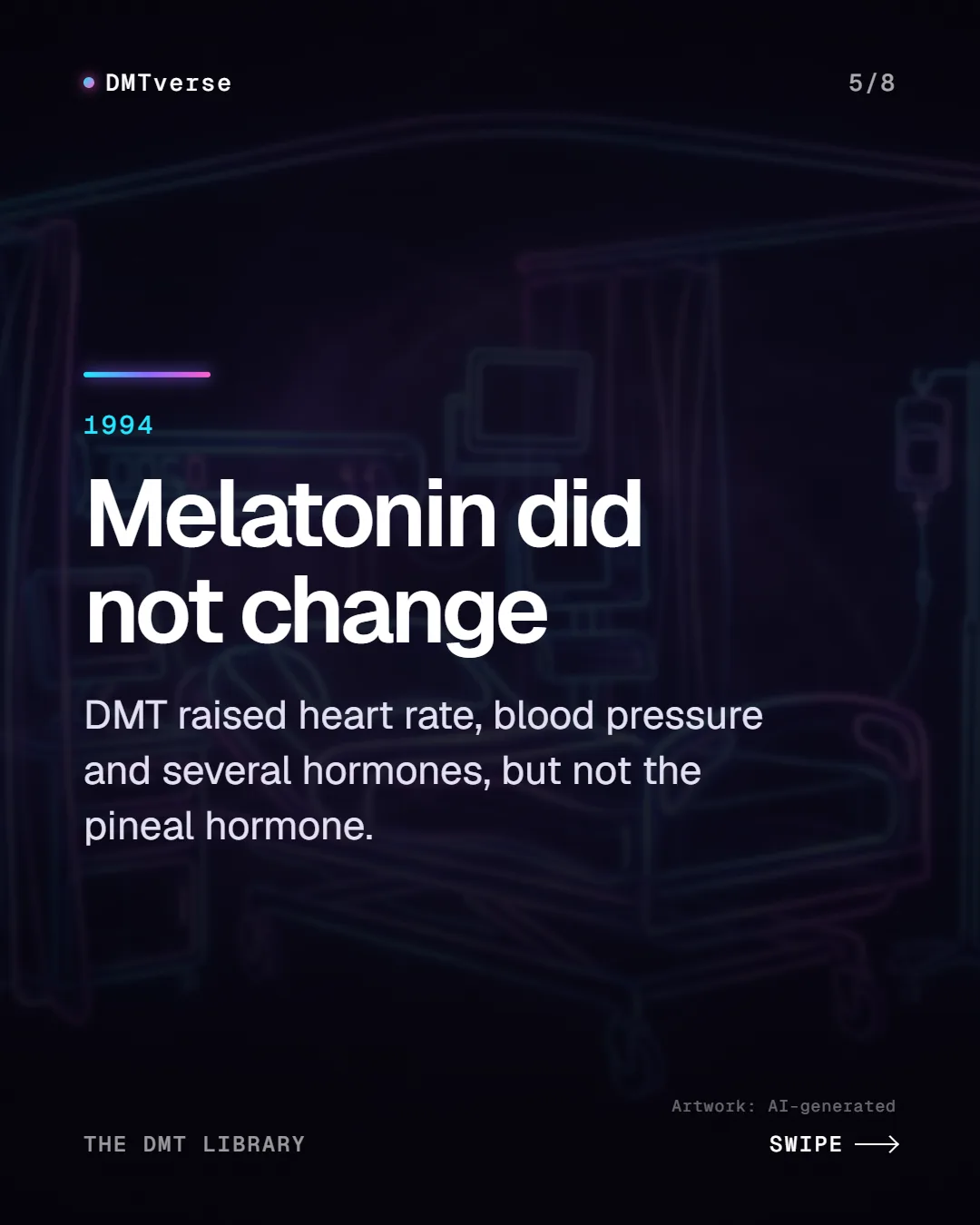
The first paper measured the body. Peak DMT blood levels and subjective effects came within 2 minutes and were negligible at 30. DMT raised blood pressure, heart rate, pupil diameter and body temperature in a dose-dependent way, and raised blood levels of beta-endorphin, corticotropin, cortisol and prolactin. Growth hormone rose equally at all doses, and melatonin, the pineal gland’s main hormone, was unaffected. The authors concluded that DMT could be given safely to experienced hallucinogen users under these conditions (Strassman and Qualls, 1994). Evidence: established for these measures in this small, screened, monitored sample.
The second paper described the mind. Effects began almost immediately, peaked at 90–120 seconds and were almost completely resolved by 30 minutes, tracking blood levels. At the higher doses, volunteers described a rapidly moving, brightly coloured visual display; a brief, overwhelming “rush” with a sense of loss of control; and a dissociated state in which euphoria and anxiety alternated or coexisted. The effects replaced ongoing mental experience and were described as more vivid and compelling than dreams or waking awareness. Lower doses were mainly emotional and bodily (Strassman et al., 1994). Evidence: established as what these 12 volunteers reported; they are subjective reports.
The same paper introduced the Hallucinogen Rating Scale, which grouped effects better by dose than the biological measures did (Strassman et al., 1994). It gave later researchers a common yardstick for comparing psychedelics. Evidence: established.
Did volunteers build tolerance to DMT?
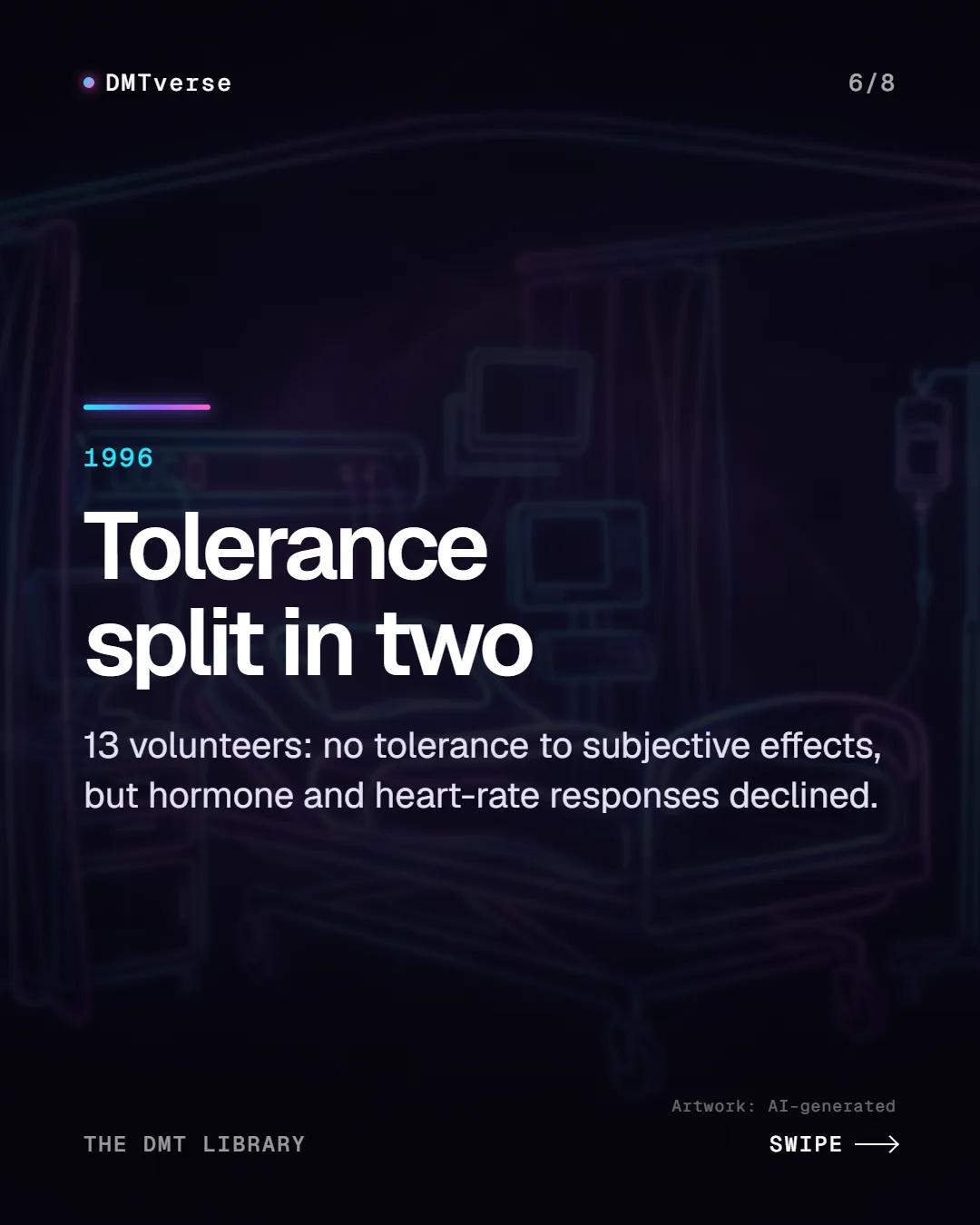
Before this study, tolerance to DMT’s behavioural effects had been seen inconsistently in animals and had never been produced in people (Strassman et al., 1996). In the 1996 study, tolerance to the subjective “psychedelic” effects did not occur by either clinical interview or rating-scale scores, but the hormone responses (ACTH, prolactin, cortisol) and heart-rate response decreased with repeated doses; blood pressure did not (Strassman et al., 1996). The authors called this differential regulation of the processes behind DMT’s effects. Evidence: established for this single small study.
That “no tolerance” result later became the premise for a different idea. In 2016, Andrew Gallimore and Strassman proposed holding people in a prolonged DMT state for research by target-controlled infusion, citing DMT’s lack of acute tolerance to its subjective effects (Gallimore and Strassman, 2016). Note what the 1996 study did and did not test: four separate doses with gaps between them, not a continuous infusion. Whether the subjective effects stay flat under continuous exposure is a separate question, covered in DMT therapy research. Evidence: preliminary.
Why did Strassman stop his DMT research?
Strassman has given two accounts, and they emphasise different things. In the autumn 1995 MAPS newsletter, he wrote that several factors led him to leave the university at the end of August 1995, and named as the primary one his family’s move to Victoria, British Columbia: running intensive studies in New Mexico while living mostly in Canada did not allow the relationships and follow-up with volunteers he believed necessary, a concern that would have grown with the planned shift to psilocybin, whose effects last far longer (Strassman, MAPS, 1995). Evidence: his own report.
His book, five years later, gives a longer list (Strassman, chapter summaries):
- Volunteer recruitment became harder as add-on studies grew more intrusive.
- In his account, a graduate student caused serious problems, including taking drugs with volunteers after hours.
- Hoped-for colleagues did not arrive, and some set up competing foundations.
- In his words, long-term benefits were meagre and adverse effects were adding up.
- The frequency of reported contact with “beings” was unexpected and personally disorienting to him.
- A serious illness in his family, and the move to Canada.
- Condemnation of his work from within the Zen Buddhist community he belonged to, which came to a head after he published an article linking psychedelics and Buddhism.
He writes that he ended the research several months after moving to Canada and returned the remaining drugs and the last year of grant support to the federal government (Strassman, chapter summaries). His book page puts it in one line: problems inside and outside the research environment ended the studies in 1995 (Strassman, book page). No source we read says the government shut the research down. Evidence: these are his own reports, which differ in emphasis.
How did his interpretation change?
The scientific papers make no claims about other worlds. The book does, and Strassman says so openly: he included what he calls highly speculative ideas, among them that the pineal gland releases DMT when the spirit enters the fetus at 49 days after conception, and that DMT may let the brain perceive dark matter or parallel universes inhabited by conscious entities (Strassman, book page). His model compared the brain to a television receiver whose “channels” DMT changes (Strassman, chapter summaries). Evidence: these are his speculations, not findings.
By 2014 his framework had moved from Buddhism to the Hebrew Bible. In DMT and the Soul of Prophecy he compares the DMT state with prophetic experience as described in the Bible and medieval Jewish philosophy, and proposes what he calls theoneurology, a top-down model in which God communicates through the brain (Strassman, Soul of Prophecy page). In a January 2024 interview he said that only one of his volunteers had what one might call a mystical unitive state, that each person’s experience depended on them rather than the drug, and, on the idea that the body’s own DMT drives non-drug states, that “the data aren’t there yet” (Psychedelic Medicine Podcast, 2024). Evidence: these are his interpretations over three decades.
Studies begin
Protocol 89-001 begins at UNM after federal approval (Strassman, 1991).
Two dose-response papers
Body and mind effects in 11 and 12 volunteers, and a new rating scale (Strassman and Qualls, 1994; Strassman et al., 1994).
The work ends
He leaves UNM at the end of August (Strassman, MAPS, 1995).
Tolerance paper
No tolerance to subjective effects; bodily responses decline (Strassman et al., 1996).
The Spirit Molecule
A book mixing the research with speculative pineal and parallel-world ideas (Strassman, book page).
Soul of Prophecy
A biblical-prophetic model of the DMT state (Strassman, Soul of Prophecy page).
“The data aren’t there yet”
On endogenous DMT and non-drug states (Psychedelic Medicine Podcast, 2024).
Each panel restates the sourced paragraphs above.
What later research supported, and what it did not
The pharmacology held up: DMT’s fast onset and short action are now standard findings (Strassman and Qualls, 1994). The pineal speculation did not fare as well. A 2018 review by David Nichols, the chemist who made the study’s DMT, argued that scientific evidence is not consistent with the idea that the pineal gland secretes DMT at birth, in dreams or near death, noting that the tiny amounts detected in brain are not enough to produce psychoactive effects (Nichols, 2018). A 2019 rat study, which Strassman co-authored, measured DMT in the living cortex at levels similar to serotonin, with or without a pineal gland (Dean et al., 2019). In people, brain DMT has never been measured. Evidence: established for the time course; the pineal idea is unsupported; the role of DMT in the human brain is unresolved. See is DMT in the pineal gland.
Risks the studies recorded, and where to get help in Canada
Even in a hospital unit, DMT raised blood pressure and heart rate (Strassman and Qualls, 1994), anxiety was part of the reported experience (Strassman et al., 1994), and Strassman later wrote that adverse effects were adding up (Strassman, chapter summaries). Canada’s Centre for Addiction and Mental Health warns that most hallucinogens are illegal and unregulated, may contain toxins or not contain the drug they are sold as, and can impair judgment (CAMH). Evidence: established.
If someone is in danger
Call 911 for immediate danger or urgent medical help. In Ontario, the Ontario Poison Centre is at 1-800-268-9017; every province has a poison centre, listed by SickKids (AboutKidsHealth). If you or someone you know is thinking about suicide, call or text 9-8-8, 24 hours a day (Government of Canada). See also our safety page.
Common questions
What was Rick Strassman’s DMT study?
A series of federally approved studies at the University of New Mexico from 1990 to 1995, which Strassman describes as the first new US human psychedelic research in over 20 years. Healthy, experienced volunteers received intravenous DMT or placebo under medical monitoring, and the team measured bodily and subjective effects.
How many people took part?
By Strassman’s own count, about 60 volunteers received about 400 doses in total. The published controlled studies each had 11 to 13 participants. “400 volunteers” is a common error.
What did the studies find?
DMT acted within about two minutes and was largely over by 30, raised heart rate, blood pressure, temperature and several hormones, left melatonin unchanged, and produced intense visual and emotional effects. A 1996 study found no tolerance to subjective effects with closely spaced doses, though bodily responses declined.
Why did Strassman stop his DMT research?
By his own accounts, for several reasons: a move to Victoria, British Columbia, recruitment and staffing problems, meagre long-term benefits and accumulating adverse effects, the unexpected frequency of reported contact with beings, a family illness, and pressure from his Buddhist community. No source we read says the government shut it down.
Did Strassman prove that the pineal gland makes DMT?
No. That was a speculation in his 2000 book. Melatonin did not change in his 1994 study, a 2018 review found the pineal idea unsupported, and in rats brain DMT did not depend on the pineal gland. He said in 2024 that the data on the body’s own DMT “aren’t there yet”.
What is the Hallucinogen Rating Scale?
A questionnaire Strassman’s team drafted from interviews with experienced DMT users and introduced in a 1994 paper. It grouped subjective effects by dose better than the biological measures did, and gave later researchers a shared measure.
Is Strassman still involved in DMT research?
He has written several books since, co-authored a 2019 rat-brain DMT study and a 2016 proposal for prolonged DMT infusion, and is a clinical associate professor of psychiatry at the University of New Mexico, according to his website.
Shroomverse sells mushroom products. This article is general information about the history of Rick Strassman’s DMT research. It is not medical, legal or purchasing advice, and it does not recommend any product.
SOURCES
- Human hallucinogenic drug research in the United States: a present-day case history and review of the process (Strassman RJ, Journal of Psychoactive Drugs 23(1):29–38, 1991), Taylor & Francis (peer-reviewed). Accessed . Abstract read via Europe PMC. His application for and receipt of federal permission to give DMT to people, the obstacles, and his conclusion that further research is possible with collaborative effort.
- Dose-response study of N,N-dimethyltryptamine in humans. I. Neuroendocrine, autonomic, and cardiovascular effects (Strassman RJ, Qualls CR, Archives of General Psychiatry 51(2):85–97, 1994), American Medical Association (peer-reviewed). Accessed . Abstract read via Europe PMC. 11 experienced users; randomized, double-blind, saline placebo; treatments at least 1 week apart; peak within 2 minutes, negligible at 30; rises in blood pressure, heart rate, pupil diameter, temperature, beta-endorphin, corticotropin, cortisol, prolactin; growth hormone; melatonin unaffected; authors’ safety conclusion for experienced users. Doses not reproduced.
- Dose-response study of N,N-dimethyltryptamine in humans. II. Subjective effects and preliminary results of a new rating scale (Strassman RJ, Qualls CR, Uhlenhuth EH, Kellner R, Archives of General Psychiatry 51(2):98–108, 1994), American Medical Association (peer-reviewed). Accessed . Abstract read via Europe PMC. 12 volunteers; two non-blind doses then randomized, double-blind, saline placebo; peak at 90–120 seconds, almost resolved by 30 minutes; visual display, rush, loss of control, euphoria and anxiety; Hallucinogen Rating Scale drafted from 19 experienced DMT users. Doses not reproduced.
- Differential tolerance to biological and subjective effects of four closely spaced doses of N,N-dimethyltryptamine in humans (Strassman RJ, Qualls CR, Berg LM, Biological Psychiatry 39(9):784–795, 1996), Elsevier (peer-reviewed). Accessed . Abstract read via Europe PMC. 13 experienced users; four doses at 30-minute intervals or placebo on separate days; randomized, double-blind; no tolerance to subjective effects; ACTH, prolactin, cortisol and heart-rate responses decreased; blood pressure did not. Dose not reproduced.
- DMT: The Spirit Molecule (book page), Rick Strassman MD (author’s website). Accessed . Read. Author’s account: research began 1990; approximately 400 doses to 60 volunteers over five years; tenured associate professor; pineal motivation; Zen monastery relationship; over 1,000 pages of bedside notes; problems inside and outside the research ended it in 1995; his list of highly speculative ideas (49 days, dark matter, parallel universes).
- DMT: The Spirit Molecule, chapter summaries, Rick Strassman MD (author’s website). Accessed . Read. Sixty volunteers, nearly 400 doses; protocol 89-001; recruitment difficulties; his reasons for ending the work (graduate student, colleagues, meagre benefits and adverse effects, being-contact, family illness and move to Canada, Buddhist community); ended months after moving; drugs and last grant year returned; receiver/television model.
- Biography, Rick Strassman MD (author’s website). Accessed . Read. Joined UNM psychiatry in 1984; melatonin research; tenured associate professor before leaving in 1995; books; current clinical associate professor at UNM.
- DMT and the Soul of Prophecy (book page), Rick Strassman MD (author’s website). Accessed . Read. Hebrew Bible prophetic model of the DMT state; medieval Jewish philosophy; theoneurology as a top-down model.
- University of New Mexico Update (Strassman R, MAPS Newsletter 6(1), Autumn 1995), Multidisciplinary Association for Psychedelic Studies. Accessed . Read. Leaving UNM at the end of August 1995; move to Victoria, British Columbia named as primary factor; follow-up concerns; planned shift to psilocybin; David E. Nichols made the DMT for the first study.
- Exploring Endogenous DMT with Rick Strassman, MD (Psychedelic Medicine Podcast, 3 January 2024), PlantMedicine.org. Accessed . Episode page read (quotes as published on the page, not the audio). “Fifty-five or so” normal volunteers; one had a mystical unitive state; experiences dependent on the person; “the data aren’t there yet” on endogenous DMT and non-drug states.
- N,N-dimethyltryptamine and the pineal gland: Separating fact from myth (Nichols DE, Journal of Psychopharmacology 32(1):30–36, 2018), SAGE (peer-reviewed). Accessed . Abstract read via Europe PMC. Evidence not consistent with pineal DMT secretion at birth, dreaming or near death; minute brain concentrations insufficient for psychoactive effects.
- Biosynthesis and Extracellular Concentrations of N,N-dimethyltryptamine (DMT) in Mammalian Brain (Dean JG, et al., Scientific Reports 9:9333, 2019), Springer Nature (peer-reviewed, open access); PMC6597727. Accessed . Abstract read via Europe PMC; Strassman RJ is a co-author. DMT in living rat cortex, with or without the pineal gland, at levels similar to monoamine neurotransmitters.
- A Model for the Application of Target-Controlled Intravenous Infusion for a Prolonged Immersive DMT Psychedelic Experience (Gallimore AR, Strassman RJ, Frontiers in Pharmacology 7:211, 2016), Frontiers (peer-reviewed, open access); PMC4944667. Accessed . Abstract read via Europe PMC. Modelling proposal citing DMT’s lack of acute tolerance to subjective effects.
- Hallucinogens, Centre for Addiction and Mental Health (CAMH). Accessed . Read. Most hallucinogens illegal and unregulated, may contain toxins or not contain the drug they are sold as; effects on perception and judgment.
- Mental health support: get help, Government of Canada, Public Health Agency of Canada. Accessed . Read. Call 9-1-1 in immediate danger or for urgent medical support; call or text 9-8-8, 24 hours a day, 7 days a week.
- Poison information centres in Canada, AboutKidsHealth, The Hospital for Sick Children (SickKids). Accessed . Read. Provincial poison centre list, including Ontario toll-free 1-800-268-9017.
CHANGES
- : Linked glossary definitions.
- : Published. Every source opened and checked on this date. A claim that Strassman had become agnostic about the beings’ status by 2023 was left out because we could not open a source for it.
- : Editorial review: summary leads with the primary keyword and attributes the “first in over 20 years” claim to Strassman; unsupported “all volunteers experienced” wording narrowed to the published studies; volunteer and dose totals stated as about 60 and about 400, self-reported, to match our other DMT articles; H2s rewritten as questions; the graduate-student item attributed to his account; opening tightened.
- : Added source links beside figures and legal statements.



