THE SHROOMVERSE JOURNAL ✳ 15 MIN READ
DMT and God: what research on religious and mystical experiences actually measured
Topic: DMT
Published
Short answer, checked 21 October 2026
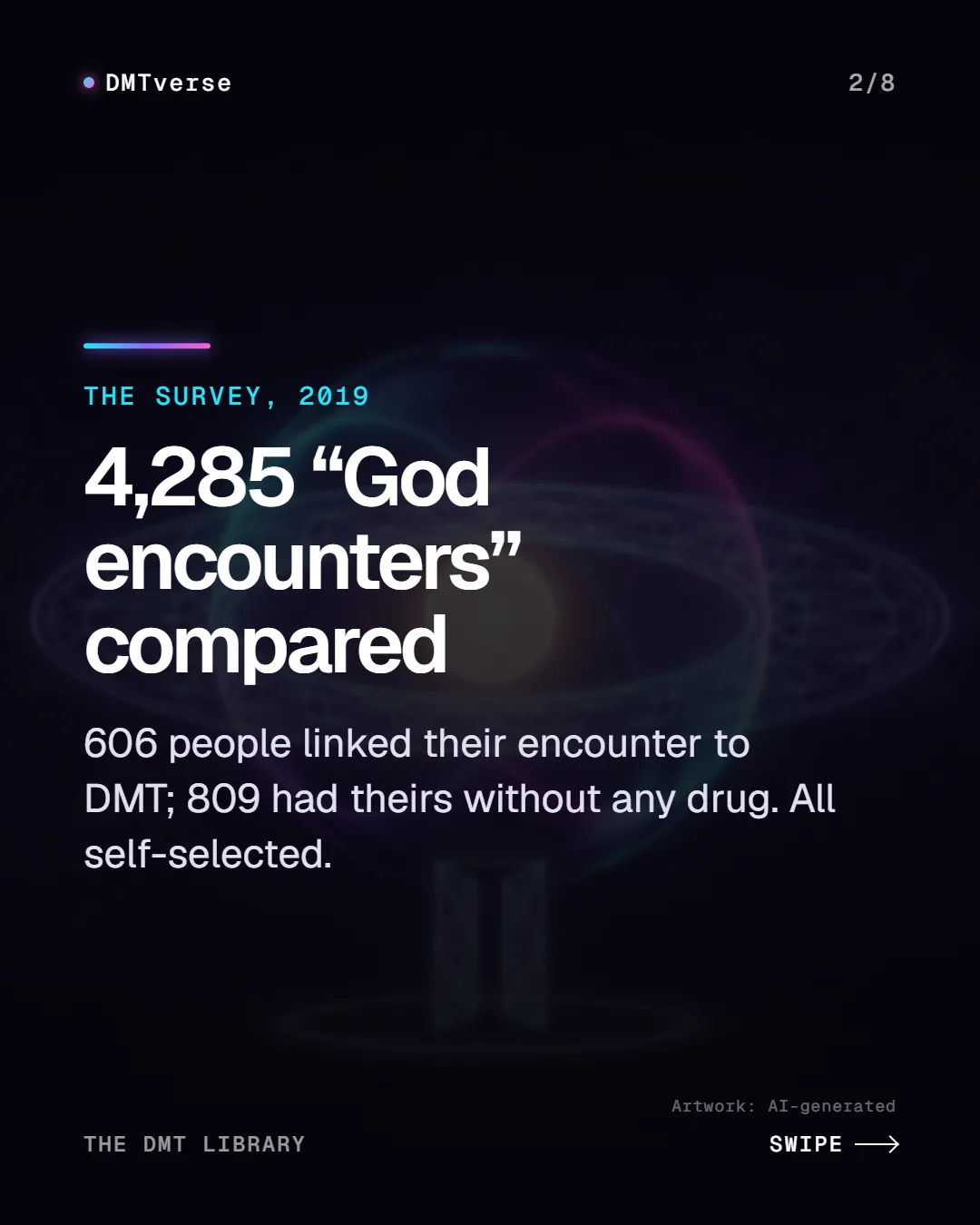
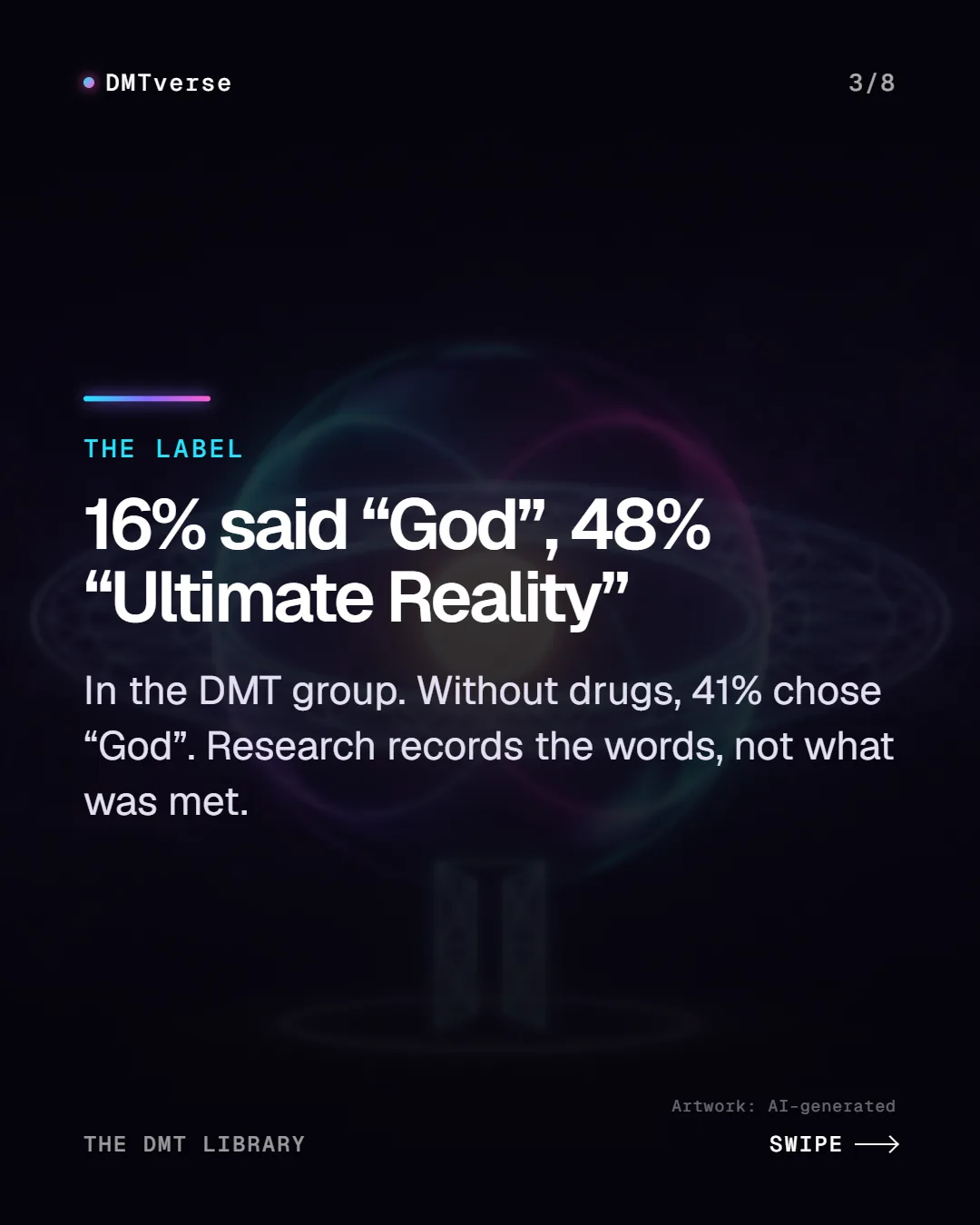
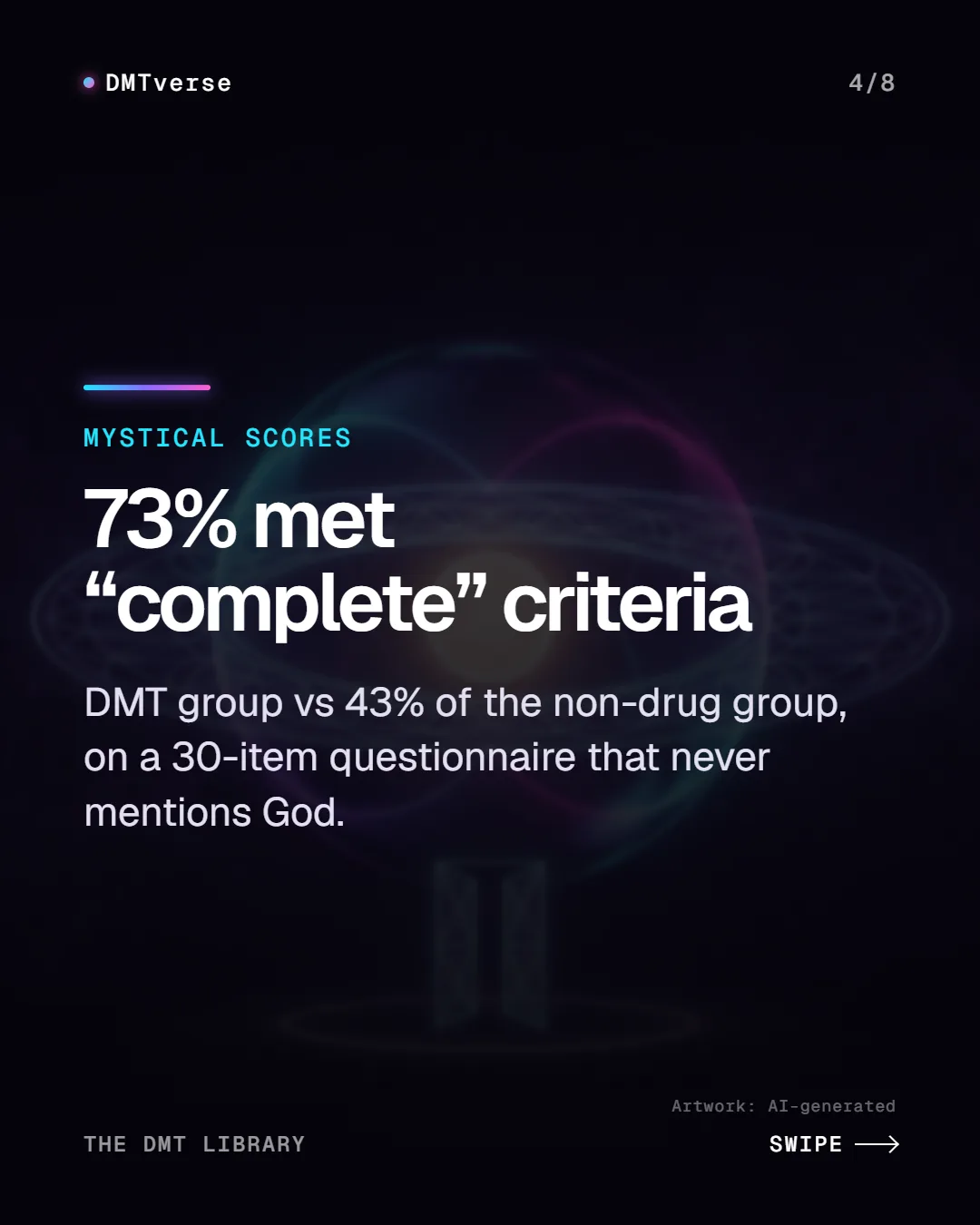
Research cannot say whether a DMT “God” experience meets anything real; it can measure what people report. In a 2019 survey of 4,285 people describing a “God encounter”, 606 linked theirs to DMT: 16% of them called what they met “God” and 48% “Ultimate Reality”, and 73% met a questionnaire’s criteria for a “complete” mystical experience. Small lab studies find mystical-type scores rise with DMT compared with placebo. The best-documented religious use involves ayahuasca, not DMT alone. Most of the evidence is self-selected and recalled years later.
THE SHORT VERSION · SWIPE
On this page 11 sections
People search “DMT God” for different reasons: some have read that DMT shows people God, some want to know which religions use it, and some have heard it called “the God molecule”. This article sets out what researchers have actually measured: a large survey of “God encounter” experiences, the questionnaire used to score mystical experiences, small DMT lab studies, Rick Strassman’s spiritual framing, and religious use of ayahuasca. It takes no position on whether God exists or was encountered. For the basics, start with our pillar, what is DMT.
Education only, and neutral on belief
This article describes published research and how participants interpreted their own experiences. It gives no amounts, no instructions and no advice on use, and it does not present any experience as a benefit or a spiritual path. It neither endorses nor rejects any religious interpretation. DMT is a controlled substance in Canada. Evidence labels used below: established (shown in peer-reviewed studies and not seriously disputed), preliminary (early, small, self-selected or indirect) and unresolved (an open question).
What is a “DMT God experience”?
In research, it is a self-report: a person says that during a DMT experience they encountered something they would call God, a higher power or ultimate reality. Johns Hopkins researchers built a whole survey around that category, asking about an encounter with “God (the God of your understanding)”, a Higher Power, Ultimate Reality, or an aspect or emissary of God, such as an angel (Griffiths et al., 2019). The study measured how people described and interpreted the encounter, not whether anything was encountered. Evidence: established as a description of the survey’s design.
A “DMT spiritual experience” is broader. It can mean a sense of unity, sacredness or meaning with no encounter at all, which researchers usually call a mystical-type experience and score with a questionnaire, described below. Encounters with beings that are not identified as God are covered in our overview of DMT entity encounters research. Evidence: established as a distinction researchers draw.
What did the 2019 “God encounter” survey find?
It is the largest study of the question. Between December 2014 and August 2016, 12,725 people began an online survey recruited mainly through internet adverts, email and social networks; after exclusions, 4,285 gave usable data. Each described their single most memorable God encounter: 809 without any drug, and 1,184 with psilocybin, 1,251 with LSD, 435 with ayahuasca and 606 with DMT. Anyone in the non-drug group who had ever had such an encounter on a drug was excluded, and group differences were adjusted for demographics (Griffiths et al., 2019). Evidence: preliminary; a self-selected, retrospective survey.
The headline was similarity. Most people in every group described communicating with something they experienced as conscious, benevolent, intelligent, sacred, eternal and all-knowing, and rated the encounter among the most meaningful and spiritually significant experiences of their lives. The main difference was the label: the non-drug group most often chose “God”, while the psychedelic groups most often chose “Ultimate Reality” (Griffiths et al., 2019). Evidence: preliminary.
| Measure | Non-drug group (809) | DMT group (606) |
|---|---|---|
| Best descriptor: “God (the God of your understanding)” | 41% | 16% |
| Best descriptor: “Ultimate Reality” | 26% | 48% |
| Best descriptor: “Higher Power” | 15% | 25% |
| Best descriptor: an aspect or emissary of God, such as an angel | 18% | 12% |
| Described what they met as benevolent | 86% | 75% |
| Described it as malicious | 1% | 8% |
| Went in intending to encounter it | 16% | 30% |
| Met the criteria for a “complete” mystical experience | 43% | 73% |
How did the DMT group differ?
The DMT group was younger and had its experience more recently than the other psychedelic groups. It differed from the psilocybin and LSD groups on 16 of 76 items, mostly sensory and communication items: 83% interacted visually and 80% reported communication. It scored highest of all groups on the mystical questionnaire’s transcendence of time and space and its total score, and a larger share reported a decreased fear of death. Compared with the ayahuasca group, it reported smaller positive changes in social relationships (Griffiths et al., 2019). Evidence: preliminary.
Two findings from the same survey, on how real these encounters felt, are covered in why DMT feels more real than reality, so we do not repeat them here.
Does DMT change religious belief?
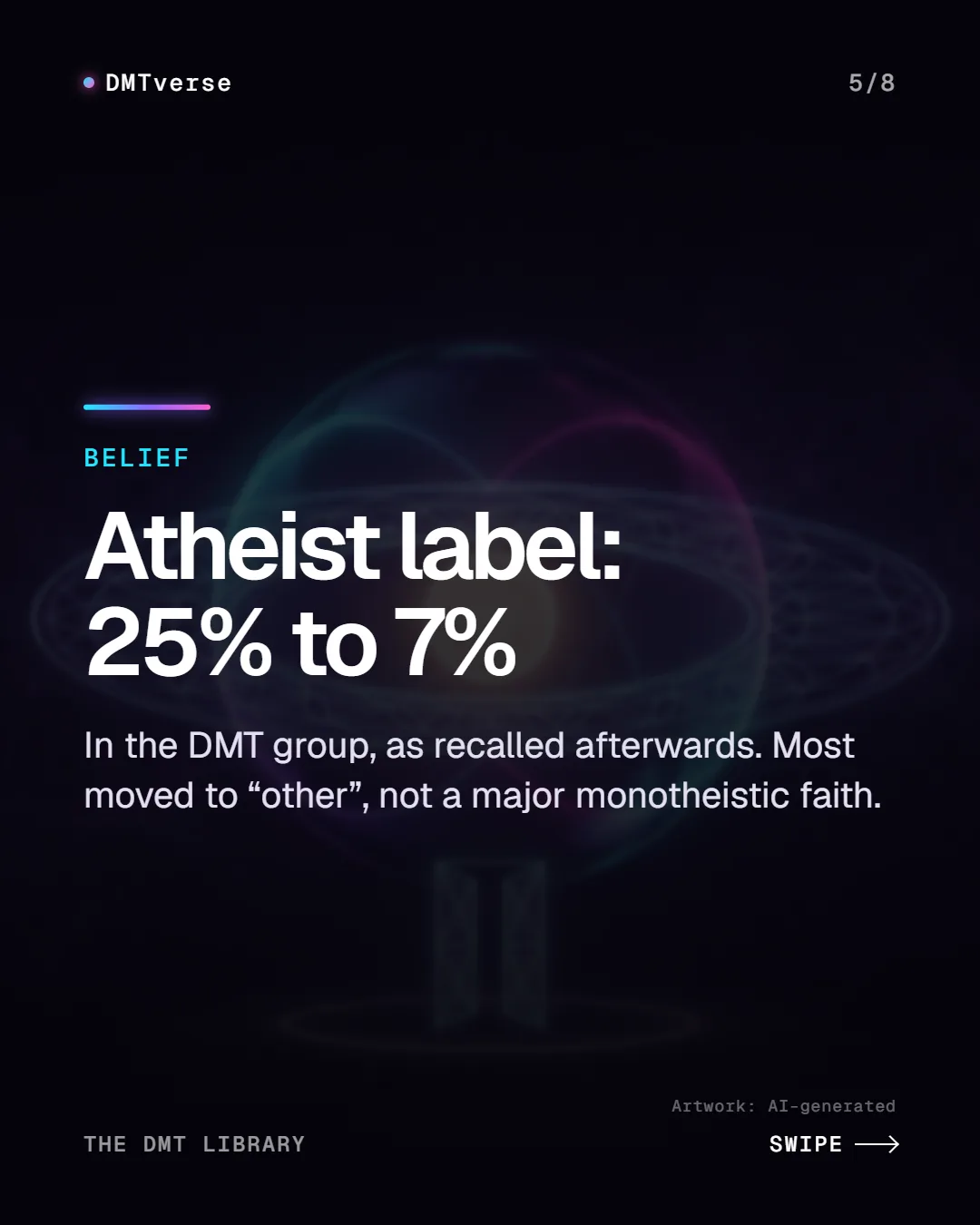
Participants say it changed how they describe themselves. In the 2019 survey, people rated their religious identity before and after the encounter. In the DMT group, the share identifying as atheist fell from 25% to 7%, the share in a major monotheistic tradition (Christian, Jewish or Muslim) from 7% to 5%, and the share choosing “other” rose from 68% to 88%. Atheist identification fell significantly in all five groups, including the non-drug group, from 3% to 1% (Griffiths et al., 2019). Evidence: preliminary.
So the shift was mostly away from both atheism and organised monotheism, towards labels outside both. A 2020 survey of 2,561 people describing a DMT entity encounter found the same direction: more than half of former atheists no longer identified as atheist, and the authors wrote of “profound and enduring ontological changes in worldview” (Davis et al., 2020). Our entity encounters overview covers that survey and a stronger before-and-after study of beliefs, and does DMT change you covers personality. Evidence: preliminary.
The weakness is built into the design: the “before” answer was given after the event, often years later, by people who chose to answer a long survey about a memorable experience. That can exaggerate change. A change in self-description also says nothing about whether the new belief is true or false. Evidence: established as a limitation of retrospective surveys.
How do researchers measure a DMT mystical experience?
Usually with the 30-item Mystical Experience Questionnaire (MEQ30), filled in after the experience. It was first developed in an online survey of psilocybin mushroom experiences that had happened on average eight years earlier, then validated in 184 participants from five laboratory psilocybin studies, where higher scores predicted lasting changes in attitudes, behaviour and well-being that participants attributed to the session (Barrett et al., 2015). Evidence: established as a validated scale, though validated with psilocybin, not DMT.
It has four subscales: mystical (including unity and a sense of sacredness), positive mood, transcendence of time and space, and ineffability, meaning the experience feels impossible to put into words (Timmermann et al., 2018). A “complete” mystical experience means scoring at least 60% on all four. The scale is based on the philosopher W. T. Stace’s model, which emphasises unity and makes no reference to God (Griffiths et al., 2019). A high score therefore measures a pattern of reported experience, not a religious conclusion. Evidence: established.
Researchers disagree about the framework itself. Two researchers argued in 2021 that a concept tied to supernatural or non-empirical belief systems carries risks in science, and called for a “demystified” model of the psychedelic state (Sanders and Zijlmans, 2021). A reply argued that mystical-type experiences have a long research tradition and tools worth keeping, and called for more diverse experiences and participants in the research (Breeksema and van Elk, 2021). Evidence: unresolved; a live academic debate.
What have DMT lab studies measured?
Only a few controlled DMT studies have used the MEQ. They are small and use healthy or experienced volunteers, but unlike the surveys they compare DMT with a placebo at the time. The table summarises them; doses are not reproduced.
| Study | Design | What was found | Main limit |
|---|---|---|---|
| Timmermann et al., 2018 | 13 healthy volunteers; DMT vs placebo; MEQ and a near-death scale | All four MEQ factors higher on DMT; MEQ change correlated with near-death scores (r = 0.90) | Placebo always given first; doses not uniform |
| James et al., 2023 | Phase 1 trial; psychedelic-naive volunteers; placebo or one of four dose levels | 9 participants on DMT met “complete” criteria, at every dose level | Six people per dose level |
| Meling et al., 2024 | 40 experienced meditators on a 3-day retreat; DMT with harmine vs placebo | Higher mystical-type and non-dual awareness ratings than placebo | Combined with an MAO inhibitor; one retreat setting |
| Rucker et al., 2024 | 44 psychedelic-naive volunteers; intranasal 5-MeO-DMT vs placebo | 60% had a “complete” mystical experience at the two highest doses tested | 5-MeO-DMT, a different drug |
In the 2018 Imperial College study, the questionnaire’s mystical factor, which includes items such as “sense of being at a spiritual height”, was the one most strongly linked with near-death-type features (Timmermann et al., 2018). In the 2023 phase 1 trial, a mean MEQ score of at least 60% was the target the team used when choosing a dose to take forward into patients with depression (James et al., 2023). Evidence: preliminary. More on the first study in DMT and near-death experiences.
In the 2024 Swiss retreat study, meditators given DMT with harmine, a compound that blocks the enzyme that breaks DMT down, rated their experience as more personally meaningful and spiritually significant than the placebo group did a month later (Meling et al., 2024). Mindfulness and compassion did not differ from placebo. These are self-ratings by people who chose a meditation retreat. Evidence: preliminary.
Did Rick Strassman think DMT was spiritual?
His framing changed over time. His 2000 book, DMT: The Spirit Molecule (Open Library record), proposed that DMT made in the body might be involved in mystical and near-death states, yet its preface says DMT has no beneficial effects “in and of itself” and that context is at least as important (Strassman, book page). His later book, DMT and the Soul of Prophecy, proposes “theoneurology”, in which God communicates through the brain, set against neurotheology, in which brain chemistry gives the impression of the divine (Strassman, prophecy page). These are his interpretations; no experiment can test either. Evidence: established as his stated views.
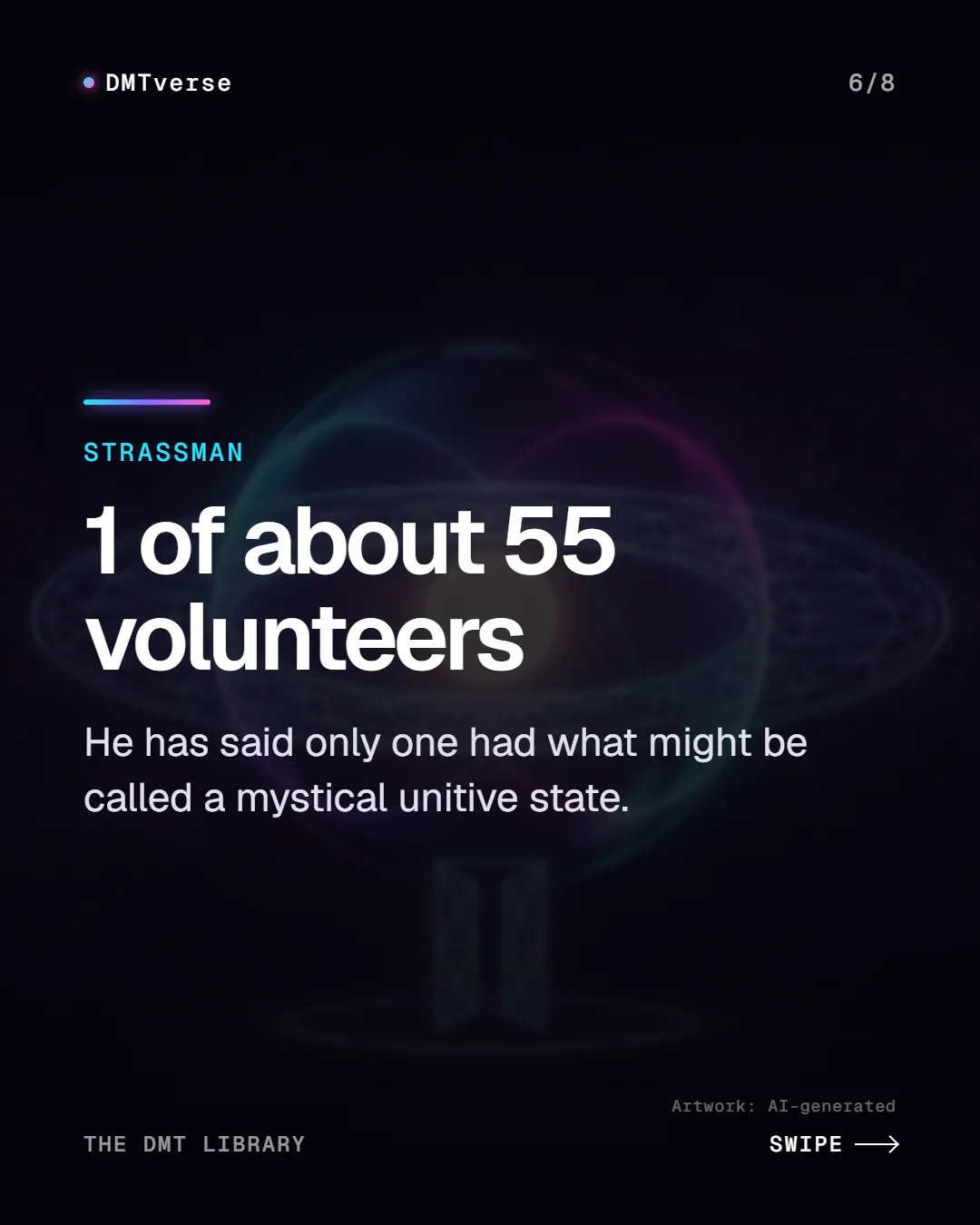
On data from his own studies he has been cautious. A 2024 podcast page quotes him saying that only one of his “fifty-five or so normal volunteers” had what might be called a mystical unitive state, and that each experience was “totally dependent on them” (Psychedelic Medicine Podcast, 2024). For the full story, see Rick Strassman’s DMT study and why DMT is called the spirit molecule. Evidence: established as a recorded statement.
What religion uses DMT?
The best-documented religious use is of ayahuasca, a brew that contains DMT, rather than DMT on its own. Two Brazilian churches, Santo Daime and the União do Vegetal, drink it as a sacrament; the UDV’s tea is called hoasca. In 2006 the US Supreme Court held that the government had not shown, at the preliminary-injunction stage, a compelling interest in barring the UDV’s sacramental use under a religious-freedom law (Gonzales v. O Centro Espírita, 2006). Our article on Santo Daime and UDV ayahuasca churches covers their history and the Canadian exemptions. Evidence: established.
Indigenous Amazonian use is often described as ancient religious use of DMT, but anthropologists are more careful. One, writing from the ethnographic record, says Indigenous use mainly understands ayahuasca as an amplifying power for dealing with non-human beings in animal, plant or spirit realms, where efficacy depends on correct communication between the healer and those powers rather than on the drug, and argues these concepts cannot be used to legitimise modern uses (Brabec de Mori, 2021). See what is ayahuasca. Evidence: preliminary; one scholar’s interpretation.
Is DMT “the God molecule”?
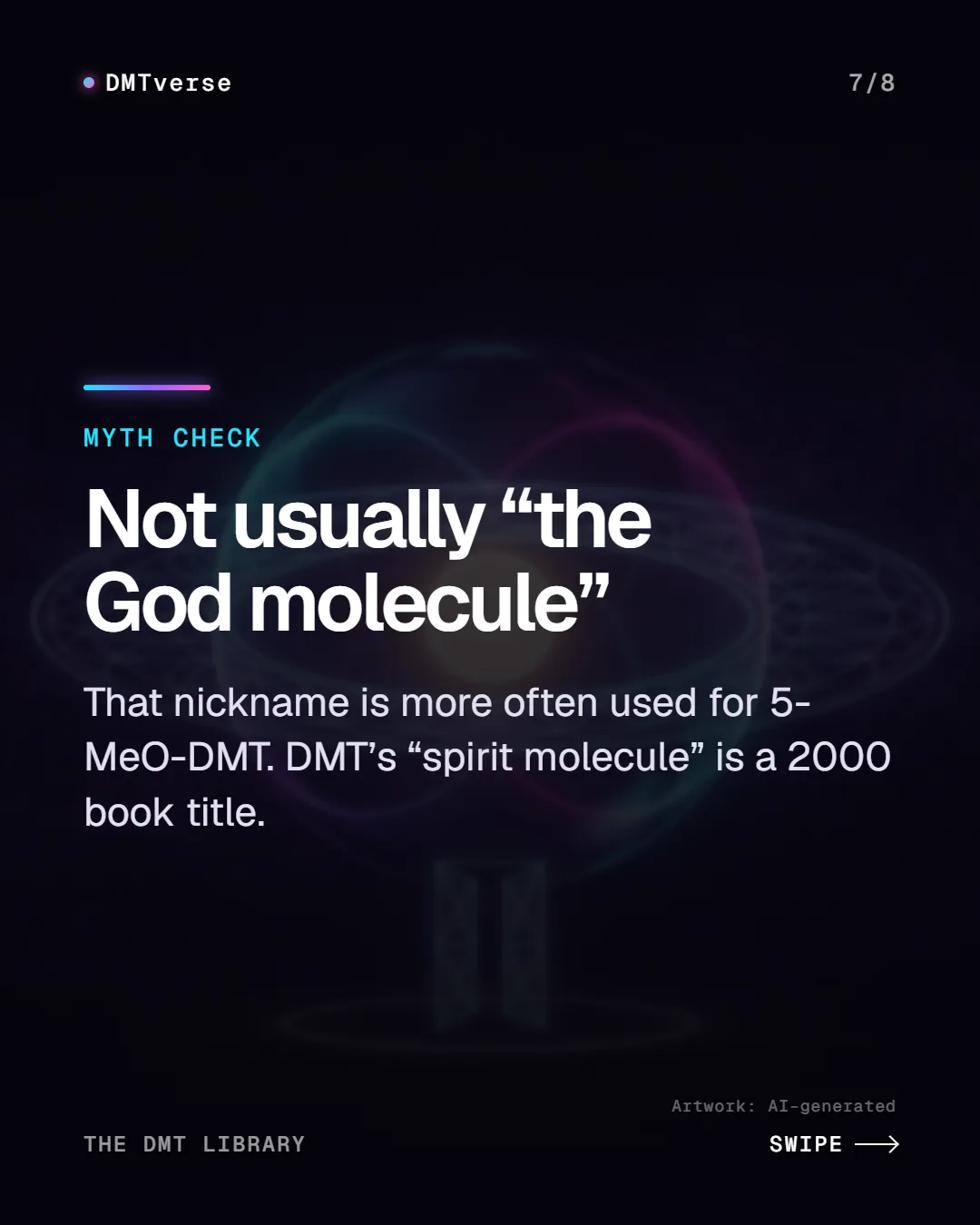
Not by its usual nickname. The phrase “God molecule” is more often attached to 5-MeO-DMT, a different tryptamine, as a 2023 review of DMT literature and online search interest notes (Al-Imam et al., 2023). DMT’s own nickname, “the spirit molecule”, comes from Strassman’s book title. Both are popular labels, not scientific terms. See 5-MeO-DMT vs DMT for how the two differ. Evidence: established for the origin of “spirit molecule”; preliminary for the usage of “God molecule”, which is not formally documented.
No molecule can be shown to contain or reveal God, and no study has tried. What studies show is narrower: DMT and related drugs often produce experiences that people score as mystical and some interpret as encounters with God or ultimate reality. Drug-free experiences can be interpreted the same way, as the 2019 non-drug group shows. Whether such experiences point beyond the brain is a philosophical and religious question. Evidence: unresolved.
What are the limits of this research?
- Self-selection: survey respondents chose to answer a long (about 50 minutes), unpaid, anonymous questionnaire about one of the most meaningful experiences of their lives, and we do not know how representative they are (Griffiths et al., 2019).
- Memory: experiences were recalled on average more than a decade later, and the “before” beliefs were reported afterwards (Griffiths et al., 2019).
- Social desirability: the survey authors note that participants may have answered as they believed the researchers wanted (Griffiths et al., 2019).
- Diversity: only 1% of both survey groups were Black or African American (Griffiths et al., 2019).
- Expectancy: psychedelic effects are hard to mask, and media hype shapes what participants expect, which can produce large placebo and nocebo effects (Aday et al., 2022).
- Scale: the MEQ30 was validated with psilocybin, and the DMT lab studies involve tens of people, not hundreds.
Expectation matters especially here. A 2022 review of psychedelic trial methods warns that hype from positive media coverage can shape participants’ expectations and interact with unmasking (Aday et al., 2022). People who go into a DMT experience expecting God may be more likely to report God; in the 2019 survey, 30% of the DMT group said they went in intending an encounter (Griffiths et al., 2019). Our guide to set and setting covers this further. Evidence: preliminary.
If someone is in danger
Call 911 for immediate danger or urgent medical help, including if someone is unconscious, not breathing or having a seizure. In Ontario, the Ontario Poison Centre is at 1-800-268-9017; every province has a poison centre, listed by SickKids (AboutKidsHealth). If you or someone you know is thinking about suicide, call or text 9-8-8, 24 hours a day (Government of Canada). See also our safety page and how to help someone having a bad trip. Intense religious or existential experiences can be distressing; if one leaves you unsettled for weeks, speak to a doctor.
What we still don’t know
- Whether shifts in religious identity seen in retrospective surveys appear in studies that measure belief before and after a DMT experience (unresolved).
- Why drug-free experiences are more often labelled “God” and DMT experiences more often “Ultimate Reality”: culture, expectation, the experience itself, or who answered (unresolved).
- Whether a questionnaire built on one philosophical model of mysticism captures what people mean by a religious experience (unresolved).
- How common God-type experiences are among all people who use DMT, rather than among survey volunteers (unresolved).
- Whether any such experience reveals something beyond the brain. Science has no method to settle this (unresolved).
The fair summary: many people who use DMT report experiences they score as mystical and sometimes interpret as meeting God or ultimate reality, and they say these experiences changed how they describe their beliefs. Drug-free experiences are described in strikingly similar terms. The evidence is mostly self-selected and recalled, the lab studies are small, and the religious meaning remains a question for each tradition and person, not for a questionnaire. For what people report meeting, read DMT entity types explained.
Common questions
Do people see God on DMT?
Some report it. In a 2019 survey, 16% of 606 people describing a DMT “God encounter” chose “God” as the best word for what they met, and 48% chose “Ultimate Reality”. Research records these reports; it cannot say whether anything was encountered.
Is a DMT God experience the same as a drug-free religious experience?
The 2019 survey found the two strikingly similar in how people described them, with the main difference in labels: the drug-free group more often said “God”, the psychedelic groups “Ultimate Reality”. Both groups were self-selected.
What religion uses DMT?
The best-documented religious use is of ayahuasca, a DMT-containing brew, by Brazilian churches such as Santo Daime and the União do Vegetal. Indigenous Amazonian use is described by anthropologists in its own terms, not as a religion of DMT.
Is DMT the God molecule?
Not by its usual nickname. “God molecule” is more often used for 5-MeO-DMT, a different compound; DMT is called “the spirit molecule” after a 2000 book title. Neither is a scientific term.
Does DMT make atheists believe in God?
In retrospective surveys, many former atheists stopped calling themselves atheist: in the DMT group of the 2019 survey, atheist identification fell from 25% to 7%. Most moved to “other” labels rather than a major monotheistic religion, and the “before” answers were recalled afterwards.
How is a DMT mystical experience measured?
Usually with the 30-item Mystical Experience Questionnaire, scored on mystical, positive mood, transcendence of time and space, and ineffability subscales. A “complete” mystical experience means at least 60% on all four. The scale makes no reference to God.
Did Rick Strassman find DMT gave people mystical experiences?
Rarely, by his account: he has said only one of about 55 normal volunteers had what might be called a mystical unitive state, and that experiences depended on the person, not the drug.
Shroomverse sells mushroom products. This article is general information about research on DMT and religious, spiritual and mystical experiences. It is not medical, legal or purchasing advice, and it does not recommend any product.
SOURCES
- Survey of subjective “God encounter experiences”: Comparisons among naturally occurring experiences and those occasioned by the classic psychedelics psilocybin, LSD, ayahuasca, or DMT (Griffiths RR, Hurwitz ES, Davis AK, Johnson MW, Jesse R, PLoS One 14(4):e0214377, 2019), PLOS (peer-reviewed, open access); full text via Europe PMC, PMC6478303. Accessed . Full text read. Supports the God/Higher Power/Ultimate Reality/emissary categories; recruitment 2014–2016, 12,725 starters, 4,285 usable; group sizes; non-drug exclusion and demographic adjustment; Table 8 descriptors (non-drug vs DMT: God 41% vs 16%, Ultimate Reality 26% vs 48%, Higher Power 15% vs 25%, emissary 18% vs 12%, benevolent 86% vs 75%, malicious 1% vs 8%); intention 16% vs 30%; DMT visual 83%, communication 80%; complete mystical 43% vs 73%; DMT highest on transcendence of time and space and total MEQ; 16 of 76 items differing from psilocybin/LSD; decreased fear of death; social relationships vs ayahuasca; religious orientation (DMT atheist 25% to 7%, monotheist 7% to 5%, other 68% to 88%; non-drug atheist 3% to 1%); MEQ30 based on Stace, no reference to God, complete = 60% on all four subscales; limitations (retrospective, over a decade, social desirability, about 50 minutes, uncompensated, anonymous, 1% Black/African American).
- Survey of entity encounter experiences occasioned by inhaled N,N-dimethyltryptamine: Phenomenology, interpretation, and enduring effects (Davis AK, Clifton JM, Weaver EG, Hurwitz ES, Johnson MW, Griffiths RR, Journal of Psychopharmacology 34(9):1008–1020, 2020), SAGE (peer-reviewed). Accessed . Abstract read via Europe PMC. 2,561 respondents; more than half of prior atheists no longer identified as atheist; the authors’ phrase “profound and enduring ontological changes in worldview”.
- Validation of the revised Mystical Experience Questionnaire in experimental sessions with psilocybin (Barrett FS, Johnson MW, Griffiths RR, Journal of Psychopharmacology, 2015), SAGE (peer-reviewed); PMC5203697. Accessed . Abstract read via Europe PMC. MEQ30 first developed in an online survey of psilocybin mushroom experiences on average eight years earlier; validated in 184 participants from five lab psilocybin studies; scores predicted persisting changes in attitudes, behaviour and well-being; complete mystical experience scoring validated. Doses not reproduced.
- Moving Past Mysticism in Psychedelic Science (Sanders JW, Zijlmans J, ACS Pharmacology & Translational Science, 2021), American Chemical Society (peer-reviewed); PMC8205234. Accessed . Abstract read via Europe PMC. Risks of using a framework associated with supernatural or non-empirical belief systems; call for a demystified model.
- Working with Weirdness: A Response to “Moving Past Mysticism in Psychedelic Science” (Breeksema JJ, van Elk M, ACS Pharmacology & Translational Science, 2021), American Chemical Society (peer-reviewed); PMC8369678. Accessed . Abstract read via Europe PMC. Rich research tradition and tools for mystical-type experiences; need for more diversity in experiences and participants.
- DMT Models the Near-Death Experience (Timmermann C, Roseman L, Williams L, Erritzoe D, Martial C, Cassol H, Laureys S, Nutt D, Carhart-Harris R, Frontiers in Psychology 9:1424, 2018), Frontiers (peer-reviewed, open access); full text via Europe PMC, PMC6107838. Accessed . Full text read. 13 healthy participants, placebo-controlled; MEQ four subscales; all MEQ factors higher on DMT; MEQ–NDE correlation r = 0.90; Mystical factor (example item “sense of being at a spiritual height”) most strongly associated; limitations: non-uniform doses, placebo always first.
- Safety, tolerability, pharmacodynamic and wellbeing effects of SPL026 (dimethyltryptamine fumarate) in healthy participants: a randomized, placebo-controlled phase 1 trial (James E, et al., Frontiers in Psychiatry, 2023), Frontiers (peer-reviewed, open access); full text via Europe PMC, PMC10810248. Accessed . Abstract and full text read. Psychedelic-naive participants; placebo (8) or four escalating dose levels (6 each); complete mystical experiences in 9 participants across all dose levels; mean MEQ of at least 60% used as the target for dose selection for patients with major depressive disorder. Doses deliberately not reproduced.
- Meditating on psychedelics. A randomized placebo-controlled study of DMT and harmine in a mindfulness retreat (Meling D, et al., Journal of Psychopharmacology, 2024), SAGE (peer-reviewed, open access); full text via Europe PMC, PMC11487865. Accessed . Abstract and full text read. 40 experienced meditators, double-blind, placebo-controlled, 3-day retreat; MEQ30 used; greater mystical-type experiences and non-dual awareness than placebo; mindfulness and compassion not different; at 1 month, rated more personally meaningful and spiritually significant. Doses not reproduced.
- Phase 1, placebo-controlled, single ascending dose trial to evaluate the safety, pharmacokinetics and effect on altered states of consciousness of intranasal BPL-003 (5-methoxy-N,N-dimethyltryptamine benzoate) in healthy participants (Rucker JJ, et al., Journal of Psychopharmacology, 2024), SAGE (peer-reviewed, open access); PMC11311898. Accessed . Abstract read via Europe PMC. 44 psychedelic-naive participants; MEQ-30 and EDI; 60% had a complete mystical experience at the two highest doses tested. 5-MeO-DMT, not DMT. Doses deliberately not reproduced.
- Infoveillance and Critical Analysis of the Systematically Reviewed Literature on Dimethyltryptamine and the “God Molecule” (Al-Imam A, Motyka MA, Hoffmann B, Magowska A, Michalak M, Pharmaceuticals 16:831, 2023), MDPI (peer-reviewed, open access); full text via Europe PMC, PMC10302259. Accessed . Abstract and full text read. Used only for the observation that 5-MeO-DMT is also known as the “God Molecule”. Its historical claims about 5-MeO-DMT use are not repeated here.
- Great Expectations: recommendations for improving the methodological rigor of psychedelic clinical trials (Aday JS, Heifets BD, Pratscher SD, Bradley E, Rosen R, Woolley JD, Psychopharmacology 239, 2022), Springer (peer-reviewed); PMC10184717. Accessed . Abstract read via Europe PMC. Difficulty masking psychedelic effects; media hype influencing expectations; unmasking and expectancy making trials susceptible to large placebo and nocebo effects.
- The Power of Social Attribution: Perspectives on the Healing Efficacy of Ayahuasca (Brabec de Mori B, Frontiers in Psychology 12:748131, 2021), Frontiers (peer-reviewed, open access); PMC8581211. Accessed . Abstract read via Europe PMC. Indigenous use understands ayahuasca as an amplifying power for interacting with non-human beings; efficacy depends on correct communication, not the drug; Indigenous concepts cannot legitimate modern uses or vice versa.
- DMT: The Spirit Molecule (author’s book page and preface), Rick Strassman, rickstrassman.com. Accessed . Page read 21 October 2026. Preface: DMT has no beneficial effects “in and of itself”; context at least as important.
- DMT: The Spirit Molecule (Strassman R, Park Street Press, 2000), edition record, Open Library (Internet Archive). Accessed . Record read via the Open Library JSON API. Supports publication by Park Street Press on 1 December 2000.
- DMT and the Soul of Prophecy (author’s book page), Rick Strassman, rickstrassman.com. Accessed . Page read 21 October 2026. Theoneurology (God communicates via the brain) contrasted with neurotheology (brain chemistry gives the impression of the divine).
- Exploring Endogenous DMT with Rick Strassman, MD (episode page, January 2024), Psychedelic Medicine Podcast, plantmedicine.org. Accessed . Episode page read (not the audio). Quotes as published on the page: only one of “fifty-five or so normal volunteers” had a mystical unitive state; experiences “totally dependent on them”.
- Gonzales v. O Centro Espírita Beneficente União do Vegetal, 546 U.S. 418 (2006), syllabus, Supreme Court of the United States, via Legal Information Institute, Cornell Law School. Accessed . Syllabus read. UDV members receive communion by drinking hoasca, a tea containing DMT; held that the Government failed to demonstrate, at the preliminary injunction stage, a compelling interest under RFRA.
- Mental health support: get help, Government of Canada, Public Health Agency of Canada. Accessed . Page read 21 October 2026. Supports calling 9-1-1 in immediate danger or for urgent medical support, and calling or texting 9-8-8, 24 hours a day, 7 days a week.
- Poison information centres in Canada, AboutKidsHealth, The Hospital for Sick Children (SickKids). Accessed . Page read 21 October 2026. Supports Ontario toll-free 1-800-268-9017 and calling 911 if someone is unconscious, not breathing or having a seizure.
CHANGES
- : Published. Sources opened and checked on this date.



