THE SHROOMVERSE JOURNAL ✳ 13 MIN READ
DMT art: how reported visions have been painted, modelled and simulated
Topic: DMT
Published Updated
Listen: the 3-minute version
AI-narrated summary of this article
Short answer, checked 20 October 2026
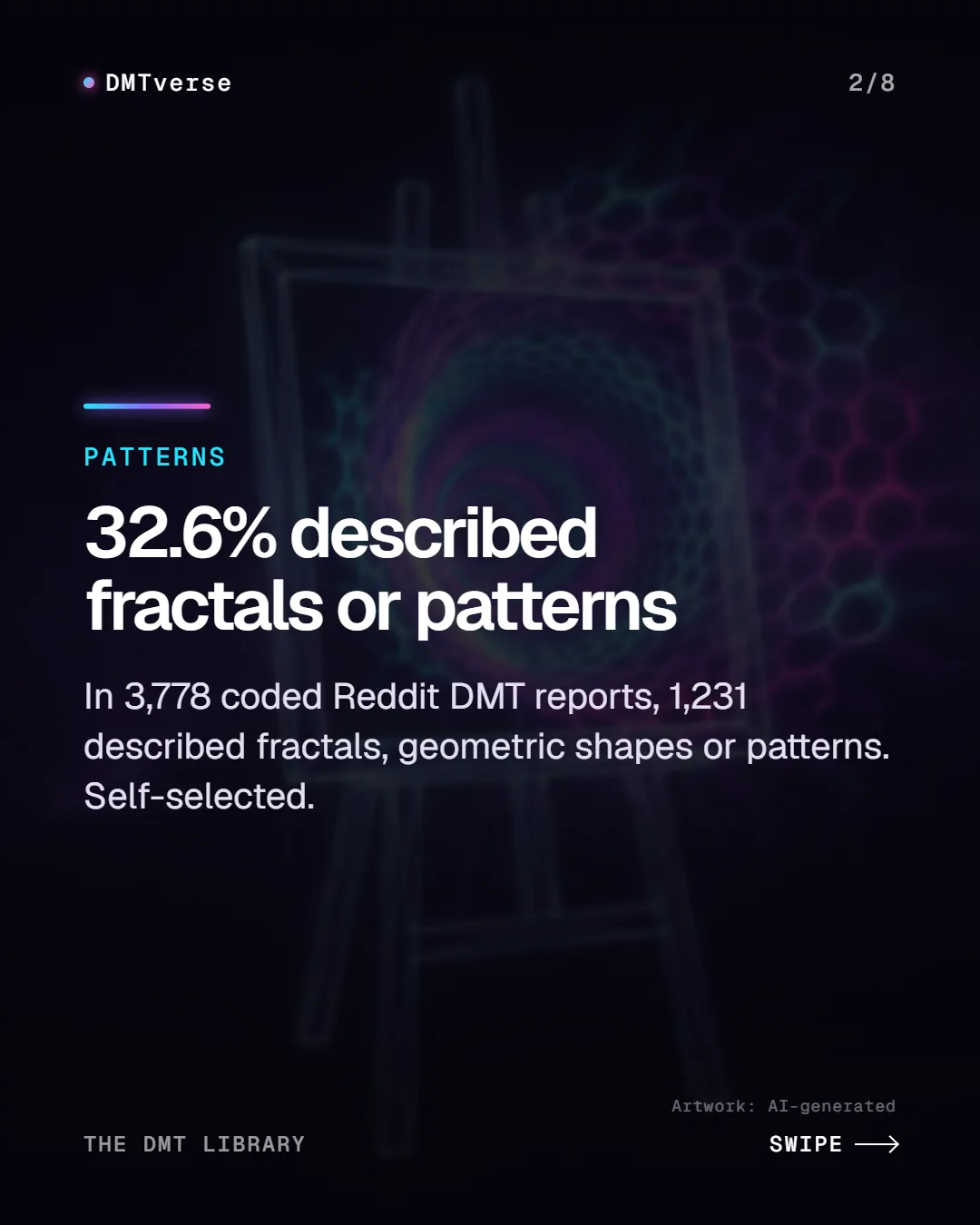
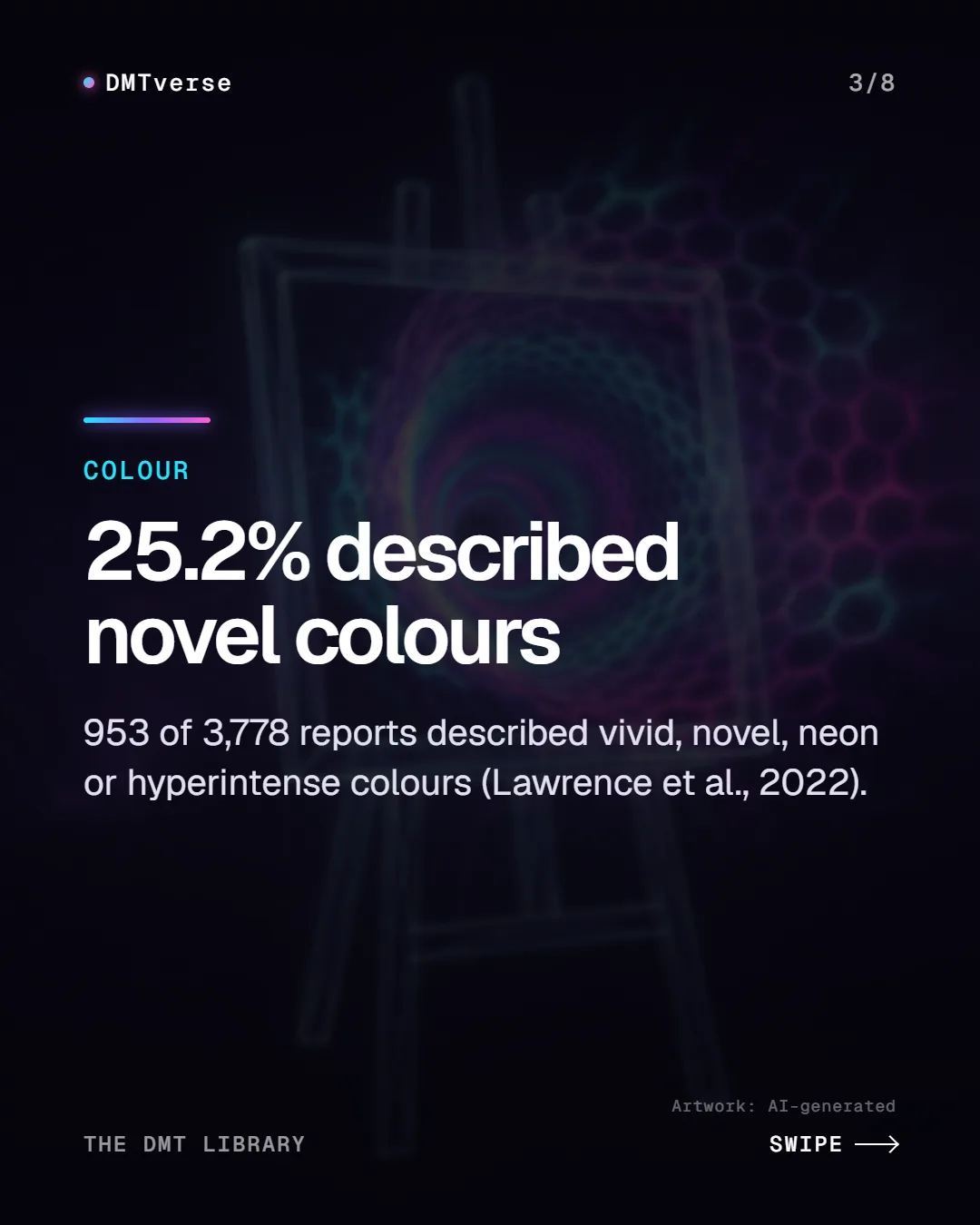
DMT art is any painting, drawing or digital image made to depict what people report seeing on DMT or ayahuasca: shifting geometry, vivid colour, tunnels and beings. In 3,778 coded online reports, 32.6% described fractals or patterns and 25.2% vivid or novel colours. Pablo Amaringo, a Peruvian painter whose ayahuasca visions influenced later imagery, co-founded the Usko-Ayar painting school in Peru in 1988. Researchers now also use AI and virtual reality to imitate such visions. Every picture is an interpretation: the reports describe motion, intensity and meaning that a still image cannot hold.
THE SHORT VERSION · SWIPE
On this page 10 sections
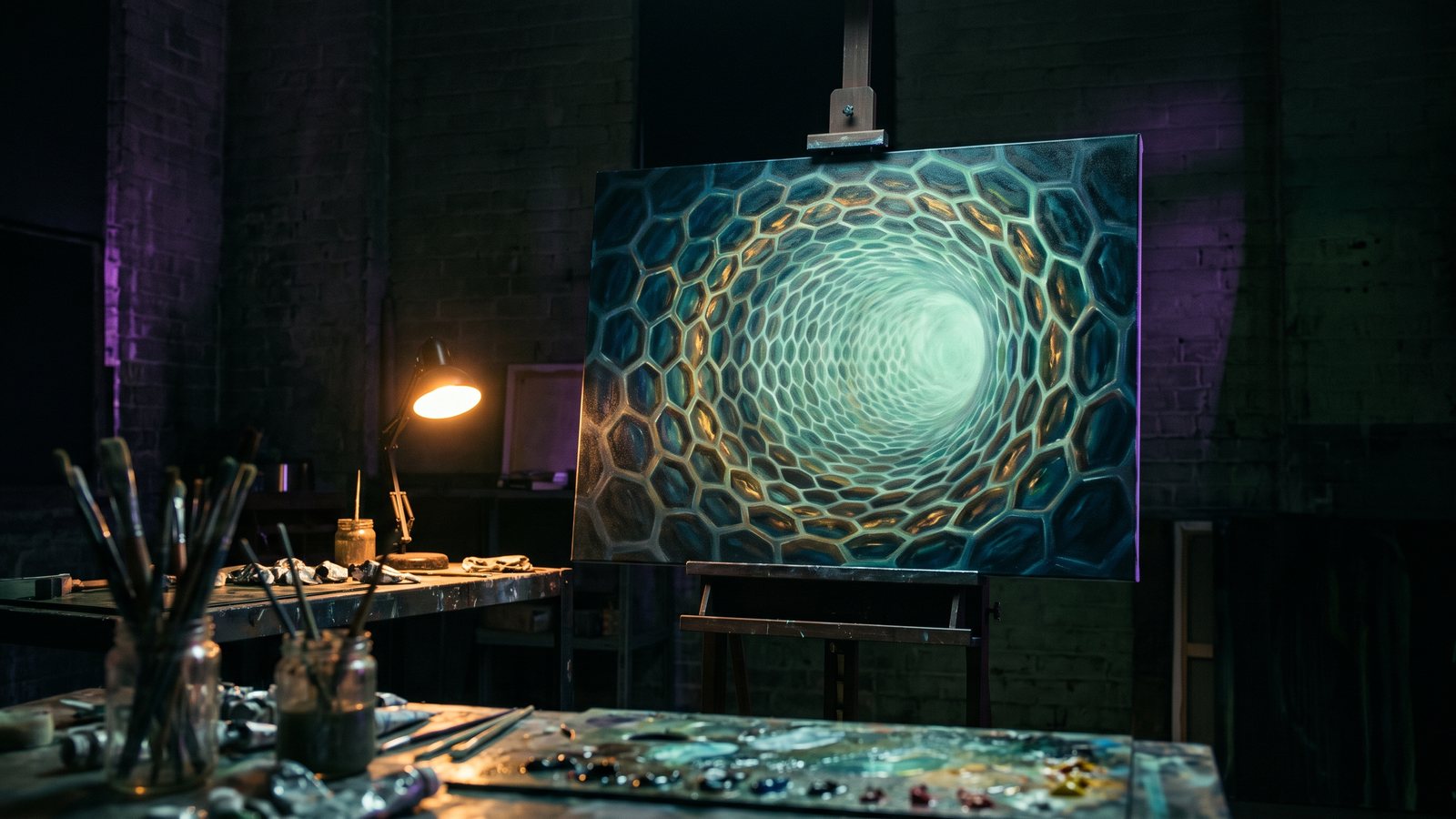
Search for DMT images and you will find thousands of glowing, symmetrical pictures. None of them is a photograph of anything. Each is someone’s attempt to show an experience that happens inside a person. This article looks at what people actually report seeing, the science of hallucinated geometry, the painters who made ayahuasca visions famous, the visionary-art tradition, and the newer AI and virtual-reality simulations. We describe artworks; we do not reproduce them.
Education only, not guidance
This article describes published research, art history and reported experiences. It gives no amounts, no instructions and no advice on use, and it does not describe any effect as a benefit. DMT is a controlled substance in Canada. Evidence labels used below: established (shown in peer-reviewed studies and not seriously disputed), preliminary (early, small, self-selected or indirect) and unresolved (an open question). Descriptions of what an experience looked like are reports, not facts about the world.
What is DMT art?
“DMT art” is a loose label, not a formal school. It covers paintings and digital images that try to depict visions reported on DMT (N,N-dimethyltryptamine, a short-acting psychedelic) or on ayahuasca, an Amazonian brew that contains it. Researchers treat such paintings as one way of recording the experience, alongside verbal reports and questionnaires. A 2020 paper by Imperial College London researchers lists “paintings featured in ‘visionary art’” among the sources that describe how DMT changes perception (Schartner and Timmermann, 2020). Evidence: established as a description of how researchers use art.
So a DMT painting is closer to a translation than a record. The artist remembers, selects and arranges, using skills and visual habits learned elsewhere. For what the experience is like in words, see what does DMT feel like. Evidence: established that paintings are made after the fact; how faithful any one painting is remains unresolved.
What do people say DMT visuals look like?
The largest count comes from a 2022 study that hand-coded 3,778 DMT experiences posted to the r/DMT Reddit community over ten years. Fractals, geometric shapes and patterns appeared in 1,231 experiences (32.6%). “Vivid, novel, neon, beautiful, hyperintense” colours appeared in 953 (25.2%). A tunnel-type structure appeared in 390 (10.3%), and visuals with eyes open in 499 (13.2%) (Lawrence et al., 2022). Evidence: preliminary; the posters were self-selected, and the counts measure what people chose to write.
Fractals, shapes or patterns, 32.6%
1,231 of 3,778 experiences described fractals, geometric shapes or patterns (Lawrence et al., 2022).
Vivid or novel colours, 25.2%
953 experiences described vivid, novel, neon, beautiful or hyperintense colours.
Open-eye visuals, 13.2%
499 experiences described visuals with eyes open, such as walls warping or breathing.
Tunnel-type structure, 10.3%
390 experiences described a tunnel or tunnel-type structure.
Kaleidoscope, 2.2%
85 experiences described a kaleidoscope; mandalas appeared in 1.2%.
Restates Lawrence et al., 2022. Self-selected posts; a count of what people wrote, not of what everyone experiences.
Lab studies describe the same kind of imagery. In Rick Strassman’s early-1990s lab study, 12 experienced volunteers received DMT under controlled conditions. The paper reports a “rapidly moving, brightly colored visual display of images” (Strassman et al., 1994). The 2022 authors quote the same team: many subjects described “kaleidoscopic geometric patterns that were not obviously representational” (Lawrence et al., 2022). Evidence: established as reported content in small lab samples.
The very first account set the tone. A 2021 paper quotes Stephen Szára, who took DMT himself in 1956, describing “brilliantly coloured oriental motifs and wonderful scenes altering rapidly” (Michael et al., 2021); our Szára article tells that story. In the same 2021 field study of 36 interviews, 16 people (44%) described geometric objects, and some called the patterns alive, “sentient geometries”. Evidence: preliminary; a single self-report and a small field study.
Why is DMT art so geometric? Klüver’s form constants
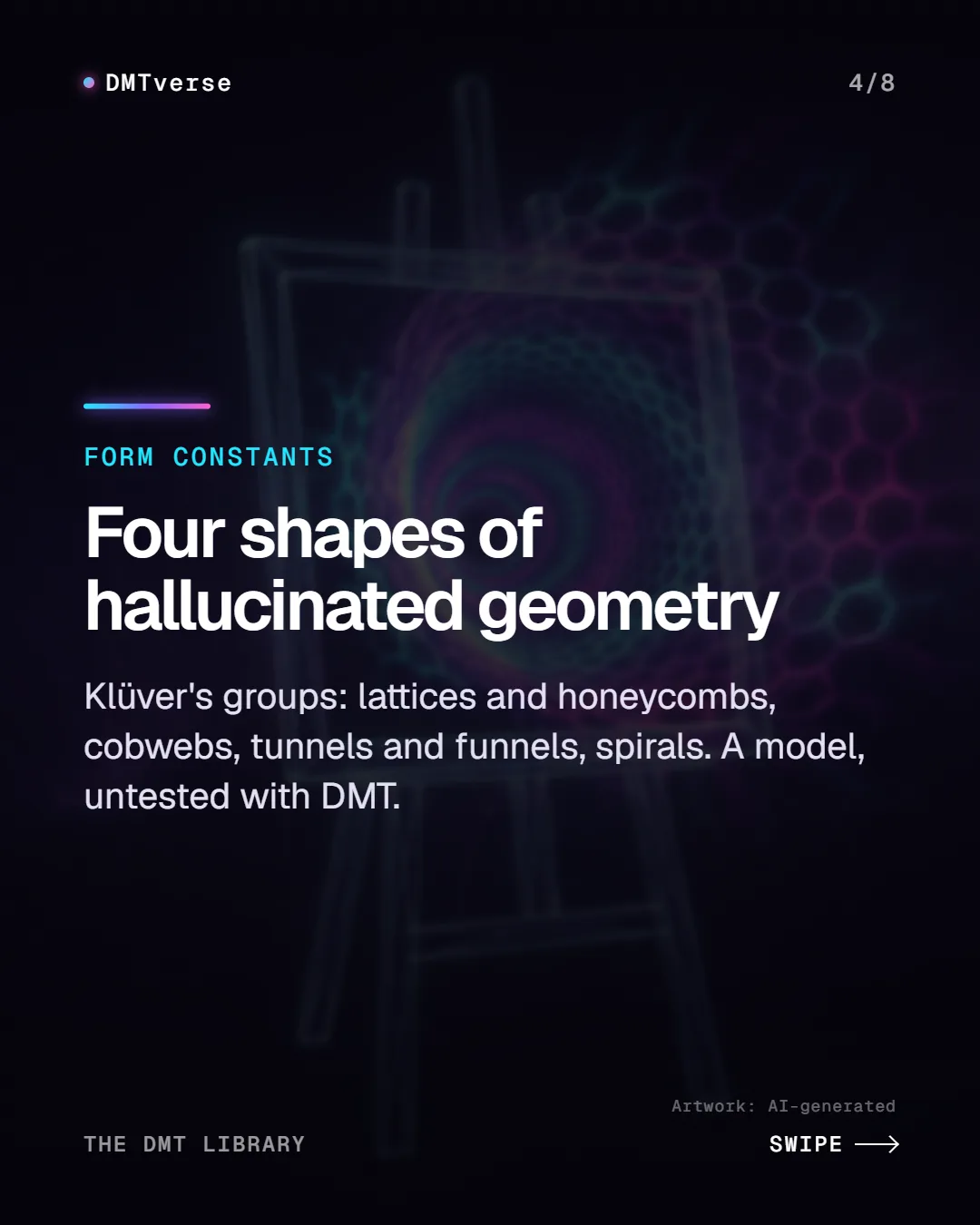
Long before DMT research, the neurologist Heinrich Klüver sorted geometric hallucinations into four groups he called “form constants”. A 2001 mathematical paper sets them out (Bressloff et al., 2001):
- Gratings, lattices, fretworks, filigrees, honeycombs and chequer-boards.
- Cobwebs.
- Tunnels, funnels, alleys, cones and vessels.
- Spirals.
The 2001 paper modelled the primary visual cortex (V1, the first area of the brain’s outer layer to process sight). It showed that if V1 becomes unstable, as the authors presume happens under hallucinogens or flickering light, its own wiring would generate patterns matching all four form constants (Bressloff et al., 2001). Evidence: preliminary; a mathematical model.
If the model is right, it would offer one reason why honeycombs, spirals and tunnels are so common in psychedelic pictures; that link to art is our inference, not something the paper tested. Evidence: preliminary; it is a mathematical model, never tested with DMT, and it covers simple geometry, not scenes or beings.
The famous radiating “chrysanthemum” pattern fits this geometric family; our article on the waiting room, the dome and the chrysanthemum covers that vocabulary, and the DMT laser experiment looks at claims about seeing hidden code.
Who was Pablo Amaringo, and what is ayahuasca art?
Pablo Amaringo (1943–2009) is the painter most often linked with ayahuasca visions in the sources we read. He came from a family of vegetalistas, mestizo healers who specialise in plant medicine, and worked as one himself. He first painted portraits and landscapes. In the 1980s, after the anthropologist Luis Eduardo Luna asked him to draw his ayahuasca visions, they became his subject (Dino, 2019). Luna says he met Amaringo in 1985, during research in the Peruvian Amazon (Luna, 2023). Evidence: established from biographical sources.
Their collaboration produced the book Ayahuasca Visions: The Religious Iconography of a Peruvian Shaman, published in 1991 according to Dino (Dino, 2019) and reviewed in the journal American Anthropologist in 1993 (Whitten, 1993). Researchers still cite it, in a 1999 edition, when they discuss how DMT and ayahuasca visions are depicted (Schartner and Timmermann, 2020). Dino describes the paintings as dense images of the many spiritual realms Amaringo said he had visited. Evidence: established for the book and its use by researchers.
What was the Usko-Ayar school of painting?
In 1988 Amaringo and Luna founded the Usko-Ayar Amazonian School of Painting, which charged no fees. Luna says it had around 300 students when he left the project in 1994, and that former students have since exhibited internationally (Luna, 2023). The school is in Pucallpa, a major city of the Peruvian Amazon, and its Quechua name means “spiritual prince”; Dino reported in 2019 that it still teaches Amaringo’s style (Dino, 2019). Evidence: established from first-hand and secondary accounts; we could not confirm its current status independently.
- 1943Pablo Amaringo born in the Loreto region of PeruSource Dino, 2019
- 1985Luis Eduardo Luna meets Amaringo during research in the Peruvian AmazonSource Luna, 2023
- 1988Usko-Ayar Amazonian School of Painting founded in Pucallpa, free of chargeSource Luna, 2023; Dino, 2019
- 1991Ayahuasca Visions publishedSource Dino, 2019
- 1993Book reviewed in American AnthropologistSource Whitten, 1993
- 1994Luna leaves the project; around 300 students at that pointSource Luna, 2023
- 2009Amaringo diesSource Dino, 2019
This painting is newer than many viewers assume. Western Amazonian peoples are known for geometric designs on ceramics and bodies, while figurative painting is relatively absent from traditional contexts. Dino argues that mestizo artists, some trained in art schools, translate visions into familiar images for a wider public. He also names the Shipibo-Konibo artist Olinda Silvano, who brings traditional kené designs to murals (Dino, 2019). For the brew itself, see what is ayahuasca. Evidence: established as an art-historical account.
What is visionary art, and how is it linked to DMT?
“Visionary art” is the wider label for art that depicts inner, spiritual or altered-state experience. In DMT research, two books are cited as its examples: Ayahuasca Visions and Alex Grey’s 1990 book Sacred Mirrors: The Visionary Art of Alex Grey (Schartner and Timmermann, 2020). Researchers cite them as depictions, including of the beings (“entities”) people report, not as evidence of what DMT does. Evidence: established for how the works are cited.
Museums have treated psychedelic and visionary art as a strand of contemporary art. A 2010 exhibition organised by the San Antonio Museum of Art, with a catalogue by David S. Rubin and others, traced a psychedelic sensibility from 1960s Op Art through painters including Alex Grey to digital work. Its catalogue says the story is about the influence of psychedelic culture on art, “not necessarily the influence of drugs” (Rubin et al., 2010). Evidence: established as a curatorial account.
DMT culture itself leans on pictures. The anthropologist Graham St John, studying online user reports, found that the DMT “breakthrough” is often linked to perceived contact with entities and to information transmitted in the form of “visual language” (St John, 2018). That helps explain why so much DMT talk is illustrated. For the places people describe, see what is DMT hyperspace; for the beings, see DMT entity types explained. Evidence: preliminary; an exploratory anthropological study.
Does DMT art shape what people see?
Possibly. An 18-month ethnography at a shamanic centre in the Peruvian Amazon found that visitors’ ayahuasca visions often echoed familiar imagery. The anthropologist David Dupuis notes that an iconography of paintings, drawings and films, “strongly influenced” by artists such as Amaringo, decorates the books and forums of shamanic tourists. One recurring scene, a woman with plant and snake features, is a major trope of that iconography (Dupuis, 2022). Evidence: preliminary; one centre, one researcher, ayahuasca rather than DMT alone.
Dupuis argues that culture shapes not only how people interpret visions but their content, through what people learn to notice and expect (Dupuis, 2022). The 2022 Reddit study raises a similar worry: earlier posts may influence later reports, as shown by recurring labels (Lawrence et al., 2022). So art and reports may feed each other. Evidence: unresolved; no controlled study has tested whether seeing DMT art changes what people later see.
Can AI or virtual reality simulate DMT visuals?
Researchers have tried, as illustrations and as research tools. In a 2020 paper, two Imperial College London researchers used deep neural networks (AI systems that learn patterns from many images) to alter ordinary pictures. Adding noise to a face generator, and transferring the style of a painting onto a photo, gave images they call consistent with reported DMT hallucinations and with entities in visionary art (Schartner and Timmermann, 2020). Evidence: preliminary; the authors call these speculative examples, with no participants.
The best-known simulation is the “Hallucination Machine”, built at the University of Sussex. It runs panoramic videos through the DeepDream algorithm and shows them in a virtual-reality headset. Twelve participants rated the experience as clearly different from normal video and broadly similar to earlier psilocybin ratings, though stronger evidence of a difference appeared for intensity. The simulation did not distort time, as drug states often do (Suzuki et al., 2017). Evidence: preliminary; small sample, compared with psilocybin, not DMT.
A 2022 study used the same kind of DeepDream VR videos and measured how flexibly people then solved thinking tasks (Rastelli et al., 2022). We found no peer-reviewed study that used virtual reality to simulate a DMT experience specifically; our DMT therapy research article reached the same finding for trials combining DMT and VR. So a “DMT simulation” online is an artist’s interpretation, not a validated replica. Evidence: unresolved.
Researchers have also watched people paint during a DMT state. In a 2026 double-blind, placebo-controlled study, 30 healthy men had sessions with a DMT and harmine formulation, harmine alone, and placebo. They completed thinking tasks and a real painting task. The DMT formulation impaired convergent thinking (finding one correct answer) and reduced the moments of sudden insight recorded during painting (Suay et al., 2026). Evidence: preliminary; one small study, men only, abstract read.
Why can’t DMT pictures capture the experience?
The reports themselves point to several gaps between an experience and any image of it:
- Words fail first. In the 2022 Reddit coding, 534 experiences (14.1%) included a sense that the experience “cannot be described adequately in words” (Lawrence et al., 2022). A painting depends on memory and description too.
- Motion. Lab volunteers described a rapidly moving display (Strassman et al., 1994); a canvas stands still.
- Colour. Posters described colours as “novel” and “hyperintense” (Lawrence et al., 2022); paint and screens have fixed ranges.
- Meaning. Some people describe geometry as alive or aware (Michael et al., 2021), a quality no pattern can show on its own.
- Intensity and time. Even a well-built VR simulation differed from a drug state on intensity and did not distort time (Suzuki et al., 2017).
Evidence: preliminary; each point rests on self-report or small studies, and none measures how faithful a given painting is.
What we still don’t know
- Whether the form-constant model explains DMT geometry; it has never been tested with DMT (preliminary, as a hypothesis).
- Whether seeing DMT or ayahuasca art changes what people later see, or only how they describe it (unresolved).
- How common these visuals are among people who do not post online; the largest counts come from self-selected reports (unresolved).
- Whether any simulation can match a DMT state on intensity, motion and meaning; no DMT-specific VR study was found (unresolved).
- The current status of the Usko-Ayar school; the latest account we found dates from 2019 (unresolved).
For the wider science, start with what is DMT.
Common questions
What is DMT art?
DMT art is a loose name for paintings and digital images that try to depict visions reported on DMT or ayahuasca, such as geometry, vivid colour, tunnels and beings. Every such image is an artist’s interpretation made afterwards, not a recording.
What do DMT visuals look like, according to reports?
In 3,778 coded Reddit reports, 32.6% described fractals, shapes or patterns and 25.2% vivid or novel colours, while 10.3% described a tunnel. Lab volunteers in the 1990s described a rapidly moving, brightly coloured display. These are self-reports.
Who was Pablo Amaringo?
A Peruvian painter (1943–2009) and former vegetalista healer, best known for painting ayahuasca visions. With the anthropologist Luis Eduardo Luna he published Ayahuasca Visions and, in 1988, co-founded the free Usko-Ayar Amazonian School of Painting in Pucallpa.
What are Klüver’s form constants?
Four groups of geometric hallucination described by Heinrich Klüver: lattices and honeycombs, cobwebs, tunnels and funnels, and spirals. A 2001 mathematical model showed that an unstable visual cortex could generate all four, but it has not been tested with DMT.
Is visionary art the same as DMT art?
No. Visionary art is a wider tradition depicting spiritual or altered-state experience. DMT researchers cite visionary works such as Ayahuasca Visions and Alex Grey’s Sacred Mirrors as depictions, and a 2010 museum show framed psychedelic art as cultural influence, not necessarily drug use.
Can AI or VR show what a DMT trip looks like?
Not reliably. AI-altered images and DeepDream virtual reality can produce trip-like visuals, and one VR study found ratings broadly similar to psilocybin. We found no peer-reviewed study simulating DMT specifically in VR, and the simulation did not reproduce time distortion.
Does looking at ayahuasca art change what people see?
It may. An ethnography in the Peruvian Amazon found visitors’ visions echoed imagery influenced by painters such as Amaringo. No controlled study has tested whether viewing such art changes later visions.
Shroomverse sells mushroom products. This article is general information about how DMT and ayahuasca visions have been depicted in art and research. It is not medical, legal or purchasing advice, and it does not recommend any product.
SOURCES
- Phenomenology and content of the inhaled N,N-dimethyltryptamine (N,N-DMT) experience (Lawrence DW, Carhart-Harris R, Griffiths R, Timmermann C, Scientific Reports 12:8562, 2022), Springer Nature (peer-reviewed, open access); PMC9130218. Accessed . Full text read via Europe PMC. 3,778 experiences from 3,305 r/DMT posts; fractals/shapes/patterns 32.6% (1,231), kaleidoscope 2.2%, mandala 1.2%; vivid/novel/neon/hyperintense colours 25.2% (953); open-eye visuals 13.2% (499); tunnel 10.3% (390); 'cannot be described adequately in words' 14.1% (534); quotes Strassman et al. on kaleidoscopic, non-representational patterns; limitation on recurring labels.
- An Encounter With the Other: A Thematic and Content Analysis of DMT Experiences From a Naturalistic Field Study (Michael P, Luke D, Robinson O, Frontiers in Psychology 12:720717, 2021), Frontiers (peer-reviewed, open access); PMC8716686. Accessed . Full text read via Europe PMC. 36 interviews; geometric objects in 16 (44%); participants' phrase 'sentient geometries'; quotes Szára's 1956 self-report of brilliantly coloured oriental motifs (dose not reproduced here).
- Dose-response study of N,N-dimethyltryptamine in humans. II. Subjective effects and preliminary results of a new rating scale (Strassman RJ, Qualls CR, Uhlenhuth EH, Kellner R, Archives of General Psychiatry 51(2):98–108, 1994), American Medical Association (peer-reviewed). Accessed . Abstract read via Europe PMC. Twelve volunteers; hallucinogenic effects included a rapidly moving, brightly colored visual display of images. Doses not reproduced.
- Geometric visual hallucinations, Euclidean symmetry and the functional architecture of striate cortex (Bressloff PC, Cowan JD, Golubitsky M, Thomas PJ, Wiener MC, Phil Trans R Soc B 356(1407):299–330, 2001), The Royal Society (peer-reviewed); PMC1088430. Accessed . Abstract read via Europe PMC. Klüver's four form constants listed in full; model in which instability of V1 under the presumed action of hallucinogens or flickering light generates planforms representing all form constants. A model, not a DMT study.
- Neural network models for DMT-induced visual hallucinations (Schartner MM, Timmermann C, Neuroscience of Consciousness 2020(1):niaa024, 2020), Oxford University Press (peer-reviewed, open access); PMC7734438. Accessed . Full text read via Europe PMC. Lists paintings in 'visionary art' (Grey 1990, Sacred Mirrors; Luna and Amaringo 1999, Ayahuasca Visions) among descriptions of DMT perception; StyleGAN noise and style-transfer examples consistent with reported hallucinations and visionary depictions of entities; authors call the interpretations speculative.
- A Deep-Dream Virtual Reality Platform for Studying Altered Perceptual Phenomenology (Suzuki K, Roseboom W, Schwartzman DJ, Seth AK, Scientific Reports 7:15982, 2017), Springer Nature (peer-reviewed, open access); PMC5700081. Accessed . Full text read via Europe PMC. 'Hallucination Machine' (DeepDream + panoramic VR); 12 participants in Experiment 1; ASC ratings distinct from control video and qualitatively similar to earlier psilocybin data, with stronger evidence of a difference on intensity; no temporal distortion.
- Simulated visual hallucinations in virtual reality enhance cognitive flexibility (Rastelli C, Greco A, Kenett YN, Finocchiaro C, De Pisapia N, Scientific Reports 12:4027, 2022), Springer Nature (peer-reviewed, open access); PMC8901713. Accessed . Abstract read via Europe PMC. DeepDream-altered VR panoramic videos vs unaltered; cognitive flexibility measured afterwards. Cited for design only.
- Ayahuasca-inspired DMT/harmine formulation alters creative thinking dynamics during artistic creation (Suay D, et al., Journal of Psychopharmacology 40:1292–1304, 2026), SAGE (peer-reviewed). Accessed . Abstract read via Europe PMC. Double-blind, placebo-controlled, within-subject; 30 healthy men; DMT/harmine impaired convergent thinking and decreased incubation-to-illumination transitions in a real painting task.
- The socialization of hallucinations: Cultural priors, social interactions, and contextual factors in the use of psychedelics (Dupuis D, Transcultural Psychiatry 59(5):625–637, 2022), SAGE (peer-reviewed, open access); PMC9660275. Accessed . Full text read via Europe PMC. Ethnography at a Peruvian Amazon shamanic centre; iconography 'strongly influenced' by artists such as Pablo Amaringo decorates shamanic tourists' books and forums; snake/plant woman as a major trope; culture shapes vision content.
- The Ayahuasca Visions of Peruvian Painter Pablo Amaringo and The Usko-Ayar Amazonian School of Painting: A chronicle (1985–1994) (Luna LE, colloquium abstract, 31 March 2023), University of Exeter, Psychedelic Colloquium Archive. Accessed . Abstract read. Luna met Amaringo, a former vegetalista, in 1985; in 1988 they founded the free Usko-Ayar Amazonian School of Painting; around 300 students when Luna left in 1994; former students exhibit internationally. First-hand account by a co-founder.
- Visionary Art in Peruvian Amazonia: The Power of Images and Translation Effects (Dino V, 2 July 2019), Chacruna Institute for Psychedelic Plant Medicines. Accessed . Essay read. Amaringo 1943–2009, vegetalista family, began painting visions in the 1980s at Luna's request; Ayahuasca Visions 1991; Usko-Ayar founded 1988 in Pucallpa, Quechua for 'spiritual prince', still teaching in 2019; figurative painting relatively absent from traditional Western Amazonian contexts; translation argument; Olinda Silvano and kené murals.
- Review of Ayahuasca Visions: The Religious Iconography of a Peruvian Shaman, by Luis Eduardo Luna and Pablo Amaringo (Whitten NE, American Anthropologist 95(2):490–492, 1993), Wiley / American Anthropological Association (peer-reviewed journal). Accessed . Crossref record read (review text not open). Confirms the book's title, authors and a 1993 review in American Anthropologist.
- Psychedelic: Optical and Visionary Art since the 1960s (Rubin DS, with Morgan RC and Pinchbeck D; San Antonio Museum of Art and MIT Press, 2010), Publisher's description, reproduced on the Ruiz-Healy Art publications page; Crossref record 10.5860/choice.48-0074 (Choice review) also checked. Accessed . Publisher's description read. Exhibition organised by the San Antonio Museum of Art; traces a psychedelic sensibility from 1960s Op Art through painters including Alex Grey to digital work; frames the story as the influence of psychedelic culture on art, 'not necessarily the influence of drugs'.
- The Breakthrough Experience: DMT Hyperspace and its Liminal Aesthetics (St John G, Anthropology of Consciousness 29(1):57–76, 2018), Wiley / American Anthropological Association (peer-reviewed). Accessed . Abstract read via the Crossref record. Online user reports; breakthrough linked to perceived contact with entities and transmission of information 'often in the form of visual language'; exploratory study.
CHANGES
- : Linked glossary definitions.
- : Published. All sources opened and checked on this date via Europe PMC, Crossref and the linked web pages.
- : Editorial review: unsourced “best-known painter” superlative removed from the summary and body; the link from Klüver’s form constants to recurring motifs in art is now labelled as our inference, and the unsourced “across cultures” dropped. Lawrence 2022, Strassman 1994 (part II), Bressloff 2001, Suzuki 2017 and Suay 2026 abstracts and the Whitten 1993 Crossref record re-checked.



