THE SHROOMVERSE JOURNAL ✳ 11 MIN READ
Ayahuasca documentaries and films: a sourced guide to what each one shows
Topic: DMT
Published
Listen: the 3-minute version
AI-narrated summary of this article
Short answer, checked 21 October 2026
Notable ayahuasca documentary and film titles include Jan Kounen’s Other Worlds (2004), Vine of the Soul (2010), Aya: Awakenings (2013), The Last Shaman (2017) and the fiction feature Icaros: A Vision (2016). Most are personal journeys that present the brew sympathetically; few dwell on risks. A film is a point of view, not evidence. This guide gives each title’s credits from festival, listing or review sources, and how it frames ayahuasca.
THE SHORT VERSION · SWIPE
On this page 8 sections
Films have shaped how many people first hear about ayahuasca, a traditional Amazonian brew that contains DMT. This guide lists notable documentaries and films that feature it, with each title’s year and director checked against a festival record, a cinema listing or a published review. It also notes how each film frames the brew. This is media literacy, not a viewing or use recommendation.
How to read this guide
We describe films; we do not quote them, rate them or say where to watch them. A documentary shows its makers’ choices about who speaks and what is left out. For what research has actually measured, see our evidence articles linked below. Evidence labels: established (documented in the sources and not seriously disputed), preliminary (early, small or indirect) and unresolved (an open question).
Which ayahuasca documentaries and films are notable?
| Title | Year | Director | What it covers | Framing |
|---|---|---|---|---|
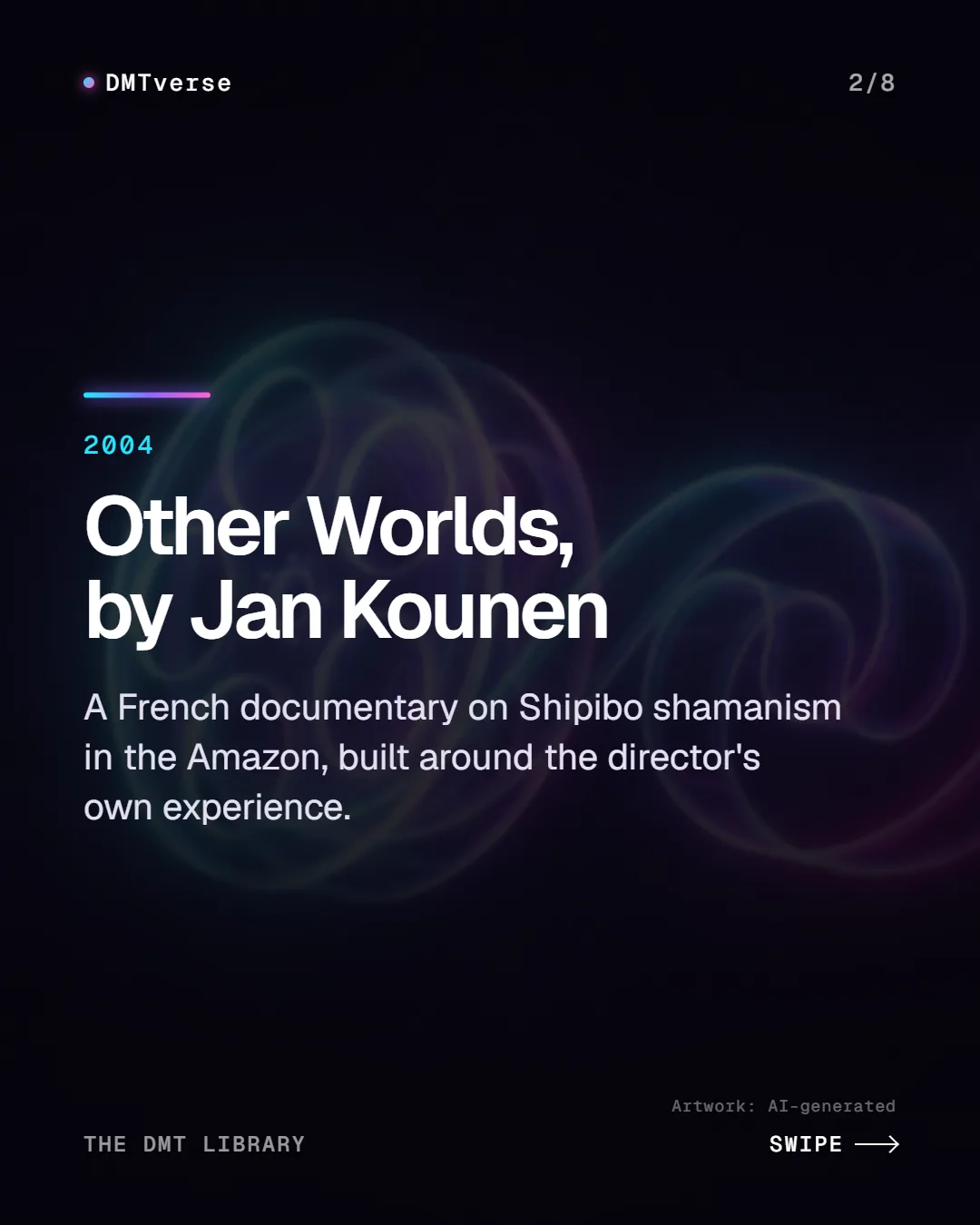
| Other Worlds (D’autres mondes) | 2004 | Jan Kounen | French documentary on shamanism among the Shipibo people of the Amazon, built around the director’s own experience. | Personal and partly ethnographic; sympathetic |
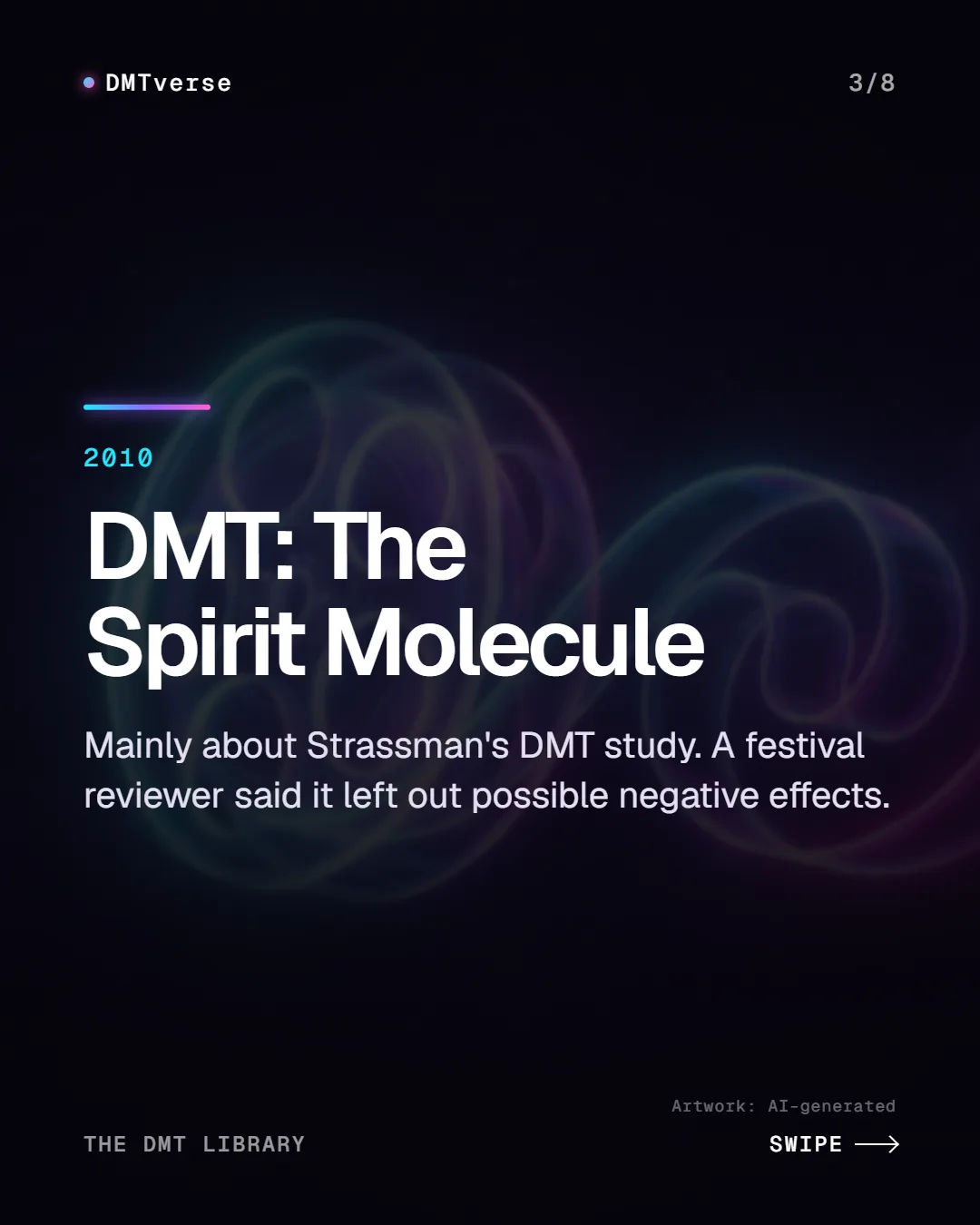
| DMT: The Spirit Molecule | 2010 | Mitch Schultz | Mainly Rick Strassman’s 1990s DMT study; ayahuasca ceremonies appear as context. | Promotional, per a festival review |
| Vine of the Soul: Encounters with Ayahuasca | 2010 | Richard Meech | Anthropologists on traditional use and scientists studying the brew in addiction research. | Mixed ethnographic and scientific |
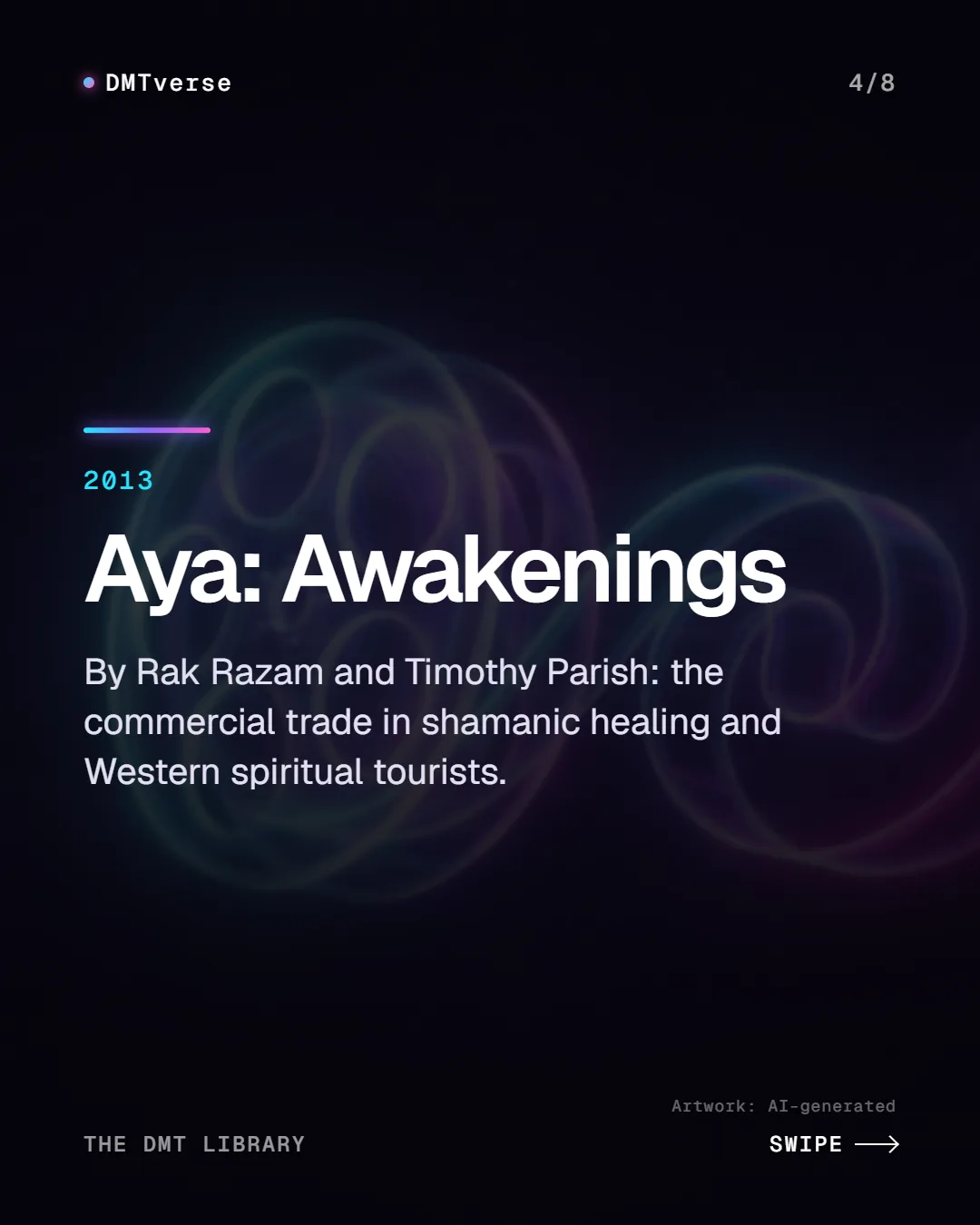
| Aya: Awakenings | 2013 | Rak Razam, Timothy Parish | Adapted from Razam’s book; the commercial trade in shamanic healing and Western spiritual tourists. | Experiential, with attention to commercialization |
| Icaros: A Vision | 2016 | Leonor Caraballo, Matteo Norzi | Fiction: an American woman joins healing ceremonies in the Amazon. | Drama, not documentary |
| The Last Shaman | 2017 | Raz Degan | A young American with depression travels to the Amazon to try ayahuasca. | Personal journey; critics divided |
| Ayahuasca (Kosmik Journey) | 2019 | Jan Kounen | Short virtual-reality work recreating visions, shown at Tribeca and IDFA. | Artistic simulation |
We left out films whose year and director we could not confirm from a festival record, a cinema listing or a published review, including several titles that appear mainly on screening-event pages. Inclusion here is not an endorsement. Evidence: established for the credits as listed in the sources below.
What does each ayahuasca documentary cover?
Other Worlds (D’autres mondes), 2004
A Paris cinema guide lists the French documentary as directed by Jan Kounen, 73 minutes long, released in France on 30 June 2004 by the distributor Eurozoom. Its synopsis describes Kounen meeting Kestenbetsa, a Shipibo spiritual leader, and filming a solstice ceremony that had reportedly not been held for about 70 years and was closed to outsiders. The film sets out to challenge common misconceptions about shamanism (Offi, D’autres mondes). Evidence: established for the credits.
A statement from Kounen about the project, posted by Arthur Magazine in 2005, describes a deliberately personal and subjective film placed between Western science and Indigenous healing knowledge. In it he also stressed the risk of psychological breakdown without competent guidance and said he wanted to avoid a New Age tone (Arthur Magazine, 2005). The framing is sympathetic but not uncritical. Evidence: established for what the statement says; the framing is our reading.
DMT: The Spirit Molecule, 2010
This documentary is about DMT more than ayahuasca. A review of its 2010 festival screening names Austin filmmaker Mitch Schultz as director and describes a film centred on Rick Strassman’s 1990s DMT study, contrasting US drug policy with more tolerant approaches elsewhere, including ayahuasca ceremonies. The reviewer called it strongly pro-psychedelic and said it left out possible negative effects; Schultz acknowledged those risks in the post-screening discussion, according to the review (Slackerwood, 2010). Our article on DMT: The Spirit Molecule, the book and the film checks its claims against later research. Evidence: established for the review’s account.
Vine of the Soul: Encounters with Ayahuasca, 2010
Directed by Richard Meech, this documentary explores ayahuasca through anthropologists studying its traditional shamanic uses and scientists investigating it as a possible addiction treatment, according to a 2011 screening listing that calls it a new documentary (MAPS, 2011). That listing was published by a psychedelic-advocacy organization, so it is a description, not a review. A 2023 film-studies thesis at Lund University chose it, dated 2010, as one of two case studies of the “ayahuasca documentary” as a genre (Nalvarte Nunez, 2023). Evidence: established for the director; the 2010 date rests on the thesis record, and we found no independent review or festival record.
Aya: Awakenings, 2013
A TV Guide listing credits Rak Razam and Timothy Parish as directors of this 101-minute documentary, adapted from Razam’s book. Its synopsis describes Razam travelling to the Amazon to look at the growing commercial trade in shamanic healing, a clash between older traditions and modern demand, and Western spiritual tourists seeking visionary experiences (TV Guide). The Lund thesis used it as its second case study and included an interview with Razam (Nalvarte Nunez, 2023). Evidence: established for the credits.
The Last Shaman, 2017
Directed by Raz Degan and produced with Appian Way, this 77-minute documentary follows a young American struggling with depression who travels to the Amazon and takes ayahuasca. On the review aggregator Rotten Tomatoes it holds a 44% critics’ score from 9 reviews (Rotten Tomatoes). Evidence: established for the credits and score as listed on 21 October 2026.
The listed reviews diverge. As summarised on that page, the Los Angeles Times found it a fascinating and sometimes frightening introduction to ayahuasca; the New York Times reviewer had doubts about the brew’s commercialization; and The Hollywood Reporter found the storytelling hazy (Rotten Tomatoes). The film tells one person’s story, which is not evidence about depression treatment. Evidence: established for the review summaries; we read the summaries, not the full reviews.
Is there an ayahuasca movie, not just documentaries?
Yes. Icaros: A Vision, directed by Leonor Caraballo and Matteo Norzi, had its world premiere in the International Narrative Competition at the 2016 Tribeca Film Festival. Tribeca lists it as a 91-minute drama about an American woman who travels to the Amazon, joins ayahuasca healing ceremonies and forms a bond with a young Indigenous shaman facing difficulties of his own (Tribeca, 2016). As fiction, it dramatizes rather than documents. Evidence: established for the credits.
Jan Kounen returned to the subject in 2019 with a short virtual-reality work. Tribeca lists Ayahuasca by Kounen in its 2019 Virtual Arcade, at 12 minutes, as a world premiere tagged animation, experimental and documentary (Tribeca, 2019). IDFA lists Ayahuasca: Kosmik Journey at 18 minutes, also as a world premiere, in exhibition and planetarium-dome versions, describing it as recreating ayahuasca visions from Shipibo ceremonies (IDFA, 2019). The two listings differ on runtime and premiere, probably because they describe different versions. Evidence: established that both festivals showed it; the discrepancy is unresolved.
A VR rendering is one artist’s interpretation of reported visions. Our article on DMT art and visionary art explains why images cannot capture what people report. Evidence: established that it is an artistic work.
Is there an ayahuasca documentary on Netflix?
None of the sources we checked lists any film in this guide as a Netflix title, and the aggregator page for The Last Shaman listed other services, not Netflix, when we read it. Streaming catalogues change by country and month, so we do not list where to watch any film and include no streaming links. Evidence: unresolved, because availability changes.
How do ayahuasca documentaries frame the brew?
Three framings recur in the films above. Promotional films present the brew mainly as healing or awakening and say little about risk. Critical films question commercialization, tourism or the claims made for it. Ethnographic films centre Indigenous and traditional practitioners and their own terms. Many films mix all three. The Lund thesis argued that the genre invites viewers to reflect on other realities and presents ancient knowledge in contemporary, accessible terms (Nalvarte Nunez, 2023). Evidence: preliminary; this is one master’s thesis and our own reading.
- Who is speaking? Note whether Indigenous practitioners speak for themselves or are filmed as a backdrop for a visitor’s story.
- Is it one person’s journey? A single story, however moving, cannot show how often anything happens.
- Are risks shown? Look for medical screening, drug interactions and people for whom it went badly.
- Who made and promoted it? Check whether the makers or screening hosts have an advocacy or commercial stake.
- Does it separate claims from evidence? Compare what the film says with what controlled studies found.
Coverage can shape behaviour. In a survey of 209 adults entering New York City nightclubs, 21% said media coverage of MDMA’s medical benefits made them more likely to use it, and 10% said the same of ketamine; the largest group said coverage made no difference (Palamar and Le, 2022). That study did not cover ayahuasca or films, and its answers were self-reported. Evidence: preliminary.
Where can you check what films claim?
Films compress years of research and centuries of practice into a story. For the evidence behind the headlines, read what is ayahuasca for its pharmacology, history and risks, and ayahuasca benefits: what the research shows for trials and surveys with their designs and limits. Santo Daime and UDV ayahuasca churches covers religious use, and how DMT went mainstream traces the wider media story.
Ayahuasca blocks the enzyme MAO, which creates serious interaction risks with some medicines, including common antidepressants; the articles above set out the research. Films rarely cover this in depth. Evidence: established, as sourced in those articles.
If someone is in danger
Call 911 for immediate danger or urgent medical help, including if someone is unconscious, not breathing or having a seizure. In Ontario, the Ontario Poison Centre is at 1-800-268-9017; every province has a poison centre, listed by SickKids (AboutKidsHealth). If you or someone you know is thinking about suicide, call or text 9-8-8, 24 hours a day (Government of Canada). See also our safety page.
What this guide can’t tell you
- Whether any film is accurate in detail: we checked credits and framing, not every scene.
- How films influence decisions about ayahuasca specifically; we found no study of that.
- Where any film is currently available to watch, which changes often.
- The many smaller ayahuasca documentaries, more than 50 by one thesis count, that lack festival or review records.
For the science behind ayahuasca’s main active compound, start with our pillar guide, what is DMT.
Common questions
What is the best-known ayahuasca documentary?
Notable titles include Other Worlds (2004, Jan Kounen), Vine of the Soul (2010, Richard Meech), Aya: Awakenings (2013, Rak Razam and Timothy Parish) and The Last Shaman (2017, Raz Degan). DMT: The Spirit Molecule (2010) is about DMT but features ayahuasca ceremonies. We list credits and framing, not rankings.
Is there an ayahuasca movie that is fiction?
Yes. Icaros: A Vision, directed by Leonor Caraballo and Matteo Norzi, premiered in Tribeca’s 2016 International Narrative Competition. It is a drama about an American woman who joins ayahuasca healing ceremonies in the Amazon.
Is there an ayahuasca documentary on Netflix?
None of the sources we checked lists any film in this guide as a Netflix title. Streaming catalogues change by country and over time, so we do not list where to watch any film.
What is The Last Shaman about?
It is a 2017 documentary directed by Raz Degan that follows a young American struggling with depression who travels to the Amazon and takes ayahuasca. Critics were divided: it holds a 44% score from 9 reviews on Rotten Tomatoes. It is one person’s story, not evidence about treatment.
Are ayahuasca documentaries reliable?
They are points of view. Many are personal journeys that present the brew sympathetically and say little about risks or drug interactions. Check who made the film, who speaks in it and whether its claims match controlled studies.
Is DMT: The Spirit Molecule about ayahuasca?
Mainly no. The 2010 documentary, directed by Mitch Schultz, centres on Rick Strassman’s 1990s DMT study, with ayahuasca ceremonies as context. A festival reviewer described it as strongly pro-psychedelic and said it left out possible negative effects.
Is there a virtual-reality ayahuasca film?
Yes. Jan Kounen’s short VR work, listed as Ayahuasca at Tribeca and as Ayahuasca: Kosmik Journey at IDFA, was shown at both festivals in 2019. It is one artist’s rendering of reported visions, not a recording of an experience.
Shroomverse sells mushroom products. This article is general information about documentaries and films that feature ayahuasca. It is not medical, legal or purchasing advice, and it does not recommend any product.
SOURCES
- D’autres mondes (Jan Kounen, 2004), film listing, Offi.fr (Paris cinema and events guide). Accessed . Listing read. Director Jan Kounen; 2004; 1 h 13; French release 30 June 2004; distributor Eurozoom; documentary; synopsis: Kestenbetsa, Shipibo spiritual leader; solstice ceremony not held for about 70 years and closed to outsiders; aims to challenge misconceptions about shamanism.
- Jan Kounen’s doc on Shipibo shamanism (posted 13 April 2005), Arthur Magazine. Accessed . Read. A statement by Kounen about the project: personal, subjective film between Western science and Indigenous healing knowledge; risk of psychological breakdown without competent guidance; intention to avoid a New Age tone. Used only for the director’s stated framing.
- AFF 2010 Review: The Spirit Molecule (Clinchy D, 30 October 2010), Slackerwood (Austin film blog). Accessed . Read. Festival-screening review: director Mitch Schultz; film centred on Strassman’s 1990s DMT study; contrasts US policy with approaches elsewhere, including ayahuasca ceremonies; reviewer found it strongly pro-drug and said it omitted possible negative effects; Schultz acknowledged risks in the Q&A.
- Noetic Film Night: Vine of the Soul: Encounters with Ayahuasca (screening listing, 6 July 2011), Multidisciplinary Association for Psychedelic Studies (MAPS). Accessed . Read. Director Richard Meech; film explores ayahuasca through anthropologists studying traditional shamanic use and scientists investigating it as a possible addiction treatment. An advocacy organization’s event listing, not a review.
- A Study of Ayahuasca Documentary Film (Nalvarte Nunez G, master’s thesis, Film Studies, Lund University, 2023), Lund University (student publication record). Accessed . Record and abstract read. Defines the ayahuasca documentary as a sub-genre from a catalogue of over 50 films; case studies Ayahuasca: Vine of the Soul (2010) and Aya: Awakenings (2013); interview with Rak Razam; argues the films present ancient knowledge in accessible terms. A master’s thesis, not peer reviewed.
- Aya: Awakenings (2013), cast and crew, TV Guide. Accessed . Listing read. 2013; 1 h 41; directors Timothy Parish and Rak Razam; written by Razam; based on his book; synopsis: the commercial trade in shamanic healing in the Amazon and Western spiritual tourists.
- Icaros: A Vision (2016), Tribeca Festival. Accessed . Festival record read. Directors Leonor Caraballo and Matteo Norzi; International Narrative Competition; 91 minutes; world premiere; drama; synopsis of an American woman in ayahuasca healing ceremonies in the Amazon.
- The Last Shaman (2017), Rotten Tomatoes (review aggregator). Accessed . Page read. Director Raz Degan; production company Appian Way; 1 h 17; documentary; synopsis; 44% critics’ score from 9 reviews; one-line summaries of reviews from the Los Angeles Times, New York Times and The Hollywood Reporter (full reviews not read); where-to-watch box listed other services, not Netflix (services deliberately not named).
- Ayahuasca (Jan Kounen, 2019), Tribeca Festival. Accessed . Festival record read. Director Jan Kounen; Virtual Arcade; 12 minutes; world premiere; tagged animation, experimental and documentary; immerses viewers in visions induced by ayahuasca.
- Ayahuasca: Kosmik Journey Dome Experience (Jan Kounen, 2019), IDFA (International Documentary Film Festival Amsterdam). Accessed . Festival record read. Director Jan Kounen; IDFA 2019, DocLab; 18 minutes; VR, exhibition and dome versions; world premiere; recreates ayahuasca visions from Shipibo ceremonies.
- Media coverage about medical benefits of MDMA and ketamine affects perceived likelihood of engaging in recreational use (Palamar JJ, Le A, Addiction Research & Theory 30(2):96–103, 2022), Taylor & Francis (peer-reviewed). Accessed . Abstract read via Europe PMC. Survey of 209 adults entering randomly selected New York City nightclubs; 21.0% (MDMA) and 10.1% (ketamine) reported increased likelihood of use in response to coverage; plurality reported no effect. Self-reported; not about ayahuasca or films.
- Mental health support: get help, Government of Canada, Public Health Agency of Canada. Accessed . Read. Source for calling 9-1-1 in immediate danger or for urgent medical support, and the 9-8-8 line (call or text, 24 hours a day, 7 days a week).
- Poison information centres in Canada, AboutKidsHealth, The Hospital for Sick Children (SickKids). Accessed . Read. Source for the provincial poison centre list, including the Ontario toll-free number 1-800-268-9017.
CHANGES
- : Linked glossary definitions.
- : Published. Film credits checked on this date against festival records (Tribeca, IDFA), a cinema listing, a TV listing, a festival review, a review aggregator and a university thesis record; films we could not source were left out.
- : Editorial review: reopened every film source and confirmed each year and director; corrected the media-survey wording (a plurality, not most, said coverage made no difference); noted that Vine of the Soul's date rests on a thesis record; dropped country names from film settings; primary keyword added to the summary's first sentence.



