THE SHROOMVERSE JOURNAL ✳ 13 MIN READ
What does DMT feel like? What research records, from the first seconds to the hours after
Topic: DMT
Published Updated
Listen: the 3-minute version
AI-narrated summary of this article
Short answer, checked 20 October 2026
In research reports, DMT feels sudden and overwhelming: a bodily rush or vibration, fast-moving, brightly coloured geometric visuals, a sense of entering another space and, for many but not all, a presence or being. Emotions range from joy to fear. In a 1994 lab study, effects peaked within about two minutes and had almost resolved by 30. These are self-reports, mostly from experienced volunteers, and the share reporting any feature changes a lot with how people were asked.
THE SHORT VERSION · SWIPE
On this page 12 sections
People who describe DMT often start by saying it cannot be described. Researchers have tried anyway, with forum analyses, surveys, field interviews and lab studies. This article draws on six of the most detailed and follows the experience in order: timing, body, visuals, space, presences, self, emotion and the aftermath. It ends with what self-reports can and cannot tell us. For the molecule itself, see what is DMT.
Reports, not recommendations
Everything below is what people in studies reported. None of it is a prediction of what anyone else would experience, a recommendation, or a description of a benefit. This article gives no amounts and no instructions; where a study used a dose, it is not reproduced here. DMT is a controlled substance in Canada. Evidence labels: established (shown in peer-reviewed studies and not seriously disputed), preliminary (early, small, self-selected or indirect) and unresolved (an open question).
How do researchers know what DMT feels like?
Only by asking people, in different ways. Each method has a different blind spot, so it helps to know who was asked, where, and how, before reading any figure.
| Study | Setting and design | Who | How experiences were recorded |
|---|---|---|---|
| Strassman et al., 1994 | Hospital research unit; randomized, double-blind, placebo-controlled (intravenous) | 12 volunteers experienced with hallucinogens | Interviews after effects resolved; a new rating scale |
| Timmermann et al., 2018 | Laboratory; within-subjects, placebo-controlled (intravenous) | 13 healthy volunteers | A validated near-death experience questionnaire |
| Davis et al., 2020 | Online survey (inhaled use, outside research) | 2,561 self-selected people | Fixed-choice questions about their single most memorable entity encounter |
| Michael et al., 2021 | Participants’ homes, researchers present; naturalistic field study (inhaled) | 36 sessions by screened, experienced users; 83% white, 8 women | In-depth interviews immediately afterwards |
| Lawrence et al., 2022 | Public online forum, 2009–2018 (inhaled use, outside research) | 3,778 experiences posted by self-selected authors | Qualitative coding of written reports |
| Sanders et al., 2026 | Laboratory, during brain scanning; blindfolded, eyes closed (intravenous) | 23 participants | Micro-phenomenological interviews on how the experience unfolded |
Sources for the table: Strassman et al., 1994; Timmermann et al., 2018; Davis et al., 2020; Michael et al., 2021; Lawrence et al., 2022; Sanders et al., 2026. The designs differ so much that figures from one cannot be added to or compared directly with another. Evidence: established for the study designs.
What are the stages of a DMT experience?
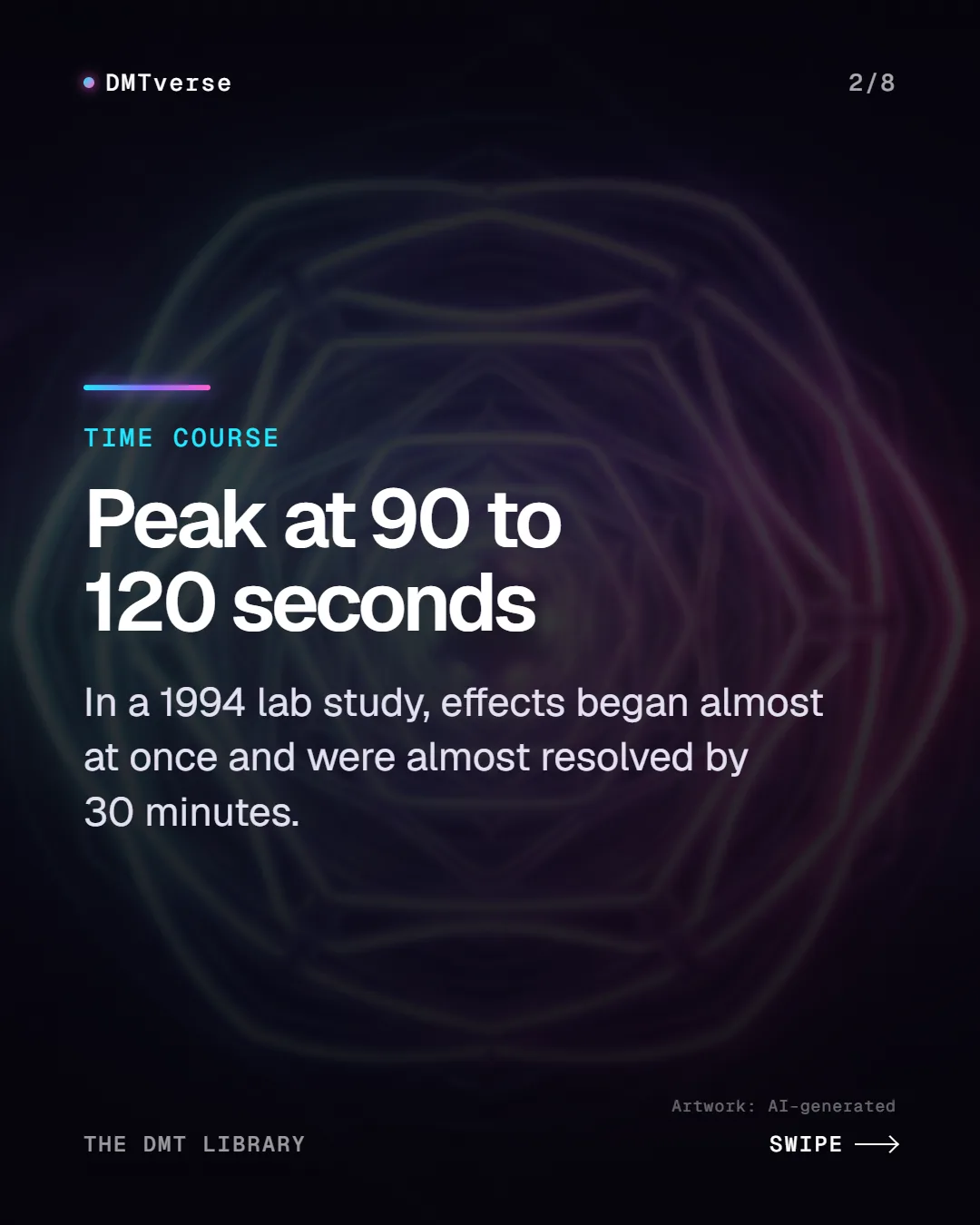
Fast. In the 1994 study, psychological effects began almost immediately after administration, peaked at 90 to 120 seconds and were almost completely resolved by 30 minutes, a time course that paralleled DMT levels in the blood (Strassman et al., 1994). In the forum reports, where people estimated it themselves, the median reported duration was 10 minutes (Lawrence et al., 2022). Evidence: established for the laboratory time course; the forum figure is a self-estimate. Our article on how long DMT lasts covers newer timing studies.
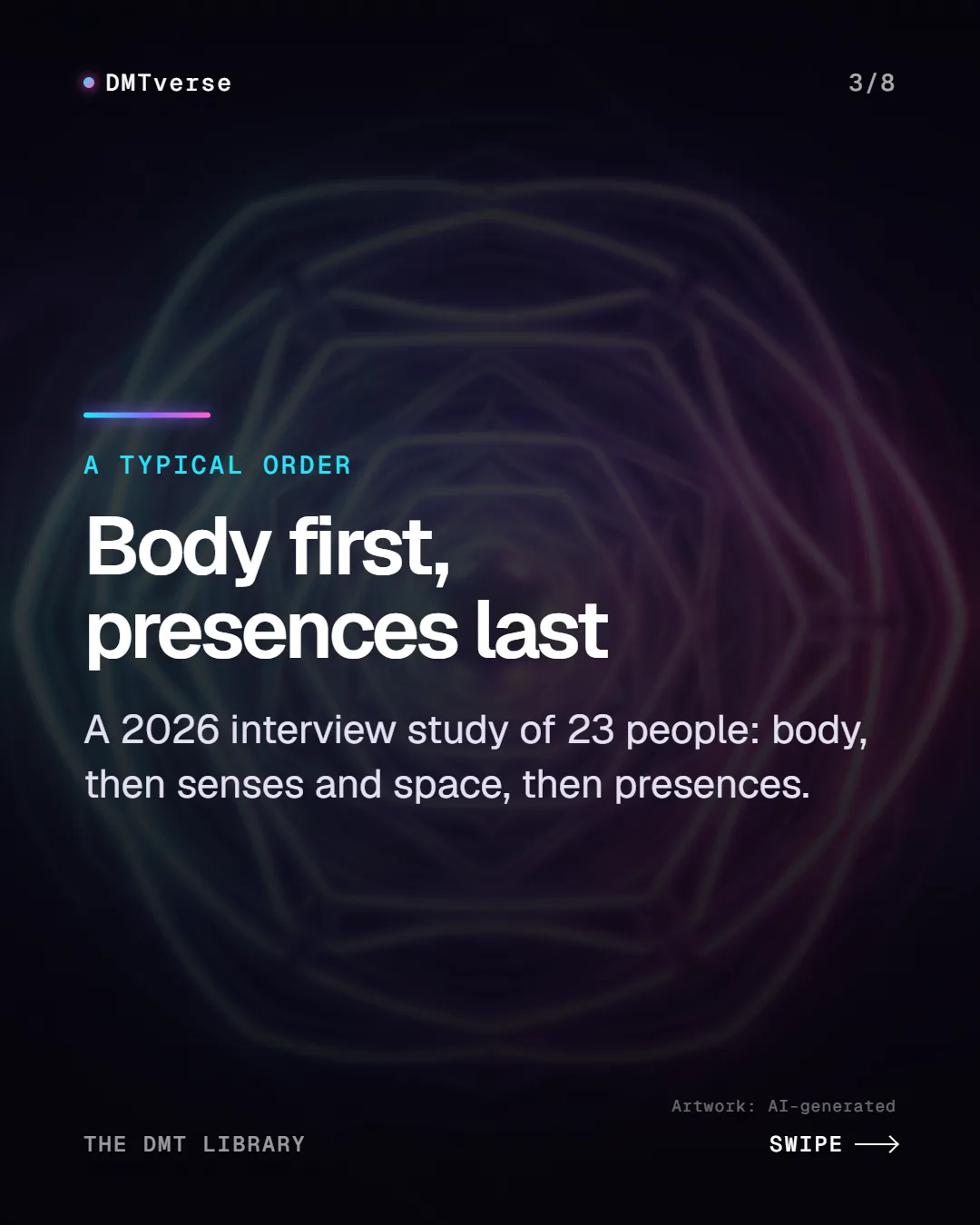
Within those minutes, the 2026 interview study found a reliable order. Bodily effects typically came before visual and auditory ones, and perceived presences emerged only after the senses had integrated and a three-dimensional space had formed (Sanders et al., 2026). The same order is shown step by step below. Evidence: preliminary (one study of 23 people in a scanner).
Bodily effects come first
Vibrations, warm rushes and pressure were described; at points, 48% described having no bodily awareness (Sanders et al., 2026).
Visuals, then sound
Every interview described a rich visual experience; 78% described auditory experiences. Sometimes the senses blended (synaesthesia, 39%).
A space forms
Spaces were described by size, shape and location; 91% described three-dimensional environments, some enclosed like a tunnel or room.
Presences appear last
Presences featured in 17 of 23 interviews. For 82% of those, the presences inhabited a perceived landscape; 26% were felt without any sensory form.
From Sanders et al., 2026 (23 participants, laboratory). Not everyone followed every step, and other settings may differ.
What does DMT feel like in the body?
Strassman’s volunteers described a brief but overwhelming “rush” with a sense of “loss of control”, leading into a dissociated state, meaning a feeling of being cut off from the body and surroundings (Strassman et al., 1994). In the 2026 interviews, pressure on the body from the surrounding environment was described in 91% and temperature changes in 70% (Sanders et al., 2026). Evidence: preliminary.
In the forum reports, bodily sensations were the most commonly coded effect (Lawrence et al., 2022). Evidence: preliminary; the percentages count only what writers chose to mention.
- Any bodily sensation: 37.5%
- Vibration, buzzing or tingling: 27.2%
- Floating, out-of-body or “body dissolving” feelings: 17.3%
- A ringing-type sound: 15.4%
- Nausea: 2.8%
- A sense of racing or irregular heartbeat: 2.1%
What do people see and hear on DMT?
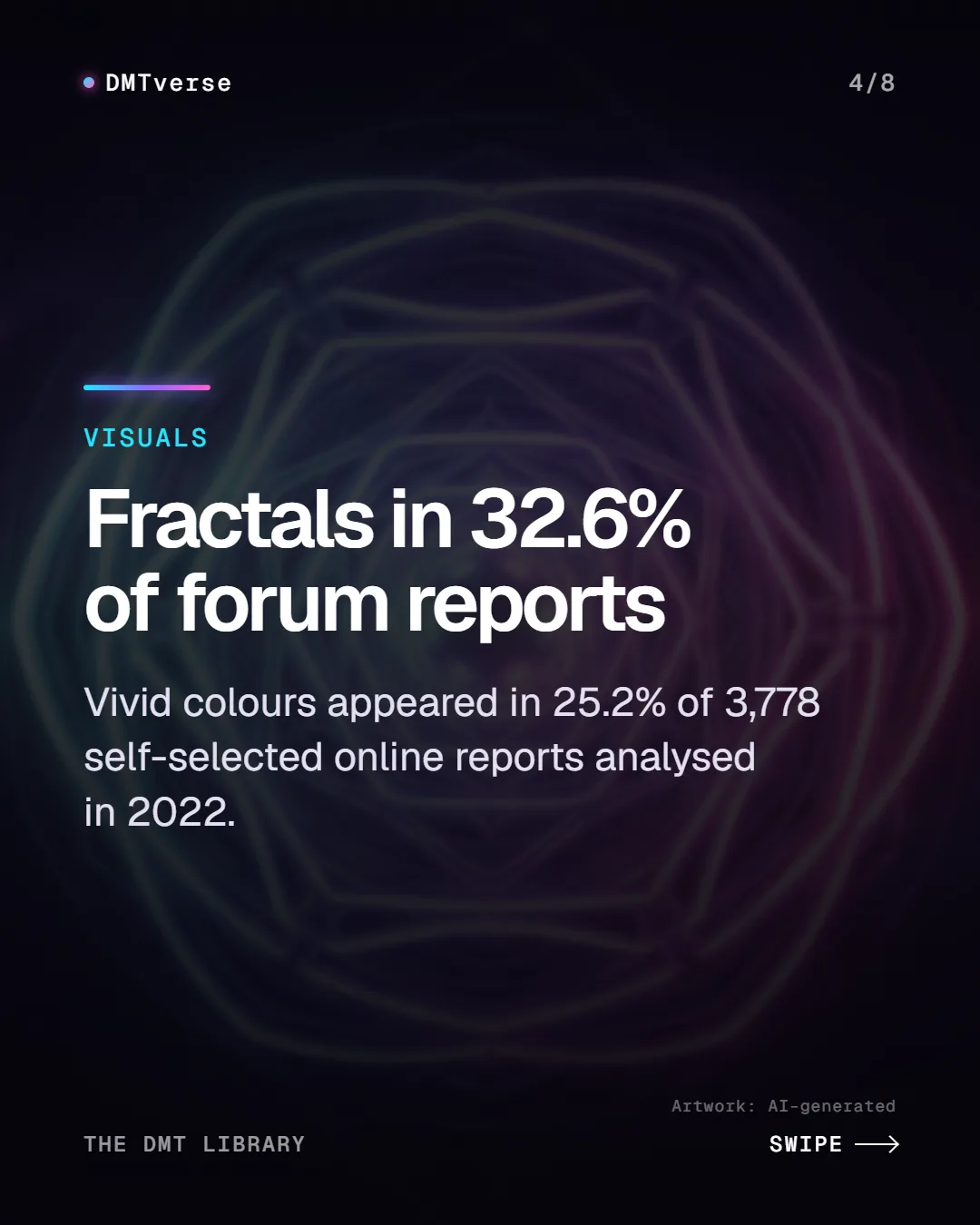
Visual effects dominate. The 1994 paper describes “a rapidly moving, brightly colored visual display of images”, with auditory effects less common (Strassman et al., 1994). In the forum reports, fractals, shapes and patterns were described in 32.6% and vivid colours in 25.2% (Lawrence et al., 2022). Evidence: established that visual effects are prominent.
In the 2026 interviews, every participant described a rich visual experience. Most visuals were simple shapes and colour (91%), though some were recognisable objects, architecture, beings or symbols; sounds were described in 78% (Sanders et al., 2026). Evidence: preliminary. DMT hyperspace and the “waiting room” covers the recurring imagery.
Why do people say they went somewhere else?
Because a sense of place is one of the most consistent reports. In the home field study, all 36 interviews described emerging into other “worlds” (Michael et al., 2021). In the forum reports, 71.7% mentioned a loss of the usual sense of space; descriptions included alternate or higher dimensions (25.2%), rooms (15.4%, including the so-called “waiting room” at 2.8%) and tunnels (10.3%) (Lawrence et al., 2022). Evidence: preliminary.
How people related to that space varied. In the lab interviews, 74% felt inside it and 57% outside it at some point, and it felt clearly separate from them (74%) or fused with the self (35%) (Sanders et al., 2026). Evidence: preliminary.
Does everyone meet beings on DMT?
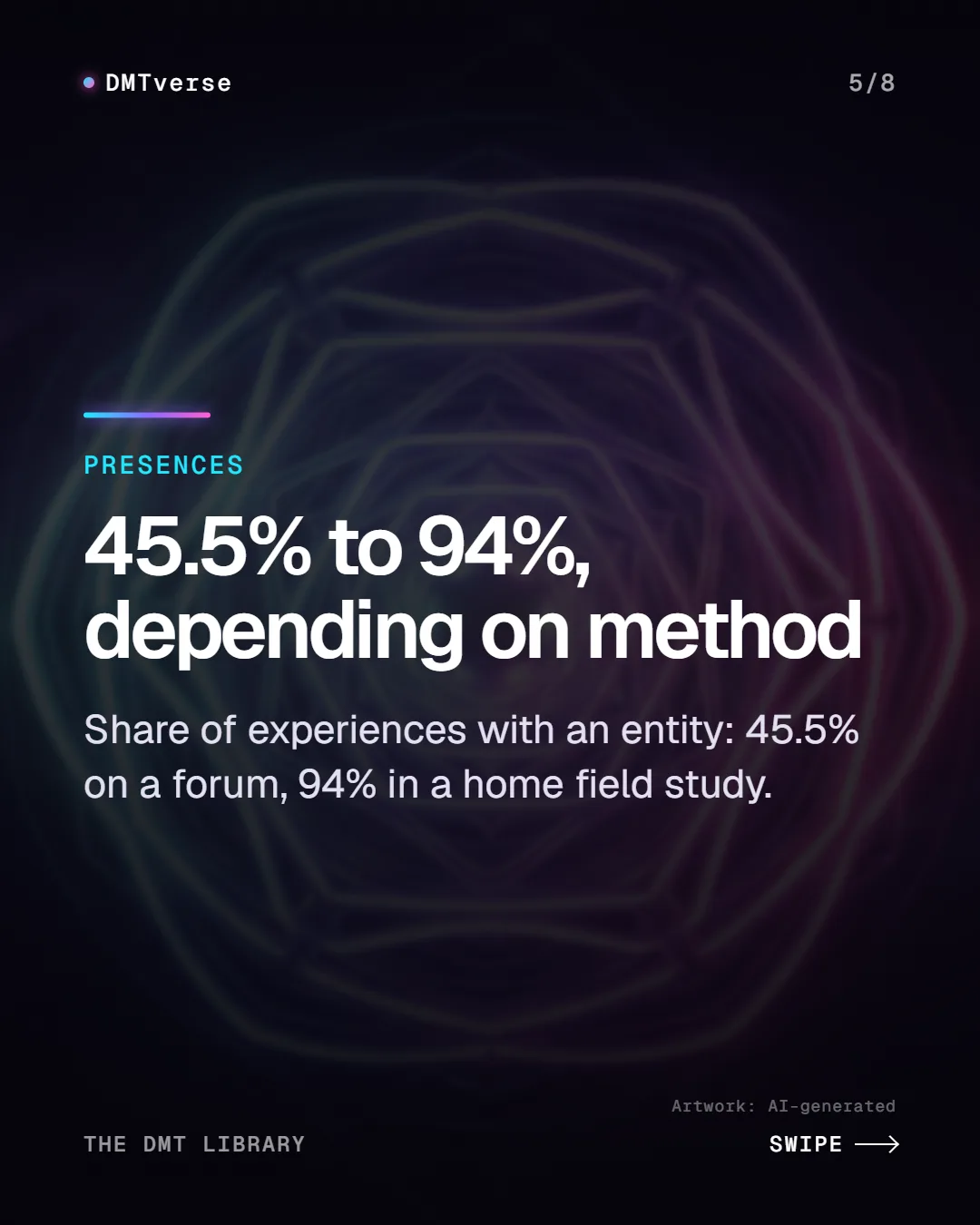
No, and the share depends heavily on how people were asked:
| Study | Share with a presence | Why it differs |
|---|---|---|
| Forum analysis (Lawrence et al., 2022) | 45.5% | Counts only what writers chose to mention |
| Lab interviews (Sanders et al., 2026) | 17 of 23 | Detailed questioning in a scanner |
| Home field study (Michael et al., 2021) | 94% | In-depth interviews of experienced users |
| Online survey (Davis et al., 2020) | All | Recruited only people who had had an encounter |
Sources: Lawrence et al., 2022; Sanders et al., 2026; Michael et al., 2021; Davis et al., 2020. Presences were not always seen: in the lab study, some were felt rather than perceived, and some communication was described as wordless “felt meaning” (17%). In the field study, encounters were most often described as charming and inviting (20 of 36 sessions) and rarely as fearsome or menacing (3 of 36). Evidence: preliminary.
These findings describe experiences; they say nothing about whether the beings exist. See DMT entity encounters: what the research says and DMT entity types.
What happens to the sense of self, time and reality?
Strassman’s volunteers said the effects completely replaced their ongoing mental experience and were “more vivid and compelling than dreams or waking awareness” (Strassman et al., 1994). In the forum reports, features of mystical experience were coded in 31.4% and explicit ego-dissolution items (the sense of self dissolving) in 6.9%; only 9.6% mentioned a loss of the usual sense of time (Lawrence et al., 2022). Evidence: preliminary.
In the lab interviews, 65% described a feeling of familiarity, and 26% described a felt sense of reality, which pointed either way: 22% described the experience as real and 9% as unreal (Sanders et al., 2026). Evidence: preliminary.
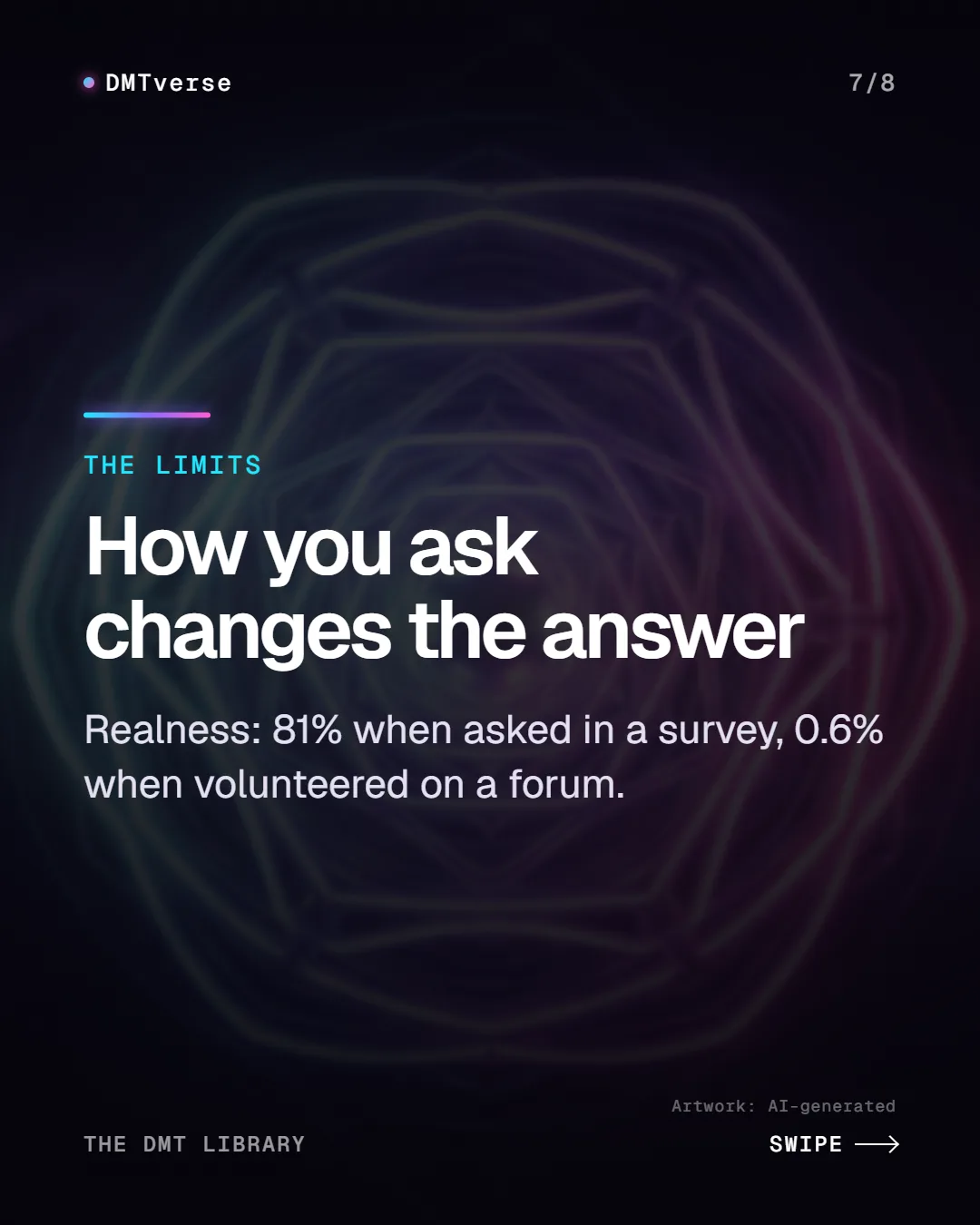
Realness shows how much the question shapes the answer. Michael and colleagues note that in the 2020 survey, 81% called their encounter “hyperreal” when asked (Michael et al., 2021), yet only 0.6% of the forum reports mentioned that it felt real or more real than everyday reality unprompted (Lawrence et al., 2022). And in a 2019 survey, people describing drug-free “God encounters” rated theirs nearly as real as DMT encounters, 72.7 versus 77.5 out of 100 (Griffiths et al., 2019). Evidence: preliminary. Our article on why DMT feels more real than reality goes further.
Some features overlap with near-death experiences. In a placebo-controlled study of 13 volunteers, DMT significantly increased scores on a near-death experience scale, and the features overlapped with those of people who had actually come close to death (Timmermann et al., 2018). Evidence: preliminary.
A 2025 comparison of 36 DMT interviews with 34 near-death narratives found that 95% of DMT participants reported at least one classic near-death theme, but that the two diverge in detailed content, and five classic near-death features were entirely absent from the DMT reports (Michael et al., 2025). Evidence: preliminary. See DMT and near-death experiences.
Is DMT pleasant or frightening?
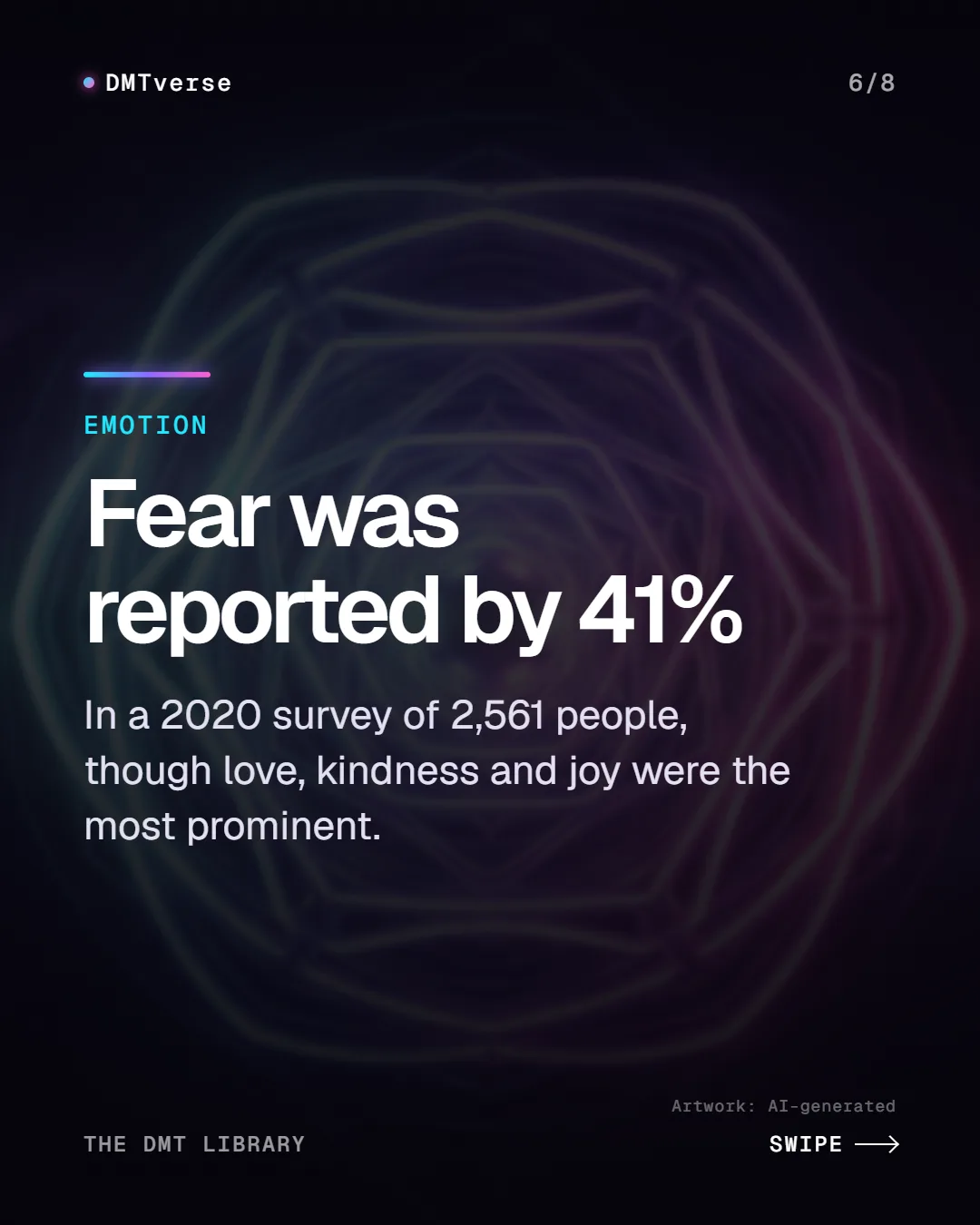
Both, often in the same session. The 1994 paper describes euphoria that “alternated or coexisted with anxiety” (Strassman et al., 1994). In the 2020 survey, 41% reported fear during their encounter, although love, kindness and joy were the most prominent emotions reported (Davis et al., 2020). Evidence: preliminary.
In the forum reports, fear-related items from a challenging-experience questionnaire appeared in 22.2% and grief-related items in 11.0%; feeling trapped or lost, and fear of going insane, were rarer (Lawrence et al., 2022). In the home study, 3 of 36 encounters were described as fearsome or menacing (Michael et al., 2021). Across these studies, fear is common rather than unusual. Evidence: preliminary.
If someone is in danger
Call 911 for immediate danger or urgent medical help, including if someone is unconscious, not breathing or having a seizure. In Ontario, the Ontario Poison Centre is at 1-800-268-9017; every province has a poison centre, listed by SickKids (AboutKidsHealth). If you or someone you know is thinking about suicide, call or text 9-8-8, 24 hours a day (Government of Canada). See also our safety page and how to help someone having a bad trip.
Canada’s Centre for Addiction and Mental Health warns that most hallucinogens are illegal and unregulated, may contain toxins or not contain the drug they are sold as, and can leave people disoriented, with poor judgment and more likely to take risks (CAMH). Evidence: established as public-health guidance.
What do people report afterwards?
Memory is incomplete for some: the forum analysis coded partial amnesia in 13.6% of reports and full amnesia in 1.8%, and 14.1% said the experience could not be described adequately in words (Lawrence et al., 2022). Evidence: preliminary.
Others describe lasting meaning. In the 2020 survey, respondents rated their encounters among the most meaningful, spiritual and psychologically insightful experiences of their lives, and attributed persisting positive changes in life satisfaction, purpose and meaning to them; more than half of those who had identified as atheist no longer did (Davis et al., 2020). The forum reports also included acceptance or removal of the fear of death, in 1.6% (Lawrence et al., 2022).
Read those findings carefully. They are what people attributed to a past experience, recalled after the fact by volunteers who chose to take part; no before-and-after measurement or control group was involved, so they show how people interpret the experience, not that it caused any change. Evidence: preliminary. Ongoing clinical trials are a separate question, covered in DMT research today.
What are the limits of what people report?
- Self-selection: the survey and forum samples are people who chose to write or answer, which may favour vivid, positive or unusual experiences (Davis 2020; Lawrence 2022).
- Memory: surveys asked about a “most memorable” encounter, sometimes long ago; even the 1994 interviews came after effects resolved (Davis 2020; Strassman 1994).
- The question shapes the answer: realness was 81% when asked in a survey and 0.6% when volunteered on a forum (Michael 2021, summarising Davis 2020; Lawrence 2022).
- Setting: the 2026 authors note that the lab, interview procedures and scanner may have influenced what people experienced (Sanders 2026).
- Experience and culture: most participants were experienced users, and the field study was 83% white and mostly men (Michael 2021).
- Words: many people say the experience cannot be put into words, so every report is a translation (Lawrence 2022).
Micro-phenomenology, the method used in the 2026 study, tries to reduce some of these problems by guiding people through the moment-to-moment structure of an experience rather than its story, and its coders agreed well with one another (Sanders et al., 2026). It cannot remove them. Evidence: established that these limits apply; how much they distort the picture is unresolved.
What we still don’t know
- Why the experience assembles in a typical order, body before space before presences, and whether that holds outside a laboratory (unresolved).
- How much expectation, culture and online descriptions shape what people report; no controlled study has tested it for DMT (unresolved).
- Why some people meet presences and others do not (unresolved).
- Whether the sense of realness reflects anything beyond the brain’s own judgment (unresolved).
- How first-time experiences differ from those of the experienced users who dominate the research (unresolved).
Common questions
What does DMT feel like?
In research reports: a fast, intense rush; bodily vibration or pressure; rapidly moving, brightly coloured geometric visuals; a sense of entering another space; for many, a felt presence or being; and emotions from joy to fear. These are self-reports from people in studies, not predictions for anyone else.
How quickly does DMT take effect?
In Strassman’s 1994 laboratory study, effects began almost immediately, peaked at 90 to 120 seconds and had almost completely resolved by 30 minutes. People posting online estimated a median of 10 minutes.
Does everyone see entities on DMT?
No. Reported rates range from 45.5% of online forum reports to 94% in a home field study, and 100% in a survey that recruited only people who had had an encounter. The figure depends on who was asked and how.
Is DMT scary?
It can be. In a 2020 survey of 2,561 people, 41% reported fear during their most memorable encounter, even though love, kindness and joy were the most prominent emotions. In Strassman’s study, euphoria alternated or coexisted with anxiety.
Does DMT feel real?
Many say so when asked: 81% called their encounter hyperreal in one survey. But only 0.6% of forum reports mentioned realness unprompted, and in a lab study a minority described the experience as unreal. People describing drug-free “God encounters” rated theirs almost as real.
Is DMT like a near-death experience?
Partly. A 2018 placebo-controlled study found that DMT raised scores on a near-death experience scale, and a 2025 comparison found that 95% of DMT participants reported at least one classic near-death theme, but detailed content diverged and five classic features never appeared.
What happens after a DMT experience?
Some reports describe partial memory loss and difficulty putting the experience into words. In one survey, people rated their encounters as among the most meaningful of their lives and attributed lasting changes to them, but those are recollections from self-selected volunteers, not measured effects.
Shroomverse sells mushroom products. This article is general information about published research on the DMT experience. It is not medical, legal or purchasing advice, and it does not recommend any product.
SOURCES
- Dose-response study of N,N-dimethyltryptamine in humans. II. Subjective effects and preliminary results of a new rating scale (Strassman RJ, Qualls CR, Uhlenhuth EH, Kellner R, Archives of General Psychiatry 51(2):98–108, 1994), American Medical Association (peer-reviewed). Accessed . Abstract read via Europe PMC. 12 experienced volunteers, randomized double-blind placebo-controlled; onset almost immediate, peak 90–120 s, almost resolved by 30 min; colourful moving visuals, auditory effects less common; “rush” and loss of control; euphoria alternating or coexisting with anxiety; more vivid and compelling than dreams or waking awareness. Doses not reproduced here.
- Phenomenology and content of the inhaled N,N-dimethyltryptamine (N,N-DMT) experience (Lawrence DW, Carhart-Harris R, Griffiths R, Timmermann C, Scientific Reports 12:8562, 2022), Springer Nature (peer-reviewed, open access); PMC9130218. Accessed . Full text read via Europe PMC. 3,778 forum experiences: median self-estimated duration 10 min; somaesthesias 37.5%, vibration 27.2%, ringing 15.4%, OBE/floating 17.3%, nausea 2.8%, tachycardia sense 2.1%; fractals 32.6%, colours 25.2%; entity 45.5%; loss of usual sense of space 71.7%, dimensions 25.2%, rooms 15.4%, waiting room 2.8%, tunnel 10.3%; mystical 31.4%, EDI 6.9%, loss of sense of time 9.6%; CEQ fear 22.2%, grief 11.0%; partial amnesia 13.6%, full 1.8%; ineffability 14.1%; realness unprompted 0.6%; fear of death removed 1.6%.
- Survey of entity encounter experiences occasioned by inhaled N,N-dimethyltryptamine: Phenomenology, interpretation, and enduring effects (Davis AK, et al., Journal of Psychopharmacology 34(9):1008–1020, 2020), SAGE (peer-reviewed). Accessed . Abstract read via Europe PMC. 2,561 self-selected respondents describing their single most memorable encounter; 41% fear; love, kindness and joy most prominent; rated among most meaningful experiences, with attributed persisting changes; more than half of prior atheists no longer atheist. The 81% realness figure is cited through Michael et al. 2021.
- An Encounter With the Other: A Thematic and Content Analysis of DMT Experiences From a Naturalistic Field Study (Michael P, Luke D, Robinson O, Frontiers in Psychology 12:720717, 2021), Frontiers (peer-reviewed, open access); PMC8716686. Accessed . Full text read via Europe PMC. 36 interviews in participants’ homes with researchers present; 83% Caucasian, 8 women; beings 94%, other worlds 100%; charming and inviting 20 (56%), fearsome or menacing 3 (8%); discussion summarises Davis 2020’s 81% “hyperreal”. Doses not reproduced here.
- Micro-phenomenology of immersion and perceived presences under DMT (Sanders JW, Millière R, Demšar E, Daily ZG, Erritzoe D, Carhart-Harris R, Timmermann C, Neuroscience of Consciousness, niag015, 2026), Oxford University Press (peer-reviewed, open access); PMC13366535. Accessed . Full text read via Europe PMC. 23 participants, blindfolded in fMRI-EEG; bodily effects before visual and auditory; presences after multisensory integration and 3D space (17 interviews); no bodily awareness 48%, pressure 91%, temperature 70%; visual 100%, auditory 78%, synaesthesia 39%, simple visuals 91%; 3D 91%; within 74%, outside 57%, distinct 74%, fused 35%; familiarity 65%; feeling of reality 26% (real 22%, unreal 9%); landscape 82%, felt presence 26%; authors’ limitation on lab and scanner setting. Dose not reproduced here.
- DMT Models the Near-Death Experience (Timmermann C, et al., Frontiers in Psychology 9:1424, 2018), Frontiers (peer-reviewed, open access); PMC6107838. Accessed . Abstract read via Europe PMC. Within-subjects, placebo-controlled, 13 healthy participants; significant increases in near-death features vs placebo; overlap with a matched group of near-death experiencers.
- An encounter with death: a comparative thematic and content analysis of naturalistic DMT experiences and the near-death experience (Michael P, Luke D, Robinson O, Frontiers in Psychology 16:1532937, 2025), Frontiers (peer-reviewed, open access); PMC11920758. Accessed . Abstract read via Europe PMC. 36 DMT interviews vs 34 near-death narratives; 95% of DMT participants reported at least one canonical theme; five classic near-death features absent; content diverges in detail.
- Survey of subjective “God encounter experiences” (Griffiths RR, Hurwitz ES, Davis AK, Johnson MW, Jesse R, PLoS One 14:e0214377, 2019), PLOS (peer-reviewed, open access); PMC6478303. Accessed . Full text read via Europe PMC. “More real than everyday normal consciousness”: 72.7 non-drug vs 77.5 DMT group (0–100); self-selected online samples.
- Hallucinogens, Centre for Addiction and Mental Health (CAMH). Accessed . Page read. Most hallucinogens illegal and unregulated, may include toxins or not contain the drug sold; may cause disorientation, poor judgment and risk-taking. An older overview page.
- Mental health support: get help, Government of Canada, Public Health Agency of Canada. Accessed . Page read. Call 9-1-1 in immediate danger or for urgent medical support; call or text 9-8-8, 24 hours a day, 7 days a week.
- Poison information centres in Canada, AboutKidsHealth, The Hospital for Sick Children (SickKids). Accessed . Page read. Ontario toll-free 1-800-268-9017; call 911 if someone is unconscious, not breathing or having a seizure.
CHANGES
- : Linked glossary definitions.
- : Keyword pass: renamed the time-course heading to the searched wording (“stages of a DMT experience”); content unchanged.
- : Published. Each study opened and its figures checked against the full text or abstract on this date.
- : Editorial review: fixed the “five studies” count in the title, intro and description (six studies are tabled); shortened the short answer; turned the body-effect and presence figures into a list and a table; split long paragraphs and added evidence labels; defined dissociation and ego dissolution; removed a link that did not match its description.



