THE SHROOMVERSE JOURNAL ✳ 16 MIN READ
DMT therapy: what the clinical trials have tested, found and not yet shown
Topic: Therapy and legal access
Published Updated
Listen: the 3-minute version
AI-narrated summary of this article
Short answer, checked 20 October 2026
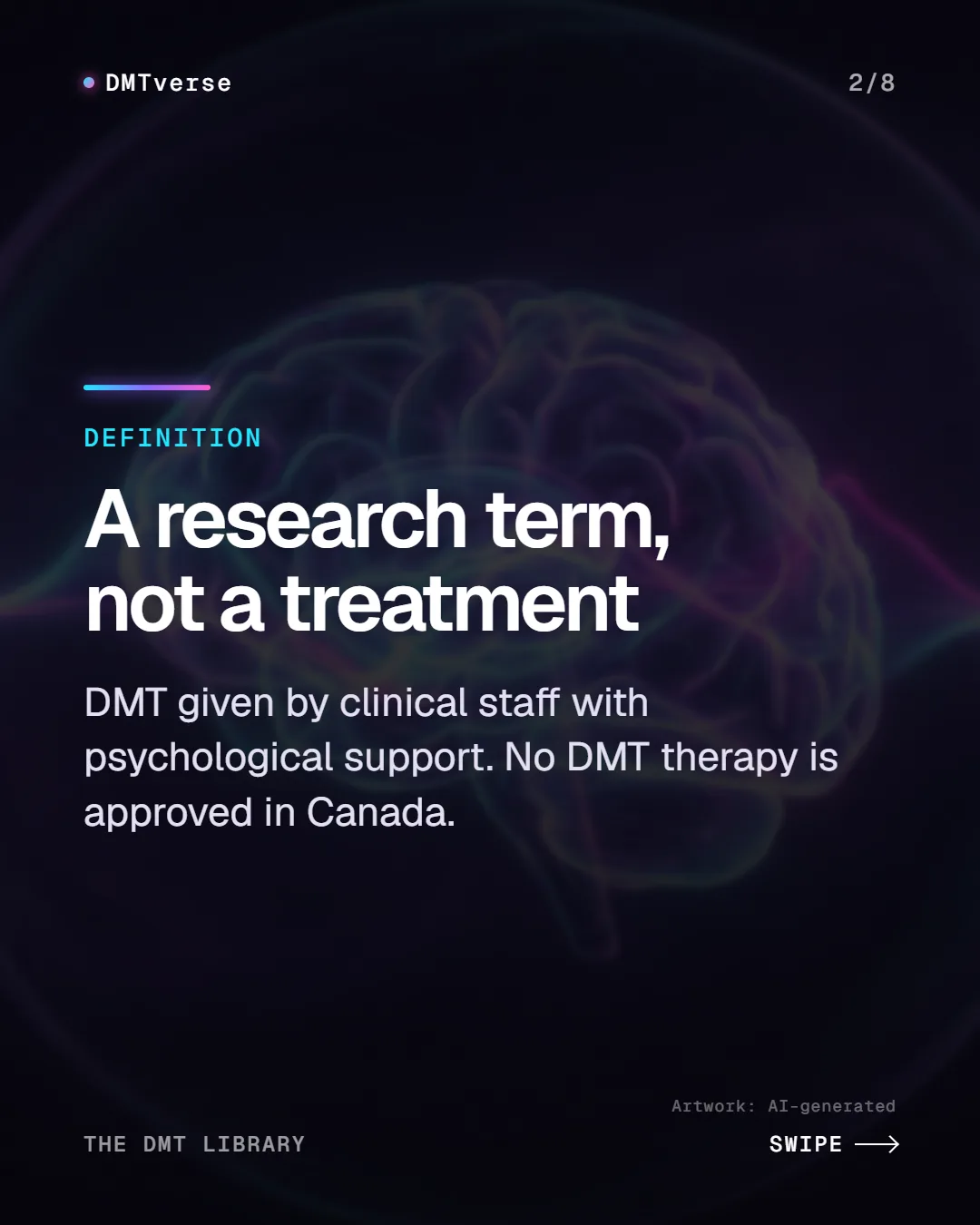
“DMT therapy” is a research term, not an approved treatment. It means DMT given by clinical staff, usually into a vein, alongside psychological support. The largest placebo-controlled result we found is a 2026 phase 2a trial of 34 adults with depression, in which scores fell more after one DMT session than after placebo at two weeks; one small trial is not proof of a treatment. Other studies are smaller or uncontrolled. Researchers are also testing slow infusions that hold the short DMT state for longer. In Canada DMT remains a controlled substance (CDSA Schedule III, item 7), and no DMT drug appears in Health Canada’s product database.
THE SHORT VERSION · SWIPE
On this page 9 sections
DMT (N,N-dimethyltryptamine) is best known for an intense experience that is over quickly. Researchers say that short duration is exactly why they are interested: a session that fits into an hour or two might be easier to run in a clinic than a full day with psilocybin (Timmermann et al., 2024; Erritzoe et al., 2026). For how DMT compares chemically with psilocybin and LSD, see psilocybin, LSD and DMT compared.
This page covers DMT in medical research only: the trials for depression and anxiety, what a trial session involves, the results so far, what safety data show, the research on longer “extended” DMT states, and where Canada fits. It describes study designs and results. It gives no doses and says nothing about obtaining or using DMT.
Not medical advice
This article describes clinical research. It does not say whether anyone should seek DMT treatment, and no DMT therapy is approved in Canada. Questions about your own health belong with a regulated health care practitioner.
What is DMT therapy?
In the published trials, DMT therapy is a single supervised drug session, or sometimes two, wrapped in preparation and follow-up talks with trained therapists. The phase 2a depression trial described below calls it DMT “with supportive psychotherapeutic support” (Erritzoe et al., 2026). The drug is usually given intravenously, which lets staff control the amount and timing precisely (Luan et al., 2024). One Brazilian team has tested an inhaled form in hospital settings (Falchi-Carvalho et al., 2025). Evidence: established as trial design.
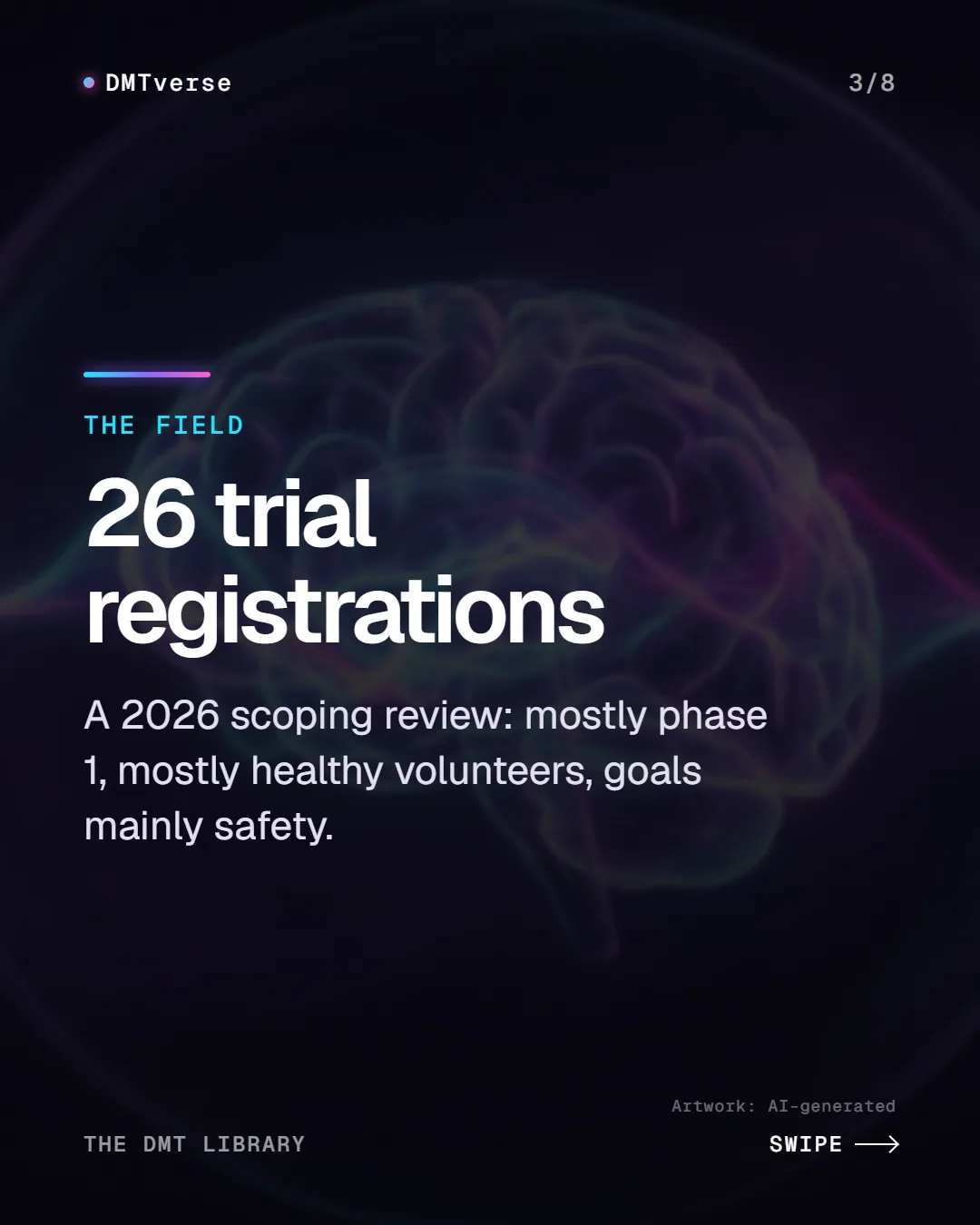
A 2026 scoping review of trials registered on ClinicalTrials.gov found 26 registrations for DMT, ayahuasca or DMT combined with harmine. Most were phase 1, most were in healthy volunteers, and primary goals were mainly safety and describing the experience. Only a smaller set of publications, from depression-focused trials, offered preliminary evidence of clinical effects (Stojanović et al., 2026). In other words, the field is still early. Evidence: established for the count.
Which DMT therapy trials have been run or registered?
The table lists the patient trials we could verify, completed and registered. Sizes and statuses are taken from the papers or the registry records on 20 October 2026. A registration shows a trial was planned, not that it worked. Dose amounts are left out on purpose.
| Trial and sponsor | Design | Participants | Status and main result |
|---|---|---|---|
| SPL026 (DMT fumarate) for major depression, Small Pharma, now part of Cybin (NCT04673383) | Phase 2a, randomized, double-blind, placebo-controlled first session; open-label second session for everyone. | 34 adults with moderate to severe depression (17 per group). | Completed. Depression scores fell 7.35 points more with DMT than placebo at 2 weeks. No serious adverse events. |
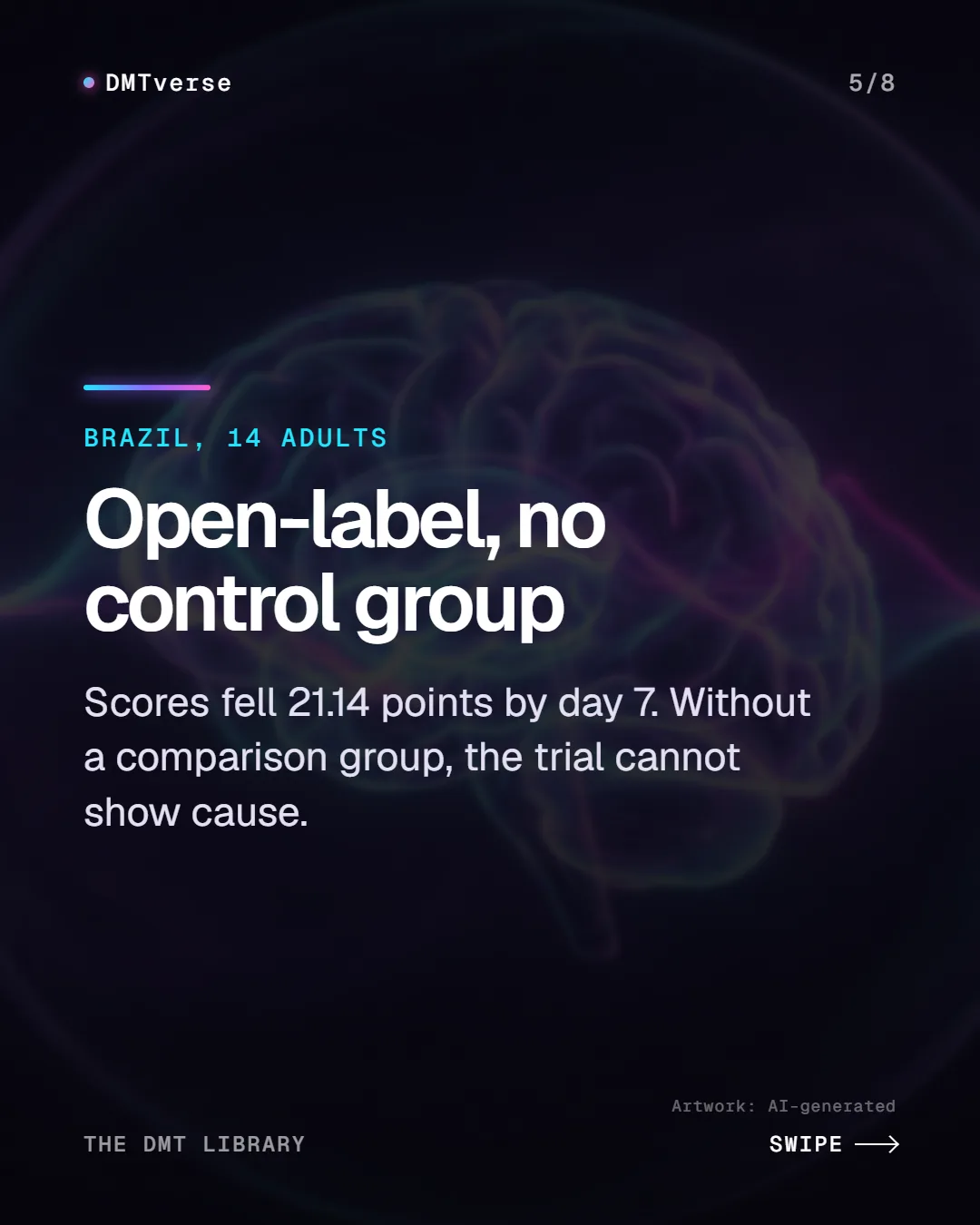
| Inhaled DMT for treatment-resistant depression, Federal University of Rio Grande do Norte, Brazil | Phase 2a, open-label, no control group, fixed order. | 14 adults. | Published 2025. Depression scores fell 21.14 points on average by day 7. No serious adverse events. |
| SPL026 alone or with SSRI antidepressants, Small Pharma (NCT05553691) | Phase 1, open-label, non-randomized; one group already taking an SSRI. | 18 adults with depression (actual). | Completed 2023. No results posted on the registry, and we found no paper. |
| CYB004 (deuterated DMT) for generalized anxiety disorder, Cybin IRL (NCT06051721) | Phase 2a, randomized, quadruple-masked; a low dose of the same drug as the comparator; EMBARK psychotherapy for all. | 36 adults (actual), at US sites. | Completed August 2026. No results posted, and we found no peer-reviewed paper. |
| VLS-01 (DMT buccal film) for treatment-resistant depression, atai Therapeutics (NCT06524830) | Phase 2, randomized, placebo-controlled, triple-masked. | 142 estimated; 2 of the listed sites are in Canada. | Recruiting; primary completion estimated August 2026. No results found. |
| Inhaled DMT for major depression, Federal University of Rio Grande do Norte (NCT07562191) | Phase 2b, randomized, quadruple-masked, low dose as active comparator, with open-label extension. | 140 estimated, five Brazilian sites. | Recruiting; primary completion estimated February 2027. |
| DMT given with or without propofol sedation (DMT4D), University Hospital Basel (NCT06927076) | Randomized, placebo-controlled, 2×2 factorial. | 112 estimated, Basel. | Recruiting; primary completion estimated March 2029. |
| Ayahuasca for treatment-resistant depression, Federal University of Rio Grande do Norte (NCT02914769) | Randomized, double-blind, placebo-controlled; single session. | 29 patients analysed. | Published 2019. Response at day 7: 64% with ayahuasca vs 27% with placebo. |
What happens in a DMT therapy session in a trial?
The most detailed published account comes from the SPL026 phase 2a trial run at clinical research units in London and Liverpool (Erritzoe et al., 2026; ClinicalTrials.gov NCT04673383). As the authors describe it:
- Screening. Applicants were checked by a trial physician, psychiatrist and therapist, with their family doctor’s records. People with a personal or immediate family history of psychosis, a history of serious suicide attempts, or certain other conditions were excluded. Of 399 people prescreened, 34 were randomized.
- Stopping antidepressants. Anyone taking an antidepressant stopped it, with a study psychiatrist’s support, at least two weeks before the trial drug.
- Admission and preparation. Participants were admitted to the ward the day before dosing. A 90-minute preparation session with two therapists covered the setting, a guided relaxation exercise and what to expect, with a brief extra session on the day.
- The session. DMT or placebo was infused over ten minutes in a softly lit, non-clinical room. Participants wore eyeshades and noise-cancelling headphones playing ambient music. Two therapists stayed throughout, and a study psychiatrist remained on site.
- Monitoring. Blood pressure and heart rate were checked before dosing and at set times up to four hours afterwards, with heart tracings (ECGs) and lab tests.
- Integration. Participants went home the next morning. Follow-up sessions on days 1, 2 and 15 helped them reflect on the experience, with later check-ins.
That structure closely resembles psilocybin trials, with one big difference: the drug part is minutes rather than most of a day. For the psilocybin version of each stage, see what happens in a psilocybin therapy session. An earlier phase 1 part of the same trial, in healthy volunteers who had never taken a psychedelic, also had two therapy team members with each participant (James et al., 2024). Evidence: established as trial design.
What have DMT depression trials found so far?
The SPL026 trial: 34 adults, placebo-controlled
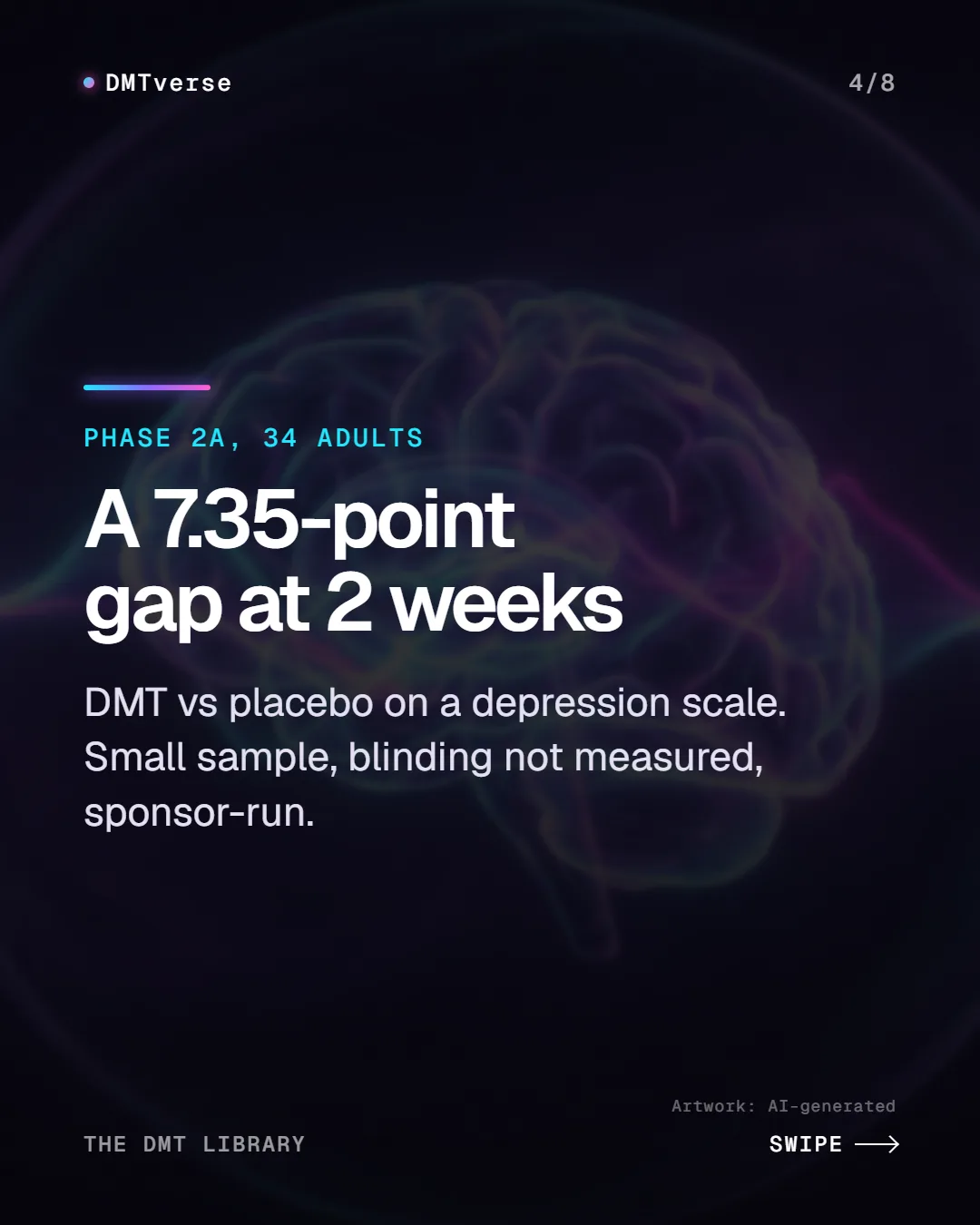
In stage 1, 17 people received DMT and 17 received placebo, alongside the same psychological support. The main measure was the change in a clinician-rated depression scale (MADRS) after two weeks. Scores fell 7.35 points more with DMT than with placebo, a statistically significant difference, which the authors put at an effect size of 0.82 (Erritzoe et al., 2026). Evidence: preliminary (one small trial).
The difference was larger at one week than at two. At one week, 44% of the DMT group had responded (their score halved), against 6% on placebo. At two weeks, response was 35% against 12%, a difference whose confidence interval crossed zero. In stage 2, everyone was offered DMT, so later results had no placebo comparison. The authors report lower scores up to three months, with no clear difference between people who had one dose and two. At six months, 44% of all participants met the response threshold and 40% were in remission (Erritzoe et al., 2026). Evidence: preliminary.
The authors are frank about the limits. The sample was small and 88% white, and the authors report dropouts of 9 of 34 in the later phase, which reduced statistical power. Blinding and expectancy were not measured, so it is unknown how many people could tell what they had received. Every participant had psychological support, so it is unclear whether results would hold with less (Erritzoe et al., 2026). Several authors were employed by the sponsor, Small Pharma, which the paper says is now Cybin UK. Evidence: established for the stated limits.
Inhaled DMT in Brazil: 14 adults, no control group
An open-label phase 2a trial gave 14 people with treatment-resistant depression inhaled DMT in a single day. Depression scores fell by 21.14 points on average by day 7; 85.71% responded and 57.14% were in remission at that point, and the authors report lower scores up to three months (Falchi-Carvalho et al., 2025). With no comparison group and everyone knowing what they received, these numbers cannot be read as the drug’s effect alone. The same university has now registered a 140-person randomized trial (ClinicalTrials.gov NCT07562191). Evidence: preliminary.
What about ayahuasca?
Ayahuasca is a traditional brew that contains DMT along with other compounds; see what is ayahuasca. In a 2019 randomized trial of 29 people with treatment-resistant depression, scores were lower after a single ayahuasca session than after placebo at days 1, 2 and 7, with response at day 7 of 64% against 27% (Palhano-Fontes et al., 2019). The authors of the inhaled-DMT trial note that ayahuasca’s other compounds include monoamine oxidase inhibitors, which carry drug-interaction risks (Falchi-Carvalho et al., 2025). Results for ayahuasca cannot simply be transferred to DMT; ayahuasca vs DMT compares the two. Evidence: preliminary.
Anxiety and other conditions
For anxiety, the main test is Cybin’s CYB004, a deuterated DMT (one where some hydrogen atoms are swapped for a heavier form to slow the body’s breakdown of it). Its phase 2a trial in 36 people with generalized anxiety disorder is listed as completed, but we found no posted or peer-reviewed results (ClinicalTrials.gov NCT06051721). For DMT and substance misuse, the authors of a 2026 meta-analysis found a high risk of bias in the studies and called their results preliminary (Wallace et al., 2026). Evidence: unresolved.
What is “extended” DMT, and can a DMT trip be simulated?
A single DMT injection peaks within two to three minutes and fades after about half an hour (Luan et al., 2024); see how long does DMT last. In 2016 two researchers proposed borrowing a method from anaesthesia, target-controlled intravenous infusion, which uses a computer model to hold drug levels steady. Their simulations suggested it could keep a person in a stable, prolonged DMT state for study, imaging or possible therapy (Gallimore and Strassman, 2016). Evidence: established that this was a modelling proposal.
That idea has now been tested in people. At Imperial College London, 11 healthy volunteers who had used psychedelics before received a starting injection followed by a slow infusion for 30 minutes. Effects held at a steady level, anxiety ratings stayed low and heart rate settled within 15 minutes. The authors call the method safe and effective for research, from a small sample (Luan et al., 2024). Evidence: preliminary.
In Basel, 22 healthy participants received two-hour infusions in a placebo-controlled crossover study. Effects plateaued after 30 minutes, the highest rate tested caused significant anxiety, and in a self-guided session participants could adjust the rate themselves (Erne et al., 2025). A Dutch study of 29 volunteers gave six-hour infusions at lower levels as groundwork for stroke research, with only mild effects and no serious adverse events (van der Heijden et al., 2025). All three were small studies in healthy volunteers. Evidence: preliminary.
What about simulating a DMT trip without the drug, for example in virtual reality? We found no published trial combining DMT with virtual reality. Separate research uses VR to evoke self-transcendent states with no drug at all; one 2026 study of 96 people linked heart-rate measures during “numadelic” VR to the strength of those experiences (Bonnelle et al., 2026). That is a different question from DMT therapy, and it is not evidence that any app reproduces a DMT experience. Evidence: unresolved.
How safe has DMT been in trials?
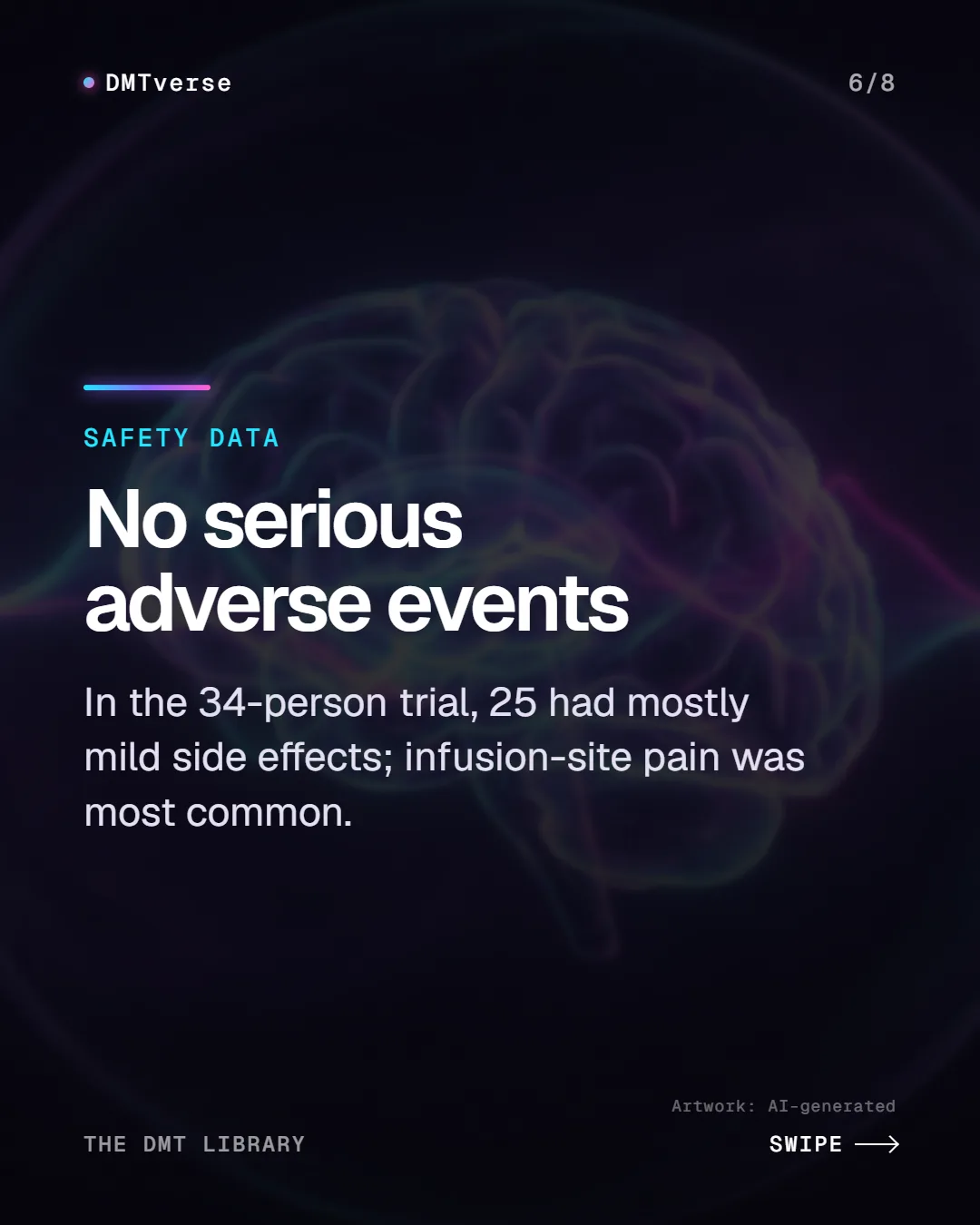
- In the phase 2a depression trial, 25 of 34 people (73.5%) had side effects judged possibly related to treatment, mostly mild and gone by the end of the dosing visit. The most common was pain at the infusion site; nausea and passing anxiety also occurred. There were no serious adverse events and no treatment-related suicidal thinking or behaviour (Erritzoe et al., 2026).
- In the phase 1 part, in 32 healthy volunteers, there were no serious adverse events (James et al., 2024).
- In the Brazilian inhaled trial, there were no serious adverse events, and a subgroup taking antidepressants had similar safety results (Falchi-Carvalho et al., 2025).
- In a healthy-volunteer study of CYB004, high doses led to intense experiences and some participants withdrew. Lower doses had an acceptable safety profile, and the deuterated drug’s effects lasted roughly 40 to 60 minutes, about twice as long as DMT (van der Heijden et al., CYB004, 2026).
- Raised heart rate and anxiety can occur during the experience. In the Basel infusion study, the highest rate tested produced significant anxiety compared with placebo (Erne et al., 2025).
These are results in screened, closely monitored people. Trials excluded people with psychosis risk, serious heart problems or recent suicide attempts, so they say little about anyone outside that setting. Small trials cannot reveal uncommon harms. Nothing here describes using DMT outside a trial. Evidence: preliminary.
If you or someone you know is in crisis
This article is about research and is not a substitute for care. The Government of Canada says to call 9-1-1 if you are in immediate danger or need urgent medical support, and that anyone thinking about suicide, or worried about someone, can call or text 9-8-8, 24 hours a day, 7 days a week (Government of Canada). More numbers are on our safety page.
Is DMT therapy available in Canada?
Not as an approved treatment. DMT is item 7 of Schedule III of the Controlled Drugs and Substances Act, in the consolidation current to 30 September 2026 (Justice Laws, CDSA). It is also item 4 of the restricted drugs in Part 1 of Schedule 4 of the Controlled Substances Regulations, which came into force on 1 October 2026; the regulations do not make it legal (Justice Laws, SOR/2025-242). A search of Health Canada’s Drug Product Database for the ingredient on 20 October 2026 returned no products (Health Canada DPD). For offences and exemptions, see is DMT legal in Canada?. This is general information, not legal advice. Evidence: established.
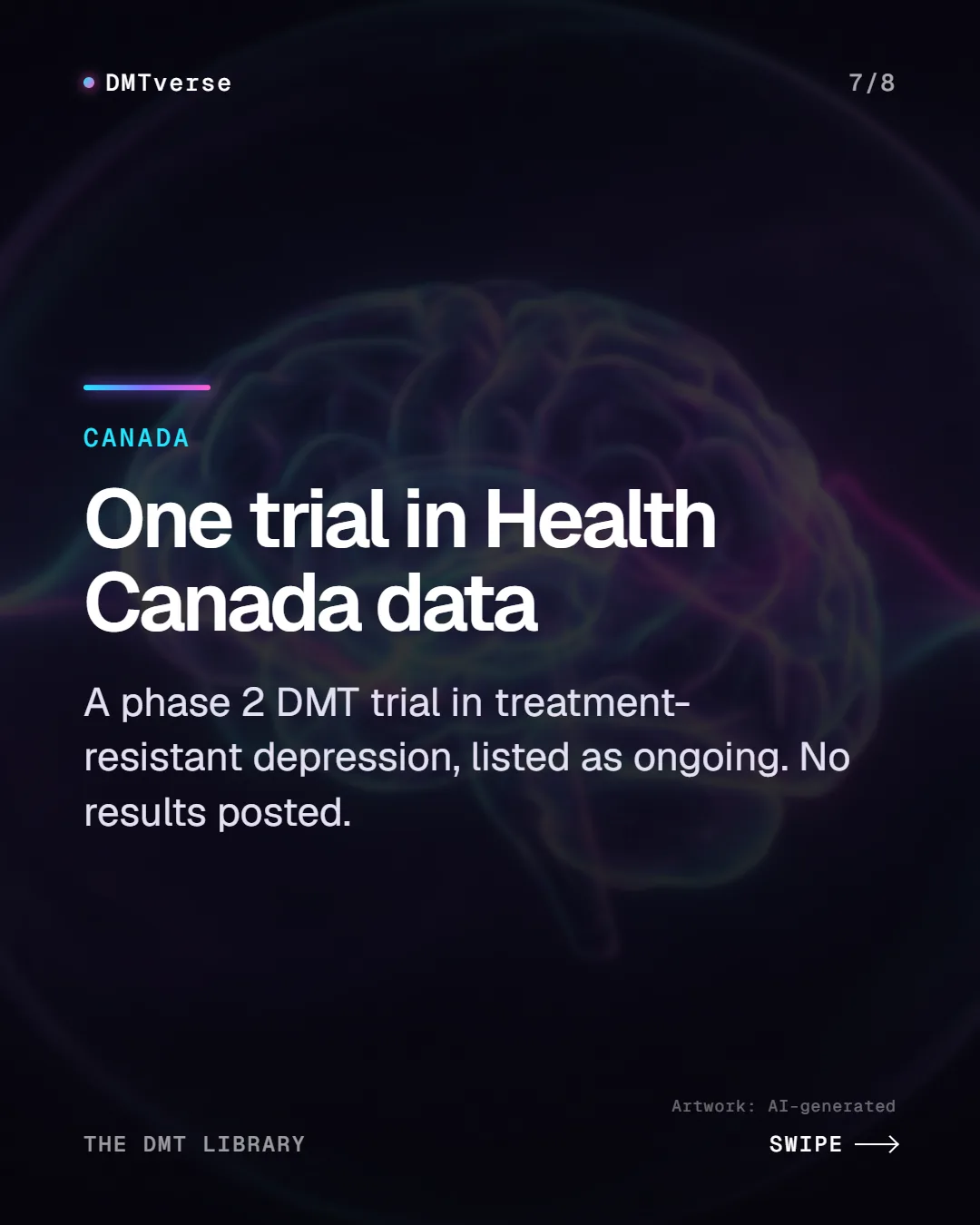
Research is the main route. Health Canada’s clinical trials portal covers phase 1 to 3 drug trials authorized since April 2013 (Health Canada). In its data we found one DMT trial: atai Therapeutics’ phase 2 study of a DMT buccal film for treatment-resistant depression, with a no-objection letter dated 7 November 2024 and status listed as ongoing (Health Canada clinical trials data). The matching registry entry lists sites in Surrey, British Columbia and Kingston, Ontario (ClinicalTrials.gov NCT06524830). Evidence: established for the records.
There is also a Toronto link. A September 2026 paper on CYB004 lists its company authors under Cybin IRL, described as a wholly owned subsidiary of Helus Pharma Corp, Toronto (van der Heijden et al., CYB004, 2026). The CYB004 and SPL026 trials themselves ran in the US and UK.
Health Canada’s Special Access Program lets practitioners request unapproved drugs for serious or life-threatening conditions when other treatments have failed, are unsuitable or are unavailable (Health Canada SAP). Health Canada has said that clinical trials remain the best option for access to restricted drugs, a group that includes psychedelics (Health Canada notice). We found no public data on SAP requests for DMT. Evidence: established for what Health Canada says. For how the program works for psilocybin, see the Special Access Program explained, and for treatments that are approved, psilocybin vs ketamine therapy in Canada.
What is still unknown about DMT therapy?
- Whether DMT works for depression beyond one small trial. Only one placebo-controlled DMT study in patients has reported, with 34 people.
- How much comes from the drug and how much from the therapy, expectation and the trial setting. Blinding was not measured in the main trial. The Basel DMT4D trial is testing whether the conscious experience is needed at all, by giving DMT with or without sedation.
- Whether any effect lasts. Follow-up beyond three months is thin and partly open-label.
- Whether anxiety, addiction and other conditions respond. The anxiety trial has no published results.
- Whether extended infusions have any use in patients. So far they have been tested in small groups of healthy volunteers.
- Who might be harmed. Excluded groups and rare risks remain unstudied.
The accurate summary is that DMT therapy is an early and unproven research idea. For background on the related compound, read about psilocybin depression trials and what magic mushrooms are.
Common questions
What is DMT therapy?
In research, it is DMT given by clinical staff, usually through a drip into a vein, in a single supervised session with preparation and follow-up from trained therapists. It is being tested in trials and is not an approved treatment in Canada.
Does DMT therapy work for depression?
It has not been shown to. In a 2026 phase 2a trial of 34 adults, scores fell more after one DMT session than after placebo at two weeks, but the trial was small and blinding was not measured. A 14-person inhaled DMT study had no control group. Larger randomized trials are under way.
How long does a DMT therapy session last?
The drug part is short. In the phase 2a trial the infusion lasted ten minutes, and a single injection fades after about half an hour in lab studies. Participants still had screening, a preparation day, an overnight stay and several follow-up sessions.
What is extended DMT?
A research method that gives a starting injection then a slow infusion to keep the DMT state steady for longer. Small studies in healthy volunteers, at Imperial College London and in Basel, found it can hold effects at a stable level. It has not been tested as a treatment.
Can a DMT trip be simulated with virtual reality?
We found no published study combining DMT with virtual reality. Some VR research tries to evoke self-transcendent states without any drug, but that is not evidence that any app reproduces a DMT experience.
Is DMT therapy legal in Canada?
There is no approved DMT therapy in Canada. DMT is item 7 of Schedule III of the Controlled Drugs and Substances Act and a restricted drug under the Controlled Substances Regulations in force since 1 October 2026. Health Canada’s trial data list one ongoing DMT depression trial, with Canadian sites. This is not legal advice.
Is DMT safe in clinical trials?
In trials so far, mostly mild side effects such as infusion-site pain, nausea and passing anxiety, and no serious adverse events in the published depression studies. Participants were screened and monitored, and the trials were small, so rare risks are unknown.
Shroomverse sells mushroom products. This article is general information about clinical research on DMT. It is not medical, legal or purchasing advice, and it does not recommend any product or treatment.
SOURCES
- A short-acting psychedelic intervention for major depressive disorder: a phase IIa randomized placebo-controlled trial (Erritzoe D, et al., Nature Medicine 32(2):591–598, 2026), Springer Nature (peer-reviewed, open access); full text via PubMed Central, PMC12920121. Accessed . Abstract and open full text read via Europe PMC. Supports the design, 399 prescreened and 34 randomized, exclusions, antidepressant discontinuation, inpatient setting, preparation, room, eyeshades and music, two therapists and psychiatrist on site, monitoring schedule, integration days, the 7.35-point difference and d = 0.82, response and remission rates, 6-month figures, 73.5% with related side effects, no serious events, limits, the sponsor note (Small Pharma, now Cybin UK) and the short-session rationale. Doses not reproduced.
- Safety, tolerability, pharmacodynamic and wellbeing effects of SPL026 (dimethyltryptamine fumarate) in healthy participants: a randomized, placebo-controlled phase 1 trial (James E, et al., Frontiers in Psychiatry 14:1305796, 2024), Frontiers (peer-reviewed, open access); PMC10810248. Accessed . Abstract read via Europe PMC. Supports psychedelic-naive healthy participants (8 placebo and 24 on DMT), support from two therapy team members, and no serious adverse events.
- Rapid and sustained antidepressant effects of vaporized N,N-dimethyltryptamine: a phase 2a clinical trial in treatment-resistant depression (Falchi-Carvalho M, et al., Neuropsychopharmacology 50:895–903, 2025), Springer Nature (peer-reviewed); PMC12032144. Accessed . Abstract read via Europe PMC. Supports 14 patients, open-label fixed order, 21.14-point drop by day 7, 85.71% response and 57.14% remission, effects up to 3 months, no serious adverse events, similar safety with antidepressants, and the statement on ayahuasca’s MAO inhibitors.
- Rapid antidepressant effects of the psychedelic ayahuasca in treatment-resistant depression: a randomized placebo-controlled trial (Palhano-Fontes F, et al., Psychological Medicine 49(4):655–663, 2019), Cambridge University Press (peer-reviewed); PMC6378413. Accessed . Abstract read via Europe PMC. Supports 29 patients, single session, lower scores at days 1, 2 and 7, and 64% vs 27% response at day 7.
- Psychological and physiological effects of extended DMT (Luan LX, et al., Journal of Psychopharmacology 38(1):56–67, 2024), SAGE (peer-reviewed, open access); PMC10851633. Accessed . Abstract and open full text read. Supports Imperial College London, 11 psychedelic-experienced healthy volunteers, bolus plus 30-minute infusion, low anxiety, heart rate settling within 15 minutes, eye mask and music, small-sample limit, and bolus timing (peak in 2 to 3 minutes, negligible after about 30).
- A Model for the Application of Target-Controlled Intravenous Infusion for a Prolonged Immersive DMT Psychedelic Experience (Gallimore AR, Strassman RJ, Frontiers in Pharmacology 7:211, 2016), Frontiers (peer-reviewed, open access); PMC4944667. Accessed . Abstract read. Supports the proposal to use target-controlled infusion, a technique from anaesthesia, to produce a stable, prolonged DMT state for research and possible psychotherapy.
- Acute dose-dependent effects and self-guided titration of continuous N,N-dimethyltryptamine infusions in a double-blind placebo-controlled study in healthy participants (Erne L, et al., Neuropsychopharmacology 50(6):1008–1016, 2025), Springer Nature (peer-reviewed); PMC12032411. Accessed . Abstract read. Supports 22 healthy participants, 120-minute infusions, plateau after 30 minutes, significant anxiety at the highest rate, and self-guided titration. Rates not reproduced.
- Safety, Pharmacokinetics, and Pharmacodynamics of a 6-h N,N-Dimethyltryptamine (DMT) Infusion in Healthy Volunteers (van der Heijden KV, et al., Clinical and Translational Science 18(5):e70234, 2025), Wiley (peer-reviewed, open access); PMC12070030. Accessed . Abstract read. Supports 29 healthy participants, six-hour infusion, stroke-research rationale, mild effects and no serious adverse events.
- Safety, pharmacokinetics, and pharmacodynamics of intravenously administered deuterated N,N-dimethyltryptamine (CYB004) in healthy volunteers (van der Heijden KV, et al., Journal of Psychopharmacology, published online 3 September 2026), SAGE (peer-reviewed); record via Europe PMC and Crossref. Accessed . Abstract read via Europe PMC; author affiliations read via Crossref. Supports withdrawals at high doses, acceptable safety at lower exposures, about 40 to 60 minutes of effects and twice DMT’s half-life, and the affiliation “Cybin IRL Limited, a Wholly Owned Subsidiary of Helus Pharma Corp, Toronto, ON, Canada”.
- Effects of DMT on mental health outcomes in healthy volunteers (Timmermann C, et al., Scientific Reports 14:3097, 2024), Springer Nature (peer-reviewed, open access); PMC10850177. Accessed . Abstract read. Cited for the rationale that oral psilocybin’s long acute effects may limit practicality and that short-acting IV DMT is being explored instead.
- Registered Clinical Trials of Ayahuasca and DMT: A Scoping Review (Stojanović T, et al., Clinical Pharmacology & Therapeutics 120(1):94–108, 2026), Wiley (peer-reviewed, open access); PMC13264465. Accessed . Abstract read. Supports 26 registrations, mostly phase 1 and healthy volunteers, safety-focused primary outcomes, and preliminary evidence limited to depression trials.
- Efficacy of N,N-dimethyltryptamine (DMT) psychedelic therapy for substance misuse: A systematic review and meta-analysis (Wallace LM, et al., Journal of Psychopharmacology 40(8):1224–1246, 2026), SAGE (peer-reviewed, open access); PMC13415906. Accessed . Abstract read. Cited only for its high risk of bias and the authors’ statement that results are preliminary.
- Autonomic indicators of self-transcendence: insights from the numadelic VR paradigm (Bonnelle V, et al., Neuroscience of Consciousness 2026(1):niag009), Oxford University Press (peer-reviewed, open access); PMC13099402. Accessed . Abstract read. Supports 96 participants in drug-free VR or audio-guided meditation, and heart-rate variability tracking the reported experience. Not a DMT study.
- ClinicalTrials.gov record NCT04673383: SPL026 (DMT fumarate) in healthy subjects (Part A) and patients with major depressive disorder (Part B), US National Library of Medicine (record read via the ClinicalTrials.gov API). Accessed . Small Pharma; phase 1/2, randomized, quadruple-masked; completed; 66 actual across both parts; sites in London and Liverpool.
- ClinicalTrials.gov record NCT05553691: SPL026 with or without SSRIs in participants with MDD, US National Library of Medicine (record read via the ClinicalTrials.gov API). Accessed . Small Pharma; phase 1, open-label, non-randomized; 18 actual; completed August 2023; no results posted.
- ClinicalTrials.gov record NCT06051721: CYB004 in participants with generalized anxiety disorder, US National Library of Medicine (record read via the ClinicalTrials.gov API; last updated 13 August 2026). Accessed . Cybin IRL; phase 2a, randomized, quadruple-masked, low-dose comparator, EMBARK psychotherapy; 36 actual; completed 5 August 2026; US sites; no results posted.
- ClinicalTrials.gov record NCT06524830: VLS-01 buccal film vs placebo in treatment-resistant depression (ELUMINA), US National Library of Medicine (record read via the ClinicalTrials.gov API). Accessed . atai Therapeutics; phase 2, randomized, triple-masked; 142 estimated; recruiting; primary completion estimated August 2026; two Canadian sites (Surrey and Kingston).
- ClinicalTrials.gov record NCT07562191: Phase IIb trial of inhaled DMT for major depressive disorder, US National Library of Medicine (record read via the ClinicalTrials.gov API). Accessed . Federal University of Rio Grande do Norte; randomized, quadruple-masked, low-dose comparator; 140 estimated; recruiting; five Brazilian sites.
- ClinicalTrials.gov record NCT06927076: DMT masked with propofol in major depression (DMT4D), US National Library of Medicine (record read via the ClinicalTrials.gov API). Accessed . University Hospital Basel; randomized 2×2 factorial (DMT or placebo, with or without propofol sedation); 112 estimated; recruiting; primary completion estimated March 2029.
- ClinicalTrials.gov record NCT02914769: Antidepressant effects of ayahuasca in treatment-resistant depression, US National Library of Medicine (record read via the ClinicalTrials.gov API). Accessed . Registration of the 2019 ayahuasca trial; randomized, triple-masked, completed.
- Health Canada clinical trials data, protocol VLS-01-203 (API record), Health Canada. Accessed . Read via the Health Canada clinical trials API. Phase 2, randomized, placebo-controlled trial of VLS-01 (DMT) buccal film in treatment-resistant depression; sponsor atai Therapeutics; no-objection letter 2024-11-07; status ongoing. It was the only DMT entry we found in the drug-product list.
- Clinical trials search portal, Health Canada. Accessed . Page details 2026-07-28. Supports the portal’s scope: phase 1 to 3 drug trials in patients approved since 1 April 2013, replacing the former Clinical Trials Database on 29 July 2026.
- Drug Product Database, active ingredient query for dimethyltryptamine (API), Health Canada. Accessed . Query returned an empty list on 20 October 2026 (the same query for ketamine returned products, confirming it works).
- Special Access Program for drugs: request a drug, Health Canada. Accessed . Page details 2026-04-08. Supports who can request and the serious or life-threatening condition criteria.
- Notice: Clarifications Regarding Access to Restricted Drugs through the Special Access Program (SAP), 23 July 2021, Health Canada. Accessed . Cited only for Health Canada’s statements that restricted drugs include psychedelic drugs and that clinical trials remain the best option for access to restricted drugs. The notice predates later regulatory changes.
- Controlled Drugs and Substances Act (S.C. 1996, c. 19), Schedule III, Justice Laws Website, Government of Canada. Accessed . Act current to 2026-09-30. Schedule III, item 7: N,N-Dimethyltryptamine (DMT) and any salt thereof.
- Controlled Substances Regulations (SOR/2025-242), Schedule 4, Restricted Drugs, Justice Laws Website, Government of Canada. Accessed . Regulations current to 2026-09-30, rechecked 20 October 2026. Schedule 4, Part 1 (Restricted Drugs), item 4: N,N-Dimethyltryptamine (DMT) and its salts; section 239: the Regulations come into force on 1 October 2026.
- Mental health support: get help, Government of Canada (Public Health Agency of Canada). Accessed . Page details 2026-01-14. Supports 9-1-1 for immediate danger and call or text 9-8-8, 24 hours a day, 7 days a week.
CHANGES
- : Linked glossary definitions.
- : Published.
- : Editorial review: removed benefit framing (“promising”, “effects lasted”, “benefits”, the claim that pure DMT avoids interaction risks); limited the Wallace 2026 sentence to what the source note supports; added the Schedule III item number, the CSR Part 1 item 4 listing and its 1 October 2026 force date (rechecked), a not-legal-advice line, evidence labels and links to the ayahuasca, duration and Canadian-law guides; split a long paragraph.



