THE SHROOMVERSE JOURNAL ✳ 11 MIN READ
The DMT laser experiment: does a laser reveal the “code of reality”?
Topic: DMT
Published Updated
Listen: the 3-minute version
AI-narrated summary of this article
Short answer, checked 20 October 2026
The “DMT laser experiment” is an online claim, not a scientific experiment: people say that a laser spot on a wall, viewed during a DMT experience, reveals stable symbols or “code”. It spread online after 2020, and no controlled or blinded study has tested it. Three bodies of established science suggest more ordinary explanations: laser light scattered from a rough surface always forms a grainy, shifting “speckle” pattern; the visual cortex tends to generate geometric patterns of its own when destabilised; and expectation measurably changes what people detect in noisy signals. Lasers can also injure the eye.
THE SHORT VERSION · SWIPE

On this page 8 sections
Few DMT claims have spread as fast as this one. Videos and posts describe a laser shone at a wall during a DMT experience and a viewer who sees, in the light, rows of characters or symbols said to be the “code” of reality. Supporters treat it as a repeatable experiment. This article looks at where the idea came from, what would be needed to test it, and what is already known about laser light, the visual brain and expectation. It does not explain how to try it.
Education only, not guidance
This article describes a claim, published reporting and research. It gives no amounts, no instructions and no advice on use, and it does not describe any effect as a benefit. DMT is a controlled substance in Canada. In an emergency, call 911. Evidence labels used below: established (shown in peer-reviewed studies and not seriously disputed), preliminary (early, small, self-selected or indirect) and unresolved (an open question). Accounts of what people saw are labelled as reports.
What is the DMT laser experiment?
As described in a 2026 DoubleBlind feature, the claim is that during a DMT experience, a laser pattern shone on a wall reveals a field of characters that some viewers describe as coherent and stable in space. Some participants describe other things instead: a cityscape, a biological world, an “interdimensional space”. Some interpret the pattern as the code of reality or as a hologram disrupted by the laser (Busby, 2026). These are reports and interpretations, not findings. Evidence: unresolved.
The same feature credits Danny Goler, who describes himself as a researcher and filmmaker, with popularising the method; he told the magazine the idea came to him in August 2020, and a documentary and a widely viewed trailer followed. The journalist who wrote the piece reported seeing only the laser reflection, which he described as wobbling, while two acquaintances reported code-like visions (Busby, 2026). This is journalism about how the claim spread; the visions themselves are reports.
Has the DMT laser experiment been tested?
Not in any published study we could find. On 20 October 2026, the most relevant results of a Europe PMC search combining DMT, laser and visual or hallucinatory effects contained no study of the claim, and the journalism we read treats it as unproven. A fair test would need, at minimum: a control condition with no drug or a placebo, viewers who do not know what they are supposed to see, a way to record what each person reports independently, and a check of whether different people report the same specific symbols at the same place on the wall. None of that has been done.
Videos and testimonials cannot separate what is in the light from what the viewer brings to it. Evidence: unresolved.
Researchers quoted by DoubleBlind made the same point. David Luke of the University of Exeter said the evidence is confounded by priming, because people were told publicly what to expect; Zeus Tipado, a neuroscientist, called it an optical illusion helped by suggestion; and Andres Gómez Emilsson of the Qualia Research Institute attributed the pattern to laser speckle that the visual system compresses (Busby, 2026). These are expert opinions reported in journalism, not study results.
What is laser speckle, and why does it matter?
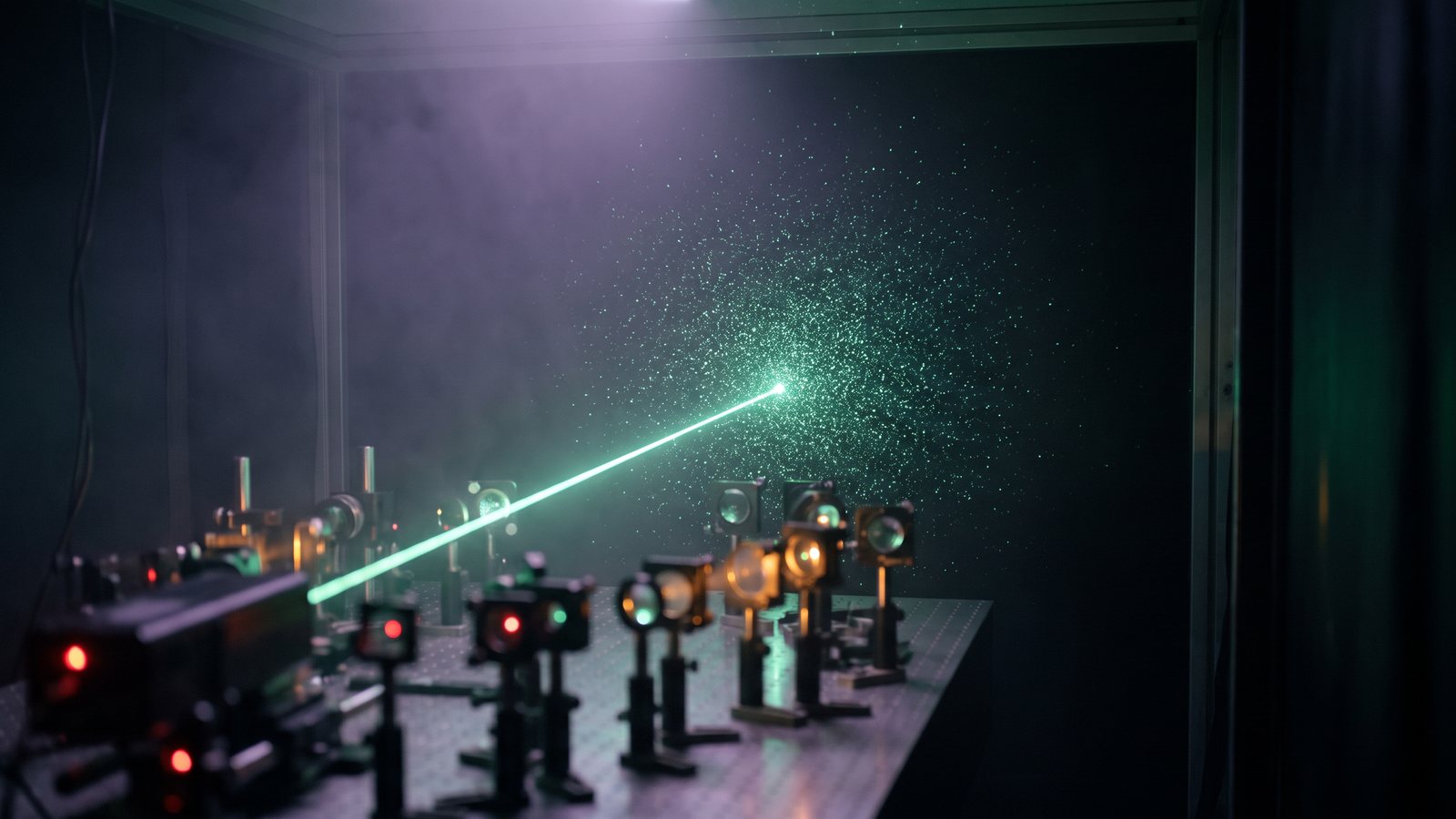
Laser speckle is ordinary optics. When coherent light, such as a laser’s, is scattered back from a rough surface, it forms “a random interference pattern at the detector”. Waves travel slightly different path lengths and reach the observer at random relative phases, producing bright and dark spots, and movement causes the pattern to fluctuate (Heeman et al., 2019). Doctors use exactly this effect to image blood flow in tissue. Evidence: established.
Two consequences matter here. First, a laser spot on a painted wall is never a smooth blob: it is a grainy, high-contrast texture of tiny points, even for a sober viewer. Second, the pattern forms at whatever detects the light, and when a person looks at the wall, that detector is their own eye, so small movements of the eye or head make the grain shimmer and shift. A finely detailed, ever-changing, high-contrast texture is just the kind of input a brain may organise into shapes. The physics is established; using it to explain the reports is a plausible reading, not a tested account of what laser viewers see. Evidence: preliminary.
Does the visual brain make its own patterns?
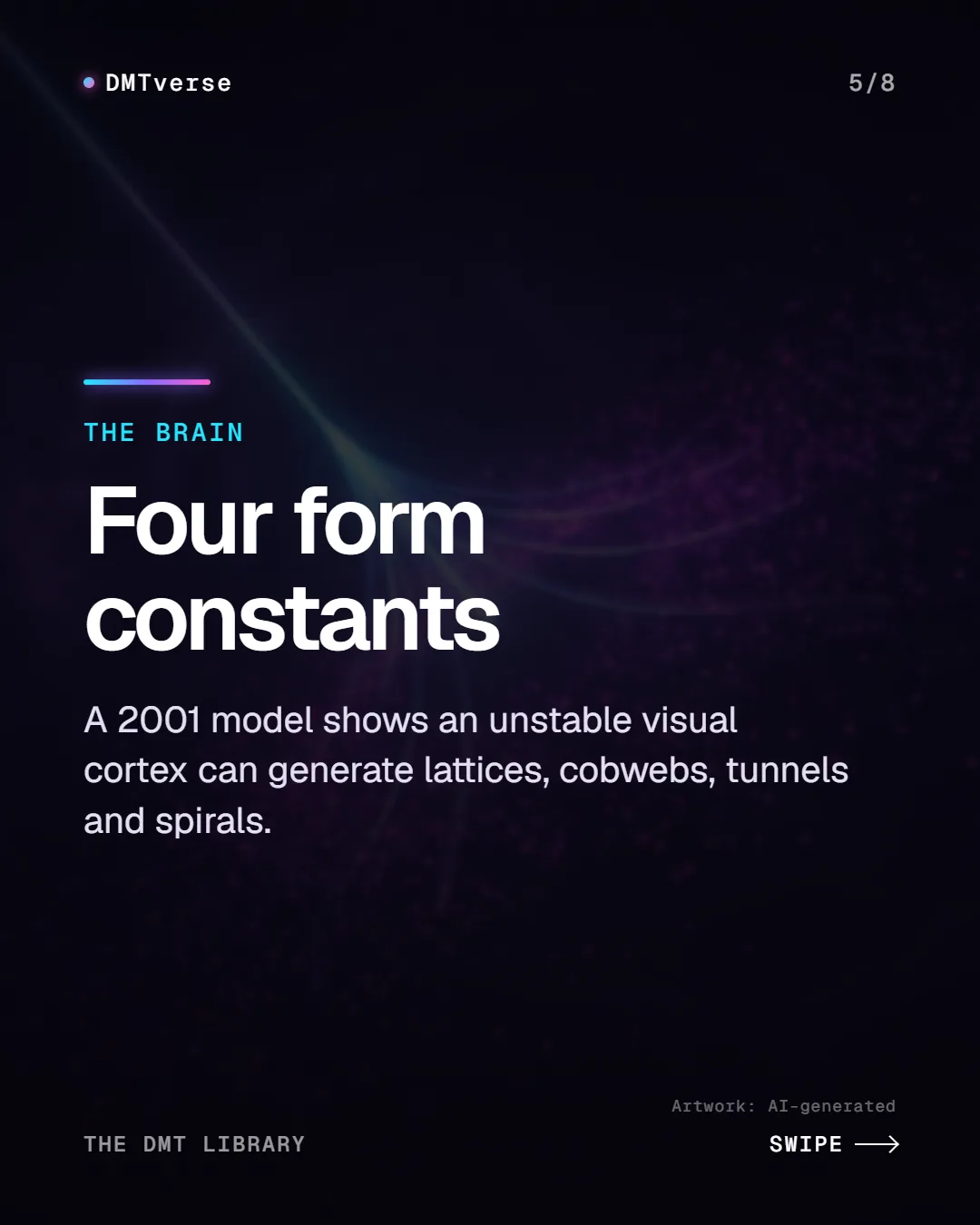
Yes, and in predictable shapes. The researcher Heinrich Klüver grouped geometric hallucinations into four “form constants”: gratings, lattices, honeycombs and chequer-boards; cobwebs; tunnels and funnels; and spirals. A 2001 mathematical model showed that if the primary visual cortex (V1) becomes unstable, the cortex’s own pattern of connections would produce those geometries (Bressloff et al., 2001). It is a model, not a DMT experiment, and it covers simple geometry, not symbols or scenes. Evidence: preliminary.
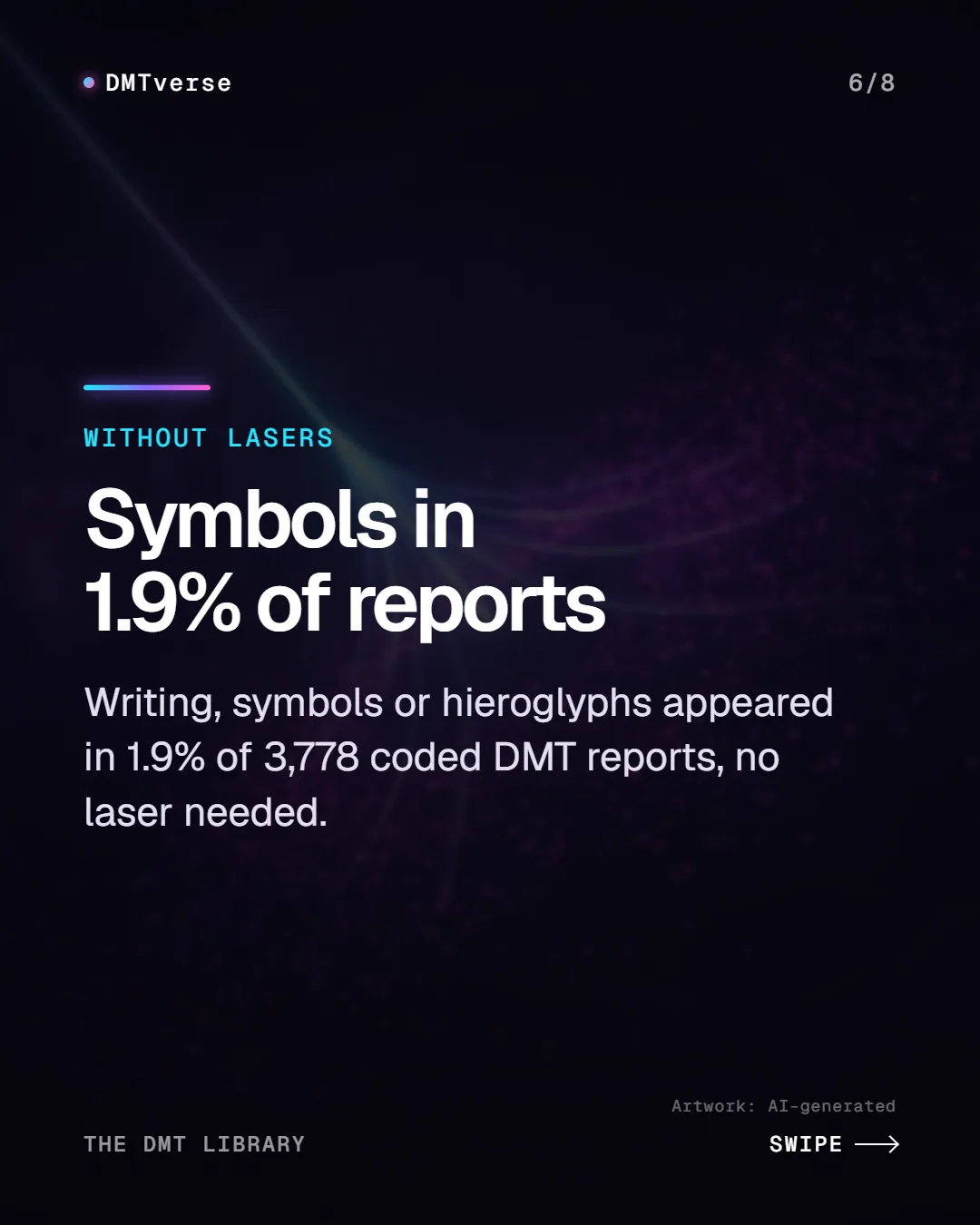
DMT reports are full of such patterns. In 3,778 coded Reddit reports, fractals, geometric shapes or patterns appeared in 32.6%, and open-eye visuals in 13.2%, including room and wall distortion (4.6%) and pixelation (1.0%). Writing, symbols, scripture or hieroglyphs were described in 1.9%, and digital or alien visuals in 0.8% (Lawrence et al., 2022). In other words, people saw symbol-like imagery on DMT without any laser, though only in a small minority of reports. In a lab EEG study, the emergence of slower brain rhythms correlated with the peak of the experience, particularly its eyes-closed visual component (Timmermann et al., 2019). Evidence: preliminary; self-selected reports and a small study.
How much does expectation change what people see?
A lot, especially when the signal is noisy, and the laser claim is a near-perfect case: a noisy visual texture, a strong prior expectation and a vivid altered state. Several lines of research are relevant:
- Expectations shift detection. In a preregistered study, people who expected more voices in noise were more willing to report detecting voices, and the effect was strongest when the sound was unreliable (Szymanek et al., 2024). That was a hearing task, not a drug study.
- Imagination can cross a “reality threshold”. A 2023 study found that imagined and perceived signals mix, and that people judge something real when the mixed signal is strong enough; when imagined signals are strong, they can become “subjectively indistinguishable from reality” (Dijkstra and Fleming, 2023). That used simple gratings with sober participants.
- Expectation changes DMT intensity. Identical doses were rated less intense when given open-label, step by step, than when given blind (Erne et al., 2026).
- Culture shapes visions. Ethnographic work at an ayahuasca centre argues that social context shapes the content of visions, not only how they are interpreted (Dupuis, 2022).
Put together: a person who has watched videos of “code” and then looks at a shimmering speckle pattern in a state known for geometric imagery has every ingredient for seeing code, whether or not anything is encoded in the light. That does not prove the reports are mistaken. It shows why only a blinded, controlled test could tell. Evidence: unresolved.
| Part of the claim | What is known | Evidence |
|---|---|---|
| The laser spot shows fine, shifting detail | True of any laser on a rough surface: speckle is a random interference pattern that fluctuates with movement | Established (Heeman et al., 2019) |
| Viewers on DMT see geometric or symbol-like forms | Geometry is common in DMT reports; symbol-like imagery appears in about 2% even without a laser | Preliminary (Lawrence et al., 2022) |
| Different viewers see the same stable code | Never tested independently or blind | Unresolved |
| The code reveals the structure of reality | No test has been proposed that could show this | Unresolved |
Can lasers damage your eyes?
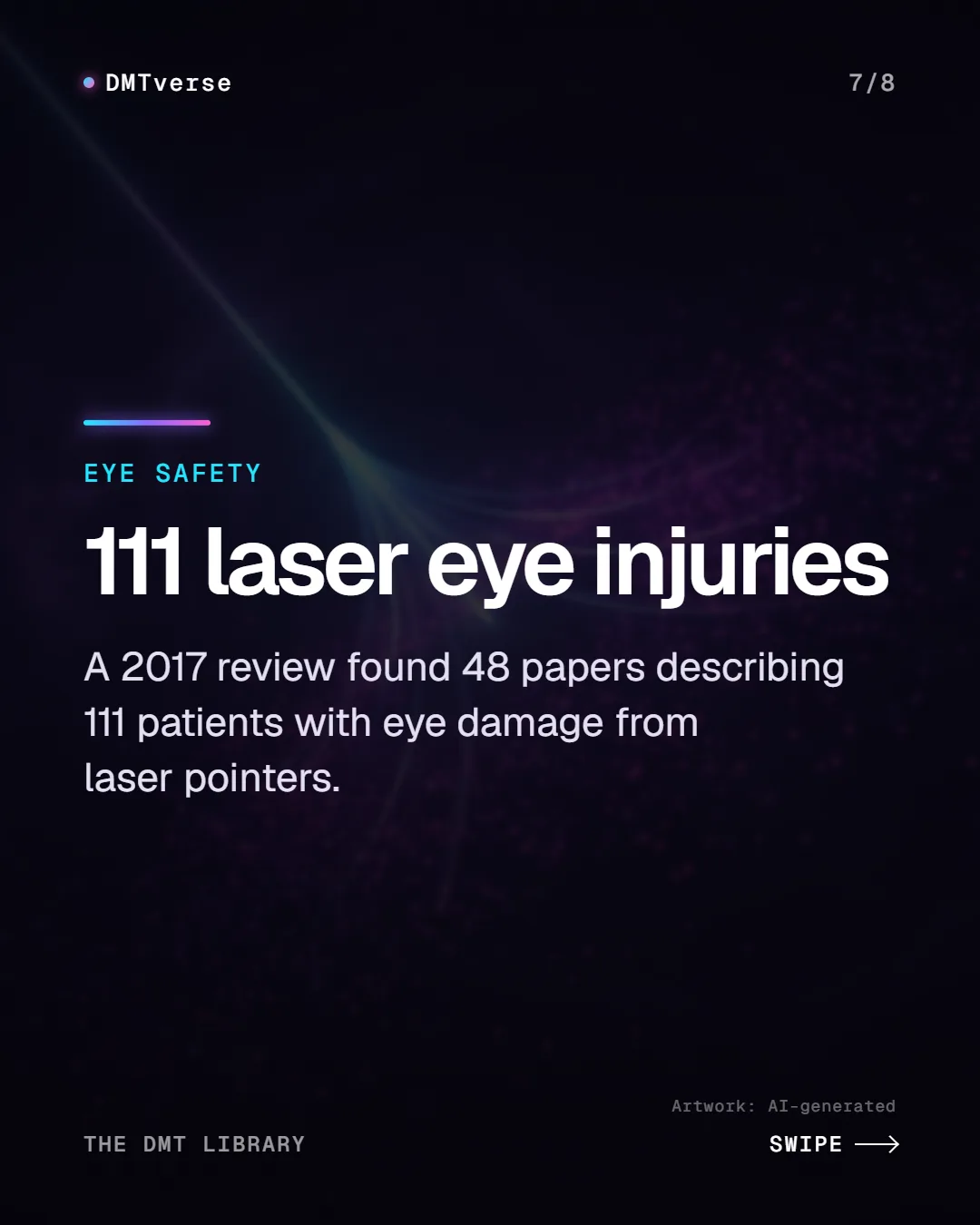
Yes. A 2017 review found 48 publications describing 111 patients with documented acute and permanent eye damage from laser pointers, ranging from focal photoreceptor defects to macular holes and retinal bleeding with loss of vision. At first examination, visual acuity was worse than 20/40 in 55% of affected eyes. The authors say injuries are often caused by untested or wrongly classified devices sold online, and that treatment options are limited (Birtel et al., 2017). Evidence: established.
Lasers and altered states
Laser pointers can cause permanent retinal damage, and devices sold online are sometimes untested or wrongly classified (Birtel et al., 2017). Canada’s Centre for Addiction and Mental Health warns that hallucinogens can cause disorientation and poor judgment (CAMH), which is a poor combination with any device that can injure the eye. If someone has a sudden change in vision after laser exposure, they should get urgent medical care.
If someone is in danger
Call 911 for immediate danger or urgent medical help, including if someone is unconscious, not breathing or having a seizure. In Ontario, the Ontario Poison Centre is at 1-800-268-9017; every province has a poison centre, listed by SickKids (AboutKidsHealth). If you or someone you know is thinking about suicide, call or text 9-8-8, 24 hours a day (Government of Canada). See also our safety page.
What we still don’t know
- Whether people who do not know about the claim report code when viewing a laser on DMT; no blinded test exists (unresolved).
- Whether independent viewers ever report the same specific symbols at the same place; this has never been checked (unresolved).
- Whether the form-constant model explains DMT geometry; it has not been tested with DMT (preliminary, as a hypothesis).
- How speckle, eye movement and an altered visual cortex interact; no study has combined them (unresolved).
The fair summary: the DMT laser experiment is a striking story, but not yet an experiment. Speckle physics, the visual brain’s habit of making patterns, and expectation can each produce some of what people describe, and nobody has run the blinded test that could tell these apart from hidden code. For more, read what is DMT, our guide to the waiting room, the dome and the chrysanthemum, and what researchers have recorded about entities.
Common questions
What is the DMT laser experiment?
An online claim that a laser spot on a wall, viewed during a DMT experience, reveals symbols or “code”. It spread through social media in the 2020s. It has not been tested in any controlled or blinded study.
Who started the DMT laser experiment?
A 2026 DoubleBlind feature credits Danny Goler with popularising it and reports that he said the idea came to him in August 2020. We describe him only through that published reporting.
Who is Danny Goler?
In the 2026 DoubleBlind feature, Danny Goler is described as a self-described researcher and filmmaker credited with popularising the DMT laser experiment; a documentary and a widely viewed trailer followed. That reporting is our only source on him. His claims about the laser have not been tested in any controlled or blinded study.
Is the DMT laser code real?
There is no evidence that it is. No study has checked whether independent, uninformed viewers report the same symbols. Laser speckle, the visual brain’s own patterns and expectation are well-documented alternatives, but they have not been tested against the claim either.
What is laser speckle?
The grainy pattern of bright and dark spots you see when laser light scatters off a rough surface. It is a random interference pattern that forms at the detector, including the eye, and it shifts with movement. It is used in medicine to image blood flow.
Why do people see geometric patterns on DMT?
Nobody knows for sure. One mathematical model shows that an unstable primary visual cortex would generate the classic geometric “form constants” from its own wiring, but this has not been tested with DMT. Geometric imagery appeared in about a third of coded online reports.
Can a laser damage your eyes?
Yes. A 2017 review documented 111 patients with eye damage from laser pointers, some of it permanent. Untested or misclassified devices are a particular problem. Seek urgent care for any sudden change in vision.
Shroomverse sells mushroom products. This article is general information about the “DMT laser experiment” claim and the science of vision and laser light. It is not medical, legal or purchasing advice, and it does not recommend any product.
SOURCES
- Wait, Are We In a Simulation? (article headline: If You Stare Into the Laser, You’ll See the ‘Code of Reality’. Allegedly.) (Busby M, The Drop In, 17 April 2026), DoubleBlind. Accessed . Page read. Description of the claim and reported visions; Danny Goler credited with popularising it, idea dated by him to August 2020; author saw only the reflection; comments from David Luke (priming), Zeus Tipado (optical illusion, suggestion) and Andres Gómez Emilsson (speckle). Journalism, not research.
- Clinical applications of laser speckle contrast imaging: a review (Heeman W, Steenbergen W, van Dam G, Boerma EC, Journal of Biomedical Optics 24(8):080901, 2019), SPIE (peer-reviewed, open access); PMC6983474. Accessed . Abstract and theory section read via Europe PMC full text. Speckle as a random interference pattern formed at the detector from coherent light scattered by a rough medium; random phases give bright and dark spots; movement causes fluctuation.
- Geometric visual hallucinations, Euclidean symmetry and the functional architecture of striate cortex (Bressloff PC, Cowan JD, Golubitsky M, Thomas PJ, Wiener MC, Phil Trans R Soc B 356(1407):299–330, 2001), The Royal Society (peer-reviewed); PMC1088430. Accessed . Abstract read via Europe PMC. Klüver’s four form constants; model in which V1 connectivity determines hallucination geometry. A mathematical model, not a DMT study.
- Effects of expectations and sensory unreliability on voice detection: A preregistered study (Szymanek P, Homan M, van Elk M, Hohol M, Consciousness and Cognition 123:103718, 2024), Elsevier (peer-reviewed). Accessed . Abstract read via Europe PMC. Expectations shifted response bias in voice detection, more strongly with sensory noise. (Our ledger had listed this as a point-light walker study; the abstract shows it is a voice-detection study, and it is described accordingly.)
- Subjective signal strength distinguishes reality from imagination (Dijkstra N, Fleming SM, Nature Communications 14:1627, 2023), Springer Nature (peer-reviewed, open access); PMC10036541. Accessed . Abstract read via Europe PMC. Imagined and perceived signals intermix; reality judged when the signal crosses a threshold; strong imagined signals can become indistinguishable from reality.
- Phenomenology and content of the inhaled N,N-dimethyltryptamine (N,N-DMT) experience (Lawrence DW, et al., Scientific Reports 12:8562, 2022), Springer Nature (peer-reviewed, open access); PMC9130218. Accessed . Full text read via Europe PMC. 3,778 reports: fractals/patterns 32.6%; open-eye visuals 13.2%; room and wall distortion 4.6%; pixilation 1.0%; writing, symbols, scripture or hieroglyphs 1.9%; digital or alien visuals 0.8%.
- Neural correlates of the DMT experience assessed with multivariate EEG (Timmermann C, et al., Scientific Reports 9:16324, 2019), Springer Nature (peer-reviewed, open access); PMC6864083. Accessed . Full text read via Europe PMC. Delta/theta emergence correlated with the peak of the experience, particularly its eyes-closed visual component; 13 participants.
- Dose-dependent pharmacokinetics and acute effects of intravenous bolus N,N-dimethyltryptamine (Erne L, et al., Translational Psychiatry 16:213, 2026), Springer Nature (peer-reviewed, open access); PMC13039932. Accessed . Abstract read via Europe PMC. Equivalent doses rated less intense under open-label escalation than blinded dosing. Doses not reproduced.
- The socialization of hallucinations: Cultural priors, social interactions, and contextual factors in the use of psychedelics (Dupuis D, Transcultural Psychiatry 59(5):625–637, 2022), SAGE (peer-reviewed, open access); PMC9660275. Accessed . Abstract read via Europe PMC. Cultural background and social interaction organise the content of visions, not only their interpretation.
- Retinal Injury Following Laser Pointer Exposure (Birtel J, Harmening WM, Krohne TU, Holz FG, Charbel Issa P, Herrmann P, Deutsches Ärzteblatt International, 2017), Deutscher Ärzteverlag (peer-reviewed, open access); PMC5754573. Accessed . Abstract read via Europe PMC. Systematic search: 48 publications, 111 patients with acute and permanent damage; acuity worse than 20/40 in 55% of affected eyes; untested or misclassified devices; limited treatment.
- Hallucinogens, Centre for Addiction and Mental Health (CAMH). Accessed . Page read. Hallucinogens can cause disorientation and poor judgment; unregulated products may contain toxins or other drugs.
- Mental health support: get help, Government of Canada, Public Health Agency of Canada. Accessed . Page read. Call 9-1-1 in immediate danger; call or text 9-8-8, 24/7.
- Poison information centres in Canada, AboutKidsHealth, The Hospital for Sick Children (SickKids). Accessed . Page read. Ontario toll-free 1-800-268-9017; call 911 if someone is unconscious, not breathing or having a seizure.
CHANGES
- : Added Danny Goler search wordings to keywords and an FAQ on who he is, answered only from the DoubleBlind feature already cited; no new claims.
- : Published. All sources opened and checked on this date.
- : Editorial review: removed equipment detail from the description of the claim; softened “mainly through social media in the 2020s” to what the source supports; evidence labels moved to one house-style label per paragraph; long testing paragraph split; dropped the unsourced “neurologist” label for Klüver.
- : Added source links beside figures and legal statements.



