
THE SHROOMVERSE JOURNAL ✳ 11 MIN READ
Can breathwork or meditation release DMT? What has actually been measured
Topic: DMT
Published Updated
Short answer, checked 20 October 2026
There is no evidence that meditation or breathwork releases DMT. No study has measured DMT during either practice, and DMT has never been measured in a living human brain at all. Breathwork’s effects have measured causes of their own: fast, deep breathing lowers carbon dioxide in the blood, makes it more alkaline and narrows brain blood vessels, and lower carbon dioxide tracked with the onset of altered states in a 2025 study. Psychedelic-like reports can arise without DMT, and breathwork carries known risks such as fainting.
THE SHORT VERSION · SWIPE
On this page 8 sections
A popular claim says you can reach a DMT state without DMT: breathe the right way, or meditate deeply enough, and your brain will release its own. Online, the breathing version is often called “DMT breathing”. This article checks what has been measured, what breathwork is known to do to the body, and why breathwork and meditation can produce experiences people compare to psychedelics.
Education only, not guidance
This article describes published research. It gives no breathing techniques, durations or instructions, and it does not describe any effect as a benefit. Safety notes below are information, not a medical screen; anyone with health questions should ask a clinician. In an emergency, call 911. Evidence labels: established (shown in peer-reviewed studies and not seriously disputed), preliminary (early, small, animal-only or indirect) and unresolved (an open question).
Does meditation release DMT?
Not as far as anyone has measured, because nobody has measured it. On 20 October 2026 we searched Europe PMC, a large open database of biomedical literature, for studies of DMT with meditation, breathwork or hyperventilation. A query requiring DMT, one of those practices and a measurement term (plasma, urine, serum, concentrations or measured) in the abstract returned zero records (Europe PMC search). Evidence: established that no such measurement has been published, as far as this search can show.
Broader searches did return studies pairing DMT with meditation, but they run the other way: researchers gave DMT to meditators. In one double-blind study, 40 experienced meditators on a three-day retreat received either placebo or DMT combined with harmine, a compound that slows DMT’s breakdown (Meling et al., 2024). That tells us how administered DMT interacts with meditation. It says nothing about whether meditation makes the body release DMT. Evidence: established for the study design.
What has actually been measured about DMT in the body?
The strongest data come from rats. In 2019, researchers sampled fluid from the living rat cortex and found DMT at levels similar to serotonin, with or without a pineal gland (Dean et al., 2019). The same team found the enzyme thought to make DMT in human brain tissue, but they write that it is unknown whether their findings occur in humans. Evidence: preliminary; rats.
In people, the record is thin. A 2022 review notes that only a handful of studies have tried to detect DMT in the human brain, and only indirectly, through cerebrospinal fluid, the liquid around the brain and spinal cord (Barker, 2022). A 2018 review concludes that the tiny amounts detected in brain are not enough to produce psychoactive effects (Nichols, 2018). So no one has measured a release during meditation either. Evidence: established. See does the brain make DMT.
What does breathwork actually do to the body?
“Breathwork” covers many practices. The ones linked to DMT-like claims are high-ventilation styles, where people breathe faster or deeper than they need to for a sustained period. A 2023 review describes these practices as having profound effects on the central and autonomic nervous systems, through changes in the brain’s chemical balance and in the senses that monitor the body’s inner state (Fincham et al., 2023). Evidence: established that these practices change physiology; preliminary for detailed mechanisms.
The core change is to carbon dioxide (CO2). Breathing out more CO2 than the body makes lowers its level in the blood, a state called hypocapnia. Studies of circular breathwork find it lowers CO2 and raises blood oxygen; with less CO2, blood becomes more alkaline (respiratory alkalosis), which narrows blood vessels, particularly across the outer layer of the brain (Havenith et al., 2025). Evidence: established.
A 2025 brain-imaging study reached the same picture. It notes that hyperventilation acutely reduces regional blood flow in the brain through combined effects of low CO2, alkalosis in the brain and low oxygen. In experienced practitioners, fast breathing also raised sympathetic “fight or flight” activity in the heart (Kartar et al., 2025). Evidence: established for the physiology; preliminary for the imaging findings, from a small sample.
What is Holotropic Breathwork?
Holotropic Breathwork is a named form of breathwork, usually practised with music. A 2007 paper describes it as “a prolonged, voluntary hyperventilation procedure”, and proposed, as a hypothesis, that it might help in psychotherapy (Rhinewine and Williams, 2007). In a 2025 study comparing Holotropic Breathwork with a similar style, Conscious-Connected breathwork, in about 30 people each, the two produced highly similar outcomes (Havenith et al., 2025). Evidence: established that it is a form of hyperventilation; preliminary for its effects.
Why can breathwork feel like a psychedelic without DMT?
Because the altered state tracks measured changes in the body. In the 2025 study of 61 experienced practitioners, lower end-tidal CO2 (the CO2 level in each breath at the end of exhaling) was significantly correlated with the onset of altered states, and the states resembled psychedelic ones on standard questionnaires, including ego dissolution, a loss of the usual sense of self (Havenith et al., 2025). Evidence: preliminary; a correlation in a self-selected, experienced group.
The imaging study found that the intensity of the altered state was proportional to the rise in sympathetic activity and to changes in blood flow in regions involved in sensing breathing (the insula) and in emotional memory (the amygdala and hippocampus) (Kartar et al., 2025). None of these studies measured DMT, and none needed it to explain what they saw. Evidence: preliminary.
Expectation plays a part too. In a small randomised trial, 24 healthy adults did either breathwork or a body-scan meditation, and breathwork produced larger mystical-type and “emotional breakthrough” scores. But allocation was open-label, and only the breathwork group was prepared for psychedelic-like experiences, which the authors flag as a limitation (Fincham et al., 2026). Evidence: preliminary.
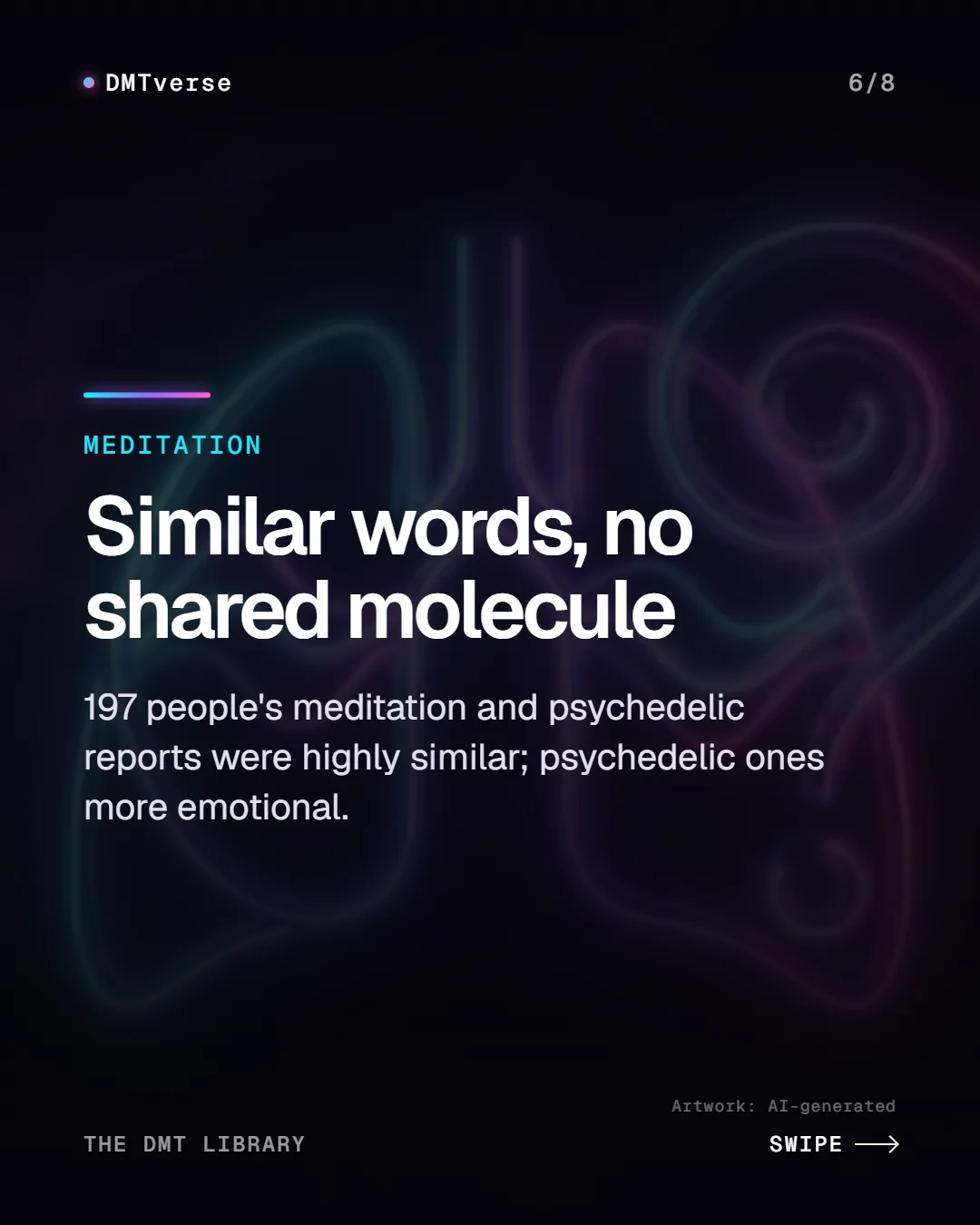
Meditation can also produce reports that read like psychedelic ones. When 197 people wrote about their most meaningful experience, the meditation and psychedelic accounts were highly similar in content, though the psychedelic ones were more emotionally charged (Kallio-Mannila et al., 2025). Similar words do not mean a shared molecule. As the 2018 pineal review argues, stress and other states can produce altered consciousness without invoking DMT (Nichols, 2018). Evidence: preliminary.
| Claim | What research shows | Evidence |
|---|---|---|
| Meditation releases DMT | No study has measured DMT during meditation; DMT has never been measured in a living human brain. | Unsupported |
| Breathwork releases DMT | No study has measured DMT during breathwork; its effects track lower CO2 and blood-flow changes. | Unsupported |
| Breathwork can feel psychedelic | Questionnaire scores resembled psychedelic states in experienced practitioners. | Preliminary |
| The brain can make DMT | Shown in rats; human brain levels unmeasured. | Preliminary |
Is breathwork safe? What researchers flag
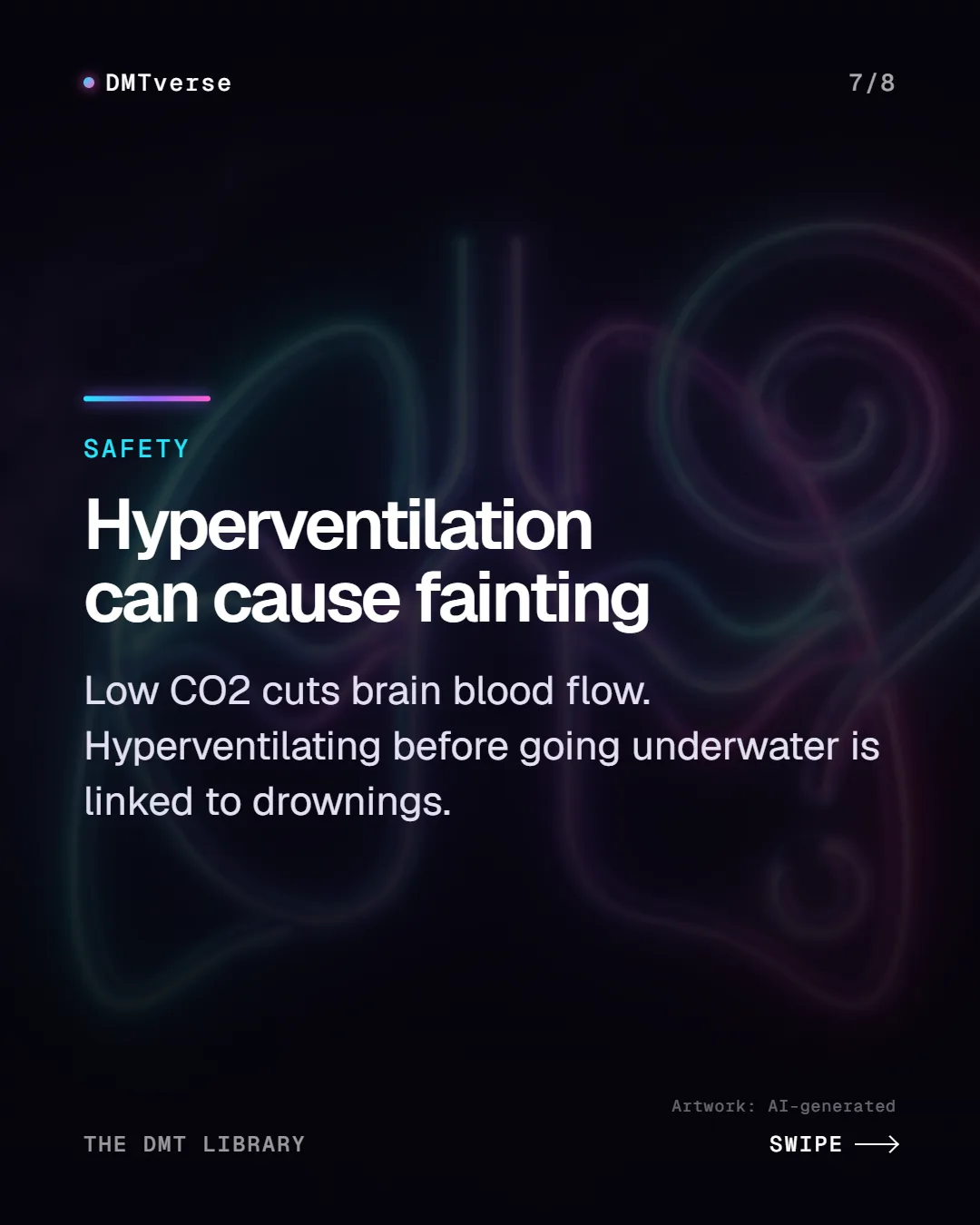
Fainting is the best-documented physical risk. A 2014 review links low CO2 from hyperventilation to reduced blood flow to the brain and, in some circumstances, to syncope, a brief loss of consciousness. The risk rises when hyperventilation is combined with other strains on circulation, such as cold-water immersion or reduced heart output (Immink et al., 2014). Evidence: established for the mechanism.
Water makes this far more dangerous. A US public-health review identified 16 fatal and nonfatal drownings in New York State, between 1988 and 2011, linked to deliberate underwater breath-holding behaviours. The incident that prompted it involved two healthy young men who lost consciousness underwater after hyperventilating before submerging, a phenomenon described as hypoxic blackout (Boyd et al., 2015). Evidence: established.
Breathwork studies screen people out for specific conditions. One trial excluded people with a history of low or high blood pressure, respiratory or cardiovascular conditions, fainting, epilepsy or seizures, panic disorder or panic attacks, or cerebral aneurysm, and people who were or might be pregnant or were breastfeeding (Fincham et al., 2026). Another excluded psychosis, personality disorders, recent substance use disorder, cardiovascular disease, chronic lung disease, pregnancy and chronic nervous-system disease, especially epilepsy (Havenith et al., 2025). Evidence: established as published research criteria, not a complete medical list.
Physical reactions can be strong. In the 2026 trial, facilitators prepared participants for body-temperature changes, tetany (involuntary muscle cramping or stiffening) and emotional expression (Fincham et al., 2026). The 2025 authors caution that adverse effects have not been sufficiently studied, and that recruiting experienced practitioners will underestimate how often they happen in the general population (Havenith et al., 2025). Evidence: preliminary.
What the safety evidence does and does not say
The conditions above are reasons researchers excluded people from studies; they are not a checklist that makes breathwork safe for everyone else. Most studies so far recruited healthy, experienced practitioners, so rare harms may be missed. Questions about a specific health condition belong with a clinician.
If someone is in danger
Call 911 for immediate danger or urgent medical help, including if someone is unconscious, not breathing or having a seizure. In Ontario, the Ontario Poison Centre is at 1-800-268-9017; every province has a poison centre, listed by SickKids (AboutKidsHealth). If you or someone you know is thinking about suicide, call or text 9-8-8, 24 hours a day (Government of Canada). See also our safety page.
Why does the DMT-release idea persist?
It borrows credibility from real findings: the body can make DMT in rats, and breathwork and meditation can produce vivid, meaningful experiences. Joining those two facts gives a tidy story, but the link between them has never been measured. Related claims about the pineal gland and dying follow the same pattern; see is DMT in the pineal gland and does the brain release DMT when you die. Evidence: unresolved for the link; established that it is untested.
What we still don’t know
- Whether DMT levels change in any human body fluid during breathwork or meditation; no study has looked (unresolved).
- Whether DMT plays any role in the living human brain; it has never been measured there (unresolved).
- How much of breathwork’s altered state comes from CO2 and blood-flow changes, and how much from music, setting and expectation (preliminary).
- How common adverse effects of breathwork are in the general population, beyond experienced volunteers (unresolved).
The fair summary: breathwork and meditation can change how people feel and what they experience, and breathwork has measurable physiological effects. That they release DMT is a hypothesis nobody has tested. For the bigger picture, see our pillar guide, what is DMT.
Common questions
Does meditation release DMT?
There is no evidence that it does. Our Europe PMC search on 20 October 2026 found no study that measured DMT during meditation, and DMT has never been measured in a living human brain.
Does breathwork release DMT?
No study has measured DMT during breathwork. Its effects are tied to measured changes: lower blood CO2, more alkaline blood and narrowed brain blood vessels. Lower CO2 correlated with the onset of altered states in a 2025 study.
Does Holotropic Breathwork release DMT?
No study has measured it. Holotropic Breathwork is described in the literature as a prolonged, voluntary hyperventilation procedure, and a 2025 study found it produced outcomes highly similar to another breathwork style.
What is “DMT breathing”?
A popular name for breathwork, usually fast or deep breathing styles, said to bring on a DMT-like state or make the brain release DMT. No study has measured DMT during breathwork. The science points elsewhere: breathing out more CO2 than the body makes lowers blood CO2, makes blood more alkaline and narrows brain blood vessels, and lower CO2 tracked the onset of altered states in a 2025 study. Fainting is a known risk. We describe no techniques here.
Why does breathwork feel like a psychedelic trip?
In studies of experienced practitioners, the altered state tracked lower CO2, raised fight-or-flight activity and blood-flow changes in brain regions for body-sensing and emotional memory. Expectation and music may also contribute.
Can breathwork make you faint?
Yes. Low CO2 from hyperventilation reduces blood flow to the brain and is linked to fainting, especially combined with other strains such as cold-water immersion. Hyperventilating before going underwater has been linked to drownings.
Who is excluded from breathwork studies?
Published trials have excluded people with high or low blood pressure, heart or lung conditions, a history of fainting, epilepsy or seizures, panic disorder, cerebral aneurysm, psychosis, and people who are pregnant. These are research criteria, not a full medical list.
Can the brain make DMT?
In rats, yes: a 2019 study measured DMT in the living rat cortex. In humans it has only been looked for indirectly, in cerebrospinal fluid, and has never been measured in a living brain.
Shroomverse sells mushroom products. This article is general information about claims that breathwork or meditation release DMT. It is not medical, legal or purchasing advice, and it does not recommend any product.
SOURCES
- Europe PMC search: DMT with meditation, breathwork or hyperventilation, run 20 October 2026, Europe PMC (EMBL-EBI). Accessed . Searches run via the Europe PMC REST API. A query requiring dimethyltryptamine, meditation/breathwork/hyperventilation/breathing and plasma/urine/serum/measured/concentrations in the abstract returned 0 records. Broader queries (138, 400 and 37 hits) returned no study measuring DMT during either practice; DMT-with-meditation studies administered DMT.
- Meditating on psychedelics. A randomized placebo-controlled study of DMT and harmine in a mindfulness retreat (Meling D, et al., Journal of Psychopharmacology, 2024), SAGE (peer-reviewed, open access); PMC11487865. Accessed . Abstract read via Europe PMC. 40 experienced meditators, double-blind, placebo or DMT-harmine during a three-day retreat. Supports: DMT-meditation studies give DMT rather than measure release. Outcomes not reproduced as benefits.
- Biosynthesis and Extracellular Concentrations of N,N-dimethyltryptamine (DMT) in Mammalian Brain (Dean JG, et al., Scientific Reports 9:9333, 2019), Springer Nature (peer-reviewed, open access); PMC6597727. Accessed . Abstract and full text read via Europe PMC. Rat cortex DMT similar to monoamine neurotransmitters including serotonin, with or without the pineal gland; INMT transcript in human cortex; authors: unknown whether this occurs in humans.
- Administration of N,N-dimethyltryptamine (DMT) in psychedelic therapeutics and research and the study of endogenous DMT (Barker SA, Psychopharmacology 239:1749–1763, 2022), Springer (peer-reviewed, open access); PMC8782705. Accessed . Full text read via Europe PMC. Only a handful of studies have attempted to detect endogenous DMT in human brain, indirectly through cerebrospinal fluid.
- N,N-dimethyltryptamine and the pineal gland: Separating fact from myth (Nichols DE, Journal of Psychopharmacology 32(1):30–36, 2018), SAGE (peer-reviewed). Accessed . Abstract read via Europe PMC. Minute brain concentrations of DMT not sufficient for psychoactive effects; alternative explanations for altered states under stress and near death without DMT.
- Decreased CO2 saturation during circular breathwork supports emergence of altered states of consciousness (Havenith MN, et al., Communications Psychology 3:59, 2025), Springer Nature (peer-reviewed, open access); PMC11994804. Accessed . Full text read via Europe PMC. Holotropic (n=30) vs Conscious-Connected (n=31) breathwork in experienced practitioners; reduced end-tidal CO2 correlated with ASC onset (r = −0.46); ASCs resembled psychedelic ones (incl. ego dissolution); styles highly similar; background: lower CO2, higher oxygenation, respiratory alkalosis, vasoconstriction especially neocortex; exclusion criteria; adverse effects insufficiently studied; experienced sample underestimates adverse events.
- Neurobiological substrates of altered states of consciousness induced by high ventilation breathwork accompanied by music (Kartar AA, et al., PLOS ONE, 2025), PLOS (peer-reviewed, open access); PMC12385377. Accessed . Abstract and full text read via Europe PMC. Hyperventilation reduces regional cerebral blood flow via hypocapnia, cerebral alkalosis and hypoxia; ASC intensity proportional to cardiovascular sympathetic activation and perfusion changes in operculum/posterior insula and amygdala/anterior hippocampus; small, experienced sample.
- An exploratory study of breathwork-induced altered states of consciousness in experienced practitioners: the airways to alteration (A2A) trial (Fincham GW, et al., Frontiers in Psychology, 2026), Frontiers (peer-reviewed, open access); PMC13291248. Accessed . Abstract and full text read via Europe PMC. 24 healthy adults, randomised, open-label allocation, breathwork vs body-scan meditation; larger mystical-type and emotional-breakthrough scores; priming only in breathwork arm noted; exclusion criteria list; preparation for temperature changes, tetany and emotional expression.
- High ventilation breathwork practices: An overview of their effects, mechanisms, and considerations for clinical applications (Fincham GW, et al., Neuroscience and Biobehavioral Reviews 155:105453, 2023), Elsevier (peer-reviewed). Accessed . Abstract read via Europe PMC. Review: high ventilation breathwork has profound effects on central and autonomic nervous systems via neurometabolic parameters and interoceptive systems.
- Holotropic Breathwork: the potential role of a prolonged, voluntary hyperventilation procedure as an adjunct to psychotherapy (Rhinewine JP, Williams OJ, Journal of Alternative and Complementary Medicine, 2007), Mary Ann Liebert (peer-reviewed). Accessed . Abstract read via Europe PMC. Hypothesis-posing paper defining Holotropic Breathwork as a prolonged, voluntary hyperventilation procedure.
- Hyperventilation, cerebral perfusion, and syncope (Immink RV, Pott FC, Secher NH, van Lieshout JJ, Journal of Applied Physiology 116:844–851, 2014), American Physiological Society (peer-reviewed). Accessed . Abstract read via Europe PMC. Review: hypocapnia reduces cerebral blood flow; associated with transient loss of consciousness; risk when combined with cold immersion or reduced cardiac output.
- Fatal and nonfatal drowning outcomes related to dangerous underwater breath-holding behaviors — New York State, 1988–2011 (Boyd C, et al., MMWR 64(19):518–521, 2015), US Centers for Disease Control and Prevention; PMC4584570. Accessed . Abstract read via Europe PMC. Two healthy young men lost consciousness underwater after intentional hyperventilation before submersion (hypoxic blackout); 16 cases identified 1988–2011.
- Comparing psychedelic and meditation experience reports with natural language processing (Kallio-Mannila K, Salmela R, Jylkkä J, Scientific Reports, 2025), Springer Nature (peer-reviewed, open access); PMC12708837. Accessed . Abstract read via Europe PMC. 197 participants’ reports of their most meaningful experience (134 psychedelic, 63 meditation); highly similar content; psychedelic reports more emotionally charged; method limitations noted.
- Mental health support: get help, Government of Canada, Public Health Agency of Canada. Accessed . Page read. Call 9-1-1 in immediate danger; call or text 9-8-8, 24 hours a day, 7 days a week.
- Poison information centres in Canada, AboutKidsHealth, The Hospital for Sick Children (SickKids). Accessed . Page read. Ontario toll-free 1-800-268-9017; call 911 if someone is unconscious, not breathing or having a seizure.
CHANGES
- : Added “DMT breathing” search wordings to keywords, one sentence naming the term in the introduction and an FAQ answered from the article’s existing sources (Havenith et al. 2025, Immink et al. 2014); no new claims.
- : Linked glossary definitions.
- : Published. Europe PMC searched on this date for any measurement of DMT during breathwork or meditation (none found). All sources opened and checked on this date.



