THE SHROOMVERSE JOURNAL ✳ 13 MIN READ
What is DMT hyperspace? The spaces people describe, what research has mapped, and the lockout myth
Topic: DMT
Published Updated
Listen: the 3-minute version
AI-narrated summary of this article
Short answer, checked 20 October 2026
“DMT hyperspace” is the community name for the immersive, often other-dimensional space people say they enter during a DMT experience. It describes how the experience felt; it is not evidence of a real place. In 3,778 coded online reports, 17.1% named hyperspace, and rooms, tunnels, voids and landscapes were common. A 2026 lab study found that a sense of space typically formed before any presences appeared. “Hyperspace lockout”, the idea of being shut out after earlier experiences, has never been defined or tested in a study.
THE SHORT VERSION · SWIPE
On this page 9 sections
Ask people what happened during a strong DMT experience and many will say they went somewhere. “Hyperspace” is the word that has stuck. This guide covers what people mean by it, how researchers have counted and described these spaces, and the folklore of “lockout” and the “hyper slap”, set against the controlled studies that exist.
Education only, not guidance
This article describes reports and published research. It gives no amounts, no frequencies, no instructions and no advice on use, and it does not describe any effect as a benefit. DMT is a controlled substance in Canada. In an emergency, call 911. Evidence labels: established (shown in peer-reviewed studies and not seriously disputed), preliminary (early, small, self-selected or indirect) and unresolved (an open question). Anecdotes are labelled as reports.
What is DMT hyperspace?
In user accounts, DMT hyperspace means the sense of having left ordinary surroundings for an immersive space that feels other-dimensional. A 2016 modelling paper summarises reports as the “complete replacement of normal subjective experience” with a novel “alternate universe” (Gallimore and Strassman, 2016). The word describes how the experience felt to the person; it says nothing, on its own, about whether such a place exists. Evidence: established as a common way of describing reports.
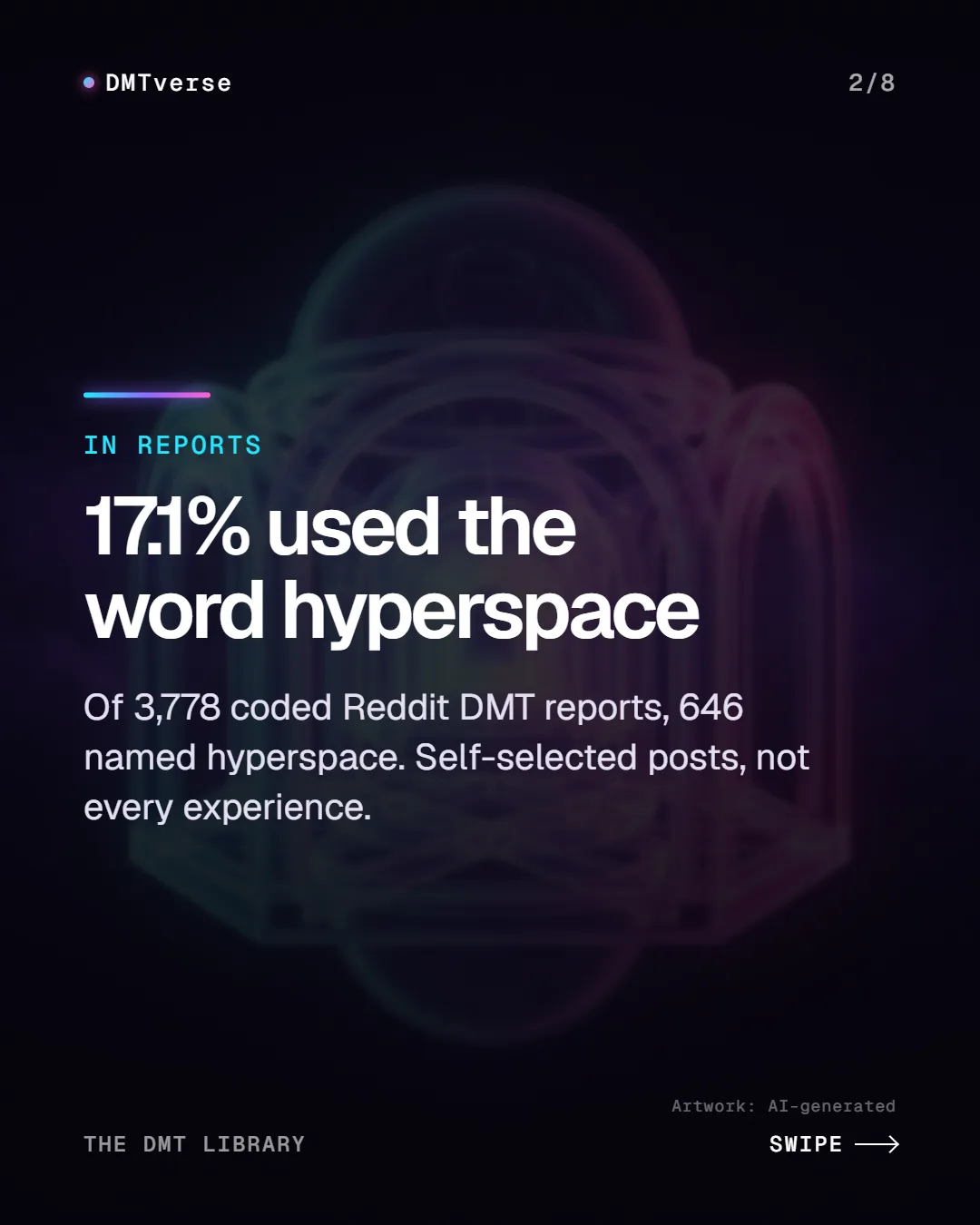
The best count comes from a 2022 study that manually coded every DMT experience posted to the r/DMT Reddit community over ten years: 3,778 experiences. Alternate or higher dimensions appeared in 952 (25.2%), and 646 (17.1%) used the word hyperspace (Lawrence et al., 2022). The posters were self-selected, so these figures describe what people chose to write, not what every experience contains. Evidence: preliminary.
What kinds of spaces do people describe in DMT hyperspace?
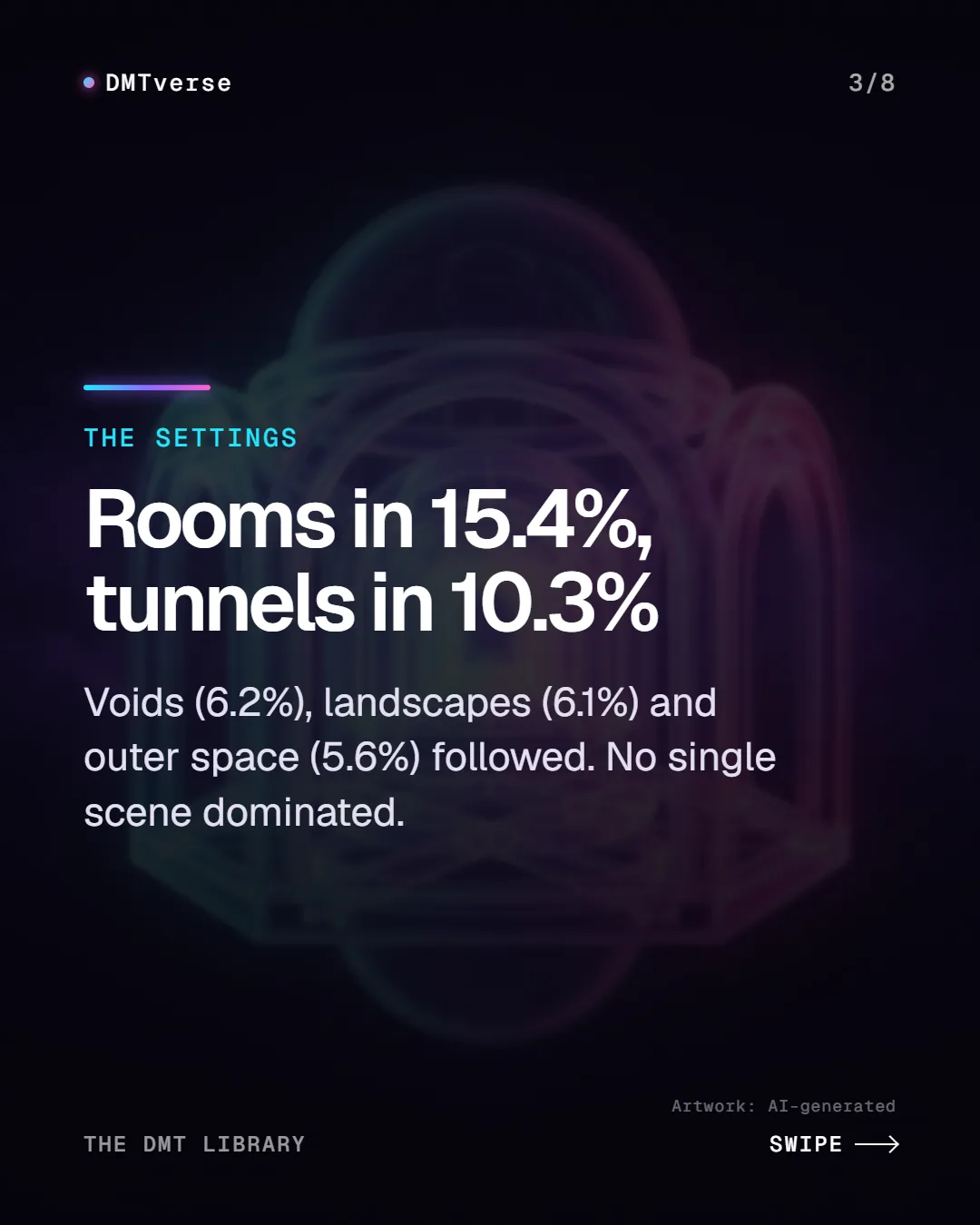
The same study coded the scenery and architecture of what it calls the “DMT world”. Rooms were the most common setting, followed by tunnels, voids (empty white, golden or black space) and landscapes. Landscapes included alien, fractal or golden ones (1.2%) and cities (1.0%). Astronomical themes such as stars, planets and galaxies appeared in 5.6% (Lawrence et al., 2022). Evidence: preliminary; self-selected reports.
Rooms, 15.4%
582 experiences described being inside a room, 105 of them the “waiting room” (Lawrence et al., 2022).
Tunnels, 10.3%
390 experiences described a tunnel or tunnel-type structure.
A void, 6.2%
233 experiences described a white, golden, black or unspecified void.
Landscapes, 6.1%
229 experiences described landscapes, from alien or fractal terrain to cities, fields and forests.
Astronomical themes, 5.6%
212 experiences described stars, planets, galaxies or outer space.
Bright light, 3.4%
130 experiences described a white or bright light, or a beam of light.
Restates Lawrence et al., 2022, Table 6. A count of what people wrote, not of what everyone experiences.
Rarer settings are just as telling. Machinery or clockwork appeared in 2.1% of experiences, ancient or culture-specific architecture in 1.9%, a carnival or circus in 1.4%, pyramids in 1.2%, places of worship and hell each in 0.8%, and heaven in 0.6% (Lawrence et al., 2022). No single scene dominates. “Hyperspace” covers a wide range of reported places rather than one shared destination. Evidence: preliminary.
How do researchers describe immersion in hyperspace?
A 2026 lab study took a different approach. Researchers gave DMT to 23 participants during combined brain scanning (fMRI and EEG), then used micro-phenomenology, a slow interview method that walks people back through each moment of an experience. They describe immersion as “a structured continuum from subtle to gross forms”: from single sensations at one end to whole configurations, such as feeling located in an emerging environment, at the other (Sanders et al., 2026). Evidence: preliminary; one lab study.
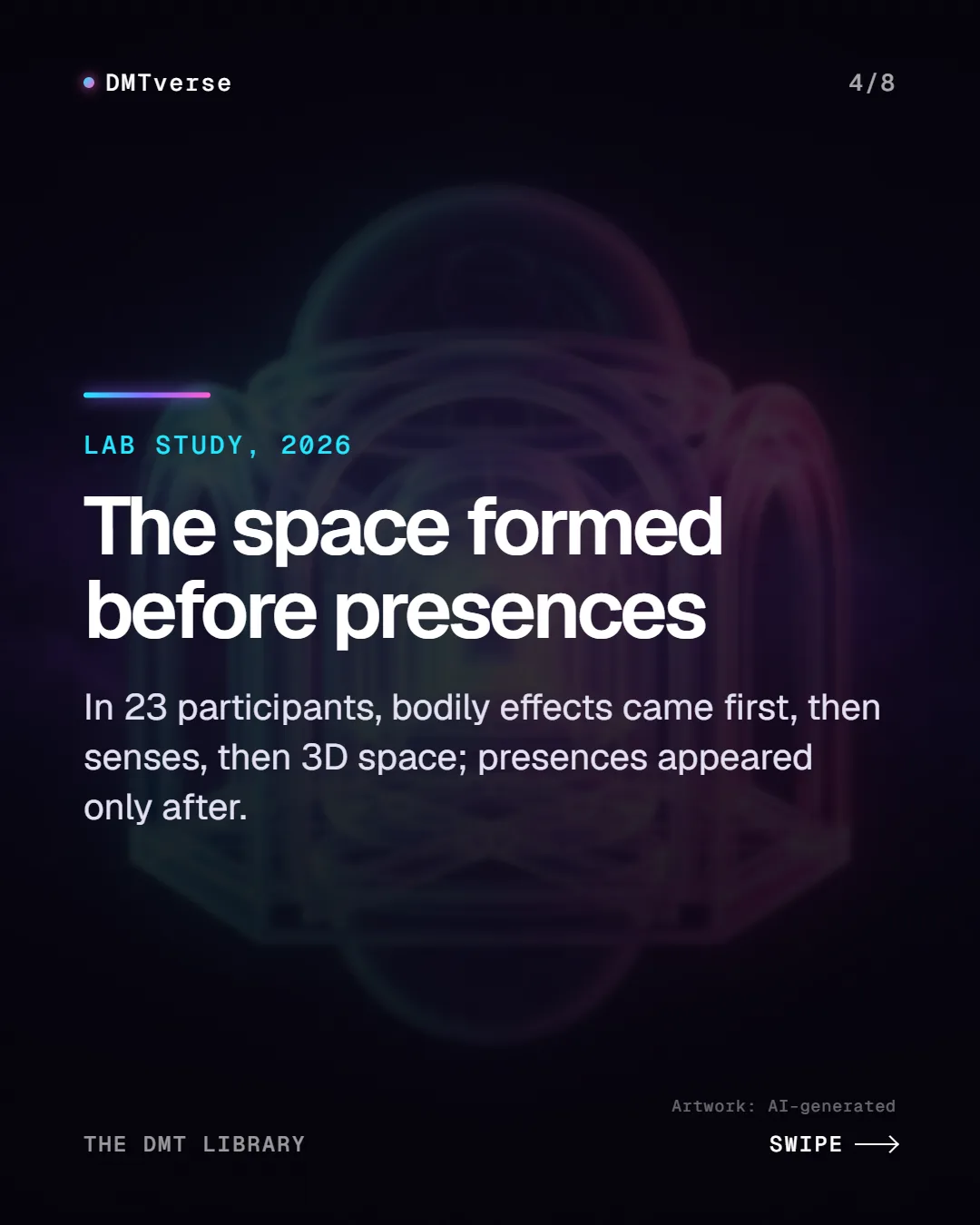
The order mattered. Bodily effects typically came first, then visual and auditory ones. Perceived presences emerged only after the senses had combined and a three-dimensional space had developed. Among participants who met presences, 82% described them as inhabiting a perceived landscape (Sanders et al., 2026). In other words, in this study, the space was built before anyone appeared in it. Our DMT breakthrough guide walks through those stages. Evidence: preliminary.
What shape does the space take?
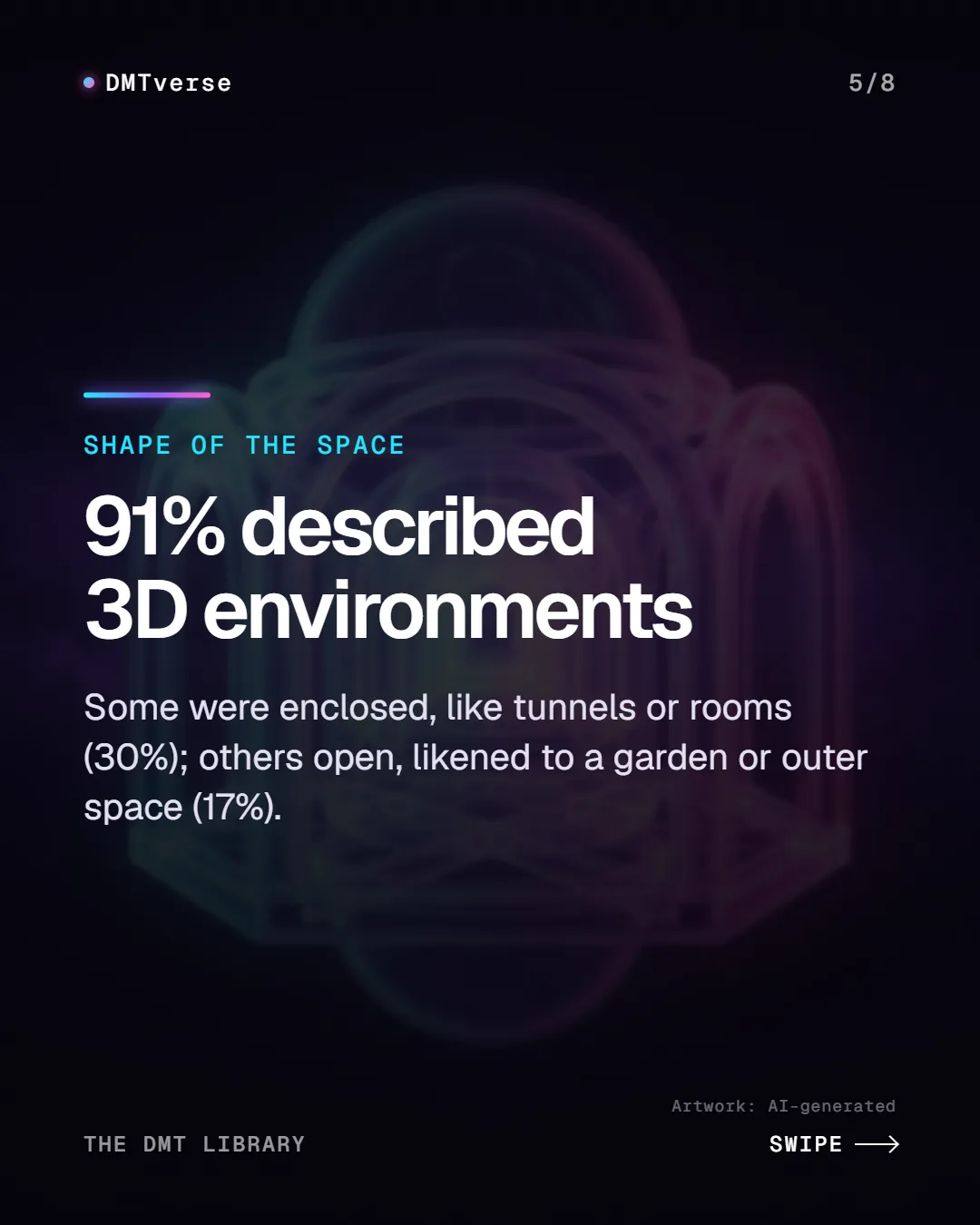
Every participant described the space in terms of size, shape and location. Most (91%) described three-dimensional environments, and 35% described flat, two-dimensional spreads of geometry. Some spaces were enclosed (30%), from a simple tunnel or cube to a series of rooms; others were open (17%), likened to a garden or outer space. A few (9%) described a fractal-like boundary that repeated within itself (Sanders et al., 2026). Evidence: preliminary; participants could fall in more than one category.
Are people inside the space or looking in?
Both. Being within a space was described by 74% and being outside it by 57%, often as looking into other worlds through portals or tunnels. A liminal position, on the threshold between inside and outside, was described by 17%. And 35% described being in two contexts at once, aware of a strange environment and of the scanner room together (Sanders et al., 2026). The setting was a scanner, the participants were experienced, and the accounts came afterwards. Evidence: preliminary.
What are the waiting room and the dome?
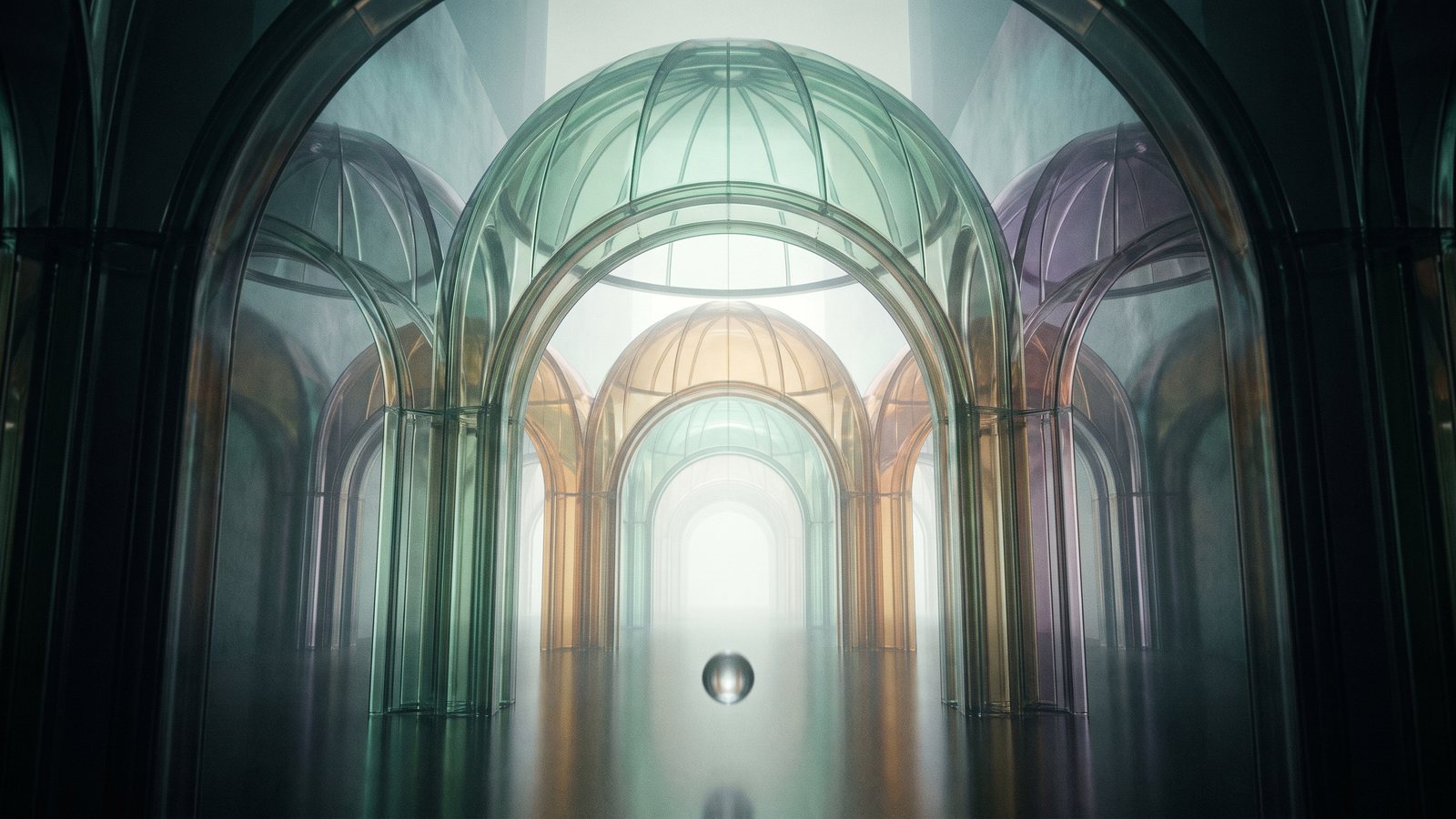
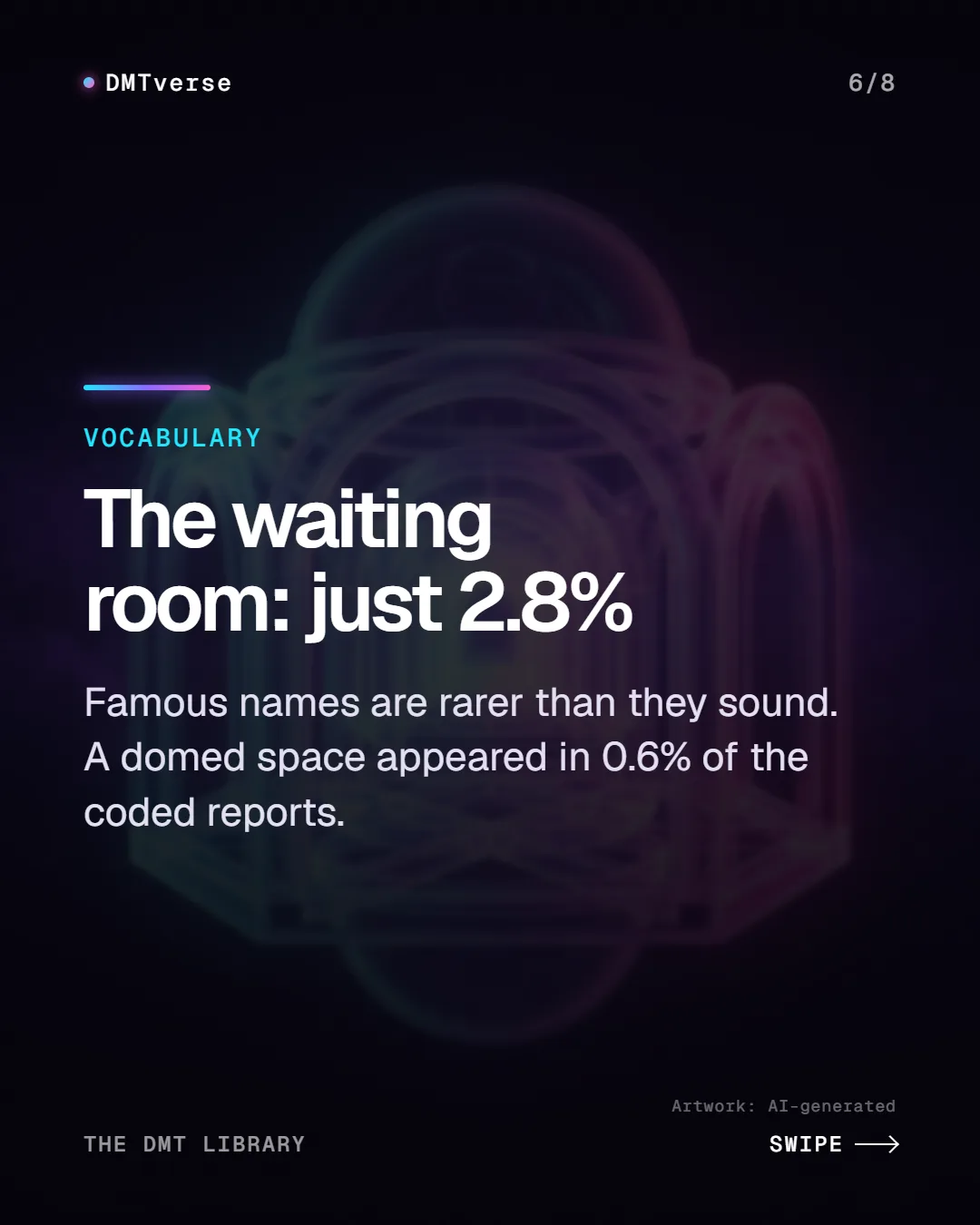
They are two of the best-known names for particular spaces. “The waiting room” is a room-like space some people say they arrive in, and “the dome” is a vaulted, domed space. Both are much rarer in reports than their fame suggests: the waiting room appeared in 2.8% of the coded experiences and a domed or spherical space in 0.6% (Lawrence et al., 2022). For where these words came from, along with “the chrysanthemum” and “the carrier wave”, see our guide to the waiting room, the dome and the chrysanthemum. Evidence: preliminary.
Is DMT hyperspace a real place?
Research cannot answer that, and the studies say so. What they can show is how people describe it. In the 2026 lab study, a feeling of reality came up in 26% of participants: 22% described things as feeling real and 9% as feeling unreal (Sanders et al., 2026). The 2022 authors warn that earlier posts may shape later ones, through the recurrent use of shared labels (Lawrence et al., 2022). Evidence: unresolved for what hyperspace is; preliminary for how it is described.
Why a hallucinated space can feel more vivid than everyday life is a question of its own; see why DMT can feel more real than reality. For the beings people report meeting there, see DMT entity encounters: what the research says.
What is hyperspace lockout?
In online discussion, “lockout” means feeling kept out of hyperspace: someone who has reported a full, immersive experience says later attempts stayed shallower, or that something stopped them going further. Explanations offered range from tolerance to the idea that the experience itself is refusing entry. On 20 October 2026 we found no published study, formal glossary or journalism that defines or measures lockout. This describes how the word is used; it is not a cited definition. Evidence: unresolved.
A lockout claim is a claim about repetition: that after a certain experience, later ones are reliably weaker or blocked. That is close to tolerance, which pharmacologists define as a reduced response to a drug given repeatedly. Unlike lockout, tolerance to DMT has been studied in controlled settings. Evidence: established for the definition of tolerance.
What is a DMT “hyper slap”?
The “hyper slap” is a user term for a harsh experience, often with hostile-seeming entities, read as a rebuke. The clearest published account we found is a 2022 Time Out Tel Aviv feature in which the journalist describes his own experience after a period of frequent use: entities that seemed to attack him, which he called a multi-dimensional slap, after which he cut back for a long time. The piece also gives a friend’s, quite different, account (Time Out Tel Aviv, 2022). This is anecdote, not evidence of a rule. Evidence: unresolved.
Difficult encounters are documented in larger samples, without that label. Of 1,719 coded encounters with entities, a negative or difficult interaction appeared in 196 (11.4%), and 92 described an entity as menacing, threatening or attacking (Lawrence et al., 2022). In a self-selected survey of 2,561 people, 41% reported fear during their most memorable encounter (Davis et al., 2020). Neither study linked negative encounters to how often someone had used DMT. Evidence: preliminary; self-selected reports.
What do DMT tolerance studies show?
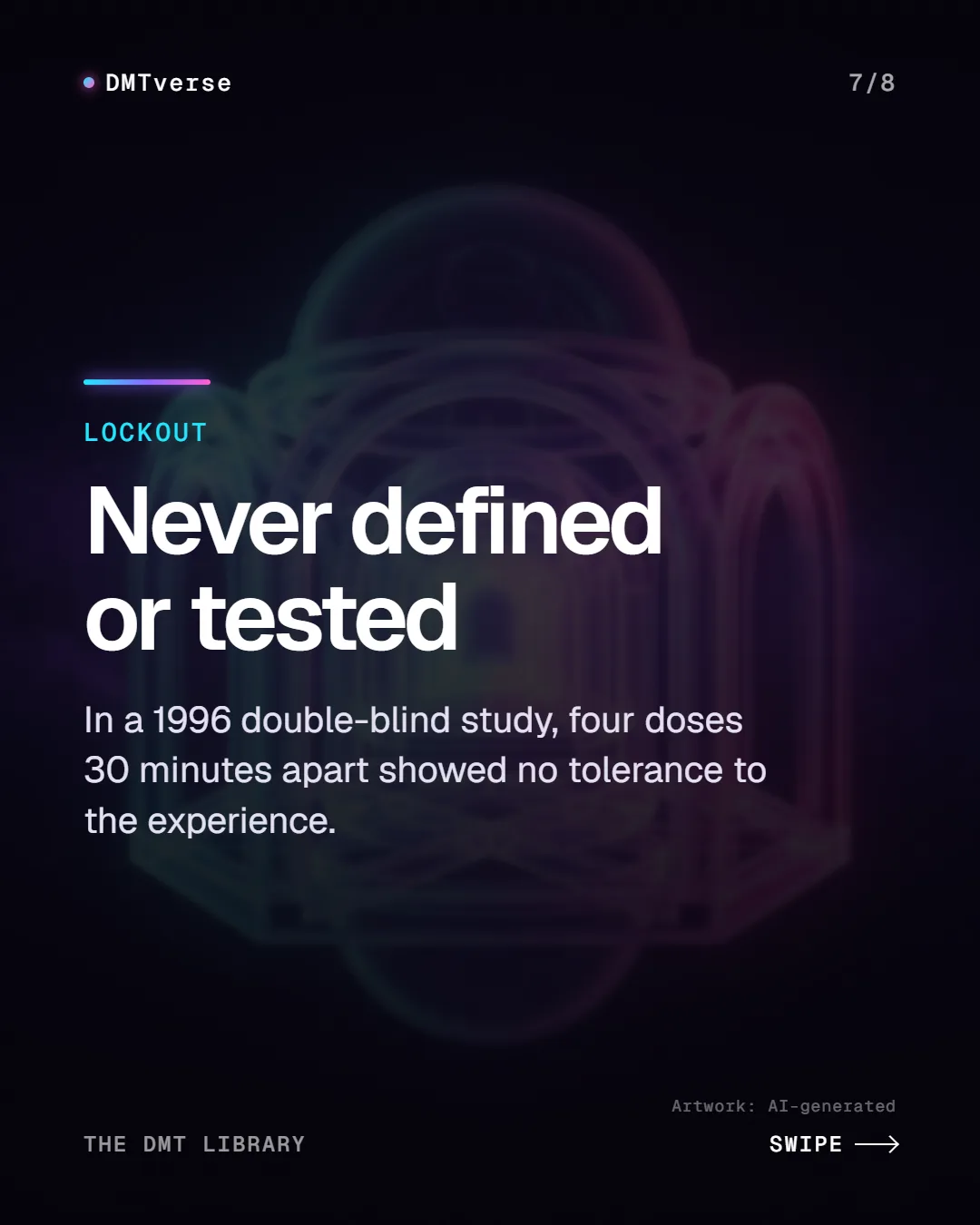
Before lab studies, field reports were, as a 1993 research update put it, “quite inconsistent regarding whether or not tolerance” occurred (MAPS Bulletin, 1993). Rick Strassman’s team then tested it. In a randomised, double-blind 1996 study, 13 experienced hallucinogen users received DMT or saline placebo four times, 30 minutes apart. Tolerance to the psychedelic effects did not occur, but responses of the stress and pituitary hormones ACTH, prolactin and cortisol, and of heart rate, decreased (Strassman et al., 1996). The body adapted; the experience did not. Evidence: preliminary; small sample.
An interim report found only a non-significant trend toward lower “Volition” scores (MAPS Bulletin, 1994), and Strassman described DMT as unique among classic hallucinogens in its inability to induce tolerance to its psychological effects (Strassman, 1996). Later infusion studies, which keep DMT continuously present, revised that picture. Evidence: preliminary.
- 1996No tolerance to subjective effects across four closely spaced doses; hormone and heart-rate responses fell.Design and sample Randomised, double-blind, placebo; 13 experienced usersSource Strassman et al., 1996
- 2016Extended infusion proposed, assuming no acute tolerance.Design and sample Pharmacokinetic modelling; no participantsSource Gallimore and Strassman, 2016
- 2023Effects stable from 30 to 90 minutes despite rising blood levels: acute tolerance.Design and sample Double-blind, placebo, crossover; 27 healthy peopleSource Vogt et al., 2023
- 2024Blood DMT rose while psychological effects plateaued.Design and sample Placebo-controlled, within-subjects; 11 healthy volunteersSource Luan et al., 2024
- 2025Moderate acute tolerance during two-hour infusions.Design and sample Double-blind, placebo, crossover; 22 healthy peopleSource Erne et al., 2025
- 2026No tolerance across repeated single doses within a session; a ceiling for peak effects.Design and sample Double-blind arm of 20 plus open-label arm of 16Source Erne et al., 2026
In Basel, continuous infusion effects plateaued and stayed stable from 30 to 90 minutes while blood levels kept rising, which the authors describe as acute tolerance (Vogt et al., 2023). A second Basel study reported moderate acute tolerance (Erne et al., 2025), and a London study found effects plateaued as blood DMT increased (Luan et al., 2024). Repeated single doses in one session again showed none (Erne et al., 2026). Rating-scale ceilings may explain part of the plateau. Evidence: preliminary; small samples of healthy volunteers.
None of these studies looked at experiences days apart, outside a hospital, or at the claim that a strong experience blocks later ones. So the research neither confirms nor rules out lockout. It does show that “DMT has no tolerance” is too simple. Evidence: unresolved for lockout.
Could expectation explain lockout?
It is one candidate. In the 2026 Basel study, identical doses were rated less intense, and were better tolerated, when given open-label in steps than when given blind; the authors point to blinding and expectancy (Erne et al., 2026). The arms were separate groups, so this is a hint, not proof. In a home field study of 36 sessions, menacing beings were the least frequent type (8%), which the authors link to participants being used to DMT and in a quiet, quasi-controlled space (Michael et al., 2021). Evidence: preliminary.
Other known features of reports could be folded into lockout and hyper-slap stories. These are possibilities to test, not explanations:
- Memory gaps. Partial amnesia was coded in 13.6% of the 3,778 reports (Lawrence et al., 2022). A poorly remembered experience can feel like one that never “arrived”.
- Anxiety at high intensity. In one infusion study, the highest level tested produced more anxious ego dissolution and significant anxiety (Erne et al., 2025).
- Shared stories. A vivid label gives people a ready-made frame for a bad experience, and earlier posts may shape later ones (Lawrence et al., 2022).
- Unknown contents. Canada’s Centre for Addiction and Mental Health (CAMH) notes that unregulated hallucinogens may contain toxins or not contain the drug they are sold as (CAMH).
Risks, and where to get help in Canada
CAMH warns that hallucinogens can leave people disoriented, with poor judgment and more likely to take risks (CAMH). A frightening experience can stay with someone afterwards; talking to a health professional is reasonable, and urgent help is available. Evidence: established.
If someone is in danger
Call 911 for immediate danger or urgent medical help, including if someone is unconscious, not breathing or having a seizure. In Ontario, the Ontario Poison Centre is at 1-800-268-9017; every province has a poison centre, listed by SickKids (AboutKidsHealth). If you or someone you know is thinking about suicide, call or text 9-8-8, 24 hours a day (Government of Canada). See also our safety page and how to help someone having a bad trip.
What we still don’t know
- Whether the order “space first, presences later” holds outside a scanner and in less experienced people (unresolved).
- How much shared vocabulary shapes the spaces people report, rather than only the words they use (unresolved).
- Whether lockout exists as a reliable pattern; no study has defined or measured it (unresolved).
- Whether tolerance to DMT’s subjective effects builds across days rather than minutes (unresolved).
- Whether the infusion plateau is receptor tolerance or a ceiling in the rating scales (unresolved).
The fair summary: hyperspace is a name for a real-feeling, widely reported kind of experience, with rooms, tunnels, voids and landscapes, and in the lab it is built up step by step. Lockout and the hyper slap are stories about that experience, not findings. For the bigger picture, start with what is DMT.
Common questions
What is DMT hyperspace?
A community name for the immersive, other-dimensional space people say they enter during a DMT experience. In 3,778 coded online reports, 17.1% used the word. It describes how the experience felt, not a place shown to exist.
What does DMT hyperspace look like?
Reports vary widely. In the 2022 coding, rooms (15.4%), tunnels (10.3%), voids (6.2%), landscapes (6.1%) and astronomical scenes (5.6%) were the most common settings. No single scene dominates.
Do people see the space or the beings first?
In a 2026 lab study of 23 people, bodily effects typically came first, then sights and sounds, then a three-dimensional space. Presences, when they appeared, came only after the space had formed.
Is the waiting room the same as hyperspace?
It is one named space within it. The waiting room appeared in 2.8% of coded reports, far fewer than the 17.1% that mentioned hyperspace. Our waiting room guide covers the vocabulary.
What is hyperspace lockout?
A community term for feeling blocked from the full experience after earlier ones. We found no published study or formal definition of it. It is an anecdote, not a research finding.
What is a DMT hyper slap?
A user term for a harsh, rejecting experience, often with entities that feel hostile. The clearest published account we found is one journalist’s first-person report from 2022. Difficult interactions appear in about 11% of coded Reddit encounters, without that label.
Does DMT have tolerance?
It depends on the design. In a 1996 double-blind study, four closely spaced doses produced no tolerance to subjective effects, though hormone and heart-rate responses fell. Later infusion studies found the experience levelled off while blood DMT kept rising, which researchers call acute tolerance.
Shroomverse sells mushroom products. This article is general information about DMT hyperspace reports, lockout folklore and tolerance research. It is not medical, legal or purchasing advice, and it does not recommend any product.
SOURCES
- Phenomenology and content of the inhaled N,N-dimethyltryptamine (N,N-DMT) experience (Lawrence DW, et al., Scientific Reports 12:8562, 2022), Springer Nature (peer-reviewed, open access); PMC9130218. Accessed . Full text read via Europe PMC. 3,778 experiences; Table 6: alternate or higher dimensions 952 (25.2%), hyperspace 646 (17.1%), rooms 582 (15.4%), waiting room 105 (2.8%), tunnels 390 (10.3%), void 233 (6.2%), landscapes 229 (6.1%), alien/fractal/golden landscape 1.2%, urban 1.0%, astronomical 212 (5.6%), light 130 (3.4%), machinery 2.1%, ancient architecture 1.9%, carnival 1.4%, pyramids 1.2%, places of worship 0.8%, hell 0.8%, domed space 0.6%, heaven 0.6%. Negative interaction 196/1,719 encounters (11.4%), menacing 92; partial amnesia 13.6%; limitation on earlier posts and recurrent labels.
- Micro-phenomenology of immersion and perceived presences under DMT (Sanders JW, Millière R, Demšar E, et al., Neuroscience of Consciousness, 2026), Oxford University Press (peer-reviewed, open access); PMC13366535. Accessed . Full text read via Europe PMC. 23 participants, IV DMT during fMRI-EEG (dose not reproduced here); immersion as a continuum from subtle to gross forms; bodily effects first, presences only after multisensory integration and 3D space; presences inhabiting a landscape 82%; 3D 91%, 2D 35%; enclosed 30%, unenclosed 17%; fractal recursion 9%; within 74%, outside 57% (portals, tunnels), liminal 17%; multiple contexts 35%; feeling of reality 26% (real 22%, unreal 9%); limitation: lab and scanner setting.
- A Model for the Application of Target-Controlled Intravenous Infusion for a Prolonged Immersive DMT Psychedelic Experience (Gallimore AR, Strassman RJ, Frontiers in Pharmacology 7:211, 2016), Frontiers (peer-reviewed, open access); PMC4944667. Accessed . Abstract read via Europe PMC. Reports summarised as complete replacement of normal experience with an “alternate universe”; modelling proposal citing lack of acute tolerance to subjective effects.
- Differential tolerance to biological and subjective effects of four closely spaced doses of N,N-dimethyltryptamine in humans (Strassman RJ, Qualls CR, Berg LM, Biological Psychiatry 39(9):784–795, 1996), Elsevier (peer-reviewed). Accessed . Abstract read via Europe PMC. 13 experienced users; four administrations 30 minutes apart on two days; randomised, double-blind; no tolerance to psychedelic effects; ACTH, prolactin, cortisol and heart rate responses decreased; blood pressure did not. Doses not reproduced.
- Human psychopharmacology of N,N-dimethyltryptamine (Strassman RJ, Behavioural Brain Research 73(1–2):121–124, 1996), Elsevier (peer-reviewed). Accessed . Abstract read via Europe PMC. DMT unique among classic hallucinogens in its inability to induce tolerance to its psychological effects.
- DMT Research: Latest Findings (MAPS Bulletin 4(2), Summer 1993), Multidisciplinary Association for Psychedelic Studies. Accessed . Page read. Unsigned research update on the University of New Mexico DMT programme: field reports “quite inconsistent regarding whether or not tolerance” occurred. Not peer reviewed.
- DMT Research Update, Spring 1994 (MAPS Bulletin 4(4)), Multidisciplinary Association for Psychedelic Studies. Accessed . Page read. HRS data showed no tolerance apart from a non-significant trend toward lower Volition scores. Not peer reviewed; doses not reproduced.
- Acute effects of intravenous DMT in a randomized placebo-controlled study in healthy participants (Vogt SB, et al., Translational Psychiatry 13:172, 2023), Springer Nature (peer-reviewed, open access); PMC10206108. Accessed . Abstract read via Europe PMC. 27 participants, double-blind crossover; infusion effects plateaued after 30 minutes and were stable to 90 minutes despite rising plasma levels (acute tolerance).
- Psychological and physiological effects of extended DMT (Luan LX, et al., Journal of Psychopharmacology 38(1):56–67, 2024), SAGE (peer-reviewed, open access); PMC10851633. Accessed . Abstract read via Europe PMC. 11 healthy volunteers, within-subjects, placebo-controlled; plasma DMT rose while psychological effects plateaued.
- Acute dose-dependent effects and self-guided titration of continuous N,N-dimethyltryptamine infusions (Erne L, et al., Neuropsychopharmacology 50(6):1008–1016, 2025), Springer Nature (peer-reviewed); PMC12032411. Accessed . Abstract read via Europe PMC. 22 participants, double-blind crossover, 120-minute infusions; plateau after 30 minutes; moderate acute tolerance; highest rate produced more anxious ego dissolution and significant anxiety.
- Dose-dependent pharmacokinetics and acute effects of intravenous bolus N,N-dimethyltryptamine: double-blind, randomized versus open-label dose-escalation (Erne L, et al., Translational Psychiatry 16:213, 2026), Springer Nature (peer-reviewed, open access); PMC13039932. Accessed . Abstract read via Europe PMC. 20 blinded plus 16 open-label participants; no tolerance to acute effects; ceiling for peak effects; equivalent doses less intense and better tolerated open-label.
- An Encounter With the Other: A Thematic and Content Analysis of DMT Experiences From a Naturalistic Field Study (Michael P, Luke D, Robinson O, Frontiers in Psychology 12:720717, 2021), Frontiers (peer-reviewed, open access); PMC8716686. Accessed . Full text read via Europe PMC. 36 post-experience interviews; menacing beings 8%, least frequent, which the authors attribute most likely to participants being accustomed to DMT and in a quasi-controlled space among quiet researchers.
- Survey of entity encounter experiences occasioned by inhaled N,N-dimethyltryptamine (Davis AK, et al., Journal of Psychopharmacology 34(9):1008–1020, 2020), SAGE (peer-reviewed). Accessed . Abstract read via Europe PMC. 2,561 self-selected respondents; 41% reported fear during the encounter.
- Feature on DMT (Hebrew; title translated: “This is the strangest, most confusing and most fascinating psychedelic drug”), 6 January 2022, Time Out Tel Aviv. Accessed . Page read in machine translation. Journalist’s first-person account of a “hyper slap” after a period of frequent use (entities seemed to attack him; he cut back for a long time) and a friend’s different account. Anecdote only; frequency details not reproduced.
- Hallucinogens, Centre for Addiction and Mental Health (CAMH). Accessed . Page read. Unregulated hallucinogens may include toxins or not contain the drug they are sold as; disorientation, poor judgment, risk-taking.
- Mental health support: get help, Government of Canada, Public Health Agency of Canada. Accessed . Page read. Call 9-1-1 in immediate danger; call or text 9-8-8, 24 hours a day, 7 days a week.
- Poison information centres in Canada, AboutKidsHealth, The Hospital for Sick Children (SickKids). Accessed . Page read. Ontario toll-free 1-800-268-9017; call 911 if someone is unconscious, not breathing or having a seizure.
CHANGES
- : Linked glossary definitions.
- : Published. Absorbs the former article on hyperspace lockout and the hyper slap (now the lockout section). All sources opened and checked on this date.



