THE SHROOMVERSE JOURNAL ✳ 11 MIN READ
Ayahuasca vs magic mushrooms: a brew and a fungus, compared
Topic: DMT
Published Updated
Listen: the 3-minute version
AI-narrated summary of this article
Short answer, checked 21 October 2026
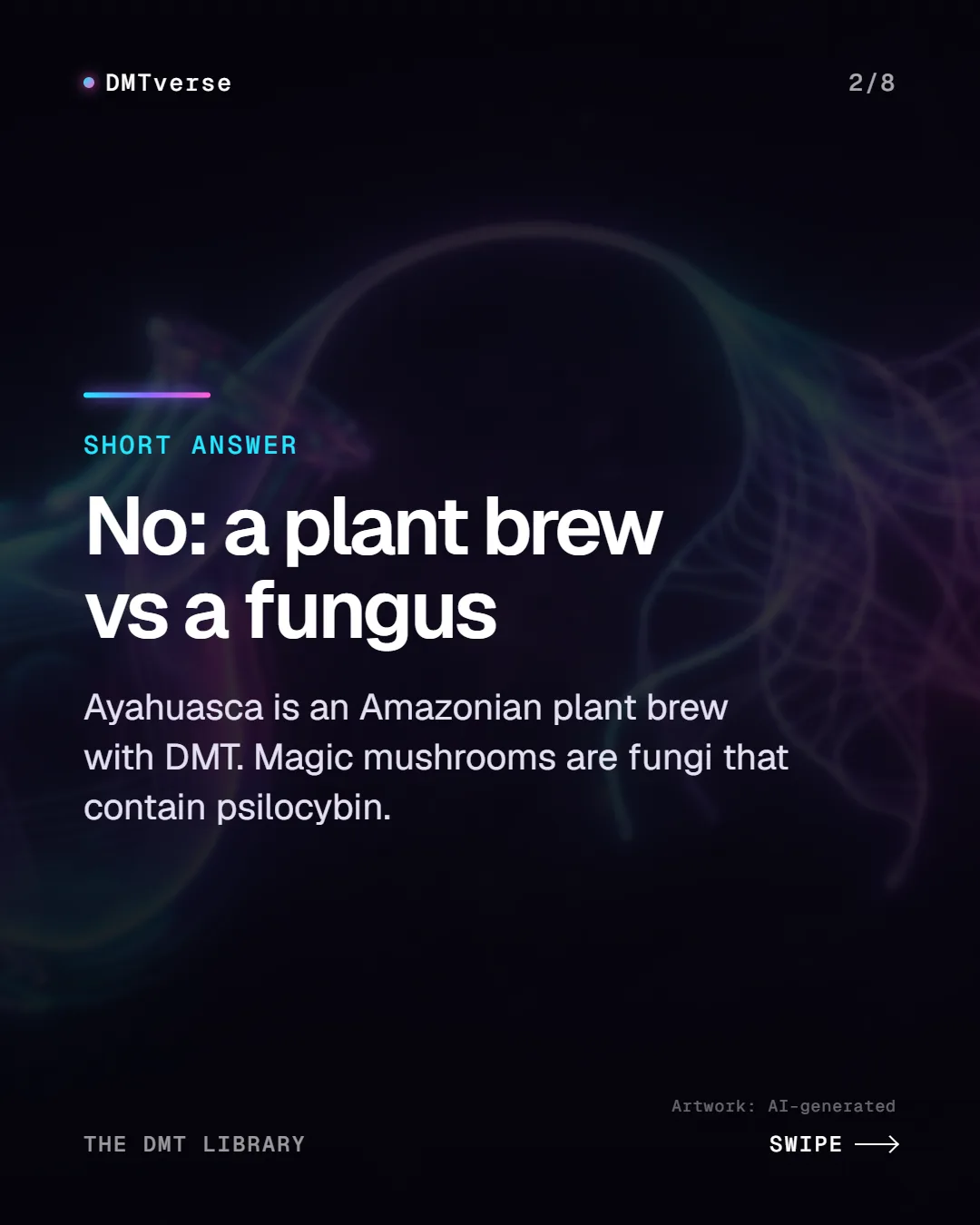
Ayahuasca vs mushrooms: ayahuasca is an Amazonian plant brew, not a mushroom. It contains DMT plus β-carbolines, compounds that block the enzyme MAO-A. Magic mushrooms are fungi that contain psilocybin. In studies, ayahuasca’s effects peaked after about 1.5 to 2 hours, and psilocybin’s lasted about 6 hours on average. Both have been tested for depression in early-stage trials, which are not proof. The brew’s MAO inhibition creates specific interaction risks. In Canada, DMT, harmaline, psilocybin and psilocin are all in Schedule III.
THE SHORT VERSION · SWIPE
On this page 10 sections
People comparing ayahuasca and mushrooms are often asking which is which, and whether they are related. They are not the same kind of thing: one is a brew made from plants, the other is a fungus. This page compares what each contains, how long effects lasted in studies, what the clinical research found, their religious histories, their risks and Canadian law.
Education only, not guidance
This compares published research and Canadian law. It gives no amounts, no preparation details, no ways of taking anything and no advice on combining substances, and it does not rank either as better for anyone. Evidence labels used below: established (shown in peer-reviewed studies and not seriously disputed), preliminary (early, small or indirect) and unresolved (an open question). In an emergency, call 911.
Ayahuasca vs mushrooms: how do they compare at a glance?
The table sums up what studies have measured. Each row is explained, with sources, below.
| Ayahuasca | Magic mushrooms | |
|---|---|---|
| What it is | An Amazonian plant brew. | Fungi. |
| Main active compounds | DMT plus β-carbolines (harmine, harmaline, tetrahydroharmine). | Psilocybin, which the body converts to psilocin. |
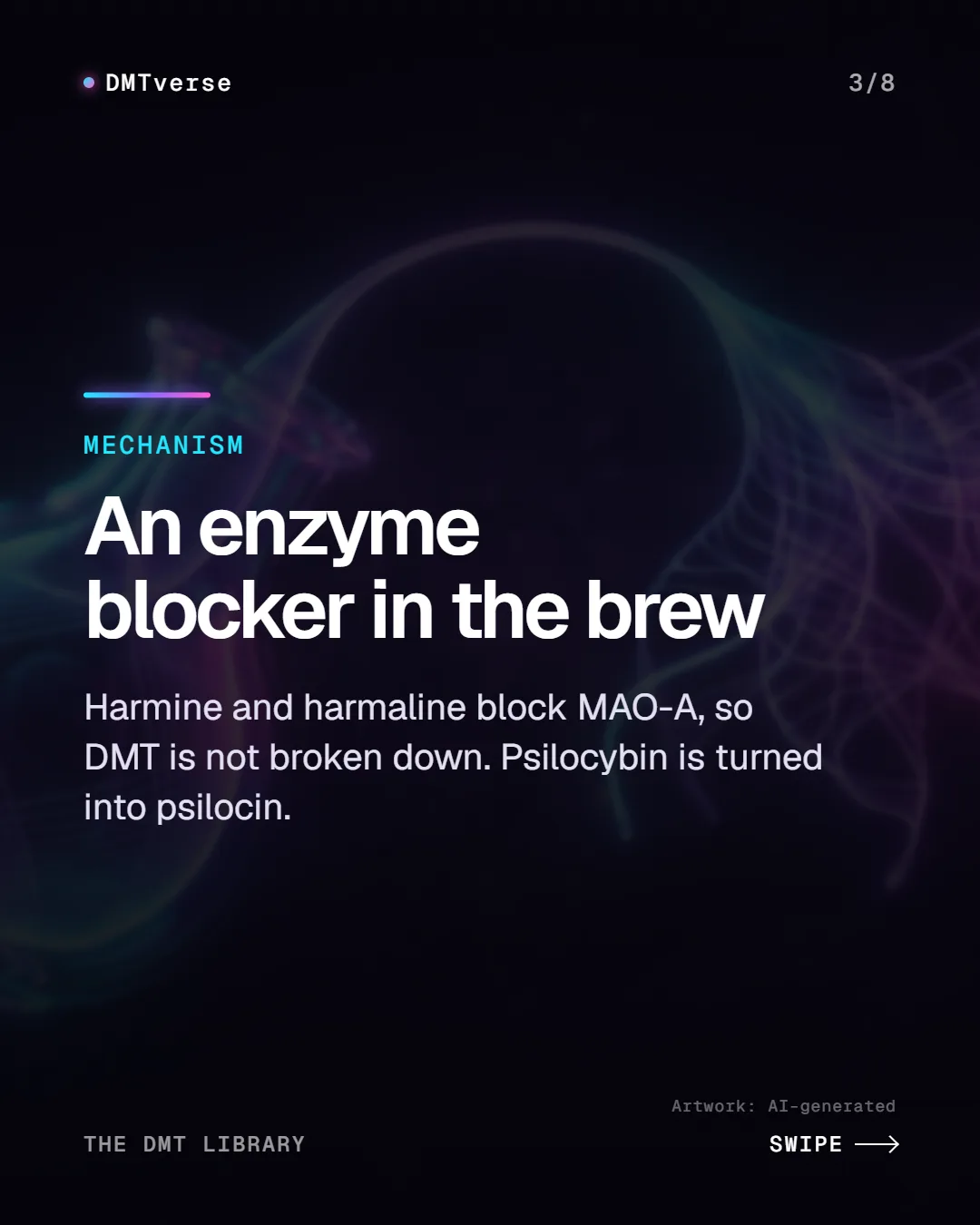
| Why it works when swallowed | Harmine and harmaline block MAO-A, so DMT is not broken down first. | Psilocybin is a prodrug: the body turns it into the active psilocin. |
| Timing in studies | Peak at about 1.5 to 2 hours; effects around 4 hours, per trial authors. | Effects lasted about 5.6 to 6.5 hours on average in one trial. |
| Main depression trial | One placebo-controlled trial of 29 people. | Several trials, including one of 233 people. |
| Religious history | Brazilian syncretic churches, such as the UDV. | The Mazatec velada in Oaxaca, Mexico. |
| Canada (CDSA) | DMT (item 7) and harmaline (item 9) in Schedule III. | Psilocin (item 11) and psilocybin (item 12) in Schedule III. |
Is ayahuasca a mushroom?
No. Ayahuasca is an Amazonian psychoactive plant beverage. It contains DMT (N,N-dimethyltryptamine), which acts on the serotonin 5-HT2A receptor, together with alkaloids that inhibit the enzyme monoamine oxidase (MAO) and so make it active when swallowed (Bouso et al., 2012). No fungus is involved. For the brew’s history and research, see what is ayahuasca. Evidence: established.
Magic mushrooms are fungi. A review notes that fungi, particularly mushrooms, are the main natural source of psychedelics, and that psilocybin is considered a prodrug of psilocin: the body converts it into the compound that acts (Lowe et al., 2021). Mushrooms do not contain N,N-DMT; see is there DMT in magic mushrooms? and what are magic mushrooms. Evidence: established.
Ayahuasca vs psilocybin: how does each one work?
DMT taken by mouth on its own is broken down before it can act; a placebo-controlled study calls it “orally labile”. In ayahuasca, the β-carbolines harmine, harmaline and tetrahydroharmine inhibit MAO (Riba et al., 2003). A pharmacokinetic study adds that harmine and harmaline reversibly inhibit MAO-A, while tetrahydroharmine weakly inhibits serotonin uptake (Callaway et al., 1999). Our MAO article explains the enzyme. Evidence: established in outline.
Psilocybin needs no helper. The body removes its phosphate group to make psilocin (Lowe et al., 2021). Both psilocin and DMT are tryptamines that act mainly at the serotonin 5-HT2A receptor; for that shared chemistry, see psilocybin, LSD and DMT. The practical difference is that ayahuasca brings MAO inhibitors with it, and those change how the body handles other drugs. Evidence: established.
How long do ayahuasca and mushrooms last in studies?
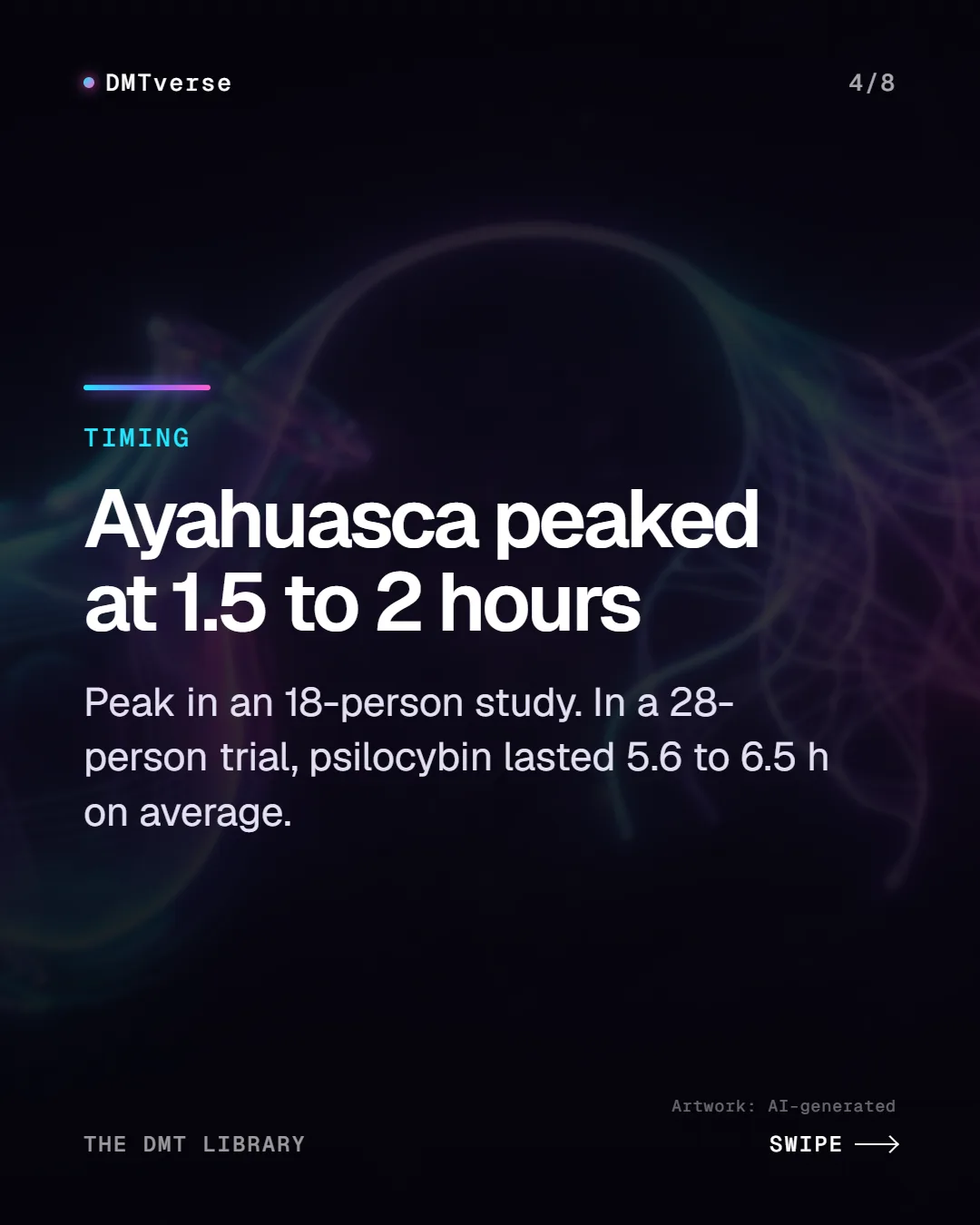
In a double-blind, placebo-controlled study of 18 volunteers with previous psychedelic experience, ayahuasca’s effects peaked between 1.5 and 2 hours, matching the peak of DMT in the blood (Riba et al., 2003). A study of 15 volunteers in a ceremonial setting found an average DMT peak of about 107 minutes (Callaway et al., 1999). The authors of the depression trial describe the acute psychological effects as lasting “around 4 h” (Palhano-Fontes et al., 2019). Evidence: established for the broad time course.
For psilocybin, a double-blind crossover trial of 28 healthy volunteers measured effects lasting about 5.6 to 6.5 hours on average, depending on the amount given (dose not reproduced here), with individual times from about 2.5 to 12 hours (Holze et al., 2022). These are averages from screened volunteers, not a prediction or guide. More detail is in how long does ayahuasca last and how long do magic mushrooms last. Evidence: established for healthy volunteers.
What does depression research show for each?
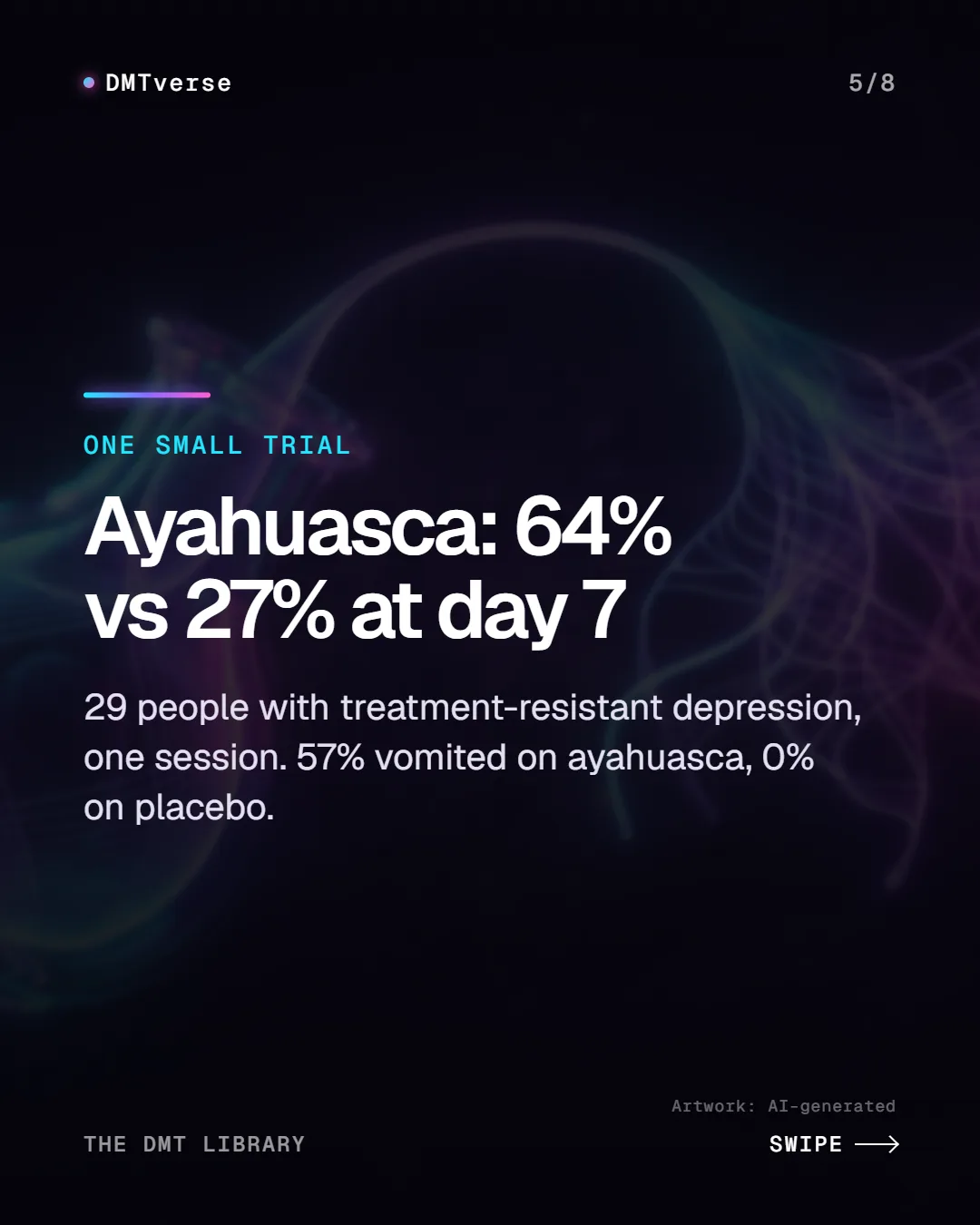
Ayahuasca has one randomised, placebo-controlled depression trial. In 29 people with treatment-resistant depression (depression that has not improved with standard treatments), one session of ayahuasca was followed by lower scores than placebo on a clinician-rated scale at days 1, 2 and 7. At day 7, 64% responded on ayahuasca against 27% on placebo; remission was 36% against 7%, just short of statistical significance (Palhano-Fontes et al., 2019). Evidence: preliminary.
The same trial shows the costs. Vomiting occurred in 57% on ayahuasca and 0% on placebo, and nausea in 71% against 26%. The authors note that vomiting is traditionally seen as part of a purging process rather than a side effect, and that for some the session came with much psychological distress (Palhano-Fontes et al., 2019). One small trial, followed for a week, is a signal, not proof. Evidence: preliminary.
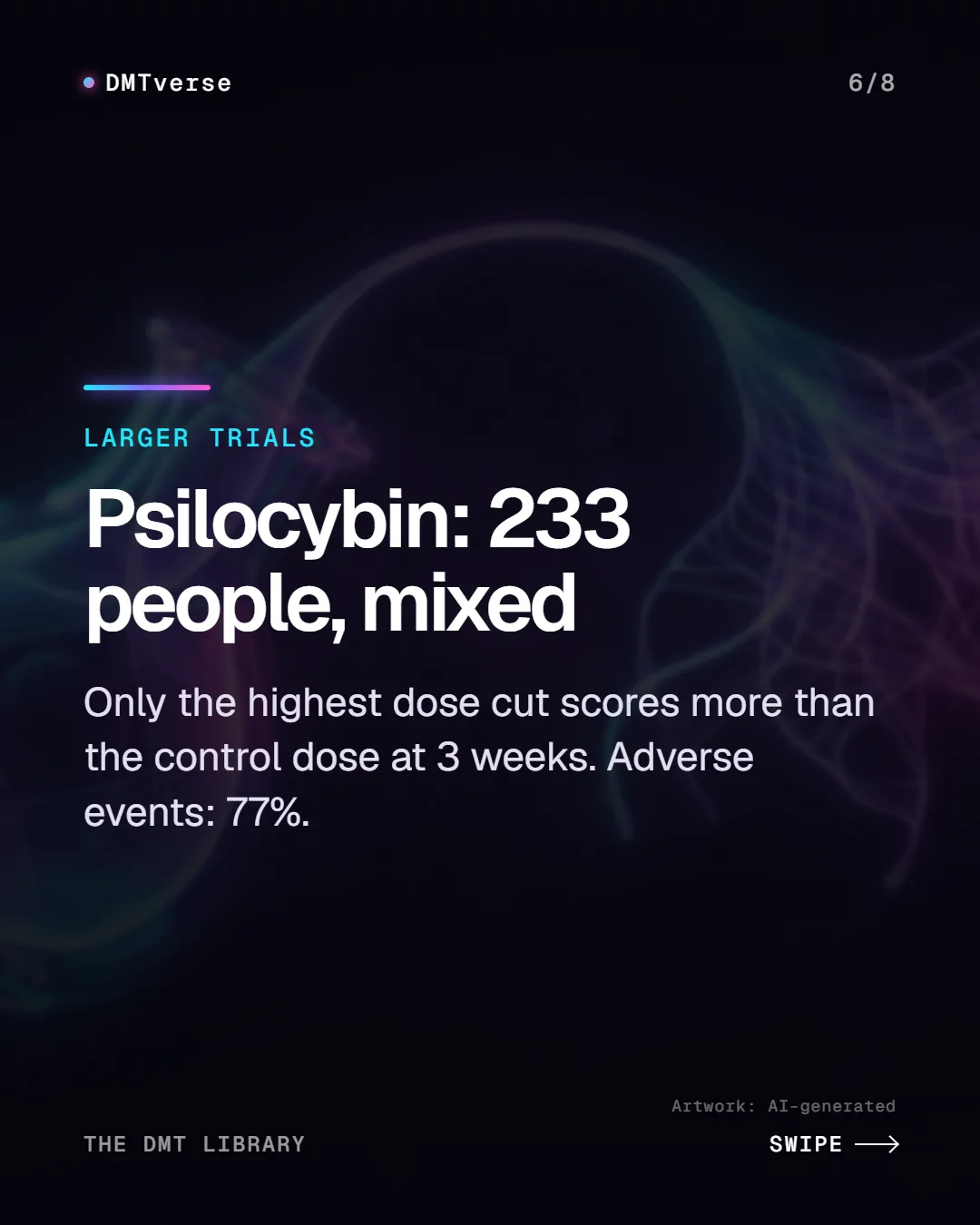
Psilocybin has larger trials. In a phase 2 trial of 233 adults with treatment-resistant depression, the highest of three single doses reduced depression scores more than the lowest, control dose at 3 weeks, and the middle dose did not. Adverse events occurred in 77% of participants, and suicidal ideation, suicidal behaviour or self-injury occurred in all groups (Goodwin et al., 2022). The authors say larger and longer trials are needed. Evidence: preliminary.
Another trial compared psilocybin with escitalopram, a standard SSRI antidepressant, in 59 people over 6 weeks. The difference on the main depression measure was not statistically significant (Carhart-Harris et al., 2021). For the full picture, see ayahuasca: what research shows and psilocybin: what research shows. Evidence: preliminary.
How have ayahuasca and mushrooms been used in religion?
Ayahuasca drinking is central to several Brazilian syncretic churches (churches that blend Christian and other traditions), which have spread to cities in Brazil, Europe and North America; members typically take part at least twice a month (Bouso et al., 2012). For the two best-known churches, see Santo Daime and the UDV. In 2006 the US Supreme Court ruled on the UDV’s sacramental use of hoasca, which it described as a tea that contains DMT (Gonzales v. O Centro Espírita, 2006). That is US law. Evidence: established.
Mushrooms have their own long history among Indigenous peoples of Mexico and elsewhere; an annotated bibliography gathers 49 texts on these practices (Spiers et al., 2024). The best-known is the Mazatec velada, a night vigil. In 1955 the banker R. Gordon Wasson and the photographer Allan Richardson took part in one led by the Mazatec healer María Sabina in Huautla, Oaxaca (García de Teresa, 2022). See María Sabina. Evidence: established.
These are living religious and cultural practices. We describe their history, not how to take part, and neither tradition is a guide for anyone outside it.
What are the risks and drug interactions?
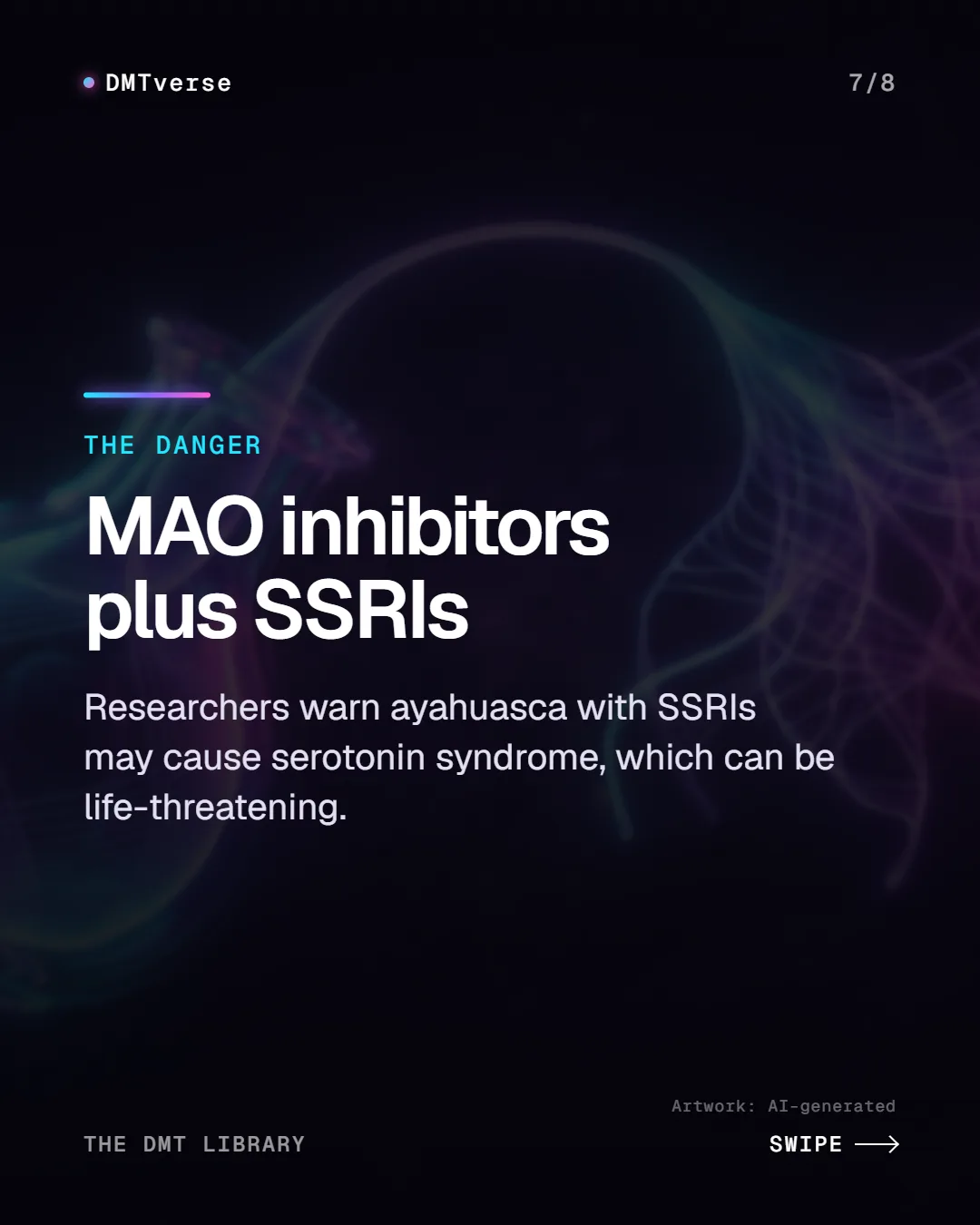
The biggest difference in risk is the MAO inhibition. Researchers warn that combining ayahuasca’s MAO-inhibiting harmala alkaloids with SSRI antidepressants “may induce a serotonin syndrome with potentially grave outcome” (Callaway and Grob, 1998). Serotonin syndrome is a dangerous excess of serotonin activity. A 2024 review adds a theoretical risk with tyramine, a substance in some foods, and describes case reports of serotonin syndrome with psychiatric drugs as extremely rare, with no confirmed cases (White et al., 2024). Evidence: established for the mechanism; unresolved for how often it happens.
That review also found animal studies at high amounts showing harm to pregnancy, and the most problems in lab models with harmaline; it notes these may not carry over to people (White et al., 2024). Psilocybin trials report their own adverse events, listed above (Goodwin et al., 2022). For psilocybin and medication, see magic mushrooms and antidepressants. Do not stop or change prescribed medication on your own; talk to a prescriber or pharmacist. Evidence: preliminary.
Ayahuasca and mushrooms together
Taking ayahuasca and magic mushrooms together has not been studied in any trial we found, so nothing is known about its safety. Because ayahuasca contains MAO inhibitors, it is a risk, not a combination with a known profile. If someone is unwell, use the help lines below.
If someone is in danger
Call 911 for immediate danger or urgent medical help, including if someone is unconscious, not breathing or having a seizure. In Ontario, the Ontario Poison Centre is at 1-800-268-9017; every province has a poison centre, listed by SickKids (AboutKidsHealth). If you or someone you know is thinking about suicide, call or text 9-8-8, 24 hours a day (Government of Canada). See also our safety page and how to help someone having a bad trip.
Are ayahuasca and magic mushrooms legal in Canada?
Both are controlled through their ingredients. The Controlled Drugs and Substances Act (CDSA) lists DMT as item 7 and harmaline as item 9 of Schedule III, and psilocin and psilocybin as items 11 and 12. The consolidation we read was current to 30 September 2026 (Justice Laws, CDSA). Except as authorised under the regulations, the Act prohibits possessing or producing a Schedule III substance, and it prohibits trafficking in one. Evidence: established.
Section 56 of the Act lets the Minister of Health grant exemptions for medical, scientific or public-interest purposes (Justice Laws, CDSA), the route reported for a few ayahuasca churches; we cover that history in ayahuasca vs DMT. For mushrooms, see are magic mushrooms legal in Canada?. This is general information, not legal advice. Evidence: established for the text of section 56.
What we still don’t know
- How the two compare in the same people. We found no study that tested ayahuasca and psilocybin side by side (unresolved).
- Whether either has lasting effects on depression. Ayahuasca’s trial had 29 people and one week of follow-up; psilocybin trials are larger but mixed (preliminary).
- How common serious interactions with ayahuasca are. The mechanism is clear, confirmed cases are not (unresolved).
- Effects in people the trials leave out, such as those with heart disease, psychiatric histories or pregnancy (unresolved).
The honest summary: ayahuasca is a plant brew built around DMT and MAO inhibitors; magic mushrooms are fungi built around psilocybin. They differ in timing, research record, religious history and, through the MAO inhibitors, in interaction risk. For the DMT side, start with what is DMT.
Common questions
Is ayahuasca a mushroom?
No. Ayahuasca is an Amazonian brew made from plants. It contains DMT plus β-carbolines such as harmine and harmaline, which block the enzyme MAO-A. Magic mushrooms are fungi that contain psilocybin, a different compound.
What is the difference between ayahuasca and psilocybin?
Ayahuasca’s main psychedelic is DMT, made active by MAO-inhibiting alkaloids in the brew. Psilocybin is a mushroom compound that the body converts to psilocin. Both act mainly at the serotonin 5-HT2A receptor, but they differ in timing, research record and interaction risks.
Which lasts longer, ayahuasca or mushrooms?
In studies, ayahuasca peaked after about 1.5 to 2 hours, and trial authors describe effects lasting around 4 hours. In one trial, psilocybin effects lasted about 5.6 to 6.5 hours on average. These are averages from screened volunteers, not predictions.
Ayahuasca or mushrooms for depression: what does research say?
Both have only early evidence. One placebo-controlled ayahuasca trial of 29 people found lower depression scores at one week. Psilocybin trials are larger, with mixed results and common adverse events. This is not medical advice.
Can you take ayahuasca and mushrooms together?
This has not been studied, so its safety is unknown, and ayahuasca’s MAO inhibitors make it a risk. In an emergency in Canada, call 911. In Ontario, the Ontario Poison Centre is at 1-800-268-9017, and 9-8-8 is the suicide crisis line.
Is it dangerous to take ayahuasca with antidepressants?
Researchers warn it can be. Ayahuasca’s MAO-inhibiting alkaloids combined with SSRIs may cause serotonin syndrome, which can be life-threatening. Do not stop or change prescribed medication on your own; talk to a prescriber or pharmacist.
Are ayahuasca and magic mushrooms legal in Canada?
No, as a rule. DMT and harmaline (in ayahuasca) and psilocybin and psilocin (in mushrooms) are all Schedule III substances under the CDSA. A few religious groups have reportedly received section 56 exemptions for ayahuasca. This is general information, not legal advice.
Shroomverse sells mushroom products. This article is general information about ayahuasca and magic mushroom research and Canadian law. It is not medical, legal or purchasing advice, and it does not recommend any product.
SOURCES
- Personality, psychopathology, life attitudes and neuropsychological performance among ritual users of Ayahuasca: a longitudinal study (Bouso JC, et al., PLoS ONE 7(8):e42421, 2012), PLOS (peer-reviewed, open access); PMC3414465. Accessed . Abstract read (via Europe PMC). Supports ayahuasca as an Amazonian plant beverage containing DMT and MAO-inhibiting alkaloids that make it orally active, and the spread and frequency of Brazilian syncretic church ceremonies.
- Human pharmacology of ayahuasca: subjective and cardiovascular effects, monoamine metabolite excretion, and pharmacokinetics (Riba J, et al., Journal of Pharmacology and Experimental Therapeutics 306(1):73–83, 2003), American Society for Pharmacology and Experimental Therapeutics (peer-reviewed). Accessed . Abstract read (via Europe PMC). Supports DMT as “orally labile”, the MAO-inhibiting β-carbolines, 18 experienced volunteers, peak effects at 1.5 to 2 hours and the DMT blood peak coinciding with peak effects. Doses not reproduced.
- Pharmacokinetics of Hoasca alkaloids in healthy humans (Callaway JC, et al., Journal of Ethnopharmacology 65(3):243–256, 1999), Elsevier (peer-reviewed). Accessed . Abstract read (via Europe PMC). Supports harmine and harmaline as reversible MAO-A inhibitors, tetrahydroharmine as a weak serotonin uptake inhibitor, 15 volunteers in a ceremonial context and the average DMT peak of about 107 minutes.
- The Therapeutic Potential of Psilocybin (Lowe H, et al., Molecules 26(10):2948, 2021), MDPI (peer-reviewed, open access); full text via PubMed Central, PMC8156539. Accessed . Abstract and full text read. Cited only for chemistry: fungi, particularly mushrooms, as the principal natural source of psychedelics, and psilocybin as a prodrug to psilocin.
- Direct comparison of the acute effects of lysergic acid diethylamide and psilocybin in a double-blind placebo-controlled study in healthy subjects (Holze F, et al., Neuropsychopharmacology 47(6):1180–1187, 2022), Springer Nature (peer-reviewed, open access); full text via PubMed Central, PMC9018810. Accessed . Abstract and full text (Table 1) read. Supports 28 healthy volunteers and psilocybin effect durations of 5.6 and 6.5 hours on average, with ranges of about 2.5 to 12 hours. Doses not reproduced.
- Rapid antidepressant effects of the psychedelic ayahuasca in treatment-resistant depression: a randomized placebo-controlled trial (Palhano-Fontes F, et al., Psychological Medicine 49(4):655–663, 2019), Cambridge University Press (peer-reviewed); full text via PubMed Central, PMC6378413. Accessed . Abstract and full text read. Supports 29 patients, lower MADRS scores at days 1, 2 and 7, response 64% vs 27% and remission 36% vs 7% at day 7, nausea and vomiting rates, the purging remark, distress, and the “around 4 h” duration. Doses not reproduced.
- Single-Dose Psilocybin for a Treatment-Resistant Episode of Major Depression (Goodwin GM, et al., New England Journal of Medicine 387(18):1637–1648, 2022), Massachusetts Medical Society (peer-reviewed). Accessed . Abstract read (via Europe PMC). Supports 233 participants in a phase 2 trial, the highest dose but not the middle dose reducing depression scores more than the control dose at 3 weeks, adverse events in 77%, suicidal ideation, behaviour or self-injury in all groups, and the call for larger, longer trials. Doses not reproduced.
- Trial of Psilocybin versus Escitalopram for Depression (Carhart-Harris R, et al., New England Journal of Medicine 384(15):1402–1411, 2021), Massachusetts Medical Society (peer-reviewed). Accessed . Abstract read (via Europe PMC). Supports 59 patients over 6 weeks and the non-significant difference on the primary outcome (QIDS-SR-16). Doses not reproduced.
- Ayahuasca preparations and serotonin reuptake inhibitors: a potential combination for severe adverse interactions (Callaway JC, Grob CS, Journal of Psychoactive Drugs 30(4):367–369, 1998), Taylor & Francis (peer-reviewed). Accessed . Abstract read (via Europe PMC). Source for the quoted warning about SSRIs and serotonin syndrome.
- Ayahuasca and Dimethyltryptamine Adverse Events and Toxicity Analysis: A Systematic Thematic Review (White E, et al., International Journal of Toxicology 43(3):327–339, 2024), SAGE (peer-reviewed); full text via PubMed Central, PMC11088222. Accessed . Abstract and full text read. Supports the theoretical tyramine risk, extremely rare serotonin syndrome case studies with no confirmed cases, animal pregnancy findings at high amounts, harmaline’s preclinical problems, and the caution that animal findings may not carry over.
- Gonzales v. O Centro Espírita Beneficente União do Vegetal, No. 04-1084 (US Supreme Court, 21 February 2006), syllabus, Legal Information Institute, Cornell Law School. Accessed . Syllabus read. Supports the decision date and the description of hoasca as a tea that contains DMT, used by UDV members as communion.
- Selling the Priceless Mushroom: A History of Psilocybin Mushroom Trade in the Sierra Mazateca (Oaxaca) (García de Teresa M, Journal of Illicit Economies and Development 4(2), 2022), LSE Press (peer-reviewed, open access). Accessed . Full text read on the journal page. Cited only for the 1955 velada in Huautla led by María Sabina, attended by Wasson and Richardson.
- Indigenous psilocybin mushroom practices: An annotated bibliography (Spiers N, et al., Journal of Psychedelic Studies 8(1):3–25, 2024), Akadémiai Kiadó (peer-reviewed). Accessed . Crossref record and abstract read. Supports the 49 texts on psilocybin mushroom practices of Indigenous peoples, in Mexico and other regions.
- Controlled Drugs and Substances Act (S.C. 1996, c. 19), current to 30 September 2026, Government of Canada, Justice Laws Website. Accessed . Full text read. Supports Schedule III items 7 (DMT), 9 (harmaline), 11 (psilocin) and 12 (psilocybin), the possession, trafficking and production provisions (sections 4, 5 and 7) and the section 56 exemption power.
- Get help with mental health, Government of Canada. Accessed . Page read. Supports calling 9-1-1 in an emergency and calling or texting 9-8-8, 24 hours a day, 7 days a week.
- Poison information centres in Canada, AboutKidsHealth (The Hospital for Sick Children). Accessed . Page read. Supports the Ontario Poison Centre toll-free number 1-800-268-9017 and the list of provincial poison centres.
CHANGES
- : Published. Sources opened and checked on this date, including the CDSA consolidation current to 30 September 2026.
- : Editorial review: summary now answers “is ayahuasca a mushroom?” in its first sentence and no longer calls the 233-person psilocybin trial small; serotonin-syndrome wording made clearer; evidence label added to the section 56 paragraph. Re-checked today: Palhano-Fontes 2019, Riba 2003, Callaway 1999, Goodwin 2022, Bouso 2012 and White 2024 abstracts, Holze 2022 Table 1, the Spiers 2024 Crossref record, and CDSA Schedule III items 7, 9, 11 and 12.
- : Added source links beside figures and legal statements.



