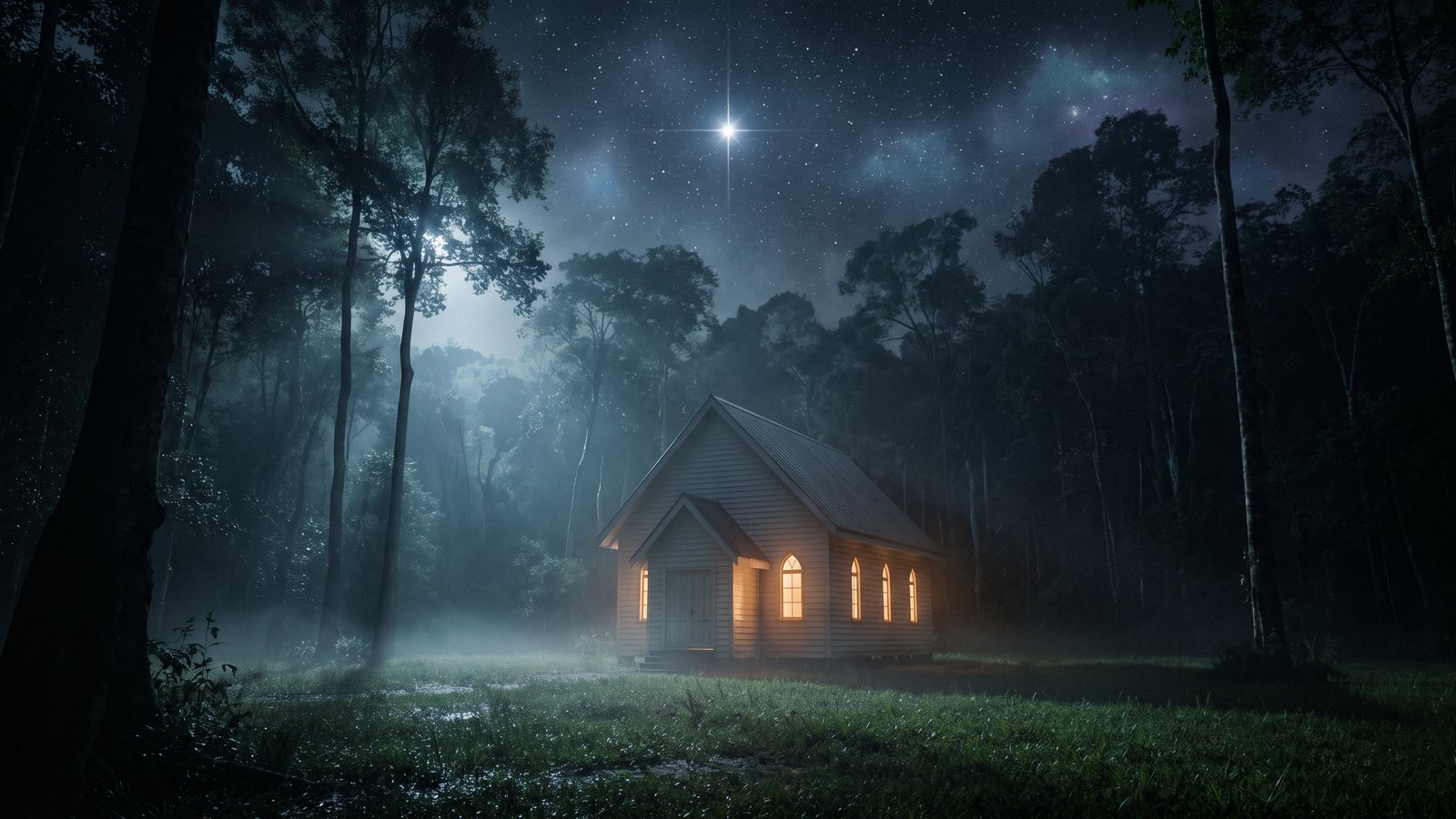
THE SHROOMVERSE JOURNAL ✳ 16 MIN READ
Santo Daime and the União do Vegetal: the ayahuasca churches, their beliefs and the court cases
Topic: DMT
Published Updated
Short answer, checked 20 October 2026
Santo Daime and the União do Vegetal (UDV) are Brazilian religions that use ayahuasca, a tea containing DMT, as a sacrament. Santo Daime was founded in the 1930s by Raimundo Irineu Serra and blends Catholic, Indigenous Amazonian and African elements; the UDV was founded on 22 July 1961 by José Gabriel da Costa and describes itself as a Christian Spiritist religion. Brazil regulates religious ayahuasca use through a 2010 resolution. In the United States, the Supreme Court’s unanimous 2006 ruling in Gonzales v. O Centro was a narrow, preliminary-stage decision about one church under a religious-freedom statute, and a 2009 Oregon ruling extended similar protection to a Santo Daime church. In Canada, a few groups have reportedly held section 56 exemptions since 2017. None of this makes ayahuasca legal for anyone else.
THE SHORT VERSION · SWIPE
On this page 10 sections
Most people meet ayahuasca through retreat tourism, but some of its longest-running organised use outside the Amazon happens in churches. Two Brazilian religions, Santo Daime and the União do Vegetal, have carried their sacrament from the rubber-tapping frontier to cities in Brazil, Europe and North America, and into the highest courts of the United States. This article covers who founded them, what they believe, how the law has treated them, and what that does and does not mean.
General information, not legal advice
This article describes religious history and court decisions. It is not legal advice and does not describe how to obtain, prepare or use any substance. DMT is a controlled substance in Canada, and a court decision or exemption for one group does not authorise anyone else. Evidence labels used below: established (documented in court records or official text and not disputed), preliminary (reported by one source or not officially confirmed) and unresolved (an open question).
What are the Brazilian ayahuasca churches?
A 2023 review of ayahuasca’s history says that in the 1930s ayahuasca entered urban Brazil within religious contexts, that by the 1980s it had reached international cities, and that syncretic churches such as Santo Daime, Barquinha and the União do Vegetal incorporated it into their traditions (Ruffell et al., 2023). A 2012 study of church members describes these groups as having expanded to urban Brazil, Europe and North America, with members typically taking part in ceremonies at least twice a month (Bouso et al., 2012). Evidence: established.
The sacrament is a tea made from Amazonian plants. The US Supreme Court described the UDV’s version, hoasca, as “a tea brewed from plants unique to the Amazon Rainforest that contains DMT” (Gonzales v. O Centro, 2006). An Oregon federal court found that the UDV’s hoasca and Santo Daime’s Daime tea are the same drink under different names (Church of the Holy Light of the Queen v. Mukasey, 2009). We do not name the plants here. For what the brew is, see what is ayahuasca; for how it differs from DMT on its own, see ayahuasca vs DMT. Evidence: established.
What is Santo Daime? History and beliefs
Santo Daime’s founder, Raimundo Irineu Serra, known as Mestre Irineu, was an Afro-Brazilian rubber tapper and guard in the Amazon region of northern Brazil (Mukasey, 2009). According to the church’s own account, as recorded by an Oregon federal court in 2009, he learned about ayahuasca from a shaman. Evidence: established as recorded by the court.
In that account he had visions of a woman calling herself the Queen of the Forest, whom he later identified as the Virgin Mary; she told him to found a religion with ayahuasca as its sacrament and to call it Daime, Portuguese for “give me”, as in prayers asking for light, strength or wisdom (Mukasey, 2009). A Santo Daime church leader writing in 2017 dates the founding to the 1930s (Chacruna, 2017). Evidence: established as the church’s own history; the visions are religious tradition.
The same court described Santo Daime as syncretic, blending Catholicism with Indigenous Amazonian and African beliefs. Its followers regard the tea as the blood of Christ, comparable to Communion wine, and as a holy being in itself; its hymns constitute church doctrine; and the tea is taken at all services (Mukasey, 2009). The 2017 church leader’s account adds European Kardecist Spiritism and, in some urban centres, Eastern traditions (Chacruna, 2017). Evidence: established as descriptions of belief, not claims about the tea’s effects.
After Mestre Irineu died in 1971, the movement split. One branch was started in 1974 by Sebastião Mota de Melo, known as Padrinho Sebastião, and on his death in 1990 was led by his son, Alfredo Gregório de Melo; it opened churches in the United States, Japan and Europe. Its head office was then known as CEFLURIS (Mukasey, 2009), and the 2017 account says it is now known as ICEFLU (Chacruna, 2017). Evidence: established.
What is the União do Vegetal (UDV)?
The UDV’s founder, José Gabriel da Costa, known as Mestre Gabriel, was born on 10 February 1922 in Bahia. According to the UDV’s official biography, he went to the Amazon in 1944 as a “rubber soldier” in Brazil’s wartime rubber drive, worked in rubber forests in Acre, Rondônia and Bolivia, first encountered the tea in April 1959, and created the União do Vegetal on 22 July 1961, continuing to serve the tea with ritual and doctrine (UDV, official biography). Evidence: established as the organisation’s own account.
The UDV’s US branch describes it as a Christian Spiritist religion that originated in Brazil, practised by about 25,000 people in 11 countries. Its name means “the union of the plants”, and members drink the tea, which they call hoasca, as a sacrament meant to heighten spiritual understanding and bring them closer to God (UDV USA). The Oregon court noted that the UDV differs from Santo Daime in doctrine and practice and that hoasca is taken only during church ceremonies (Mukasey, 2009). Evidence: membership figures are the organisation’s own and preliminary; the rest is established as self-description.
| Santo Daime | União do Vegetal (UDV) | |
|---|---|---|
| Founder | Raimundo Irineu Serra (Mestre Irineu) | José Gabriel da Costa (Mestre Gabriel) |
| Founded | 1930s, in the Brazilian Amazon | 22 July 1961, in the Amazon rubber-tapping region |
| Self-description | Syncretic: Catholic, Indigenous Amazonian and African elements | Christian Spiritist |
| Name of the tea | Daime (Portuguese for “give me”) | Hoasca |
| Teaching carried in | Hymns, which constitute doctrine | Ritual and doctrine set by the founder |
| Key US case | Church of the Holy Light of the Queen v. Mukasey (D. Or. 2009) | Gonzales v. O Centro Espírita (US Supreme Court, 2006) |
How does Brazil regulate religious ayahuasca use?
Brazil recognised the churches first. The Oregon court recorded that the Brazilian government, after studying Santo Daime and its members, recognised it as a legitimate religion and permits sacramental use, and also recognised the UDV (Mukasey, 2009). Evidence: established as recorded by the court.
A September 2026 analysis for the Chacruna Institute explains that a multidisciplinary working group of Brazil’s National Council on Drug Policy (CONAD) signed its final report on 23 November 2006, reaffirming the legitimacy of religious use on grounds of freedom of religion; that its framework, including no commercial purpose and self-regulation by the churches, was incorporated into CONAD Resolution No. 1/2010; and that DMT itself remained subject to drug laws (Chacruna, 2026). Evidence: established.
That settlement is being reopened. On 2 September 2026, Brazil’s Federal Public Prosecutor’s Office in Acre recommended that CONAD and the health regulator Anvisa set up working groups to revisit the regulation of ayahuasca and DMT, this time explicitly including Indigenous peoples alongside religious groups (Chacruna, 2026). Evidence: established that the recommendations were issued; their outcome is unresolved.
Gonzales v. O Centro (2006): what the Supreme Court decided
After US Customs seized a shipment of hoasca bound for the American UDV and threatened prosecution, the church sued under the Religious Freedom Restoration Act (RFRA), a federal statute that bars the government from substantially burdening religious exercise unless it shows a compelling interest pursued by the least restrictive means (Gonzales v. O Centro, 2006). Evidence: established.
At a preliminary-injunction hearing the government conceded the burden on a sincere religious practice but argued it had three compelling interests: members’ health, preventing diversion to recreational users, and a 1971 UN drug convention. The district court found the evidence on health and diversion evenly balanced, and the appeals court agreed (Gonzales v. O Centro, 2006). Evidence: established.
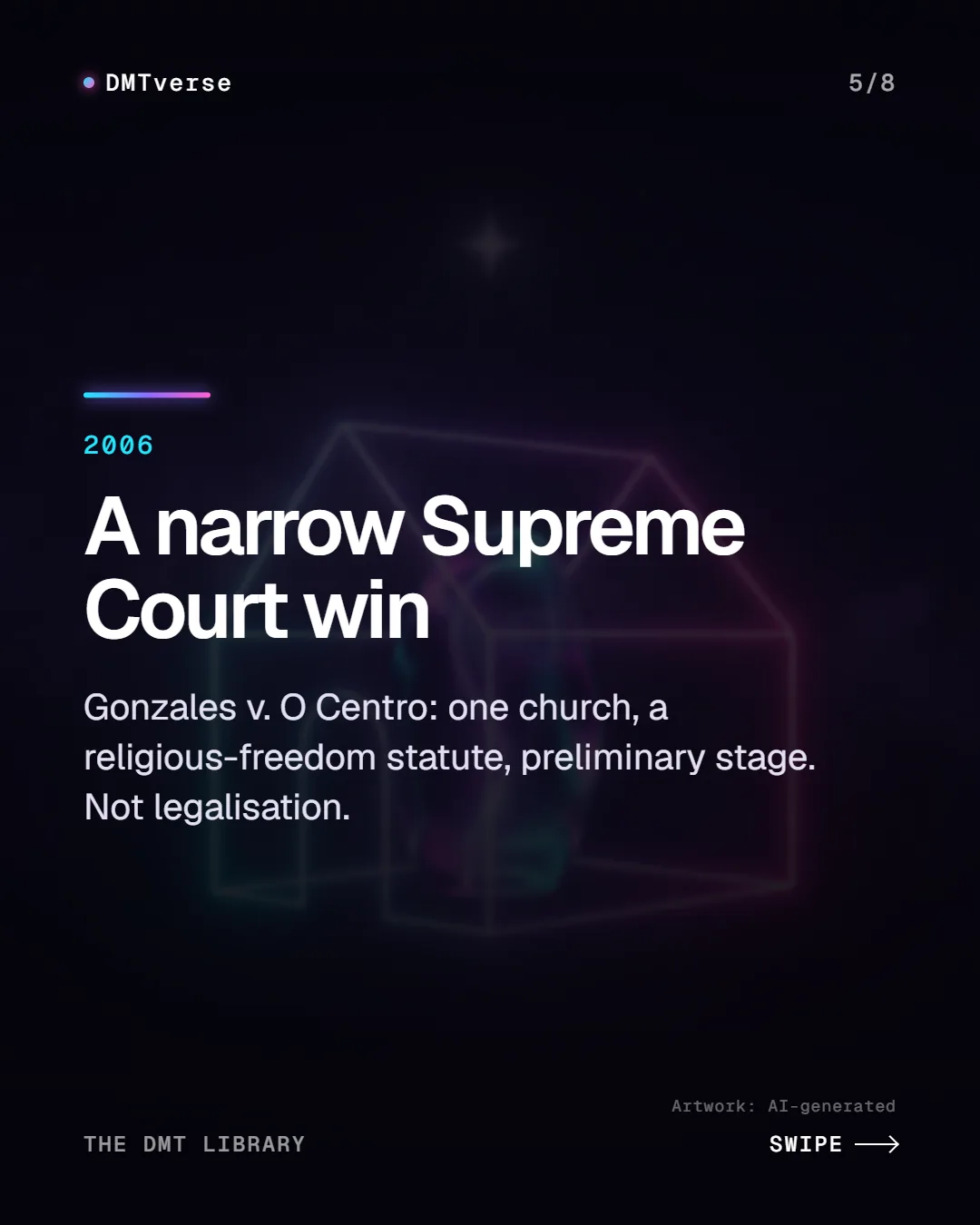
On 21 February 2006 the Supreme Court held that the lower courts did not err in finding that the government had failed to show, at the preliminary-injunction stage, a compelling interest in barring the UDV’s sacramental use. It pointed to the long-standing exemption for Native American religious use of peyote, which contains another Schedule I substance, and noted the UDV had about 130 American members. Chief Justice Roberts wrote for all participating justices; Justice Alito took no part (Gonzales v. O Centro, 2006). Evidence: established.
What Gonzales did not decide
It did not make ayahuasca or DMT legal in the United States. It was a ruling under a federal statute, not the First Amendment; it concerned one church; and it was decided at the preliminary-injunction stage, on whether the government had met its burden of proof so far (Gonzales v. O Centro, 2006). It is US law and does not apply in Canada.
Church of the Holy Light of the Queen v. Mukasey (2009)
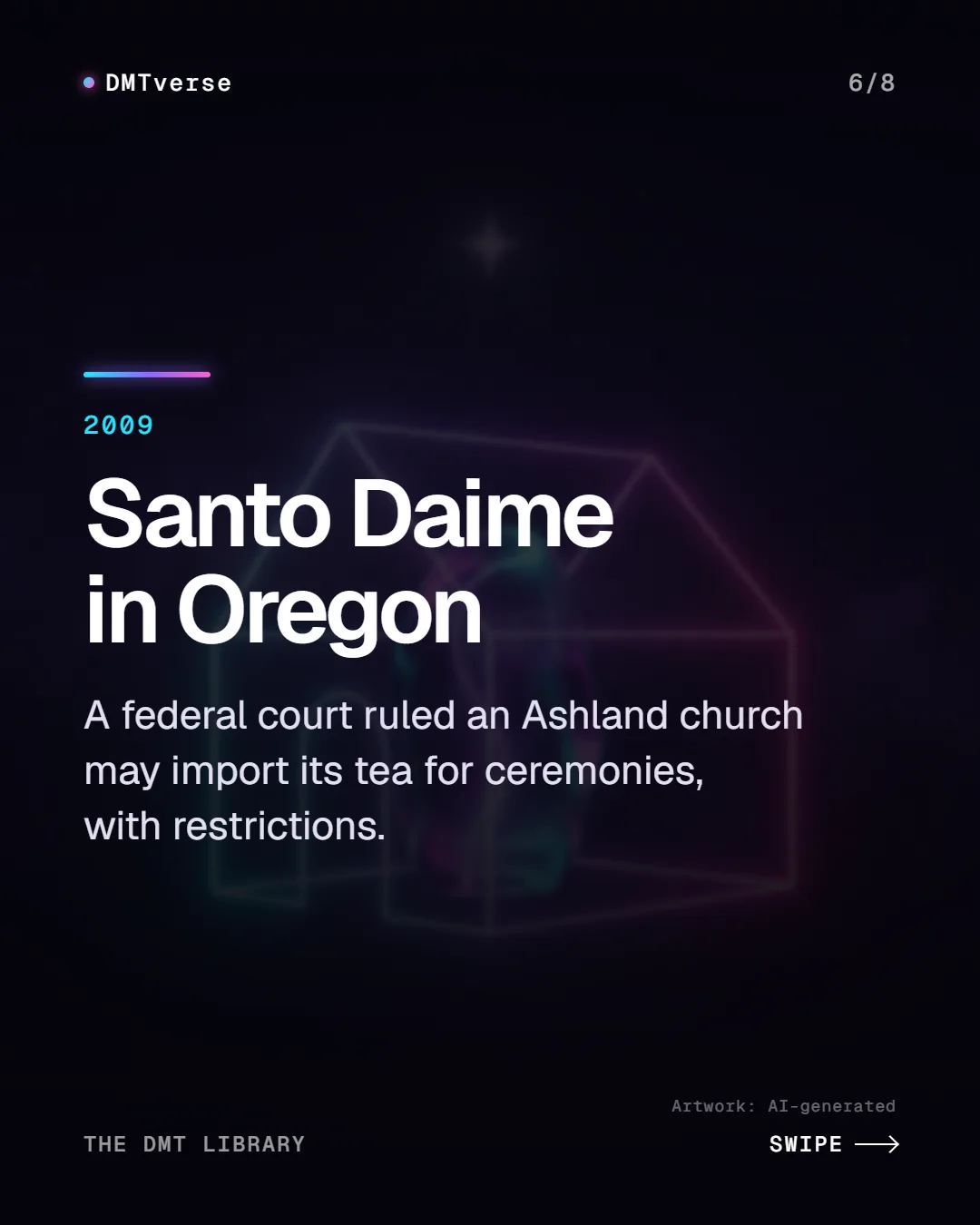
Santo Daime followed. The Church of the Holy Light of the Queen in Ashland, Oregon, founded in 1993 with authorisation from the Brazilian mother church, sued after federal agents seized a shipment of Daime tea in 1999. After a trial, District Judge Panner ruled on 18 March 2009 that, guided by the Supreme Court’s UDV decision, RFRA required that the plaintiffs be allowed to import and drink Daime tea for their religious ceremonies, subject to reasonable restrictions (Mukasey, 2009). Evidence: established.
The judge found that the government had not shown that outright prohibition was the least restrictive means, that it had presented no evidence of diversion, and that diversion was best handled through rules on storage and inventory (Mukasey, 2009). Evidence: established.
The government appealed only the scope of the order. In 2011 the Ninth Circuit, in an unpublished memorandum, vacated the injunction as too broad, because it reached regulations the church had never challenged, and sent the case back with instructions to limit it to the court’s actual holding: that the government had not justified prohibiting outright the church’s importation of Daime tea solely for use at church ceremonies (Church of the Holy Light of the Queen v. Holder, 2011). Evidence: established.
Can ayahuasca churches get a section 56 exemption in Canada?
In Canada, DMT is item 7 of Schedule III of the Controlled Drugs and Substances Act, so possessing or providing it is an offence unless the regulations or an exemption authorize it. Section 56 lets the Minister of Health exempt a person, class of persons or substance from the Act if the Minister considers it necessary for a medical or scientific purpose or otherwise in the public interest; religious use is not named but falls under that general wording (Justice Laws, CDSA). The consolidation we read on 20 October 2026 was current to 30 September 2026. Evidence: established.
The founder of Montreal’s Santo Daime church Céu do Montréal wrote in 2017 that the church had worked with Health Canada’s Office of Controlled Substances since 2001, that an exemption granted in 2006 could not be issued without Brazilian export permission, that the Health Minister refused the request in 2012, and that in June 2017, applying alongside the UDV, the church received a section 56 exemption valid for two years and renewable (Chacruna, 2017). Evidence: preliminary (a participant’s account).
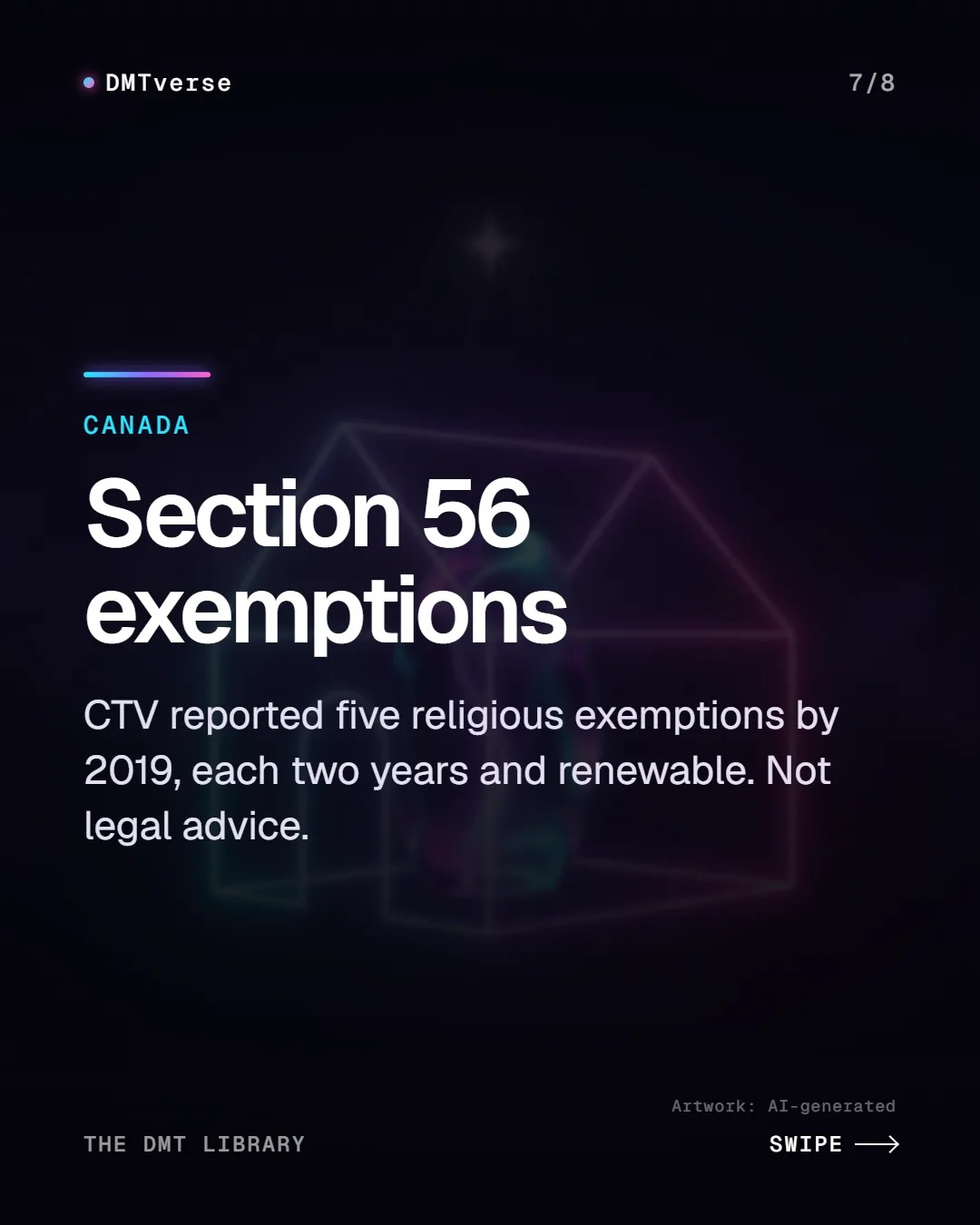
In May 2019 CTV News reported that Health Canada had by then granted five exemptions: two in Montreal in 2017 (Céu do Montréal and a UDV centre) and three in 2018 (a second Montreal church, one in Val-David, Quebec, and Céu de Toronto), each valid for two years and renewable. A Health Canada spokesperson told CTV that the exemptions let designated members possess, provide, transport, import, administer and destroy Daime tea for their religious practice, subject to conditions, and that the details are confidential (CTV News, 2019). Evidence: preliminary. This history is reported by a participant and a news outlet; we found no official Health Canada list confirming it or saying which exemptions are in force today.
The official record does confirm the process exists. A 2024 report by the Information Commissioner of Canada, on a complaint about delays in releasing records, describes an application for a religious exemption to serve ayahuasca under section 56 that Health Canada said was still under review and could set a precedent for future applications (Information Commissioner of Canada, 2024). For the wider legal picture, see is DMT legal in Canada?. This is general information, not legal advice. Evidence: established for the pending application in the report.
- 22 Jul 1961José Gabriel da Costa creates the União do Vegetal.Source UDV official biography
- 1971Mestre Irineu dies; Santo Daime later divides into branches.Source Mukasey, 2009
- 1999Federal agents seize Daime tea in Oregon and hoasca from a UDV church in New Mexico.Source Mukasey, 2009
- 21 Feb 2006US Supreme Court decides Gonzales v. O Centro.Source Cornell LII
- 23 Nov 2006CONAD working group signs its final report on religious ayahuasca use in Brazil.Source Chacruna, 2026
- 18 Mar 2009Oregon federal court rules for the Church of the Holy Light of the Queen.Source Mukasey, 2009
- 2010CONAD Resolution No. 1/2010 incorporates the religious-use framework.Source Chacruna, 2026
- 18 Jul 2011Ninth Circuit vacates the Oregon injunction as overbroad and remands.Source Holder, 2011
- Jun 2017Céu do Montréal reports receiving a section 56 exemption in Canada.Source Chacruna, 2017
- May 2019CTV reports five Canadian exemptions granted since 2017.Source CTV News, 2019
- 2 Sep 2026Brazil’s federal prosecutors recommend reopening ayahuasca and DMT regulation.Source Chacruna, 2026
Is church ayahuasca use safe? What courts and studies say
Courts have weighed health evidence without settling it. In the UDV case the lower courts found the evidence on health risks evenly balanced, which was enough for the church at that stage because the government carried the burden of proof (Gonzales v. O Centro, 2006). The Oregon court found the government had presented no evidence that the tea is addictive or causes long-term harm, while the plaintiffs’ own experts cautioned that larger, more rigorous studies were needed (Mukasey, 2009). Evidence: established for what the courts found.
A 2012 longitudinal study of 127 regular church users and 115 members of other religions found no signs of the psychopathology or cognitive deficits sometimes assumed, but it was observational and cannot separate the tea from community and religious life (Bouso et al., 2012). Evidence: preliminary. None of this makes ayahuasca safe for everyone, and our ayahuasca vs DMT guide covers known risks and interactions.
If someone is in danger
Call 911 for immediate danger or urgent medical help, including if someone is unconscious, not breathing or having a seizure. In Ontario, the Ontario Poison Centre is at 1-800-268-9017; every province has a poison centre, listed by SickKids (AboutKidsHealth). If you or someone you know is thinking about suicide, call or text 9-8-8, 24 hours a day (Government of Canada). See also our safety page.
What we still don’t know
- Which Canadian religious exemptions are in force today and on what terms; Health Canada does not publish a list we could find (unresolved).
- How Brazil will respond to the 2026 prosecutors’ recommendations (unresolved).
- Whether the health findings in long-term church members reflect the tea, the community or who chooses to join; existing studies are observational (unresolved).
The fair summary: Santo Daime and the UDV are established religions with documented histories, and they have won narrow, group-specific legal protection in Brazil, the United States and, reportedly, Canada. For the chemistry behind the sacrament, start with what is DMT; for the much older archaeological record, see ancient DMT: what the archaeology shows.
Common questions
What is Santo Daime?
A Brazilian religion founded in the 1930s by Raimundo Irineu Serra, known as Mestre Irineu. It blends Catholic, Indigenous Amazonian and African elements, teaches through hymns, and uses ayahuasca, which it calls Daime, as a sacrament regarded as the blood of Christ.
What is the União do Vegetal (UDV)?
A Christian Spiritist religion founded in Brazil on 22 July 1961 by José Gabriel da Costa, known as Mestre Gabriel. Its members drink a tea called hoasca as a sacrament. Its US branch says about 25,000 people in 11 countries practise it.
What did Gonzales v. O Centro decide?
In 2006 the US Supreme Court unanimously upheld a preliminary injunction for the UDV, because the government had not shown, at that stage, a compelling interest in barring the church’s sacramental use under the Religious Freedom Restoration Act. It did not make ayahuasca legal in the US.
What happened in Church of the Holy Light of the Queen v. Mukasey?
In 2009 an Oregon federal court ruled that RFRA required that a Santo Daime church be allowed to import and drink its sacramental tea for ceremonies, subject to reasonable restrictions. In 2011 the Ninth Circuit narrowed the injunction to that holding.
Is ayahuasca legal for churches in Canada?
Only for groups holding a section 56 exemption from the Minister of Health. News and participant accounts report that Santo Daime and UDV groups received exemptions from 2017, valid for two years and renewable; we found no official list confirming which are in force. An exemption usually covers only the person or group named in it. This is not legal advice.
Is Santo Daime legal in Brazil?
Brazil recognises the religious use of ayahuasca. A 2006 national working group report was incorporated into CONAD Resolution No. 1/2010. In September 2026, federal prosecutors recommended reopening the regulation of ayahuasca and DMT.
Does a church exemption make DMT legal for others?
No. In both the US cases and the Canadian exemptions, protection applies to a specific group’s ceremonial use. DMT remains a controlled substance for everyone else.
Shroomverse sells mushroom products. This article is general information about the history, beliefs and legal cases of the Santo Daime and União do Vegetal churches. It is not medical, legal or purchasing advice, and it does not recommend any product.
SOURCES
- Gonzales v. O Centro Espírita Beneficente União do Vegetal, 546 U.S. 418 (2006), No. 04-1084, syllabus, Supreme Court of the United States, via Legal Information Institute, Cornell Law School. Accessed . Syllabus read. Supports the hoasca description, the Customs seizure, the RFRA test, the government’s three asserted interests, evidentiary equipoise, the holding at the preliminary-injunction stage, the peyote comparison, about 130 American UDV members, decision date 21 February 2006, and Roberts writing for all members except Alito, who took no part.
- Church of the Holy Light of the Queen v. Mukasey, 615 F. Supp. 2d 1210 (D. Or. 2009), findings of fact and conclusions of law, US District Court, District of Oregon, via the Caselaw Access Project (Harvard Law School Library). Accessed . Full opinion read (decided 18 March 2009, Judge Panner). Supports Santo Daime’s history as recorded by the court (Irineu, Queen of the Forest, meaning of Daime, 1971 death, 1974 branch, CEFLURIS), beliefs, Brazilian recognition, UDV founded 1961 and its tea being the same drink, the 1999 seizure, the RFRA holding and reasoning on diversion and least restrictive means, and the absence of evidence of addiction or long-term harm. Amounts and church members’ names deliberately not reproduced.
- Church of the Holy Light of the Queen v. Holder, 443 F. App’x 302 (9th Cir. 2011), memorandum, US Court of Appeals for the Ninth Circuit, via the Caselaw Access Project (Harvard Law School Library). Accessed . Full memorandum read (18 July 2011, unpublished, not precedent). Supports that the government challenged only the injunction’s scope, and that it was vacated as overbroad and remanded to be limited to the outright prohibition on importing Daime tea for church ceremonies.
- From the Sertão to the Amazon (biography of Mestre Gabriel), Centro Espírita Beneficente União do Vegetal (official website). Accessed . Read. The organisation’s own account: born 10 February 1922 in Bahia; rubber soldier from 1944; work in Acre, Rondônia and Bolivia; first contact with the tea in April 1959; UDV created 22 July 1961.
- União do Vegetal (home page), UDV USA (official website). Accessed . Read. Self-description as a Christian Spiritist religion; about 25,000 people in 11 countries; meaning of the name; hoasca as a sacrament.
- Ayahuasca: A review of historical, pharmacological, and therapeutic aspects (Ruffell SGD, et al.; PCN Reports 2(4):e146, 2023), Wiley (peer-reviewed, open access); full text via Europe PMC, PMC11114307. Accessed . Full text read (history section cited). Supports 1930s urban religious introduction in Brazil, international spread by the 1980s, and Santo Daime, Barquinha and UDV as syncretic churches.
- Personality, psychopathology, life attitudes and neuropsychological performance among ritual users of Ayahuasca: a longitudinal study (Bouso JC, et al.; PLoS One 7(8):e42421, 2012), PLOS (peer-reviewed, open access); PMC3414465. Accessed . Abstract read via Europe PMC. Brazilian syncretic churches expanded to urban Brazil, Europe and North America; members typically attend at least twice a month; 127 regular users vs 115 controls from other religions, assessed at baseline and one year. Observational.
- Between Protection and Control: Federal Public Prosecutor’s Office Reignites the Debate on Ayahuasca Regulation in Brazil (Henrique Fernandes Antunes, 11 September 2026), Chacruna Institute for Psychedelic Plant Medicines. Accessed . Full article read. Supports the 2 September 2026 MPF Recommendations Nos. 4 and 5 to CONAD and Anvisa; the CONAD working group report of 23 November 2006; CONAD Resolution No. 1/2010; DMT remaining subject to drug laws.
- How Our Santo Daime Church Received Religious Exemption to Use Ayahuasca in Canada (17 July 2017), Chacruna Institute for Psychedelic Plant Medicines. Accessed . Full article read; written by the founder of Céu do Montréal, so a participant’s account. Supports founding in the 1930s by Mestre Irineu; syncretic elements; work with Health Canada since 2001; 2006 exemption pending Brazilian export permission; 2012 refusal; June 2017 section 56 exemption alongside the UDV, two years, renewable; CEFLURIS now ICEFLU.
- Health Canada allows more religious groups to import psychedelic ayahuasca (Cillian O’Brien, 8 May 2019), CTV News. Accessed . Article body read from the page’s structured data. Supports five exemptions (two in Montreal in 2017; Ceu da Divina Luz do Montreal in May 2018, a Val-David church in December 2018 and Ceu de Toronto in November 2018), two-year renewable terms, the spokesperson’s list of authorised activities, and confidentiality of details.
- Health Canada (Re), 2024 OIC 10, Office of the Information Commissioner of Canada. Accessed . Report read. Supports a religious exemption application to serve ayahuasca under section 56, under review at the time, which Health Canada said could set a precedent.
- Controlled Drugs and Substances Act (S.C. 1996, c. 19), Schedule III and section 56, Government of Canada, Justice Laws Website. Accessed . Consolidation current to 2026-09-30; section 56(1) re-read 24 October 2026 (it can exempt a person, a class of persons or a substance). Schedule III item 7, N,N-dimethyltryptamine (DMT); section 56(1) exemptions for a medical or scientific purpose or otherwise in the public interest.
- Mental health support: get help, Government of Canada, Public Health Agency of Canada. Accessed . Source for calling 9-1-1 in immediate danger or for urgent medical support, and the 9-8-8 Suicide Crisis Helpline (call or text, 24/7).
- Poison information centres in Canada, AboutKidsHealth, The Hospital for Sick Children (SickKids). Accessed . Source for the provincial poison centre list, including Ontario toll-free 1-800-268-9017.
CHANGES
- : Linked glossary definitions.
- : Published. All sources opened and checked on this date, including both Holy Light of the Queen decisions and the CDSA consolidation current to 30 September 2026.
- : Editorial review: split long paragraphs (founder, Brazil, RFRA, Oregon ruling, Canada, health); removed the unsourced plant count; stated what Schedule III means; added evidence labels and a link to the ayahuasca explainer.
- : Narrowed “an exemption covers only its holder”: section 56(1) lets the Minister exempt a person, a class of persons or a substance, so an exemption usually covers only the person or group named in it. Checked against the CDSA text on 24 October 2026.



