THE SHROOMVERSE JOURNAL ✳ 11 MIN READ
Psilocin vs psilocybin: what is the difference, and why does it matter?
Topic: Psilocybin research
Published Updated
Listen: the 3-minute version
AI-narrated summary of this article
Short answer, checked 10 October 2026
Psilocin vs psilocybin is a difference of one chemical group between two closely related molecules found in magic mushrooms: psilocybin carries a phosphate, and psilocin has a hydroxyl in its place. In the body, psilocybin is primarily a prodrug, converted to psilocin by alkaline phosphatase, and psilocin is the form that acts on 5-HT2A serotonin receptors. In Canada both are listed separately in Schedule III of the Controlled Drugs and Substances Act.
On this page 9 sections
Psilocin vs psilocybin is a question that comes up because both names appear on the same pages, often as if they were interchangeable. This guide sets out what each term means, how the two relate in the body and in the mushroom, and why the distinction matters. Health Canada names two active ingredients in magic mushrooms: “chemicals called psilocybin and psilocin” (Health Canada). They are not the same molecule, and they do not play the same role. Psilocybin is what the mushroom mostly holds. Psilocin is what the body makes from it, and it is the compound that reaches the receptors.
This article is about the chemistry and pharmacology only. It is not a guide to using, finding, growing or preparing anything, and it gives no dosing information. For the wider picture, start with what are magic mushrooms and what is psilocybin.
What is psilocin?
Psilocin is the compound from magic mushrooms that acts in the body. The Controlled Drugs and Substances Act describes it chemically as 3-[2-(dimethylamino)ethyl]-4-hydroxyindole (CDSA). Magic mushrooms contain psilocybin as well, and the body converts psilocybin to psilocin by removing a phosphate group; psilocin is the form that acts on serotonin 2A (5-HT2A) receptors (Dinis-Oliveira, 2017). It is also the molecule behind the blue bruising of these mushrooms, because its hydroxyl group is the part that oxidizes (Lenz et al., 2020). In Canada it is listed in Schedule III of the CDSA, separately from psilocybin (CDSA).
What is the difference between psilocin and psilocybin?
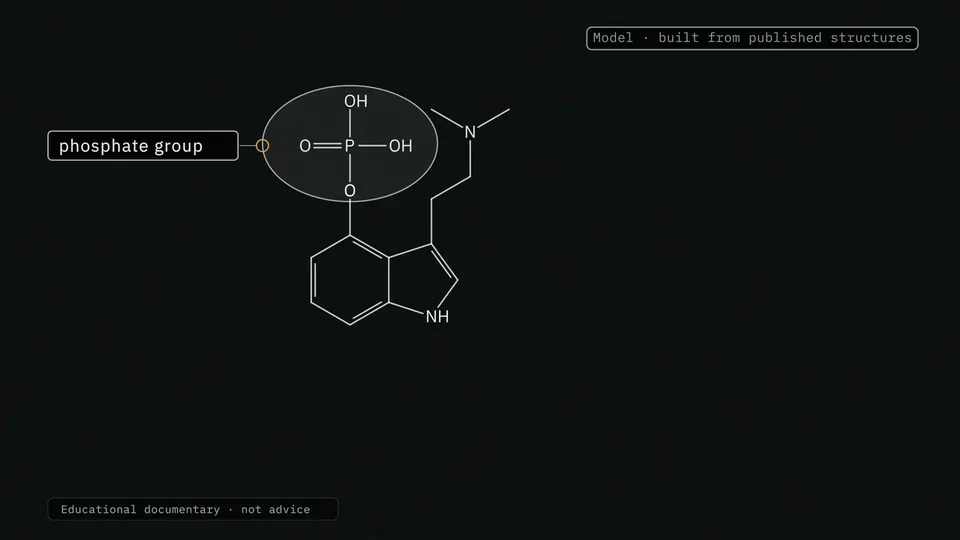
The difference is one small group of atoms. The Controlled Drugs and Substances Act describes psilocin as 3-[2-(dimethylamino)ethyl]-4-hydroxyindole and psilocybin as 3-[2-(dimethylamino)ethyl]-4-phosphoryloxyindole (CDSA). The two share the same indole core and the same side chain. Where psilocin has a hydroxyl group (an oxygen and a hydrogen) at position 4, psilocybin has that oxygen attached to a phosphate.
| Psilocybin | Psilocin | |
|---|---|---|
| Group at position 4 of the indole ring | Phosphoryloxy (a phosphate ester) | Hydroxyl |
| Role in the body | Primarily a prodrug: it is converted to psilocin | The active metabolite, acting on 5-HT2A receptors |
| What converts it | Alkaline phosphatase, an enzyme, strips off the phosphate | Not applicable: it is the product |
| Site of oxidation in bruised tissue | Must lose its phosphate first | The hydroxyl is the group oxidized, giving blue products |
| Canadian schedule | Schedule III, CDSA, item 12 | Schedule III, CDSA, item 11 |
Sources for the table: Dinis-Oliveira, 2017; Lenz et al., 2020; CDSA.
Why is psilocybin called a prodrug?
A prodrug is a compound that has to be converted before it is active. A 2017 review of how the body handles these molecules states that psilocybin is “primarily a pro-drug that is dephosphorylated by alkaline phosphatase to active metabolite psilocin” (Dinis-Oliveira, 2017). Dephosphorylation simply means removing the phosphate group. A 2025 systematic review of the human and animal studies describes psilocybin as quickly converted to psilocin (Meshkat et al., 2025). Evidence: established.
Psilocin is then cleared by further metabolism. According to the 2017 review, the main urinary metabolite is psilocin-O-glucuronide, a form with a sugar-derived group attached, which matters for clinical and forensic testing (Dinis-Oliveira, 2017). The 2025 review adds that psilocin is metabolized mainly by the enzymes CYP2D6 and CYP3A4, with a smaller role for monoamine oxidase A, and that pharmacokinetics vary considerably with dose, route of administration and species (Meshkat et al., 2025). That is a general pharmacology point, not guidance: it is one reason the same compound does not behave identically in every person or study.
Psilocybin: the stored form
Psilocybin is psilocin with a phosphate attached at position 4 of the indole ring. A 2017 review calls it “primarily a pro-drug”: it has to be converted before it is active (Dinis-Oliveira, 2017).
Dephosphorylation
An enzyme, alkaline phosphatase, strips off the phosphate (Dinis-Oliveira, 2017). A 2025 systematic review describes psilocybin as quickly converted to psilocin (Meshkat et al., 2025).
Psilocin: the active form
Psilocin has a hydroxyl group where psilocybin carried its phosphate. It is the form that binds and switches on serotonin 2A (5-HT2A) receptors (Dinis-Oliveira, 2017).
At the receptor
In a 2019 PET study of eight healthy volunteers, receptor occupancy and psilocin levels in blood tracked how intense the volunteers rated the experience (Madsen et al., 2019).
Cleared from the body
Psilocin is metabolized mainly by the enzymes CYP2D6 and CYP3A4, with a smaller role for monoamine oxidase A (Meshkat et al., 2025). The main urinary metabolite is psilocin-O-glucuronide (Dinis-Oliveira, 2017).
Choose a step. Each one restates the sources cited in this article; it is chemistry, not guidance.
Why is psilocin the active form?
Psilocin is the form that binds and switches on serotonin 2A (5-HT2A) receptors. Both compounds are described as acting at these receptors (Dinis-Oliveira, 2017), but the laboratory comparison is telling. In a 2022 structure-activity study, the 4-hydroxy compounds (psilocin and its relatives) behaved like their 4-acetoxy counterparts and were more potent than the 4-phosphoryloxy analogues, which is the group psilocybin carries. In mice, a 5-HT2A antagonist blocked the head-twitch response used as a marker of psychedelic-like activity, which supports the receptor’s involvement (Glatfelter et al., 2022). Psilocybin did produce the response in mice, which fits the picture that the animal converts it to psilocin. Evidence: established for the conversion; the mouse and cell work is preliminary as a model of the human experience.
Human imaging fits the same story. In a 2019 study, eight healthy volunteers were scanned by PET before and after receiving psilocybin. Psilocybin occupied 5-HT2A receptors in the brain, and both receptor occupancy and psilocin levels in blood tracked the volunteers’ ratings of subjective intensity. The authors conclude that 5-HT2A stimulation is a key determinant of the psychedelic experience (Madsen et al., 2019). Evidence: established as a finding, though the study is small. Our article on whether psilocybin rewires the brain looks at what is and is not known downstream of the receptor.
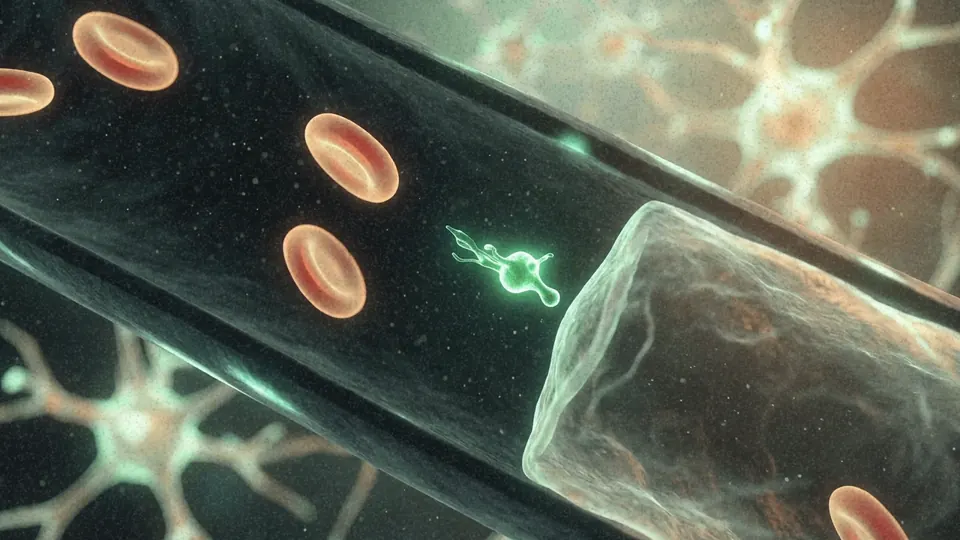
5-HT2A is probably not the only site psilocin touches. A 2016 comparison of psychedelic tryptamines with LSD, DMT and mescaline found that psilocin had lower affinity for 5-HT2A than LSD did, and that psilocin also interacted with the serotonin transporter (Rickli et al., 2016). The comparison with other drugs is in psilocybin, LSD and DMT: the differences. Evidence: preliminary for what any off-target binding means in people.
Why do bruised mushrooms turn blue, and what does psilocin have to do with it?
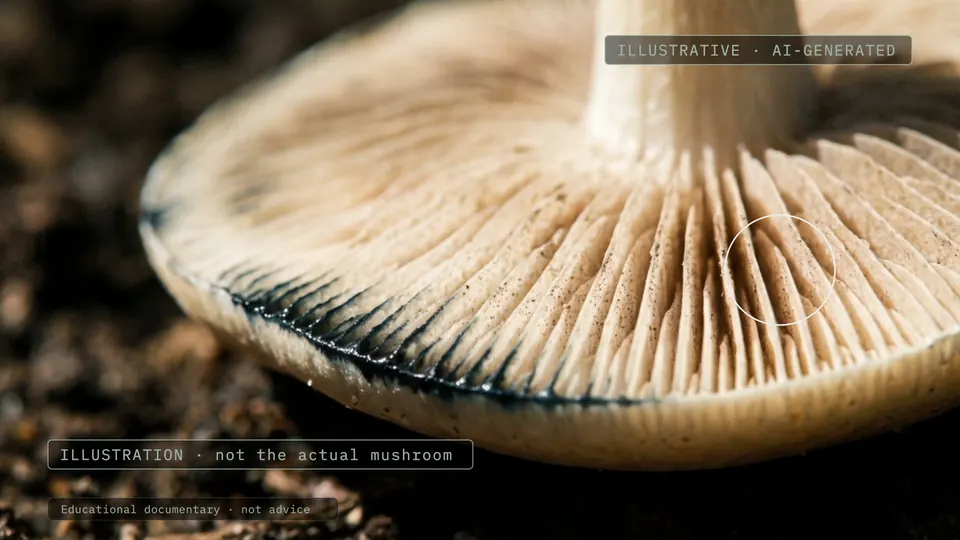
The blue colour is the visible trace of the psilocybin-to-psilocin step happening in the mushroom itself. A 2020 study of Psilocybe cubensis identified two enzymes acting in sequence. First, a phosphatase called PsiP removes the phosphate at position 4, producing psilocin. Then an enzyme called PsiL oxidizes the 4-hydroxy group, preparing it to couple into chains (oligomers) that make blue products. The authors suggest that the phosphate in psilocybin may act as a reversible protective group (Lenz et al., 2020). Evidence: established as a mechanism in this species.
So the hydroxyl that makes psilocin active is also the part that is chemically reactive. The reaction is covered step by step, along with what blue bruising does and does not tell you, in why magic mushrooms turn blue.
How stable are the two compounds?
Not equally, and this is a measurement problem for researchers. A 2021 study tracked psilocybin and four related compounds in cultivated P. cubensis and found that losses depended on the form of the material and how it was held; some conditions preserved the compounds much better than others (Gotvaldová et al., 2021). The practical lesson for readers is narrower: a compound level reported in a paper describes a specific sample at a specific moment, so figures from different studies are hard to compare. We take that up in what lab studies do and do not establish about potency claims.
What are baeocystin and norbaeocystin?
They are two further tryptamines that occur alongside psilocybin and psilocin in psilocybin-containing mushrooms. Chemically they are close relatives of psilocybin. One 2022 study describes baeocystin as a secondary amine and aeruginascin, a fifth compound often measured with them, as a quaternary ammonium, in contrast to psilocybin’s tertiary amine (Glatfelter et al., 2022). A 2022 survey of 226 fruiting bodies from 82 collections across seven genera measured psilocybin, psilocin, baeocystin, norbaeocystin and aeruginascin, and reported baeocystin, norbaeocystin and aeruginascin concentrations for the first time for many of the species tested (Gotvaldová et al., 2022).
What they do is much less studied. A 2022 mouse and cell study compared psilocybin, baeocystin and aeruginascin with their 4-hydroxy and 4-acetoxy relatives. The compounds bound serotonin receptors, including 5-HT2A, in laboratory assays, but only the tertiary amines (psilocin, psilocybin and psilacetin) triggered head twitches in mice; the secondary and quaternary compounds did not (Glatfelter et al., 2022). The authors describe these other compounds as having received little study. We found no human data in the sources we checked, so whether they change the experience of a whole mushroom is unresolved. Evidence: preliminary.
Why this matters for reading research
Clinical trials use a measured, synthetic psilocybin. A mushroom contains a variable mix of several tryptamines, and the 2022 survey describes their concentrations as highly variable. A result for one is not automatically a result for the other. Nothing here is medical advice; see our safety page for key emergency and poison-control information.
How are psilocin and psilocybin listed in Canadian law?
As of 10 October 2026, they are two separate entries in Schedule III of the Controlled Drugs and Substances Act. Item 11 is “Psilocin (3–[2–(dimethylamino)ethyl]–4–hydroxyindole) and any salt thereof” and item 12 is “Psilocybin (3–[2–(dimethylamino)ethyl]–4–phosphoryloxyindole) and any salt thereof”. The same schedule lists LSD, DMT and mescaline (the last “but not peyote”), among others (CDSA). The Justice Laws page we read was current to 21 September 2026, and its list of amendments not yet in force did not touch items 11 or 12.
Health Canada says the production, sale and possession of magic mushrooms are illegal in Canada, with clinical trials as the route for research on unapproved drugs (Health Canada, page dated 20 October 2026). This is general information, not legal advice. Check the official pages before relying on any summary, including ours. For how the listing came about, see how magic mushrooms became illegal in Canada.
What we still don’t know
- Whether baeocystin, norbaeocystin and aeruginascin contribute anything to the experience of a whole mushroom. Human data are missing.
- How much of psilocin’s effect comes from 5-HT2A alone and how much from other sites such as the serotonin transporter.
- How much individual physiological variability changes how people process these compounds; the 2017 review flags it but does not settle it.
- Why the mushroom keeps the phosphorylated form: the “reversible protective group” idea is a suggestion by the authors, not an established function.
If you want the history of how the two molecules were first isolated and named, it is in what is psilocybin and the history of magic mushrooms.
Common questions
What is psilocin?
The compound the body makes from psilocybin, and the form that acts on serotonin 2A (5-HT2A) receptors. It differs from psilocybin by one chemical group, a hydroxyl where psilocybin has a phosphate, and in Canada it is listed separately in Schedule III.
Is psilocin the same as psilocybin?
No. They are closely related but different molecules. Psilocybin has a phosphate group at position 4 of its indole ring; psilocin has a hydroxyl group there. Health Canada names both as active ingredients of magic mushrooms.
Why is psilocybin called a prodrug?
Because it is converted into the active compound before it acts. The enzyme alkaline phosphatase removes its phosphate group, leaving psilocin, which is the form that acts on 5-HT2A serotonin receptors.
Which one is the active form?
Psilocin. In imaging work in eight healthy volunteers, receptor occupancy and blood levels of psilocin tracked the reported intensity, and in laboratory assays the 4-hydroxy compounds were more potent than their phosphate-bearing analogues.
Why do magic mushrooms turn blue?
When tissue is damaged, an enzyme removes the phosphate from psilocybin to give psilocin, and a second enzyme oxidizes its hydroxyl group, which leads to blue oligomers. Our article on blue bruising covers the steps and what the colour does not show.
What are baeocystin and norbaeocystin?
Related tryptamines that occur in psilocybin-containing mushrooms alongside psilocybin and psilocin. They are much less studied. In one mouse study, only the tertiary amines produced a head-twitch response; no human data were found in our sources.
Are psilocin and psilocybin both illegal in Canada?
Both are listed by name in Schedule III of the Controlled Drugs and Substances Act (items 11 and 12), and Health Canada says the production, sale and possession of magic mushrooms are illegal. This is not legal advice; check the official Government of Canada pages.
Does this article tell me how much to take?
No. It explains chemistry and pharmacology only and gives no dosing or use information. If you or someone near you is unwell, see our safety page for emergency and poison-control information.
Shroomverse sells mushroom products. This article is general information about psilocybin science. It is not medical, legal or purchasing advice, and it does not encourage anyone to use drugs.
SOURCES
- Psilocybin and psilocin (magic mushrooms) (page dated 20 October 2026), Health Canada. Accessed . Source for: the active ingredients are psilocybin and psilocin; production, sale and possession of magic mushrooms are illegal in Canada; clinical trials as the route for research on unapproved drugs.
- Controlled Drugs and Substances Act, S.C. 1996, c. 19, Schedule III, items 11 (psilocin) and 12 (psilocybin), Justice Laws Website, Government of Canada. Accessed . Source for the exact wording and chemical names of items 11 and 12, the other substances in Schedule III, and the statement that the page is current to 2026-09-21. The amendments-not-in-force list was read and did not touch these two items. The effect of any regulation said to take effect on 1 October 2026 was not verified and is not described.
- Metabolism of psilocybin and psilocin: clinical and forensic toxicological relevance (Dinis-Oliveira RJ, Drug Metabolism Reviews 49(1):84–91, 2017), Taylor & Francis (peer-reviewed review); record on Europe PMC, PMID 28074670. Accessed . Abstract consulted; full text not open. Source for the prodrug and alkaline phosphatase statement, activity at 5-HT2A receptors, and psilocin-O-glucuronide as the main urinary metabolite.
- Pharmacokinetics of Psilocybin: A Systematic Review (Meshkat S, et al., Pharmaceutics 17(4):411, 2025), MDPI (peer-reviewed, open access); PMID 40284409. Accessed . Abstract consulted; full text not read. Source for rapid conversion to psilocin, metabolism by CYP2D6 and CYP3A4 with a smaller role for monoamine oxidase A, and variability by dose, route and species.
- Structure-Activity Relationships for Psilocybin, Baeocystin, Aeruginascin, and Related Analogues to Produce Pharmacological Effects in Mice (Glatfelter GC, et al., ACS Pharmacology & Translational Science 5(11):1181–1196, 2022), American Chemical Society (peer-reviewed); PMID 36407948. Accessed . Abstract consulted; full text not read. Mouse and cell-assay work. Source for the amine classes of psilocybin, baeocystin and aeruginascin, 4-hydroxy and 4-acetoxy compounds being more potent than 4-phosphoryloxy analogues, head twitches only from tertiary amines, blockade by a 5-HT2A antagonist, and the statement that baeocystin and aeruginascin are little studied.
- Psychedelic effects of psilocybin correlate with serotonin 2A receptor occupancy and plasma psilocin levels (Madsen MK, et al., Neuropsychopharmacology 44(7):1328–1334, 2019), Springer Nature (peer-reviewed); PMID 30685771. Accessed . Abstract consulted; full text not read. Eight healthy volunteers, PET imaging. Source for receptor occupancy and plasma psilocin tracking subjective intensity.
- Receptor interaction profiles of novel psychoactive tryptamines compared with classic hallucinogens (Rickli A, Moning OD, Hoener MC, Liechti ME, European Neuropsychopharmacology 26(8):1327–1337, 2016), Elsevier (peer-reviewed); PMID 27216487. Accessed . Abstract consulted; full text not open. Source for lower 5-HT2A affinity of psilocin than LSD and interaction of psilocin with the serotonin transporter. In vitro work.
- Injury-Triggered Blueing Reactions of Psilocybe “Magic” Mushrooms (Lenz C, et al., Angewandte Chemie International Edition 59(4):1450–1454, 2020), Wiley (peer-reviewed); record read on Europe PMC. Accessed . Abstract consulted; full text not read. Source for PsiP dephosphorylation to psilocin, PsiL oxidation of the 4-hydroxy group, blue oligomers, and the suggested protective role of the phosphate.
- Stability of psilocybin and its four analogs in the biomass of the psychotropic mushroom Psilocybe cubensis (Gotvaldová K, et al., Drug Testing and Analysis 13(2):439–446, 2021), Wiley (peer-reviewed); PMID 33119971. Accessed . Abstract consulted; full text not read. Cited only for the finding that losses differed with the form of the material and storage conditions.
- Extensive Collection of Psychotropic Mushrooms with Determination of Their Tryptamine Alkaloids (Gotvaldová K, et al., International Journal of Molecular Sciences 23(22):14068, 2022), MDPI (peer-reviewed, open access); PMID 36430546. Accessed . Abstract consulted; full text not read. Source for 226 fruiting bodies from 82 collections across seven genera, five compounds measured including baeocystin, norbaeocystin and aeruginascin, first-time reports for many species, and highly variable concentrations.
- Wikidata entities used for the article’s “about” markup: psilocybin (Q208118), psilocin (Q409150), 5-hydroxytryptamine receptor 2A (Q1949517), Wikidata. Accessed . Entity records fetched and the labels checked; used only for structured-data identifiers, not for any claim.
CHANGES
- : Added a link to the interactive explainer of how psilocybin works.
- : Added links to the DMT Library.
- : Published.
- : Re-read Health Canada’s psilocybin page, updated on 20 October 2026, and corrected its date here. The statements this article cites from it are unchanged.



