
THE SHROOMVERSE JOURNAL ✳ 14 MIN READ
Andrew Gallimore’s “reality switch” idea: what it claims about DMT, and how it could be tested
Topic: DMT
Published Updated
Listen: the 3-minute version
AI-narrated summary of this article
Short answer, checked 20 October 2026
Andrew Gallimore is a researcher whose DMT papers list the Computational Neuroscience Unit at the Okinawa Institute of Science and Technology. He has written that DMT does not distort the ordinary world so much as replace it, and his books, including Reality Switch Technologies (2022), present psychedelics as tools for exploring other worlds. In 2016 he and Rick Strassman proposed keeping people in the DMT state for longer with a controlled infusion; later studies made that work but found that the experience levels off while blood levels keep rising, against one of the proposal’s premises. In 2026 he and two co-authors posted a preprint, not peer reviewed, proposing experiments to test whether DMT entities are independent of the person; none has been run. A rival 2026 model explains entities as the brain attributing its own content to someone else.
THE SHORT VERSION · SWIPE
On this page 9 sections
Andrew Gallimore has published on a question that most DMT research does not address: whether the beings people meet in the DMT state might be more than hallucinations. This article sets out what he has published, what his central idea claims, what has happened to the testable parts, and what critics and rival models say. We describe; we do not endorse or dismiss.
How we wrote this
We describe Gallimore’s ideas from his peer-reviewed papers and his 2026 preprint, which we read on 20 October 2026. We did not read his books for this article, so we cite them by title and publisher only. A preprint has not been peer reviewed. This article gives no amounts, no instructions and no advice on use, and describes no effect as a benefit. Evidence labels: established (shown in peer-reviewed studies and not seriously disputed), preliminary (early, small or indirect) and unresolved (an open question, including proposals not yet tested). Points marked “our reading” are the editors’ own analysis, not published critiques.
Who is Andrew Gallimore?
His two peer-reviewed DMT papers that we read, from 2015 and 2016, list his affiliation as the Computational Neuroscience Unit of the Okinawa Institute of Science and Technology (OIST) in Japan (Gallimore, 2015; Gallimore and Strassman, 2016). Alongside his DMT writing, the same unit appears on his computational models of learning in the cerebellum and of how nerve cells recycle the vesicles that carry neurotransmitters (Gallimore et al., 2018; Gallimore et al., 2025). The 2026 preprint lists OIST and Noonautics, a non-profit that it says partly funded the work (Gallimore, Hermansson and Hoffman, 2026).
Library records list three books by him on psychedelics: Alien Information Theory: Psychedelic Drug Technologies and the Cosmic Game (Strange Worlds Press, 2019) (Open Library), Reality Switch Technologies: Psychedelics as Tools for the Discovery and Exploration of New Worlds (Strange Worlds Press, 2022) (Open Library) and Death by Astonishment (St. Martin’s Press, 2025) (Open Library). His preprint’s reference list also cites a 2013 essay, “Building Alien Worlds”, in the Journal of Scientific Exploration (Gallimore, Hermansson and Hoffman, 2026).
- 2013Essay “Building Alien Worlds” in the Journal of Scientific Exploration (cited in his 2026 preprint).Source Gallimore et al., 2026 (reference list)
- 2015Paper applying integrated information theory to the psychedelic state.Source Gallimore, 2015
- 2016With Rick Strassman, a model for extending the DMT state by target-controlled infusion.Source Gallimore and Strassman, 2016
- 2019Book: Alien Information Theory.Source Open Library
- 2022Book: Reality Switch Technologies.Source Open Library
- 2023–2025Swiss and London infusion studies extend the DMT state and find acute tolerance.Source Vogt, 2023; Luan, 2024; Erne, 2025
- 2025Book: Death by Astonishment.Source Open Library
- 2026Preprint with Hermansson and Hoffman proposing tests of entity independence (not peer reviewed).Source Gallimore et al., 2026
- 2026A rival active-inference model of entity encounters is published.Source Mago et al., 2026
What does the “reality switch” idea claim?
“Reality switch” comes from the title of his 2022 book (Open Library). Because we have not read the book, we describe the idea from his papers, where a consistent thread runs through. In 2016 he and Strassman wrote that DMT users consistently report the complete replacement of normal experience with a novel “alternate universe”, often densely populated with complex visual content and what appear to be sentient beings (Gallimore and Strassman, 2016). The emphasis is on replacement: on this view DMT does not merely distort the familiar world, it swaps it for another. The replacement is what users report; reading it as access to another world is an untested hypothesis. Evidence: unresolved.
His 2015 paper offered a brain-based model. Using integrated information theory, a mathematical theory of consciousness, he argued that psychedelics change both the level and the structure of consciousness, increasing flexibility and imagination at the cost of the brain’s ability to organise and differentiate what it experiences, and he set out predictions that imaging could test (Gallimore, 2015). That paper is about classic psychedelics in general and stays within standard neuroscience. Its predictions remain a proposal. Evidence: unresolved.
The 2026 preprint goes further. Written with Niffe Hermansson and the cognitive psychologist Donald Hoffman, it adopts Hoffman’s “conscious realism”, in which reality consists of interacting conscious agents and perception is a species-specific interface, not a true picture of an objective world. The authors propose that DMT perturbs this interface, widening the region of experience a person can reach, so that normally imperceptible agents might leave stable, structured “traces” that are experienced as the populated worlds of the DMT state (Gallimore, Hermansson and Hoffman, 2026). They say plainly that they are not claiming DMT entities are external agents, only that the possibility can be stated precisely and tested. It is an untested proposal and has not been peer reviewed. Evidence: unresolved.
The 2016 proposal: holding the DMT state for longer
DMT’s effects are brief, which makes the experience hard to study. In 2016, Gallimore and Strassman used pharmacokinetic modelling to propose target-controlled intravenous infusion, a technology developed to keep anaesthetic levels stable during surgery, as a way to hold volunteers in a stable, prolonged DMT state for observation and brain imaging. Their model relied on DMT’s rapid onset and, they wrote, its lack of acute tolerance to its subjective effects, meaning the effects would not fade while blood levels were held steady (Gallimore and Strassman, 2016). At the time it was a modelling proposal with no participants. Evidence: preliminary.
Later studies did extend the state, and also revised that premise. In London, 11 volunteers were held in a steady state for 30 minutes; their effects plateaued while blood DMT kept rising, which the authors read as acute psychological tolerance (Luan et al., 2024). In Basel, 27 participants’ effects were stable from 30 to 90 minutes despite rising blood levels, “indicating acute tolerance” (Vogt et al., 2023).
A second Basel study ran 120-minute infusions with 22 participants. Effects plateaued after 30 minutes, the highest rate tested caused significant anxiety, and the team observed moderate acute tolerance (Erne et al., 2025). So the method can extend the state in research settings, but the experience does not keep pace with rising blood levels. Doses are deliberately not reproduced. For the clinical side, see DMT therapy research. Evidence: preliminary, from small samples.
The 2026 preprint: proposed tests of entity independence
The preprint, posted on PsyArXiv in May 2026, has not been peer reviewed, and none of its experiments has been run. It proposes a programme rather than one decisive test, to be carried out with extended-state infusions so that participants have time to interact (Gallimore, Hermansson and Hoffman, 2026). The authors describe two classes:
- Single-subject tests. A computer in a separate room, isolated from both the participant and the experimenters, randomly switches between two states, for example a blue and a yellow screen. The question is whether anything in the experience, such as an entity’s colour, tracks that hidden variable better than chance. The authors call for randomisation, blinding, pre-registered analyses and control conditions such as imagination or other psychedelic states.
- Multiple-subject tests. Participants isolated from one another take part under identical conditions, to see whether their reports converge beyond chance. In an information deposit and retrieval design, one participant passes a randomly generated word or multi-digit number to an entity, and another participant tries to retrieve it.
- A random word or number is generated and kept from everyone except the first participant.
- The first participant, in an extended DMT session, tries to communicate it to an entity.
- A second participant, isolated and blind to the target, has a separate session and tries to retrieve it.
- Pre-registered scoring compares what the second participant reports with the target and with chance.
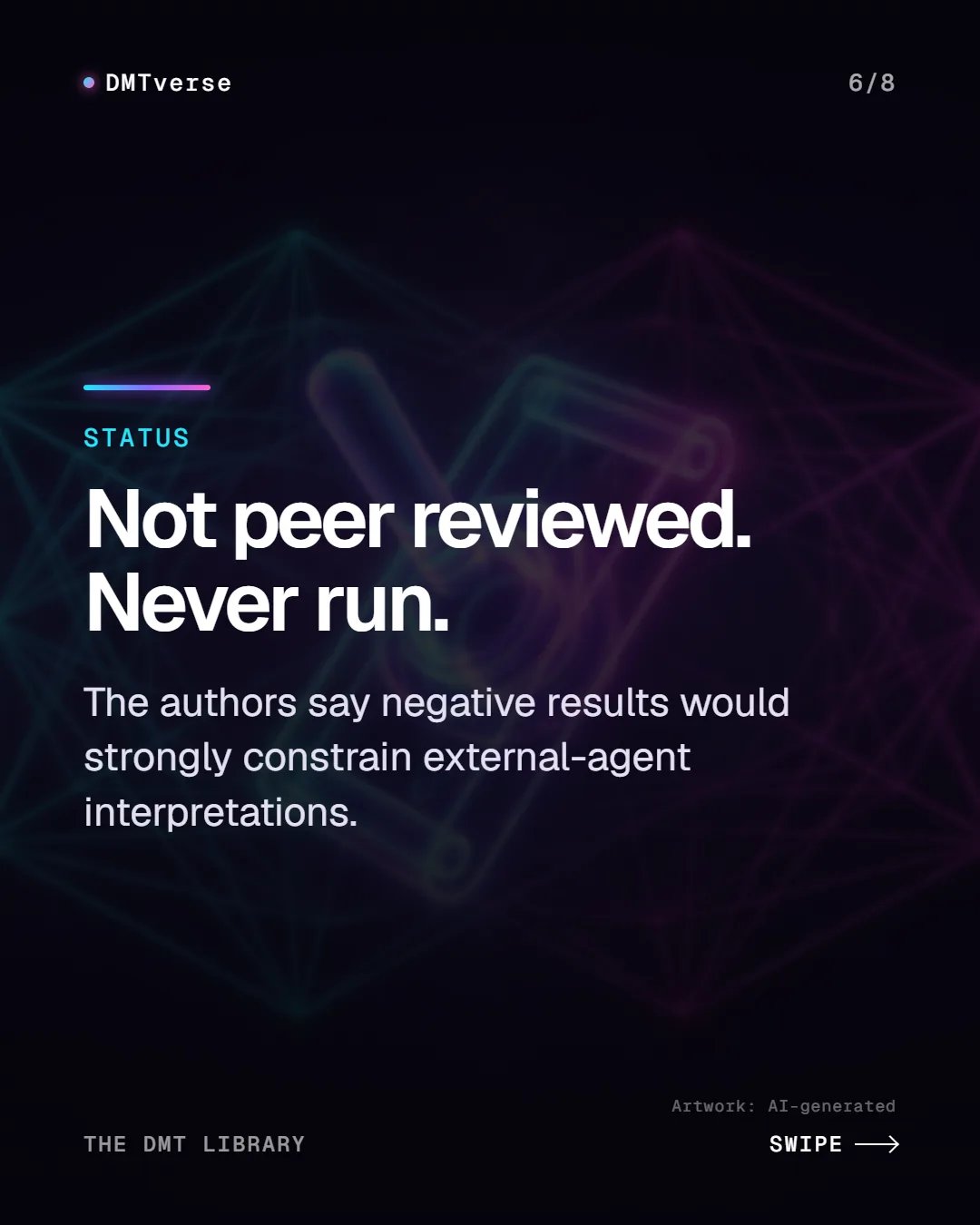
The authors flag the main limitation themselves: the single-subject test needs the entity’s active cooperation, which cannot be assumed, and they suggest recruiting people who report regular contact with the same entity. They also write that negative results “would strongly constrain external-agent interpretations” (Gallimore, Hermansson and Hoffman, 2026). Evidence: unresolved.
Critiques and open problems
- Not yet peer reviewed or run. The test programme exists only as a preprint, and no data exist (Gallimore, Hermansson and Hoffman, 2026). Unresolved.
- Interpreting the results (our reading). A positive result would need to rule out information leaking and chance. A null result could, in principle, be put down to entities not cooperating, the limitation the authors flag themselves, although they also write that negative results would strongly constrain external-agent interpretations (Gallimore, Hermansson and Hoffman, 2026). Pre-registration and blinding, which the authors call for, narrow both problems. Our analysis, not a published critique.
- Who takes part (our reading). Recruiting people who report regular contact with the same entity may help the experiment, as the authors argue, but it also selects people with strong expectations. Blinding the target, which the design already does, is what protects the test from those expectations. Our analysis, not a published critique.
- A contested foundation. Conscious realism builds on Hoffman’s interface theory of perception, which holds that natural selection favours perceptions tuned to fitness rather than truth. When it was published in 2015, several commentators argued against it, while others proposed ways to test it (Hoffman, Singh and Prakash, 2015). Debated.
- A revised premise. The extended-state method that the tests depend on works, but the 2016 assumption of no acute tolerance did not hold in later infusion studies (Erne et al., 2025). Preliminary.
- A precedent. Hidden-target tests have been tried in another setting. In the AWARE-II cardiac-arrest study, nobody identified a hidden visual image, though few survivors could be tested and the study was not about DMT (Parnia et al., 2023). Preliminary.
What are the alternative explanations?
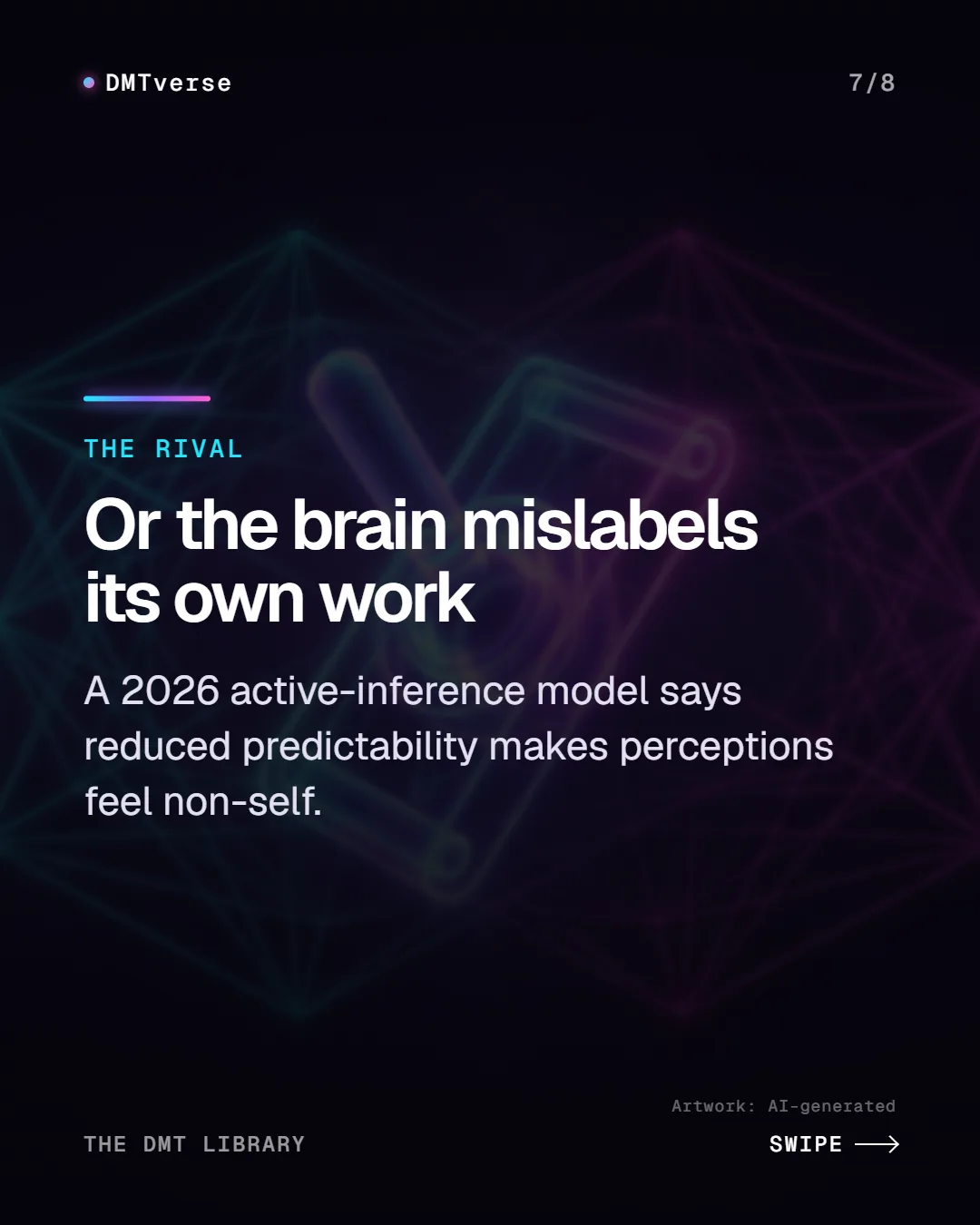
The main published rival is a 2026 active-inference model by Mago and colleagues. It proposes that psychedelics reduce how predictable perceptions are, which may incline the brain to interpret perceptions, internal and external, as coming from agents other than the self. Like the preprint, it does not take a stance on what entities ultimately are; it aims to explain the experience of meeting them, including why their forms vary with culture (Mago et al., 2026). Its authors list its limits: no formal mathematical implementation yet, which limits testability, and no explanation of why 5-MeO-DMT, despite its similar structure, tends to produce non-dual states rather than entities. Evidence: unresolved.
Lab phenomenology adds constraints any theory must meet. In a 2026 micro-phenomenology study, 23 participants were interviewed in fine detail after intravenous DMT during brain scanning; bodily effects tended to come first, and perceived presences emerged only after multisensory and three-dimensional space had developed. The authors describe immersion under DMT as “a dynamic, constructive process” (Sanders et al., 2026). Entities are also not universal: in 3,778 online reports, 45.5% described one (Lawrence et al., 2022). Evidence: preliminary.
Elaborate hallucination
The usual interpretation, which the preprint itself describes as the standard view in neuroscience: entities are complex hallucinations generated by brain activity (Gallimore, Hermansson and Hoffman, 2026).
Misattributed self-generated content
Reduced predictability leads the brain to attribute perceptions to non-self agents; ontologically neutral; needs measures of sensory attenuation to test (Mago et al., 2026).
Traces of other agents
DMT perturbs the perceptual interface so that normally imperceptible conscious agents may leave traces; testable with hidden variables and isolated participants; not peer reviewed (Gallimore, Hermansson and Hoffman, 2026).
Each panel restates sources cited in this article. None is established.
How could the competing ideas be tested?
- Hidden-variable and deposit-retrieval experiments, as proposed in the preprint, with pre-registration and blinded scoring (Gallimore, Hermansson and Hoffman, 2026).
- Measures of sensory attenuation and of how rich the brain’s predictions are, as the active-inference authors call for, to see whether entity onset tracks a loss of self-attribution (Mago et al., 2026).
- Reports collected during the experience rather than afterwards. Lucid dreamers have answered questions in real time from REM sleep, and their later reports sometimes diverged from what they signalled (Konkoly et al., 2021). No such method has been published for DMT.
- Comparisons across molecules, such as DMT and 5-MeO-DMT, to explain why one so often produces entities and the other rarely does, a gap the active-inference authors acknowledge (Mago et al., 2026). See 5-MeO-DMT vs DMT.
Only some of these could separate the theories. Brain measures can show how entity experiences arise, which fits both the hallucination and active-inference views. What would favour the conscious-realism view over the others is information that could not have come from the participant’s own brain, which is why the preprint focuses on hidden targets. Evidence: unresolved.
What we still don’t know
- Whether any of the preprint’s proposed experiments will be run, and under what oversight (unresolved).
- How the preprint will change, if at all, in peer review (unresolved).
- Whether active-inference models can be made precise enough to make predictions that the other views do not (unresolved).
- Why entity reports are common with DMT and rare with 5-MeO-DMT (unresolved).
- Whether expectations brought into the room shape who or what people meet; no controlled DMT study we found has tested it (unresolved).
The fair summary: Gallimore’s central claim, that DMT may open perception onto something real rather than only generate hallucinations, departs from what his own preprint calls the standard view in neuroscience. Its most useful feature is that he and his co-authors have tried to make it testable. Until the tests are run, it stays a hypothesis, alongside rival accounts that are also untested. For more, read what is DMT, DMT entity encounters: what the research says and DMT and dreams.
Common questions
Who is Andrew Gallimore?
A researcher whose DMT papers (2015, 2016) and computational-neuroscience papers list the Computational Neuroscience Unit at the Okinawa Institute of Science and Technology. Library records list three books by him on psychedelics: Alien Information Theory (2019), Reality Switch Technologies (2022) and Death by Astonishment (2025).
What is the “reality switch” theory?
The phrase comes from the title of his 2022 book. In his papers, the core idea is that DMT replaces ordinary experience with another, populated world rather than merely distorting it, and a 2026 preprint proposes that this might involve perceiving normally imperceptible conscious agents. It is a hypothesis, not an established finding.
Does Gallimore claim DMT entities are real?
Not in the 2026 preprint. He and his co-authors say they are not claiming the entities are external agents, only that the possibility can be stated precisely and tested, and that negative results would strongly constrain such interpretations.
What experiments does the 2026 preprint propose?
Two kinds: tests of whether an experience tracks a hidden random variable, such as a computer in another room switching between blue and yellow, and tests with isolated participants, including one person passing a random word or number to an entity and another trying to retrieve it. None has been run, and the preprint is not peer reviewed.
What was the 2016 extended-state DMT proposal?
Gallimore and Strassman modelled using target-controlled intravenous infusion, a technology from anaesthesia, to hold people in a stable DMT state for longer. Later studies did extend the state but found acute tolerance: effects levelled off while blood levels kept rising, contrary to the proposal’s assumption.
What do critics say about Gallimore’s DMT theory?
We found no published critique of the 2026 preprint itself, which is unreviewed and whose tests have not been run. Conscious realism builds on Hoffman’s interface theory of perception, which drew critical commentary in 2015. A rival 2026 active-inference model explains entities as the brain attributing its own content to someone else.
Is there scientific evidence that DMT entities are independent beings?
No. No study has tested it. The evidence so far describes what people report and how the experience unfolds, for example that presences appeared only after a sense of space had formed in a 2026 lab study. That is compatible with several interpretations.
Shroomverse sells mushroom products. This article is general information about Andrew Gallimore’s ideas on DMT and the research around them. It is not medical, legal or purchasing advice, and it does not recommend any product.
SOURCES
- Traces of the Other – Are DMT Entities Real? DMT Phenomenology in the Framework of Conscious Realism (Gallimore AR, Hermansson N, Hoffman DD, PsyArXiv preprint, version 2, 2026), PsyArXiv (OSF) preprint, not peer reviewed. Accessed . Full text read (preprint PDF, posted 27 May 2026). Affiliations (OIST, Noonautics; Trace Institute; UC Irvine); funding partly from Noonautics; conscious realism hypothesis; single-subject hidden blue/yellow screen test; multi-subject deposit and retrieval of a random word or number; cooperation limitation; not claiming entities are external; “Negative results would strongly constrain external-agent interpretations”. Reference list cites the 2013 Journal of Scientific Exploration essay and Death by Astonishment (2025).
- A Model for the Application of Target-Controlled Intravenous Infusion for a Prolonged Immersive DMT Psychedelic Experience (Gallimore AR, Strassman RJ, Frontiers in Pharmacology 7:211, 2016), Frontiers (peer-reviewed, open access). Accessed . Abstract and Europe PMC record read. Reports of complete replacement by an “alternate universe”; target-controlled infusion model; premise of rapid onset and lack of acute tolerance; OIST affiliation.
- Restructuring consciousness – the psychedelic state in light of integrated information theory (Gallimore AR, Frontiers in Human Neuroscience 9:346, 2015), Frontiers (peer-reviewed, open access). Accessed . Abstract and Europe PMC record read. IIT model of psychedelic state; flexibility at the expense of cause-effect information; testable predictions; OIST affiliation.
- Switching On Depression and Potentiation in the Cerebellum (Gallimore AR, Kim T, Tanaka-Yamamoto K, De Schutter E, Cell Reports 22(3):722–733, 2018), Cell Press (peer-reviewed). Accessed . Europe PMC record read; cited only for his computational-neuroscience work and the listed OIST Computational Neuroscience Unit affiliation.
- Dynamic regulation of vesicle pools in a detailed spatial model of the complete synaptic vesicle cycle (Gallimore AR, Hepburn I, Georgiev SV, Rizzoli SO, De Schutter E, Science Advances 11(22):eadq6477, 2025), American Association for the Advancement of Science (peer-reviewed). Accessed . Europe PMC record read; cited only for his computational-neuroscience work and the listed affiliation.
- Alien Information Theory: Psychedelic Drug Technologies and the Cosmic Game (Gallimore AR, Strange Worlds Press, 2019), Open Library bibliographic record. Accessed . Record only (title, subtitle, publisher, 2019 edition). Book not read; no content attributed to it.
- Reality Switch Technologies: Psychedelics As Tools for the Discovery and Exploration of New Worlds (Gallimore AR, Strange Worlds Press, 2022), Open Library bibliographic record. Accessed . Record only (title, subtitle, publisher, 2022). Book not read; cited as the origin of the phrase “reality switch”.
- Death by Astonishment (Gallimore A, St. Martin’s Press, 2025), Open Library bibliographic record. Accessed . Record only (publisher, 2025 editions with two subtitle variants). Book not read; no content attributed to it.
- Probing the interface theory of perception: Reply to commentaries (Hoffman DD, Singh M, Prakash C, Psychonomic Bulletin & Review 22(6):1551–1576, 2015), Springer (peer-reviewed). Accessed . Abstract read via Europe PMC. Selection favours non-veridical perceptions tuned to fitness; several commentators argued against the proposal, others proposed tests.
- Computational spirits: a neuroscientific account of psychedelic entity encounters (Mago J, Deane G, Sandved-Smith L, et al., Neuroscience of Consciousness 2026(1):niaf069), Oxford University Press (peer-reviewed, open access); full text via Europe PMC, PMC13240852. Accessed . Full text read. Active-inference model; reduced predictability inclines attribution to non-self agents; no stance on ontology; acknowledged limits: no formal implementation, 5-MeO-DMT rarely produces entities.
- Micro-phenomenology of immersion and perceived presences under DMT (Sanders JW, Millière R, Demšar E, et al., Neuroscience of Consciousness, niag015, 2026), Oxford University Press (peer-reviewed, open access); full text via Europe PMC, PMC13366535. Accessed . Abstract and full text read. 23 participants; bodily effects first; presences emerged only after multisensory integration and 3D space; “a dynamic, constructive process”. Dose not reproduced.
- Phenomenology and content of the inhaled N,N-dimethyltryptamine (N,N-DMT) experience (Lawrence DW, Carhart-Harris R, Griffiths R, Timmermann C, Scientific Reports 12:8562, 2022), Springer Nature (peer-reviewed, open access); full text via Europe PMC, PMC9130218. Accessed . Full text read. Entity encounters in 45.5% (1,719) of 3,778 self-selected forum reports.
- Psychological and physiological effects of extended DMT (Luan LX, et al., Journal of Psychopharmacology 38(1):56–67, 2024), SAGE (peer-reviewed). Accessed . Abstract read via Europe PMC. 11 volunteers; steady state over 30 minutes; plasma rose while effects plateaued, suggesting acute psychological tolerance. Doses not reproduced.
- Acute effects of intravenous DMT in a randomized placebo-controlled study in healthy participants (Vogt SB, et al., Translational Psychiatry 13:172, 2023), Springer Nature (peer-reviewed, open access). Accessed . Abstract read via Europe PMC. 27 participants; effects stable from 30 to 90 minutes despite rising plasma, indicating acute tolerance. Doses not reproduced.
- Acute dose-dependent effects and self-guided titration of continuous N,N-dimethyltryptamine infusions in a double-blind placebo-controlled study in healthy participants (Erne L, et al., Neuropsychopharmacology 50(6):1008–1016, 2025), Springer Nature (peer-reviewed). Accessed . Abstract read via Europe PMC. 22 participants, 120-minute infusions; plateau after 30 minutes; highest rate caused significant anxiety; moderate acute tolerance. Rates deliberately not reproduced.
- AWAreness during REsuscitation - II: A multi-center study of consciousness and awareness in cardiac arrest (Parnia S, et al., Resuscitation 191:109903, 2023), Elsevier (peer-reviewed). Accessed . Abstract read via Europe PMC. Nobody identified the visual image; 28 survivors interviewed; low survival limited testing.
- Real-time dialogue between experimenters and dreamers during REM sleep (Konkoly KR, et al., Current Biology 31(7):1417–1427, 2021), Cell Press (peer-reviewed, open access); full text via Europe PMC, PMC8162929. Accessed . Full text read. Two-way communication in verified lucid REM dreams; later reports sometimes diverged from recorded signals.
CHANGES
- : Linked glossary definitions.
- : Published. Every source opened and checked on this date: Europe PMC abstracts and full text, the preprint PDF on OSF, Open Library records and Crossref.
- : Editorial review: the two editorial critique points are now both labelled “our reading” and rewritten to credit the authors’ own safeguards (blinding, pre-registration, their statement on negative results); FAQ on critics no longer presents our analysis as published criticism; neutral opening without an unsourced claim about what most neuroscientists do; evidence labels moved to the house set (the “hypothesis” label became unresolved); the infusion paragraph split; the 5-MeO-DMT test point now cited; summary tightened.



