THE SHROOMVERSE JOURNAL ✳ 12 MIN READ
DMT and “ego death”: what ego dissolution is, how it is measured, and what the studies found
Topic: DMT
Published Updated
Short answer, checked 20 October 2026
“Ego death” is the popular name for what researchers call ego dissolution: a temporary breakdown of the usual sense of being a separate self. It is usually measured with self-report scales such as the 8-item Ego Dissolution Inventory, validated in 2016 on 1,828 drug experiences, or with single questionnaire items. In a 2026 EEG analysis of 27 healthy volunteers, DMT pushed brain rhythms away from a balanced “critical” state, and the size of that shift tracked how strongly people rated the disintegration of their sense of self. Ego dissolution can be calm or frightening: at the highest infusion rate in one trial, the anxious form increased. It is different from depersonalisation disorder, a lasting condition that hallucinogens are among the reported triggers for. Evidence for DMT is small and recent.
THE SHORT VERSION · SWIPE
On this page 8 sections
Online, “ego death” is often described as the defining moment of a strong DMT experience: the sense of “I” falling away. Researchers study the same thing under a plainer name, ego dissolution. This article explains what the term means, how it is measured and where those measures fall short, what DMT studies have found in the brain, how ego dissolution relates to fear, and why it should not be confused with depersonalisation disorder. For the general meaning of the term and where it came from, see what is ego death. For the basics, see our pillar, what is DMT; for how researchers rate the intensity of the experience it usually belongs to, see what is a DMT breakthrough.
Education only, not guidance
This article describes published research. It gives no amounts, no instructions and no advice on use, and it does not present ego dissolution as a goal or a benefit. Some people find it frightening or destabilising. DMT is a controlled substance in Canada. Evidence labels used below: established (shown in peer-reviewed studies and not seriously disputed), preliminary (early, small, self-selected or indirect) and unresolved (an open question).
What is ego death, in research terms?
“Ego death” is not a scientific term. Researchers say ego dissolution, which the team that built the most used scale defines as a compromised sense of “self”, and describe as a key feature of the psychedelic experience (Nour et al., 2016). A 2015 psilocybin study describes it as feeling that one’s “self”, “ego” or “I” is disintegrating, or that the border between self and world is dissolving, and notes that similar ego disturbances have been described in schizophrenia since the earliest clinical accounts (Lebedev et al., 2015). Evidence: established as a commonly reported feature of psychedelic states.
It is probably not one thing. A 2018 review comparing psychedelic states with meditation argues that self-consciousness has several dimensions, that neither meditation nor psychedelic states are uniform categories, and that there are important differences even between experiences all described as “self-loss” (Millière et al., 2018). Losing one’s name and story, losing the sense of a body, and losing any boundary between self and world may all be called ego death, yet differ. Evidence: preliminary (a conceptual review).
How is ego dissolution measured?
Mostly by asking people afterwards. The Ego Dissolution Inventory (EDI), published in 2016, is an 8-item self-report scale. Its developers tested it in an internet survey of 691 people, who described 1,828 drug experiences: 1,043 with psychedelics, 377 with cocaine and 408 with alcohol. The eight items formed a single factor with excellent internal consistency (Cronbach’s alpha 0.93) and correlated strongly with a measure of unitive experience. Ego dissolution rose with dose for psychedelics but not for cocaine or alcohol, while the opposite, “ego inflation”, was linked to cocaine (Nour et al., 2016). Evidence: established as a validated scale, from a self-selected online sample.
Scales have limits. When the EDI was translated and tested in German, the expected single-factor structure was not confirmed, and only five of the eight items loaded onto a common ego-dissolution factor (Dworatzyk et al., 2022). Other studies use one questionnaire item, or the “anxious ego dissolution” dimension of a broader altered-states scale. A 2026 DMT interview study argues that questionnaires average over the whole experience and rely on broad constructs such as ego dissolution, which may reflect theoretical assumptions more than lived experience (Sanders et al., 2026). Evidence: preliminary.
| Measure | What it is | Used in | Main limit |
|---|---|---|---|
| Ego Dissolution Inventory (EDI) | 8 self-report items, rated after the experience | Validation survey; a DMT near-death study; coding of online reports | Single-factor structure not confirmed in a German translation |
| Single questionnaire item | “Disintegration of my usual sense of self or ego”, rated after the session | DMT criticality EEG analysis | Participants not asked what they understood by it |
| “Anxious ego dissolution” | A dimension of a broader altered-states questionnaire | Continuous-infusion DMT trial | Mixes loss of self with loss of control and fear |
| Detailed interviews | Guided description of the moment-to-moment experience | DMT micro-phenomenology study | Small samples; still relies on memory |
How often do DMT reports describe ego dissolution?
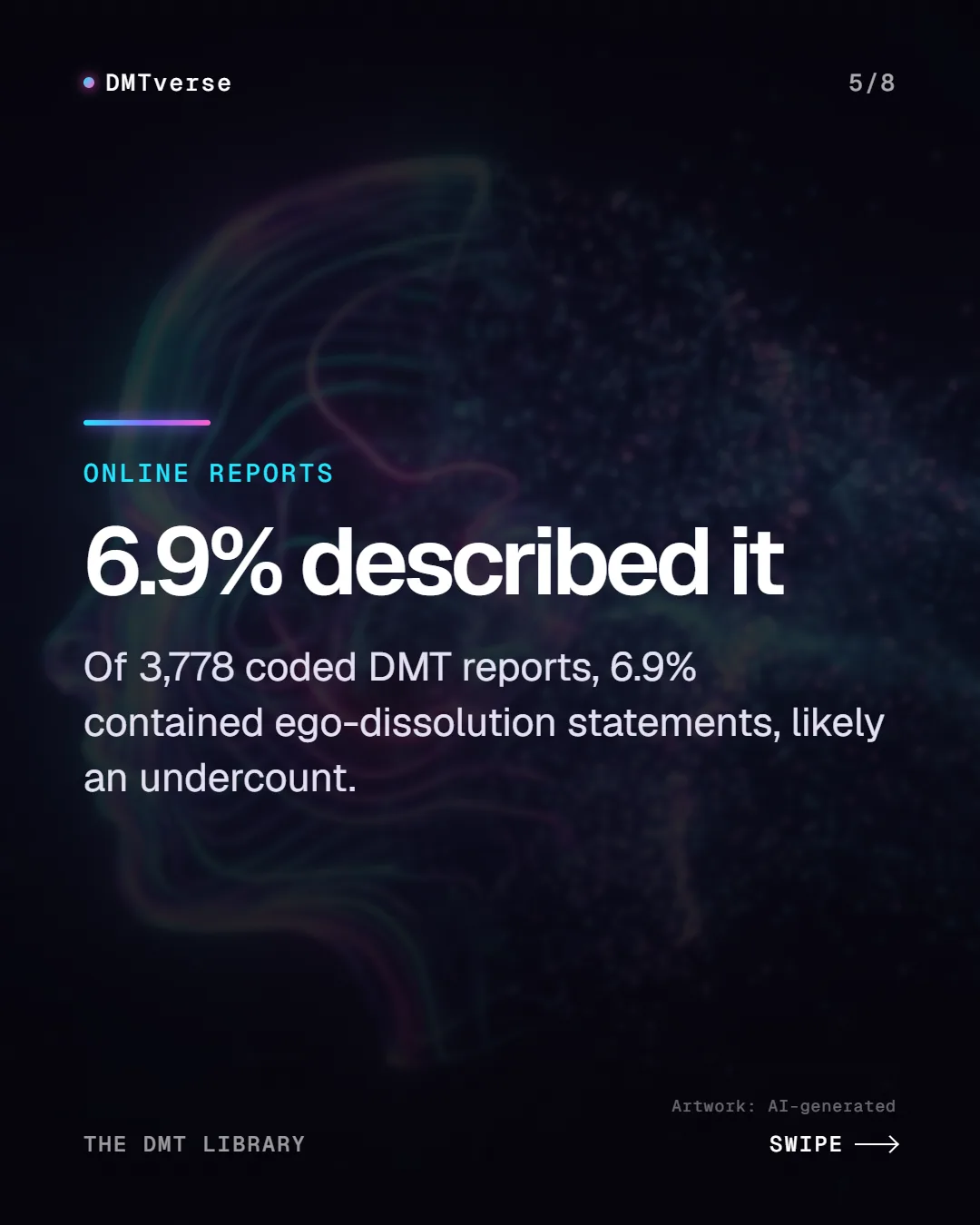
It depends on how you look. In 3,778 DMT experiences posted to an online forum and coded by a University of Toronto-led team, 6.9% contained at least one EDI-type statement; the most frequent were a dissolution of “self” or ego (3.7%) and losing all sense of ego (3.5%). The authors caution that the EDI is validated for self-report, not for coding other people’s writing (Lawrence et al., 2022). Forum posts also tend to focus on visions and beings, so this is likely an undercount. Evidence: preliminary.
In the lab, ego dissolution travels with other features. In a 2018 placebo-controlled study, 13 healthy volunteers rated their DMT session on a standard near-death-experience scale, the EDI and a mystical-experience questionnaire. The bigger a person’s rise in ego dissolution, the bigger their rise in near-death-type features (r = 0.69) (Timmermann et al., 2018). That is a correlation in a small group. Evidence: preliminary. See also DMT and near-death experiences.
What happens in the brain during DMT ego dissolution?
The most direct DMT evidence is a 2026 analysis that pooled EEG recordings from two placebo-controlled, single-blind Imperial College studies, giving 27 healthy participants (Irrmischer et al., 2026). The idea they tested is “criticality”: healthy brain rhythms are thought to sit near a balance point between too much order and too much disorder. They found:
- DMT shifted brain rhythms away from that balance point in the alpha band and neighbouring frequencies, towards the more ordered, “subcritical” side.
- Entropy, a measure of unpredictability, rose, while complexity fell.
- The size of the shift in alpha and theta rhythms correlated with how strongly people rated the item “I experienced a disintegration of my usual sense of self or ego”.
- The authors note a limitation: they did not ask participants what they understood that item to mean.
The direction runs against the influential “entropic brain” hypothesis, which, as the authors describe it, predicts that psychedelics move brain dynamics closer to criticality from a slightly subcritical waking baseline (Irrmischer et al., 2026). Evidence: preliminary; the link to the self is a correlation with one rating item.
The two source studies found that DMT sharply reduced alpha and beta rhythms in 13 people, with brain changes closely tracking the subjective experience over time (Timmermann et al., 2019), and that the largest changes in brain connectivity were in high-level “transmodal” regions rich in the 5-HT2A receptor, the main target of classic psychedelics (Timmermann et al., 2023). Evidence: preliminary, from small samples.
Similar questions have been asked of psilocybin. In a 2015 placebo-controlled study of 15 people, psilocybin-related ego dissolution was associated with reduced connectivity between the medial temporal lobe, a memory hub, and high-level cortex, and with a breakdown of the salience network (Lebedev et al., 2015). That was psilocybin, not DMT. Meanwhile, a 2026 theory paper notes that 5-MeO-DMT, a close relative, often produces non-dual or ego-dissolving states rather than encounters with beings (Mago et al., 2026), which hints that “ego death” and entity encounters may involve different processes. Evidence: preliminary. More on the brain side in what happens in the brain on DMT and DMT and the default mode network.
Is DMT ego death frightening?
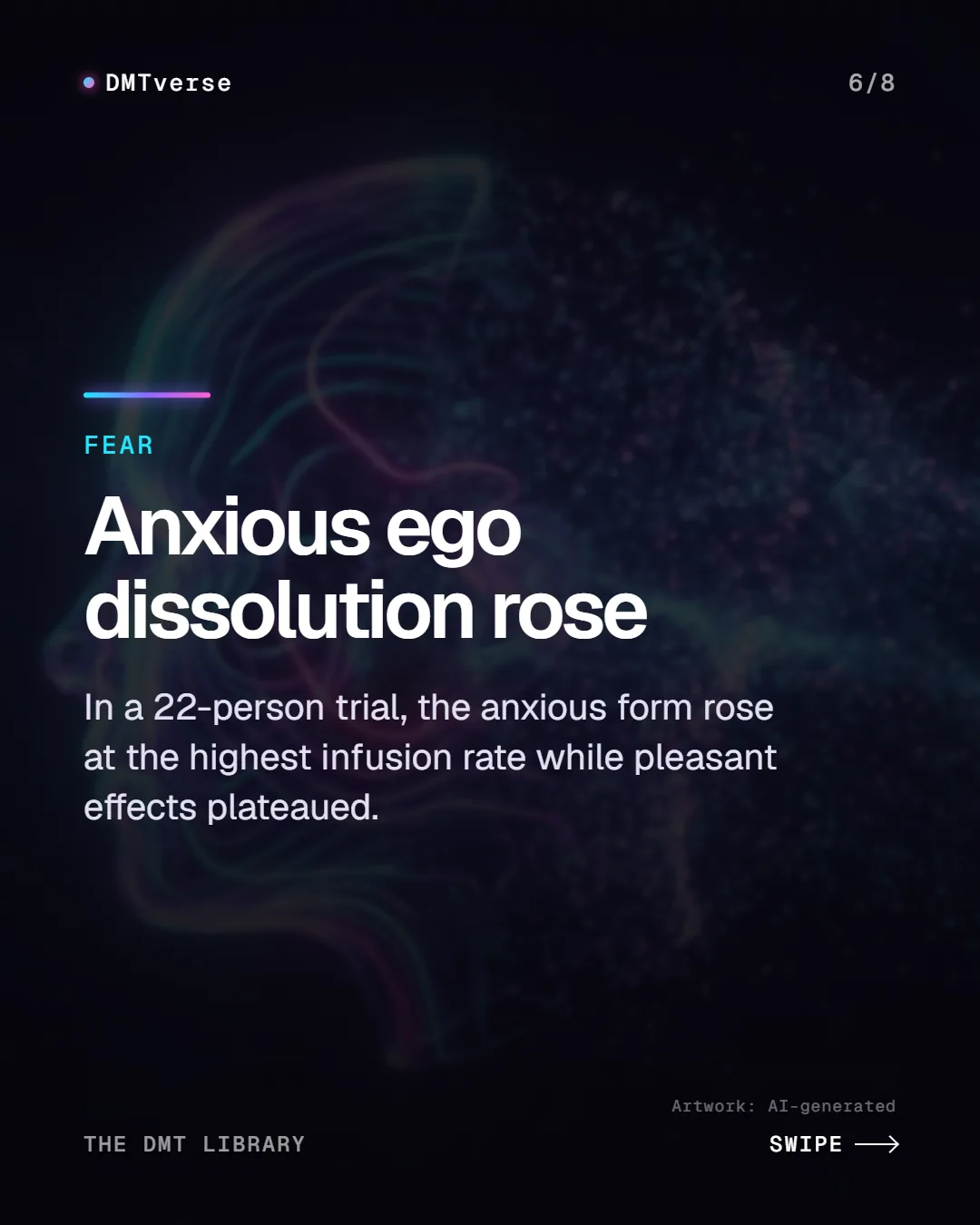
It can be. In Rick Strassman’s 1990s hospital studies, 12 experienced volunteers described a brief, overwhelming “rush” and a “loss of control” leading into a dissociated state in which euphoria and anxiety alternated or existed together (Strassman et al., 1994). In a 2025 trial at University Hospital Basel, 22 healthy participants received two-hour DMT infusions at several rates in a double-blind, placebo-controlled design. Pleasant effects levelled off, but at the highest rate “anxious ego dissolution” increased further and anxiety was significantly higher than on placebo (Erne et al., 2025). Rates are not reproduced here. Evidence: preliminary.
Outside the lab, fear is common in reports. In the coded forum reports, items from the fear section of a challenging-experience questionnaire appeared in 22.2% of experiences. The authors note that ego dissolution can bring a sense of unity but also a “dread of ego dissolution”, with possible destabilising effects through depersonalisation and derealisation (Lawrence et al., 2022). In a 2020 survey of 2,561 people recalling their most memorable DMT encounter, 41% reported fear (Davis et al., 2020). Evidence: preliminary (self-selected reports).
Not a goal to aim for
Popular culture sometimes treats ego death as something to achieve. The research does not support that framing: it records ego dissolution as one feature among many, sometimes accompanied by fear, and it gives no basis for seeking it. Supervised lab studies screened their volunteers carefully, and their results do not transfer to anyone else.
Is ego death the same as depersonalisation?
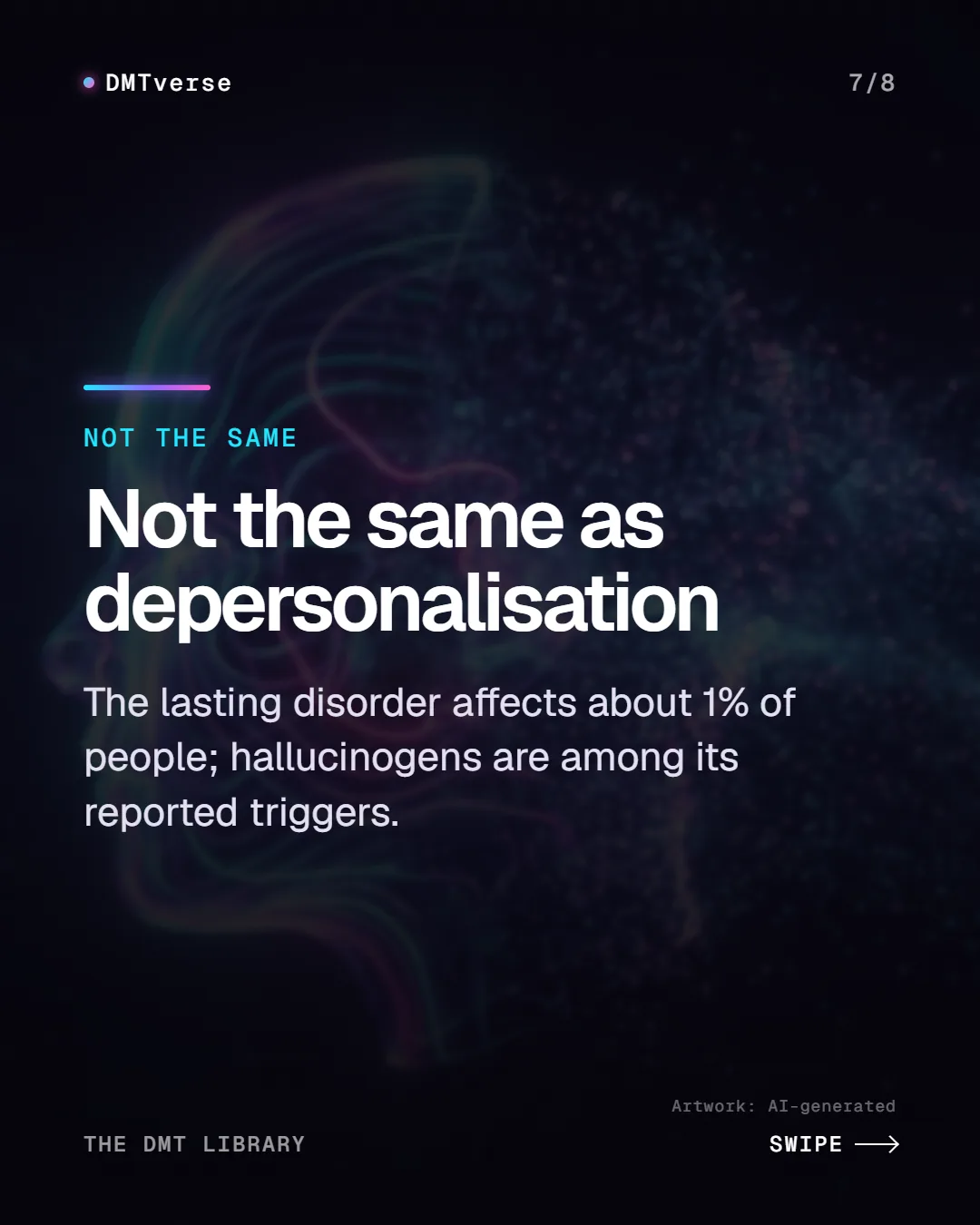
No, though they are related. Depersonalisation (the self feels unreal) and derealisation (the world feels unreal) are common, short-lived effects of classic psychedelics that usually stop when the drug wears off. When these symptoms last most of the day for months, the diagnosis of depersonalisation-derealisation disorder is likely (Michal, 2026). A 2023 systematic review of 23 studies puts the disorder at around 1% of the general population (Yang et al., 2023). Evidence: established.
Drugs can trigger it. In an internet survey of 394 adults with chronic depersonalisation, 196 said a drug set it off; cannabis and hallucinogens were the most common, followed by ecstasy. Drug-triggered and other cases looked alike and responded similarly, and the drug-triggered group improved more over time (Simeon et al., 2009). There are no DMT-specific figures. One specialist argues that psychedelics act as a catalyst that speeds the onset in vulnerable people rather than as the sole cause, and that the “never-ending trip” framing is reductionist and may lead to false illness beliefs and erode patients’ self-efficacy (Michal, 2026). That is one expert’s view. Evidence: preliminary.
If ego dissolution and depersonalisation share a mechanism, that has not been shown. One possibility, which is our framing and has not been tested, is that the sense of being a real self and the sense of the world being real are set by related processes that DMT and depersonalisation push in different directions. Our article on why DMT feels more real than reality covers the realness side. Evidence: unresolved.
If someone is in danger
Call 911 for immediate danger or urgent medical help, including if someone is unconscious, not breathing or having a seizure. In Ontario, the Ontario Poison Centre is at 1-800-268-9017; every province has a poison centre, listed by SickKids (AboutKidsHealth). If you or someone you know is thinking about suicide, call or text 9-8-8, 24 hours a day (Government of Canada). See also our safety page and how to help someone having a bad trip. If the world or your sense of self has felt unreal for weeks after any drug experience, speak to a doctor.
What we still don’t know
- Whether “ego dissolution” is one experience or several. Researchers increasingly think several (preliminary).
- How often it happens with DMT in general. Forum coding gives 6.9%, but forum posts are not designed to capture it (unresolved).
- Whether the criticality shift causes the loss of self, follows from it, or just accompanies it. The evidence is one correlation in 27 people (unresolved).
- Why some ego dissolution is peaceful and some terrifying (unresolved).
- Whether DMT specifically can trigger lasting depersonalisation, and in whom. No DMT-specific data exist (unresolved).
The fair summary: ego dissolution is a real and measurable part of many psychedelic experiences, with a validated if imperfect scale and a first DMT brain correlate. It is not a reward, it is sometimes frightening, and it is different from a lasting loss of the sense of reality. For what people report alongside it, read DMT entity types explained.
Common questions
What is DMT ego death?
The popular name for ego dissolution: a temporary breakdown of the usual sense of being a separate self, sometimes including the boundary between self and world. Researchers measure it with self-report scales after the experience.
What is the Ego Dissolution Inventory?
An 8-item self-report scale published in 2016, validated in an online survey of 691 people describing 1,828 drug experiences. Its scores rose with dose for psychedelics but not for cocaine or alcohol. A German translation did not confirm its single-factor structure.
What happens in the brain during ego dissolution on DMT?
In one 2026 EEG analysis of 27 people, DMT shifted brain rhythms away from a balanced “critical” state towards a more ordered one, and the size of the shift correlated with ratings of a disintegrating sense of self. It is a single, small correlational study.
Is ego death on DMT scary?
It can be. Early hospital studies described euphoria and anxiety alternating, a 2025 trial found anxious ego dissolution increased at the highest infusion rate, and 41% of a 2020 survey reported fear during their encounter.
Is ego death the same as depersonalisation?
No. Ego dissolution is temporary and happens during the experience. Depersonalisation-derealisation disorder is a lasting condition affecting about 1% of people; hallucinogens are among the reported triggers, though there are no DMT-specific data.
How common is ego death on DMT?
Nobody knows. In 3,778 online reports, 6.9% described ego-dissolution features, but posts are not designed to capture it. Lab studies measure its strength, not how often it happens across all users.
Shroomverse sells mushroom products. This article is general information about ego dissolution in published DMT research. It is not medical, legal or purchasing advice, and it does not recommend any product.
SOURCES
- Ego-Dissolution and Psychedelics: Validation of the Ego-Dissolution Inventory (EDI) (Nour MM, Evans L, Nutt D, Carhart-Harris RL, Frontiers in Human Neuroscience 10:269, 2016), Frontiers (peer-reviewed, open access); PMC4906025. Accessed . Abstract read via Europe PMC. Supports the definition (compromised sense of self); 8 items; 691 participants, 1,828 experiences (1,043 psychedelic, 377 cocaine, 408 alcohol); single factor; alpha 0.93; correlation with unitive experience (rho 0.735); dose correlation for psychedelics only; ego inflation with cocaine.
- Phenomenological assessment of psychedelics induced experiences: Translation and validation of the German Challenging Experience Questionnaire (CEQ) and Ego-Dissolution Inventory (EDI) (Dworatzyk K, Jansen T, Schmidt TT, PLoS One, 2022), PLOS (peer-reviewed, open access); PMC8926265. Accessed . Abstract read via Europe PMC. Confirmatory factor analysis did not support the single-factor German EDI; five items loaded on a common factor.
- Psychedelics, Meditation, and Self-Consciousness (Millière R, Carhart-Harris RL, Roseman L, Trautwein FM, Berkovich-Ohana A, Frontiers in Psychology 9:1475, 2018), Frontiers (peer-reviewed, open access); PMC6137697. Accessed . Abstract read via Europe PMC. Review: self-consciousness as multidimensional; neither meditation nor psychedelic states uniform; differences between experiences described as self-loss.
- Finding the self by losing the self: Neural correlates of ego-dissolution under psilocybin (Lebedev AV, Lövdén M, Rosenthal G, Feilding A, Nutt DJ, Carhart-Harris RL, Human Brain Mapping 36(8):3137–3153, 2015), Wiley (peer-reviewed); PMC6869189. Accessed . Abstract read via Europe PMC. 15 healthy subjects, placebo-controlled fMRI; ego dissolution described as the self disintegrating or the self–world border dissolving; associated with reduced medial temporal lobe–cortex connectivity and salience-network disintegration. Psilocybin, not DMT; dose not reproduced here.
- Phenomenology and content of the inhaled N,N-dimethyltryptamine (N,N-DMT) experience (Lawrence DW, Carhart-Harris R, Griffiths R, Timmermann C, Scientific Reports 12:8562, 2022), Springer Nature (peer-reviewed, open access); full text via Europe PMC, PMC9130218. Accessed . Full text read. Supports 3,778 experiences; at least one EDI item in 259 (6.9%); dissolution of self or ego 3.7%; lost all sense of ego 3.5%; questionnaires validated for self-report, not third-party coding; CEQ fear items 22.2%; “dread of ego dissolution” and possible destabilisation via depersonalisation and derealisation.
- DMT Models the Near-Death Experience (Timmermann C, et al., Frontiers in Psychology 9:1424, 2018), Frontiers (peer-reviewed, open access); full text via Europe PMC, PMC6107838. Accessed . Full text read. 13 healthy participants, within-subjects placebo-controlled; EDI used; DMT-minus-placebo EDI change correlated with NDE scale change (r = 0.69).
- DMT-Induced Shifts in Criticality Correlate with Self-Dissolution (Irrmischer M, Aqil M, Luan L, Wang T, Engelbregt H, Carhart-Harris R, Linkenkaer-Hansen K, Timmermann C, Journal of Neuroscience 46(2):e0344252025, 2026), Society for Neuroscience (peer-reviewed, open access); full text via Europe PMC, PMC12809620. Accessed . Full text read. Pooled EEG from two placebo-controlled, single-blind studies (Timmermann 2019, 2023), 27 healthy participants; shift away from criticality in alpha and adjacent bands, toward subcritical; entropy up, complexity down; alpha and theta shifts correlated with the single item on disintegration of the usual sense of self or ego; limitation that item meaning was not probed.
- Neural correlates of the DMT experience assessed with multivariate EEG (Timmermann C, et al., Scientific Reports 9:16324, 2019), Springer Nature (peer-reviewed, open access); full text via Europe PMC, PMC6864083. Accessed . Abstract and full text read. 13 participants; reduced alpha and beta power versus placebo; changes paralleled the subjective experience over time. One of the two datasets pooled by Irrmischer et al.
- Human brain effects of DMT assessed via EEG-fMRI (Timmermann C, et al., PNAS 120(13):e2218949120, 2023), National Academy of Sciences (peer-reviewed); full text via Europe PMC, PMC10068756. Accessed . Abstract and full text read. 20 healthy volunteers, placebo-controlled; largest effects in transmodal, 5-HT2A-rich cortex; the authors’ suggestion that normal function of this cortex may be needed for human-specific faculties but not wakeful consciousness itself. Dose not reproduced here.
- Acute dose-dependent effects and self-guided titration of continuous N,N-dimethyltryptamine infusions in a double-blind placebo-controlled study in healthy participants (Erne L, et al., Neuropsychopharmacology 50(6):1008–1016, 2025), Springer Nature (peer-reviewed, open access); full text via Europe PMC, PMC12032411. Accessed . Abstract and full text read. 22 healthy participants, randomised crossover, two-hour infusions; ceiling for positive effects; highest rate produced greater anxious ego dissolution (5D-ASC) than the next rate and significant anxiety vs placebo. Rates deliberately not reproduced.
- Dose-response study of N,N-dimethyltryptamine in humans. II. Subjective effects and preliminary results of a new rating scale (Strassman RJ, Qualls CR, Uhlenhuth EH, Kellner R, Archives of General Psychiatry 51(2):98–108, 1994), American Medical Association (peer-reviewed). Accessed . Abstract read via Europe PMC. 12 experienced volunteers; “loss of control” with an overwhelming “rush” leading to a dissociated state where euphoria alternated or coexisted with anxiety. Doses deliberately not reproduced.
- Survey of entity encounter experiences occasioned by inhaled N,N-dimethyltryptamine: Phenomenology, interpretation, and enduring effects (Davis AK, et al., Journal of Psychopharmacology 34(9):1008–1020, 2020), SAGE (peer-reviewed). Accessed . Abstract read via Europe PMC. 2,561 self-selected respondents; 41% reported fear during the encounter.
- Micro-phenomenology of immersion and perceived presences under DMT (Sanders JW, et al., Neuroscience of Consciousness, niag015, 2026), Oxford University Press (peer-reviewed, open access); full text via Europe PMC, PMC13366535. Accessed . Full text read. Supports the critique that questionnaires average across the experience and rely on broad constructs such as ego dissolution.
- Computational spirits: a neuroscientific account of psychedelic entity encounters (Mago J, et al., Neuroscience of Consciousness 2026(1):niaf069), Oxford University Press (peer-reviewed, open access); full text via Europe PMC, PMC13240852. Accessed . Full text read. Supports the observation that 5-MeO-DMT often induces non-duality or ego dissolution rather than autonomous entities.
- Psychedelic-Associated Depersonalization-Derealization Disorder (Michal M, Current Topics in Behavioral Neurosciences 77:217–239, 2026), Springer (book chapter, peer-reviewed series). Accessed . Abstract read via Europe PMC. DP/DR symptoms commonly elicited by classic psychedelics and usually ceasing when the drug is eliminated; diagnosis when persisting most of the day for months; the author’s argument that psychedelics act as a catalyst in vulnerable people and that the “never-ending trip” framing is reductionist.
- The Prevalence of Depersonalization-Derealization Disorder: A Systematic Review (Yang J, Millman LSM, David AS, Hunter ECM, Journal of Trauma & Dissociation 24(1):8–41, 2023), Taylor & Francis (peer-reviewed). Accessed . Abstract read via Europe PMC. 23 studies; prevalence around 1% in the general population.
- Is depersonalization disorder initiated by illicit drug use any different? A survey of 394 adults (Simeon D, Kozin DS, Segal K, Lerch B, Journal of Clinical Psychiatry 70(10):1358–1364, 2009), Physicians Postgraduate Press (peer-reviewed). Accessed . Abstract read via Europe PMC. 394 adults; 196 drug-initiated; cannabis and hallucinogens most common, then ecstasy; similar course; greater improvement over time in the drug-initiated group. No DMT-specific data.
- Mental health support: get help, Government of Canada, Public Health Agency of Canada. Accessed . Page read 20 October 2026. Supports calling 9-1-1 in immediate danger or for urgent medical support, and calling or texting 9-8-8, 24 hours a day, 7 days a week.
- Poison information centres in Canada, AboutKidsHealth, The Hospital for Sick Children (SickKids). Accessed . Page read 20 October 2026. Supports Ontario toll-free 1-800-268-9017 and calling 911 if someone is unconscious, not breathing or having a seizure.
CHANGES
- : Linked the new general explainer, what is ego death; general ego-death keywords moved to it so the two pages target different searches.
- : Linked glossary definitions.
- : Published. Sources opened and checked on this date.
- : Editorial review: brain section split and trimmed (a tangential claim about high-level cortex removed); 5-HT2A defined and linked to the glossary; an unsourced “some researchers suspect” claim recast as our own untested framing; link to the breakthrough article added.



