THE SHROOMVERSE JOURNAL ✳ 13 MIN READ
What happens in the brain on DMT? EEG, fMRI and the limits of the evidence
Topic: DMT
Published Updated
Listen: the 3-minute version
AI-narrated summary of this article
Short answer, checked 20 October 2026
On DMT, the brain’s main resting rhythm, alpha, collapses. In EEG studies the drop tracks how intense people rate the experience, minute by minute, while slower delta and theta rhythms rise and the signal becomes more varied. Brain scans show high-level regions, the ones richest in the 5-HT2A receptor, linking up more with the rest of the brain. The studies are small, though. A 2026 pooled analysis found that claims of networks ‘dissolving’ were overstated, popular ‘entropy’ measures disagree with each other, fMRI tracks blood rather than neurons, and few measures map onto specific parts of the experience.
THE SHORT VERSION · SWIPE
On this page 10 sections
DMT suits brain-recording labs because its effects are short. In one EEG study, effects peaked two to three minutes after the injection and stayed above placebo for 17 minutes, so a whole experience fits inside one recording (Timmermann et al., 2019). This article walks through what those recordings show, study by study, and where the evidence is thinner than headlines suggest. For the molecule itself, start with what is DMT.
Education only, not guidance
This article describes published research. It gives no amounts, no instructions and no advice on use, and it does not describe any effect as a benefit. Routes of use appear only to describe how a named study was designed. DMT is a controlled substance in Canada. Evidence labels: established (shown in peer-reviewed studies and not seriously disputed), preliminary (early, small, animal-only or indirect) and unresolved (an open question).
Why do scientists use DMT to study the brain?
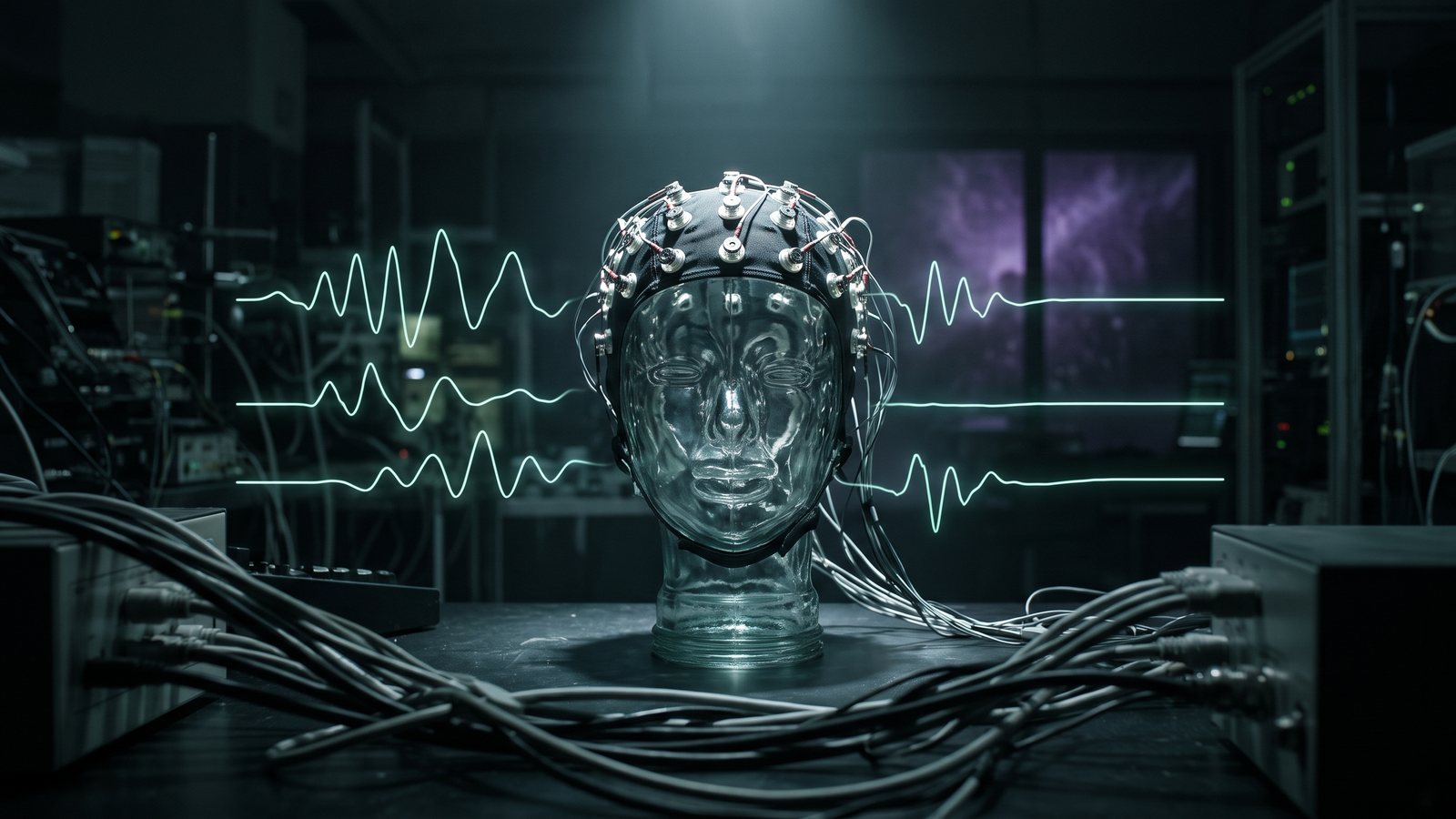
Researchers at Imperial College London describe studying the transitions into and out of the DMT state as a way of advancing knowledge on the neurobiology of conscious states. Because the experience is short, one session can capture the brain before, during and after the peak, and relate each moment to the person’s ratings (Timmermann et al., 2019). Evidence: established.
Two main tools appear below. EEG records electrical activity through sensors on the scalp; it is fast, tracking changes over milliseconds, but blurry about where in the brain they come from. Functional MRI (fMRI) is the reverse: sharper about where, slower about when, and it measures blood oxygen rather than nerve-cell firing directly. A third method, PET, can map where particular receptors sit. Evidence: established.
| Tool | What it actually records | Main limit |
|---|---|---|
| EEG | Electrical rhythms from the scalp, moment to moment | Poor at locating the source of a signal |
| fMRI | Changes in blood oxygen, used as a stand-in for activity | Indirect; psychedelics also affect blood vessels |
| PET maps | Where a receptor, such as 5-HT2A, is concentrated | Usually from separate people, not the same scan |
What does DMT do to brain waves?
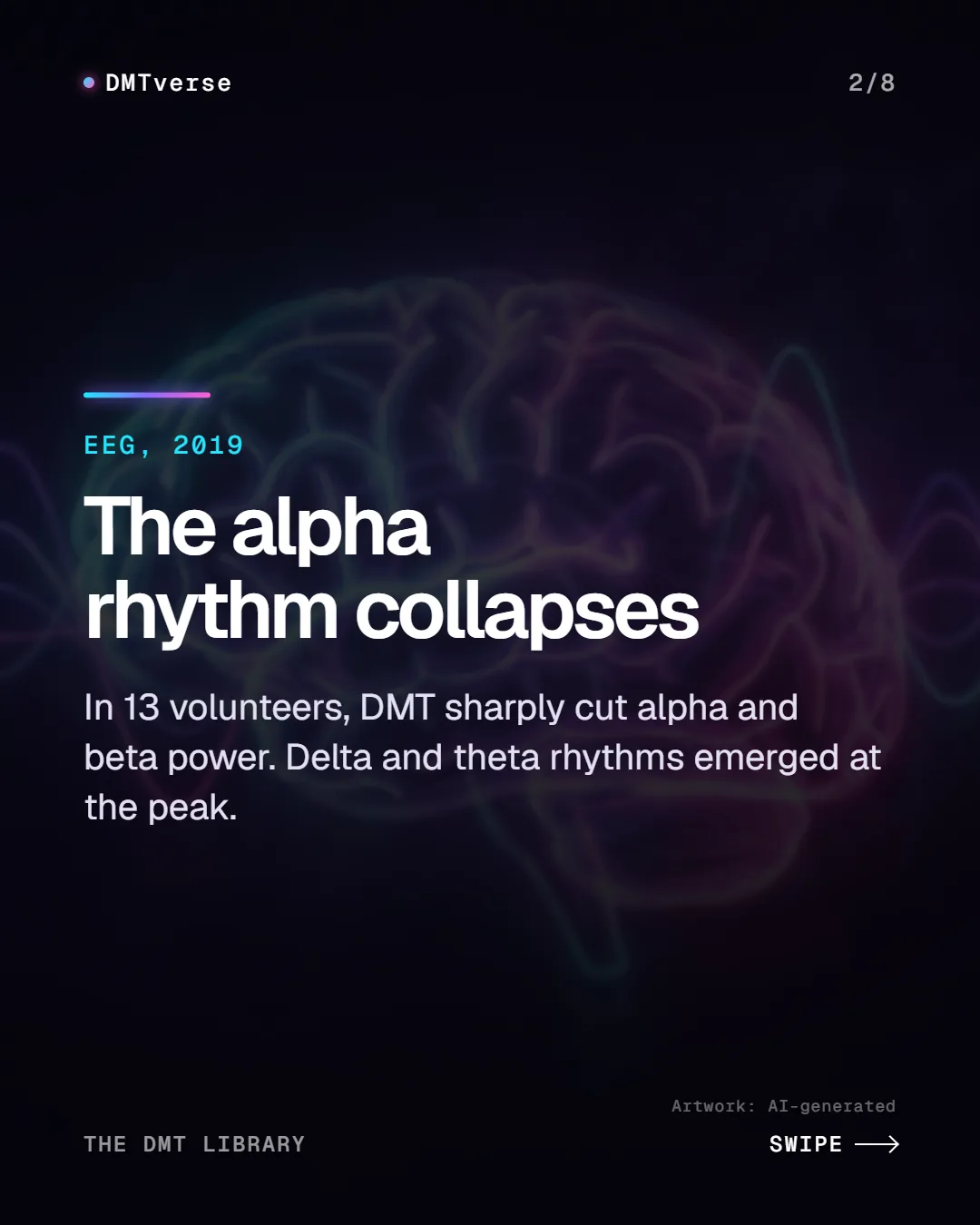
In the first modern EEG study of intravenous DMT, 13 healthy volunteers were recorded with their eyes closed. Compared with placebo, DMT markedly reduced power in the alpha and beta frequency bands and robustly increased signal diversity, a measure of how varied the signal is from moment to moment. Participants rated intensity every minute, and the lower their alpha power, the higher their rating, across every scalp sensor. Slower delta and theta rhythms emerged, and their rise tracked the peak of the experience, especially its eyes-closed visual side (Timmermann et al., 2019). Evidence: established for the alpha collapse.
The design had limits the authors name: it was single-blind and fixed-order, with placebo always on the first visit and DMT a week later. ‘Signal diversity’ here means Lempel-Ziv complexity, a count of how many distinct patterns a signal contains; it comes up again in the entropy section below. Evidence: established for these design limits.
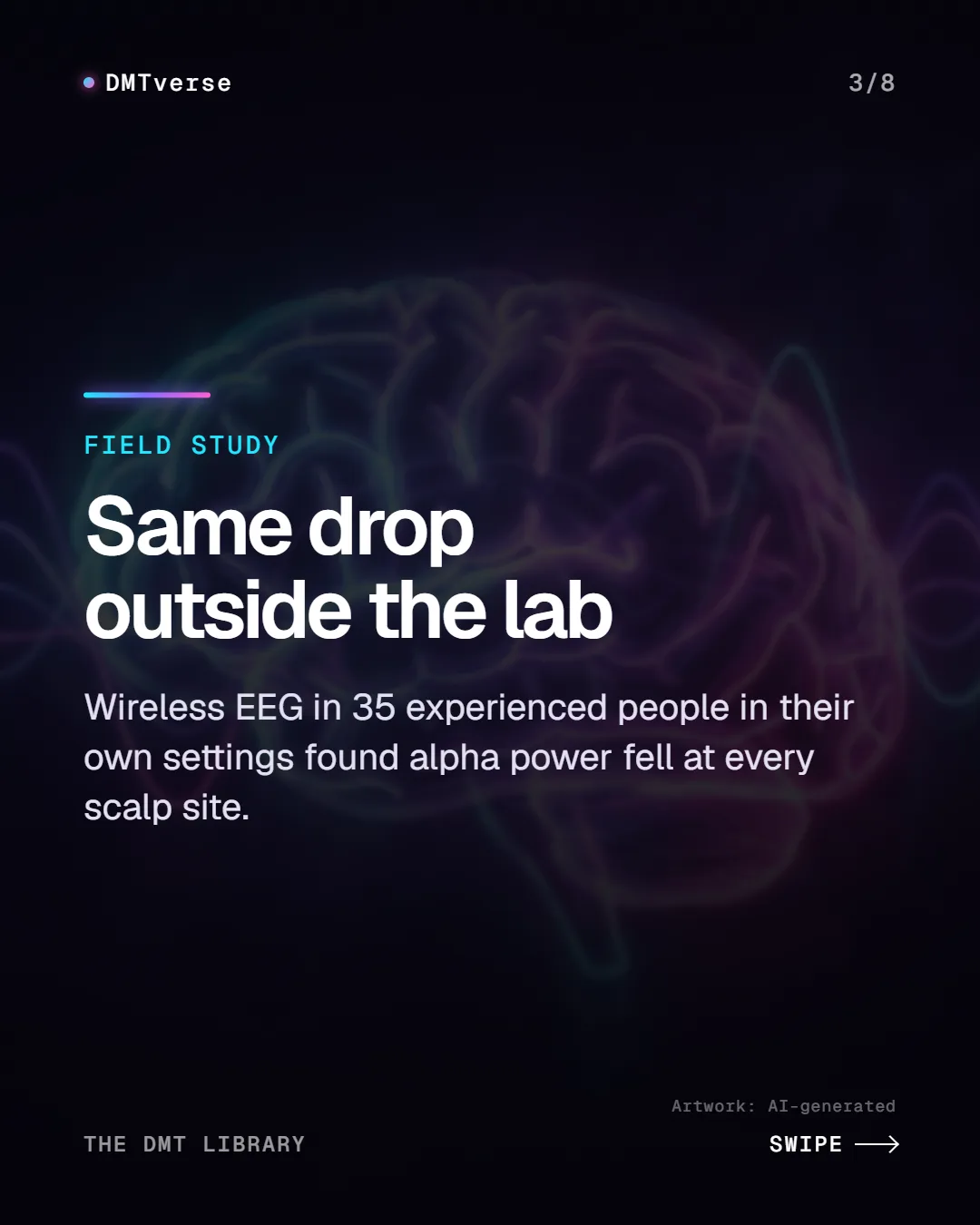
The same alpha drop appeared outside the lab. A field study recorded wireless EEG in 35 healthy, experienced people who inhaled DMT in their own familiar settings. DMT significantly decreased alpha power at every scalp location, while increasing delta and gamma power; gamma increases correlated with some features of mystical-type experience (Pallavicini et al., 2021). A naturalistic study cannot control everything a lab can, so the agreement between the two is what matters. Evidence: established.
Is the DMT brain ‘like dreaming’?
The 2019 authors noted that the emergence of theta and delta rhythms has classically been associated with REM-sleep dreaming, and likened the DMT state to a dream-like, inwardly driven world (Timmermann et al., 2019). That is an analogy, not a measurement: no sleep recordings were compared in the study. Evidence: unresolved.
Do DMT brain waves travel as if the eyes were open?
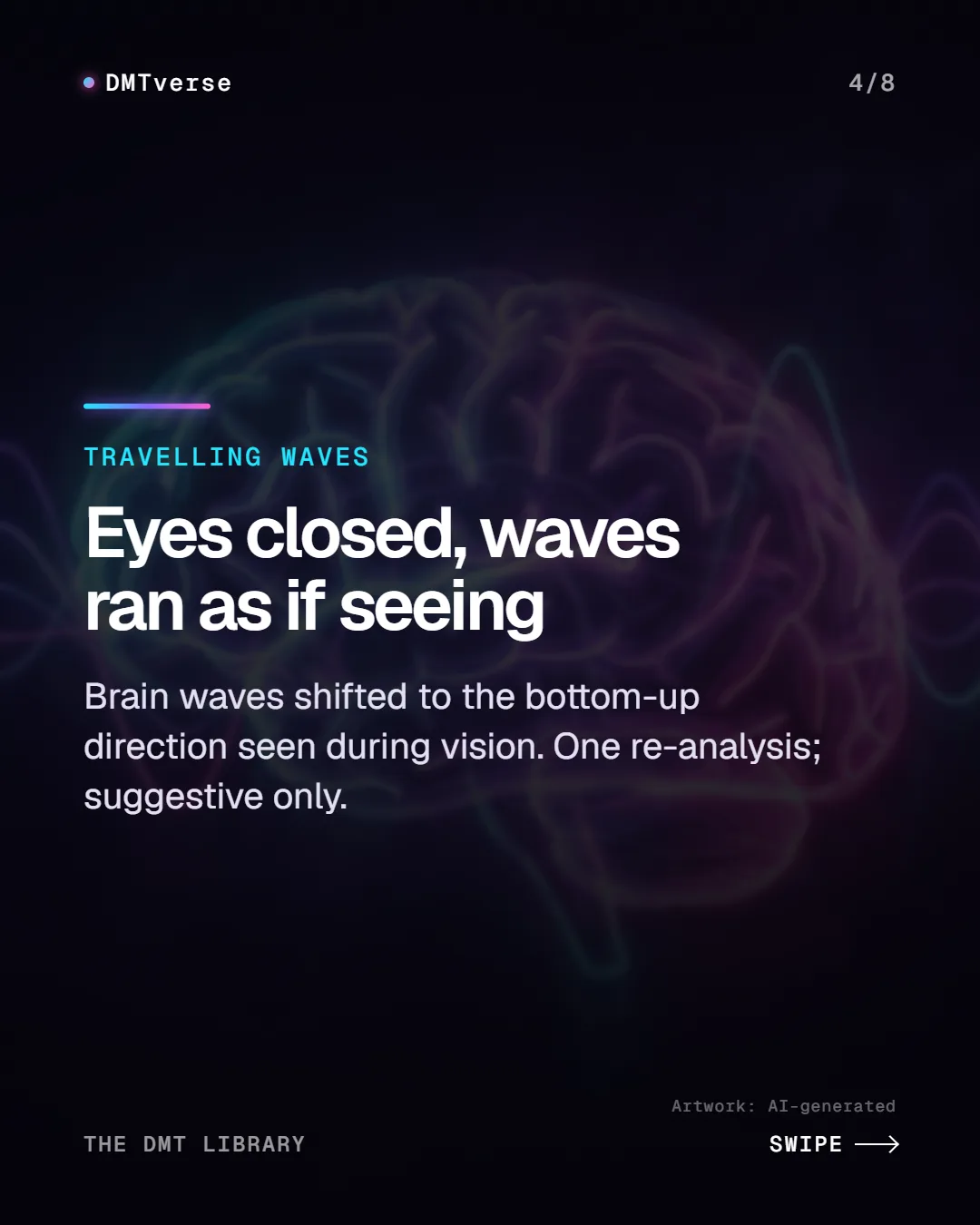
EEG rhythms are not static; they can sweep across the scalp as travelling waves. A re-analysis of the Imperial EEG data looked at the direction of those waves while participants kept their eyes closed. Under DMT, the usual top-down, “backward” alpha waves of closed-eye rest decreased, and the bottom-up, “forward” wave increased, a pattern the authors describe as similar to that elicited by visual stimulation (Alamia et al., 2020). They read this as support for a model in which psychedelics loosen the brain’s top-down expectations. The comparison with real visual input relied on a different dataset, so it is suggestive rather than a direct test. Evidence: preliminary.
What did EEG and fMRI together show?
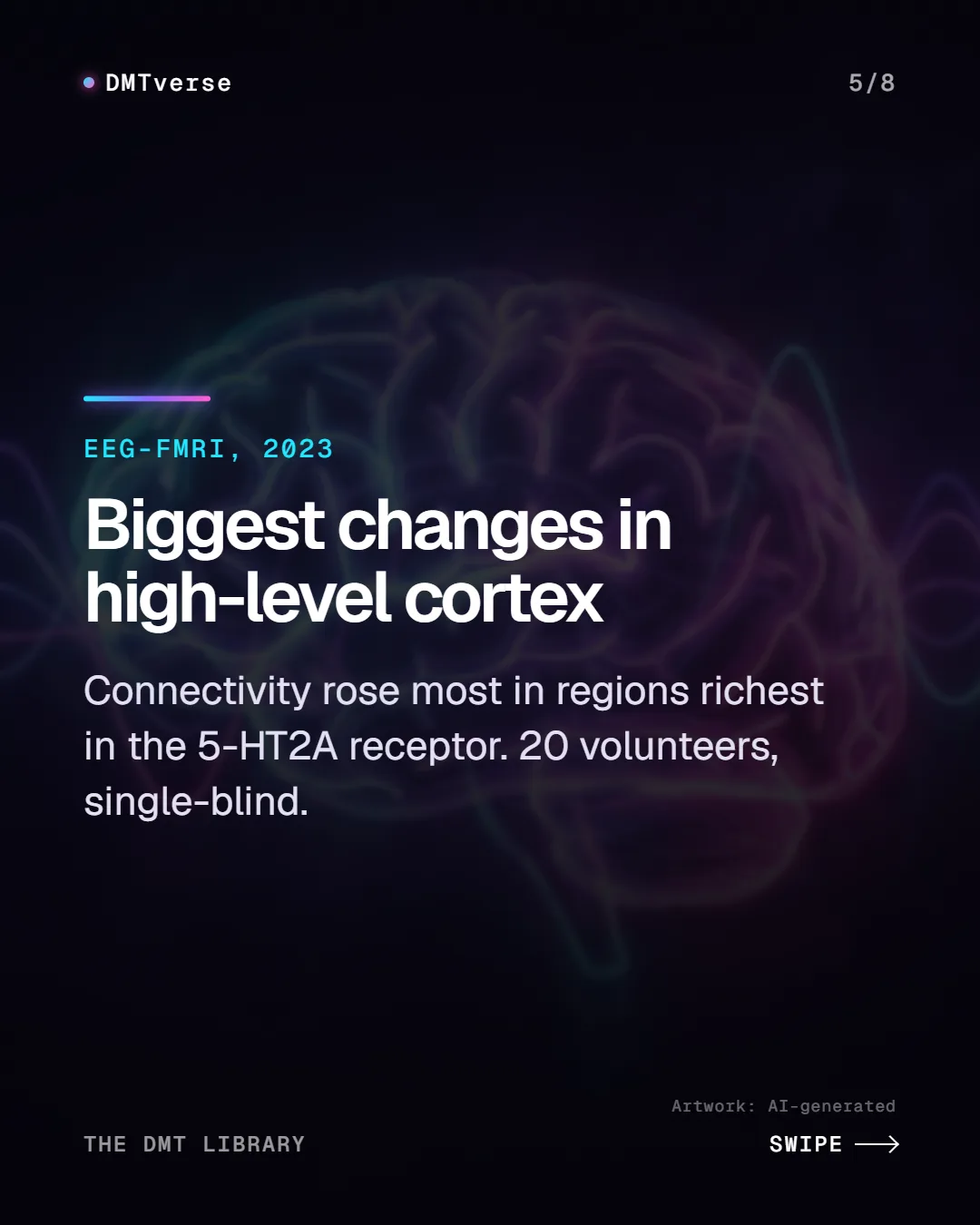
In 2023 the same group recorded EEG and fMRI at the same time, before, during and after intravenous DMT and, on a separate day, placebo, in 20 healthy volunteers. The fMRI results showed robust increases in global functional connectivity, “network disintegration and desegregation”, meaning the brain’s usual networks became less internally cohesive and less separate from each other, and a compression of the principal cortical gradient, the axis that normally runs from sensory regions to high-level association regions (Timmermann et al., 2023). Evidence: preliminary.
The biggest increases in connectivity were in transmodal cortex, the high-level regions that integrate information, including the default mode and frontoparietal networks. Maps of these changes weighted by how intense people rated the experience correlated with independent PET maps of where the 5-HT2A receptor is densest (Timmermann et al., 2023). That is the receptor DMT acts on most; see DMT and the 5-HT2A receptor. Evidence: preliminary.
The paper is candid about its limits. The design was single-blind, head motion was a concern (the team re-ran key analyses on subsamples without motion problems), and although global connectivity tracked overall intensity, “few correlations” were found between imaging measures and specific effects such as visual imagery, entity encounters or feelings of immersion (Timmermann et al., 2023). In plain terms: the scans show the brain changing a lot, not where any particular part of the experience happens. Evidence: established for that limit.
What happened when the field pooled its data?
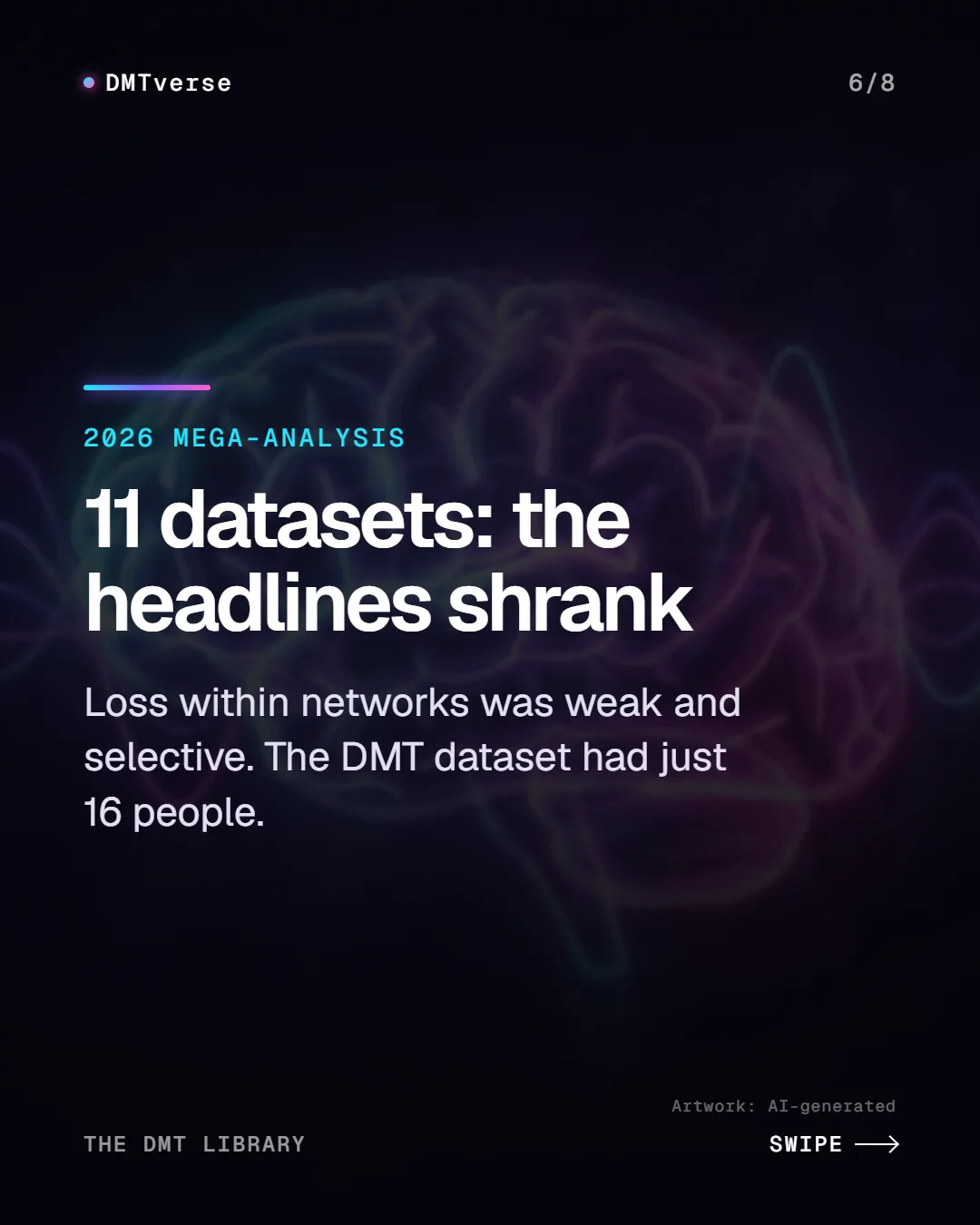
Single fMRI studies of psychedelics have produced “fragmented and sometimes inconsistent findings”. To test what holds up, a 2026 mega-analysis ran 11 resting-state fMRI datasets, covering psilocybin, LSD, mescaline, DMT and ayahuasca from groups on three continents, through one uniform pipeline. The most prominent shared signature was increased connectivity between transmodal networks (default, frontoparietal and limbic) and sensory networks (visual and somatomotor). Reductions in connectivity within networks were only “weak-to-moderate and selective”, in contrast to several single-site reports (Girn et al., 2026). Evidence: preliminary, but the strongest pooled evidence so far.
DMT contributed one dataset of 16 people. Its pattern looked like an amplified version of the all-drug average, but its statistical estimates were among the least certain, which the authors attribute to single studies with small samples. They also note that the datasets used different scanners and timings, and that the strong effects of psychedelics make true blinding hard (Girn et al., 2026). The idea that psychedelics simply “dissolve” brain networks is examined in detail in DMT and the default mode network. Evidence: preliminary.
Is the DMT brain really ‘more entropic’?
A popular theory says psychedelics raise brain “entropy”, a loose word for disorder or unpredictability in brain signals. A 2026 study tested this idea directly in psilocybin fMRI data from 28 healthy people with 121 scans. It found that 8 of 14 published entropy measures showed no consistent effect, results for one common measure (Lempel-Ziv complexity of the fMRI signal) were inconsistent, and the measures correlated poorly with one another. The authors conclude that these metrics “do not reflect a singular construct” (McCulloch et al., 2026). That study used psilocybin, not DMT, but it shows that “entropy goes up” means little unless the measure is named. Evidence: preliminary.
For DMT itself, a 2026 study recorded EEG in 19 people across two sessions in a naturalistic setting, with two blinded dose levels in counterbalanced order (dose not reproduced here), while participants traced how their experience changed over time. Alpha power and a measure called permutation entropy were most strongly linked to the moment-to-moment experience. Lempel-Ziv complexity, which the authors note was “previously hailed as a robust correlate”, gave the weakest associations (Lewis-Healey et al., 2026). The experience ratings were traced afterwards, not live. Evidence: preliminary.
A third 2026 study, pooling EEG from DMT experiments, looked at “criticality”, the idea that a healthy brain hovers near a tipping point between order and disorder. DMT shifted brain rhythms away from criticality in the alpha and nearby bands, toward the more ordered, subcritical side; entropy increased while complexity fell, and the size of the shift correlated with ratings of self-dissolution (Irrmischer et al., 2026). That runs against the simple story that DMT pushes the brain toward chaos. Evidence: preliminary.
- 2019Timmermann et al.: alpha and beta power collapse; delta and theta emerge; signal diversity rises.Design note EEG, 13 people, single-blind, fixed order
- 2020Alamia et al.: travelling waves shift from top-down to bottom-up with eyes closed.Design note Re-analysis of the same EEG data
- 2021Pallavicini et al.: alpha drop replicated in natural settings; gamma rises.Design note Field EEG, 35 people, no lab control
- 2023Timmermann et al.: connectivity rises most in transmodal, 5-HT2A-rich cortex.Design note EEG-fMRI, 20 people, single-blind
- 2026Girn et al.: pooled data show between-network coupling; within-network loss weak.Design note Mega-analysis, 11 datasets; DMT n = 16
- 2026Lewis-Healey et al.: complexity is the weakest correlate of experience.Design note EEG, 19 people, naturalistic
- 2026Irrmischer et al.: DMT moves rhythms away from criticality.Design note Pooled EEG; retrospective ratings
Does fMRI measure neurons or blood?
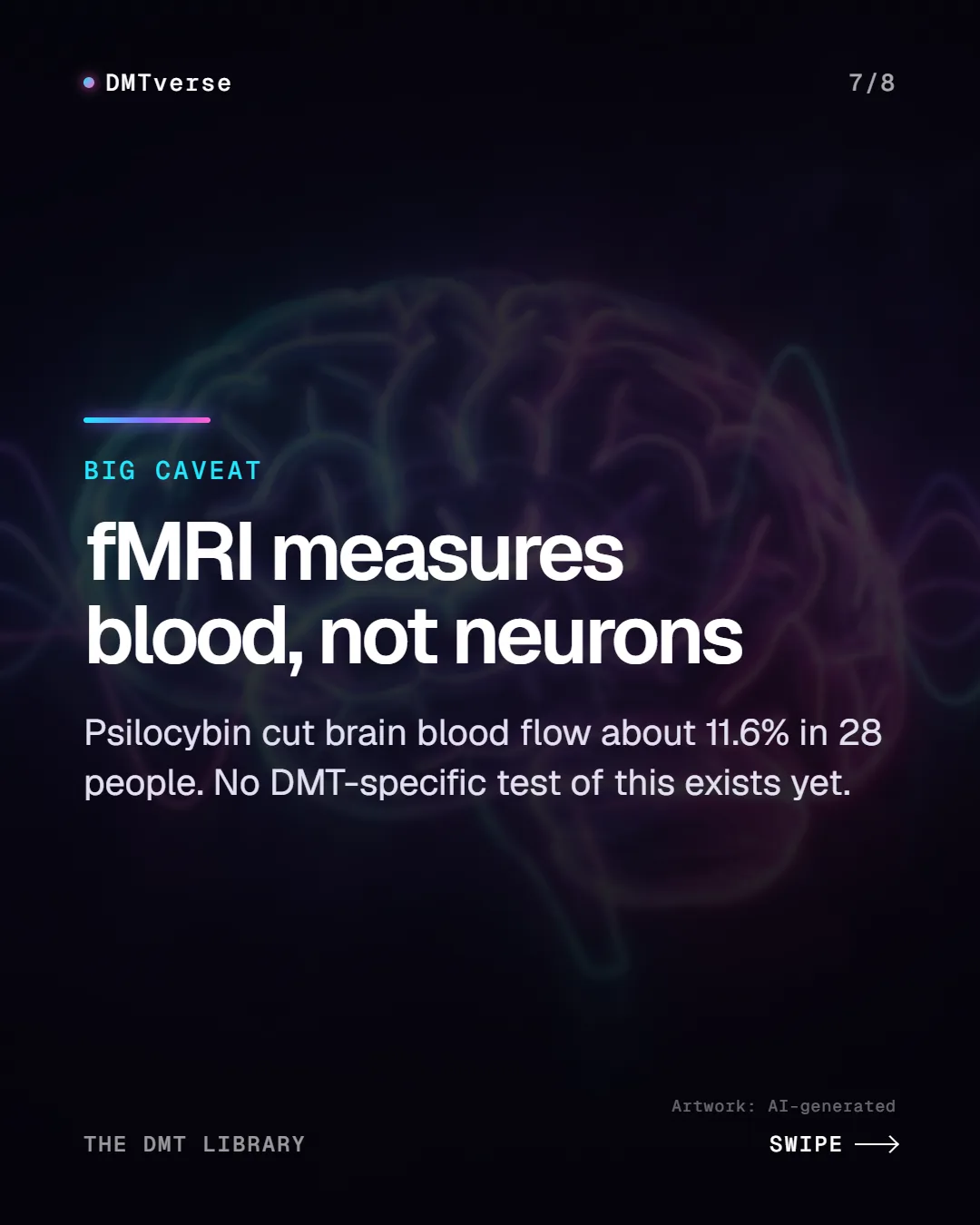
fMRI infers brain activity from blood oxygen. That matters because serotonin acts on blood vessels as well as on nerve cells. In a 2025 study of 28 healthy people, psilocybin lowered global cerebral blood flow by about 11.6% at peak effect and narrowed the internal carotid artery by 10.5% (Larsen et al., 2025). In mice, a 5-HT2A-activating psychedelic pulled apart the neuronal and blood-flow signals, so that connectivity measured from blood and from neurons changed in different ways (Padawer-Curry et al., 2025). Neither study used DMT, and we found no DMT-specific study of this effect. Evidence: preliminary for DMT; the general caveat is well supported.
The practical lesson is to read fMRI “connectivity” as a statistical relationship between blood-based signals, not as a picture of neurons wiring together. EEG measures electrical activity more directly, which is one reason the EEG alpha finding is the most trusted result in this field. Evidence: established.
What might all this mean?
The leading framework, called REBUS, proposes that psychedelics relax the weight the brain gives to its high-level assumptions, letting bottom-up information flow more freely (Carhart-Harris and Friston, 2019). The travelling-wave result and the changes in transmodal cortex fit that picture, but fitting is not proof: it remains a well-developed hypothesis, not a demonstrated mechanism. Why the experience can feel “more real than real” is a separate question; see why DMT feels more real than reality. Evidence: unresolved.
What is still unknown about DMT and the brain?
- Which brain changes, if any, correspond to specific parts of the experience such as visions or entity encounters; so far very few correlations have been found (unresolved).
- Whether the network findings hold up in larger, independently run DMT samples; the pooled analysis had one DMT dataset of 16 people (preliminary).
- Which ‘entropy’ or complexity measure, if any, tracks the experience reliably; the measures disagree with each other (unresolved).
- How much of the fMRI signal under DMT reflects changes in blood vessels rather than neurons; no DMT-specific study exists that we could find (unresolved).
- What happens in the brain during longer DMT states studied with continuous infusions; we found no published imaging results (unresolved).
The fair summary: DMT reliably flattens the brain’s alpha rhythm and reshapes how its big networks talk to each other, with the strongest effects in the regions richest in its main receptor. Beyond that, the field is still sorting out which measures are meaningful. Evidence: established for the alpha collapse; preliminary for the network findings. For related questions, see whether the brain makes DMT and how long DMT lasts.
Common questions
What does DMT do to the brain?
In EEG studies, DMT collapses the brain’s alpha rhythm, and the size of the drop tracks how intense people rate the experience minute by minute. Slower rhythms emerge and the signal becomes more varied. fMRI shows the largest connectivity increases in high-level association regions rich in the 5-HT2A receptor. The studies are small.
Does DMT change brain waves?
Yes. Both a lab study of 13 people and a field study of 35 people found a marked drop in alpha power. Delta and theta rose in the lab study; delta and gamma rose in the field study. With eyes closed, travelling waves shifted toward the bottom-up direction usually seen during vision.
Is the DMT brain state the same as dreaming?
No study has shown that. Researchers have compared the rise in slow theta and delta rhythms to REM-sleep dreaming, but no sleep recordings were compared, so it is an analogy, not a finding.
Does DMT increase brain entropy?
It depends on the measure. Some signal-diversity measures rise under DMT, but a 2026 study found that published entropy measures disagree with each other, and in a DMT study the most famous one, Lempel-Ziv complexity, was the weakest link to experience. Another 2026 study found DMT moved rhythms toward the more ordered side of criticality.
Do brain scans show where DMT visions or entities come from?
No. The 2023 EEG-fMRI study found that global connectivity tracked overall intensity, but very few imaging measures correlated with specific effects such as visual imagery or entity encounters.
Can fMRI show neurons firing on DMT?
Not directly. fMRI measures changes in blood oxygen. Psychedelics also act on blood vessels: psilocybin reduced brain blood flow in one human study, and in mice a psychedelic made neuronal and blood signals diverge. No DMT-specific study of this exists that we found.
What did the 2026 mega-analysis find?
Pooling 11 fMRI datasets across five psychedelics, it found a robust increase in coupling between high-level and sensory networks, and only weak, selective reductions within networks. The DMT dataset had 16 people and the least certain estimates.
Shroomverse sells mushroom products. This article is general information about brain research on DMT. It is not medical, legal or purchasing advice, and it does not recommend any product.
SOURCES
- Neural correlates of the DMT experience assessed with multivariate EEG (Timmermann C, et al., Scientific Reports 9:16324, 2019), Springer Nature (peer-reviewed, open access); full text via Europe PMC, PMC6864083. Accessed . Full text read. 13 participants (6 female, 7 male), eyes closed; intensity rated every minute, peak 2–3 minutes after injection, above placebo for 17 minutes; lower alpha and beta power correlated with higher intensity ratings; alpha and beta power reduced; signal diversity increased; delta and theta emergence correlated with the peak, especially eyes-closed visuals; fixed-order, single-blind design named as a limitation; REM-dreaming comparison offered as an interpretation. Doses not reproduced.
- Neural and subjective effects of inhaled N,N-dimethyltryptamine in natural settings (Pallavicini C, et al., Journal of Psychopharmacology 35(4):406–420, 2021), SAGE (peer-reviewed). Accessed . Abstract read via Europe PMC. Wireless EEG in 35 healthy, experienced participants in natural settings; alpha power decreased at all scalp locations; delta and gamma increased; gamma linked to some mystical-type features.
- DMT alters cortical travelling waves (Alamia A, Timmermann C, Nutt DJ, VanRullen R, Carhart-Harris RL, eLife 9:e59784, 2020), eLife (peer-reviewed, open access); PMC7577737. Accessed . Abstract read via Europe PMC; DMTverse ledger (N3) records a full-text read and the authors' statement that a direct comparison with visual stimulation was not statistically possible. Eyes closed; top-down alpha waves decreased; bottom-up forward wave increased; interpreted as support for reduced precision of priors.
- Human brain effects of DMT assessed via EEG-fMRI (Timmermann C, et al., PNAS 120(13):e2218949120, 2023), National Academy of Sciences (peer-reviewed); full text via Europe PMC, PMC10068756. Accessed . Full text read. 20 healthy volunteers, single-blind, placebo-controlled; global functional connectivity increased, especially in default-mode, frontoparietal and salience networks (transmodal pole); network disintegration and desegregation; gradient compression; correlation with PET-derived 5-HT2A maps; head-motion checks; few correlations with specific subjective effects. fMRI analysis n = 16 per the DMTverse ledger and the reported t(15) statistic.
- An international mega-analysis of psychedelic drug effects on brain circuit function (Girn M, et al., Nature Medicine 32(4):1543–1554, 2026), Springer Nature (peer-reviewed); full text via Europe PMC, PMC13099416. Accessed . Full text read. 11 resting-state fMRI datasets, five drugs; core signature of increased transmodal–unimodal coupling; weak-to-moderate, selective within-network reductions in contrast to several single-site reports; DMT one dataset, n = 16, amplified pattern but wide posteriors; scanner heterogeneity and blinding limits.
- Multi-metric evaluations of acute psychedelic effects on fMRI brain entropy (McCulloch DE, et al., Nature Communications 17:7940, 2026), Springer Nature (peer-reviewed, open access); PMC13448839. Accessed . Abstract read via Europe PMC. Psilocybin, 28 participants, 121 scans; 8 of 14 entropy metrics showed no consistent effect; inconsistent Lempel-Ziv results; limited inter-measure correlation; metrics do not reflect a singular construct.
- Time-resolved Neural and Experience Dynamics of Medium- and High-dose N,N-Dimethyltryptamine (DMT) (Lewis-Healey E, et al., Journal of Cognitive Neuroscience 38(6):1244–1263, 2026), MIT Press (peer-reviewed). Accessed . Abstract read via Europe PMC. 19 participants, two blinded, counterbalanced sessions under naturalistic conditions (doses not reproduced); alpha power and permutation entropy most strongly associated with traced experience; Lempel-Ziv complexity the weakest.
- DMT-Induced Shifts in Criticality Correlate with Self-Dissolution (Irrmischer M, et al., Journal of Neuroscience 46(2):e0344252025, 2026), Society for Neuroscience (peer-reviewed); PMC12809620. Accessed . Abstract read via Europe PMC. DMT shifted oscillations away from criticality in alpha and adjacent bands, toward subcritical regimes; entropy up, complexity down; shifts correlated with self-dissolution ratings. Pooled sample of 27 per the DMTverse ledger.
- Acute psilocybin and ketanserin effects on cerebral blood flow: 5-HT2AR neuromodulation in healthy humans (Larsen K, et al., Journal of Cerebral Blood Flow and Metabolism 45(7):1385–1401, 2025), SAGE (peer-reviewed, open access); PMC11863199. Accessed . Abstract read via Europe PMC. 28 healthy participants; global cerebral blood flow about 11.6% lower at peak psilocybin effect; internal carotid artery diameter down 10.5%. Psilocybin, not DMT.
- Psychedelic 5-HT2A receptor agonism alters neurovascular coupling and differentially affects neuronal and hemodynamic measures of brain function (Padawer-Curry JA, et al., Nature Neuroscience 28(11):2330–2343, 2025), Springer Nature (peer-reviewed); PMC12699989. Accessed . Abstract read via Europe PMC. In mice, the psychedelic DOI altered coupling between neuronal and haemodynamic activity and produced discordant neuronal versus haemodynamic connectivity; a 5-HT2A antagonist reversed many effects. Not DMT.
- REBUS and the Anarchic Brain: Toward a Unified Model of the Brain Action of Psychedelics (Carhart-Harris RL, Friston KJ, Pharmacological Reviews 71(3):316–344, 2019), American Society for Pharmacology and Experimental Therapeutics (peer-reviewed, open access). Accessed . Abstract read via Europe PMC (PMC6588209). Theoretical framework proposing that psychedelics relax the precision of high-level priors; cited only as a hypothesis.
CHANGES
- : Linked glossary definitions.
- : Published. Each study re-checked against its Europe PMC record (full text for Timmermann 2019, Timmermann 2023 and Girn 2026) on this date.
- : Editorial review: rewrote the summary and opening so timing claims match the 2019 EEG study (peak at 2–3 minutes, above placebo for 17 minutes); added the sourced link between alpha loss and intensity ratings and removed a summary line that contradicted it; split a long paragraph and defined Lempel-Ziv complexity; turned H2s into questions; pointed the ‘more real than real’ link to the dedicated article.



