THE SHROOMVERSE JOURNAL ✳ 11 MIN READ
DMT’s chemical structure, explained: one indole ring, a short chain and two methyl groups
Topic: DMT
Published Updated
Listen: the 3-minute version
AI-narrated summary of this article
Short answer, checked 20 October 2026
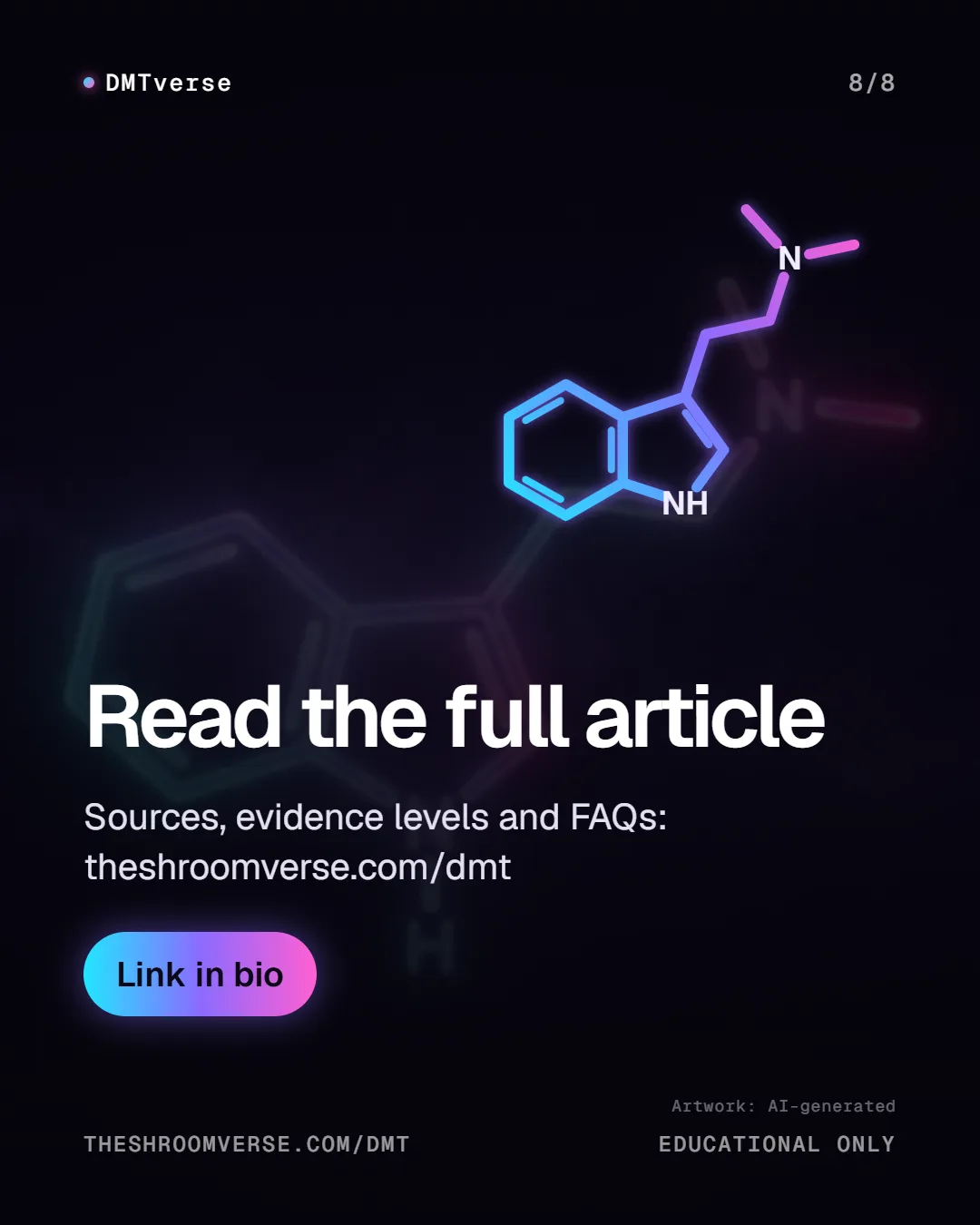
Dimethyltryptamine (N,N-dimethyltryptamine, sometimes written dimethyl tryptamine) is DMT’s full chemical name, and its structure has three parts: an indole (two fused rings, one containing a nitrogen), a two-carbon chain attached at the indole’s 3-position, and a nitrogen at the end of that chain carrying two methyl groups. Its formula is C12H16N2, with no oxygen. Remove the two methyls and you have tryptamine, the parent of the family. Close relatives differ by a single group: psilocin adds a hydroxyl at position 4, 5-MeO-DMT a methoxy at position 5. Small changes like these alter which receptors a molecule fits.
THE SHORT VERSION · SWIPE
On this page 8 sections
DMT is a small molecule that shares a skeleton with a brain messenger (serotonin), a hormone (melatonin) and the active compound of magic mushrooms (psilocin). Below, we take the structure apart piece by piece, set it beside its relatives, and explain why one extra group of atoms can matter so much at a receptor. For where DMT occurs and what it does, see our pillar guide, what is DMT.
Structure only, not guidance
This is a chemistry explainer. Comparisons between molecules here are about shape and atoms; they do not imply that any two compounds have similar effects. It gives no amounts, no instructions and no information on making or obtaining anything. DMT is a controlled substance in Canada. Evidence labels used below: established (shown in peer-reviewed studies or standard reference records and not seriously disputed), preliminary (early, small, animal-only or indirect) and unresolved (an open question).
What is the chemical structure of dimethyltryptamine (DMT)?
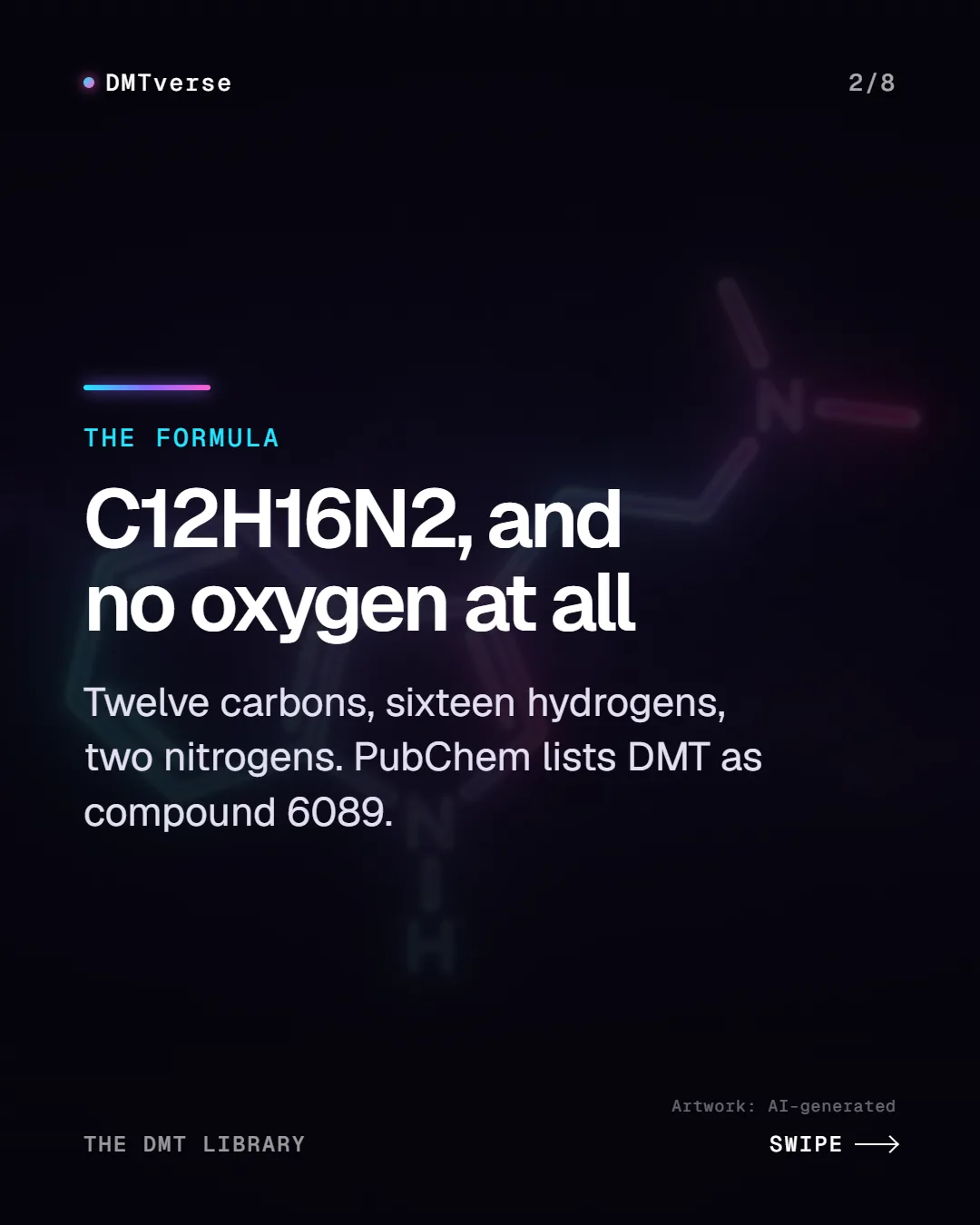
PubChem, the US National Library of Medicine’s chemistry database, lists N,N-dimethyltryptamine as compound 6089, with the formula C12H16N2 (twelve carbons, sixteen hydrogens, two nitrogens and no oxygen), a molecular weight of 188.27 g/mol and the systematic (IUPAC) name 2-(1H-indol-3-yl)-N,N-dimethylethanamine (PubChem, DMT). Evidence: established.
Read left to right, that name says: an indole, attached at its 3-position to an ethanamine (a two-carbon chain ending in an amine nitrogen), with two methyl groups on that nitrogen. The table lists the identifiers chemists use to pin the molecule down.
| Identifier | Value | What it is for |
|---|---|---|
| PubChem CID | 6089 | PubChem’s compound number |
| Molecular formula | C12H16N2 | The atoms, counted |
| Molecular weight | 188.27 g/mol | The mass of one mole of the molecule |
| IUPAC name | 2-(1H-indol-3-yl)-N,N-dimethylethanamine | The systematic name, which encodes the structure |
| SMILES | CN(C)CCC1=CNC2=CC=CC=C21 | A one-line text drawing of the connections |
| InChIKey | DMULVCHRPCFFGV-UHFFFAOYSA-N | A fixed-length fingerprint used to match records across databases |
The indole ring system
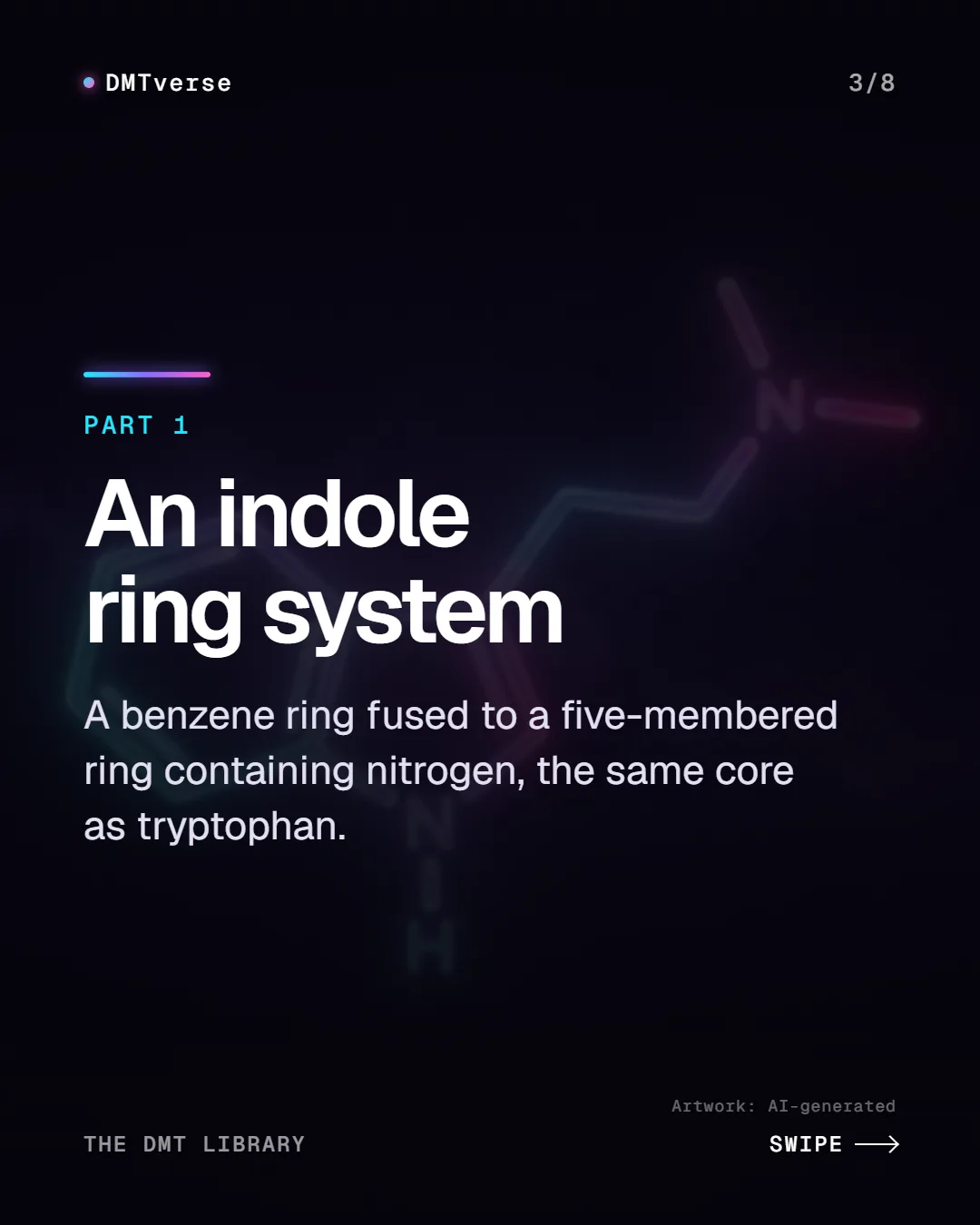
A six-membered benzene ring fused to a five-membered ring that contains one nitrogen (the N–H of the “1H-indol”). On its own, indole is C8H7N (PubChem, indole).
The attachment point
The side chain hangs off carbon 3 of the five-membered ring, the “3-yl” in the IUPAC name. Ring positions 4 to 7 sit on the benzene ring; that numbering is how relatives such as psilocin (4-position) and serotonin or 5-MeO-DMT (5-position) are described.
A two-carbon bridge
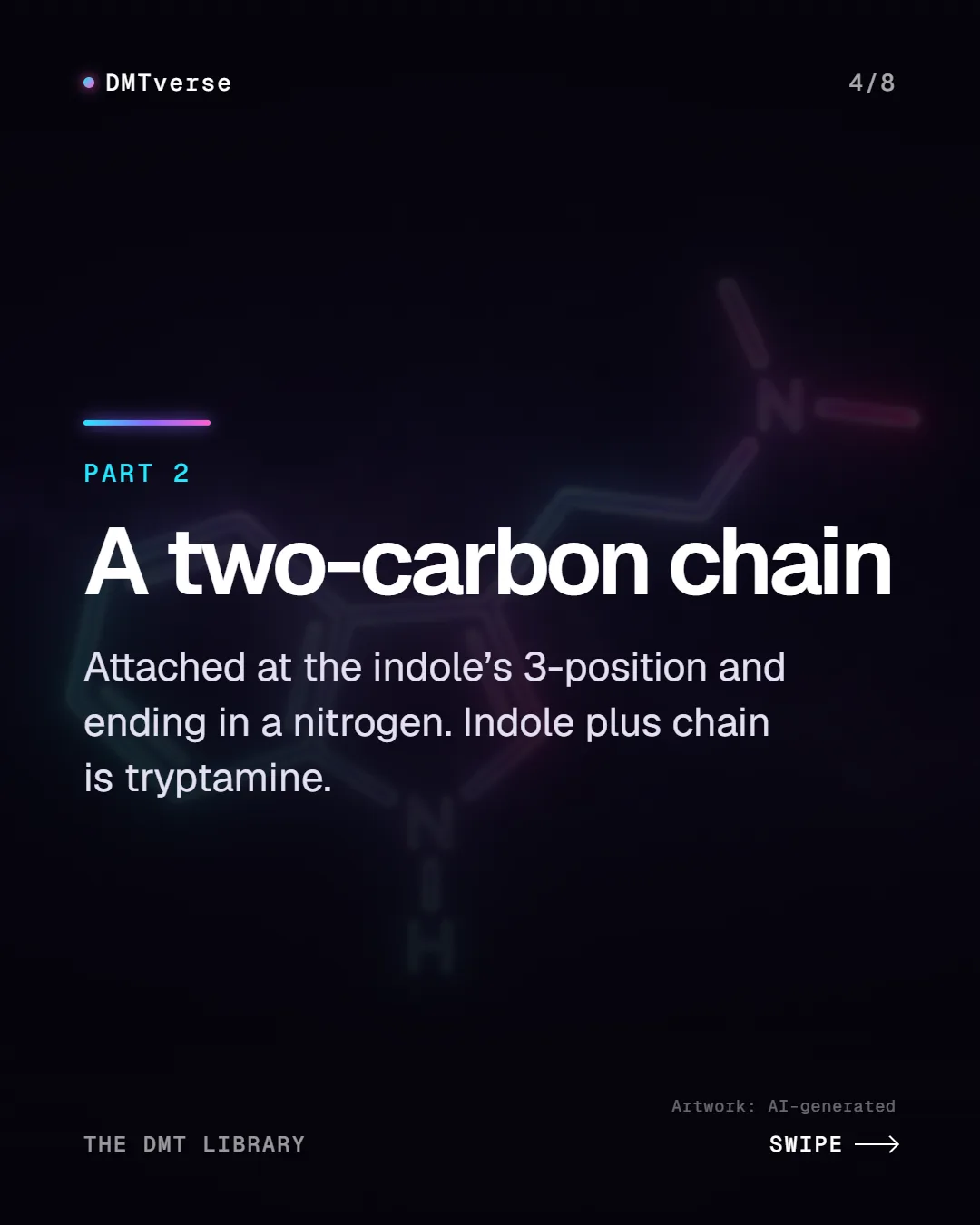
Two carbons link the ring to a nitrogen: the “ethanamine” in the name. Indole plus this chain and a bare nitrogen is tryptamine, the parent compound.
Two methyl groups on the nitrogen
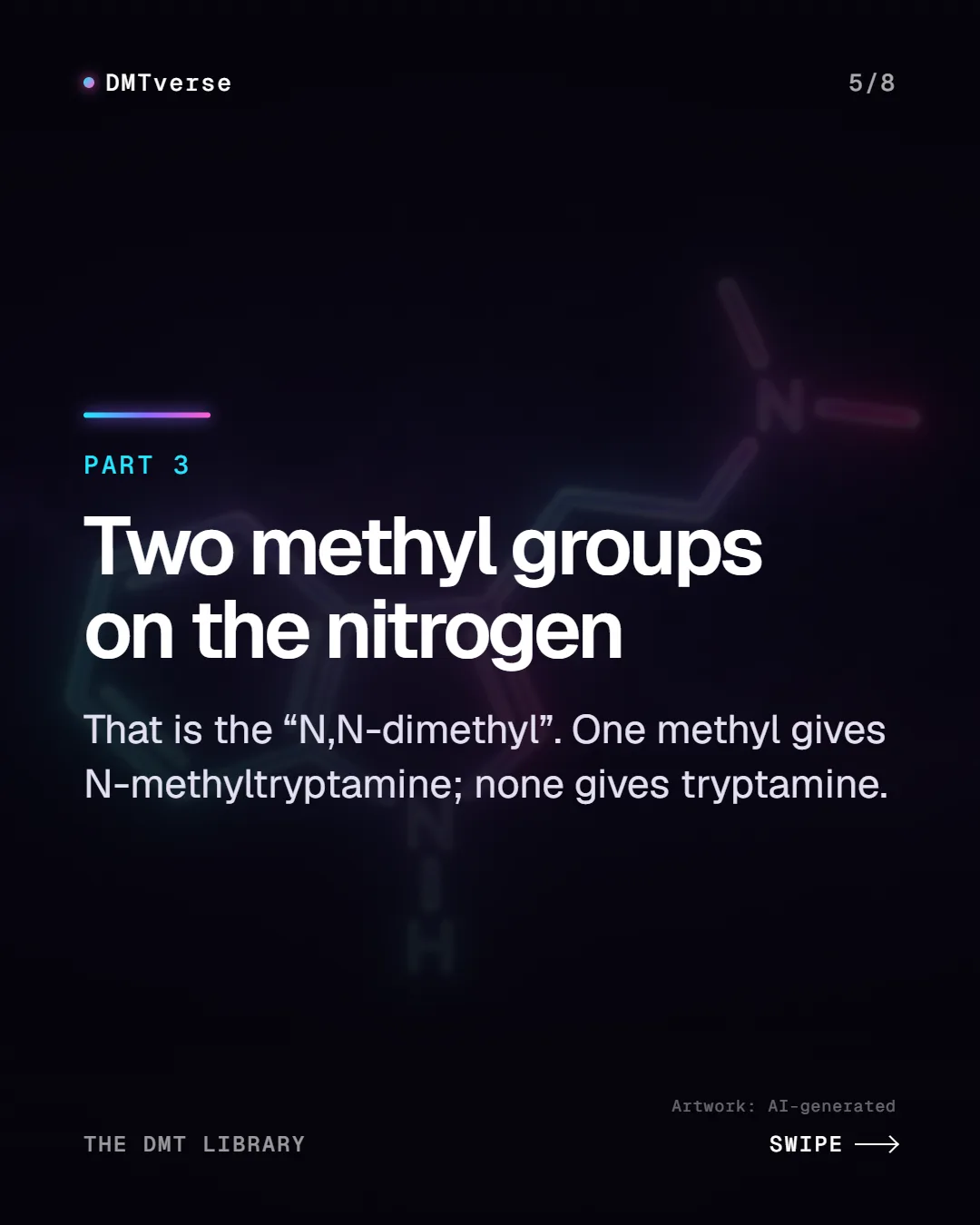
The “N,N-dimethyl” means two methyl (CH3) groups, both on the chain’s nitrogen. This makes it a tertiary amine. With one methyl it would be N-methyltryptamine; with none, tryptamine.
No oxygen at all
Unlike serotonin, psilocin, 5-MeO-DMT, melatonin or psilocybin, DMT has no oxygen-containing group on the ring or chain. C12H16N2 contains only carbon, hydrogen and nitrogen.
Each panel restates the structure described in the text, from PubChem. It describes the finished molecule, not a way of making it.
What are the indole ring and the tryptamine family?
An indole is a pair of fused rings: a benzene ring and a five-membered pyrrole ring that contains one nitrogen. PubChem lists indole itself as C8H7N (PubChem, indole). The same ring system sits in the amino acid tryptophan, (2S)-2-amino-3-(1H-indol-3-yl)propanoic acid (PubChem, tryptophan), which is why compounds built on it are called indoles or indolealkylamines. Evidence: established.
Tryptamine, 2-(1H-indol-3-yl)ethanamine (C10H12N2), is the indole with a two-carbon chain ending in a bare amine nitrogen (PubChem, tryptamine). Every member of the tryptamine family keeps that core and varies what sits on the ring or the nitrogen. Add one methyl group to the nitrogen and you have N-methyltryptamine, C11H14N2 (PubChem, NMT); add a second and you have DMT. Evidence: established.
In mammals the textbook pathway runs in the same order, from tryptophan to tryptamine to N-methyltryptamine to DMT, though which enzyme adds the methyl groups is now debated (Barker, 2018); see INMT, the enzyme linked to DMT. A 2018 review calls DMT “the archetype for all indole-containing serotonergic psychedelics”, with its structure embedded within those of LSD and psilocybin (Cameron and Olson, 2018). Evidence: established for the structures; unresolved for the enzyme.
What does the N,N-dimethyl group do?
Chemically, the two methyl groups turn tryptamine’s primary amine (a nitrogen with two hydrogens) into a tertiary amine (a nitrogen with three carbon attachments and no hydrogens). That changes the molecule’s size around the nitrogen, how it shares charge and how greasy it is, all of which affect how it is handled in the body and how it sits in a receptor’s binding pocket. That is general chemistry rather than a DMT-specific finding; the next paragraphs give the measured examples.
One concrete consequence has been reported. The sigma-1 receptor’s recognised binding pattern includes an alkylamine core, and a 2009 study noted that this core is also found in DMT. In that study DMT bound sigma-1 receptors in cells and made normal mice more active but not mice lacking the receptor (Fontanilla et al., 2009). DMT needs far higher concentrations to act at sigma-1 than at the 5-HT2A receptor (Barker, 2018), so what this means in people is unclear. Evidence: preliminary. More in DMT and the sigma-1 receptor.
The same small molecule is cleared quickly. The enzyme monoamine oxidase A breaks DMT down mainly to indoleacetic acid, with DMT-N-oxide as the second most abundant product (Barker, 2018). Evidence: established. Why that matters is the subject of why DMT breaks down so fast.
How does DMT’s structure compare with serotonin, melatonin, psilocin and 5-MeO-DMT?
All five share the indole and the two-carbon chain. They differ in two places: what is on ring position 4 or 5, and what is on the chain’s nitrogen. The table sets them side by side from their PubChem records. It is a comparison of structure only; it implies nothing about effects.
| Molecule (PubChem CID) | Formula | On the ring | On the chain’s nitrogen |
|---|---|---|---|
| Tryptamine (1150) | C10H12N2 | Nothing | Two hydrogens (no methyls) |
| N-methyltryptamine (6088) | C11H14N2 | Nothing | One methyl |
| DMT (6089) | C12H16N2 | Nothing | Two methyls |
| Serotonin, 5-HT (5202) | C10H12N2O | Hydroxyl (–OH) at position 5 | Two hydrogens (no methyls) |
| Psilocin (4980) | C12H16N2O | Hydroxyl (–OH) at position 4 | Two methyls |
| Psilocybin (10624) | C12H17N2O4P | Phosphate ester at position 4 | Two methyls |
| 5-MeO-DMT (1832) | C13H18N2O | Methoxy (–OCH3) at position 5 | Two methyls |
| Melatonin (896) | C13H16N2O2 | Methoxy (–OCH3) at position 5 | One acetyl group (an amide, not an amine) |
DMT and serotonin
Serotonin is 3-(2-aminoethyl)-1H-indol-5-ol, C10H12N2O (PubChem, serotonin): the tryptamine skeleton with a hydroxyl group at ring position 5 and no methyls on the nitrogen. DMT is the reverse: no hydroxyl, two methyls. The family resemblance is part of why early research looked for a serotonin basis for psychedelic action, and classic psychedelics are now understood to act as agonists or partial agonists at serotonin 5-HT2A receptors (Nichols, 2016). Evidence: established.
DMT, psilocin and psilocybin
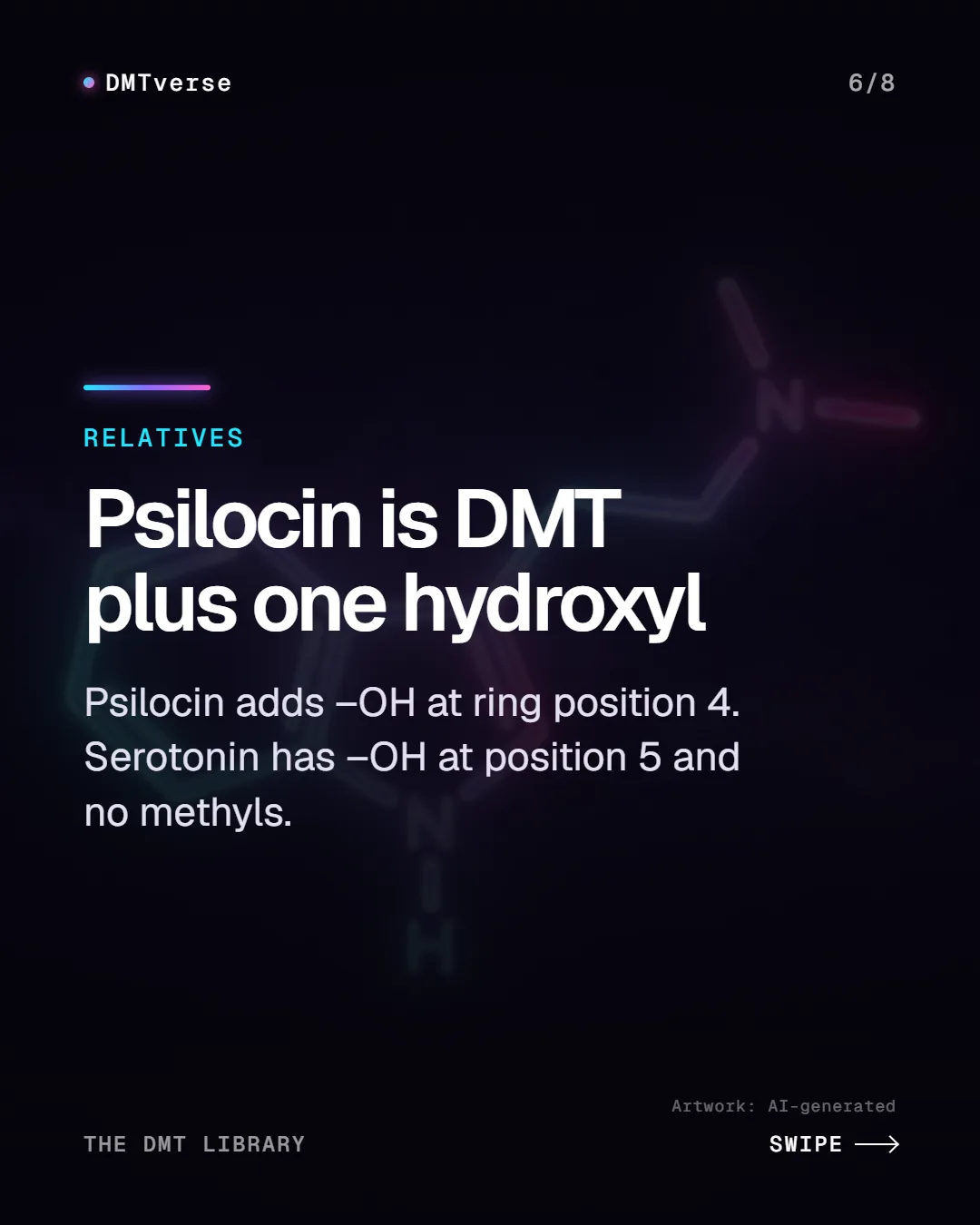
Psilocin is 3-[2-(dimethylamino)ethyl]-1H-indol-4-ol, C12H16N2O (PubChem, psilocin). In structural terms it is DMT with one hydroxyl group added at ring position 4, which is why chemists sometimes call it 4-hydroxy-DMT. Psilocybin carries a phosphate group at that position instead, C12H17N2O4P (PubChem, psilocybin); in the body it is primarily a prodrug, a compound the body converts into the active form, dephosphorylated by alkaline phosphatase to psilocin (Dinis-Oliveira, 2017). Evidence: established. Our article on psilocin vs psilocybin covers that step.
DMT and 5-MeO-DMT
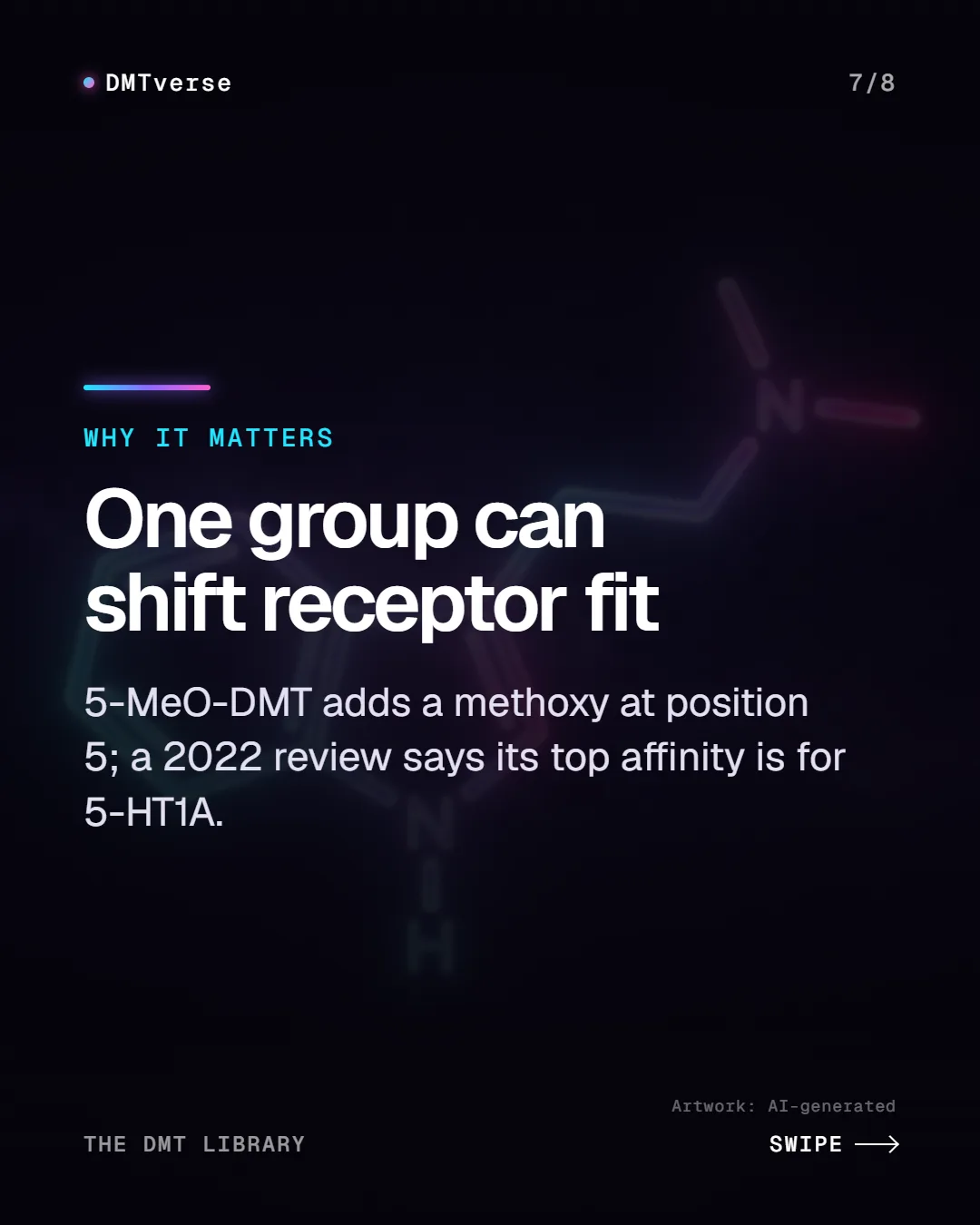
5-MeO-DMT is 2-(5-methoxy-1H-indol-3-yl)-N,N-dimethylethanamine, C13H18N2O (PubChem, 5-MeO-DMT): DMT with a methoxy group (an oxygen bonded to a methyl) at ring position 5. That one group is enough to shift its receptor profile. A 2022 review describes 5-MeO-DMT as acting mainly at 5-HT1A and 5-HT2A receptors, with its highest affinity for 5-HT1A (Reckweg et al., 2022). Evidence: established for the structure; the full comparison is in 5-MeO-DMT vs DMT.
DMT and melatonin
Melatonin, the pineal gland’s hormone, is N-[2-(5-methoxy-1H-indol-3-yl)ethyl]acetamide, C13H16N2O2 (PubChem, melatonin). It shares the 5-methoxy group with 5-MeO-DMT, but its nitrogen carries an acetyl group, which makes it an amide rather than a basic amine. That is a bigger chemical change than it looks: melatonin is a close cousin on paper and a different kind of molecule in practice. Evidence: established.
The shared indole is one reason DMT and the pineal gland are so often mentioned together, but structure alone says nothing about where DMT is made. See is DMT in the pineal gland.
Why do small structural changes matter for receptors?
Receptors are proteins with pockets shaped to fit particular molecules. Structural biology now shows those pockets directly. In 2017 a team solved the crystal structure of LSD bound to the human serotonin 5-HT2B receptor and found that the receptor rearranges to accommodate LSD’s diethylamide group, with a “lid” over the pocket that may explain LSD’s slow binding (Wacker et al., 2017). Evidence: established.
In 2020 the active-state structure of the 5-HT2A receptor itself was solved, bound to a hallucinogen and its signalling partner, showing the rearrangements involved in switching the receptor on (Kim et al., 2020). Neither study used DMT, but both show the principle: a few atoms on a ligand meet specific features of the pocket. Evidence: established.
That is why changes on the indole ring or the nitrogen change how a molecule acts. A 2011 review notes that psychedelic phenylalkylamines such as mescaline are selective for 5-HT2 receptors, while indoleamines such as LSD and psilocybin are relatively non-selective across serotonin receptors (Halberstadt and Geyer, 2011). A 2010 screen of 35 psychedelic drugs found them less selective than generally believed, with diverse patterns of interaction across eighteen receptors (Ray, 2010). Evidence: established.
DMT itself binds many serotonin receptors and also trace amine-associated receptor 1 (TAAR1) (Barker, 2018), and the consensus is that 5-HT2A is the key target for classic psychedelics (Nichols, 2016). Evidence: established for multi-receptor binding; how each receptor contributes to DMT’s effects in people is unresolved. For the receptor in depth, see DMT and the 5-HT2A receptor.
- A hydroxyl at position 4 (psilocin) or 5 (serotonin) adds a group that can form hydrogen bonds; in psilocin it is also where the body attaches glucuronic acid, giving its main urinary metabolite, psilocin-O-glucuronide (2017 review cited above).
- A methoxy at position 5 (5-MeO-DMT) shifts the balance between 5-HT1A and 5-HT2A affinity, according to the 2022 review cited above.
- Methyl groups on the nitrogen (DMT, psilocin, 5-MeO-DMT) change bulk and basicity at the end of the chain; an acetyl there (melatonin) removes the basic amine altogether.
- A phosphate (psilocybin) mostly has to be removed before the molecule acts, as the 2017 metabolism review describes.
The general lesson, more than any single rule: in this family, molecules that look almost identical on paper can differ in receptor fit, metabolism and legal status. Never infer one compound’s effects or safety from another’s structure. Evidence: established as a principle; specific structure-activity rules for DMT relatives are covered only in part by the sources here.
How does Canadian law identify DMT by structure?
Canada’s drug law names DMT by structure as well as by name. Schedule III of the Controlled Drugs and Substances Act lists, as item 7, “N,N-Dimethyltryptamine (DMT) (3-[(2-dimethylamino) ethyl]indole) and any salt thereof”, in the consolidation current to 30 September 2026 that we read on 20 October 2026 (CDSA). The structural name means the listing covers the molecule wherever it comes from. This is general information, not legal advice; for detail see is DMT legal in Canada.
What we still don’t know
- Exactly how DMT sits in the 5-HT2A binding pocket; the published receptor structures we cite used other ligands (unresolved for DMT itself in our sources).
- How much each receptor DMT binds, beyond 5-HT2A, contributes to its effects in people (unresolved).
- Which enzyme adds the two methyl groups in mammals, now that knockout studies have questioned INMT (unresolved).
- Whether DMT’s sigma-1 activity matters at the concentrations found in the body (preliminary).
Common questions
What is the chemical formula of DMT?
C12H16N2: twelve carbon atoms, sixteen hydrogens and two nitrogens, with no oxygen. PubChem lists it as compound 6089 with a molecular weight of 188.27 g/mol.
What is the structure of DMT in simple terms?
An indole (two fused rings, one containing nitrogen), a two-carbon chain attached at the indole’s 3-position, and a nitrogen at the end of the chain carrying two methyl groups. Remove the methyls and you have tryptamine.
How is DMT different from serotonin?
Serotonin has a hydroxyl group at ring position 5 and no methyl groups on its nitrogen. DMT has no hydroxyl and two methyl groups. Both share the indole and the two-carbon chain, which is why they are called relatives.
Is psilocin the same as DMT?
No. Psilocin is DMT’s structure plus one hydroxyl group at ring position 4 (C12H16N2O), which is why it is sometimes called 4-hydroxy-DMT. One extra group is enough to make it a different compound with its own pharmacology.
What is the difference between DMT and 5-MeO-DMT?
5-MeO-DMT has a methoxy group at ring position 5 (C13H18N2O). A 2022 review reports that it has its highest affinity for the 5-HT1A receptor, a different profile from DMT. They are separate molecules and should not be treated as interchangeable.
Is DMT related to melatonin?
Both are indoles with the same two-carbon chain, but melatonin has a methoxy group at position 5 and an acetyl group on its nitrogen, making it an amide rather than an amine. The structural link does not show that the pineal gland makes DMT.
Why does such a small molecule have such strong effects?
Size is not the point; fit is. DMT’s shape lets it bind serotonin receptors, especially 5-HT2A, and several others. How each contributes in people is still being worked out.
Shroomverse sells mushroom products. This article is general information about the chemical structure of DMT and related molecules. It is not medical, legal or purchasing advice, and it does not recommend any product.
SOURCES
- N,N-Dimethyltryptamine, compound summary (CID 6089), U.S. National Library of Medicine, PubChem. Accessed . Record read through the PubChem REST interface: formula C12H16N2, molecular weight 188.27, IUPAC name 2-(1H-indol-3-yl)-N,N-dimethylethanamine, SMILES and InChIKey DMULVCHRPCFFGV-UHFFFAOYSA-N.
- Indole (CID 798), tryptamine (CID 1150), N-methyltryptamine (CID 6088) and L-tryptophan (CID 6305), compound summaries, U.S. National Library of Medicine, PubChem. Accessed . Records read through the PubChem REST interface: indole C8H7N; tryptamine C10H12N2, 2-(1H-indol-3-yl)ethanamine; NMT C11H14N2; tryptophan C11H12N2O2, (2S)-2-amino-3-(1H-indol-3-yl)propanoic acid. Indole, NMT and tryptophan are linked in the text at their own CIDs.
- Serotonin, compound summary (CID 5202), U.S. National Library of Medicine, PubChem. Accessed . Record read through the PubChem REST interface: C10H12N2O, 3-(2-aminoethyl)-1H-indol-5-ol.
- Melatonin, compound summary (CID 896), U.S. National Library of Medicine, PubChem. Accessed . Record read through the PubChem REST interface: C13H16N2O2, N-[2-(5-methoxy-1H-indol-3-yl)ethyl]acetamide.
- Psilocin (CID 4980) and psilocybin (CID 10624), compound summaries, U.S. National Library of Medicine, PubChem. Accessed . Records read through the PubChem REST interface: psilocin C12H16N2O, 3-[2-(dimethylamino)ethyl]-1H-indol-4-ol; psilocybin C12H17N2O4P, the 4-yl dihydrogen phosphate (linked in the text at its own CID).
- 5-Methoxy-N,N-dimethyltryptamine, compound summary (CID 1832), U.S. National Library of Medicine, PubChem. Accessed . Record read through the PubChem REST interface: C13H18N2O, 2-(5-methoxy-1H-indol-3-yl)-N,N-dimethylethanamine.
- Controlled Drugs and Substances Act (S.C. 1996, c. 19), Schedule III, Government of Canada, Justice Laws Website. Accessed . Full text read; Schedule III item 7, N,N-Dimethyltryptamine (DMT) (3-[(2-dimethylamino) ethyl]indole) and any salt thereof. Consolidation current to 2026-09-30.
- Dark Classics in Chemical Neuroscience: N,N-Dimethyltryptamine (DMT) (Cameron LP, Olson DE, ACS Chemical Neuroscience 9(10):2344–2357, 2018), American Chemical Society (peer-reviewed). Accessed . Abstract read via Europe PMC. DMT as the archetype of indole-containing serotonergic psychedelics; its structure embedded within LSD and psilocybin.
- N,N-Dimethyltryptamine (DMT), an Endogenous Hallucinogen: Past, Present, and Future Research to Determine Its Role and Function (Barker SA, Frontiers in Neuroscience 12:536, 2018), Frontiers (peer-reviewed, open access); PMC6088236. Accessed . Full text read via Europe PMC. Tryptophan–tryptamine–NMT–DMT pathway; MAO-A breakdown to indoleacetic acid, DMT-N-oxide second; binding to many 5-HT receptors and TAAR1; sigma-1 activity only at high concentrations compared with 5-HT2A.
- Psychedelics (Nichols DE, Pharmacological Reviews 68(2):264–355, 2016), American Society for Pharmacology and Experimental Therapeutics (peer-reviewed review). Accessed . Abstract read via Europe PMC. Early link between LSD, serotonin and psychedelics; consensus that psychedelics are agonists or partial agonists at 5-HT2A receptors.
- Psychedelics and the human receptorome (Ray TS, PLoS One 5(2):e9019, 2010), PLOS (peer-reviewed, open access). Accessed . Abstract read via Europe PMC. 35 psychedelic drugs profiled at many receptors, transporters and ion channels; less selective than believed; diverse patterns across eighteen receptors.
- Multiple receptors contribute to the behavioral effects of indoleamine hallucinogens (Halberstadt AL, Geyer MA, Neuropharmacology 61(3):364–381, 2011), Elsevier (peer-reviewed review). Accessed . Abstract read via Europe PMC. Phenylalkylamines selective for 5-HT2 receptors; indoleamines relatively non-selective; 5-HT2A central, other sites contribute.
- Structure of a Hallucinogen-Activated Gq-Coupled 5-HT2A Serotonin Receptor (Kim K, et al., Cell 182(6):1574–1588, 2020), Cell Press (peer-reviewed). Accessed . Abstract read via Europe PMC. Active-state 5-HT2A structure bound to the hallucinogen 25-CN-NBOH with Gq; crystal structures with LSD and methiothepin. DMT not studied.
- Crystal Structure of an LSD-Bound Human Serotonin Receptor (Wacker D, et al., Cell 168(3):377–389, 2017), Cell Press (peer-reviewed). Accessed . Abstract read via Europe PMC. LSD bound to 5-HT2B; receptor rearranges around the diethylamide; extracellular-loop “lid” linked to slow binding. DMT not studied.
- The clinical pharmacology and potential therapeutic applications of 5-methoxy-N,N-dimethyltryptamine (5-MeO-DMT) (Reckweg JT, et al., Journal of Neurochemistry 162(1):128–146, 2022), Wiley (peer-reviewed review). Accessed . Abstract read via Europe PMC. 5-MeO-DMT acts mainly at 5-HT1A and 5-HT2A receptors, with highest affinity for 5-HT1A. Used only for the receptor-profile contrast.
- Metabolism of psilocybin and psilocin: clinical and forensic toxicological relevance (Dinis-Oliveira RJ, Drug Metabolism Reviews 49(1):84–91, 2017), Taylor & Francis (peer-reviewed review). Accessed . Abstract read via Europe PMC. Psilocybin is primarily a prodrug dephosphorylated by alkaline phosphatase to psilocin; psilocin-O-glucuronide is the main urinary metabolite.
- The Hallucinogen N,N-Dimethyltryptamine (DMT) Is an Endogenous Sigma-1 Receptor Regulator (Fontanilla D, et al., Science 323(5916):934–937, 2009), American Association for the Advancement of Science (peer-reviewed). Accessed . Abstract read via Europe PMC. Sigma-1 pharmacophore includes an alkylamine core also found in DMT; DMT bound sigma-1; hypermobility in wild-type but not knockout mice.
CHANGES
- : Linked glossary definitions.
- : Retitled for the search terms “dimethyltryptamine” and “dimethyl tryptamine” (title, description, summary opening, one H2). No change to the facts.
- : Published. Every PubChem record, the CDSA schedule and each paper abstract or full text opened and checked on this date.
- : Editorial review: rewrote the short answer to lead with the three-part structure; cut the unsourced “one of the simplest molecules” claim; split long paragraphs and added evidence labels; linked tryptamine and prodrug to the glossary and defined prodrug; sharper SEO title.



