THE SHROOMVERSE JOURNAL ✳ 12 MIN READ
INMT: the enzyme said to make DMT, and why knockout studies put it in doubt
Topic: DMT
Published Updated
Short answer, checked 20 October 2026
INMT (indolethylamine N-methyltransferase) is the enzyme long credited with making DMT in mammals, by adding two methyl groups to tryptamine. Human and rabbit INMT do make DMT in the test tube. But INMT-knockout rats (2023) kept their tryptamine-methylating activity, and INMT-knockout mice (2025) showed no obvious drop in their own psychedelic tryptamines. In rodents at least, something else seems to do the job, and nobody yet knows what. Julius Axelrod described the enzyme in 1961, and its messenger RNA is found in many human tissues, including autopsy brain tissue.
THE SHORT VERSION · SWIPE
On this page 11 sections
Every explanation of how the body might make DMT names the same enzyme: INMT. It appears in textbook diagrams, review articles and, often, in confident online claims that “your body has the enzyme to make DMT”. The enzyme is real, and its chemistry is well described. What has changed in the past few years is the evidence that it is the enzyme that matters.
This explainer covers what INMT is, how it was found, where it sits in the body, and the knockout experiments that unsettled the story. For the bigger question it feeds into, see does the brain make DMT?; for the molecule itself, our pillar guide, what is DMT.
Education only, not guidance
This is a biochemistry explainer. It gives no amounts, no instructions and no advice on use, and nothing here describes how to make any substance. DMT is a controlled substance in Canada; for risks and help, see our safety page. Evidence labels: established (shown in peer-reviewed studies and not seriously disputed), preliminary (early, small, animal-only or indirect) and unresolved (an open question).
What is the INMT enzyme?
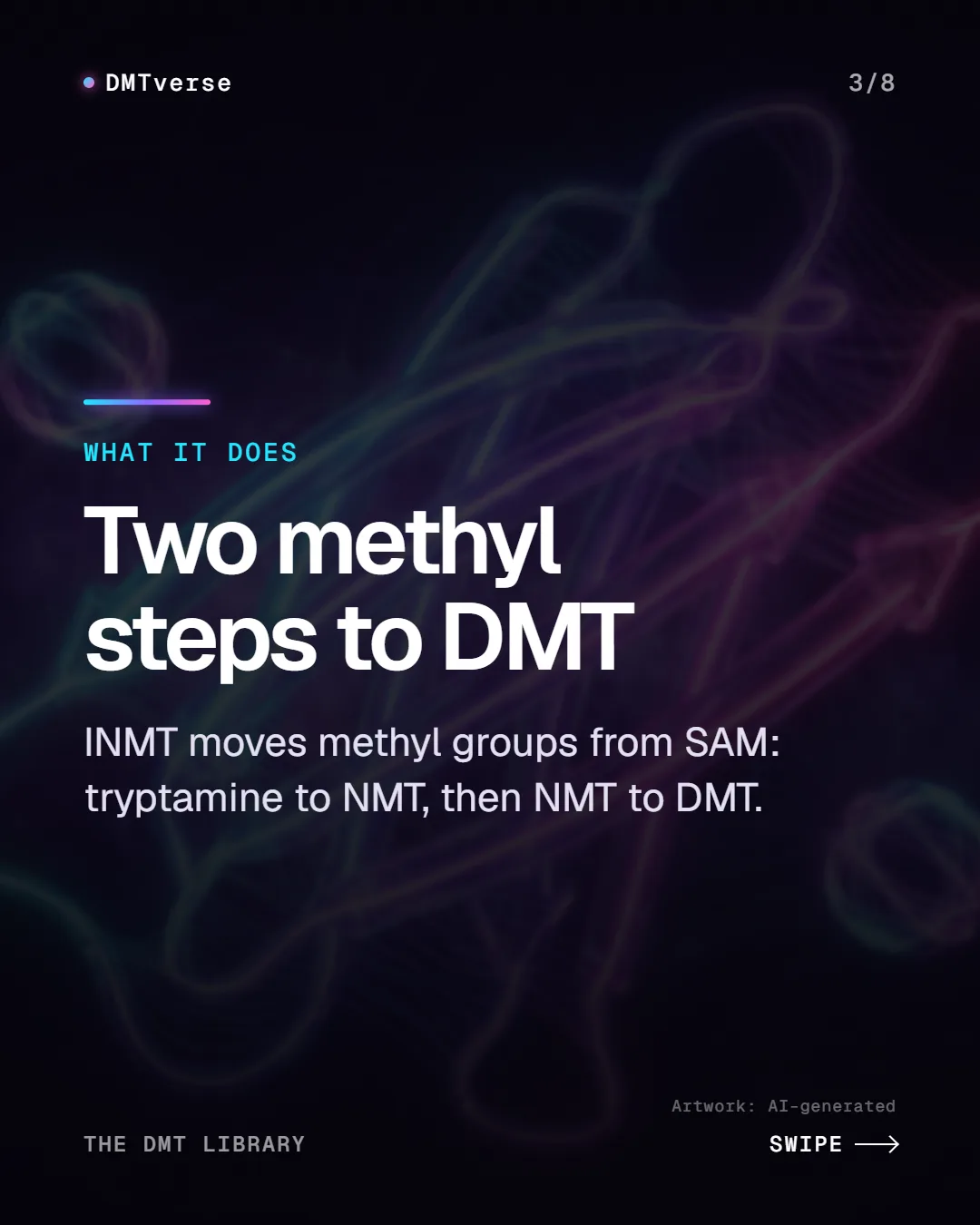
INMT stands for indolethylamine N-methyltransferase. It is a transmethylation enzyme: it takes a methyl group (one carbon with three hydrogens) from the body’s common methyl donor, S-adenosyl-L-methionine (SAM), and attaches it to a nitrogen on a small acceptor molecule. In the textbook DMT pathway it does this twice, turning tryptamine into N-methyltryptamine (NMT) and then NMT into DMT (Glynos et al., 2023). Tryptamine itself comes from the amino acid tryptophan, through a different enzyme, AADC (Barker, 2018). Evidence: established as the textbook pathway.
- Tryptophan, an amino acid from the diet, loses its carboxyl group to become tryptamine. Enzyme: AADC.
- Tryptamine gains one methyl group from SAM to become N-methyltryptamine (NMT). Enzyme credited: INMT.
- NMT gains a second methyl group to become DMT. Enzyme credited: INMT.
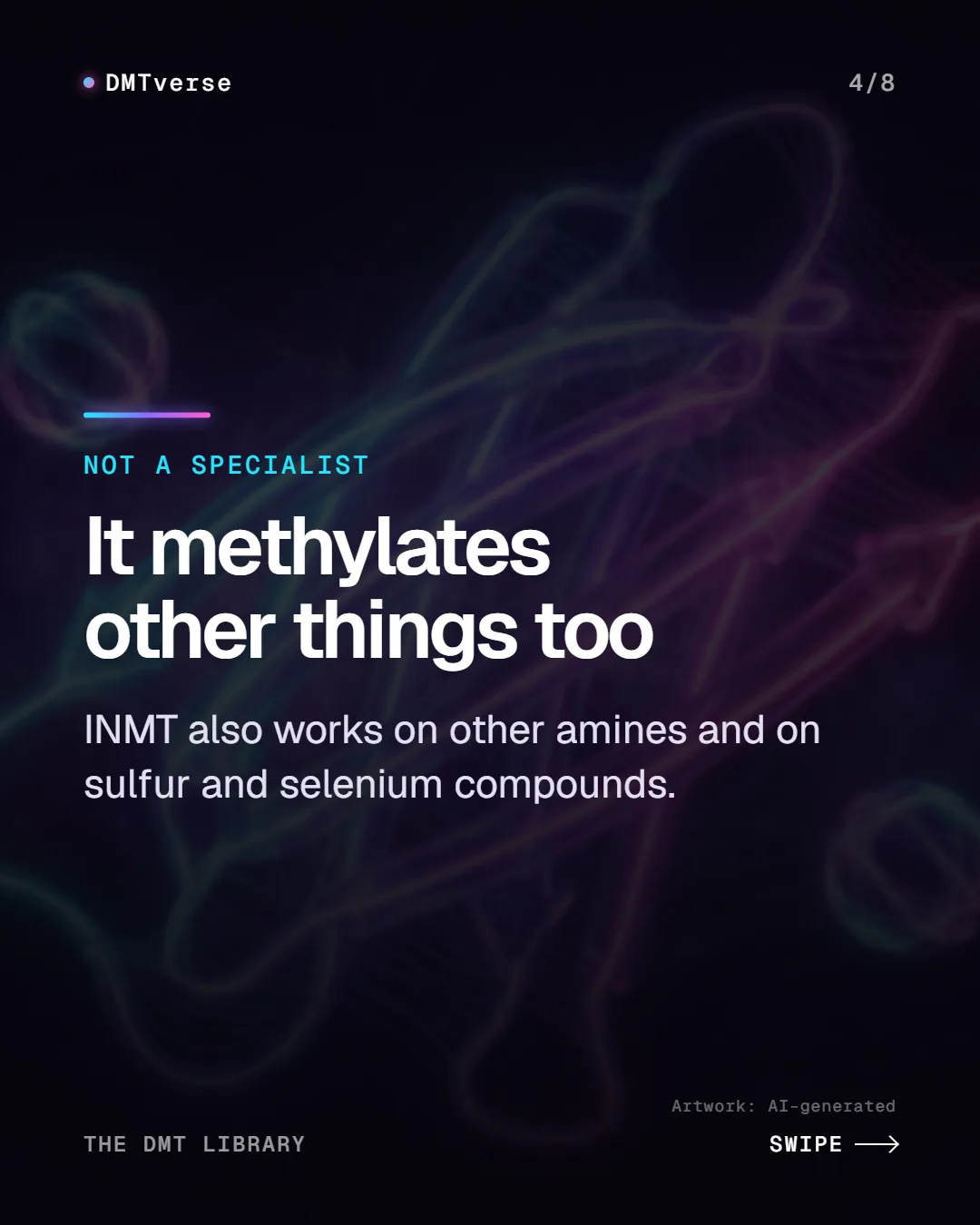
INMT is not a DMT specialist. It has a broad substrate range, working on several of the body’s own amines and other small molecules (Glynos et al., 2023). A 2025 review notes that it is also called a thioether S-methyltransferase because it methylates sulfur-containing compounds and related selenium and tellurium compounds, and that it belongs to the same family as nicotinamide N-methyltransferase (NNMT) and phenylethanolamine N-methyltransferase (PNMT) (Abouheif et al., 2025). The 2019 brain study likewise lists histamine, sulfur compounds and selenium metabolism among its DMT-independent jobs (Dean et al., 2019). Evidence: established.
How was INMT discovered?
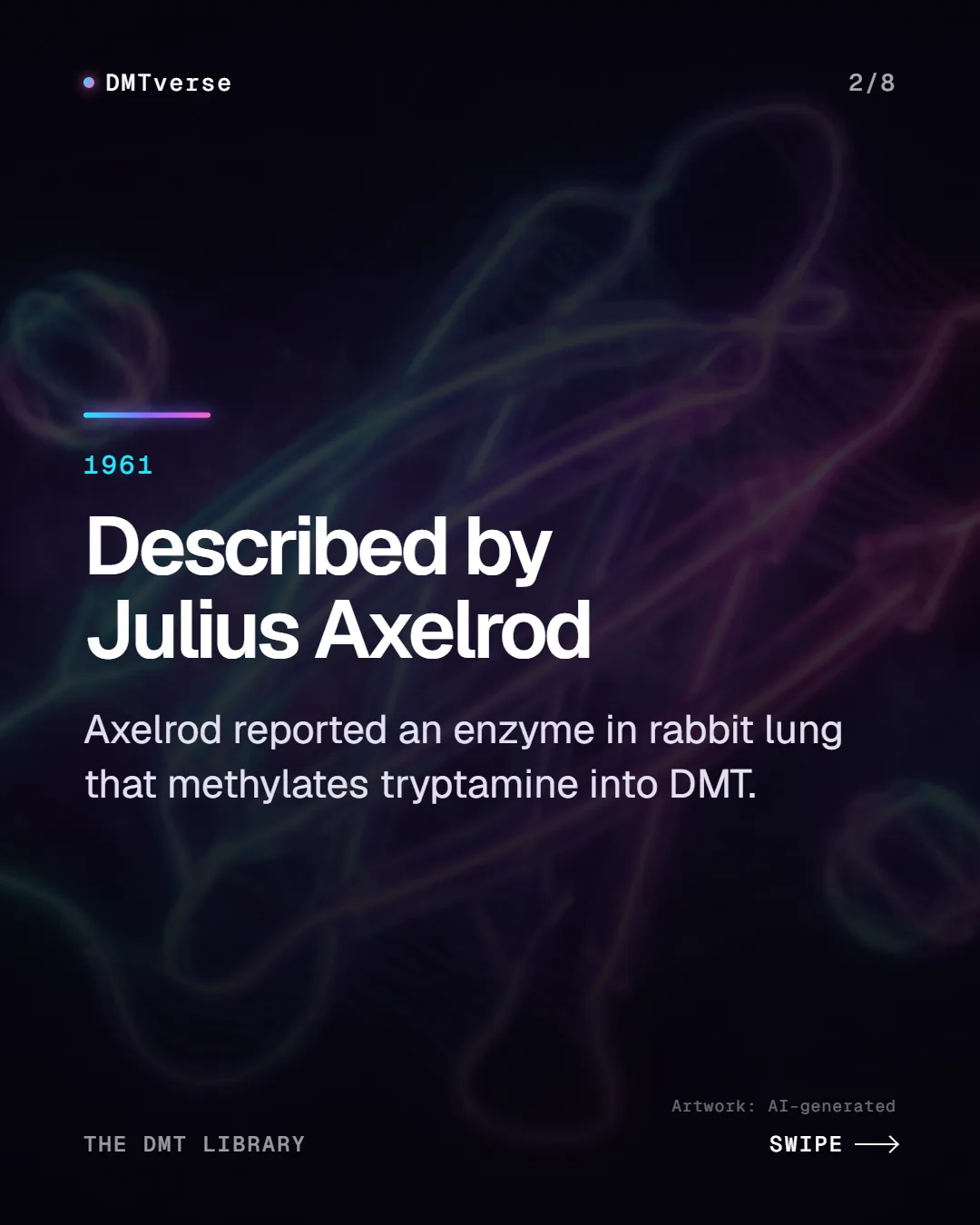
In 1961, Julius Axelrod reported in Science an enzyme that N-methylates serotonin and tryptamine into bufotenine and DMT, which he called psychotomimetic metabolites. His abstract says the enzyme is highly localised in rabbit lung and also methylates other amines, including tyramine, phenylethylamine and dopamine (Axelrod, 1961). A 2023 paper describes the experiment: rabbit lung extracts incubated with tryptamine and a radio-labelled methyl donor produced labelled NMT and DMT, one of the first demonstrations that such compounds could be formed enzymatically from naturally occurring ones (Glynos et al., 2023). Evidence: established.
A note on the record: a 2018 review places Axelrod’s 1961 discovery in rat brain (Barker, 2018), but Axelrod’s own abstract describes the enzyme in rabbit lung, and we follow the original. Axelrod’s search was part of the “transmethylation hypothesis”, the idea that conditions such as schizophrenia might involve the body making its own hallucinogens. That premise remains unproven, but it led to INMT (Barker, 2022). Evidence: established as history.
The brain came into the story in 1972. Juan Saavedra and Axelrod reported that tryptamine occurs normally in rat brain, that labelled tryptamine placed in the fluid space of the rat brain was converted to NMT and DMT, and that an enzyme able to do this was present in rat and human brain (Saavedra and Axelrod, 1972). Evidence: established as a published finding; the enzyme activity was measured in tissue extracts, not attributed to one purified protein.
INMT research at a glance
Axelrod describes the enzyme
An enzyme in rabbit lung methylates tryptamine and serotonin into DMT and bufotenine (Axelrod, 1961).
DMT forms in rat brain
Labelled tryptamine becomes NMT and DMT in rat brain; enzyme activity reported in rat and human brain (Saavedra and Axelrod, 1972).
Human INMT cloned
A 263-amino-acid protein, 88% identical to rabbit INMT; gene on chromosome 7 (Thompson et al., 1999).
INMT protein in primate nervous tissue
Found in monkey spinal cord, pineal gland and retina (Barker, 2018).
DMT inhibits INMT
DMT inhibited rabbit lung INMT in lab assays (Chu et al., 2014).
INMT messages in human brain tissue
INMT messenger RNA in human cortex, pineal and choroid plexus from autopsies (Dean et al., 2019).
Knockout rats
INMT not needed for tryptamine methylation in rat brain and lung; rat INMT inactive (Glynos et al., 2023).
Knockout mice
No obvious drop in endogenous psychedelic levels (Hatzipantelis et al., 2025).
Each event restates a finding described and sourced in this article.
Where in the body is INMT found?
Mostly outside the brain, as far as older methods could tell. Rabbit lung has historically shown the highest INMT expression and methylating activity (Glynos et al., 2023). When the human gene was cloned in 1999, its messenger RNA showed up in most of 35 tissues tested by Northern blot (Thompson et al., 1999); a 2025 review notes high levels in human lung and adrenal gland and significant levels in spinal cord (Abouheif et al., 2025). Relatively high INMT activity has also been reported in the placenta of several species, including humans (Barker, 2018). Evidence: established.
| Species | Where | How it was detected | Source |
|---|---|---|---|
| Rabbit | Lung (highest), also other tissues | Enzyme activity; messenger RNA | Axelrod, 1961; Glynos et al., 2023 |
| Human | Most of 35 tissues tested | Northern blot (messenger RNA) | Thompson et al., 1999 |
| Human | Cortex, pineal gland, choroid plexus (autopsy tissue) | RNAscope in situ hybridisation | Dean et al., 2019 |
| Rhesus monkey | Spinal cord motor neurons, pineal gland, retina | Antibody staining (protein) | Barker, 2018 |
| Rat | Cortex, hippocampus, pineal, choroid plexus; adrenal, kidney, lung, heart | RNAscope in situ hybridisation | Dean et al., 2019 |
The brain was the gap. Northern blots found INMT messenger RNA at very low levels in rabbit brain and not at all in human brain, which led to speculation that DMT is made in the body and carried to the brain (Dean et al., 2019). Then, in 2019, a more sensitive method found INMT messages in rat and human cortex, pineal gland and choroid plexus. In rat brain, INMT messages sat in the same cells as AADC messages; in rat lung, heart, kidney and adrenal gland they rarely overlapped, which led the authors to suggest that INMT in the body may mostly do other jobs (Dean et al., 2019). Evidence: preliminary. One lab’s staining results; messenger RNA is not enzyme activity.
Does INMT work the same way in every species?
No, and this turned out to matter a great deal. Human INMT made in cells in the lab methylates tryptamine, but with a much weaker apparent affinity than rabbit INMT, roughly ten times weaker by the reported constants (Glynos et al., 2023). Human INMT is 88% identical in sequence to rabbit INMT (Thompson et al., 1999). Rat INMT is the outlier: it shares only about 57% of its sequence with the rabbit or human enzyme, and in 2023 tests, rat INMT showed no ability to methylate tryptamine or NMT at all, while rabbit and human INMT both produced NMT and DMT (Glynos et al., 2023). Evidence: preliminary. Test-tube results with engineered proteins.
That creates an odd situation. The rat is the main animal in which DMT has been measured in the living brain, yet rat INMT, by these tests, cannot make it. So in rats at least, something else must be making the DMT that has been detected (Glynos et al., 2023). Evidence: preliminary.
What did the 2023 knockout rats show?
A knockout animal has a gene deliberately disabled, so researchers can see what changes without it. In 2023, the University of Michigan group that had measured DMT in rat brains used CRISPR gene editing to delete two letters of the rat INMT gene, which scrambled it and left the rats with no INMT protein. The rats showed no obvious behavioural or physiological abnormalities and could reproduce (Glynos et al., 2023). Then they tested tissue from six knockout and six normal littermates:
- Brain and lung tissue from knockout rats methylated tryptamine just as much as tissue from normal rats.
- In both groups, the products were neither NMT nor DMT, by two independent methods, thin-layer chromatography and mass spectrometry. Rabbit lung, used as a positive control, did make NMT and DMT.
- Rat INMT on its own did not methylate tryptamine; rabbit and human INMT did.
The authors concluded that INMT is not necessary for tryptamine methylation in rat brain and lung, and that an alternative enzymatic pathway for DMT likely exists in rats (Glynos et al., 2023). They were also open about a limit: the tests used tissue extracts under particular lab conditions, and different conditions might reveal DMT production that these assays missed. Note what the study did not do: it did not measure DMT in the living knockout rats. Evidence: preliminary.
What did the 2025 knockout mice show?
In 2025, a separate team developed mass-spectrometry methods sensitive enough to measure endogenous psychedelics in mice, and created mice lacking INMT. The knockout mice had no major abnormalities in reproduction or growth, but their behaviour differed across several distinct domains. Crucially, deleting INMT “did not result in an obvious decrease in endogenous psychedelic levels”, which the authors read as a sign that psychedelics might be made by alternative pathways in rodents (Hatzipantelis et al., 2025). Evidence: preliminary. We read the abstract only, so we do not list which compounds were measured.
What the knockout studies do and do not show
They show that, in rats and mice, INMT does not appear necessary for the tryptamine methylation or endogenous psychedelic levels measured. They do not show that humans lack a DMT pathway, that human INMT is inactive (lab tests suggest it works), or that a second human pathway has been identified. No one has knocked out INMT in human cells and measured DMT.
If not INMT, what else might make DMT?
Nobody knows yet. The candidates are mostly educated guesses (Glynos et al., 2023):
- An unidentified N-methyltransferase. The 2023 authors think it likely that a distinct mammalian enzyme can methylate tryptamine to NMT and DMT under the right conditions.
- Enzymes already glimpsed decades ago. Older work on rabbit lung found two INMT-like tryptamine-methylating proteins with different properties, and work on rabbit liver separated two methyltransferases, “A” and “B”, with tryptamine-methylating activity.
- Different products altogether. The unknown products made by rat tissue in 2023 might be β-carbolines, a class of compounds tryptamine can form, according to the authors’ hypothesis. That would explain tryptamine use without explaining DMT.
INMT’s family members are natural suspects, since the human INMT gene is structurally similar to the genes for NNMT and PNMT (Thompson et al., 1999), but no source we read has shown that either makes DMT. One more piece of chemistry may matter for how any pathway is regulated: DMT itself inhibited rabbit lung INMT in lab tests, pointing to a regulatory site on the enzyme (Chu et al., 2014). Evidence: unresolved.
Is INMT linked to health or disease?
Researchers have looked. A 2025 review summarises reports linking changes in INMT levels to several cancers, including lower expression in some lung and liver cancers and higher expression in one form of prostate cancer, along with older ideas about psychiatric conditions, and concludes that INMT’s exact role in cancer and other disorders remains unclear (Abouheif et al., 2025). These are associations, mostly from tissue and database studies, not evidence that INMT or DMT causes or treats anything. Evidence: preliminary.
What is still unknown about INMT?
- Which enzyme makes DMT in rats and mice, given that INMT appears unnecessary there (unresolved).
- Whether human INMT makes meaningful DMT in living human tissue, as it does in the test tube (unresolved).
- What INMT’s main everyday job is: DMT, sulfur and selenium compounds, or something else (unresolved).
- Whether the INMT messages found in human brain tissue reflect active enzyme (unresolved).
- How results in rats, whose INMT is unusual, translate to humans (unresolved).
The fair summary: INMT is a real enzyme that can make DMT in the test tube when it comes from rabbits or humans, but the best recent experiments in living rodents suggest it is not what makes their DMT. The enzyme behind endogenous DMT is, for now, an open question. For how this fits the rat brain measurements, read the DMT rat brain study explained; for the pineal angle, is DMT in the pineal gland?.
Common questions
What is the INMT enzyme?
INMT, or indolethylamine N-methyltransferase, is an enzyme that transfers methyl groups from the donor molecule SAM onto small molecules. It is best known for methylating tryptamine twice to make DMT, but it also works on other amines and on sulfur and selenium compounds.
Does INMT make DMT in the human body?
It can make DMT in the test tube: human INMT produced NMT and DMT in 2023 lab tests. Whether it does so in meaningful amounts in living human tissue is unknown, and knockout studies in rats and mice suggest INMT is not what makes their DMT.
Who discovered INMT?
Julius Axelrod reported the enzyme in Science in 1961, describing it in rabbit lung methylating tryptamine and serotonin into DMT and bufotenine. In 1972, Juan Saavedra and Axelrod reported an enzyme able to make DMT in rat and human brain.
Where is INMT found in the body?
Its messenger RNA appears in most human tissues tested, with high levels reported in lung and adrenal gland. A 2019 study also found it in human cortex, pineal gland and choroid plexus from autopsies, and INMT protein has been found in monkey spinal cord, pineal gland and retina.
What happened when scientists knocked out INMT?
INMT-knockout rats (2023) still methylated tryptamine in brain and lung, but the products were not NMT or DMT, and rat INMT itself was inactive. INMT-knockout mice (2025) showed behavioural differences but no obvious drop in endogenous psychedelic levels.
If not INMT, what makes DMT?
Nobody knows yet. Researchers suspect an unidentified N-methyltransferase, possibly one of the INMT-like enzymes glimpsed in older rabbit studies. No alternative enzyme has been shown to make DMT in mammals.
Shroomverse sells mushroom products. This article is general information about the INMT enzyme and research on how the body may make DMT. It is not medical, legal or purchasing advice, and it does not recommend any product.
SOURCES
- Enzymatic formation of psychotomimetic metabolites from normally occurring compounds (Axelrod J, Science 134(3475):343, 1961), American Association for the Advancement of Science (peer-reviewed); abstract via Europe PMC. Accessed . Abstract read; record checked on Crossref. Supports an enzyme N-methylating serotonin and tryptamine to bufotenine and DMT, highly localised in rabbit lung, also methylating tyramine, phenylethylamine and dopamine.
- Psychotomimetic N-methylated tryptamines: formation in brain in vivo and in vitro (Saavedra JM, Axelrod J, Science 175(4028):1365–1366, 1972), American Association for the Advancement of Science (peer-reviewed); abstract via Europe PMC. Accessed . Abstract read; record checked on Crossref. Supports tryptamine occurring normally in rat brain, intracisternal labelled tryptamine forming NMT and DMT in rat brain, and the enzyme in rat and human brain.
- Human indolethylamine N-methyltransferase: cDNA cloning and expression, gene cloning, and chromosomal localization (Thompson MA, Moon E, Kim UJ, Xu J, Siciliano MJ, Weinshilboum RM, Genomics 61(3):285–297, 1999), Elsevier (peer-reviewed); abstract via Europe PMC. Accessed . Abstract read; record checked on Crossref. Supports the 263-amino-acid protein 88% identical to rabbit INMT, mRNA in most of 35 tissues by Northern blot, chromosome 7p15.2–p15.3, and structural similarity to the NNMT and PNMT genes.
- N,N-Dimethyltryptamine (DMT), an Endogenous Hallucinogen: Past, Present, and Future Research to Determine Its Role and Function (Barker SA, Frontiers in Neuroscience 12:536, 2018), Frontiers (peer-reviewed, open access); full text via Europe PMC, PMC6088236. Accessed . Full text read. Supports the AADC step; its placement of Axelrod 1961 in rat brain (which we note differs from the original abstract); INMT protein in monkey spinal cord motor neurons, pineal and retina (Cozzi et al., 2011, not read directly); elevated INMT activity in placenta including human.
- Administration of N,N-dimethyltryptamine (DMT) in psychedelic therapeutics and research and the study of endogenous DMT (Barker SA, Psychopharmacology 239(6):1749–1763, 2022), Springer (peer-reviewed, open access); full text via Europe PMC, PMC8782705. Accessed . Full text read (endogenous DMT section). Supports the transmethylation hypothesis remaining unproven and leading to the discovery of INMT.
- Biosynthesis and Extracellular Concentrations of N,N-dimethyltryptamine (DMT) in Mammalian Brain (Dean JG, Liu T, Huff S, et al., Scientific Reports 9:9333, 2019), Springer Nature (peer-reviewed, open access); full text via Europe PMC, PMC6597727. Accessed . Full text read. Supports earlier Northern blot findings (very low in rabbit brain, undetectable in human brain) and the peripheral-source speculation; INMT mRNA in rat and human cortex, pineal and choroid plexus and in rat adrenal, kidney, lung and heart; INMT/AADC colocalised in rat brain but rarely in periphery; INMT’s DMT-independent substrates.
- Indolethylamine N-methyltransferase (INMT) is not essential for endogenous tryptamine-dependent methylation activity in rats (Glynos NG, Carter L, Lee SJ, Kim Y, Kennedy RT, Mashour GA, Wang MM, Borjigin J, Scientific Reports 13:280, 2023), Springer Nature (peer-reviewed, open access); full text via Europe PMC, PMC9822953. Accessed . Full text read. Supports INMT’s mechanism and broad substrates; Axelrod’s rabbit-lung experiment; rabbit lung highest activity; human vs rabbit apparent Km; 57% rat vs 89% rabbit–human homology; CRISPR 2-nucleotide deletion, no INMT protein, no overt abnormalities, reproductively viable; 6 rats per genotype; equal activity, products neither NMT nor DMT by TLC and uHPLC-MS/MS; rat INMT inactive, rabbit and human INMT active; likely alternative enzyme; older two-protein and methyltransferase A/B findings; β-carboline hypothesis; assay-condition limit.
- Indolethylamine N-Methyltransferase Deletion Impacts Mouse Behavior without Disrupting Endogenous Psychedelic Tryptamine Production (Hatzipantelis CJ, Cameron LP, Liu M, et al., ACS Chemical Neuroscience 16(20):4011–4024, 2025), American Chemical Society (peer-reviewed); abstract via Europe PMC. Accessed . Abstract read (full text not available through Europe PMC on this date). Supports sensitive mass-spectrometry methods, INMT-knockout mice without major reproduction or growth abnormalities, behavioural changes across several domains, no obvious decrease in endogenous psychedelic levels, and the quoted alternative-pathway suggestion.
- Implications of Indolethylamine N-Methyltransferase (INMT) in Health and Disease: Biological Functions, Disease Associations, Inhibitors, and Analytical Approaches (Abouheif S, Awad A, McCurdy CR, Brain Sciences 15(9):935, 2025), MDPI (peer-reviewed review, open access); full text via Europe PMC, PMC12467775. Accessed . Full text read (characterisation, distribution and disease sections). Supports the thioether S-methyltransferase name and sulfur, selenium and tellurium substrates; family membership with NNMT and PNMT; high expression in lung and adrenal and significant levels in spinal cord; reported cancer associations; the conclusion that INMT’s exact role remains unclear.
- Noncompetitive Inhibition of Indolethylamine-N-methyltransferase by N,N-Dimethyltryptamine and N,N-Dimethylaminopropyltryptamine (Chu UB, Vorperian SK, Satyshur K, et al., Biochemistry 53(18):2956–2965, 2014), American Chemical Society (peer-reviewed); abstract via Europe PMC. Accessed . Abstract read; record checked on Crossref. Supports DMT acting as a mixed competitive and noncompetitive inhibitor of rabbit lung INMT, implying an inhibitory allosteric site.
CHANGES
- : Linked glossary definitions.
- : Published. All sources opened and checked on this date.
- : Editorial review: summary shortened to lead with the direct answer and the knockout findings.



