
THE SHROOMVERSE JOURNAL ✳ 15 MIN READ
5-MeO-DMT vs DMT: two related molecules with very different research records
Topic: DMT
Published Updated
Listen: the 3-minute version
AI-narrated summary of this article
Short answer, checked 20 October 2026
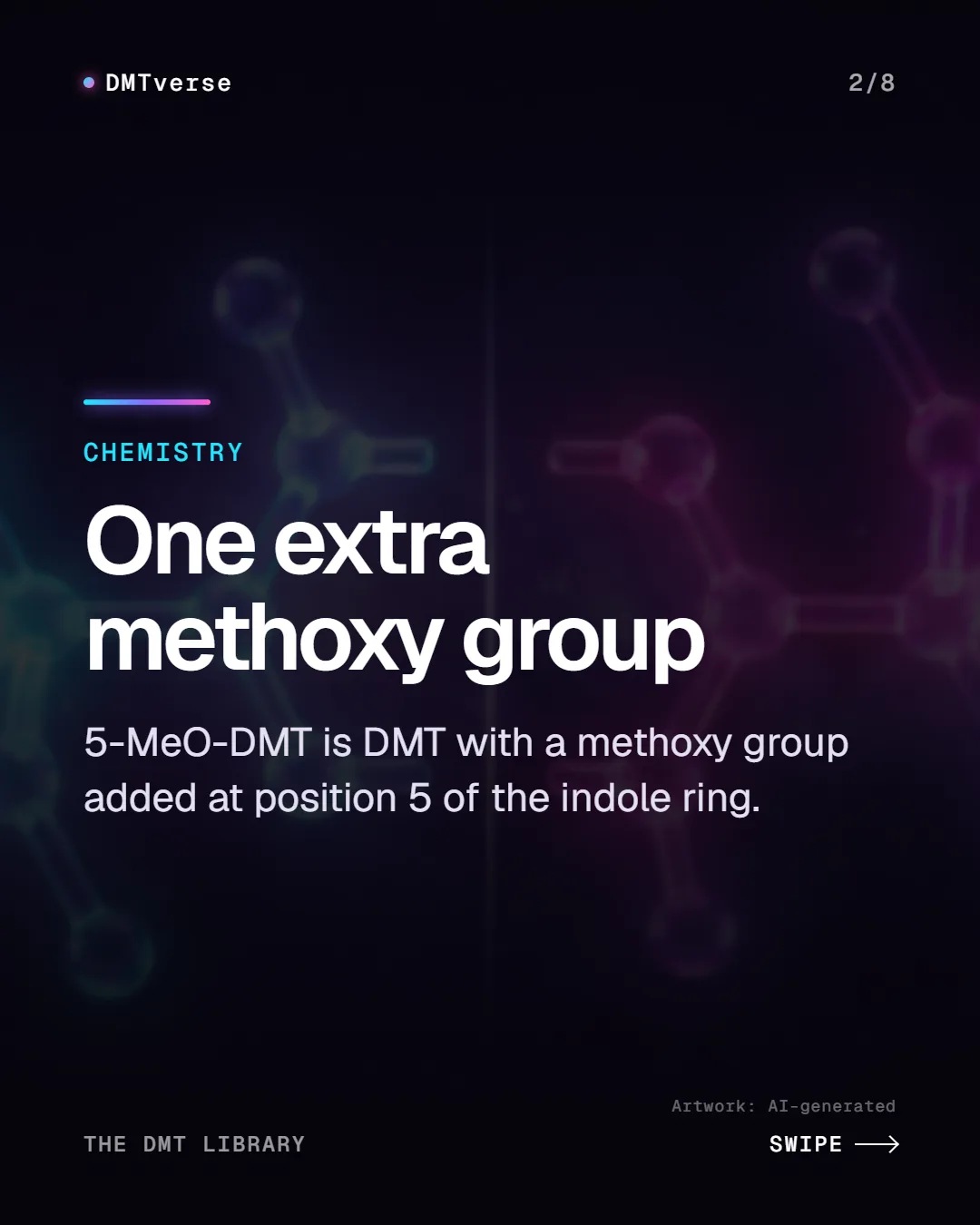
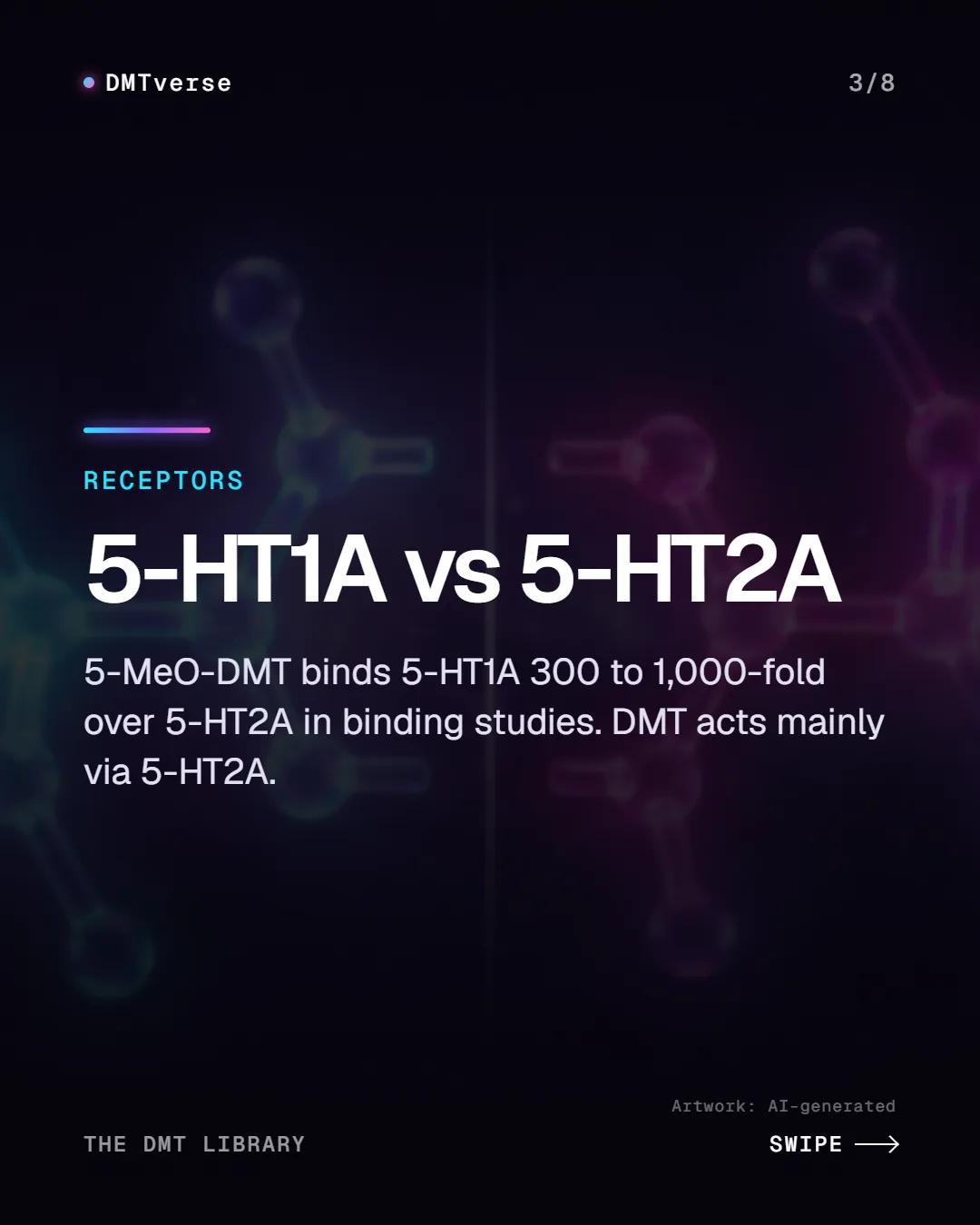
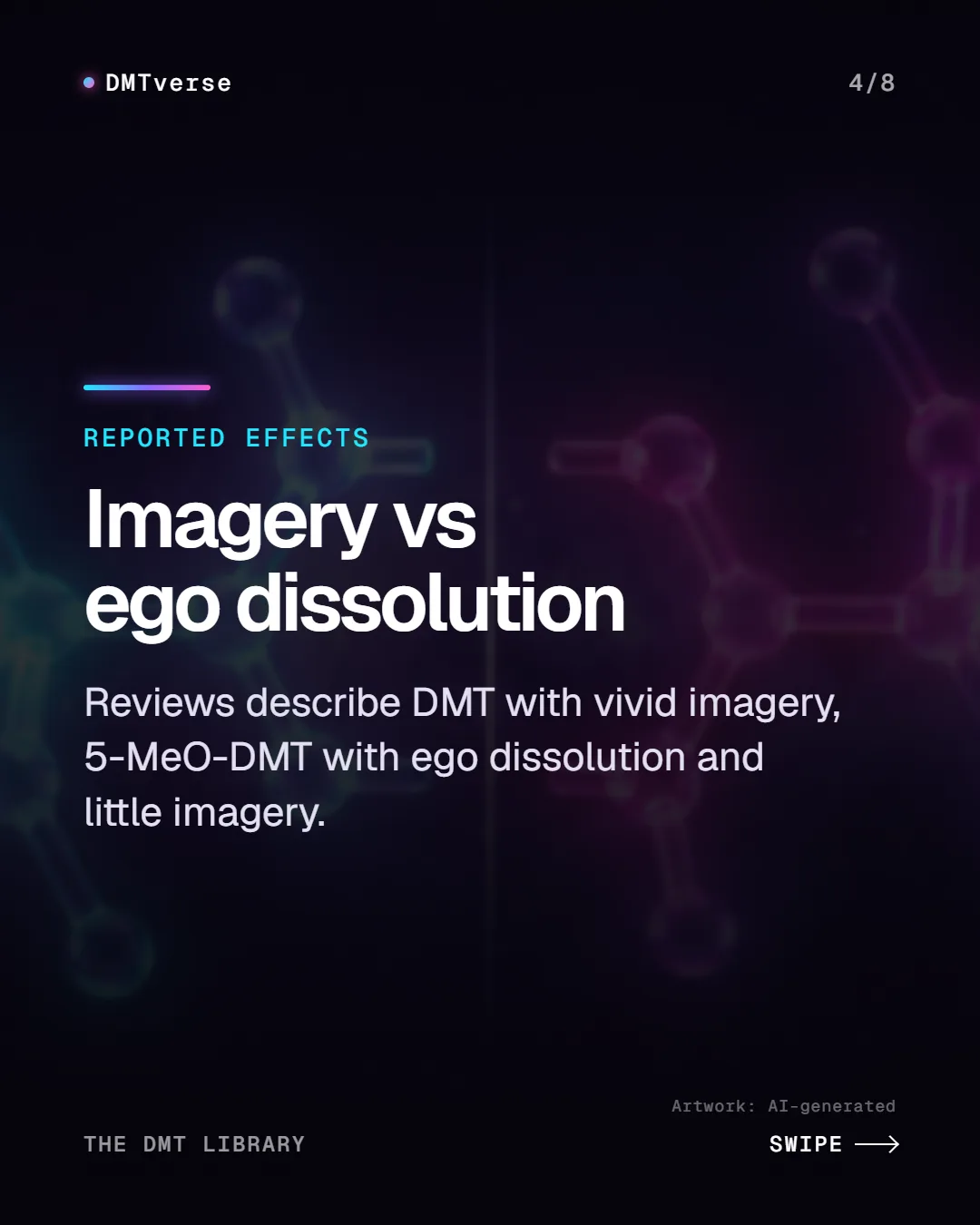
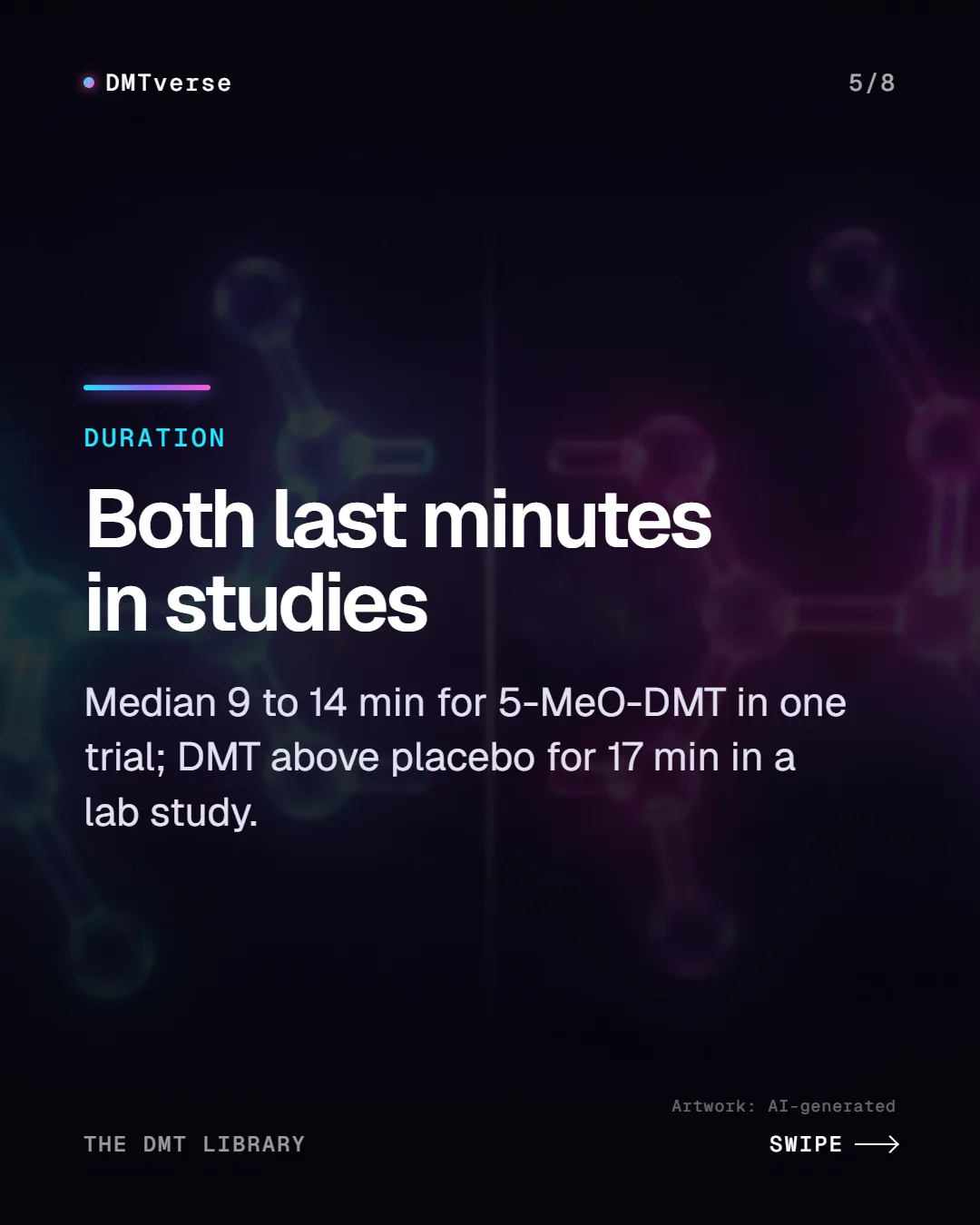
5-MeO-DMT is DMT with one extra methoxy group on the ring, and that small change makes it a different drug. It binds most strongly to the serotonin 5-HT1A receptor, while DMT acts mainly through 5-HT2A. Researchers describe DMT as producing vivid visual imagery, and 5-MeO-DMT as producing a loss of the sense of self with comparatively little imagery. Both act for minutes. In Canada, DMT is a Schedule III controlled substance; 5-MeO-DMT is not named in the schedules, but its sale falls under the Food and Drugs Act.
THE SHORT VERSION · SWIPE
On this page 12 sections
5-MeO-DMT and DMT (N,N-DMT, often written NN-DMT) share most of their name and most of their structure, so they are often lumped together. The research literature treats them as two different drugs. They differ in the receptors they favour, in what people report, in where they occur in nature, and in how far they have gone in clinical trials. For DMT on its own, start with what is DMT.
This guide compares the two side by side, using published studies and Canadian legal texts. It does not describe how to obtain, prepare or use either substance, and it gives no amounts.
General information, not medical or legal advice
Nothing here is a recommendation to use any substance. The studies described took place under medical supervision, with screening that excluded many people. Their results do not tell any one person what would happen to them.
How do 5-MeO-DMT and DMT compare at a glance?
| 5-MeO-DMT | N,N-DMT | |
|---|---|---|
| Chemistry | DMT with a methoxy group at position 5 of the indole ring | A simple tryptamine: dimethylated tryptamine |
| Strongest receptor binding | 5-HT1A, roughly 300 to 1,000 times more selective than for 5-HT2A in binding studies | Main effects through 5-HT2A; also binds several other serotonin receptors |
| Main reported experience | Ego dissolution (loss of the sense of self), comparatively little visual imagery | Vivid, complex visual imagery |
| Occurrence in nature | A narrow range: a few plants and one toad species | Widespread in plants; also found in mammals |
| Measured duration (examples) | Median 9 to 14 minutes of psychoactive effect in the GH001 phase 2b trial | Above placebo for 17 minutes after intravenous DMT in one lab study |
| Canada | Not named in the CDSA schedules; Health Canada: sale regulated under the Food and Drugs Act | CDSA Schedule III, item 7; restricted drug under the Controlled Substances Regulations |
Durations in the table come from different routes and settings, so they are not a like-for-like comparison. Sources for each row are given in the sections below.
What is the chemical difference between 5-MeO-DMT and DMT?
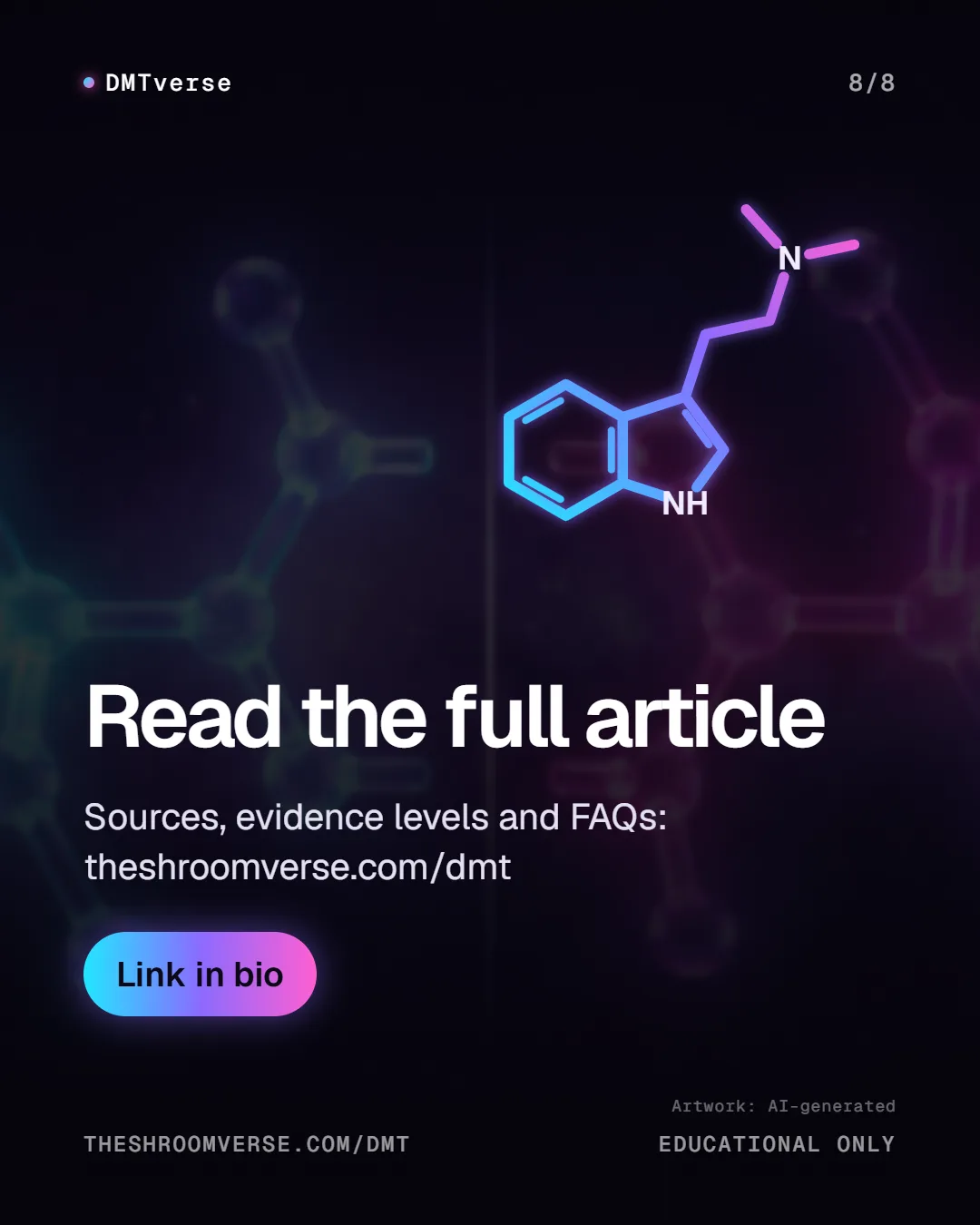
Both are tryptamines, built on the same indole skeleton as serotonin. The Canadian schedule describes DMT as 3-[(2-dimethylamino)ethyl]indole (Justice Laws, CDSA, Schedule III). 5-MeO-DMT, short for 5-methoxy-N,N-dimethyltryptamine, is the same molecule with a methoxy group (an oxygen bonded to a methyl group) attached at position 5 of the ring. Evidence: established. Our DMT chemical structure guide shows both molecules part by part.
That one group matters for how the body handles the drug. 5-MeO-DMT is broken down mainly by the enzyme monoamine oxidase A (MAO-A). A second enzyme, CYP2D6, removes the methyl from the methoxy group and turns it into bufotenine, an active metabolite (Reckweg et al., 2022). DMT is also broken down mainly by MAO-A (Barker, 2018). Both are fast-acting and short-lived, partly for this reason. Evidence: established.
How do their receptor profiles differ?
Most classic psychedelics, DMT included, produce their main effects by activating the 5-HT2A receptor. A 2018 review of DMT says its subjective effects appear to act primarily through 5-HT2A, and it cites a mouse study in which DMT’s signature head-twitch response disappeared in animals bred without that receptor. The same review notes that DMT binds many other serotonin receptors as well, including 5-HT1A, and that 5-HT2A is not the whole explanation (Barker, 2018). Evidence: established.
5-MeO-DMT leans the other way. A 2022 review summarising two binding studies on human cloned receptors reports that it binds most strongly to the 5-HT1A receptor, with 300 to 1,000-fold selectivity over 5-HT2A (Reckweg et al., 2022). Evidence: established in binding studies.
It still acts at 5-HT2A: in animals, its head-twitch response is blocked only by drugs that block 5-HT2A. But several of its other effects in rodents are reduced by a 5-HT1A blocker and not by a 5-HT2A blocker. The review adds that 5-HT1A activation tends to lower heart rate and blood pressure, while 5-HT2A activation tends to raise them (Reckweg et al., 2022). Evidence: preliminary, from animal work.
Researchers suspect this 5-HT1A tilt helps explain why 5-MeO-DMT feels different. An observational study at two ceremonies says it induces comparatively less visual imagery, which “may relate to its unusually high agonism” at 5-HT1A (Timmermann et al., 2025). That is a hypothesis, not a demonstrated mechanism in people. Evidence: preliminary.
Where are 5-MeO-DMT and DMT found in nature?
DMT is widespread. Its natural occurrence in plants was reported in 1946, and it has been found in mammalian tissue as well; it was first synthesized in 1931 by the Canadian chemist Richard Manske (Barker, 2018). Whether the human body makes 5-MeO-DMT is a different question: the same review says further studies are needed to determine whether it actually exists in humans. Evidence: established for DMT; unresolved for 5-MeO-DMT in humans.
5-MeO-DMT has a narrower known range. A 2022 review reports small amounts in a few plants that typically contain DMT too, and says indigenous ceremonial use of 5-MeO-DMT has been suggested but strong evidence is lacking (Reckweg et al., 2022). We deliberately do not list the plants. Evidence: established.
It is best known from an animal. The Sonoran Desert toad, Incilius alvarius, is described as the only animal known to secrete 5-MeO-DMT as a chemical defence. A 2025 field study in Arizona found it in every Sonoran Desert toad sampled and not in the other toads living alongside them. Diet did not explain it, and how the toad comes to have the compound is still unknown (Luccioni et al., 2025). Evidence: preliminary, from one field study.
The toad’s secretion is not just 5-MeO-DMT: it also contains bufotenine and other active substances, including compounds that act on the heart (Reckweg et al., 2022). Evidence: established.
Is the Sonoran Desert toad at risk?
Researchers have raised the concern. The 2022 review notes that the toad is not listed as endangered on the IUCN Red List, but that this classification rests on an assessment from 2004. Its authors argue that rising demand for the secretion could harm the species through habitat invasion, excessive handling of toads, amphibian trafficking and black-market dynamics, and they say a switch to synthetic 5-MeO-DMT would avoid this. They also argue the secretion is too complex and variable a mixture to develop as a medicine (Reckweg et al., 2022). Evidence: preliminary; this is the authors’ argument.
Field researchers act on the same worry. The 2025 field study, carried out under Arizona collecting licenses and with the toads released after sampling, published its site locations only approximately “due to conservation concerns” (Luccioni et al., 2025). What we could not find is a recent population assessment, so how much pressure the species is actually under is unresolved. Evidence: unresolved.
How do the reported effects differ in research?
The clearest contrast is visual. In a placebo-controlled lab study of intravenous DMT in 13 healthy volunteers, the authors describe its effects as marked by “unusually vivid visual imagery” and body sensations arising within seconds (Timmermann et al., 2019). Evidence: established. For the DMT side in depth, see what does DMT feel like.
By contrast, a review of 5-MeO-DMT describes its core effect as ego dissolution, a sense of oneness or of loosened boundaries between self and world, “in the absence of visual imagery”. The same review states the contrast directly: DMT is known for vivid, complex imagery rather than marked ego dissolution (Reckweg et al., 2022). A second review lists the “relative lack of visual effects” and possibly higher rates of ego dissolution and mystical experiences among 5-MeO-DMT’s distinguishing features (Ermakova et al., 2022). Evidence: preliminary, from reviews of mostly survey data.
The picture is not absolute. The 2025 ceremony study, with 14 participants interviewed in detail, found the 5-MeO-DMT experience moved through phases. Some people described shapes, colours or “shattering visuals” at onset, and only in the most extreme cases did people report a complete absence of self-experience (Timmermann et al., 2025). Much of what is known about 5-MeO-DMT’s effects comes from surveys and naturalistic settings like this, where nobody checked the substance or the amount. Evidence: preliminary.
How long do the effects last when measured?
Both are short. In the intravenous DMT study, ratings of intensity stayed significantly above placebo for 17 minutes and peaked at 2 to 3 minutes (Timmermann et al., 2019); how long does DMT last covers the other DMT timing studies. Evidence: established.
In the largest 5-MeO-DMT trial, the median duration of psychoactive effect for each administration ranged from 9 to 14 minutes (Cubała et al., 2026). A review gives 10 to 20 minutes as the typical range for 5-MeO-DMT and notes that duration and intensity vary with the study design (Reckweg et al., 2022). Evidence: established. For how these timings compare with psilocybin and LSD, see our classic psychedelics comparison.
What risks have been reported?
In clinical trials, reported harms have been short-lived. A 2024 systematic review found three early-phase 5-MeO-DMT trials with 78 participants in total, no serious adverse events and no dropouts, and called for larger randomized trials with longer follow-up (Kwaśny et al., 2024). Evidence: preliminary.
Outside trials, reviews list fear, anxiety, confusion, paranoia, nausea, vomiting, pressure in the chest, loss of body perception, and brief “reactivations” in the following week, with rare reports of psychosis (Reckweg et al., 2022). Evidence: preliminary.
Population data suggest the experience can be hard on people. A 2026 nationally representative US survey asked about 13 adverse effects that respondents attributed to a substance. Among 72 people who reported 5-MeO-DMT use in the past three months, 92.8% endorsed at least one, compared with 75.6% for psilocybin and 83.6% for LSD. The authors caution that the survey cannot show cause, that the 5-MeO-DMT sample was small, and that its “overwhelming phenomenology” may lead people to blame it for coincidental symptoms (Simonsson et al., 2026). Evidence: preliminary.
Why MAO inhibitors are a danger with 5-MeO-DMT
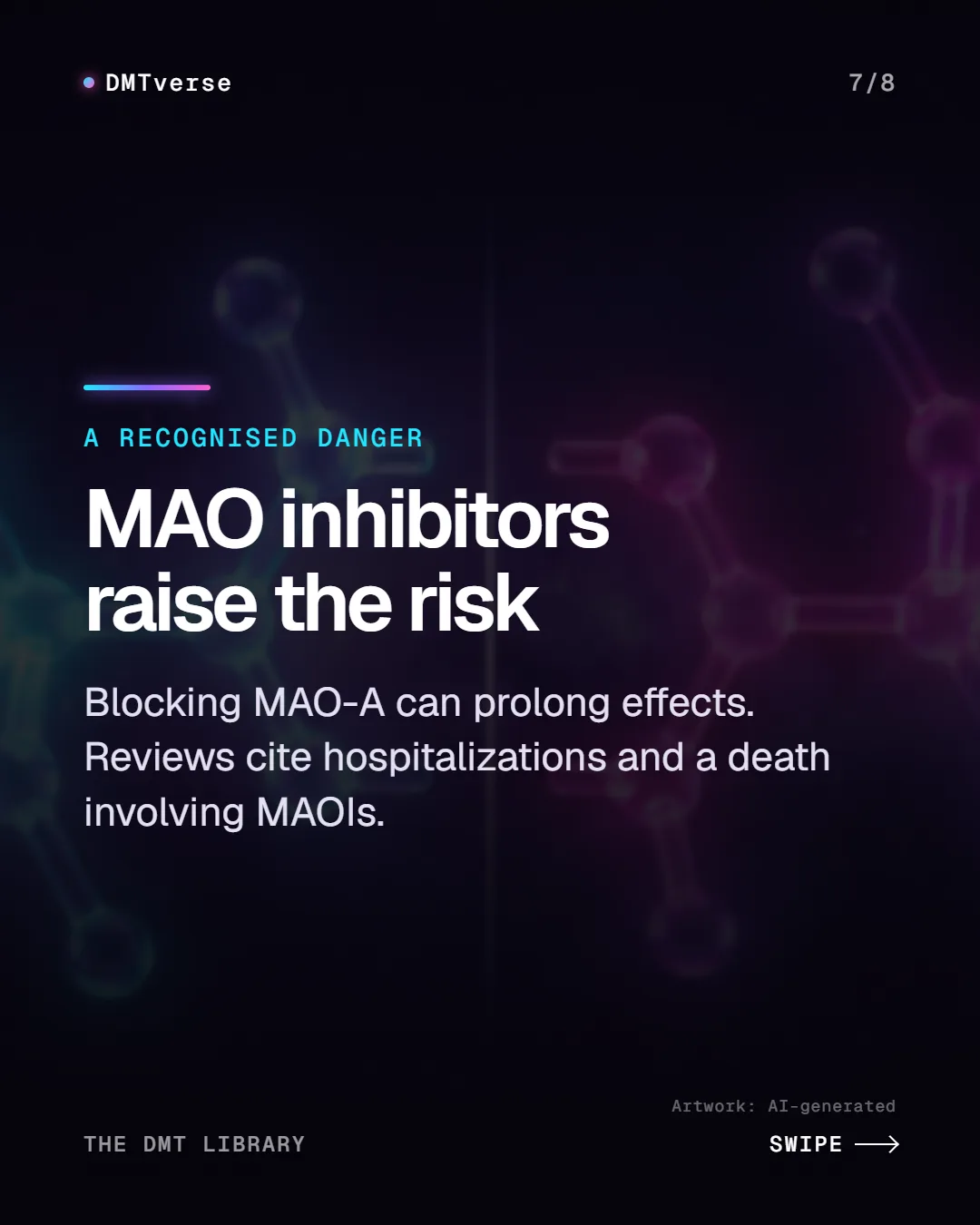
Because MAO-A is the main enzyme that clears 5-MeO-DMT, drugs or plants that inhibit MAO can block its breakdown, increasing exposure and causing enhanced, prolonged or even hyperserotonergic effects (Reckweg et al., 2022). A 2022 review notes that published deaths and hospitalizations involving 5-MeO-DMT involved toad secretion, other drugs or MAO inhibitors. It cites a teenager hospitalized with extreme agitation, overheating, a racing heart and muscle breakdown after 5-MeO-DMT with the MAO inhibitor harmaline, and a death after ayahuasca combined with 5-MeO-DMT. It recommends that trials avoid concurrent MAO inhibitors and lithium (Ermakova et al., 2022). Prescription MAOI antidepressants carry the same concern; for antidepressants and psychedelics more broadly, see magic mushrooms and antidepressants.
If someone is in danger
Call 911 for a medical emergency, such as overheating, a seizure, chest pain or someone who will not wake. For poisoning advice, Canada’s poison centres can be reached at 1-844 POISON-X (1-844-764-7669); in Quebec, the Centre antipoison du Québec is 1-800-463-5060 (Health Canada). For a mental-health or suicide crisis, call or text 9-8-8, available 24 hours a day (9-8-8). Our safety page has more.
What do clinical trials of 5-MeO-DMT show so far?
5-MeO-DMT has moved further into formal drug development than its popularity outside medicine might suggest. The main program is GH001, a synthetic inhaled formulation from GH Research. ClinicalTrials.gov lists eight GH001 studies; trials in postpartum depression and bipolar II disorder were terminated, and none of the sites listed is in Canada (ClinicalTrials.gov). Evidence: established.
| Trial | Design | Who | Main reported result |
|---|---|---|---|
| Reckweg et al., 2023 (GH001, NCT04698603) | Phase 1/2, open-label, no comparison group | 16 adults with treatment-resistant depression, Netherlands | 7 of 8 in the individualized-regimen group in remission at day 7 |
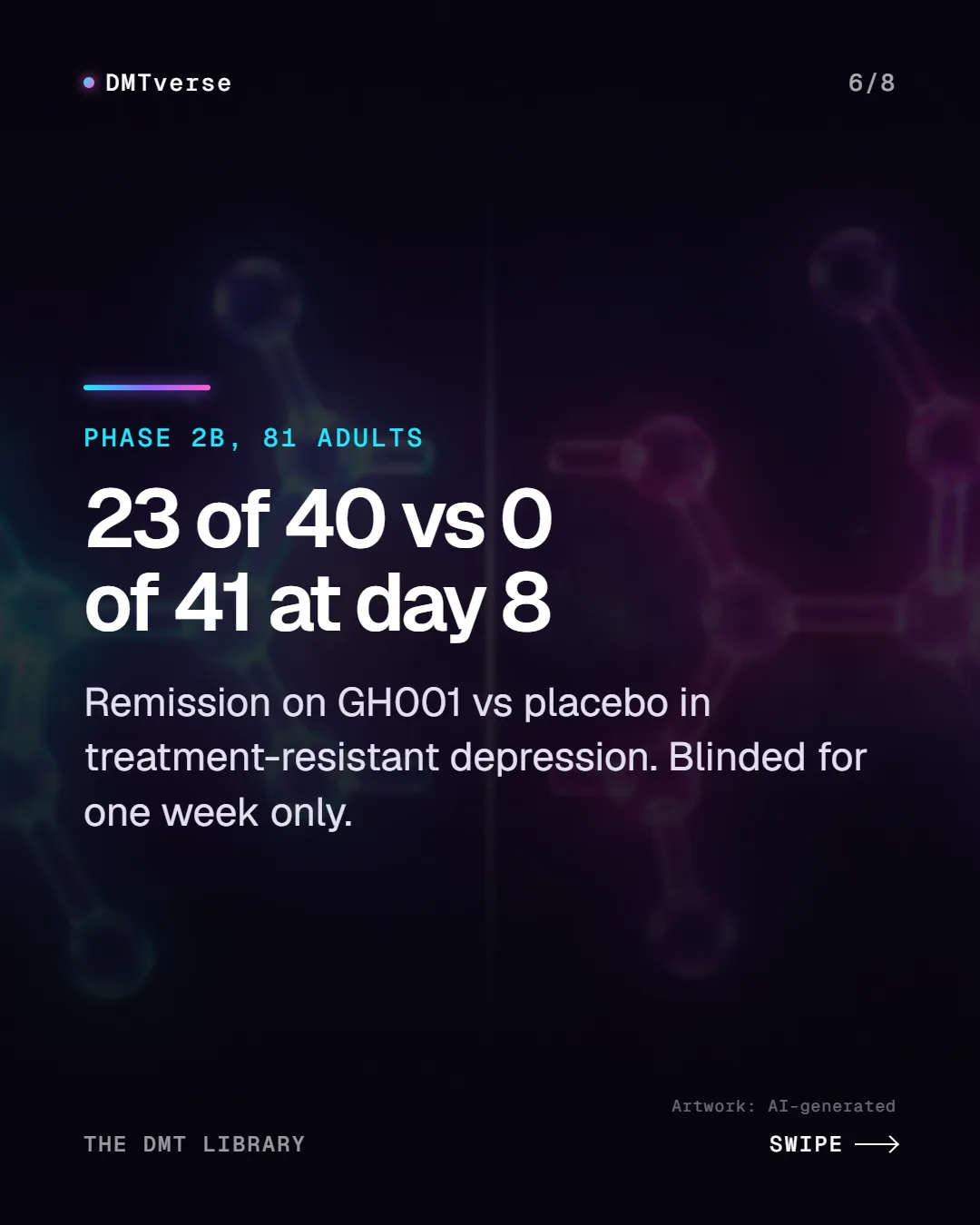
| Cubała et al., 2026 (GH001, NCT05800860) | Phase 2b, randomized, double-blind, placebo-controlled, then 6-month open-label extension | 81 adults with treatment-resistant depression, 16 sites in Europe | Remission at day 8: 23 of 40 on GH001 vs 0 of 41 on placebo |
| Seynaeve et al., 2026 (BPL-003, NCT05660642) | Open-label, ascending-dose, no comparison group | 12 adults with treatment-resistant depression who stayed on an SSRI | No severe or serious adverse events; exploratory, descriptive only |
The phase 2b trial is the strongest evidence. On the main depression scale, GH001 beat placebo by 15.5 points at day 8. Adverse events affected 72.5% of the GH001 group and 7.3% of the placebo group, mostly nausea, and all were mild or moderate; there were no severe or serious ones in the placebo-controlled week. There was no planned psychotherapy (Cubała et al., 2026). Evidence: preliminary, from one trial.
Its limits matter too. The authors acknowledge that the drug’s effects are hard to hide, which can tell patients and staff who got the real drug (functional unblinding); they used remote, blinded raters to reduce this. The blinded period lasted only a week. In the six-month open-label phase, 20 of the 23 people who had remitted were still in remission, but most had received further treatments (Cubała et al., 2026).
The earlier phase 1/2 study had no control group (Reckweg et al., 2023), and the SSRI study was a small open-label safety study (Seynaeve et al., 2026). The trial authors describe GH001 as a potential treatment, not an established one. Evidence: preliminary. For psilocybin’s depression trials, see psilocybin depression trials.
What is the legal status of 5-MeO-DMT and DMT in Canada?
DMT is controlled. The Controlled Drugs and Substances Act lists N,N-dimethyltryptamine and its salts as item 7 of Schedule III, in the consolidation current to 30 September 2026 (Justice Laws, CDSA). The new Controlled Substances Regulations, which came into force on 1 October 2026, list DMT as a restricted drug in their Schedule 4 (Justice Laws, SOR/2025-242). Evidence: established. See also is DMT legal in Canada.
5-MeO-DMT is not named in either text. We searched both for the substance and its chemical names and found no listing, and the DMT entry covers DMT and its salts, not its derivatives (Justice Laws, CDSA). Evidence: established.
Health Canada’s drug-surveillance site gives 5-MeO-DMT as its example of a “new psychoactive substance”: one not currently controlled under the CDSA, whose sale is regulated under the Food and Drugs Act (Health Canada, Health Infobase; page modified 19 March 2026). A 2022 review also lists Canada among countries where it is not controlled, while noting it has been in US Schedule I since 2009 (Ermakova et al., 2022). Evidence: established.
“Not scheduled” does not mean approved, tested or safe, and the Food and Drugs Act still applies to its sale. Health Canada runs a service that confirms its position on whether a substance not explicitly listed in the CDSA is controlled (Health Canada). We did not find a published determination for 5-MeO-DMT, and the Health Canada page predates the October 2026 regulations. Check the official texts for any later change. This is general information, not legal advice.
What we still don’t know
- Whether 5-MeO-DMT’s 5-HT1A activity explains its reduced visual effects in people, or only in animal and binding studies.
- Whether GH001’s results hold in larger, longer trials with blinding measured, and in patients with more severe or long-standing illness.
- How common serious harms are outside trials. Most case reports are second-hand, and many databases do not test for 5-MeO-DMT.
- How the Sonoran Desert toad makes 5-MeO-DMT, and how its populations are faring since the 2004 assessment.
- Whether the human body produces 5-MeO-DMT at all.
Common questions
What is the main difference between 5-MeO-DMT and DMT?
Chemically, 5-MeO-DMT is DMT with a methoxy group at position 5 of the indole ring. Pharmacologically, it binds most strongly to the 5-HT1A receptor, while DMT acts mainly through 5-HT2A. Researchers describe DMT as producing vivid visual imagery and 5-MeO-DMT as producing ego dissolution with comparatively little imagery.
What are the reported effects of 5-MeO-DMT?
Reviews describe ego dissolution, a sense of oneness and mystical-type experiences, with relatively few visual effects. Reported adverse effects include fear, anxiety, confusion, nausea, chest pressure and brief reactivations in the following week. In the largest trial, effects lasted a median of 9 to 14 minutes per administration. This is a description of research, not guidance.
Does 5-MeO-DMT come from a toad?
It is found in the secretion of the Sonoran Desert toad, Incilius alvarius, the only animal known to secrete it as a chemical defense, and in small amounts in some plants. The clinical trials use synthetic 5-MeO-DMT. Researchers have raised conservation concerns about demand for the toad’s secretion.
Is 5-MeO-DMT legal in Canada?
As read on 20 October 2026, 5-MeO-DMT is not named in the Controlled Drugs and Substances Act schedules or the restricted-drug schedule of the Controlled Substances Regulations. Health Canada describes it as a new psychoactive substance not controlled under the CDSA, whose sale is regulated under the Food and Drugs Act. DMT is a Schedule III controlled substance. This is not legal advice.
Is 5-MeO-DMT being tested as a medicine?
Yes. A randomized, double-blind, placebo-controlled phase 2b trial of a synthetic inhaled formulation, GH001, in 81 adults with treatment-resistant depression reported 23 of 40 in remission at day 8 versus none on placebo. Its blinding was hard to maintain and the blinded period lasted a week. These are trial results, not an approved treatment.
Why is combining 5-MeO-DMT with an MAO inhibitor dangerous?
MAO-A is the main enzyme that breaks 5-MeO-DMT down. Blocking it can increase exposure and cause prolonged or hyperserotonergic effects. Reviews cite hospitalizations and a death involving MAO inhibitors or ayahuasca combined with 5-MeO-DMT. In an emergency, call 911.
Shroomverse sells mushroom products. This article is general information about the chemistry, natural history, research and legal status of two tryptamines. It is not medical, legal or purchasing advice, and it does not recommend any product.
SOURCES
- Controlled Drugs and Substances Act (S.C. 1996, c. 19), full text, Schedule III, Government of Canada, Justice Laws Website. Accessed . Act current to 2026-09-30. Schedule III item 7 lists DMT and any salt thereof, with its chemical name. Searched for 5-MeO-DMT and its chemical names: not listed.
- Controlled Substances Regulations (SOR/2025-242), full text, section 239 and Schedule 4, Government of Canada, Justice Laws Website. Accessed . In force 1 October 2026 (section 239). Schedule 4 (restricted drugs) Part 1 item 4 lists DMT and its salts; 5-MeO-DMT not listed. Consolidation current to 2026-09-30.
- Canadian Drug and Substance Watch: understanding the data, Health Canada, Health Infobase. Accessed . Defines new psychoactive substances as not currently controlled under the CDSA, with sale regulated under the Food and Drugs Act, and gives 5-MeO-DMT as the example. Modified 2026-03-19.
- Health Canada’s controlled substances status determination process, Health Canada. Accessed . Source for the service that confirms Health Canada’s position on substances not explicitly listed in the CDSA schedules.
- The clinical pharmacology and potential therapeutic applications of 5-MeO-DMT (Reckweg JT et al., Journal of Neurochemistry, 2022), Wiley; full text via PubMed Central, PMC9314805. Accessed . Receptor binding (5-HT1A highest, 300–1,000-fold selectivity), MAO-A and CYP2D6 metabolism, MAOI interaction, occurrence in a few plants and in the toad secretion (with bufotenine and heart-active compounds), IUCN 2004 assessment and conservation concerns, effects, 10–20 minute duration, adverse effects, and the DMT imagery contrast.
- A narrative synthesis of research with 5-MeO-DMT (Ermakova AO et al., Journal of Psychopharmacology, 2022), SAGE; full text via PubMed Central, PMC8902691. Accessed . Relative lack of visual effects; legal status (US Schedule I 2009; not controlled in Canada); case reports of hospitalization and death involving MAOIs, toad secretion or other drugs; trials should avoid MAOIs and lithium.
- Exploring 5-MeO-DMT as a pharmacological model for deconstructed consciousness (Timmermann C et al., Neuroscience of Consciousness, 2025), Oxford University Press; full text via PubMed Central, PMC12010161. Accessed . Observational ceremony study (14 participants): less visual imagery possibly related to 5-HT1A agonism; phases of experience; complete loss of self only in the most extreme cases.
- Neural correlates of the DMT experience assessed with multivariate EEG (Timmermann C et al., Scientific Reports, 2019), Springer Nature; full text via PubMed Central, PMC6864083. Accessed . 13 healthy volunteers, placebo-controlled intravenous DMT: vivid visual imagery; intensity above placebo for 17 minutes, peak at 2–3 minutes.
- N,N-Dimethyltryptamine (DMT), an endogenous hallucinogen (Barker SA, Frontiers in Neuroscience, 2018), Frontiers; full text via PubMed Central, PMC6088236. Accessed . DMT synthesis by Richard Manske (1931), occurrence in plants and mammals, MAO-A metabolism, 5-HT2A as main mediator plus binding to other serotonin receptors, and uncertainty over 5-MeO-DMT in humans.
- Diet and chemical defenses of the Sonoran Desert toad (Luccioni MD et al., PLOS One, 2025), PLOS; full text via PubMed Central, PMC12599970. Accessed . Only animal known to secrete 5-MeO-DMT as a chemical defense; range in Arizona and Sonora; source unknown and not explained by diet; site locations withheld due to conservation concerns.
- Adverse health outcomes of psilocybin, LSD, MDMA, ibogaine, and 5-MeO-DMT (Simonsson O et al., JAMA Network Open, 2026), American Medical Association; full text via PubMed Central, PMC13624878. Accessed . US survey: 92.8% of 72 recent 5-MeO-DMT users endorsed at least one of 13 self-attributed adverse effects, vs 75.6% psilocybin and 83.6% LSD; limitations.
- Short-term safety and tolerability profile of 5-MeO-DMT in human subjects: a systematic review of clinical trials (Kwaśny A et al., Frontiers in Psychiatry, 2024), Frontiers; full text via PubMed Central, PMC11446775. Accessed . Three trials, 78 participants, no serious adverse events, no dropouts; need for larger randomized trials.
- A phase 1/2 trial of a vaporized 5-MeO-DMT formulation (GH001) in treatment-resistant depression (Reckweg JT et al., Frontiers in Psychiatry, 2023), Frontiers; full text via PubMed Central, PMC10319409. Accessed . Open-label, single-arm, 16 patients; 7 of 8 in remission at day 7 in the individualized-regimen group.
- GH001 vs placebo in patients with treatment-resistant depression: a randomized clinical trial (Cubała WJ et al., JAMA Psychiatry, 2026), American Medical Association; full text via PubMed Central, PMC13019340. Accessed . 81 randomized; −15.5 point difference on MADRS at day 8; remission 23/40 vs 0/41; adverse events 72.5% vs 7.3%; median effect 9–14 minutes; unblinding limitation; 6-month open-label results.
- Intranasal 5-MeO-DMT concomitant with SSRI for treatment-resistant depression: a proof-of-concept trial (Seynaeve M et al., CNS Drugs, 2026), Springer; full text via PubMed Central, PMC13095895. Accessed . Open-label, 12 participants on a stable SSRI; no severe or serious adverse events; exploratory analysis only.
- ClinicalTrials.gov API v2: studies with intervention GH001, U.S. National Library of Medicine, ClinicalTrials.gov. Accessed . Eight GH001 studies (GH Research Ireland Limited); phase 2b NCT05800860 completed with 81 enrolled; postpartum and bipolar II trials terminated; no Canadian sites listed.
- Canada launches new toll-free 1-844 POISON-X number for poison centres, Health Canada. Accessed . Source for 1-844-764-7669, poison centres as the 24/7 access point, and the Quebec number 1-800-463-5060.
- 9-8-8: Suicide Crisis Helpline, 9-8-8: Suicide Crisis Helpline. Accessed . Call or text 9-8-8, 24 hours a day, every day; call 9-1-1 if safety is at risk.
CHANGES
- : Added the spelling NN-DMT, which many searchers use for N,N-DMT.
- : Linked glossary definitions.
- : Published. Sources opened and checked on this date, including the CDSA consolidation current to 30 September 2026 and the Controlled Substances Regulations in force 1 October 2026.
- : Editorial review: shorter short answer; removed the secretion concentration figure, the plant-part detail and the town-level study location (sourcing-adjacent detail); dropped “promising” from an evidence label; split long paragraphs and added evidence labels throughout; defined ego dissolution; added links to the pillar, structure, experience, duration and Canadian law articles.



