
THE SHROOMVERSE JOURNAL ✳ 13 MIN READ
DMT vs LSD: is DMT like acid, and how do the two really differ?
Topic: DMT
Published Updated
Listen: the 3-minute version
AI-narrated summary of this article
Short answer, checked 21 October 2026
DMT vs acid: they are different drugs. DMT is a simple tryptamine, while LSD (“acid”) is an ergoline first made in a lab in 1938. Both act mainly at the serotonin 5-HT2A receptor, but on very different time scales: injected DMT in lab studies lasted minutes, and LSD lasted about 9 to 11 hours on average. LSD binds more receptor types. A Swiss study comparing them directly is registered, but we found no published results. In Canada, both are in Schedule III of the Controlled Drugs and Substances Act.
THE SHORT VERSION · SWIPE
On this page 12 sections
People who search “DMT vs acid” usually want to know two things: is DMT a kind of LSD, and how are the two different? The short answer to the first is no. This page goes deeper on that one pair. For psilocybin alongside both, see our three-way guide to psilocybin, LSD and DMT.
Education only, not guidance
This compares published science and Canadian law. It gives no amounts, no ways of taking anything and no advice on combining drugs, and it does not rank either drug as better or stronger. Evidence labels used below: established (shown in peer-reviewed studies and not seriously disputed), preliminary (early, small or indirect) and unresolved (an open question). In an emergency, call 911.
DMT vs acid: how do they compare at a glance?
The table sums up what studies have measured. Each row is explained, with sources, in the sections below. The DMT timing comes from lab studies in which DMT was injected into a vein, a study design rather than a description of everyday use.
| DMT | LSD (acid) | |
|---|---|---|
| Chemical family | Tryptamine (a simple indole with a side chain). | Ergoline alkaloid, made from lysergic acid. |
| Where it comes from | Made by many plants and animals, including mammals; first synthesised in 1931. | First made in a lab in 1938, during research on ergot alkaloids. |
| Effects first reported in people | 1956 (Stephen Szára, Budapest). | 1943 (Albert Hofmann, by accident). |
| Main receptor target | Serotonin 5-HT2A, per one review “primarily”. | Serotonin 5-HT2A; also adrenergic and dopamine receptors. |
| Time course in studies | Injected: peak within about 2 minutes, mostly gone by 30. | Effects lasted about 9 to 11 hours on average in one trial. |
| Head-to-head trial | Registered in Basel (NCT06899334); no published results found. | Same trial. |
| Canada (CDSA) | Schedule III, item 7. | Schedule III, item 5. |
Is DMT acid?
No. “Acid” is slang for LSD (lysergic acid diethylamide). PubChem, the US government chemistry database, classes LSD as an ergoline alkaloid, made by joining lysergic acid with diethylamine (PubChem, LSD). It classes DMT (N,N-dimethyltryptamine) as a tryptamine with two methyl groups on its side chain (PubChem, DMT). They are separate molecules with separate entries in Canadian law. Evidence: established.
The mix-up is understandable. Both are classic psychedelics, and a pharmacology review groups LSD and the tryptamines together as indoleamines, drugs built on the same ring-shaped indole core (Halberstadt and Geyer, 2011). A chemistry review notes that DMT’s structure is embedded within LSD’s (Cameron and Olson, 2018). Related is not the same. For other names DMT goes by, see DMT street names. Evidence: established.
What is the difference between DMT and LSD chemically?
DMT is small and simple. A 2018 review calls it the archetype for all indole-containing serotonergic psychedelics, and notes that, unlike LSD, it is produced by a wide variety of plant and animal species. It is one of the few psychedelics made by mammals, and its role in the body “remains a mystery” (Cameron and Olson, 2018). For the molecule itself, see DMT’s chemical structure explained. Evidence: established.
LSD has a different origin. The Swiss chemist Albert Hofmann first made it at Sandoz in Basel in 1938, as part of research on ergot alkaloids, compounds from the ergot fungus (Omidian and Omidian, 2025). Its four-ring ergoline frame is what sets it apart from the tryptamines (PubChem, LSD). Evidence: established.
When were DMT and LSD discovered?
- 1931The Canadian chemist Richard Manske first synthesises DMT; it is not tested in people at the time.Source Barker, 2018
- 1938Albert Hofmann first synthesises LSD at Sandoz, during ergot alkaloid research.Source Omidian and Omidian, 2025
- 1943Hofmann discovers LSD’s psychoactive effects by accident.Source Nichols, 2018
- 1946Oswaldo Gonçalves de Lima reports DMT occurring naturally in plants.Source Barker, 2018
- 1956Stephen Szára reports DMT’s hallucinogenic effects in people.Source Barker, 2018; Wirz-Justice, 2021
- c. 1970US clinical research with LSD ends when it is placed in Schedule 1 there.Source Nichols, 2018
The two stories cross. Szára’s obituary says he made DMT himself after Sandoz declined to send him LSD, and that he was the first to study DMT’s psychotropic effects (Wirz-Justice, 2021). A 2018 review dates the first synthesis to 1931 and the first human reports to 1956 (Barker, 2018). LSD’s 1943 discovery and the end of US clinical research around 1970 come from a review of LSD (Nichols, 2018). More in our history of DMT and Stephen Szára articles. Evidence: established.
Do DMT and LSD work the same way in the brain?
Partly. Both act at the serotonin 5-HT2A receptor, a protein on brain cells that serotonin normally switches on. A review says DMT’s subjective effects “appear to be primarily acting via 5-HT2A receptors”, while it also touches other receptors (Barker, 2018). For LSD, the 5-HT2A role is backed by human blocking studies, summarised, with the full receptor comparison, in our three-way guide. Evidence: established for LSD; for DMT, established in animal and lab work, preliminary in people.
The differences show up in lab tests of receptor binding (how tightly a drug attaches). DMT bound the 5-HT2A receptor less tightly than LSD; LSD, but not DMT, also interacted with adrenergic and dopamine receptors; and DMT, but not LSD, interacted with the serotonin transporter, the pump that clears serotonin away (Rickli et al., 2016). Tighter binding is not the same as a stronger experience. Evidence: established as lab findings, preliminary for what they mean in people.
For this pair, the key lab finding is about time. LSD lets go of the 5-HT2A receptor “exceptionally slow”, and simulations suggest a loop of the receptor forms a “lid” over it (Wacker et al., 2017). DMT, by contrast, is cleared rapidly after injection (Barker, 2018). Those two facts are the leading explanations for why one lasts minutes and the other most of a day, but neither has been shown to explain it in people. Evidence: unresolved. See also DMT and the 5-HT2A receptor.
How long do DMT and LSD last in studies?
This is the biggest measured difference. In a double-blind study of 11 experienced users given DMT into a vein, peak blood levels and effects came within 2 minutes and were negligible at 30 minutes (Strassman and Qualls, 1994). In a later study of 13 volunteers, rated intensity peaked 2 to 3 minutes after injection and stayed above placebo for 17 minutes (Timmermann et al., 2019). Evidence: established for injected DMT in lab conditions.
LSD runs for most of a day. In a double-blind crossover trial of 28 healthy volunteers, LSD effects lasted about 9.3 to 11 hours on average, depending on the amount given (dose not reproduced here), with individual times from about 5 to 20 hours (Holze et al., 2022). An earlier trial of 16 healthy people reported altered consciousness lasting 12 hours (Schmid et al., 2015). Evidence: established for healthy volunteers. For DMT’s timing in more detail, see how long does DMT last.
These are averages from screened volunteers under supervision. They are not a prediction for any one person, and they are not a guide to use.
DMT vs LSD effects: what do people report?
Volunteers in a 1990s DMT study were interviewed after each session. They described a “rush”, a rapidly moving, brightly coloured visual display, and a sense of loss of control leading to a dissociated state, in which euphoria and anxiety alternated or coexisted. The effects replaced their ongoing experience and were described as more vivid than dreams or waking awareness (Strassman et al., 1994). These are reports from 12 experienced volunteers. Evidence: preliminary.
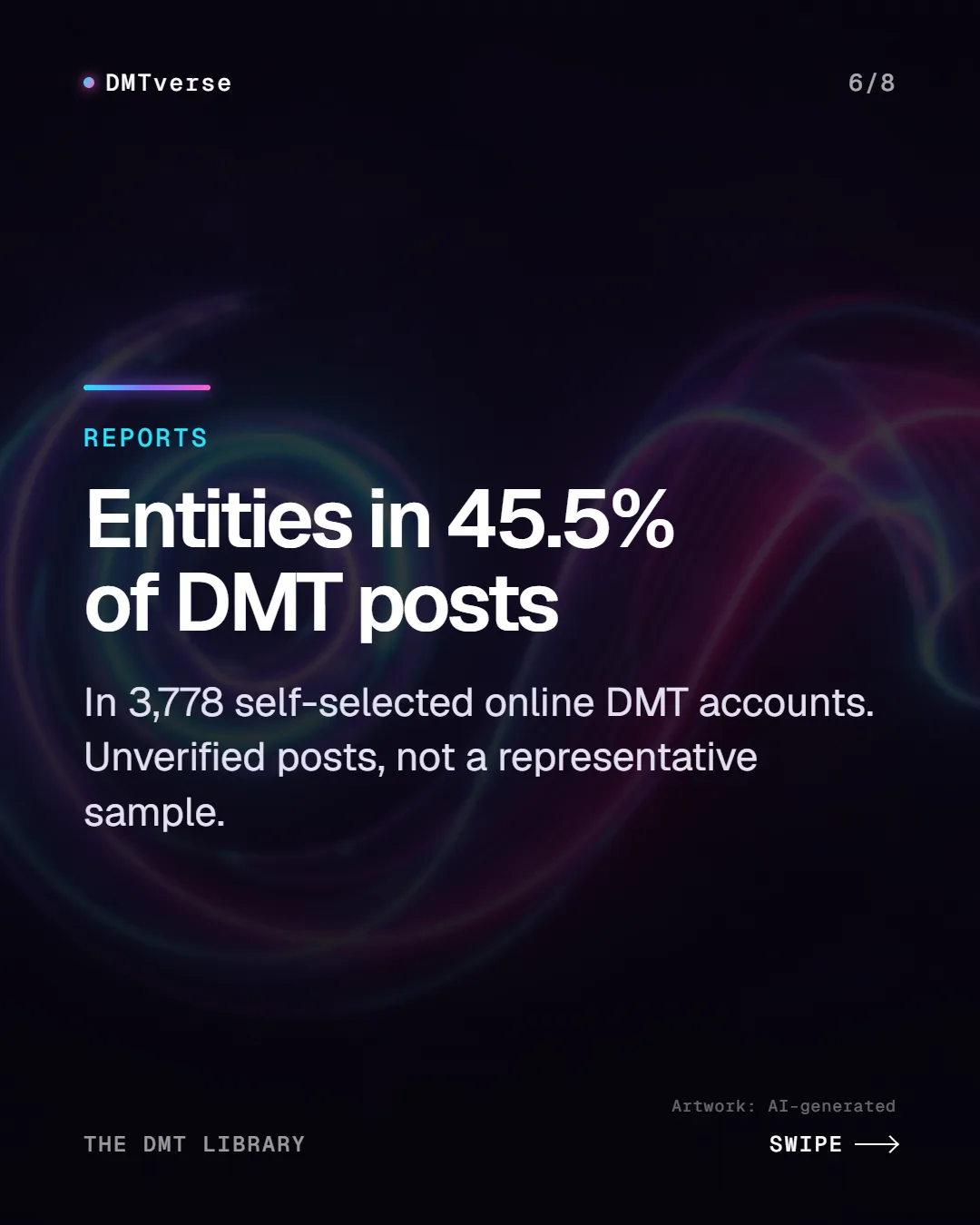
A larger but self-selected source is a study of 3,778 DMT accounts posted to a Reddit forum from 2009 to 2018, all describing inhaled use. Fractals, shapes and patterns appeared in 32.6%, and encounters with “entities” in 45.5%. The median reported experience lasted 10 minutes (Lawrence et al., 2022). Online posts are unverified and not representative. See what does DMT feel like and DMT entity encounters research. Evidence: preliminary.
For LSD, a placebo-controlled trial of 16 healthy people recorded visual hallucinations, audiovisual synaesthesia (sounds experienced as visuals) and derealisation and depersonalisation, feelings that the world or self seem unreal, which the authors describe as positively experienced (Schmid et al., 2015). Ratings of well-being, closeness and trust also rose during the session. These are acute ratings, not lasting effects. Evidence: preliminary.
So is DMT like acid? The reports overlap in their visual changes, but differ in shape: a fast, overwhelming few minutes, sometimes with reported “entities”, against a long, slowly unfolding day. No published study has yet put both side by side in the same people with the same measures. Evidence: unresolved.
Has anyone compared DMT and LSD directly?
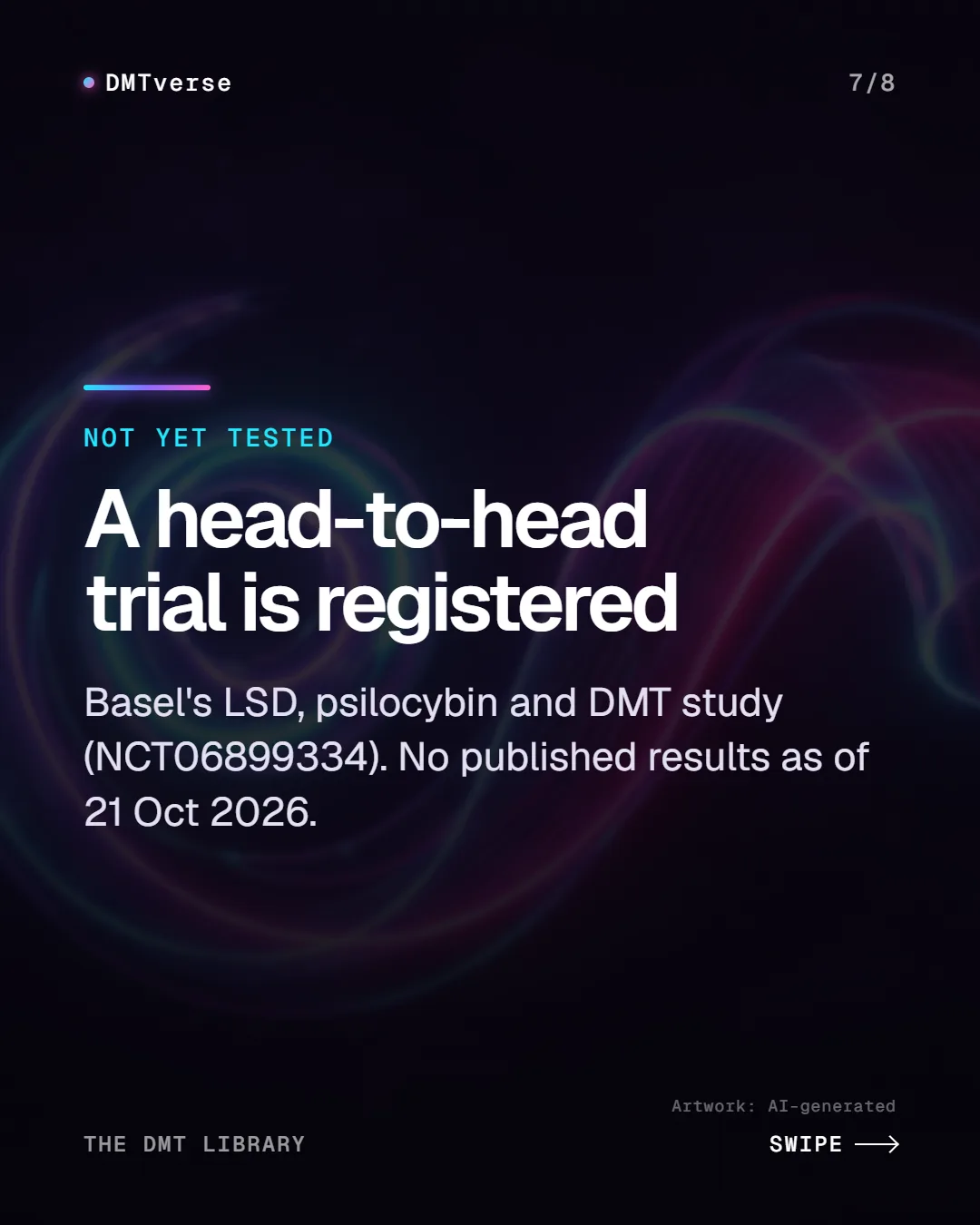
Not yet in published form, as far as we could find. University Hospital Basel registered a randomised, placebo-controlled, double-blind crossover study comparing LSD, psilocybin and DMT in about 24 healthy participants. Its stated aim is to test whether equivalent, moderately high doses produce similar peak effects once duration is evened out: DMT is given as an infusion meant to mimic the time course of the other two, and ketanserin, a drug that blocks 5-HT2A, is used to standardise how long the effects last (ClinicalTrials.gov, NCT06899334). Evidence: established for the registration.
The record lists the study as recruiting, last verified in March 2025, with completion estimated for August 2026 (ClinicalTrials.gov, NCT06899334). A Europe PMC search on 21 October 2026 found no published results. When they appear, they will be the first direct test of this pair. The closest published work is a head-to-head trial of LSD and psilocybin, which found their effects did not differ beyond duration (Holze et al., 2022). Evidence: unresolved for DMT vs LSD.
What are the risks of DMT and LSD?
Both raise heart and body measures. Injected DMT raised blood pressure, heart rate, pupil size and body temperature, more so at higher amounts (Strassman and Qualls, 1994). LSD raised blood pressure, heart rate, body temperature and pupil size in healthy volunteers; adverse effects resolved within 72 hours and none were severe in that controlled setting (Schmid et al., 2015). People with heart conditions are usually screened out, so these studies say little about them. Evidence: established for healthy volunteers.
The mind carries risk too. In the DMT interviews, euphoria often came with anxiety (Strassman et al., 1994). In the LSD and psilocybin trial, after-effects included headaches (Holze et al., 2022). A 2025 review of LSD research lists cardiovascular risks, emotional vulnerability and hallucinogen persisting perception disorder (HPPD), lasting visual changes, among its safety considerations (Omidian and Omidian, 2025). See HPPD explained. Evidence: preliminary.
DMT and LSD at the same time
Taking DMT and LSD together has not been studied in any trial we found, so nothing is known about its safety. It is a risk, not a combination with a known profile. If someone is unwell after taking either, use the help lines below.
If someone is in danger
Call 911 for immediate danger or urgent medical help, including if someone is unconscious, not breathing or having a seizure. In Ontario, the Ontario Poison Centre is at 1-800-268-9017; every province has a poison centre, listed by SickKids (AboutKidsHealth). If you or someone you know is thinking about suicide, call or text 9-8-8, 24 hours a day (Government of Canada). See also our safety page and how to help someone having a bad trip.
Are DMT and LSD legal in Canada?
No. The Controlled Drugs and Substances Act (CDSA) lists both in Schedule III: LSD is item 5, and N,N-dimethyltryptamine (DMT) is item 7. The consolidation we read was current to 30 September 2026 (Justice Laws, CDSA). Except as authorised under the regulations, the Act prohibits possessing or producing a Schedule III substance, and it prohibits trafficking in one (sections 4, 5 and 7). Evidence: established.
Being in the same schedule does not mean the two are alike in effect or risk; it is a legal grouping. Penalties, exemptions and recent rule changes are covered in is DMT legal in Canada?. This is general information, not legal advice.
What we still don’t know
- How the two compare in the same people. The Basel trial is the first registered direct test; results were not published when we checked (unresolved).
- Why LSD lasts so much longer. Slow release from the receptor and DMT’s rapid breakdown are both discussed, but neither is proven to explain it in people (unresolved).
- What LSD’s extra receptor activity adds. Its adrenergic and dopamine binding comes from lab work (preliminary).
- How far reports carry over. DMT experience data come from small lab groups and self-selected online posts (preliminary).
- Effects in people the trials leave out, such as those with heart disease or psychiatric histories (unresolved).
The honest summary: DMT is not acid. The two share a main receptor and some visual effects, but differ in chemistry, history, receptor reach and, above all, time course. For the bigger picture, start with what is DMT.
Common questions
Is DMT acid?
No. Acid is slang for LSD, an ergoline first made in a lab in 1938. DMT is a simple tryptamine made by many plants and animals. They are related classic psychedelics that both act at the 5-HT2A receptor, but they are different molecules with separate legal listings.
What is the difference between DMT and LSD?
Chemistry, history and timing. DMT is a tryptamine first synthesised in 1931; LSD is an ergoline made in 1938. LSD binds more receptor types in lab tests. In studies, injected DMT lasted minutes, while LSD lasted about 9 to 11 hours on average.
Is DMT like acid?
Reports overlap on visual changes, but the shape differs. DMT volunteers described a fast, overwhelming rush lasting minutes, and many online accounts mention entities. LSD trial participants described hallucinations and synaesthesia over most of a day. No published study has compared them directly.
Does DMT last longer than LSD?
No, much shorter. In lab studies, injected DMT peaked within about 2 to 3 minutes and was mostly gone by 30. In a trial of 28 volunteers, LSD effects lasted about 9 to 11 hours on average. These are averages, not predictions.
Is it safe to take DMT and LSD together?
This has not been studied, so its safety is unknown and it is a risk. In an emergency in Canada, call 911. In Ontario, the Ontario Poison Centre is at 1-800-268-9017, and 9-8-8 is the suicide crisis line.
Has a study compared DMT and LSD head to head?
One is registered. University Hospital Basel lists a placebo-controlled crossover trial comparing LSD, psilocybin and DMT in healthy volunteers (NCT06899334). It was recruiting when last updated, and we found no published results as of 21 October 2026.
Are DMT and LSD legal in Canada?
No. Both are in Schedule III of the Controlled Drugs and Substances Act: LSD is item 5 and DMT is item 7. Possession, trafficking and production are prohibited unless authorised. This is general information, not legal advice.
Shroomverse sells mushroom products. This article is general information about DMT and LSD research and Canadian law. It is not medical, legal or purchasing advice, and it does not recommend any product.
SOURCES
- Lysergic acid diethylamide (CID 5761), PubChem, U.S. National Library of Medicine. Accessed . Compound record description (ChEBI) read via the PubChem API. Supports LSD as an ergoline alkaloid formed from lysergic acid and diethylamine.
- N,N-Dimethyltryptamine (CID 6089), PubChem, U.S. National Library of Medicine. Accessed . Compound record description (ChEBI) read via the PubChem API. Supports DMT as a tryptamine with two N-methyl groups on the side chain.
- Dark Classics in Chemical Neuroscience: N,N-Dimethyltryptamine (DMT) (Cameron LP, Olson DE, ACS Chemical Neuroscience 9(10):2344–2357, 2018), American Chemical Society (peer-reviewed). Accessed . Abstract read (via Europe PMC). Supports DMT as the archetype indole psychedelic, its structure embedded in LSD, production by many plants and animals and by mammals, and its unknown function.
- N,N-Dimethyltryptamine (DMT), an Endogenous Hallucinogen: Past, Present, and Future Research to Determine Its Role and Function (Barker SA, Frontiers in Neuroscience 12:536, 2018), Frontiers (peer-reviewed, open access); full text via PubMed Central, PMC6088236. Accessed . Full text read. Supports Manske’s 1931 synthesis, Gonçalves de Lima’s 1946 plant report, Szára’s 1956 human reports, the quoted 5-HT2A phrase and DMT’s rapid clearance.
- Clinical Research on Lysergic Acid Diethylamide (LSD) in Psychiatry and Neuroscience (Omidian H, Omidian A, Pharmaceuticals 18(4):499, 2025), MDPI (peer-reviewed, open access); full text via PubMed Central, PMC12030196. Accessed . Abstract and full-text introduction read. Supports the 1938 synthesis by Hofmann at Sandoz during ergot alkaloid research, and the listed safety considerations (cardiovascular risks, emotional vulnerability, HPPD).
- Dark Classics in Chemical Neuroscience: Lysergic Acid Diethylamide (LSD) (Nichols DE, ACS Chemical Neuroscience 9(10):2331–2343, 2018), American Chemical Society (peer-reviewed). Accessed . Abstract read (via Europe PMC). Supports the accidental 1943 discovery of LSD’s effects and the end of US clinical research around 1970 with Schedule 1 placement.
- In memoriam: Stephen I. Szára, D.Sc., M.D. (1923–2021) (Wirz-Justice A, Neuropsychopharmacology 47(2):614–615, 2022; online October 2021), Springer Nature (open access); full text via Europe PMC, PMC8674227. Accessed . Full text read. Supports that Szára synthesised DMT after Sandoz declined to send LSD, and that he was the first to study its psychotropic effects.
- Receptor interaction profiles of novel psychoactive tryptamines compared with classic hallucinogens (Rickli A, et al., European Neuropsychopharmacology 26(8):1327–1337, 2016), Elsevier (peer-reviewed). Accessed . Abstract read (via Europe PMC). Supports lower 5-HT2A binding affinity for DMT and psilocin than LSD, LSD’s adrenergic and dopaminergic interactions, and DMT’s interaction with the serotonin transporter.
- Crystal Structure of an LSD-Bound Human Serotonin Receptor (Wacker D, et al., Cell 168(3):377–389, 2017), Cell Press (peer-reviewed); PMC5289311. Accessed . Abstract read (via Europe PMC). Supports LSD’s exceptionally slow dissociation from 5-HT2A and 5-HT2B receptors and the proposed “lid” from simulations.
- Multiple receptors contribute to the behavioral effects of indoleamine hallucinogens (Halberstadt AL, Geyer MA, Neuropharmacology 61(3):364–381, 2011), Elsevier (peer-reviewed); PMC3110631. Accessed . Abstract read (via Europe PMC). Supports grouping LSD with the tryptamines as indoleamine hallucinogens.
- Dose-response study of N,N-dimethyltryptamine in humans. I. Neuroendocrine, autonomic, and cardiovascular effects (Strassman RJ, Qualls CR, Archives of General Psychiatry 51(2):85–97, 1994), American Medical Association (peer-reviewed). Accessed . Abstract read (via Europe PMC). Supports 11 experienced users, intravenous design, peak within 2 minutes, negligible at 30 minutes, and dose-dependent rises in blood pressure, heart rate, pupil size and temperature. Doses not reproduced.
- Dose-response study of N,N-dimethyltryptamine in humans. II. Subjective effects and preliminary results of a new rating scale (Strassman RJ, et al., Archives of General Psychiatry 51(2):98, 1994), American Medical Association (peer-reviewed). Accessed . Abstract read (via Europe PMC). Supports 12 volunteers interviewed after sessions, the rush, the brightly coloured moving visual display, loss of control, dissociation with euphoria and anxiety, and effects more vivid than dreams.
- Neural correlates of the DMT experience assessed with multivariate EEG (Timmermann C, et al., Scientific Reports 9:16324, 2019), Springer Nature (peer-reviewed, open access); PMC6864083. Accessed . Abstract and full text read. Supports 13 volunteers given intravenous DMT, peak at 2 to 3 minutes and intensity above placebo for 17 minutes.
- Phenomenology and content of the inhaled N,N-dimethyltryptamine (N,N-DMT) experience (Lawrence DW, et al., Scientific Reports 12:8562, 2022), Springer Nature (peer-reviewed, open access); PMC9130218. Accessed . Abstract read (via Europe PMC). Supports 3,778 Reddit-posted accounts from 2009 to 2018, median 10-minute reported duration, fractals and patterns in 32.6% and entity encounters in 45.5%. Self-selected, unverified posts. Doses not reproduced.
- Direct comparison of the acute effects of lysergic acid diethylamide and psilocybin in a double-blind placebo-controlled study in healthy subjects (Holze F, et al., Neuropsychopharmacology 47(6):1180–1187, 2022), Springer Nature (peer-reviewed, open access); full text via PubMed Central, PMC9018810. Accessed . Abstract and full text (Table 1) read. Supports 28 healthy volunteers, LSD effect durations of 9.3 and 11 hours on average with ranges of about 5 to 20 hours, effects not differing from psilocybin beyond duration, and headaches as after-effects. Doses not reproduced.
- Acute Effects of Lysergic Acid Diethylamide in Healthy Subjects (Schmid Y, et al., Biological Psychiatry 78(8):544–553, 2015), Elsevier (peer-reviewed). Accessed . Abstract read (via Europe PMC). Supports 16 healthy subjects in a placebo-controlled crossover, effects lasting 12 hours, visual hallucinations, synaesthesia, positively experienced derealisation and depersonalisation, raised well-being and trust ratings, raised blood pressure, heart rate, temperature and pupil size, adverse effects resolving within 72 hours and no severe acute adverse effects.
- NCT06899334: Direct Comparison of Altered States of Consciousness Induced by LSD, Psilocybin, and DMT in Healthy Participants (LPD-Study), ClinicalTrials.gov (sponsor: University Hospital, Basel). Accessed . Registry record read via the ClinicalTrials.gov API v2. Supports the randomised, placebo-controlled, double-blind crossover design, estimated 24 participants, the stated primary objective, the DMT infusion and ketanserin, recruiting status, last verified March 2025 and estimated completion August 2026. No results posted.
- Controlled Drugs and Substances Act (S.C. 1996, c. 19), current to 30 September 2026, Government of Canada, Justice Laws Website. Accessed . Full text read. Supports Schedule III items 5 (LSD) and 7 (DMT) and the possession, trafficking and production provisions in sections 4, 5 and 7.
- Get help with mental health, Government of Canada. Accessed . Page read. Supports calling 9-1-1 in an emergency and calling or texting 9-8-8, 24 hours a day, 7 days a week.
- Poison information centres in Canada, AboutKidsHealth (The Hospital for Sick Children). Accessed . Page read. Supports the Ontario Poison Centre toll-free number 1-800-268-9017 and the list of provincial poison centres.
CHANGES
- : Published. Sources opened and checked on this date, including the CDSA consolidation current to 30 September 2026 and the NCT06899334 registry record.
- : Editorial review: receptor section shortened to a recap that links to the three-way comparison, with the pair-specific timing question kept; species name dropped from the LSD history; evidence label added to the Basel trial paragraph; “often” softened for entity reports. Re-checked today: Holze 2022 durations (full text), Rickli 2016, Wacker 2017, Strassman 1994 and Schmid 2015 abstracts, CDSA Schedule III items 5 and 7, and a Europe PMC search finding no published NCT06899334 results.
- : Added source links beside figures and legal statements.



