THE SHROOMVERSE JOURNAL ✳ 13 MIN READ
Why is DMT called “the spirit molecule”? The book behind the nickname, and what science makes of it
Topic: DMT
Published Updated
Listen: the 3-minute version
AI-narrated summary of this article
Short answer, checked 20 October 2026
DMT is called “the spirit molecule” because of a book title. In DMT: The Spirit Molecule (2000), the psychiatrist Rick Strassman, who ran human DMT studies in New Mexico from 1990 to 1995, proposed that DMT made in the body, perhaps by the pineal gland, might play a part in birth, death, near-death and mystical states. It was a hypothesis, not a finding. Since then, DMT has been measured in rat brains, pineal gland or not, but never in a living human brain, and in 2024 Strassman said of the idea that “the data aren’t there yet”.
THE SHORT VERSION · SWIPE
On this page 8 sections
“The spirit molecule” now follows DMT through documentaries, podcasts and search results, often as if it were a scientific description. It is not. It is one psychiatrist’s book title, chosen to carry his ideas. Below: where the phrase came from, what its author meant, how his view changed, and what the evidence supports. For the molecule itself, start with our pillar guide, what is DMT.
Education only, not guidance
This article describes a book, its author’s published views and the research around them. It gives no amounts, no instructions and no advice on use, and it does not describe any effect as a benefit. DMT is a controlled substance in Canada. Evidence labels used below: established (shown in peer-reviewed studies and not seriously disputed), preliminary (early, small, animal-only or indirect) and unresolved (an open question). Interpretations and personal accounts are labelled as such.
Where does the name “the spirit molecule” come from?
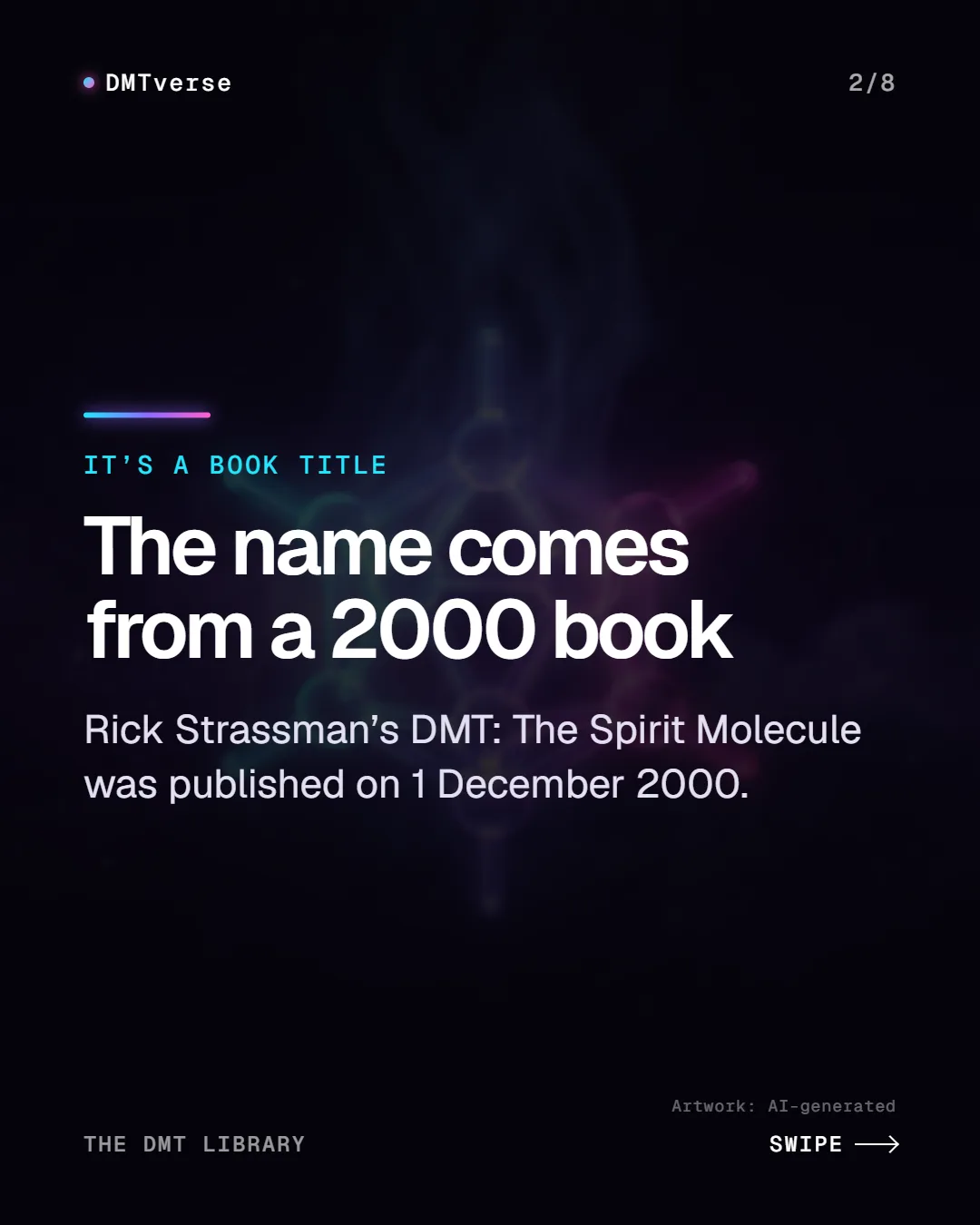
From a book title. DMT: The Spirit Molecule, with the subtitle “A Doctor’s Revolutionary Research into the Biology of Near-Death and Mystical Experiences”, was published by Park Street Press on 1 December 2000 (Open Library record). Evidence: established.
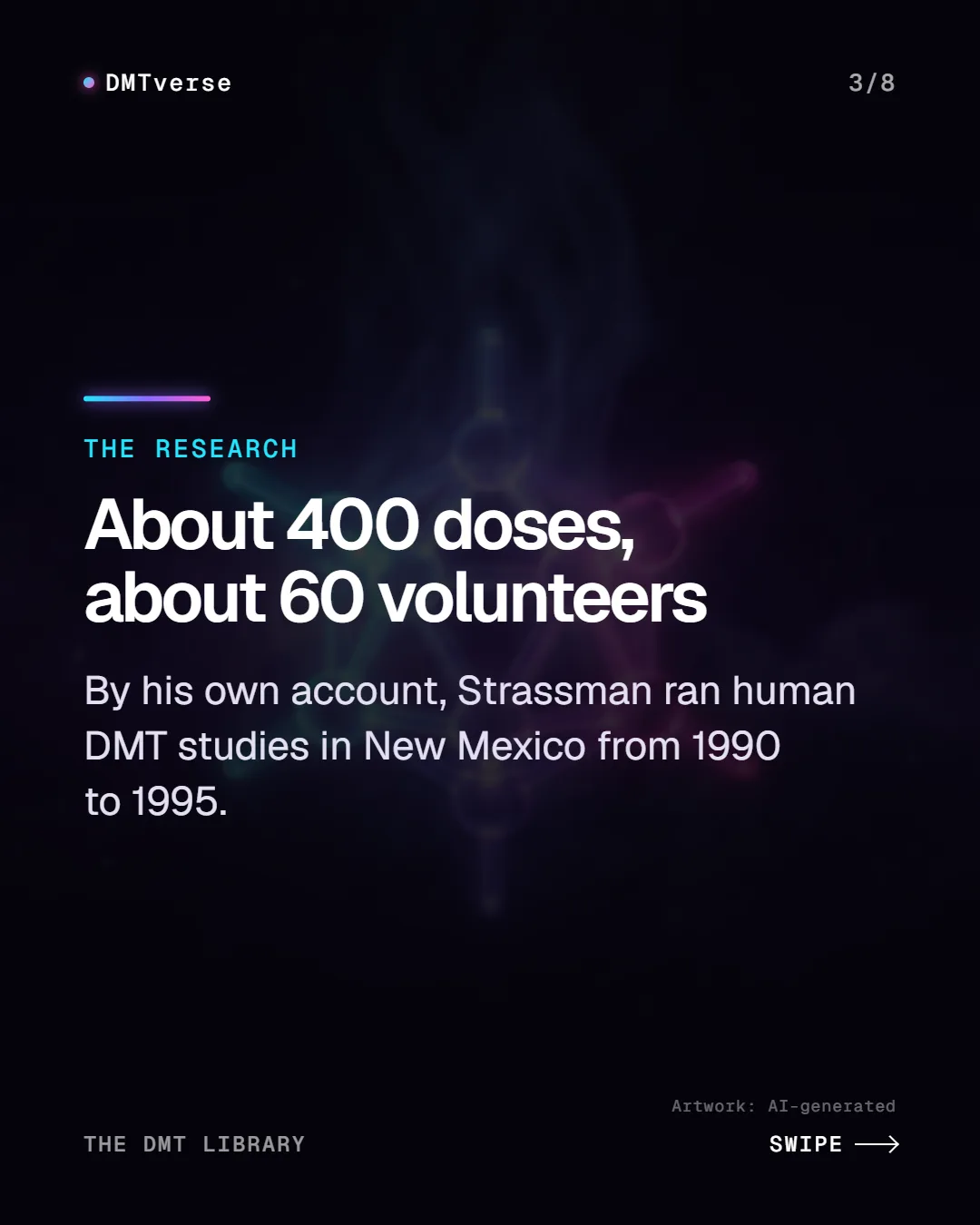
Its author, Rick Strassman, is an American psychiatrist. On his website he says that in 1990, at the University of New Mexico School of Medicine, he began the first new US human research with psychedelic drugs in over 20 years. Over five years, by his count, his team gave DMT about 400 times to 60 volunteers (Strassman, book page). Those totals are his own and are not tallied in a single peer-reviewed paper.
The scientific papers came first. In 1994 Strassman and colleagues published two linked papers: one on DMT’s hormone, heart and blood-pressure effects in 11 experienced hallucinogen users, and one on its subjective effects in 12 volunteers, which introduced a new questionnaire, the Hallucinogen Rating Scale (Strassman and Qualls, 1994; Strassman et al., 1994). Evidence: established.
The book followed six years later. Strassman explains that he had published much of the biological and psychological data but “nearly nothing” about the volunteers’ own stories, which the book tells from more than 1,000 pages of his bedside notes (Strassman, book page).
- 1984Strassman joins the University of New Mexico psychiatry department and, the same year, receives lay ordination in a Western Buddhist order.Source Strassman, biography page
- 1990–1995His DMT studies run at the University of New Mexico; about 400 doses to about 60 volunteers, by his own count.Source Strassman, book page
- 1994Two peer-reviewed papers report DMT’s biological and subjective effects.Source Strassman and Qualls, 1994; Strassman et al., 1994
- 1995The studies end. He attributes this to “problems inside and outside of the research environment”.Source Strassman, book page
- From 1996He begins exploring a model of the DMT state based on Old Testament (Hebrew Bible) prophecy.Source Strassman, home page
- 2000DMT: The Spirit Molecule is published (1 December).Source Open Library
- 2002The American Journal of Psychiatry reviews the book.Source Crossref record
- 2014DMT and the Soul of Prophecy is published.Source Open Library; Strassman, book page
- 2024On a podcast, he says the data for the endogenous-DMT idea “aren’t there yet”.Source Psychedelic Medicine Podcast page
What did Strassman mean by “spirit molecule”?
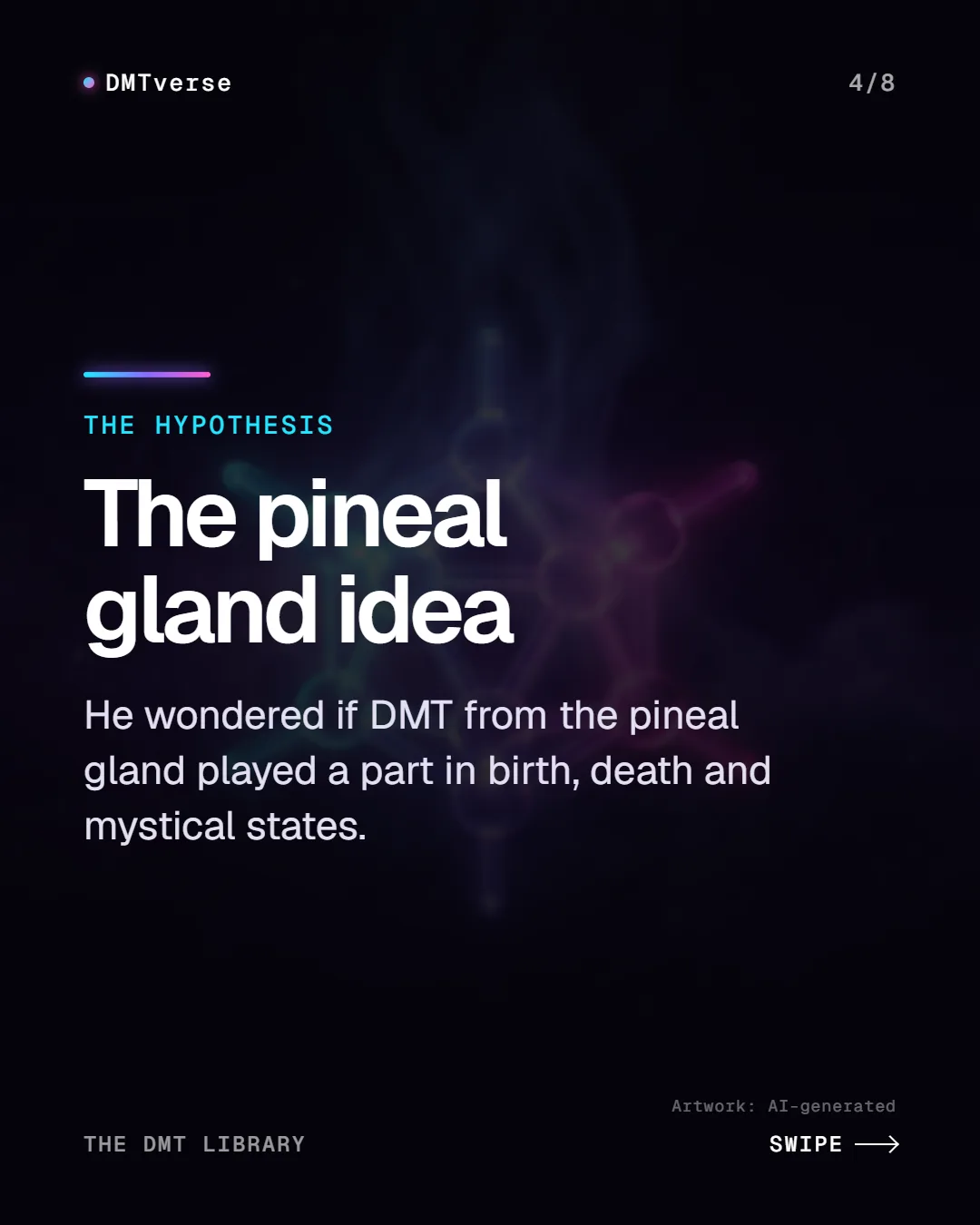
The title points at a hypothesis about DMT made inside the body. Strassman writes that he was drawn to DMT “because of its presence in all of our bodies”, and that he wondered whether excessive DMT production, coming from the pineal gland, might be involved in naturally occurring “psychedelic” states: birth, death and near-death, psychosis and mystical experiences (Strassman, book page).
The pineal focus had a history. At the University of New Mexico he had studied melatonin, the pineal gland’s main hormone (Strassman, biography), and his home page says that work led him to DMT, with the pineal gland seen “as a potential biological locus for spiritual experiences” (Strassman, home page).
He was open that some of the book’s ideas were speculative. In the preface on his website, he lists proposals he expected some readers to reject:
- that pineal DMT release 49 days after conception marks the entrance of the spirit into the fetus;
- that DMT affects the brain’s ability to receive information, rather than generating perceptions;
- that it might let the brain perceive “dark matter or parallel universes” inhabited by conscious beings.
He says he included “highly speculative ideas” deliberately, to “enlarge the discussion” about psychedelics (Strassman, book page). These are interpretations, not findings, and he presented them that way.
The same preface contains a less quoted point. Strassman writes that enthusiasts may dislike his conclusion that DMT has no beneficial effects in and of itself, and that the context in which people take it is at least as important (Strassman, book page). So even in 2000, the author of “the spirit molecule” did not claim the molecule itself was spiritual or good. That is his interpretation, reported here, not a tested claim.
How did Strassman’s interpretation change over time?
His published framing moved in at least three steps. The sources for each are his own pages and recorded statements, so they describe how he explains his thinking, not a measured change.
1980s and 1990s: a Buddhist framing
Strassman’s biography says he received lay ordination in a Western Buddhist order in 1984 and co-founded a lay meditation group associated with it (Strassman, biography). On his book page he writes that his own background, including “a decade-long relationship with a Zen Buddhist training monastery”, powerfully affected how his team prepared volunteers for, and supervised, their sessions (Strassman, book page).
From 1996: a model based on Hebrew Bible prophecy
His home page says that since 1996 he has been exploring models for the DMT effect “focusing primarily on the Old Testament concept of prophecy”. His reasons: the DMT “worlds” seem external and free-standing, and the sense of self stays highly preserved and interactive. He presents this as an alternative to models drawn from Eastern religions and Latin American shamanism (Strassman, home page).
The resulting book, DMT and the Soul of Prophecy, appeared in 2014 (Open Library record). On its page he describes a “top-down” model he calls theoneurology, in which God communicates with people through the brain. He sets it against the “bottom-up” view of neurotheology, in which brain chemistry gives the impression of the divine (Strassman, Soul of Prophecy page). This is a theological interpretation; no lab method can test it.
2024: “the data aren’t there yet”
In a January 2024 episode of the Psychedelic Medicine Podcast, the episode page quotes him on the endogenous-DMT idea, meaning DMT made inside the body: one could still speculate that it plays a role in non-drug states that resemble the DMT state, “but the data aren’t there yet” (Psychedelic Medicine Podcast, 2024).
The same page quotes him saying that only one of his “fifty-five or so normal volunteers” had what might be called a mystical unitive state, and that each person’s experience was “totally dependent on them” rather than built into the drug (Psychedelic Medicine Podcast, 2024). Beside the 2000 book, that is a more cautious position on the biology. We could not open a source on whether his view of the reported beings has changed, so we do not say.
What does the evidence say about the ideas behind the name?
Start with the pineal gland, the centre of the book’s biology. In a 2018 review titled “Separating fact from myth”, the pharmacologist David Nichols wrote that pineal DMT release at birth, during dreaming and near death is not consistent with the evidence. The pineal gland is small, its main job is making melatonin, and the tiny amounts of DMT detected in brain are too low to cause psychedelic effects (Nichols, 2018). In Strassman’s own 1994 study, DMT did not change melatonin levels (Strassman and Qualls, 1994). Evidence: unresolved; the idea is unsupported rather than disproven.
The part that has gained support is narrower. In 2019 a team including Strassman measured DMT in the visual cortex of living rats at levels comparable to known brain messengers such as serotonin. It rose after experimentally induced cardiac arrest, and removing the pineal gland made no difference (Dean et al., 2019). That supports the idea that a mammalian brain can make DMT, while moving the source away from the pineal. Evidence: preliminary.
In people, DMT has been detected in body fluids, but nobody has tried to measure it in the human brain (Barker, 2018). Evidence: unresolved. Our articles on whether the brain makes DMT and the pineal gland go further.
Does “spirit molecule” mean DMT gives access to a spiritual realm?
No experiment can show that, and none has tried to. Science can measure what people report, how their brains behave and how their beliefs change, but it has no instrument for “spirit”. What research can say is that DMT experiences are often described in spiritual language, and that how real they feel is not, on its own, evidence about what they are. Three findings make the point.
- Feeling real is not unique to DMT. In a 2019 online survey, people describing a drug-free encounter with “God” rated it 72.7 out of 100 for being more real than everyday consciousness, close to the 77.5 given by people describing a DMT encounter (Griffiths et al., 2019).
- Beliefs can shift. In a 2020 survey of 2,561 people describing their most memorable DMT entity encounter, more than half of those who had been atheists no longer identified that way afterwards (Davis et al., 2020). Both surveys used self-selected volunteers answering from memory.
- The experience is built up in stages. A 2026 lab interview study described immersion under DMT as “a dynamic, constructive process”, with presences appearing only after body, senses and space had formed (Sanders et al., 2026).
Evidence: preliminary for the survey figures and the interview study; what the experiences are is unresolved.
- What the phrase does reflect: DMT experiences are often described in spiritual terms, and the 2000 book proposed a biological role for DMT in such states.
- What it does not establish: that the pineal gland releases DMT at birth, death or in dreams; that the human brain makes psychoactive amounts; or that anything encountered exists outside the brain.
- What its author now says: on the endogenous idea, the data are not there yet; on the experience, it depends on the person (2024 podcast page).
How was the book received, and how did the name spread?
The American Journal of Psychiatry reviewed DMT: The Spirit Molecule in August 2002 (Crossref record); we checked the record, not the review’s text, so we do not characterise its verdict. Strassman’s biography says the book had sold a quarter of a million copies by mid-2021, was translated into more than a dozen languages, and inspired an independent documentary of the same name that he co-produced (Strassman, biography). These are the author’s own figures.
A title repeated that widely is how a hypothesis became a nickname, and why many people meet the phrase before any of the research. For the book and film in more detail, see DMT: The Spirit Molecule, the book and the film, and for the studies themselves, Rick Strassman’s DMT study.
The original studies are still the backbone of what is known about DMT’s time course: in the 1994 subjective-effects paper, effects began almost immediately, peaked at 90 to 120 seconds and were almost completely resolved by 30 minutes (Strassman et al., 1994). Evidence: established. Our guide to how long DMT lasts sets that beside newer studies.
What we still don’t know
- Whether the living human brain makes DMT in amounts that matter; it has never been measured there (unresolved).
- Whether any brain DMT changes at birth, during sleep or near death in humans; the only surge data are from rats (unresolved).
- What, if anything, DMT does in the body under normal conditions (unresolved).
- Why DMT experiences are so often described in spiritual language, and how much expectation and culture shape that (unresolved).
- Whether the beings people report are anything other than the brain’s own constructions; no study has a method that could settle it (unresolved).
The fair summary: “the spirit molecule” is a book title that carried a bold hypothesis. Parts of its biology have gained some support in rats, the pineal part has not, and the spiritual part was never a scientific claim. Its author has since moved further from the biology than many of the people who repeat his title. For the most common misreadings, see DMT myths, fact-checked.
Common questions
Why is DMT called the spirit molecule?
Because of Rick Strassman’s book DMT: The Spirit Molecule, published in December 2000. The title reflected his hypothesis that DMT made in the body, perhaps by the pineal gland, might be involved in birth, death, near-death and mystical states. It is a nickname from a book title, not a scientific term.
Who coined the term “spirit molecule”?
It was popularised by the psychiatrist Rick Strassman as the title of his 2000 book about his 1990–1995 DMT studies at the University of New Mexico. We did not find an earlier use we could verify.
Did Strassman prove that DMT is spiritual?
No, and he did not claim to. His book presented its pineal and spiritual ideas as speculation, and in 2024 he said the data for the endogenous-DMT idea “aren’t there yet”. No experiment can test whether a molecule carries spirit.
Does the pineal gland release DMT?
There is no human evidence that it does. A 2018 review called the idea inconsistent with the evidence, and in a 2019 rat study, brain DMT levels were unchanged when the pineal gland had been removed. DMT has never been measured in a living human brain.
How did Strassman’s views change?
By his own accounts, he moved from a Buddhist framing in the 1980s and 1990s to a model based on Hebrew Bible prophecy from 1996, set out in DMT and the Soul of Prophecy (2014). In 2024 he said most volunteers’ experiences depended on the person rather than the drug, and that the endogenous-DMT data are not there yet.
Is “the spirit molecule” a documentary?
Yes, as well as a book. DMT: The Spirit Molecule is also an independent documentary based on the 2000 book, which Strassman says he co-produced. Both use the same nickname, and neither is a scientific source on its own.
Does a DMT experience feeling real mean it is real?
Not by itself. In a 2019 survey, people describing drug-free “God encounters” rated them almost as real as people describing DMT encounters. Feeling real is a measurable report; whether anything encountered exists outside the brain is unresolved.
Shroomverse sells mushroom products. This article is general information about the origin and meaning of the phrase “the spirit molecule”. It is not medical, legal or purchasing advice, and it does not recommend any product.
SOURCES
- DMT: The Spirit Molecule: A Doctor’s Revolutionary Research into the Biology of Near-Death and Mystical Experiences (Strassman R, Park Street Press, 2000), edition record, Open Library (Internet Archive). Accessed . Record read through the Open Library API: title, subtitle, publisher Park Street Press and publication date 1 December 2000. The book’s text was not read.
- DMT: The Spirit Molecule (book page, with preface text), Rick Strassman MD (author’s website). Accessed . Full page read. Author’s own statements: research began 1990 at the University of New Mexico; about 400 doses to 60 volunteers over five years; drawn to DMT by its presence in the body; pineal hypothesis for birth, death, near-death, psychosis and mystical states; Zen monastery influence; bedside notes; studies ended 1995 after problems inside and outside the research environment; speculative proposals listed in the preface; DMT has no beneficial effects in and of itself, context at least as important.
- Rick Strassman MD (home page), Rick Strassman MD (author’s website). Accessed . Full page read. Led to DMT through earlier pineal-gland study as a potential biological locus for spiritual experiences; since 1996 exploring an Old Testament prophecy model as an alternative to Eastern and Latin American shamanic models.
- Biography, Rick Strassman MD (author’s website). Accessed . Full page read. Joined UNM in 1984; melatonin research; 1984 lay ordination in a Western Buddhist order; left UNM in 1995; book sales of a quarter-million by mid-2021 and translations; co-produced the documentary of the same name. Self-reported figures.
- DMT and the Soul of Prophecy (book page), Rick Strassman MD (author’s website). Accessed . Full page read. Hebrew Bible prophecy model; theoneurology (top-down) contrasted with neurotheology (bottom-up).
- DMT and the Soul of Prophecy (Strassman R, Inner Traditions, 2014), work record, Open Library (Internet Archive). Accessed . Record read through the Open Library API, used for the 2014 publication year and the catalogue description.
- Exploring Endogenous DMT with Rick Strassman, MD (Psychedelic Medicine Podcast, 3 January 2024), PlantMedicine.org. Accessed . Episode page read (not the audio). Quotes used: “the data aren’t there yet” on endogenous DMT; only one of “fifty-five or so normal volunteers” had a mystical unitive state; experiences “totally dependent on them”.
- DMT: The Spirit Molecule: A Doctor’s Revolutionary Research Into the Biology of Near-Death and Mystical Experiences (book review, Hirshfeld-Flores A, American Journal of Psychiatry 159(8):1448–1449, 2002), American Psychiatric Association. Accessed . Bibliographic record checked on Crossref; cited only for the fact and date of the review. Its content was not read.
- Dose-response study of N,N-dimethyltryptamine in humans. I. Neuroendocrine, autonomic, and cardiovascular effects (Strassman RJ, Qualls CR, Archives of General Psychiatry 51(2):85–97, 1994), American Medical Association (peer-reviewed). Accessed . Abstract read via Europe PMC. 11 experienced hallucinogen users; double-blind, saline placebo-controlled, randomized; melatonin levels unaffected. Doses not reproduced here.
- Dose-response study of N,N-dimethyltryptamine in humans. II. Subjective effects and preliminary results of a new rating scale (Strassman RJ, Qualls CR, Uhlenhuth EH, Kellner R, Archives of General Psychiatry 51(2):98–108, 1994), American Medical Association (peer-reviewed). Accessed . Abstract read via Europe PMC. 12 volunteers; Hallucinogen Rating Scale introduced; effects began almost immediately, peaked at 90–120 seconds, almost completely resolved by 30 minutes.
- N,N-dimethyltryptamine and the pineal gland: Separating fact from myth (Nichols DE, Journal of Psychopharmacology 32(1):30–36, 2018), SAGE (peer-reviewed review). Accessed . Abstract read via Europe PMC. Pineal release at birth, dreaming and near death not consistent with the evidence; pineal is small and mainly makes melatonin; minute brain DMT concentrations insufficient for psychoactive effects.
- Biosynthesis and Extracellular Concentrations of N,N-dimethyltryptamine (DMT) in Mammalian Brain (Dean JG, et al., Scientific Reports 9:9333, 2019), Springer Nature (peer-reviewed, open access); PMC6597727. Accessed . Abstract read via Europe PMC. Rat cortical DMT comparable to monoamine neurotransmitters, with or without the pineal gland; rise after experimental cardiac arrest; possibility, not demonstration, in humans. Strassman is a co-author.
- N,N-Dimethyltryptamine (DMT), an Endogenous Hallucinogen: Past, Present, and Future Research to Determine Its Role and Function (Barker SA, Frontiers in Neuroscience 12:536, 2018), Frontiers (peer-reviewed, open access); PMC6088236. Accessed . Full text read via Europe PMC. Used for DMT detected in human body fluids with no efforts yet to quantify it in human brain.
- Survey of subjective “God encounter experiences” (Griffiths RR, Hurwitz ES, Davis AK, Johnson MW, Jesse R, PLoS One 14:e0214377, 2019), PLOS (peer-reviewed, open access); PMC6478303. Accessed . Full text read via Europe PMC. “More real than everyday normal consciousness”: 72.7 (non-drug group, n=809) vs 77.5 (DMT group, n=606) on a 0–100 scale; self-selected online samples.
- Survey of entity encounter experiences occasioned by inhaled N,N-dimethyltryptamine (Davis AK, et al., Journal of Psychopharmacology 34(9):1008–1020, 2020), SAGE (peer-reviewed). Accessed . Abstract read via Europe PMC. 2,561 respondents describing their most memorable encounter; more than half of prior atheists no longer identified as atheist afterwards.
- Micro-phenomenology of immersion and perceived presences under DMT (Sanders JW, et al., Neuroscience of Consciousness, niag015, 2026), Oxford University Press (peer-reviewed, open access); PMC13366535. Accessed . Full text read via Europe PMC. 23 participants; presences emerged after multisensory integration and 3D space; immersion described as a dynamic, constructive process.
CHANGES
- : Linked glossary definitions.
- : Published. All sources opened and checked on this date. A claim about Strassman’s later view of the beings’ status was dropped because no source stating it could be opened.
- : Editorial review: shortened the short answer to a direct definition; split long paragraphs into shorter ones and lists; defined endogenous DMT and melatonin; standardised evidence labels; softened “reliably produces” to “often described”; made the documentary FAQ answer self-contained.
- : Added source links beside figures and legal statements.



