
THE SHROOMVERSE JOURNAL ✳ 11 MIN READ
DMT street names and other names: slang, chemical names, and how to say it
Topic: DMT
Published Updated
Listen: the 3-minute version
AI-narrated summary of this article
Short answer, checked 20 October 2026
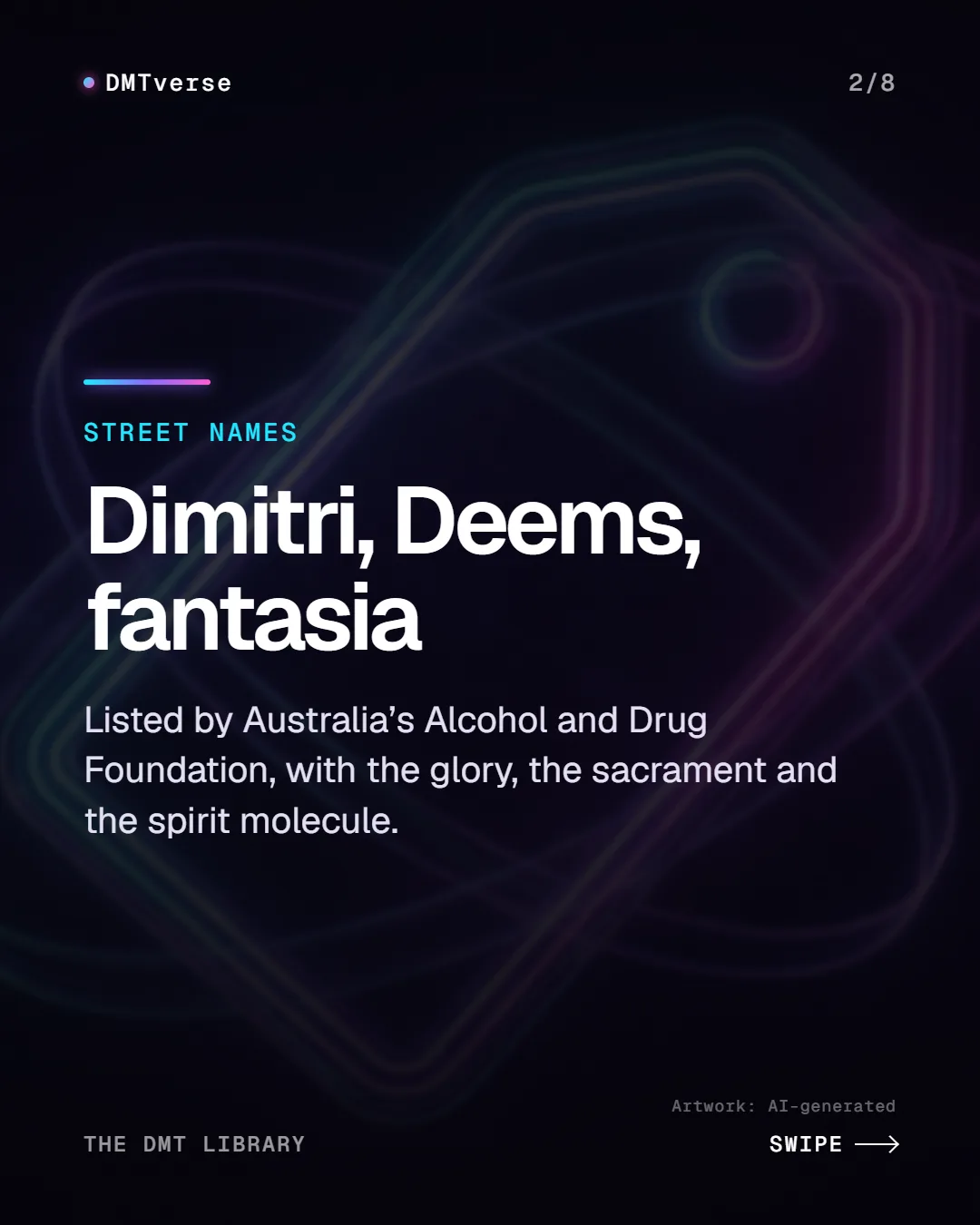
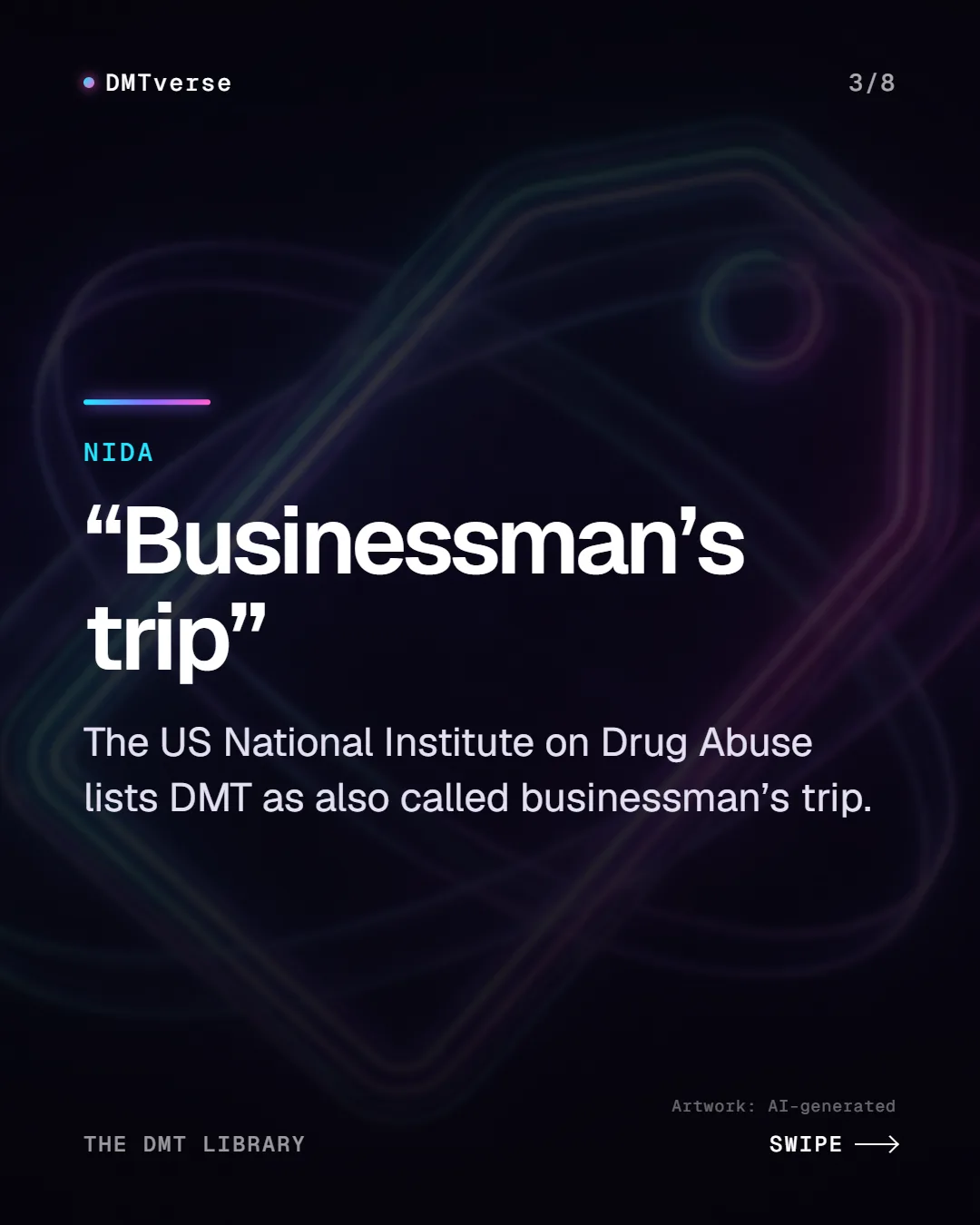
DMT street names recorded by drug-information agencies include “Dimitri”, “Deems”, “businessman’s trip”, “fantasia”, “the spirit molecule”, “the glory”, “the sacrament” and “changa”, which names a smoking blend that contains DMT. Its chemical name is N,N-dimethyltryptamine. DMT is not LSD (“acid”): they are different molecules. Slang tells you nothing about what a substance really is: at one Canadian campus drug-checking service, almost a third of samples were not what people expected.
THE SHORT VERSION · SWIPE
On this page 10 sections
People search for DMT’s other names for different reasons: a word heard in a song or a chat, a label on a news story, or a worry about what a friend has. This guide lists the names that published and government sources actually record, explains the chemical names and how to say them, and sets out why a name is never proof of what is in a bag.
Education only, not guidance
This article explains names. It gives no amounts, no instructions and no advice on use, and it does not describe what any blend contains. DMT is a controlled substance in Canada. In an emergency, call 911. Evidence labels: established (in official records, standard references or peer-reviewed studies), preliminary (one source, a small study or a self-selected sample) and unresolved (an open question).
What are the main DMT street names?
Two agency pages give the clearest lists. The Alcohol and Drug Foundation, an Australian non-profit drug-information service, lists DMT’s other names as Dimitri, Deems, the spirit molecule, changa, fantasia, the glory and the sacrament (ADF, DMT). The US National Institute on Drug Abuse (NIDA) lists DMT as “also called: Businessman’s Trip” (NIDA, commonly used drugs charts). Evidence: established that these agencies list these names.
| Name | Listed by | What we can say about it |
|---|---|---|
| Dimitri | Alcohol and Drug Foundation | Probably plays on the letters D-M-T (our inference). We found no source dating its first use. |
| Deems | Alcohol and Drug Foundation | No origin documented in our sources. |
| Businessman’s trip | NIDA | NIDA does not explain it. It is often linked to DMT’s short action, but we found no source documenting the origin. |
| The spirit molecule | Alcohol and Drug Foundation | From the title of Rick Strassman’s 2000 book, DMT: The Spirit Molecule. |
| Changa | Alcohol and Drug Foundation | A name for a smoking blend that contains DMT, not for DMT on its own. |
| Fantasia, the glory, the sacrament | Alcohol and Drug Foundation | Listed without explanation. |
Lists like these are snapshots. Slang changes by place and year, and an agency page records what its writers have seen, not a complete or current vocabulary. We did not find a Canadian government page listing DMT slang. Evidence: unresolved for how widely each name is used today.
Why is DMT called Dimitri?
“Dimitri” is a person’s name that happens to contain the sounds of D, M and T, which is the most likely reason it stuck. That is our reading of the word, not a documented history: the sources that list it do not explain it, and we found no published study of where it came from (ADF, DMT). Evidence: unresolved.
What is changa?
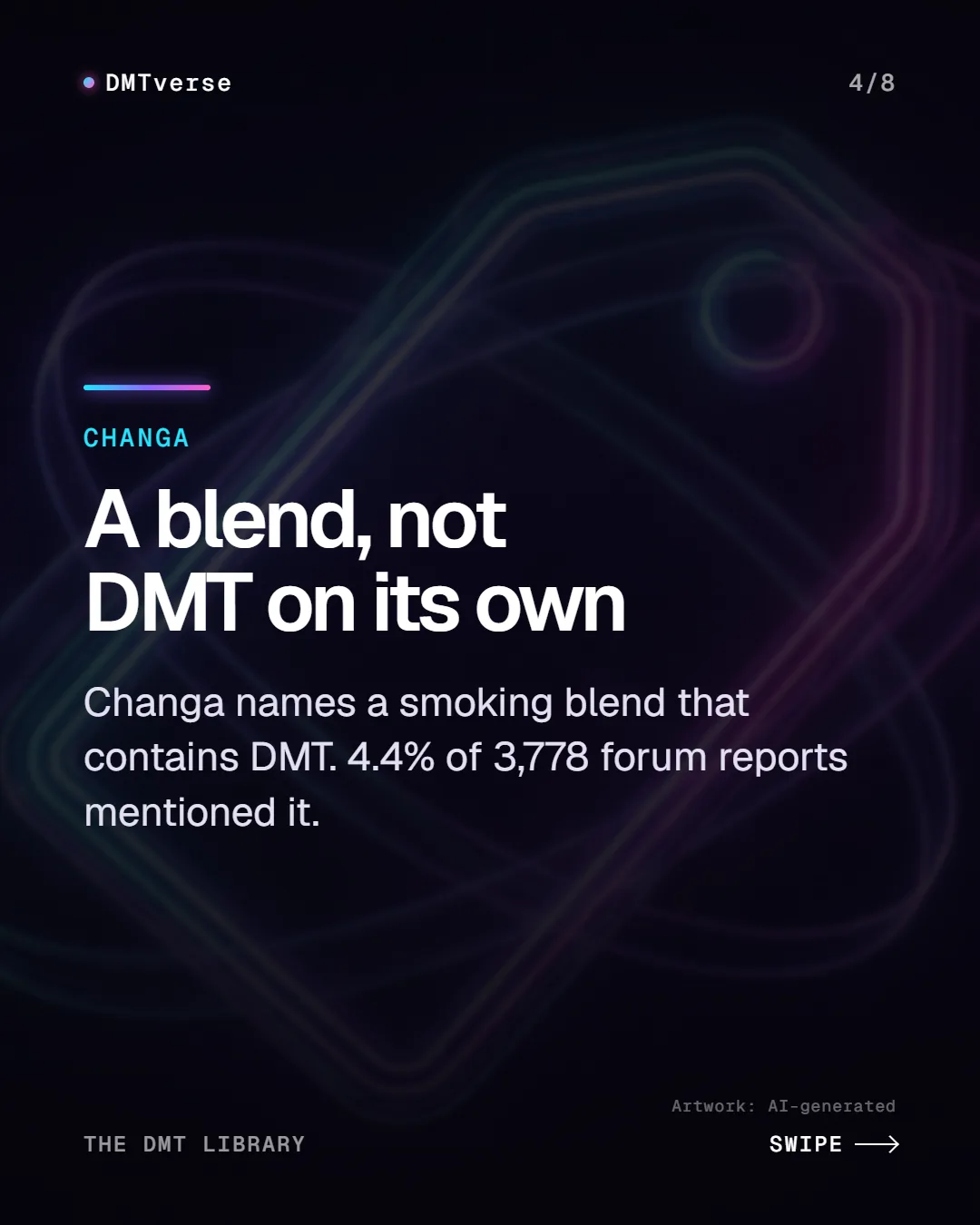
Changa is a name for a smoking blend that contains DMT. It is a different product from DMT on its own, and a person told that something is “changa” has no reliable way of knowing what else is in it. We do not describe its ingredients. In a study of 3,778 DMT experiences posted to an online forum between 2009 and 2018, 165 reports (4.4%) mentioned changa (Lawrence et al., 2022). That was a self-selected sample of posts, not a survey of users. Evidence: preliminary.
What are DMT’s chemical and official names?
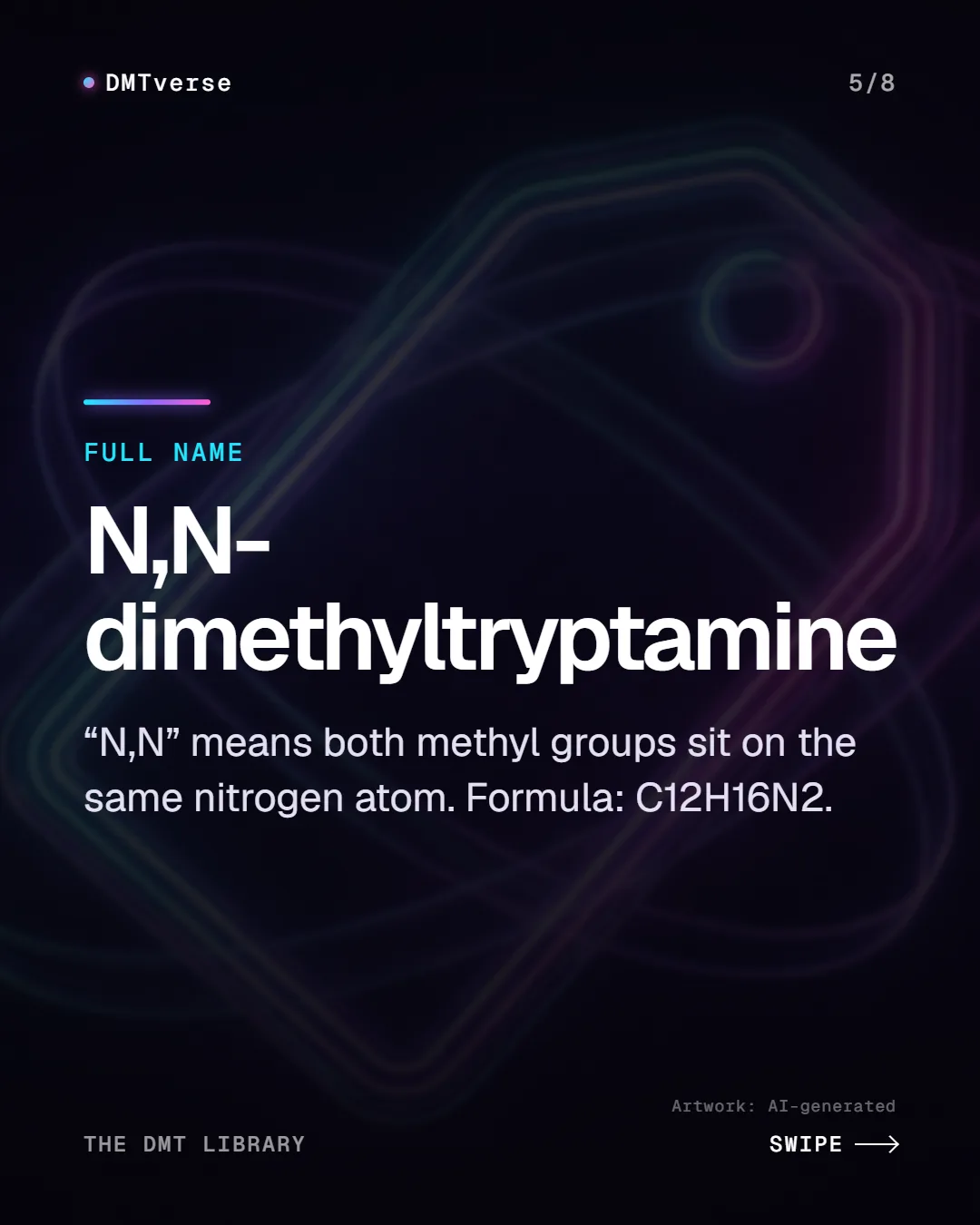
DMT is short for N,N-dimethyltryptamine. PubChem, the US National Library of Medicine’s chemistry database, gives its formula as C12H16N2 and its systematic name (the IUPAC name, from the international chemistry naming body) as 2-(1H-indol-3-yl)-N,N-dimethylethanamine (PubChem, DMT). Canada’s drug law names it “N,N-Dimethyltryptamine (DMT) (3-[(2-dimethylamino) ethyl]indole) and any salt thereof” in Schedule III (Justice Laws, CDSA). Evidence: established.
Other identifiers show up on labels, lab reports and legal papers. PubChem records the CAS registry number 61-50-7 (a unique number for each chemical) and “DEA No. 7435”, the US Drug Enforcement Administration’s code for the substance. Its synonym list also tags “dimethyltryptamine” as an INN and a USAN, the international and US non-proprietary names used for drugs (PubChem, DMT). In the United States, DMT is in Schedule I of the Controlled Substances Act (DEA, 2025). Evidence: established.
| Name or identifier | Where it is used | Source |
|---|---|---|
| N,N-dimethyltryptamine | Scientific papers; the usual full name | PubChem |
| DMT, N,N-DMT, NN-DMT | Abbreviations; PubChem lists “NN-Dimethyltryptamine” among synonyms | PubChem |
| 2-(1H-indol-3-yl)-N,N-dimethylethanamine | Systematic (IUPAC) chemical name | PubChem |
| 3-[(2-dimethylamino)ethyl]indole | Canada’s Controlled Drugs and Substances Act, Schedule III | Justice Laws |
| CAS 61-50-7 | Chemical registries and lab reports | PubChem |
| DEA No. 7435 | US controlled-substance code | PubChem |
What does the “N,N” in N,N-DMT mean?
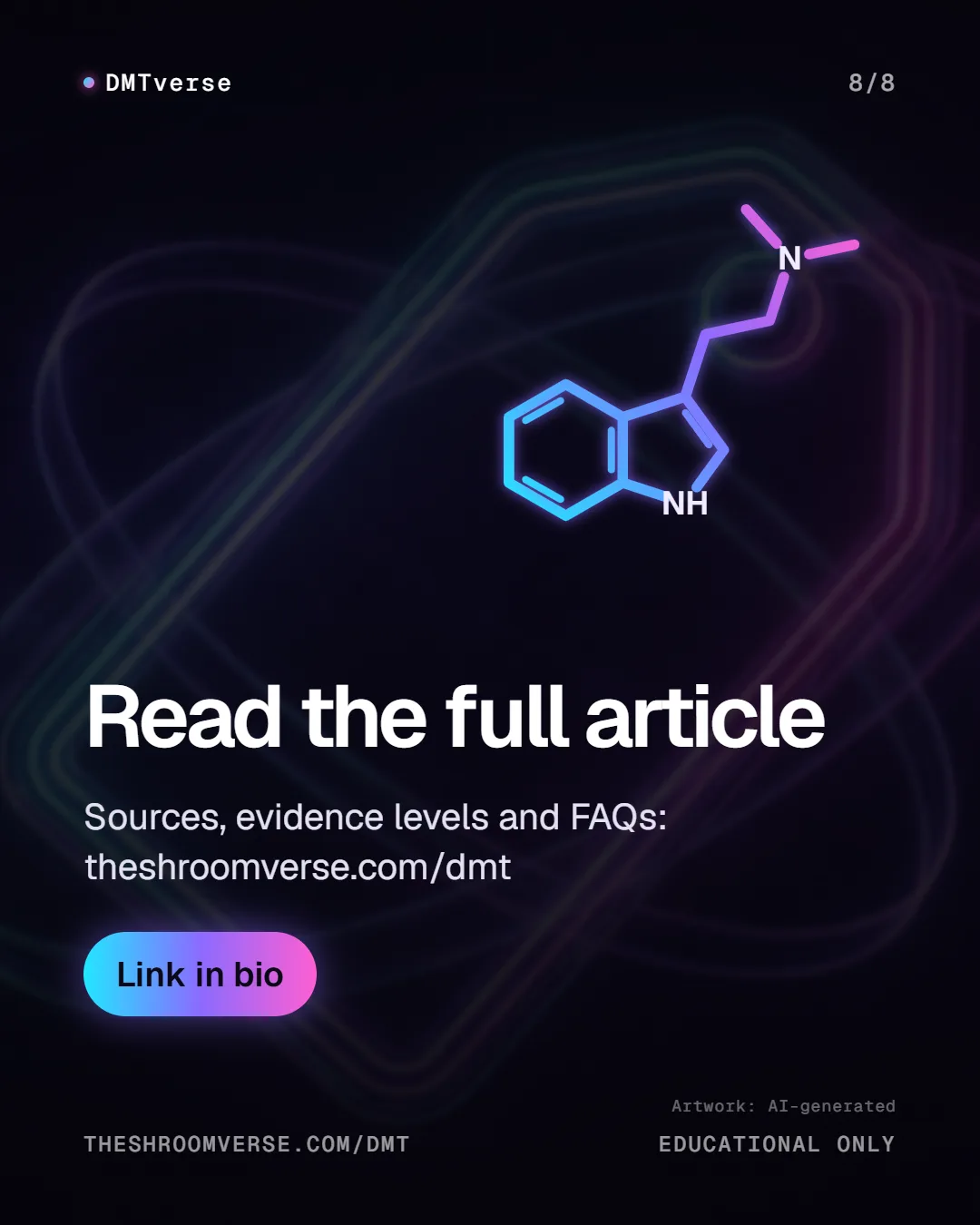
It tells you where the two methyl groups sit. A methyl group is one carbon atom with three hydrogens. DMT is tryptamine with two methyl groups put in place of the two hydrogen atoms on the nitrogen at the end of its side chain, as the DEA’s chemistry summary describes it (DEA, 2025). The “N,N” says both methyls are on that nitrogen (N), not somewhere on the ring. “NN-DMT” and “nn dmt” are just the same name typed without the comma. Our DMT chemical structure guide walks through the molecule atom by atom. Evidence: established.
The prefix matters because similar-looking names describe different molecules. 5-MeO-DMT, for example, has an extra methoxy group (an oxygen bonded to a methyl) on the ring; PubChem gives its formula as C13H18N2O and lists it under the title O-methylbufotenine (PubChem, 5-MeO-DMT). It is a separate compound with its own research record and legal position; see 5-MeO-DMT vs DMT. Evidence: established.
How do you pronounce DMT and dimethyltryptamine?
DMT is said letter by letter: “dee-em-TEE”, with the stress on the last letter. Merriam-Webster gives it as \ˌdē-(ˌ)em-ˈtē\ (Merriam-Webster, DMT). Evidence: established.
Dimethyltryptamine is said “dye-meth-ul-TRIP-tuh-meen”, with the main stress on “TRIP”. Merriam-Webster gives \ˌdī-ˌme-thəl-ˈtrip-tə-ˌmēn\, and defines the word as a hallucinogenic drug, C12H16N2, that is chemically similar to but shorter acting than psilocybin, “called also DMT” (Merriam-Webster, dimethyltryptamine). The “N,N” at the front is usually read as “en-en”. Evidence: established for the dictionary entries.
Why is DMT called the spirit molecule?
The phrase comes from the title of DMT: The Spirit Molecule, a book by Rick Strassman, MD, published by Park Street Press in December 2000 (Open Library record). It is a nickname, not a scientific term, and it carries a claim about spirituality that the evidence does not settle. The Alcohol and Drug Foundation lists it among DMT’s other names (ADF, DMT). We cover the book, the studies and what the name implies in why DMT is called the spirit molecule. Evidence: established that the name is in use.
Is DMT acid? How DMT differs from LSD
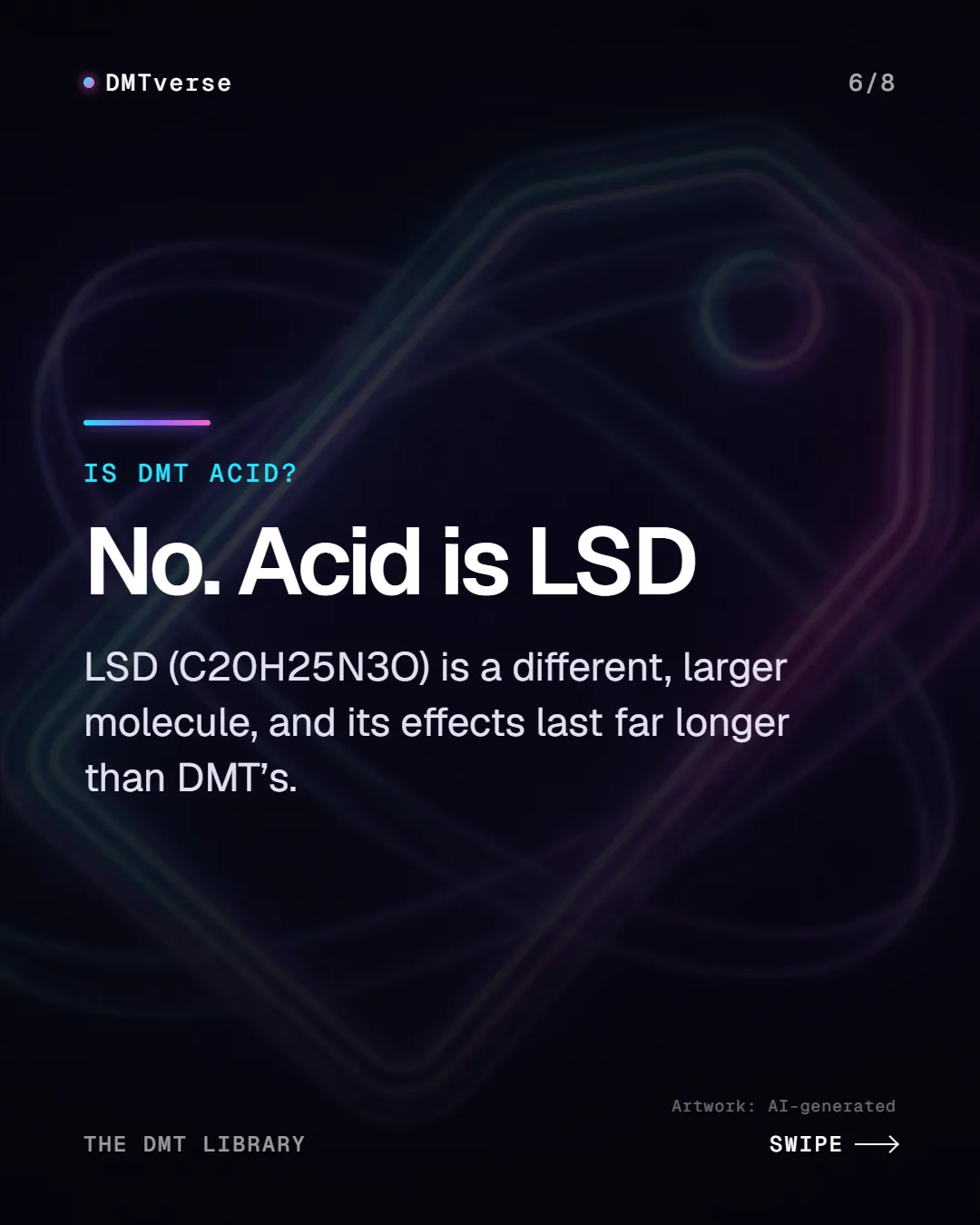
No. “Acid” is slang for LSD (lysergic acid diethylamide), which NIDA describes as a lab-made substance derived from chemicals in fungi that grow on rye and other grains (NIDA, hallucinogens). DMT is a different molecule. PubChem gives LSD’s formula as C20H25N3O, with a larger fused-ring system, against DMT’s C12H16N2 (PubChem, LSD; PubChem, DMT). Both act mainly on the brain’s serotonin 5-HT2A receptor, which is why they get grouped together (NIDA, hallucinogens). Evidence: established.
They also differ sharply in timing. The DEA’s 2025 evaluation says DMT’s effects in clinical studies generally resolve within 30 to 45 minutes, and contrasts its short action with the extended periods associated with LSD (DEA, 2025). For a side-by-side comparison, see psilocybin, LSD and DMT: how they differ. Evidence: established.
Why do drug names matter for safety?
Because a name is a claim, not a test result. In unregulated markets, the word on a bag says what someone says it is. NIDA notes that NBOMes, a family of lab-made compounds, are sometimes sold as LSD but are more potent, with a higher risk of adverse effects (NIDA, hallucinogens). The same logic applies to anything sold under a DMT nickname. Evidence: established for the NBOMe example; no DMT-specific figure was found.
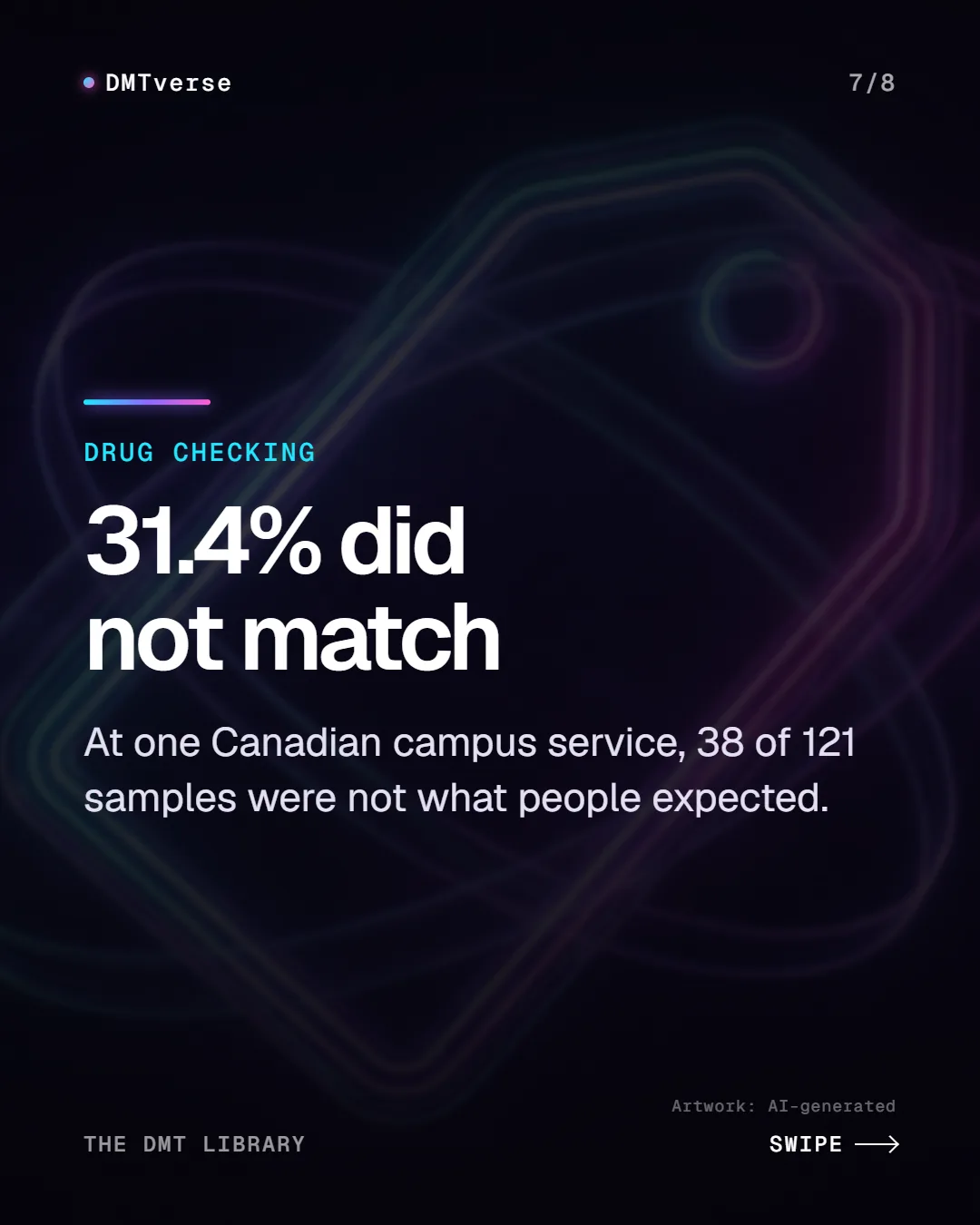
Canadian data show how often expectations are wrong. A student-run drug-checking service at a Canadian university tested 121 samples between September 2021 and April 2024. Nearly half (57, or 47.1%) were expected to be psychedelics, a group that included DMT and LSD. Across all 121 samples, 38 (31.4%) did not match what the person expected (Airth et al., 2025). The study did not report a figure for DMT alone. Evidence: preliminary (one small service).
Mixing unknown substances adds risk. A 2025 report described two deaths in the UK after DMT use, neither in the context of an ayahuasca ceremony. Both involved several other substances, including some that also raise serotonin activity, and the authors suggest serotonin syndrome (a dangerous excess of serotonin activity) may have contributed (Pullen et al., 2025). These are two case reports, so they show a possible risk, not how common it is. Evidence: preliminary.
A slang word is not an identification
No name, colour or smell tells you what a substance is. Only laboratory analysis can. A drug-checking result describes one sample at one time.
If someone is in danger
Call 911 for immediate danger or urgent medical help, including if someone is unconscious, not breathing or having a seizure. In Ontario, the Ontario Poison Centre is at 1-800-268-9017; every province has a poison centre, listed by SickKids (AboutKidsHealth). If you or someone you know is thinking about suicide, call or text 9-8-8, 24 hours a day (9-8-8). See also our safety page and how to help someone having a bad trip.
Does a different name change DMT’s legal status?
No. Canada’s Schedule III entry covers N,N-dimethyltryptamine “and any salt thereof”, and section 2(2) of the Act extends it to any substance that contains it (Justice Laws, CDSA). Calling it Dimitri or changa does not change anything. For the full legal picture, see is DMT legal in Canada. This is general information, not legal advice. Evidence: established.
What we still don’t know
- Where “Dimitri”, “Deems” and “businessman’s trip” came from, and when. We found no documented origin for any of them.
- Which names are in use in Canada today. No Canadian government page we found lists DMT slang.
- How often products sold under DMT names contain something else. The Canadian drug-checking data we found do not break out DMT.
Common questions
What is the street name for DMT?
Drug-information agencies list several. The Alcohol and Drug Foundation lists Dimitri, Deems, the spirit molecule, changa, fantasia, the glory and the sacrament, and NIDA lists “businessman’s trip”. Slang varies by place and time.
Why is DMT called Dimitri?
Most likely because the name contains the sounds of the letters D, M and T. That is an inference: the agencies that list the name do not explain it, and we found no documented history of it.
What is changa?
Changa is a name for a smoking blend that contains DMT. It is not the same as DMT on its own, and its contents vary, so the name does not tell anyone what is in it. In one analysis of 3,778 online DMT reports, 4.4% mentioned changa.
Is DMT the same as acid?
No. “Acid” is slang for LSD, a different, larger molecule (C20H25N3O, against DMT’s C12H16N2). Both act mainly on the serotonin 5-HT2A receptor, but the DEA notes DMT’s effects are much shorter than LSD’s.
What does N,N-DMT mean?
It is the full abbreviation of N,N-dimethyltryptamine. “N,N” means both methyl groups sit on the nitrogen atom at the end of the side chain. “NN-DMT” and “nn dmt” are the same name written without the comma.
How do you pronounce DMT and dimethyltryptamine?
DMT is said letter by letter, “dee-em-TEE”. Dimethyltryptamine is “dye-meth-ul-TRIP-tuh-meen”, stressed on “TRIP”, following Merriam-Webster’s pronunciation.
Why is DMT called the spirit molecule?
The nickname comes from the title of DMT: The Spirit Molecule, a 2000 book by Rick Strassman, MD, about his research with DMT. It is a nickname, not a scientific term, and the evidence does not settle the spiritual claim it implies.
Shroomverse sells mushroom products. This article is general information about the names used for DMT. It is not medical, legal or purchasing advice, and it does not recommend any product.
SOURCES
- N,N-Dimethyltryptamine, compound summary (CID 6089), U.S. National Library of Medicine, PubChem. Accessed . Read through the PubChem REST interface (properties and synonyms). Supports formula C12H16N2, IUPAC name 2-(1H-indol-3-yl)-N,N-dimethylethanamine, CAS 61-50-7, “DEA No. 7435”, the synonym “NN-Dimethyltryptamine”, and INN and USAN tags on “dimethyltryptamine”.
- Lysergide (LSD), compound summary (CID 5761), U.S. National Library of Medicine, PubChem. Accessed . Read through the PubChem REST interface. Supports formula C20H25N3O and its fused-ring IUPAC name, used for the comparison with DMT.
- 5-Methoxy-N,N-dimethyltryptamine (O-methylbufotenine), compound summary (CID 1832), U.S. National Library of Medicine, PubChem. Accessed . Read through the PubChem REST interface. Supports formula C13H18N2O, IUPAC name with a 5-methoxy group, and the record title O-methylbufotenine.
- dimethyltryptamine (entry), Merriam-Webster. Accessed . Read. Supports the pronunciation \ˌdī-ˌme-thəl-ˈtrip-tə-ˌmēn\ and the definition (hallucinogen C12H16N2, chemically similar to but shorter acting than psilocybin, called also DMT).
- DMT (entry), Merriam-Webster. Accessed . Read. Supports the pronunciation \ˌdē-(ˌ)em-ˈtē\ and the definition “dimethyltryptamine”.
- Commonly Used Drugs Charts, National Institute on Drug Abuse (NIDA), U.S. National Institutes of Health. Accessed . Read. Supports the DMT entry “Also called: Businessman’s Trip” and its Schedule I status. Routes of use on the page are deliberately not reproduced.
- Psychedelic and Dissociative Drugs (DrugFacts: hallucinogens), National Institute on Drug Abuse (NIDA), U.S. National Institutes of Health. Accessed . Read. Supports LSD as “acid”, its description as lab-made from chemicals in fungi on rye and other grains, NBOMes sometimes sold as LSD with higher risk, and psychedelics such as psilocybin, LSD and DMT acting mainly on 5-HT2A receptors.
- DMT (drug facts; last updated 6 July 2026), Alcohol and Drug Foundation (Australia). Accessed . Read. Supports the list of other names: Dimitri, Deems, the spirit molecule, changa, fantasia, the glory, the sacrament. Routes of use and composition notes on the page are deliberately not reproduced.
- N,N-Dimethyltryptamine (DMT) (December 2025), U.S. Drug Enforcement Administration, Diversion Control Division, Drug and Chemical Evaluation Section. Accessed . Full document read (two pages). Supports Schedule I control, the chemistry description (two methyl groups replacing the hydrogens on the terminal nitrogen of tryptamine), effects generally resolving within 30 to 45 minutes in clinical studies, and the contrast with the longer action of LSD. Its CAS number appears as 31-50-7, which differs from PubChem’s 61-50-7; we use PubChem’s.
- Controlled Drugs and Substances Act (S.C. 1996, c. 19), Schedule III and section 2(2), Government of Canada, Justice Laws Website. Accessed . Full text searched. Consolidation current to 2026-09-30. Supports the Schedule III wording for DMT, including the chemical name and “any salt thereof”, and section 2(2) on substances containing a controlled substance.
- DMT: The Spirit Molecule (Strassman R, Park Street Press, December 2000), edition record, Open Library (Internet Archive). Accessed . Record read through the Open Library API. Supports title, subtitle, publisher, publication date (1 December 2000) and author (Rick Strassman MD). Cited for bibliographic facts only.
- Phenomenology and content of the inhaled N,N-dimethyltryptamine (N,N-DMT) experience (Lawrence DW, Carhart-Harris R, Griffiths R, Timmermann C, Scientific Reports 12:8562, 2022), Springer Nature (peer-reviewed, open access); full text via Europe PMC, PMC9130218. Accessed . Full text read. Supports 3,778 experiences posted to an online forum from 2009 to 2018, of which 165 (4.4%) mentioned changa. Dose and composition details deliberately not reproduced.
- An implementation science study of a campus-based drug checking service at a Canadian university (Airth L, et al., PLoS One 20(9):e0332899, 2025), PLOS (peer-reviewed, open access); full text via Europe PMC, PMC12445479. Accessed . Full text read (Table 2). Supports 121 samples from September 2021 to April 2024, 57 (47.1%) expected to be psychedelics (a category including LSD and DMT), and 38 (31.4%) not matching expectation overall. No DMT-specific result is reported.
- Fatalities following DMT use: two case reports and a review of the literature (Pullen J, et al., Journal of Analytical Toxicology, 2025), Oxford University Press (peer-reviewed, open access); full text via Europe PMC, PMC12842604. Accessed . Abstract read via Europe PMC, plus the introduction’s description of changa as a smokable blend. Supports two UK deaths after DMT use, neither in an ayahuasca ceremony, polydrug use in both including other serotonergic substances, and the authors’ suggestion of serotonin syndrome. Blood concentrations deliberately not reproduced.
- Poison information centres in Canada, AboutKidsHealth, The Hospital for Sick Children (SickKids). Accessed . Read. Supports the provincial poison centre list, including Ontario toll-free 1-800-268-9017, and calling 911 if someone is unconscious, not breathing or having a seizure.
- 9-8-8: Suicide Crisis Helpline, 988.ca. Accessed . Home page read. Supports call or text 9-8-8.
CHANGES
- : Linked glossary definitions.
- : Published. Names checked against NIDA and Alcohol and Drug Foundation pages, identifiers against PubChem, pronunciations against Merriam-Webster, and studies against Europe PMC on this date.
- : Editorial review: unsourced “most common” and “best-known” claims about Dimitri removed from the summary and FAQ; “drug-checking services in Canada regularly find” narrowed to the one campus service studied; primary keyword added to the first H2. Lawrence 2022, Airth 2025 (Table 2: 121 samples, 38 not matching) and Pullen 2025 re-checked on Europe PMC.



