THE SHROOMVERSE JOURNAL ✳ 11 MIN READ
DMT and the 5-HT2A receptor: how strong is the evidence that it is the main switch?
Topic: DMT
Published Updated
Short answer, checked 20 October 2026
Very probably, but the proof for pure DMT in people is still missing. The serotonin 5-HT2A receptor is the main target of classic psychedelics. In mice, a typical psychedelic-like behaviour after DMT occurred in normal animals but not in animals lacking 5-HT2A, and in people a 5-HT2A blocker blunted the effects of ayahuasca, a brew that contains DMT plus other compounds. No published human study has blocked 5-HT2A before pure DMT, the test already done for LSD and psilocybin. DMT also acts on other receptors, and a newer idea, that it works on 5-HT2A receptors inside cells, is a hypothesis.
THE SHORT VERSION · SWIPE


On this page 9 sections
Almost every explainer says DMT “works on the 5-HT2A receptor”. That is the mainstream view, and it is probably right as far as it goes. This article sets out exactly what evidence supports it, where that evidence comes from (mice, cells, ayahuasca or pure DMT), and which experiment is still missing. For the molecule itself, see what is DMT; for other receptors, see DMT and the sigma-1 receptor.
Education only, not guidance
This article describes published research. It gives no amounts, no instructions and no advice on use, and it does not describe any effect as a benefit. Routes of use appear only to describe how a named study was designed. DMT is a controlled substance in Canada. Evidence labels: established (shown in peer-reviewed studies and not seriously disputed), preliminary (early, small, animal-only or indirect) and unresolved (an open question).
What is the 5-HT2A receptor?
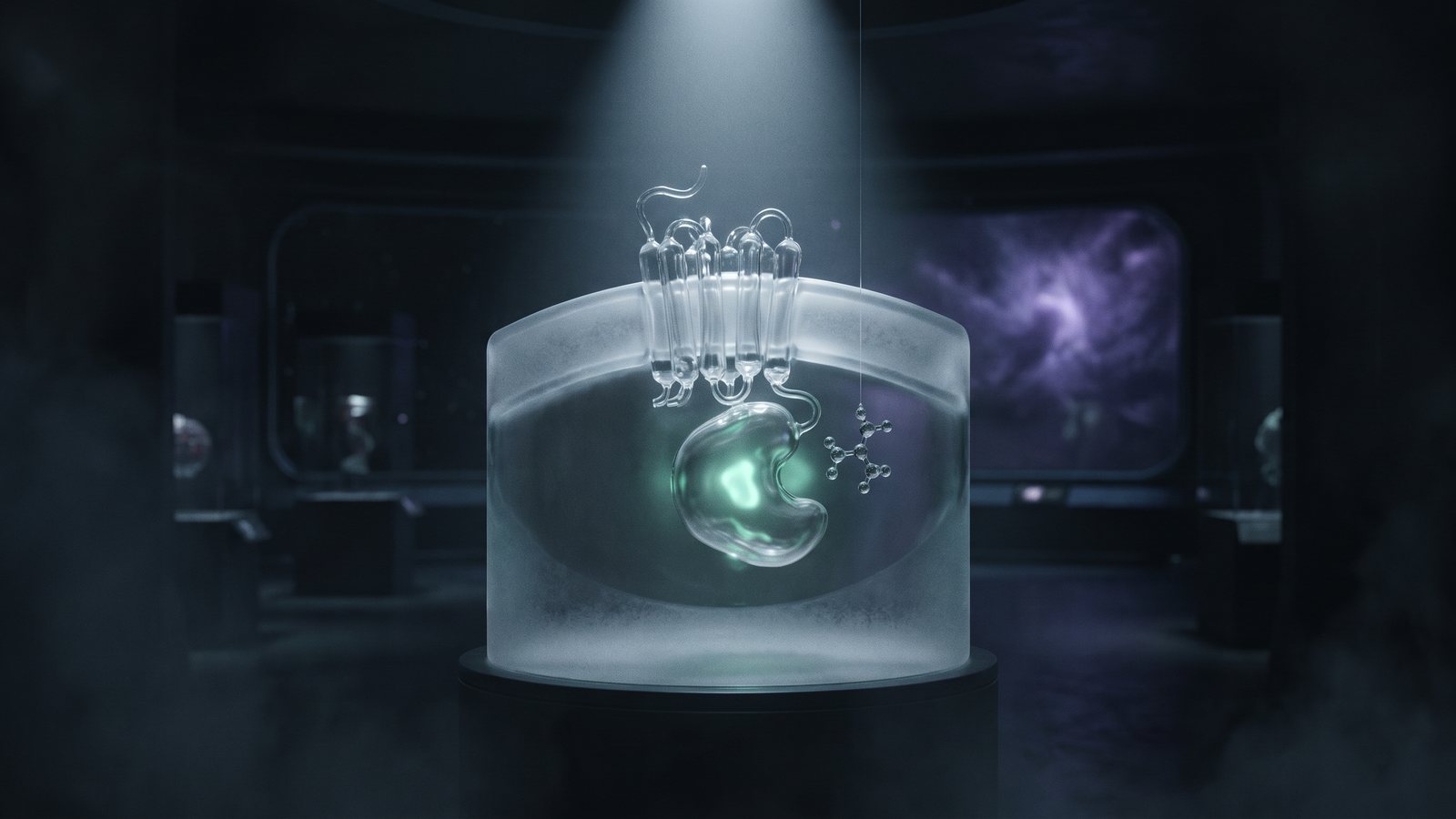
5-HT is the chemical shorthand for serotonin, and 5-HT2A is one of its many receptors: proteins that sit in cell membranes and change the cell’s behaviour when serotonin, or a molecule shaped like it, binds. A major review of psychedelic pharmacology states there is now a consensus that psychedelics are agonists or partial agonists at brain 5-HT2A receptors, with particular importance on those expressed on the apical dendrites of layer V pyramidal neurons in the neocortex (Nichols, 2016). In plain terms: psychedelics switch the receptor on, fully or partly, and the cells that matter most are large neurons in the outer layers of the cortex. Evidence: established for psychedelics as a class.
Two terms recur below. A “partial agonist” switches a receptor on, but less fully than the strongest possible activator would. An “antagonist” or blocker, such as ketanserin, occupies the receptor without switching it on, so it can be used to test whether an effect needs that receptor: if the blocker prevents the effect, the receptor is probably required. That logic is why blocking studies sit at the centre of this article. Evidence: established.
DMT is a close chemical cousin of serotonin, so it is no surprise that it binds serotonin receptors. It binds many of them, not just one: a review quotes a screen in which DMT bound nine serotonin receptor subtypes, including 5-HT1A, 5-HT2A, 5-HT2C and 5-HT7, across a wide range of strengths (Barker, 2018). The question is which of those contacts produces the effects people report. Evidence: established for binding; what each contributes is unresolved.
What do animal studies show about DMT and 5-HT2A?
The strongest single piece of evidence comes from mice. In a 2009 study that used computer predictions to find new drug targets, DMT was confirmed as a potent partial agonist at 5-HT2A, and it induced the head-twitch response, a rodent behaviour used as a predictor of hallucinogenic action, in normal mice but not in mice bred without the 5-HT2A gene. The authors also found DMT’s potency at 5-HT2A was about 100-fold better than at the sigma-1 receptor, and concluded that their observations support 5-HT2A as the primary target for DMT’s hallucinogenic effects (Keiser et al., 2009). Evidence: preliminary, from mice.
Drug-blocking studies in rodents point the same way. A review describes work in which a selective 5-HT2A blocker fully blocked both the head twitch and the discriminative-stimulus effects of DMT (a test of whether animals can tell a drug apart from a control), while a 5-HT2C blocker had little or no effect. The same review notes that DMT produces fewer head twitches than most other psychedelics, and none in one mouse strain (Carbonaro and Gatch, 2016). Evidence: preliminary, from rodents.
5-HT2A also shows up in rat-cell studies of neuron growth. In cultured rat cortical neurons, the 5-HT2A blocker ketanserin completely abolished the ability of DMT, LSD and another psychedelic to promote the growth of neuron branches and spines; separately, DMT increased dendritic spine density in rat prefrontal cortex 24 hours after one dose (Ly et al., 2018). This is a cell and rat finding, not evidence of anything in the human brain; see is DMT neuroprotective?. Evidence: preliminary.
What is the human evidence?
The best human evidence comes from ayahuasca. In a double-blind, randomized, placebo-controlled study, 12 healthy, experienced volunteers each had four sessions combining ayahuasca or placebo with ketanserin or placebo (amounts not reproduced here). Ayahuasca reduced EEG power in the delta, theta and alpha bands, and lower alpha activity in the back of the brain went with more intense visual imagery. Pretreatment with ketanserin inhibited the brain-wave changes and attenuated the intensity of the subjective experience (Valle et al., 2016). Evidence: preliminary, from one small study.
The authors themselves point out that, before their study, the role of 5-HT2A in ayahuasca’s effects “has not been tested experimentally”, and they describe ayahuasca as containing DMT plus β-carboline alkaloids that inhibit the enzyme MAO (Valle et al., 2016). So the result shows that 5-HT2A matters for ayahuasca; it does not isolate DMT. The blockade attenuated the experience rather than abolishing it. For how the two differ, see ayahuasca vs DMT. Evidence: established for that limit.
Has anyone blocked 5-HT2A before giving people pure DMT?
For two other psychedelics, the decisive human test has been done. Ketanserin fully blocked the general subjective effects of LSD in healthy volunteers (Preller et al., 2017), and blocked psilocybin’s effects in a dose-dependent way (Vollenweider et al., 1998). For pure DMT, given by injection or inhalation, we found no such study. A Europe PMC search on 20 October 2026 for titles pairing ketanserin or 5-HT2A blockade with DMT or ayahuasca returned no results, and broader searches surfaced only reviews, animal work and the ayahuasca study above. Evidence: established that the experiment is not in the indexed literature.
One registered trial in Basel uses ketanserin with DMT, but not as a pretreatment. The LPD study, listed as recruiting, compares LSD, psilocybin and a DMT infusion in healthy participants, and gives ketanserin three hours in, so that effect duration is standardized across the three drugs (ClinicalTrials.gov, NCT06899334). Blocking an effect that is already under way is a different question from whether the effect needs 5-HT2A in the first place. Evidence: established for the registry design.
| Drug | Human blocking study before the drug | Result |
|---|---|---|
| LSD | Yes (Preller et al., 2017) | General subjective effects fully blocked |
| Psilocybin | Yes (Vollenweider et al., 1998) | Effects blocked dose-dependently |
| Ayahuasca (contains DMT) | Yes (Valle et al., 2016) | Brain-wave changes inhibited; experience attenuated |
| Pure DMT, injected or inhaled | None published that we found | Unknown |
Does DMT act on other receptors too?
Some findings do not fit a one-receptor story. In a double-blind, randomized, placebo-controlled study of 12 experienced volunteers given intravenous DMT at a sub-hallucinogenic level, pretreatment with pindolol, which blocks the 5-HT1A receptor, intensified DMT’s subjective effects with a moderate effect size. The authors suggest 5-HT1A has a functional role in psychedelic effects. Blood pressure also rose with the combination (Zahid et al., 2026). It is one small study, so the result needs repeating. Evidence: preliminary.
In cell studies, one signalling response to DMT persisted even in the presence of ketanserin, and DMT also binds trace amine-associated receptors and the sigma-1 receptor (Barker, 2018). None of these has been shown to drive the experience in people. The sigma-1 story, including why it needs much higher concentrations, is covered in DMT and the sigma-1 receptor. Evidence: unresolved.
Do brain scans line up with the receptor?
Indirectly, yes. PET imaging in earlier studies produced an average map of where 5-HT2A receptors are densest in the human brain. In a 2023 EEG-fMRI study of intravenous DMT, maps of connectivity change weighted by how intense people rated the experience correlated with that independent receptor map; the strongest changes were in high-level “transmodal” cortex (Timmermann et al., 2023). The authors read this overlap as implying that increased 5-HT2A signalling causes the changes. Matching two maps from different people is a correlation, though, and the study had no receptor blocker. Evidence: preliminary.
For the full set of brain-imaging findings and their caveats, including the fact that fMRI measures blood flow rather than neurons, see what happens in the brain on DMT. Evidence: established for that caveat.
What is the intracellular 5-HT2A hypothesis?
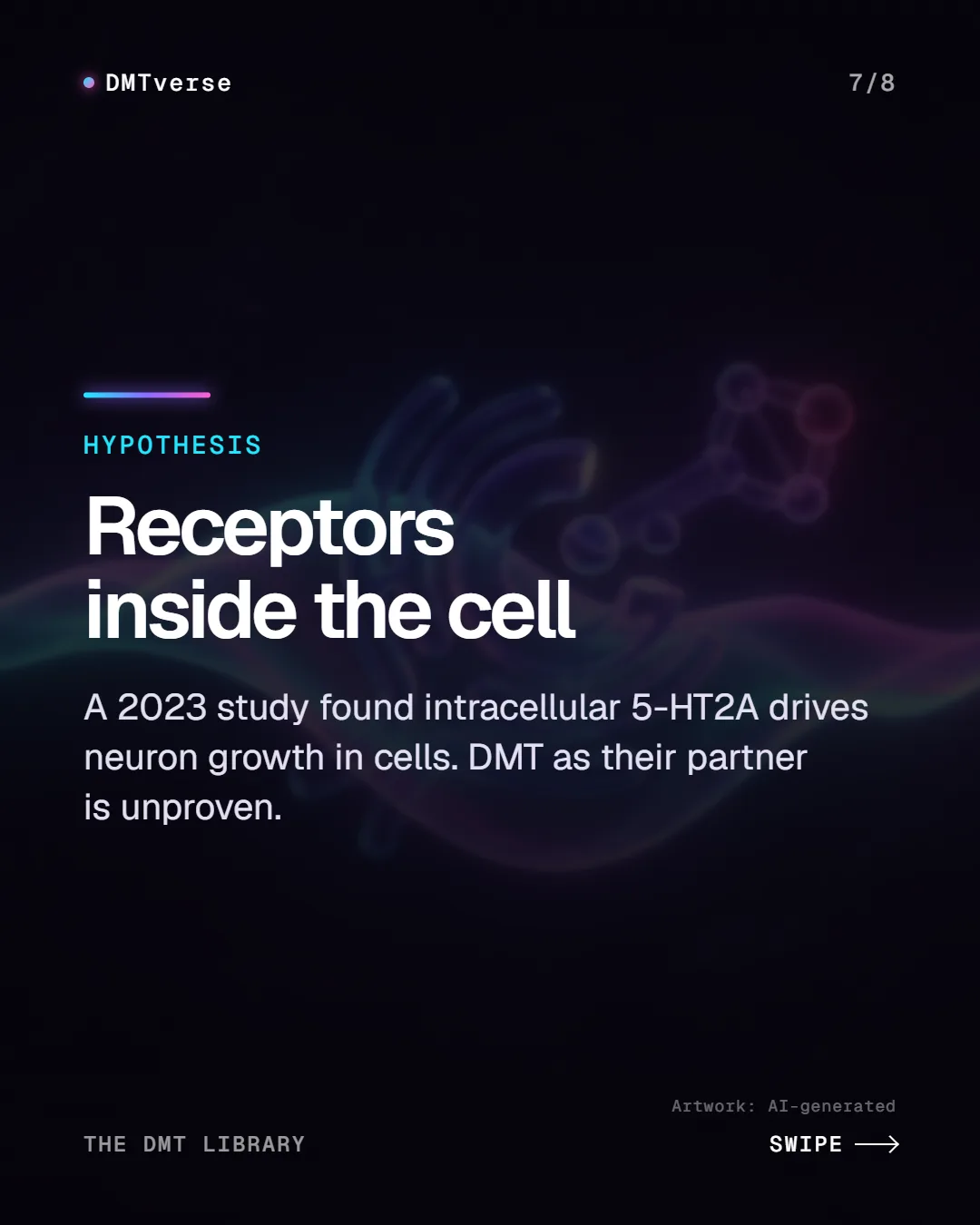
Most textbook diagrams put 5-HT2A on the outside surface of neurons. A 2023 study showed that many of these receptors sit inside cortical neurons, and that it is the intracellular ones that drive the growth-promoting effects of psychedelics in cells and mice. In rat cortical neurons, DMT, which crosses cell membranes easily, promoted neuron growth; a chemically modified version that cannot cross membranes did so only when the membrane was temporarily opened by an electrical pulse. Serotonin itself, which does not cross membranes easily, only had this effect in neurons able to pump it inside. The authors say their work raises the possibility that serotonin might not be the natural partner for these intracellular receptors in the cortex (Vargas et al., 2023). Evidence: preliminary, from cells and rodents.
Steven Barker of Louisiana State University, author of several DMT reviews, has proposed the next step: that DMT is that missing natural partner, the brain’s own ligand for intracellular 5-HT2A receptors, and that this might also help explain the subjective effects of psychedelics in general (Barker, 2025). It is one researcher’s hypothesis. No study in any species has shown the brain’s own DMT acting on these receptors inside living neurons, and DMT has never been measured in a living human brain. Whether the brain makes meaningful amounts is covered in does the brain make DMT?. Evidence: unresolved.
What is still unknown?
- Whether blocking 5-HT2A before injected or inhaled DMT prevents its effects in people; the study has not been published (unresolved).
- How much 5-HT1A, sigma-1 and trace amine receptors add to DMT’s effects in humans (unresolved).
- Whether intracellular 5-HT2A receptors are where psychedelics, including DMT, act in the living human brain (unresolved).
- Whether DMT made in the body is a natural partner for intracellular 5-HT2A, as one researcher proposes (unresolved).
The fair summary: 5-HT2A is very probably DMT’s main switch, on strong evidence from mice, cells and ayahuasca, but the one human experiment that would settle it for pure DMT has not been published. Evidence: preliminary for pure DMT in people. For how this compares with psilocybin and LSD, see psilocybin, LSD and DMT: how they differ.
Common questions
Does DMT act on the 5-HT2A receptor?
Yes. DMT is a potent partial agonist at 5-HT2A in lab tests, and in mice a typical psychedelic-like behaviour after DMT occurred in normal animals but not in animals lacking the 5-HT2A gene. In people, the evidence is indirect, from ayahuasca.
What is the 5-HT2A receptor?
One of the many receptors for serotonin. Researchers agree that classic psychedelics act as full or partial agonists at it, with particular importance for receptors on large pyramidal neurons in the cortex.
Has anyone blocked 5-HT2A before giving people DMT?
Not with pure DMT, as far as we found. Ketanserin has been given before ayahuasca, which contains DMT plus other compounds, and it blunted the brain-wave and visual effects. A Basel trial uses ketanserin three hours after DMT to end effects, which is a different test.
Is 5-HT2A the only receptor DMT uses?
No. DMT binds many serotonin receptors and also sigma-1 and trace amine receptors. In one small study, blocking 5-HT1A with pindolol made DMT’s effects stronger. What these other receptors contribute in people is unresolved.
What is the intracellular 5-HT2A hypothesis?
A 2023 study found that 5-HT2A receptors inside neurons drive psychedelic-induced neuron growth in cells and mice, and that serotonin may not reach them easily. One researcher has proposed DMT as their natural partner. It is a hypothesis with no in-vivo demonstration.
Do brain scans show DMT acting on 5-HT2A?
Indirectly. In a 2023 study, the brain regions whose connectivity changed most under DMT overlapped with independent PET maps of 5-HT2A density. That is a correlation between maps, not a direct measurement of DMT binding the receptor.
Is the evidence for DMT and 5-HT2A as strong as for LSD and psilocybin?
Not yet. For LSD and psilocybin, human studies show a 5-HT2A blocker prevents the effects. For pure DMT, that study has not been published.
Shroomverse sells mushroom products. This article is general information about DMT and the serotonin 5-HT2A receptor. It is not medical, legal or purchasing advice, and it does not recommend any product.
SOURCES
- Psychedelics (Nichols DE, Pharmacological Reviews 68(2):264–355, 2016), American Society for Pharmacology and Experimental Therapeutics (peer-reviewed); PMC4813425. Accessed . Abstract read via Europe PMC. Consensus that psychedelics are agonists or partial agonists at brain 5-HT2A receptors, particularly on apical dendrites of layer V neocortical pyramidal cells.
- N,N-Dimethyltryptamine (DMT), an Endogenous Hallucinogen: Past, Present, and Future Research to Determine Its Role and Function (Barker SA, Frontiers in Neuroscience 12:536, 2018), Frontiers (peer-reviewed, open access); full text via Europe PMC, PMC6088236. Accessed . Full text read. DMT binding to nine serotonin receptor subtypes (quoting Keiser 2009); 5-HT2A knockout head-twitch result; inositol trisphosphate response persisting with ketanserin; TAAR and sigma-1 binding.
- Predicting new molecular targets for known drugs (Keiser MJ, et al., Nature 462(7270):175–181, 2009), Springer Nature (peer-reviewed); full text via NCBI PMC, PMC2784146. Accessed . Abstract read via Europe PMC and full text checked via NCBI PMC. DMT a potent partial agonist at 5-HT2A; head-twitch response in wild-type but not 5-HT2A knockout mice; EC50 at 5-HT2A about 100-fold better than at sigma-1; supports 5-HT2A as the primary target.
- Neuropharmacology of N,N-dimethyltryptamine (Carbonaro TM, Gatch MB, Brain Research Bulletin 126(Pt 1):74–88, 2016), Elsevier (peer-reviewed); full text via NCBI PMC, PMC5048497. Accessed . Full text read. Review describing a selective 5-HT2A inverse agonist fully blocking DMT's discriminative-stimulus effects and head twitch, a 5-HT2C antagonist having little effect, DMT producing relatively few head twitches and none in Swiss Webster mice.
- Inhibition of alpha oscillations through serotonin-2A receptor activation underlies the visual effects of ayahuasca in humans (Valle M, et al., European Neuropsychopharmacology 26(7):1161–1175, 2016), Elsevier (peer-reviewed). Accessed . Abstract read via Europe PMC. Double-blind, randomized, placebo-controlled; 12 healthy experienced users; four sessions; ketanserin inhibited EEG changes, reduced the alpha–visual correlation and attenuated subjective intensity; role of 5-HT2A previously untested. Amounts deliberately not reproduced.
- The Fabric of Meaning and Subjective Effects in LSD-Induced States Depend on Serotonin 2A Receptor Activation (Preller KH, et al., Current Biology 27(3):451–457, 2017), Cell Press (peer-reviewed). Accessed . Abstract read via Europe PMC. General subjective LSD effects fully blocked by ketanserin.
- Psilocybin induces schizophrenia-like psychosis in humans via a serotonin-2 agonist action (Vollenweider FX, et al., NeuroReport 9(17):3897–3902, 1998), Lippincott Williams & Wilkins (peer-reviewed). Accessed . Abstract read via Europe PMC. Psilocybin's effects blocked dose-dependently by ketanserin or risperidone in healthy volunteers.
- Direct Comparison of Altered States of Consciousness Induced by LSD, Psilocybin, and DMT in Healthy Participants (LPD-Study), NCT06899334, ClinicalTrials.gov (U.S. National Library of Medicine); sponsor University Hospital, Basel. Accessed . Registry record read through the ClinicalTrials.gov API: status recruiting (verified March 2025); ketanserin given intravenously after 3 hours in every arm to standardize effect duration. Doses deliberately not reproduced.
- 5-HT1A receptor blockade potentiates the subjective effects of DMT (Zahid Z, Strassman RJ, Qualls CR, Nayak SM, Journal of Psychopharmacology 40(8):1261–1269, 2026), SAGE (peer-reviewed). Accessed . Abstract read via Europe PMC. Double-blind, randomized, placebo-controlled within-subjects; 12 experienced participants; sub-hallucinogenic intravenous DMT; pindolol pretreatment increased subjective effects (moderate effect size); blood pressure rose. Doses not reproduced.
- Human brain effects of DMT assessed via EEG-fMRI (Timmermann C, et al., PNAS 120(13):e2218949120, 2023), National Academy of Sciences (peer-reviewed); full text via Europe PMC, PMC10068756. Accessed . Full text read. Connectivity-by-intensity maps correlated with independent PET-derived 5-HT2A density maps; strongest effects in transmodal cortex; authors interpret the overlap as implying 5-HT2A signalling is causal.
- Psychedelics Promote Structural and Functional Neural Plasticity (Ly C, et al., Cell Reports 23(11):3170–3182, 2018), Cell Press (peer-reviewed, open access); full text via NCBI PMC, PMC6082376. Accessed . Full text read. Ketanserin completely abrogated DMT-, LSD- and DOI-induced neuritogenesis and spinogenesis in cultured rat cortical neurons; increased dendritic spine density in rat prefrontal cortex 24 hours after DMT.
- Psychedelics promote neuroplasticity through the activation of intracellular 5-HT2A receptors (Vargas MV, et al., Science 379(6633):700–706, 2023), American Association for the Advancement of Science (peer-reviewed); full text via NCBI PMC, PMC10108900. Accessed . Full text read. Intracellular 5-HT2ARs mediate plasticity; DMT promoted growth of rat cortical neurons; membrane-impermeable congener did so only with electroporation; serotonin effective only in SERT-expressing neurons; raises possibility serotonin is not the endogenous ligand for intracellular 5-HT2ARs.
- N,N-dimethyltryptamine (DMT) in rodent brain: Concentrations, distribution, and recent pharmacological data (Barker SA, Progress in Neuro-Psychopharmacology and Biological Psychiatry 137:111259, 2025), Elsevier (peer-reviewed). Accessed . Abstract read via Europe PMC. Proposes DMT as the missing endogenous ligand for intracellular 5-HT2A receptors; review and hypothesis, no new in-vivo demonstration.
CHANGES
- : Linked glossary definitions.
- : Keyword pass: search-title now uses the wording people search (“does DMT affect serotonin”); body unchanged.
- : Published. Sources re-checked on this date, including a Europe PMC search for human 5-HT2A blockade studies with DMT and the NCT06899334 registry record.
- : Editorial review: summary now opens with a direct answer; removed an unsourced statement about pindolol’s heart effects; H2s rewritten as questions, one carrying the primary keyword.



