THE SHROOMVERSE JOURNAL ✳ 12 MIN READ
Is DMT made in the pineal gland? The “third eye” claim, checked
Topic: DMT
Published Updated
Listen: the 3-minute version
AI-narrated summary of this article
Short answer, checked 20 October 2026
The “DMT gland” is the pineal gland, and there is no good evidence that it makes the body’s DMT. The idea that the pineal gland, the so-called third eye, makes the body’s DMT was popularised by psychiatrist Rick Strassman as a speculation, not a finding. DMT was detected near the rat pineal gland in 2013, but in 2019 rats with the gland surgically removed still had DMT in the cortex at levels no lower than rats with it, so the pineal is not needed for brain DMT in rats. Pineal tissue in rats and humans does carry the messenger RNA for INMT, an enzyme long linked to DMT. No one has measured DMT made by a human pineal gland. The pineal-source idea is unsupported, which is not the same as disproven.
THE SHORT VERSION · SWIPE
On this page 8 sections
Few claims about DMT travel as far as this one: a small gland deep in the brain, the “third eye”, makes DMT, and releases it at birth, in dreams and at death. It appears in podcasts, posters and videos as if it were textbook biology.
This fact-check traces where the idea came from, what the experiments actually found, and why the most accurate verdict is a careful one. For the wider question of whether the human body makes DMT at all, see does the brain make DMT?.
Education only, not guidance
This article describes published research. It gives no amounts, no instructions and no advice on use. Nothing here is a technique for “activating” any gland. DMT is a controlled substance in Canada; for risks and help, see our safety page. Evidence labels: established (shown in peer-reviewed studies and not seriously disputed), preliminary (early, small, animal-only or indirect) and unresolved (an open question).
What is the pineal gland, and why is it called the third eye?
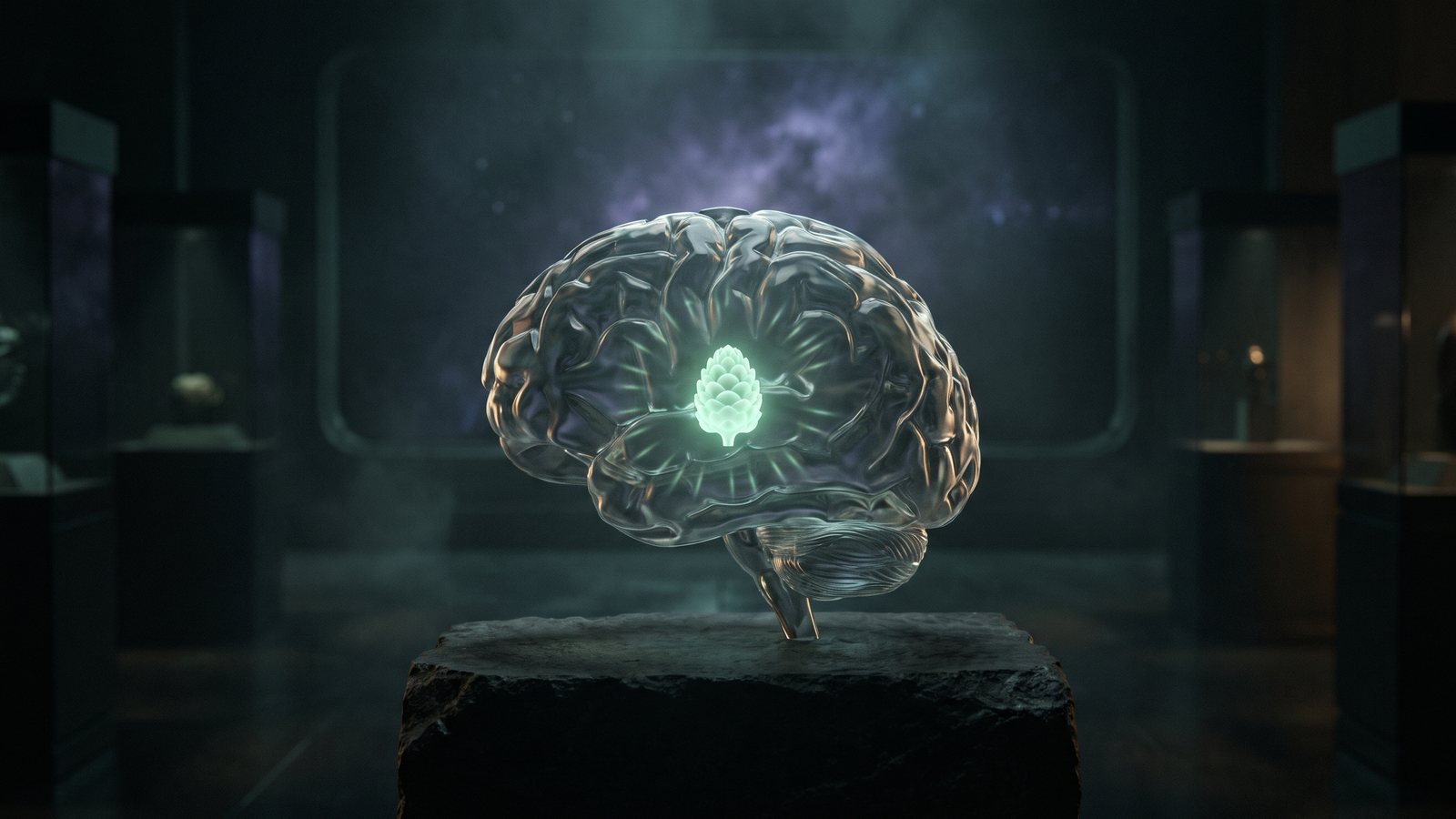
The pineal gland is a very small gland deep in the brain. The adult gland weighs less than a fifth of a gram, and its principal known job is making melatonin, the hormone that helps set the body’s daily (circadian) rhythm (Nichols, 2018). Evidence: established.
Its mystique is much older than DMT research. A 2018 review by pharmacologist David Nichols traces a “romantic history” for the gland: equated with the eye of Horus in pharaonic Egypt, and treated in various religious traditions as the seat of the soul or the third eye (Nichols, 2018). The University of Michigan’s 2019 news release on DMT in rat brains also recalled that Descartes viewed the gland as the seat of the soul, and that it is “known by some as the third eye” (University of Michigan release). Evidence: established as cultural history. These are beliefs about the gland, not findings about it.
Why is the pineal called the “DMT gland”?
The modern version traces mainly to Rick Strassman, a psychiatrist at the University of New Mexico (Dean et al., 2019, author list) who ran human DMT studies in the 1990s (Strassman and Qualls, 1994). His popular book, DMT: The Spirit Molecule, was published by Park Street Press on 1 December 2000, subtitled “A Doctor’s Revolutionary Research into the Biology of Near-Death and Mystical Experiences” (Open Library record). We have not read the book, so we describe its ideas only as other researchers summarise them. Evidence: established for the book’s publication details.
Researchers summarise the hypothesis this way. A 2018 paper describes Strassman’s proposal that endogenous DMT is released in significant concentrations during the dying process, and points readers to Nichols for a critique (Timmermann et al., 2018). Nichols writes that recent versions of pineal lore suggest DMT is secreted by the pineal gland at birth, during dreaming and near death, to produce out-of-body experiences (Nichols, 2018). The Michigan release describes Strassman’s pineal claim as a hypothesis that the Michigan team set out to test (University of Michigan release). Evidence: established that it was proposed as a hypothesis.
Strassman himself has been cautious in public since. On a January 2024 podcast, describing whether DMT plays a role in non-drug states, he is quoted in the show notes as saying “the data aren’t there yet” (Psychedelic Medicine Podcast). We read the episode page and its timestamped quotes, not a full transcript. Evidence: established that he said this; the page does not record a full retraction of the pineal idea, and we do not claim one.
What has actually been measured? A timeline
- 1994In a controlled human study, DMT given to 11 volunteers left their blood melatonin levels unaffected.Source Strassman and Qualls, 1994
- 2000Strassman’s book popularises the pineal speculation.Source Open Library record
- 2011INMT protein found in monkey pineal gland, spinal cord and retina.Source Barker, 2018 (describing Cozzi et al., 2011)
- 2013DMT detected for the first time in fluid sampled near the rat pineal gland; not quantified.Source Barker et al., 2013
- 2018Nichols argues the evidence is not consistent with pineal DMT ideas.Source Nichols, 2018
- 2019INMT messenger RNA found in rat and human pineal tissue; removing the rat pineal gland does not lower cortical DMT.Source Dean et al., 2019
- 2023INMT-knockout rats: the textbook enzyme looks unnecessary for tryptamine methylation in rat brain.Source Glynos et al., 2023
2013: DMT detected near the rat pineal gland
In 2013, a team including Steven Barker, Jimo Borjigin and Strassman developed a mass-spectrometry method that could detect 23 related compounds at once, applied it to fluid collected by microdialysis from the pineal gland region of living rats, and reported “for the first time” the presence of DMT (Barker et al., 2013). It was a qualitative result. A later review explains that the samples were essentially diluted fluid from the surrounding tissue, taken at a single point in time, so no amount was given (Barker, 2018). Evidence: preliminary. A detection in rats, not a measurement of production.
There was also an ambiguity in where the DMT came from. The microdialysis probe passed through both the pineal gland and the surrounding visual cortex, so it was unclear whether the DMT came from the pineal, the cortex or both (Dean et al., 2019). That question set up the decisive experiment. Evidence: established for the study design.
2019: remove the pineal, and cortical DMT remains
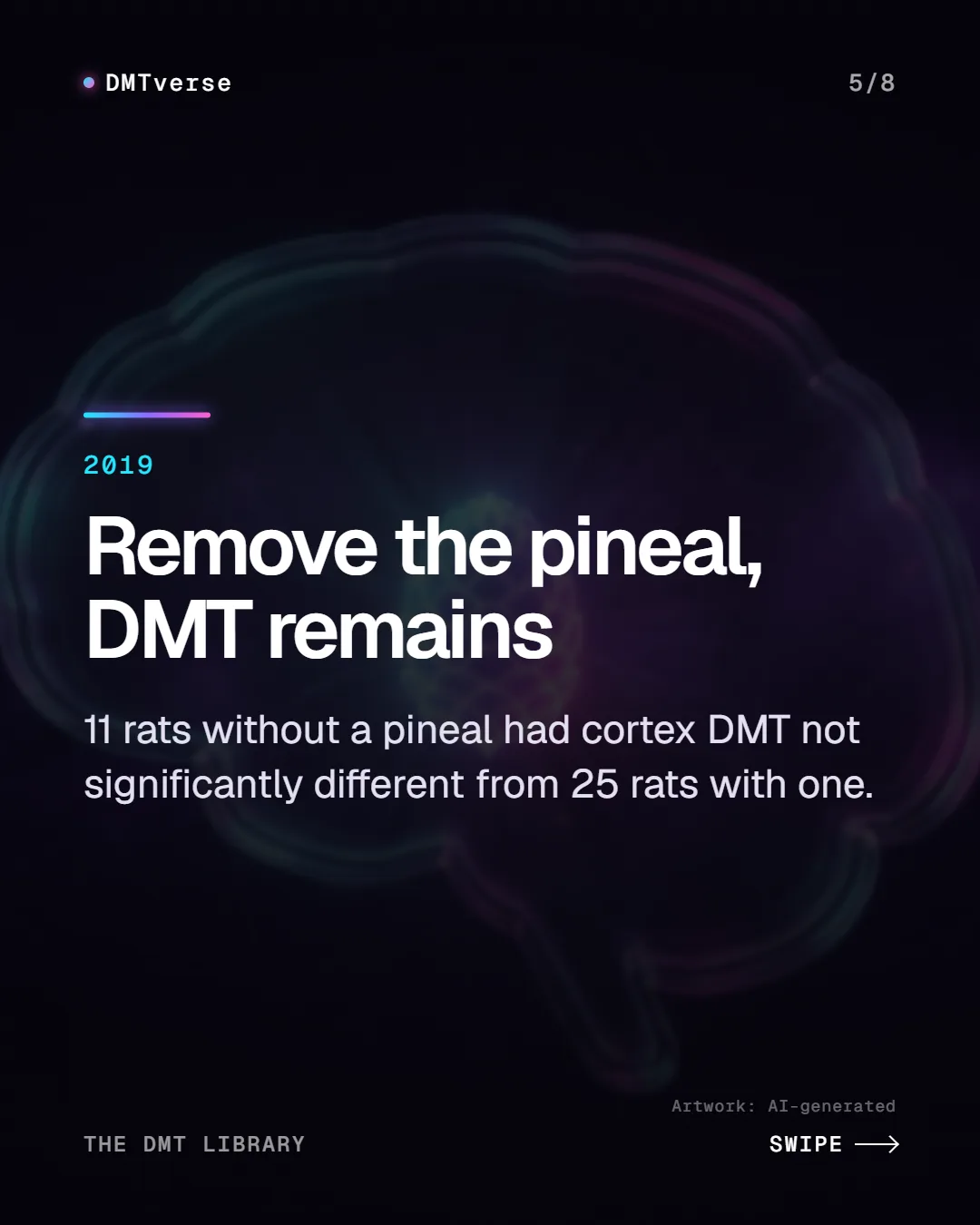
In 2019, the Michigan group sampled fluid from the visual cortex of 25 rats with the pineal gland intact and 11 rats whose pineal gland had been surgically removed (a pinealectomy), confirmed by the absence of melatonin in their samples (Dean et al., 2019). The results:
- Rats without a pineal gland still had DMT in the cortex, ranging from 0.25 to 2.2 nanomolar (billionths of a mole per litre) and averaging 1.02 nanomolar. Rats with the gland averaged 0.56 nanomolar.
- The difference between the two groups was not statistically significant, and after induced cardiac arrest DMT rose in both groups. The full numbers are in the DMT rat brain study, explained.
- The authors concluded that the cortex may be one of the major sources of DMT released in the brain, and that it is uncertain “to what extent, if any” the pineal contributes.
- They could not rule out the brain making more DMT elsewhere to compensate after the gland was removed.
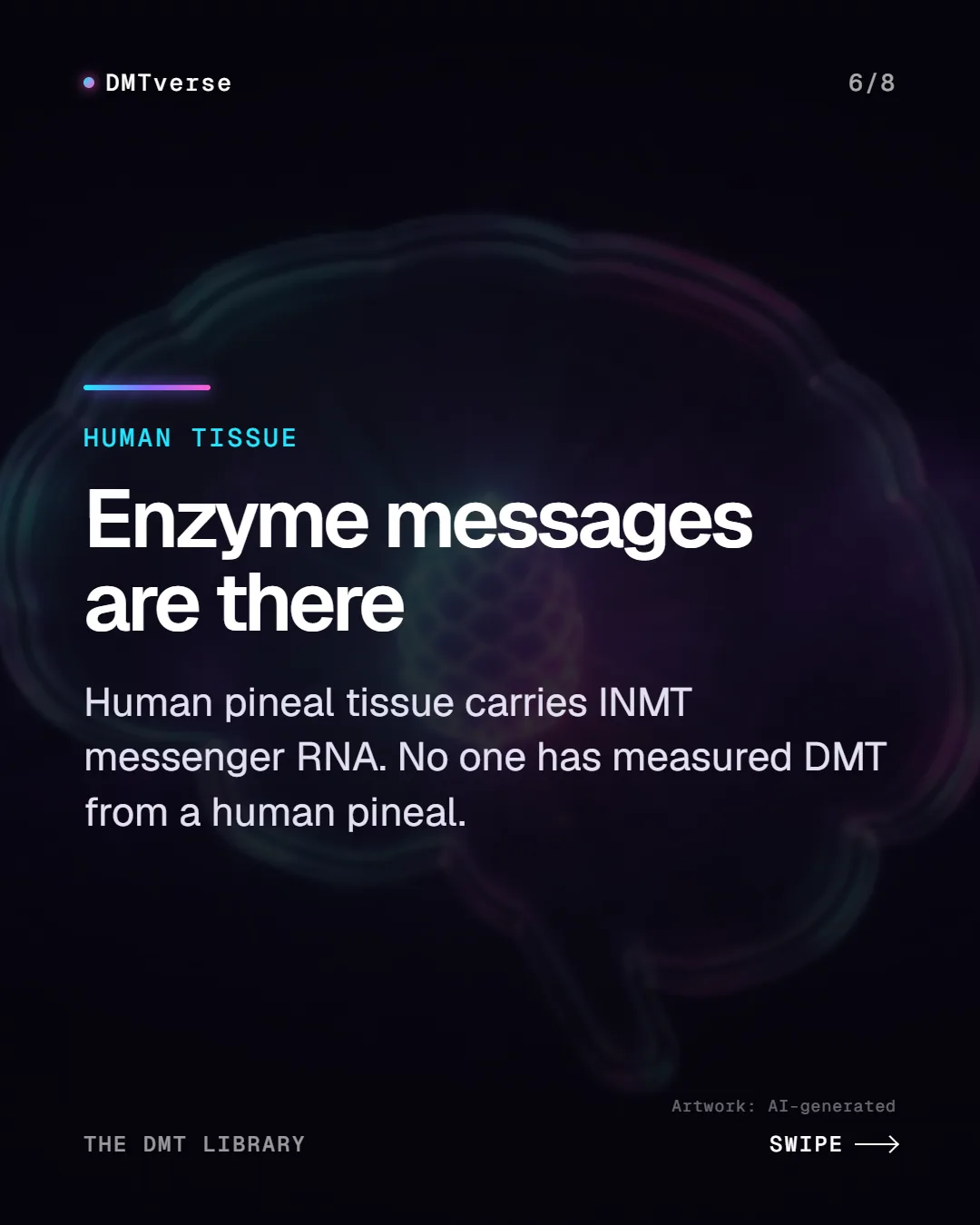
The same study found something that seems to point the other way: INMT messenger RNA was abundant in rat and human pineal tissue, and in rat pineal cells it sat alongside the message for AADC, the other enzyme in the textbook pathway. The authors called this a paradox, and proposed an explanation: in the pineal, tryptophan is overwhelmingly drawn into the serotonin and melatonin pathway, whose first enzyme binds it far more readily than AADC does, leaving little for DMT (Dean et al., 2019). Evidence: preliminary. The machinery is there in rats; whether the pineal uses it to make DMT is unresolved.
Researchers read the result differently. Barker, a co-author, suggests the pineal may make DMT and that its removal may trigger compensatory production elsewhere (Barker, 2022). The 2019 paper itself says only that compensation cannot be ruled out (Dean et al., 2019). Either way, the experiment shows the pineal is not needed for cortical DMT in rats. Evidence: established for that rat result; the interpretation is unresolved.
What is Nichols’s case against the pineal story?
Nichols’s 2018 review, subtitled “separating fact from myth”, states that scientific evidence is not consistent with the pineal ideas. His argument rests on the gland’s small size and its known role in melatonin production, and on the point that the very small DMT concentrations detected in the brain are not sufficient to produce psychoactive effects. He also sets out alternative explanations for how stress and near-death states can alter consciousness without DMT being involved (Nichols, 2018). Evidence: established as his published argument; we read the abstract, not the full text.
One human data point fits his side of the ledger, though it measures something different. In Strassman’s own 1994 study, giving DMT to 11 experienced volunteers raised several hormones but left blood melatonin levels unaffected (Strassman and Qualls, 1994). That says nothing directly about whether the pineal makes DMT, but it is a reminder that the pineal’s known product behaved independently in that study. Evidence: preliminary as an inference; the melatonin finding itself is from one small study.
Barker has argued back that DMT may be more than a trace amine in the brain, pointing to rat cortex levels in the range of established neurotransmitters (Barker, 2022). Note what that argument is about: the brain in general, mostly the cortex, not the pineal gland as the special source. Evidence: unresolved.
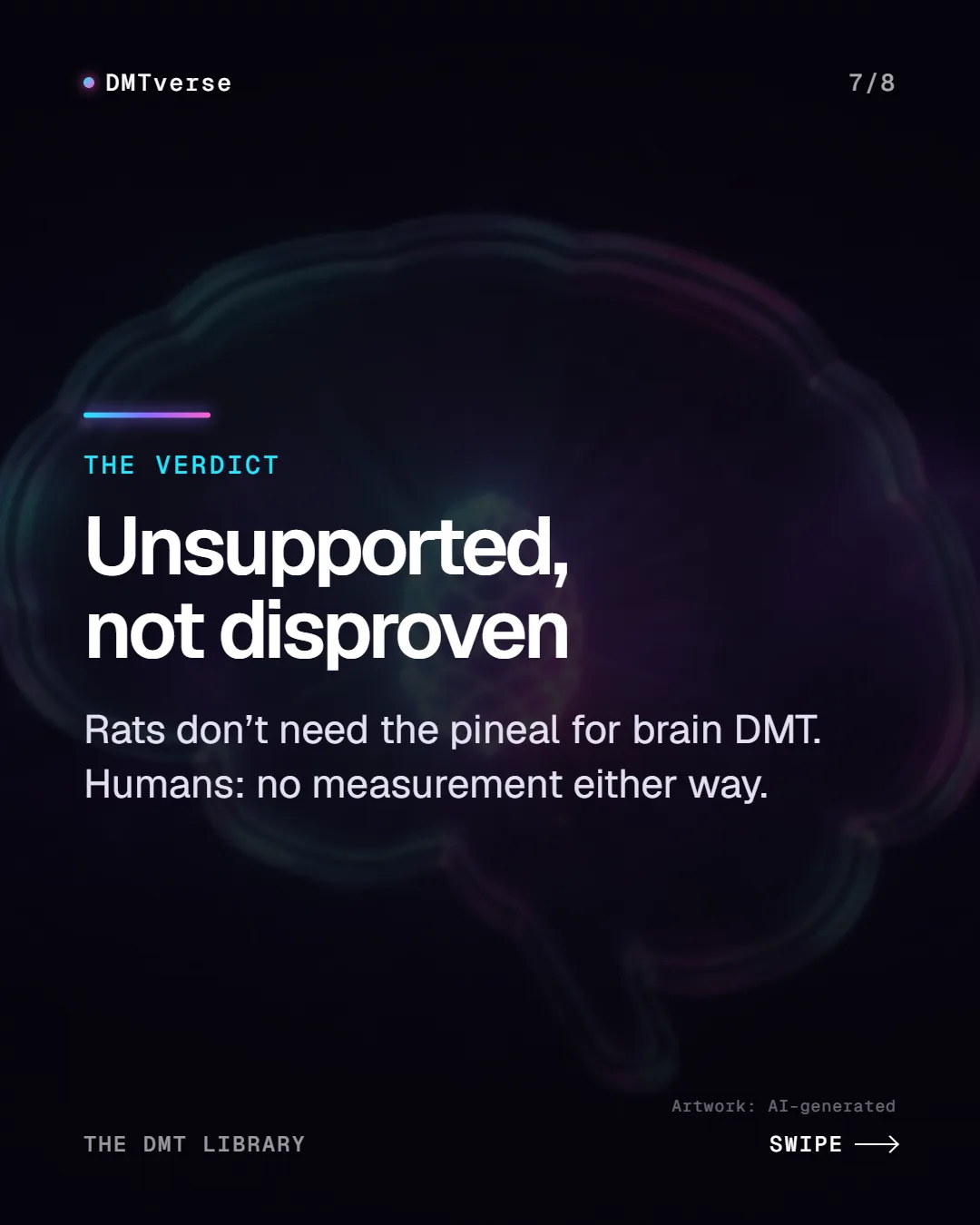
Has the DMT pineal gland idea been disproven?
It is tempting to swing from “the pineal makes your DMT” to “the pineal myth is debunked”. Neither matches the evidence. Here is what each word would need:
- Supported would need a measurement showing DMT made by, and released from, the human pineal gland. None exists.
- Disproven would need evidence that the human pineal makes no DMT. That has not been shown either: human pineal tissue carries INMT messenger RNA (Dean et al., 2019), and INMT protein has been found in monkey pineal tissue (Barker, 2018).
- Unsupported is the accurate word: the rat evidence shows the pineal is not needed for brain DMT, and no human measurement exists. As a 2018 review notes, no study had looked at DMT release from the pineal across the day (Barker, 2018).
The enzyme question adds another layer. In 2023, INMT-knockout rats turned out not to need INMT for tryptamine methylation in the brain, and rat INMT on its own could not make DMT (Glynos et al., 2023). So finding INMT messages in pineal tissue says even less than it once seemed to. See our INMT enzyme explainer. Evidence: preliminary.
Which pineal gland claims hold up?
| Claim | Rating | Why |
|---|---|---|
| The pineal gland is the “third eye” | Belief, not biology | A religious and cultural tradition (Nichols, 2018). Its known job is making melatonin. |
| DMT has been found near the pineal gland | Preliminary (rats) | Detected in rat pineal-region fluid, not quantified (Barker et al., 2013). |
| Pineal tissue has DMT-linked enzyme messages | Preliminary | INMT messenger RNA in rat and human pineal tissue (Dean et al., 2019). |
| The pineal is the brain’s main DMT source | Unsupported | Cortical DMT persisted without the pineal in rats (Dean et al., 2019). |
| The pineal releases DMT at birth, in dreams or at death | Unsupported | Never measured; described as a hypothesis (Timmermann et al., 2018; Nichols, 2018). |
| Science has disproven any pineal DMT | Overstated | No human measurement exists either way. |
For the death claim specifically, see our fact-check, does the brain release DMT when you die?.
What would settle it?
- A measurement of DMT made by, or released from, a human pineal gland (never done).
- Studies of pineal DMT across the day and night, which a 2018 review said had never been conducted (unresolved).
- Identification of the enzyme that makes DMT in mammals, now that INMT appears unnecessary in rats (unresolved).
- Independent replication of the rat pinealectomy result in another lab (not found in the sources we read).
Common questions
Does the pineal gland produce DMT?
It has not been shown. DMT was detected in fluid near the rat pineal gland in 2013, and pineal tissue in rats and humans carries messenger RNA for INMT. But rats with the pineal gland removed had cortical DMT levels no lower than normal rats, and no one has measured DMT made by a human pineal gland.
Why is the pineal gland called the third eye?
Because of a long religious and cultural tradition. A 2018 review notes the gland was equated with the eye of Horus in ancient Egypt and treated in various traditions as the seat of the soul or the third eye. Its known biological job is making melatonin.
Who came up with the pineal DMT idea?
The modern version is mainly linked to psychiatrist Rick Strassman, who ran DMT studies in the 1990s and wrote DMT: The Spirit Molecule (2000). Researchers describe his pineal and dying-process ideas as a hypothesis. In a 2024 podcast he said, of a role for DMT in non-drug states, that the data aren’t there yet.
What happened when scientists removed the pineal gland in rats?
In a 2019 study, 11 rats without a pineal gland had DMT in the visual cortex at levels no lower than in 25 rats with the gland (averages of 1.02 and 0.56 nanomolar; the difference was not statistically significant). The authors concluded the cortex may be a major source and that the pineal’s contribution is uncertain.
Has the pineal DMT theory been debunked?
Not exactly. It is unsupported: the rat data show the pineal is not needed for brain DMT, and there is no human measurement. But there is also no evidence that the human pineal makes no DMT, so “disproven” would overstate the case.
Does DMT affect melatonin?
In Strassman’s 1994 study of 11 experienced volunteers, DMT given in the lab raised several hormones but left melatonin levels unaffected. That is one small study, and it does not test whether the pineal makes DMT.
Shroomverse sells mushroom products. This article is general information about research on DMT and the pineal gland. It is not medical, legal or purchasing advice, and it does not recommend any product.
SOURCES
- N,N-dimethyltryptamine and the pineal gland: Separating fact from myth (Nichols DE, Journal of Psychopharmacology 32(1):30–36, 2018), SAGE (peer-reviewed); abstract via Europe PMC. Accessed . Abstract read. Supports the gland’s history (eye of Horus, seat of the soul, third eye), pineal DMT claims at birth, dreaming and near death, the adult gland weighing under a fifth of a gram, melatonin as its principal function, brain DMT concentrations not sufficient for psychoactive effects, and alternative explanations for altered states.
- LC/MS/MS analysis of the endogenous dimethyltryptamine hallucinogens, their precursors, and major metabolites in rat pineal gland microdialysate (Barker SA, Borjigin J, Lomnicka I, Strassman R, Biomedical Chromatography 27(12):1690–1700, 2013), Wiley (peer-reviewed); abstract via Europe PMC. Accessed . Abstract read. Supports the qualitative LC/MS/MS method for 23 compounds and the first report of DMT in rat pineal gland microdialysate.
- Biosynthesis and Extracellular Concentrations of N,N-dimethyltryptamine (DMT) in Mammalian Brain (Dean JG, Liu T, Huff S, et al., Scientific Reports 9:9333, 2019), Springer Nature (peer-reviewed, open access); full text via Europe PMC, PMC6597727. Accessed . Full text read. Supports Strassman’s University of New Mexico psychiatry affiliation (author list); the 2013 probe crossing pineal and cortex; 25 pineal-intact and 11 pinealectomized rats, pineal removal confirmed by absent melatonin; baseline 0.25–2.2 nM (mean 1.02) without pineal vs mean 0.56 with; no significant difference; rise after cardiac arrest in both; cortex as a possible major source; pineal contribution uncertain; compensation not ruled out; INMT mRNA in rat and human pineal; INMT/AADC colocalized in rat pinealocytes; the tryptophan-competition explanation of the paradox.
- N,N-Dimethyltryptamine (DMT), an Endogenous Hallucinogen: Past, Present, and Future Research to Determine Its Role and Function (Barker SA, Frontiers in Neuroscience 12:536, 2018), Frontiers (peer-reviewed, open access); full text via Europe PMC, PMC6088236. Accessed . Full text read. Supports the 2013 samples being diluted tissue effluent at a single time point, hence no quantitation; INMT protein in monkey pineal, spinal cord and retina (Cozzi et al., 2011, not read directly); no circadian studies of pineal DMT release ever conducted.
- Administration of N,N-dimethyltryptamine (DMT) in psychedelic therapeutics and research and the study of endogenous DMT (Barker SA, Psychopharmacology 239(6):1749–1763, 2022), Springer (peer-reviewed, open access); full text via Europe PMC, PMC8782705. Accessed . Full text read (endogenous DMT section). Supports Barker’s reading that pineal removal may induce compensatory production elsewhere, and his argument that DMT may be more than a trace amine, based on rat cortex levels.
- Indolethylamine N-methyltransferase (INMT) is not essential for endogenous tryptamine-dependent methylation activity in rats (Glynos NG, Carter L, Lee SJ, et al., Scientific Reports 13:280, 2023), Springer Nature (peer-reviewed, open access); full text via Europe PMC, PMC9822953. Accessed . Full text read. Supports INMT-knockout rats retaining tryptamine-methylating activity in brain and lung, with products that were neither NMT nor DMT, and rat INMT not making DMT on its own.
- DMT Models the Near-Death Experience (Timmermann C, Roseman L, Williams L, et al., Frontiers in Psychology 9:1424, 2018), Frontiers (peer-reviewed, open access); full text via Europe PMC, PMC6107838. Accessed . Introduction read. Supports its summary of Strassman’s hypothesis that endogenous DMT is released in significant concentrations during the dying process, with a pointer to Nichols’s critique.
- Dose-response study of N,N-dimethyltryptamine in humans. I. Neuroendocrine, autonomic, and cardiovascular effects (Strassman RJ, Qualls CR, Archives of General Psychiatry 51(2):85–97, 1994), American Medical Association (peer-reviewed); abstract via Europe PMC. Accessed . Abstract read. Supports 11 experienced hallucinogen users in a double-blind, saline placebo-controlled, randomized design; DMT raised several hormones; melatonin levels were unaffected. Doses deliberately not reproduced.
- DMT: The Spirit Molecule. A Doctor’s Revolutionary Research into the Biology of Near-Death and Mystical Experiences (Strassman R, Park Street Press, 2000), Open Library catalogue record. Accessed . Catalogue record only; the book was not read. Supports title, subtitle, publisher and the 1 December 2000 publication date.
- ‘Mystical’ psychedelic compound found in normal brains (University of Michigan / Michigan Medicine news release, 27 June 2019, republished by Neuroscience News), Neuroscience News, reproducing the University of Michigan release. Accessed . Read in full. Supports Descartes’ view of the pineal as the seat of the soul, the gland being “known by some as the third eye”, and the description of Strassman’s pineal claim as a hypothesis the team set out to test. The original Michigan Medicine page refused automated access on this date.
- Exploring Endogenous DMT with Rick Strassman, MD (Psychedelic Medicine Podcast, 3 January 2024), PlantMedicine.org. Accessed . Episode page read: summary, show notes and timestamped quotes; no full transcript. Supports the quote “the data aren’t there yet” about a role for DMT in non-drug states. The page does not contain an explicit retraction of the pineal hypothesis.
CHANGES
- : Linked glossary definitions.
- : Retitled for the search term “DMT gland” (title, description, summary opening, one H2). No change to the evidence.
- : Published. All sources opened and checked on this date.
- : Editorial review: summary opens with a direct answer; ‘similar’ rat DMT levels corrected to ‘no lower’ with the study’s averages (0.56 vs 1.02 nanomolar) so the numbers match the rat study and endogenous DMT articles; nanomolar defined; two H2s rewritten as questions, one carrying the primary keyword; duplicate link removed.



