THE SHROOMVERSE JOURNAL ✳ 12 MIN READ
DMT: The Spirit Molecule, the book and the film: what they claimed and what research found
Topic: DMT
Published Updated
Short answer, checked 20 October 2026
DMT: The Spirit Molecule is a 2000 book by the psychiatrist Rick Strassman about his 1990–95 DMT studies at the University of New Mexico, and a 2010 documentary of the same name, directed by Mitch Schultz and narrated by Joe Rogan. The book mixed published research with ideas its author calls highly speculative: that the pineal gland releases DMT at birth and death, and that DMT may let the brain perceive other realms. Later research supported its account of DMT’s speed and intensity and of how often people report meeting beings, but not the pineal story: in rats brain DMT does not depend on the pineal gland, and DMT has never been measured in a living human brain. Strassman himself said in 2024 that the data on the body’s own DMT “aren’t there yet”.
THE SHORT VERSION · SWIPE
On this page 9 sections
DMT: The Spirit Molecule gave DMT its best-known nickname, and its pineal-gland theory is still repeated online. The book and film blend three things: published research, the author’s speculations, and the stories volunteers told. This article separates them and checks each against what has been learned since.
Education only, not guidance
This article describes a book, a film and published research. It gives no amounts, no instructions and no advice on use, and it does not describe any effect as a benefit. DMT is a controlled substance in Canada. Evidence labels used below: established (shown in peer-reviewed studies and not seriously disputed), preliminary (early, small, self-selected or animal-only) and unresolved (an open question).
What is DMT: The Spirit Molecule about?
DMT: The Spirit Molecule was published in 2000 by Park Street Press, according to its Open Library record (Open Library). In it, Rick Strassman reviews what was known about psychedelics, traces his project through committees and review boards to its performance, and quotes from more than 1,000 pages of his bedside notes on the volunteers’ sessions (Strassman, book page). Evidence: established.
His research volunteers were healthy, and the studies were not intended to be therapeutic. By his own count, he gave about 400 doses of DMT to about 60 volunteers (Strassman, book page). By his account, the book had sold a quarter of a million copies by mid-2021 and been translated into more than a dozen languages (Strassman, biography). Evidence: established for the publication; sales figures are the author’s.
The research behind it was published in peer-reviewed journals. Two 1994 papers, from small double-blind, placebo-controlled studies of 11 and 12 experienced volunteers, found that intravenous DMT acted within about two minutes and was largely over by 30, raised heart rate and blood pressure, left the pineal hormone melatonin unchanged, and produced effects volunteers described as more vivid and compelling than dreams (Strassman and Qualls, 1994; Strassman et al., 1994). For the study design and why it ended, see Rick Strassman’s DMT study. Evidence: established.
What does the book claim?
Strassman is open about the speculative parts. On his own book page he lists ideas he expects readers to object to (Strassman, book page):
- That excess DMT made by the pineal gland might be involved in naturally occurring “psychedelic” states: birth, death and near-death, psychosis and mystical experience.
- That pineal DMT release at 49 days after conception marks the entrance of the spirit into the fetus.
- That DMT affects the brain’s ability to receive information rather than generating perceptions itself.
- That DMT may allow the brain to perceive dark matter or parallel universes inhabited by conscious entities.
- That DMT is intimately involved in “alien abduction” experiences.
The chapter summaries add the observations behind them: an unexpectedly high frequency of reported contact with “beings”, which Strassman found personally disorienting, and a television analogy in which DMT changes the brain’s “channels” (Strassman, chapter summaries). The book also reaches a conclusion often forgotten: that DMT has no beneficial effects in and of itself, and that the context in which people take it is at least as important (Strassman, book page). Evidence: the speculations are the author’s, untested or unsupported; the observations are his reports.
Where the nickname comes from
The phrase “spirit molecule” is Strassman’s. He describes the pineal gland as a possible “spirit gland” and DMT as possibly a spirit molecule, naturally produced and capable of transporting people to different states of mind. For the full story of the name, see why is DMT called the spirit molecule.
What does the 2010 documentary show?
The documentary DMT: The Spirit Molecule (2010) is based on the book, directed by Mitch Schultz and narrated by Joe Rogan. It deals with DMT through interviews with people who took it, in Strassman’s studies or as ayahuasca (Wikipedia, film article). Strassman says he co-produced it (Strassman, biography). A 2010 review from the Austin Film Festival describes a straightforward structure: Rogan introduces the ideas, which are developed through interviews with Strassman, his volunteers, other people who had taken DMT, scientists, social scientists and theologians, cut with psychedelic animation (Slackerwood, 2010). Evidence: established for the credits and content.
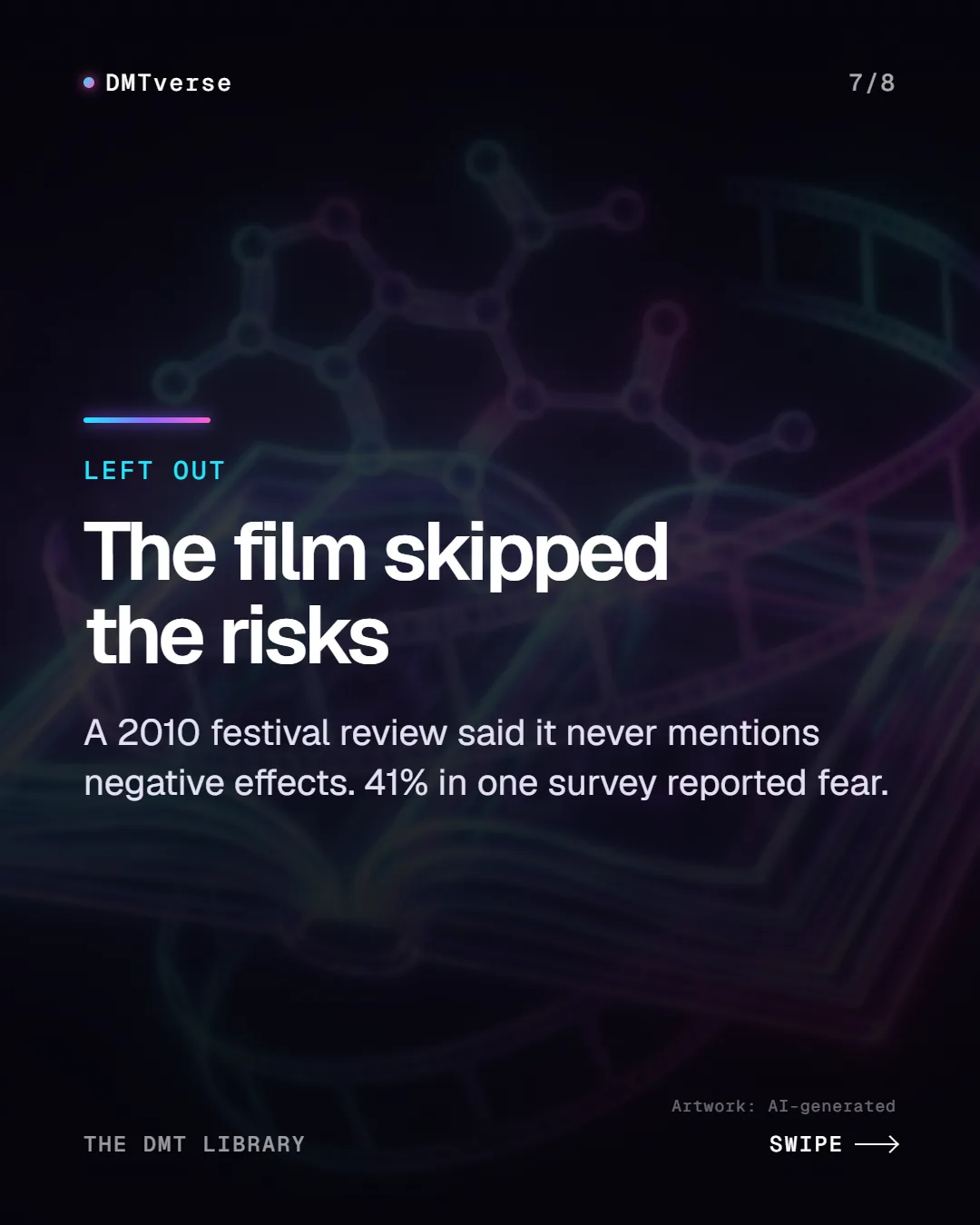
The same review found a major omission: the film does not mention DMT’s possible negative effects, and the reviewer reports that the director acknowledged, after the screening, that it was more an exploration of the drug’s possibilities, and a plea for more research, than a balanced documentary (Slackerwood, 2010). That matters, because Strassman’s own book says adverse effects were adding up in his study (Strassman, chapter summaries). Strassman’s website calls it the most-streamed independent drug documentary on Netflix (Strassman, biography); we could not check that figure independently. Evidence: one critic’s assessment and the director’s reported comments; the streaming claim is the author’s.
Did the book and film make DMT more popular?
The best-known survey figures date from 2012, after both the book and the film. In the 2012 Global Drug Survey, an anonymous online survey of 22,289 self-selected respondents, many of whom used drugs, 8.9% reported having used DMT at some point and 5.0% in the past year. DMT had a larger share of new users than psilocybin, LSD or ketamine (24%), and the authors suggested its popularity might increase (Winstock et al., 2014). Those figures describe who answered the survey, not the general population. Evidence: preliminary.
Did the book and film drive that interest? Nobody has shown it. The survey did not ask, and we found no study that tested causally how either work changed DMT use or what people expect to experience. What can be said is narrower: the vocabulary of the book (the spirit molecule, the pineal gland, beings and other realms) is common in DMT discussion online. Researchers who coded thousands of online reports noted that earlier posts may shape how later ones are written (Lawrence et al., 2022). For the wider story, see how DMT went mainstream. Evidence: unresolved for cause; the shared vocabulary is our observation, not a measured effect.
Is DMT: The Spirit Molecule accurate? What research supported
The core pharmacology has held up. DMT’s fast onset and short action, first measured precisely in Strassman’s 1994 studies (Strassman and Qualls, 1994), are now standard facts; a 2018 review summarises DMT’s rapid effects and quick breakdown (Barker, 2018). Evidence: established.
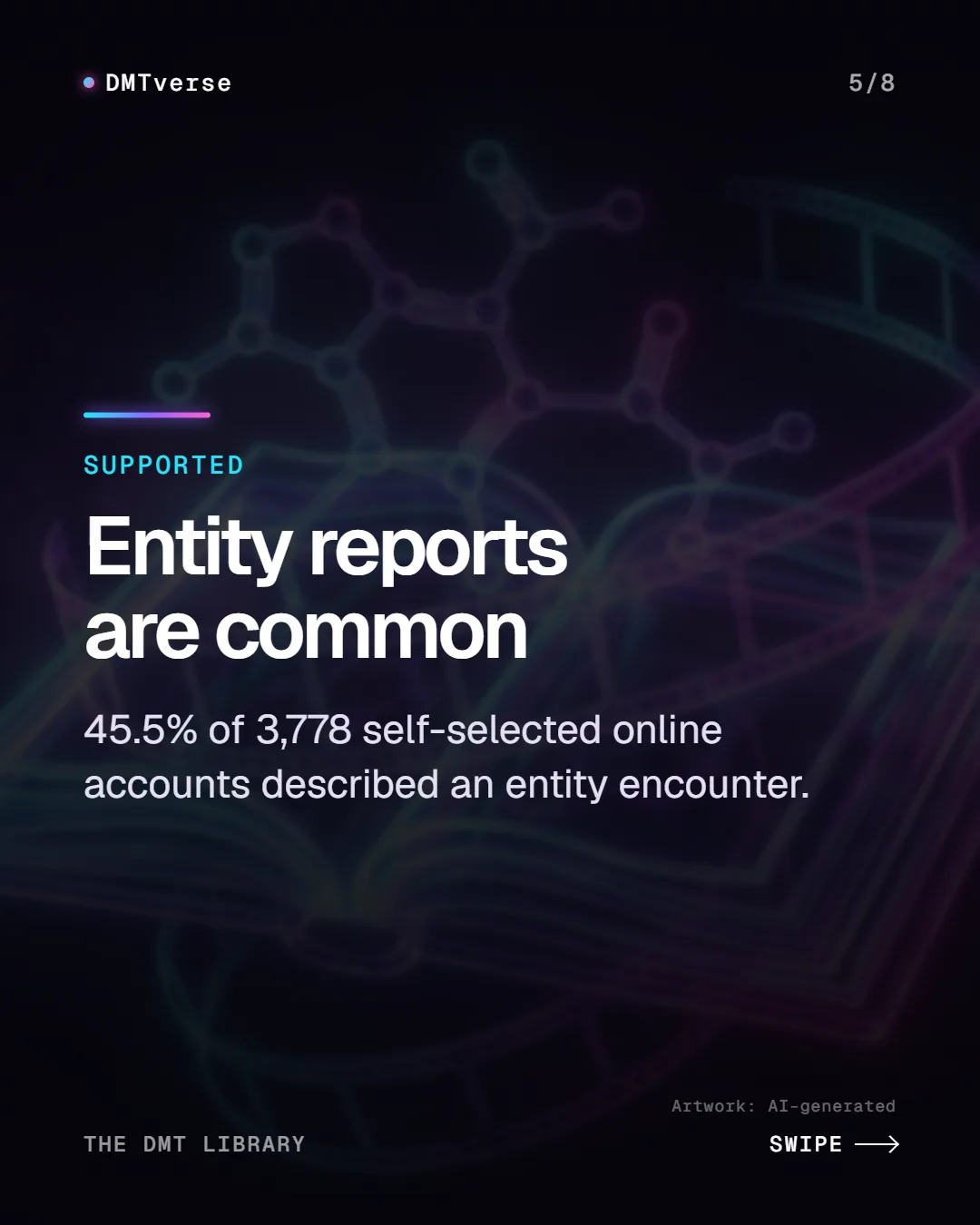
So has the report that encounters with beings are common, at least among people who describe their experiences. In 3,778 accounts posted to an online forum from 2009 to 2018, 45.5% described an entity encounter (Lawrence et al., 2022). In a survey of 2,561 people recruited because they had had such an encounter, most said the entity was conscious, intelligent and benevolent and existed in some real but different dimension, while 41% reported fear (Davis et al., 2020). Both samples were self-selected, and the reports describe experiences, not what, if anything, exists outside the brain. See DMT entity encounters: what the research says. Evidence: preliminary.
The near-death comparison has partial support. A 2025 study compared 36 interviews after DMT in natural settings with 34 written near-death narratives: 95% of DMT participants reported at least one classic near-death theme, but five classic near-death features were absent from DMT entirely and the content differed. The authors call DMT “NDE-mimetic”, similar in outline rather than the same experience (Michael et al., 2025). See does the brain release DMT when you die. Evidence: preliminary.
What did later research not support?
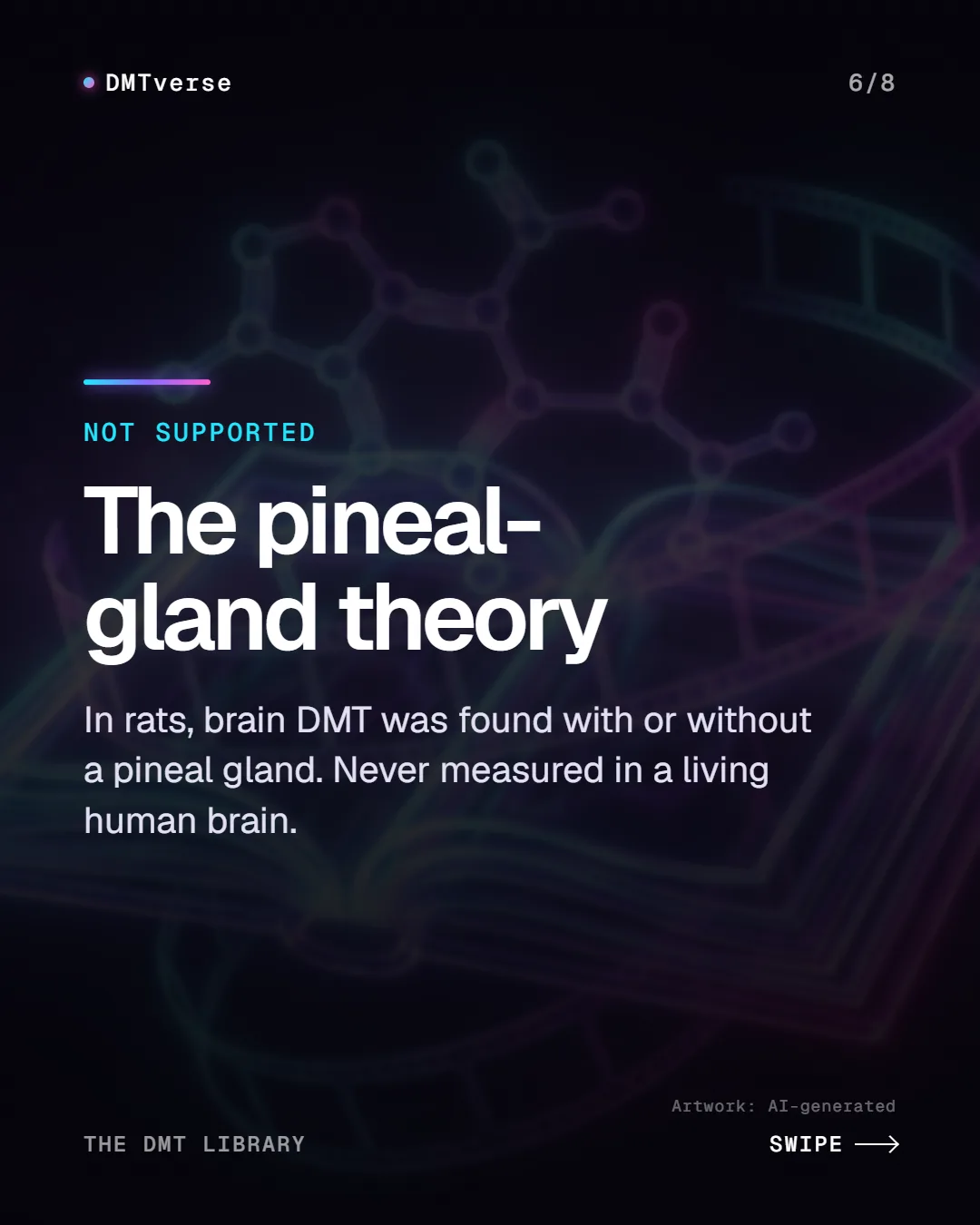
The pineal theory has the least support. In a 2018 review titled “Separating fact from myth”, David Nichols, the chemist who made the DMT for Strassman’s first study (Strassman, MAPS, 1995), concluded that the evidence is not consistent with the pineal gland secreting DMT at birth, in dreaming or near death; the tiny concentrations detected in brain are not enough to produce psychoactive effects (Nichols, 2018). In 2019, a rat study co-authored by Strassman found DMT in living cortex at levels similar to serotonin, with or without a pineal gland, which points away from the pineal as the main source, at least in rats (Dean et al., 2019). No one has quantified DMT in a living human brain (Barker, 2018). Evidence: the pineal-surge idea is unsupported in humans, which is not the same as disproven.
Strassman’s own position has shifted. In January 2024 he said one could still speculate that DMT plays a role in non-drug states that resemble the DMT state, “but the data aren’t there yet” (Psychedelic Medicine Podcast, 2024). The spiritual claims, about the 49th day, dark matter or parallel universes, have not been tested, and as written they may not be testable. Evidence: unresolved.
One later development the book did not foresee is clinical. Strassman’s volunteers were healthy and his studies not intended to be therapeutic (Strassman, book page). The first placebo-controlled trial of DMT alone in depression was published in 2026, with 34 participants and a two-week primary result; its longer follow-up had no placebo group (Erritzoe et al., 2026). See DMT therapy research. Evidence: preliminary.
| Claim in the book or film | What later research shows | Evidence |
|---|---|---|
| DMT acts within minutes and is over within about half an hour. | Measured in the 1994 studies and consistent since. | Established |
| Contact with “beings” is common. | Common in self-selected reports: 45.5% of 3,778 forum accounts. | Preliminary |
| DMT experiences resemble near-death experiences. | Similar themes, different content: “NDE-mimetic”. | Preliminary |
| The pineal gland releases DMT at birth, death and in dreams. | Unsupported; rat brain DMT does not depend on the pineal; never measured in a living human brain. | Unresolved, unsupported |
| The spirit enters through the pineal at 49 days. | Untested speculation. | Unresolved |
| DMT lets the brain perceive parallel worlds. | Untested speculation. | Unresolved |
How should you read the book and film today?
- Treat the chapters on the studies as a first-hand account of real research, and check the numbers against the published papers.
- Treat the pineal and spirit chapters as the author’s speculation, which he labels as such.
- Treat the volunteers’ stories as subjective reports, chosen by the author from his notes.
- Remember that the film, by its director’s reported admission, is not a balanced account of risk.
For the wider history the book sits in, see the history of DMT. Evidence: see that article’s sources.
The risks the film left out, and where to get help in Canada
DMT raised blood pressure and heart rate even in a hospital unit (Strassman and Qualls, 1994), anxiety was part of what volunteers reported (Strassman et al., 1994), and 41% of a large encounter survey reported fear (Davis et al., 2020). Canada’s Centre for Addiction and Mental Health warns that most hallucinogens are illegal and unregulated, may contain toxins or not contain the drug they are sold as, and can leave people disoriented, with poor judgment and more likely to take risks (CAMH). Evidence: established.
If someone is in danger
Call 911 for immediate danger or urgent medical help. In Ontario, the Ontario Poison Centre is at 1-800-268-9017; every province has a poison centre, listed by SickKids (AboutKidsHealth). If you or someone you know is thinking about suicide, call or text 9-8-8, 24 hours a day (Government of Canada). See also our safety page.
Common questions
What is DMT: The Spirit Molecule?
It is a 2000 book by the psychiatrist Rick Strassman about his 1990–95 DMT research at the University of New Mexico, and a 2010 documentary of the same name based on the book, directed by Mitch Schultz and narrated by Joe Rogan.
Is DMT: The Spirit Molecule accurate?
Partly. Its account of the studies matches the published papers, and later research supports its picture of DMT as fast, intense and often involving reported encounters. Its pineal-gland theory is unsupported, and its spiritual ideas are speculation, which the author labels as such.
Does the pineal gland release DMT?
There is no human evidence for it. A 2018 review found the idea inconsistent with the evidence, and in rats brain DMT was found with or without a pineal gland. DMT has never been measured in a living human brain.
Who made the documentary?
It was directed by Mitch Schultz, narrated by Joe Rogan and based on Strassman’s book; Strassman says he co-produced it. It features Strassman, his volunteers, other people who had taken DMT, scientists and theologians.
Does the film discuss DMT’s risks?
According to a 2010 festival review, it does not mention possible negative effects, and the director described it as an exploration of possibilities rather than a balanced documentary.
Why is DMT called the spirit molecule?
The phrase is Rick Strassman’s. He proposed that DMT, possibly made by the pineal gland, might be naturally produced and capable of carrying people into spiritual states. The name stuck, though the pineal theory behind it is unsupported.
Did the book and film make DMT more popular?
No study has shown that they did. A 2012 self-selected online survey found many new DMT users, and its authors suggested popularity might grow, but it did not ask about the book or the film.
Shroomverse sells mushroom products. This article is general information about the book and film DMT: The Spirit Molecule and the research behind them. It is not medical, legal or purchasing advice, and it does not recommend any product.
SOURCES
- DMT: The Spirit Molecule (book page), Rick Strassman MD (author’s website). Accessed . Read. Contents of the book; over 1,000 pages of bedside notes; healthy volunteers, studies not therapeutic; the author’s list of speculative ideas (pineal role in birth and death, 49 days, receiver model, dark matter and parallel universes, alien abduction); conclusion that DMT has no beneficial effects in and of itself.
- DMT: The Spirit Molecule, chapter summaries, Rick Strassman MD (author’s website). Accessed . Read. “Spirit gland” and spirit molecule wording; unexpectedly high frequency of contact with beings; adverse effects adding up; television/channels analogy.
- Biography, Rick Strassman MD (author’s website). Accessed . Read. Book sales (a quarter-million copies by mid-2021, over a dozen languages); co-produced the documentary; his description of it as the most-streamed independent drug documentary on Netflix (not independently verified).
- DMT: The Spirit Molecule, work record OL8624266W, Open Library (Internet Archive). Accessed . Record read via the Open Library API: first published 2000; publisher Park Street Press.
- DMT: The Spirit Molecule (film), Wikipedia. Accessed . Read via the Wikipedia API. Used only for basic credits: 2010 documentary based on Strassman’s book, directed by Mitch Schultz, narrated by Joe Rogan, featuring interviews with people who took DMT in his studies or as ayahuasca.
- AFF 2010 Review: The Spirit Molecule (Clinchy D, 30 October 2010), Slackerwood (Austin film blog, archived). Accessed . Read. Film structure (Rogan introduction, interviews with Strassman, volunteers, scientists and theologians; psychedelic animation); omission of negative effects; the director’s post-screening comments as reported by the reviewer.
- Dose-response study of N,N-dimethyltryptamine in humans. I. Neuroendocrine, autonomic, and cardiovascular effects (Strassman RJ, Qualls CR, Archives of General Psychiatry 51(2):85–97, 1994), American Medical Association (peer-reviewed). Accessed . Abstract read via Europe PMC. 11 experienced users; double-blind, placebo-controlled; effects within 2 minutes, negligible at 30; rises in blood pressure and heart rate; melatonin unaffected. Doses not reproduced.
- Dose-response study of N,N-dimethyltryptamine in humans. II. Subjective effects and preliminary results of a new rating scale (Strassman RJ, et al., Archives of General Psychiatry 51(2):98–108, 1994), American Medical Association (peer-reviewed). Accessed . Abstract read via Europe PMC. 12 volunteers; effects more vivid and compelling than dreams; euphoria alternating or coexisting with anxiety.
- N,N-dimethyltryptamine and the pineal gland: Separating fact from myth (Nichols DE, Journal of Psychopharmacology 32(1):30–36, 2018), SAGE (peer-reviewed). Accessed . Abstract read via Europe PMC. Evidence not consistent with pineal DMT secretion at birth, dreaming or near death; brain concentrations too low for psychoactive effects.
- Biosynthesis and Extracellular Concentrations of N,N-dimethyltryptamine (DMT) in Mammalian Brain (Dean JG, et al., Scientific Reports 9:9333, 2019), Springer Nature (peer-reviewed, open access); PMC6597727. Accessed . Abstract read via Europe PMC; Strassman RJ is a co-author. DMT in living rat cortex, with or without the pineal gland, at levels similar to serotonin.
- N,N-Dimethyltryptamine (DMT), an Endogenous Hallucinogen: Past, Present, and Future Research to Determine Its Role and Function (Barker SA, Frontiers in Neuroscience 12:536, 2018), Frontiers (peer-reviewed, open access); full text via Europe PMC, PMC6088236. Accessed . Full text read. DMT’s rapid action and breakdown; no efforts to quantify DMT in the human brain.
- Dimethyltryptamine (DMT): prevalence, user characteristics and abuse liability in a large global sample (Winstock AR, Kaar S, Borschmann R, Journal of Psychopharmacology 28(1):49–54, 2014), SAGE (peer-reviewed). Accessed . Abstract read via Europe PMC. 2012 Global Drug Survey, 22,289 anonymous online responses; lifetime DMT use 8.9%, past year 5.0%; 24% new users; popularity may increase. Does not examine the book or film.
- Survey of entity encounter experiences occasioned by inhaled N,N-dimethyltryptamine: Phenomenology, interpretation, and enduring effects (Davis AK, et al., Journal of Psychopharmacology 34(9):1008–1020, 2020), SAGE (peer-reviewed). Accessed . Abstract read via Europe PMC. 2,561 respondents describing their most memorable encounter; most endorsed the entity as conscious, intelligent, benevolent and existing in a real but different dimension; 41% reported fear.
- Phenomenology and content of the inhaled N,N-dimethyltryptamine (N,N-DMT) experience (Lawrence DW, et al., Scientific Reports 12:8562, 2022), Springer Nature (peer-reviewed, open access); PMC9130218. Accessed . Abstract read via Europe PMC. 3,778 experiences posted to an online forum, 2009–2018; entity encounters in 45.5%. Doses in the abstract not reproduced.
- An encounter with death: a comparative thematic and content analysis of naturalistic DMT experiences and the near-death experience (Michael P, Luke D, Robinson O, Frontiers in Psychology 16:1532937, 2025), Frontiers (peer-reviewed, open access); PMC11920758. Accessed . Abstract read via Europe PMC. 36 DMT interviews vs 34 NDE narratives; 95% reported at least one canonical NDE theme; five classical NDE features absent; “NDE-mimetic”.
- University of New Mexico Update (Strassman R, MAPS Newsletter 6(1), Autumn 1995), Multidisciplinary Association for Psychedelic Studies. Accessed . Read. Strassman credits David E. Nichols of Purdue University with making the DMT for the first study.
- Exploring Endogenous DMT with Rick Strassman, MD (Psychedelic Medicine Podcast, 3 January 2024), PlantMedicine.org. Accessed . Episode page read (quotes as published on the page). “The data aren’t there yet” on endogenous DMT and non-drug states.
- A short-acting psychedelic intervention for major depressive disorder: a phase IIa randomized placebo-controlled trial (Erritzoe D, et al., Nature Medicine 32(2):591–598, 2026), Springer Nature (peer-reviewed); PMC12920121. Accessed . Abstract read via Europe PMC. 34 randomized; double-blind, placebo-controlled; two-week primary outcome; later follow-up open-label. Dose not reproduced.
- Hallucinogens, Centre for Addiction and Mental Health (CAMH). Accessed . Read. Illegal and unregulated, may contain toxins or not contain the drug sold; disorientation, poor judgment and risk-taking.
- Mental health support: get help, Government of Canada, Public Health Agency of Canada. Accessed . Read. Call 9-1-1 in immediate danger or for urgent medical support; call or text 9-8-8, 24/7.
- Poison information centres in Canada, AboutKidsHealth, The Hospital for Sick Children (SickKids). Accessed . Read. Provincial poison centre list, including Ontario toll-free 1-800-268-9017.
CHANGES
- : Linked glossary definitions.
- : Published. Every source opened and checked on this date. A claim that the film caused DMT’s rise in popularity was not made, because no source we read tested it.
- : Editorial review: unsourced claims that DMT’s profile and use “rose” after the book and film removed (one 2012 survey cannot show a rise); opening tightened; H2s rewritten as questions; Strassman’s self-reported totals (about 60 volunteers, about 400 doses) added; Lawrence 2022 described as it was read; link to how DMT went mainstream added.



