THE SHROOMVERSE JOURNAL ✳ 12 MIN READ
Terence McKenna and DMT: the documented story, the influence and how researchers read him
Topic: DMT
Published Updated
Listen: the 3-minute version
AI-narrated summary of this article
Short answer, checked 20 October 2026
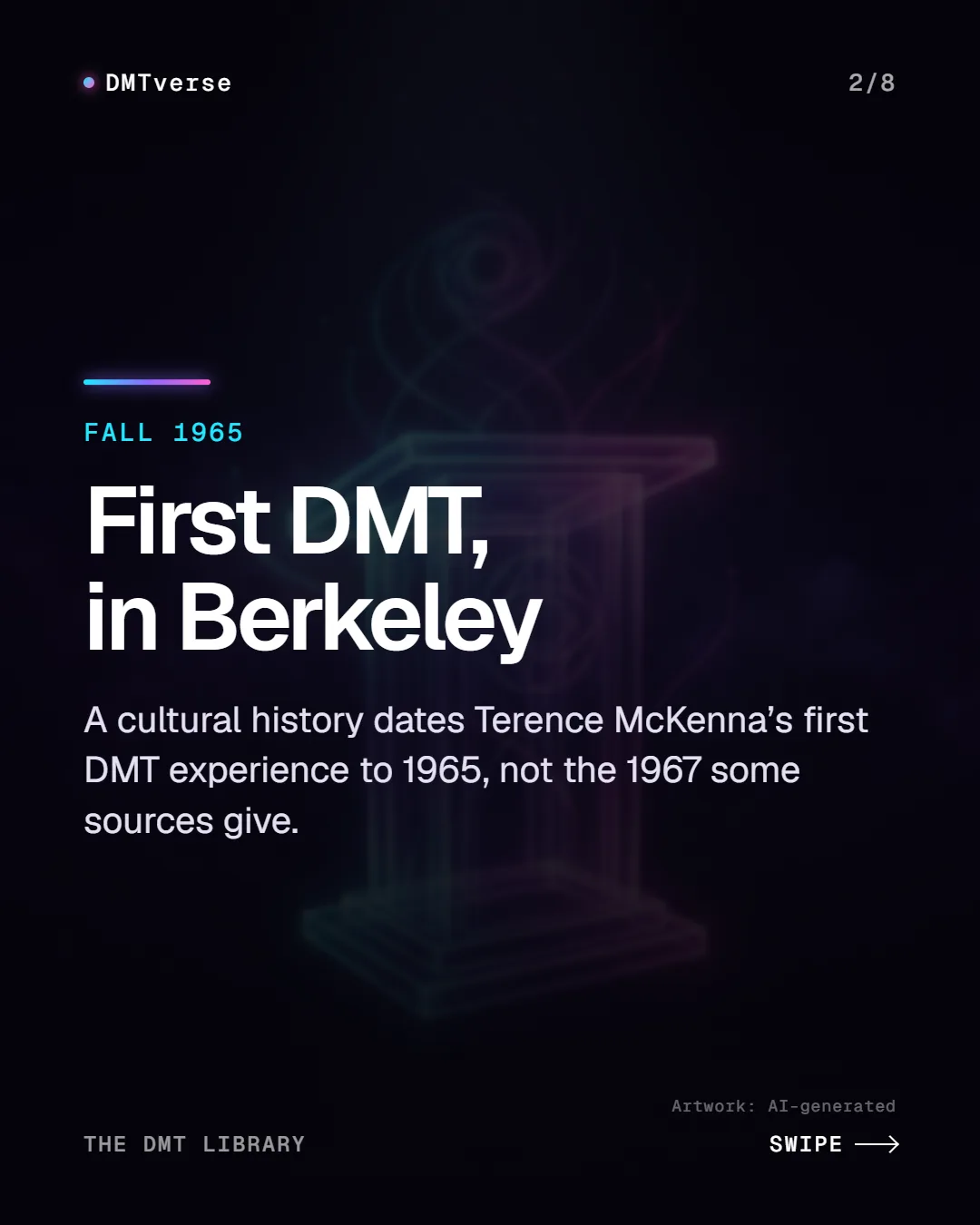
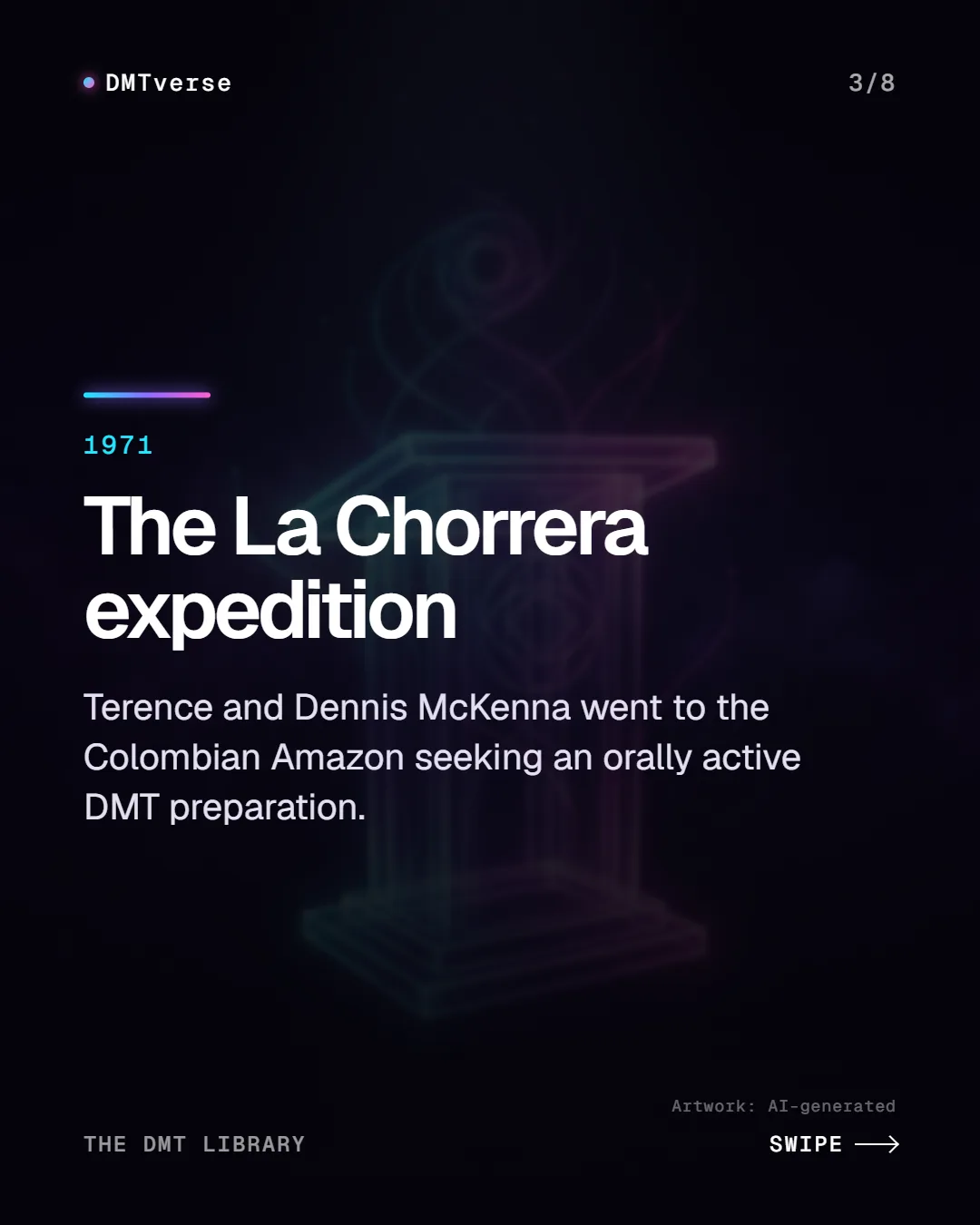
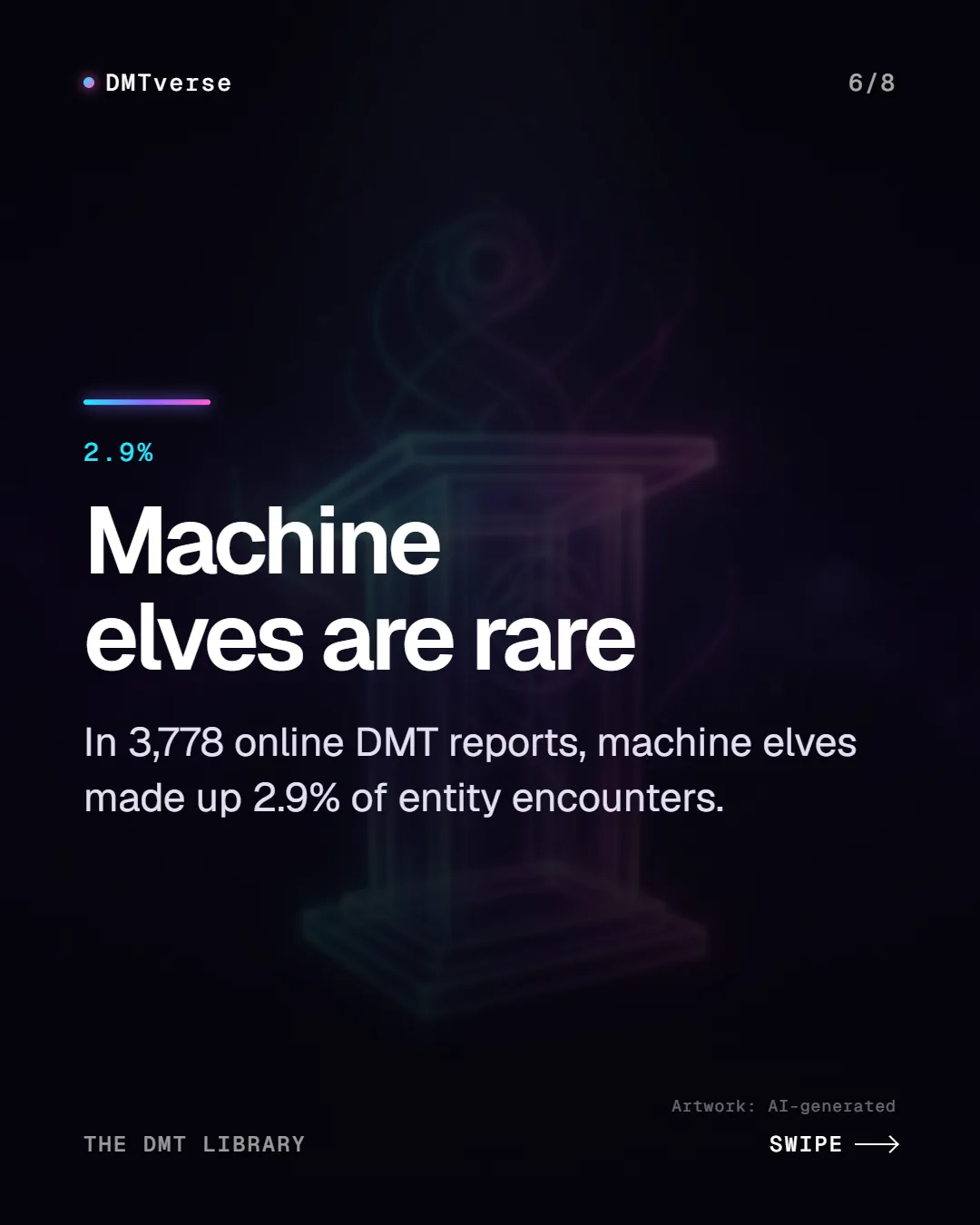
Terence McKenna (1946–2000) was an American writer and speaker whose talks and books supplied much of the popular vocabulary for DMT. A cultural history dates his first DMT experience to the fall of 1965 in Berkeley, not 1967 as some sources say. In 1971 he and his brother Dennis travelled to La Chorrera in the Colombian Amazon looking for an orally active DMT preparation; what followed became the basis of his later books and theories. His descriptions, including the beings he called machine elves, spread through lectures and books from the late 1980s. Researchers treat those descriptions as cultural reports, not data: in a 2022 study of 3,778 online DMT reports, machine elves made up 2.9% of entity encounters, and the authors noted that borrowed terms like this may shape later reports.
THE SHORT VERSION · SWIPE
On this page 9 sections
Many people meet the idea of DMT through Terence McKenna’s talks before they meet any science, and researchers still cite his terms. This article sets out what is documented about his life as it relates to DMT, what he wrote and said (in our own words), and how researchers treat his descriptions today.
How we handle McKenna’s words
We paraphrase and cite McKenna rather than quote him, and we do not invent quotes from anyone. This article describes history and published research. It gives no amounts, instructions or advice on use, and describes no effect as a benefit. Evidence labels used below: established (well documented and not seriously disputed), preliminary (early, single-source or indirect) and unresolved (an open question). Accounts of experiences are labelled as reports.
Who was Terence McKenna?
Terence McKenna was an American author and lecturer, born in 1946 according to his Open Library author record (Open Library). He wrote and spoke about psychedelic plants, shamanism, language and the future of human culture. His brother, Dennis McKenna, became an ethnopharmacologist and has written that Terence had been dead for twelve years when the date his brother had predicted for a great transformation, 21 December 2012, came and went; that places his death in 2000 (McKenna Academy). Evidence: established.
The most detailed scholarly account of McKenna and DMT is a cultural history by Graham St John, Mystery School in Hyperspace: A Cultural History of DMT, published in 2015 (Open Library). A chapter excerpt is available online (St John, via Chacruna), and much of the biography below follows it. Evidence: established for the book’s existence; its account rests on McKenna’s talks, Dennis McKenna’s memoir and interviews.
When did Terence McKenna first try DMT?
According to St John, in the fall of 1965 a friend from his high-school years visited McKenna at his rooming house in Berkeley, where he had begun studying at the University of California, and brought DMT with him. McKenna later told audiences several versions of where the substance came from; St John, drawing on an interview with the friend, concludes that McKenna embellished that part of the story (St John, via Chacruna). Wikipedia’s biography gives 1967 (Wikipedia); we follow St John’s more detailed, footnoted account, which gives 1965 and places Dennis’s first experience in 1967. Evidence: preliminary. It rests on one well-sourced history, and the dates differ between sources.
What McKenna said about that night became famous. In a lecture at the California Institute of Integral Studies in San Francisco on 2 October 1987, quoted by St John, he described falling into geometric spaces made of light and meeting small, elf-like, self-transforming beings that seemed to speak a language he could see, and said the experience overturned everything he had assumed about the world (St John, via Chacruna). Dennis McKenna, in his own memoir quoted in the same excerpt, dates his first DMT experience to 1967 and describes meeting beings too (St John, via Chacruna; Open Library, The Brotherhood of the Screaming Abyss). These are subjective reports, told years later, not evidence about what, if anything, exists outside the brain.
What happened at La Chorrera in 1971?
Dennis McKenna’s fifty-year retrospective, first published in 2021 and updated in May 2026, gives the fullest first-hand account (McKenna Academy). In summary:
- Autumn 1970: after their mother’s death, the brothers decide to travel to South America to investigate what they called the Secret, which they connected with DMT.
- Late January 1971: the brothers and three companions travel down the Río Putumayo toward La Chorrera in the Colombian Amazon, ancestral home of the Witoto people.
- Their goal is an orally active DMT preparation used by Witoto healers, described in a 1969 paper by the Harvard ethnobotanist Richard Evans Schultes. They hoped an oral form would last longer than the short smoked experience.
- The preparation proves elusive. Instead, mushrooms growing in the mission pastures take over their attention.
- 4 March 1971: the brothers attempt what they called the Experiment, which they believed could fuse mind and matter into a kind of philosopher’s stone. Dennis writes that it did not have the expected outcome.
- Afterwards, Terence develops the Time Wave, a quasi-mathematical theory that eventually pointed to 21 December 2012. The date passed without the predicted event.
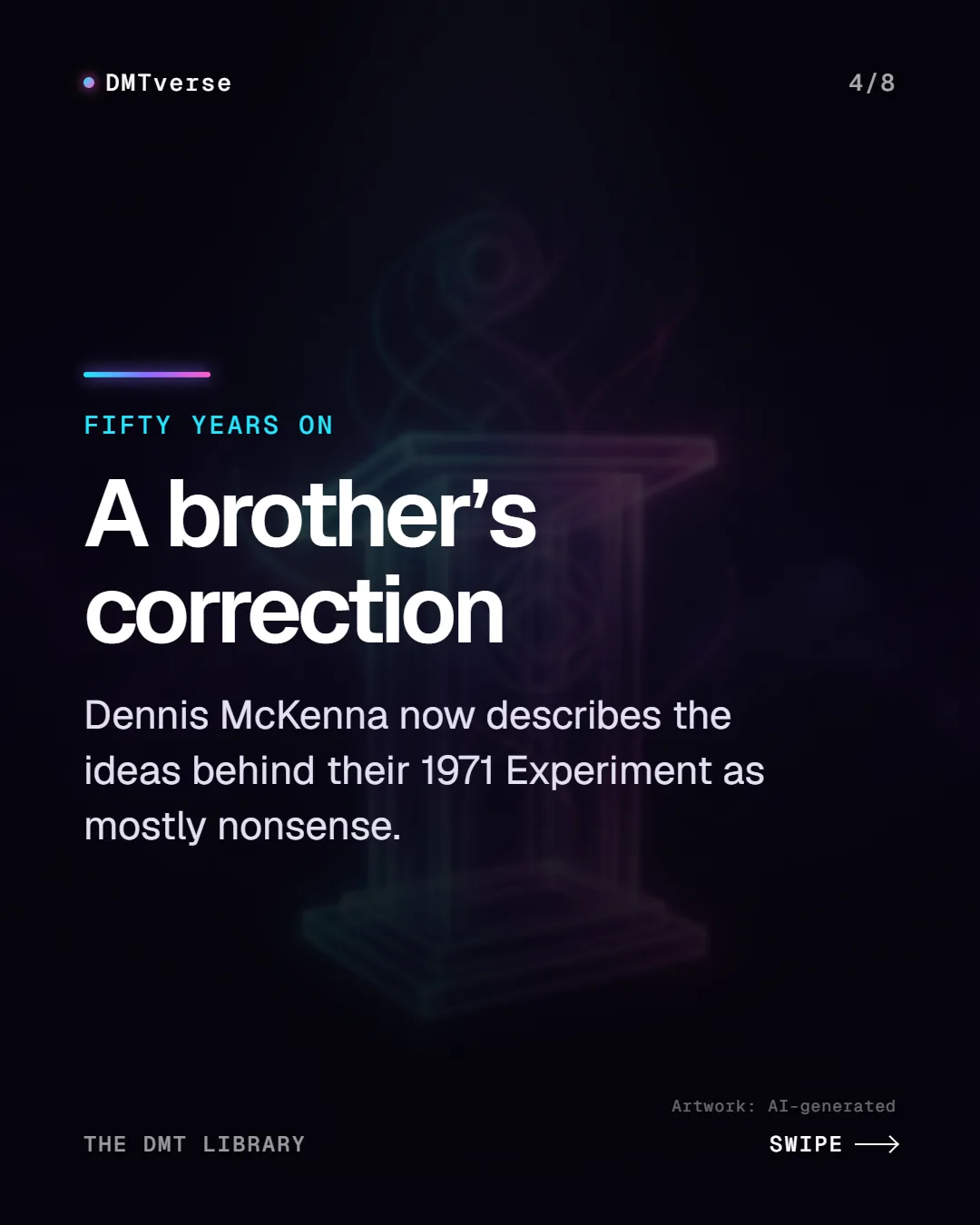
Each step is from Dennis McKenna’s account (McKenna Academy). Fifty years on, he describes the ideas that drove the Experiment as mostly nonsense and their state of mind at the time as inflated, and says he doubts the Time Wave describes the real structure of time. That is a participant revising his own earlier account. Terence’s version of the same events is in his book True Hallucinations (McKenna Academy; Open Library). Evidence: established that the trip took place and what the brothers sought; the inner events are subjective reports.
What did Terence McKenna write and say about DMT?
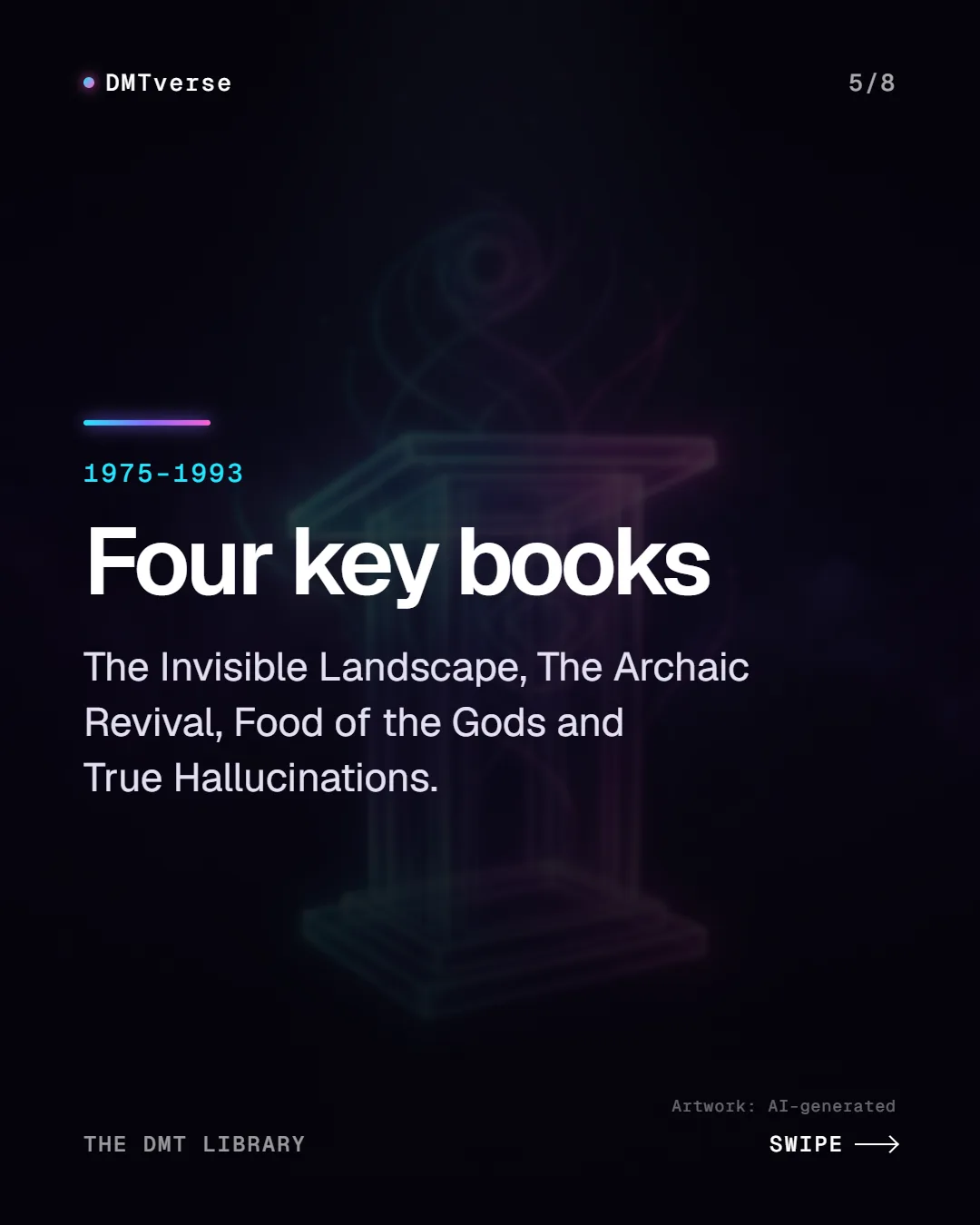
- 1975The Invisible LandscapeNotes With Dennis McKenna. Sets out the theory that grew out of La Chorrera.
- 1991The Archaic RevivalNotes A collection of essays and interviews.
- 1992Food of the GodsNotes His argument that plant psychedelics shaped human evolution.
- 1993True HallucinationsNotes His narrative of the 1971 La Chorrera expedition.
Dates and authorship come from Open Library catalogue records (The Invisible Landscape; The Archaic Revival; Food of the Gods; True Hallucinations). The Invisible Landscape’s 1975 edition credits both brothers. We describe the books from those records and from secondary sources; we did not review their full text for this article. Evidence: established.
His reach came mostly from talking. St John describes him touring in the 1980s and 1990s, giving lectures and workshops that became a lightning rod for visionary art and dance culture, and in which he presented DMT as both extraordinarily powerful and, in his view, harmless (St John, via Chacruna). That last view was his opinion. It is not a finding, and later research does not support calling any psychedelic harmless: in a 2020 survey of 2,561 people describing a DMT entity encounter, 41% reported fear during it (Davis et al., 2020). Evidence: established for the touring; his safety view is an opinion, not evidence.
Did the McKenna brothers do scientific research on DMT?
Terence did not work as a lab scientist; Dennis did. Dennis trained as a scientist, and in 1984 he and two co-authors published an analysis of ayahuasca samples from Peru. They confirmed that DMT is inactive when swallowed because the enzyme monoamine oxidase (MAO) breaks it down, and showed that the brew’s beta-carboline compounds are strong, reversible MAO inhibitors that could protect it, a mechanism that had been proposed but not tested experimentally (McKenna, Towers and Abbott, 1984). Evidence: established. For how this shapes the difference between ayahuasca and DMT on its own, see ayahuasca vs DMT.
What are machine elves, and how common are they?
McKenna’s best-known coinage is machine elves, his name for the small, shifting, self-transforming beings he described meeting. The earliest dated use we could verify is the October 1987 lecture quoted by St John (St John, via Chacruna). Researchers still use the term as a reference point: a 2021 field study of 36 DMT experiences in natural settings reports that a self-transforming quality, which the authors explicitly compare to McKenna’s machine elves, was the most often reported texture of the beings participants met (Michael et al., 2021). Evidence: established for the term’s origin with McKenna; preliminary for how common the quality is, from one small study. For the term itself, see machine elves: what the phrase means.
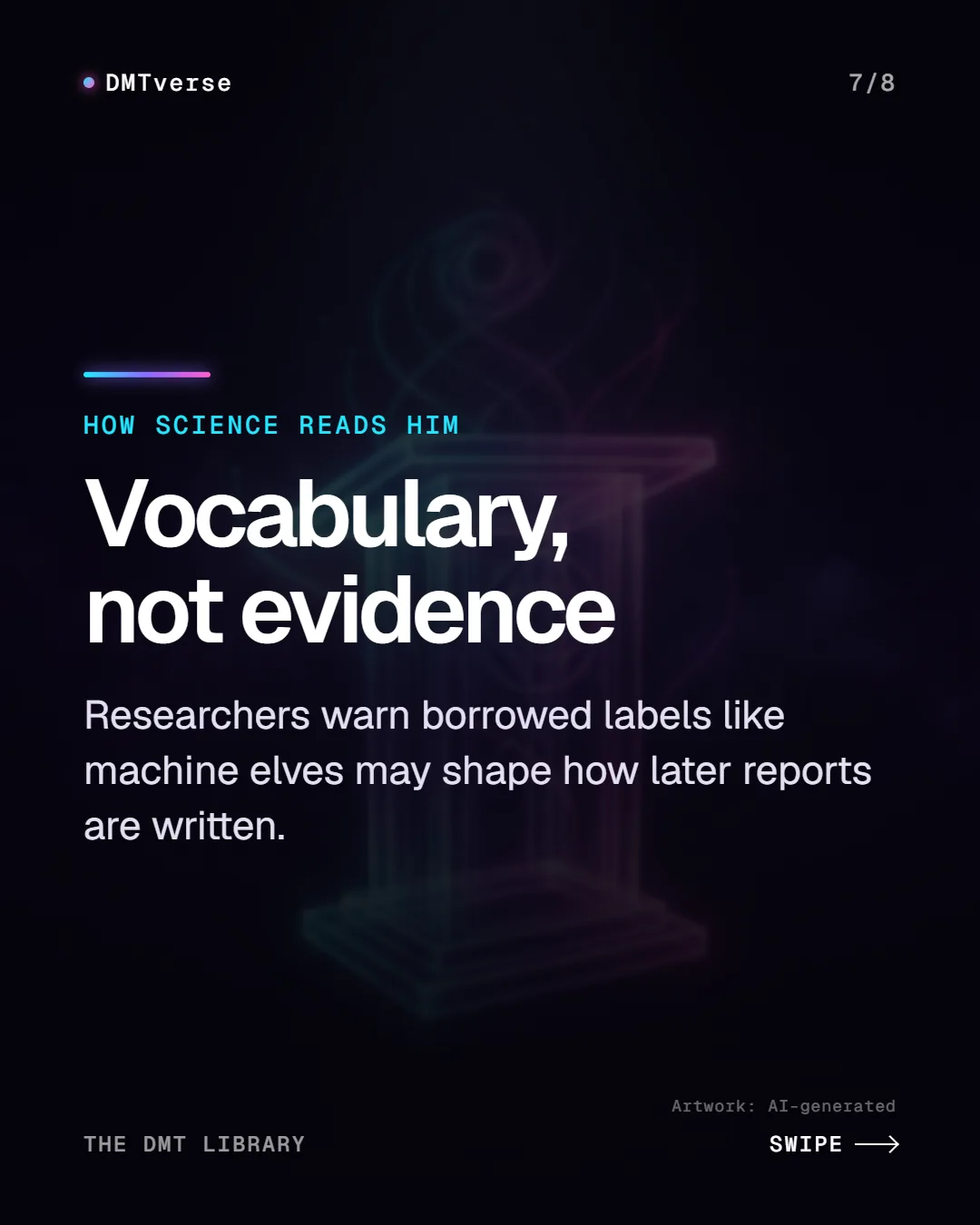
Yet machine elves are rare in larger samples. In a 2022 analysis of 3,778 DMT experiences posted to an online forum, 45.5% described an entity, and machine elves appeared in 50 experiences, 2.9% of entity encounters (Lawrence et al., 2022). In the 2020 survey, the most common labels people chose for the being they met were being, guide, spirit, alien and helper (Davis et al., 2020). The Lawrence team also flagged a problem that bears directly on McKenna’s influence: forum users may shape one another’s reports, as shown by the recurring use of borrowed labels for otherwise novel experiences, and the example they gave was machine elves (Lawrence et al., 2022). Evidence: preliminary. Both samples are self-selected.
| Study | Design | What it found about elves or McKenna’s description |
|---|---|---|
| Michael et al., 2021 | 36 DMT experiences in natural settings, interviews | Self-transforming beings, compared by the authors to McKenna’s machine elves, were the most often reported texture |
| Davis et al., 2020 | Online survey, 2,561 self-selected respondents | Top labels for the entity were being, guide, spirit, alien and helper |
| Lawrence et al., 2022 | 3,778 forum reports, coded | Machine elves in 2.9% of entity encounters; borrowed labels may shape later reports |
How do researchers treat McKenna’s descriptions?
In the papers we read for this article, researchers do three things with McKenna, and none of them is treating his accounts as evidence about the world:
- As a vocabulary source. His terms are used to name features of experience, as in the 2021 field study’s comparison (Michael et al., 2021).
- As a possible bias. His words may prime what people expect and how they describe it, which the 2022 forum study names as a limitation (Lawrence et al., 2022).
- As hypotheses to test. His proposal that psychedelic mushrooms shaped human evolution, from Food of the Gods, is treated as a hypothesis. A 2021 review of psychedelics in human evolution states plainly that a simplistic version, in which mushroom use by itself produced modern human cognition, is most certainly false, while arguing that more careful evolutionary models are worth building (Rodríguez Arce and Winkelman, 2021).
The review’s position is from its full text (Rodríguez Arce and Winkelman, 2021); our stoned ape theory fact-check covers that idea in detail. The pattern is consistent: McKenna is cited as a vivid reporter of experience and a source of influential ideas, and the claims are then checked one by one. Evidence: established for how these papers cite him.
If someone is in danger
Call 911 for immediate danger or urgent medical help, including if someone is unconscious, not breathing or having a seizure. In Ontario, the Ontario Poison Centre is at 1-800-268-9017; every province has a poison centre, listed by SickKids (AboutKidsHealth). If you or someone you know is thinking about suicide, call or text 9-8-8, 24 hours a day (Government of Canada). See also our safety page.
What we still don’t know
- Whether McKenna used the phrase machine elves in public before October 1987; an earlier use is unverified (unresolved).
- How much his descriptions shaped what later people experienced, as opposed to how they described it; no study has tested this directly (unresolved).
- How accurately his many retellings, given decades later, reflect the 1965 and 1971 events; St John found at least one embellishment (preliminary).
The fair summary: McKenna’s accounts shaped how DMT is described in popular culture, and his brother has since publicly revised parts of the story they told together. For where McKenna fits in the longer timeline, see the history of DMT and how DMT went mainstream. For the molecule itself, start with what is DMT; for how the beings people report have been studied, see DMT entity encounters: what the research says.
Common questions
When did Terence McKenna first take DMT?
Graham St John’s cultural history dates it to the fall of 1965, at McKenna’s rooming house in Berkeley, California. Some sources, including Wikipedia, say 1967; that is the year his brother Dennis first tried it.
What happened at La Chorrera?
In early 1971 Terence and Dennis McKenna travelled to La Chorrera in the Colombian Amazon looking for an orally active DMT preparation used by Witoto healers. They ended up focusing on mushrooms and, on 4 March 1971, attempted what they called the Experiment. Dennis now describes the ideas behind it as mostly nonsense.
What are machine elves?
McKenna’s name for small, shifting, self-transforming beings he described meeting on DMT. The earliest verified dated use is a 1987 lecture. In a 2022 analysis of 3,778 online reports, machine elves made up 2.9% of entity encounters, so they are a famous but rare report.
Did Terence McKenna do scientific research on DMT?
Not as a lab scientist. His brother Dennis did: a 1984 paper he co-authored analysed ayahuasca samples and showed that the brew’s beta-carbolines inhibit MAO, the enzyme that otherwise breaks DMT down when swallowed.
What books did Terence McKenna write about psychedelics?
Among others, The Invisible Landscape (1975, with Dennis McKenna), The Archaic Revival (1991), Food of the Gods (1992) and True Hallucinations (1993), his account of La Chorrera.
Do scientists take McKenna’s descriptions seriously?
As descriptions, yes; as evidence, no. Researchers use his terms as reference points, note that his vocabulary may shape how others report experiences, and treat his theories, such as the stoned ape idea, as hypotheses to test. A 2021 review calls a simplistic version of that theory most certainly false.
Why doesn’t this article quote McKenna?
Our editorial policy is to paraphrase and cite him rather than reproduce his words. Every description of what he said links to the published source where his words appear.
Shroomverse sells mushroom products. This article is general information about Terence McKenna’s documented connection to DMT. It is not medical, legal or purchasing advice, and it does not recommend any product.
SOURCES
- When Terence McKenna First Smoked DMT (Graham St John; excerpt from Mystery School in Hyperspace, 2015), posted 24 December 2016, Chacruna Institute for Psychedelic Plant Medicines. Accessed . Full excerpt read. Supports fall 1965 in Berkeley; McKenna’s studies at UC Berkeley; St John’s conclusion that McKenna embellished the provenance story; the 2 October 1987 CIIS lecture account (paraphrased, not quoted); Dennis McKenna’s first DMT in 1967; McKenna’s 1980s–90s speaking tours and his stated view of DMT as harmless.
- The experiment at La Chorrera: a 50-year retrospective (Dennis McKenna; published 17 February 2021, updated 15 May 2026), McKenna Academy of Natural Philosophy. Accessed . Full article read. Supports autumn 1970 decision; January 1971 journey toward La Chorrera with three companions; the search for an oral DMT preparation described by Schultes (1969); the 4 March 1971 Experiment; Dennis’s view that the ideas were mostly nonsense; the Time Wave and the 2012 date; Terence’s death twelve years before 2012. Amounts in the account deliberately not reproduced; the plant named for the sought preparation is deliberately not named.
- Terence McKenna, author record (born 1946), Open Library (Internet Archive). Accessed . Catalogue record read through the Open Library search API; supports the birth year only.
- Mystery School in Hyperspace: A Cultural History of DMT (Graham St John, 2015), catalogue record, Open Library (Internet Archive). Accessed . Supports title, author and first publication year (2015). We read the online excerpt, not the whole book.
- The Invisible Landscape (Terence K. McKenna and Dennis McKenna, 1975), catalogue record and editions, Open Library (Internet Archive). Accessed . Editions list read: 1975 edition credited to Terence K. McKenna and Dennis McKenna. Used for bibliographic facts only.
- The Archaic Revival (Terence McKenna, 1991), catalogue record, Open Library (Internet Archive). Accessed . Supports title, author and first publication year (1991). Bibliographic facts only.
- Food of the Gods (Terence McKenna, 1992), catalogue record, Open Library (Internet Archive). Accessed . Supports title, author, 1992 and Bantam Books. Bibliographic facts only; its argument is described from Rodríguez Arce and Winkelman 2021.
- True Hallucinations (Terence McKenna, 1993), catalogue record, Open Library (Internet Archive). Accessed . Supports title, author and first publication year (1993). Its subject (La Chorrera) is confirmed by Dennis McKenna’s retrospective, which cites its chapter on the Experiment.
- Brotherhood of the Screaming Abyss (Dennis McKenna, 2012), catalogue record, Open Library (Internet Archive). Accessed . Supports title, author and 2012. Its content is described only as quoted in the St John excerpt and Dennis McKenna’s retrospective.
- Monoamine oxidase inhibitors in South American hallucinogenic plants: tryptamine and beta-carboline constituents of ayahuasca (McKenna DJ, Towers GH, Abbott F; Journal of Ethnopharmacology 10(2):195–223, 1984), Elsevier (peer-reviewed). Accessed . Abstract read via Europe PMC. Supports DMT’s oral inactivity due to MAO, beta-carbolines as reversible MAO inhibitors, the previously untested mechanism, and analysis of Peruvian ayahuasca samples. Plant names and quantities deliberately not reproduced.
- Phenomenology and content of the inhaled N,N-dimethyltryptamine (N,N-DMT) experience (Lawrence DW, Carhart-Harris R, Griffiths R, Timmermann C; Scientific Reports 12:8562, 2022), Springer Nature (peer-reviewed, open access); full text via Europe PMC, PMC9130218. Accessed . Full text read. 3,778 forum experiences; entity in 45.5%; machine elves in 50 experiences (2.9% of encounters); limitation that earlier reports may influence later ones, shown by recurring labels such as machine elves.
- An Encounter With the Other: A Thematic and Content Analysis of DMT Experiences From a Naturalistic Field Study (Michael P, Luke D, Robinson O; Frontiers in Psychology 12:720717, 2021), Frontiers (peer-reviewed, open access); full text via Europe PMC, PMC8716686. Accessed . Full text read. 36 experiences; a self-transforming texture, compared by the authors to McKenna’s machine elves (citing a 1993 McKenna talk), was the most often reported visual quality of the beings.
- Survey of entity encounter experiences occasioned by inhaled N,N-dimethyltryptamine (Davis AK, Clifton JM, Weaver EG, Hurwitz ES, Johnson MW, Griffiths RR; Journal of Psychopharmacology 34(9):1008–1020, 2020), SAGE (peer-reviewed). Accessed . Abstract read via Europe PMC. 2,561 self-selected online respondents; 41% reported fear; most common entity labels being, guide, spirit, alien and helper.
- Psychedelics, Sociality, and Human Evolution (Rodríguez Arce JM, Winkelman MJ; Frontiers in Psychology 12:729425, 2021), Frontiers (peer-reviewed, open access); full text via Europe PMC, PMC8514078. Accessed . Full text read. Summarises McKenna’s 1992 proposal and states that a simplistic version, in which psilocybin use by itself produced modern human cognition, is most certainly false.
- Terence McKenna, Wikipedia. Accessed . Orientation only. Read to confirm that it dates his first DMT experience to 1967, which conflicts with St John’s 1965; not relied on for any other claim.
- Mental health support: get help, Government of Canada, Public Health Agency of Canada. Accessed . Source for calling 9-1-1 in immediate danger or for urgent medical support, and the 9-8-8 Suicide Crisis Helpline (call or text, 24/7).
- Poison information centres in Canada, AboutKidsHealth, The Hospital for Sick Children (SickKids). Accessed . Source for the provincial poison centre list, including Ontario toll-free 1-800-268-9017.
CHANGES
- : Linked glossary definitions.
- : Published. All sources opened and checked on this date. McKenna is paraphrased throughout; no quotations of his words.
- : Editorial review: unsourced superlatives about Terence and Dennis McKenna replaced with neutral, sourced wording; opening tightened; H2s rewritten as questions; hype words cut; sibling links to the history and mainstream articles and the machine elves explainer added. Still no McKenna quotations.



