THE SHROOMVERSE JOURNAL ✳ 11 MIN READ
Where does DMT come from? The natural history of a molecule made by plants, animals and perhaps people
Topic: DMT
Published Updated
Listen: the 3-minute version
AI-narrated summary of this article
Short answer, checked 20 October 2026
DMT comes from tryptophan, a common amino acid. Many plants and animals turn tryptophan into tryptamine and then add two methyl groups, producing DMT. Reviews describe it as made by a wide variety of species, mammals included. Why plants make it is not known; defence against animals is a general hypothesis for such compounds, untested for DMT. In people, DMT is detectable in body fluids, but has never been measured in a living brain.
THE SHORT VERSION · SWIPE
On this page 9 sections
DMT is often described as “everywhere in nature”, a phrase that is half right. This guide sets out what reviews and experiments actually show about where it occurs, how living things make it, why they might, and what traces of human use survive in the archaeological record. Each factual paragraph ends with an evidence label. For the molecule itself, start with the pillar guide, what is DMT.
Why we don’t name plant or animal sources
This article deliberately names no plant species, genera or animal species as sources of DMT. A list of sources works as a sourcing guide, and DMT is a Schedule III controlled substance in Canada with no exception for DMT that occurs in nature. Evidence labels: established (shown in peer-reviewed studies and not seriously disputed), preliminary (early, small, animal-only or indirect) and unresolved (an open question).
Where does DMT come from in nature?
From living things, across kingdoms. A 2018 review calls DMT “ubiquitous, being produced by a wide variety of plant and animal species”, and notes it is one of the few psychedelic compounds produced by mammals (Cameron and Olson, 2018). Its natural occurrence in plants was first reported in 1946 by the microbiologist Oswaldo Gonçalves de Lima (Barker, 2018). Evidence: established.
“Ubiquitous” needs care. It means the molecule turns up in many unrelated species, not that every plant or animal makes it, or makes it in meaningful amounts. Related compounds, such as 5-MeO-DMT, are also described as produced by a variety of plant and animal species (Ermakova et al., 2022). Evidence: established for wide occurrence; how widespread, species by species, is beyond what these reviews quantify.
How do living things make DMT from tryptophan?
Tryptophan is one of the amino acids every organism uses to build proteins. The route to DMT has two kinds of step, and it is broadly the same in plants and animals (Berman et al., 2026; Barker, 2018):
- Decarboxylation: tryptophan loses its carboxyl group and becomes tryptamine. In plants the enzyme is tryptophan decarboxylase (TDC); in mammals the same job is done by aromatic L-amino acid decarboxylase (AADC).
- First methylation: an N-methyltransferase (an enzyme that moves a methyl group onto a nitrogen atom) turns tryptamine into N-methyltryptamine (NMT).
- Second methylation: a methyltransferase adds a second methyl group, giving N,N-dimethyltryptamine (DMT).
- Breakdown: in animals, the enzyme monoamine oxidase A (MAO-A) quickly breaks DMT down.
For plants, this was a proposal until recently. A 2026 study identified two pairs of TDC and methyltransferase enzymes from two plant species used in traditional rituals, and rebuilt the full pathway in a laboratory plant. The methyltransferases were promiscuous, meaning they accepted several related starting molecules (Berman et al., 2026). Evidence: established for the enzymes identified; whether all DMT-producing plants use the same enzymes is unresolved.
Animals have their own versions. A 2023 study reported a new methyltransferase from a toad that converts primary tryptamines into tertiary ones such as DMT, and found that similar enzymes from several frog species were inactive (Chen et al., 2023). In mammals, the enzyme long credited with both methylation steps is indolethylamine N-methyltransferase (INMT), but knockout studies have cast doubt on that, as explained below. Evidence: established for the toad enzyme; preliminary for its role in the animal.
The mammalian pathway was worked out first. After the discovery of an indole N-methyltransferase in 1961, researchers tested whether mammalian tissues could make DMT. In 1972, Juan Saavedra and Julius Axelrod reported that tryptamine placed into the fluid around the brain of living rats was converted to NMT and DMT, the first demonstration of DMT forming in brain tissue in a living animal (Barker, 2018). In rat brain, the messages for INMT and AADC occur in the same cells, while in rat peripheral organs they rarely overlap (Dean et al., 2019). Evidence: established for these experiments.
Why would plants make DMT?
Nobody has shown why. The general background is well developed: plants make a wide range of secondary metabolites, compounds not needed for basic growth, which serve as defences against herbivores, microbes and competing plants, and as signals. A review notes that some, such as alkaloids, appear tuned to animal neurotransmitter receptors (Wink, 2015). Evidence: established as a general account of plant chemistry.
Evolutionary biologists have argued that most commonly used drugs are plant neurotoxins that evolved to punish, not reward, consumption by herbivores (Sullivan et al., 2008). Neither source tests DMT specifically, and we found no study that has measured whether DMT deters any animal from eating a plant. Applied to DMT, the defence idea is a reasonable hypothesis, not a finding. Evidence: unresolved.
There is a chemical clue worth noting, though it is not an answer. In a 2023 lab study of a toad enzyme and its products, adding the two methyl groups to most tryptamines made them more resistant to breakdown by liver enzymes (Chen et al., 2023). Whether stability matters to the organisms that make DMT has not been studied. The same review of plant chemistry stresses that many such compounds act on several targets at once, so a single purpose may not exist (Wink, 2015). Evidence: preliminary for the chemistry; the ecological role is unresolved.
Do animals and humans make DMT?
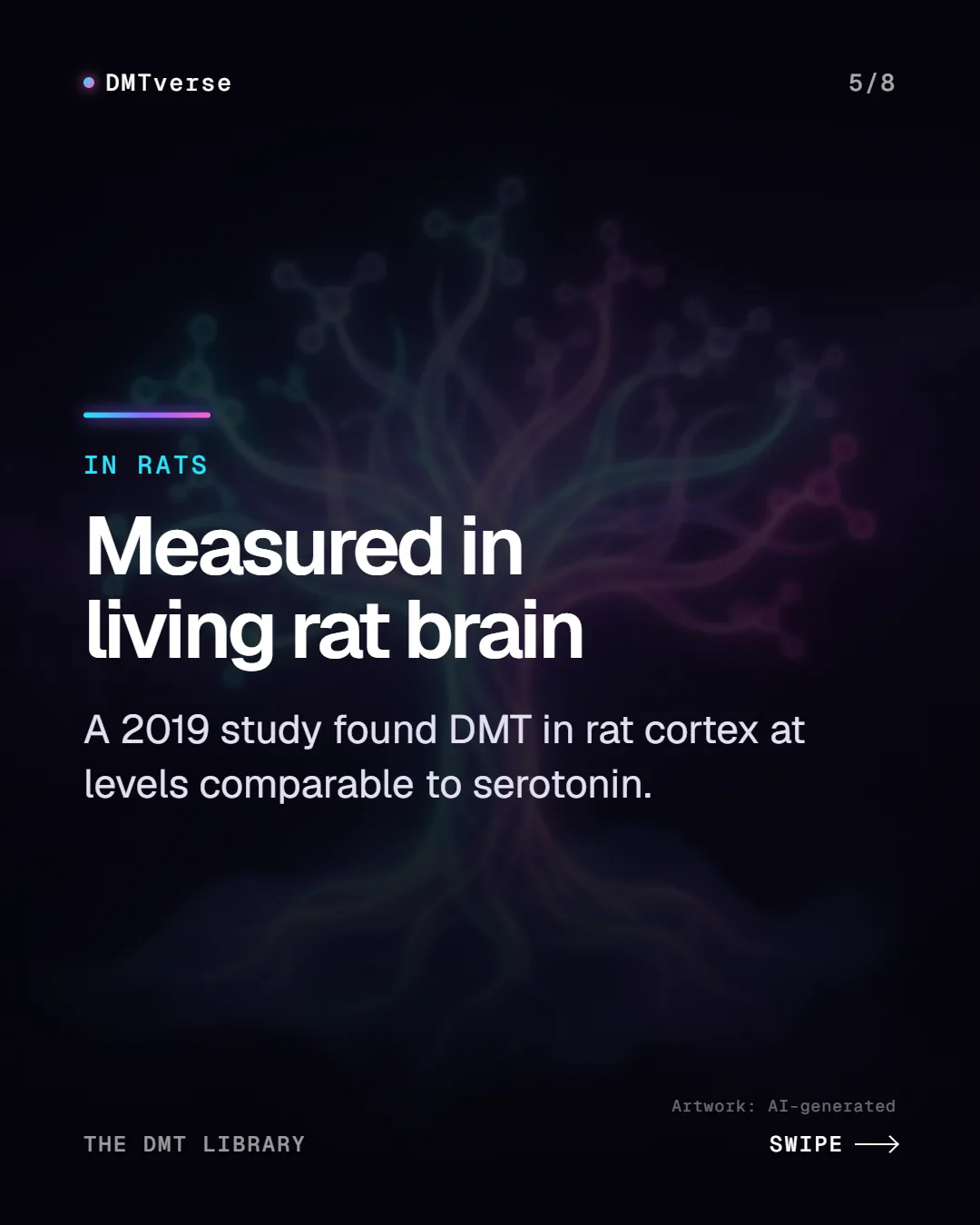
In rats, yes. Using microdialysis, which samples the fluid around brain cells in a living animal, a 2019 study measured DMT in the visual cortex of freely moving rats at levels comparable to serotonin. Removing the pineal gland made no difference, and DMT rose after experimentally induced cardiac arrest (Dean et al., 2019). Evidence: preliminary, one lab’s animal finding. The rat brain study explained covers the details.
The enzyme question is open. Rats with the INMT gene knocked out still showed the same tryptamine-methylating activity, but the products were neither NMT nor DMT (Glynos et al., 2023), and INMT-knockout mice showed no obvious drop in their own psychedelic tryptamines (Hatzipantelis et al., 2025). Both teams suggest another pathway exists in rodents. Our INMT article follows that debate. Evidence: unresolved.
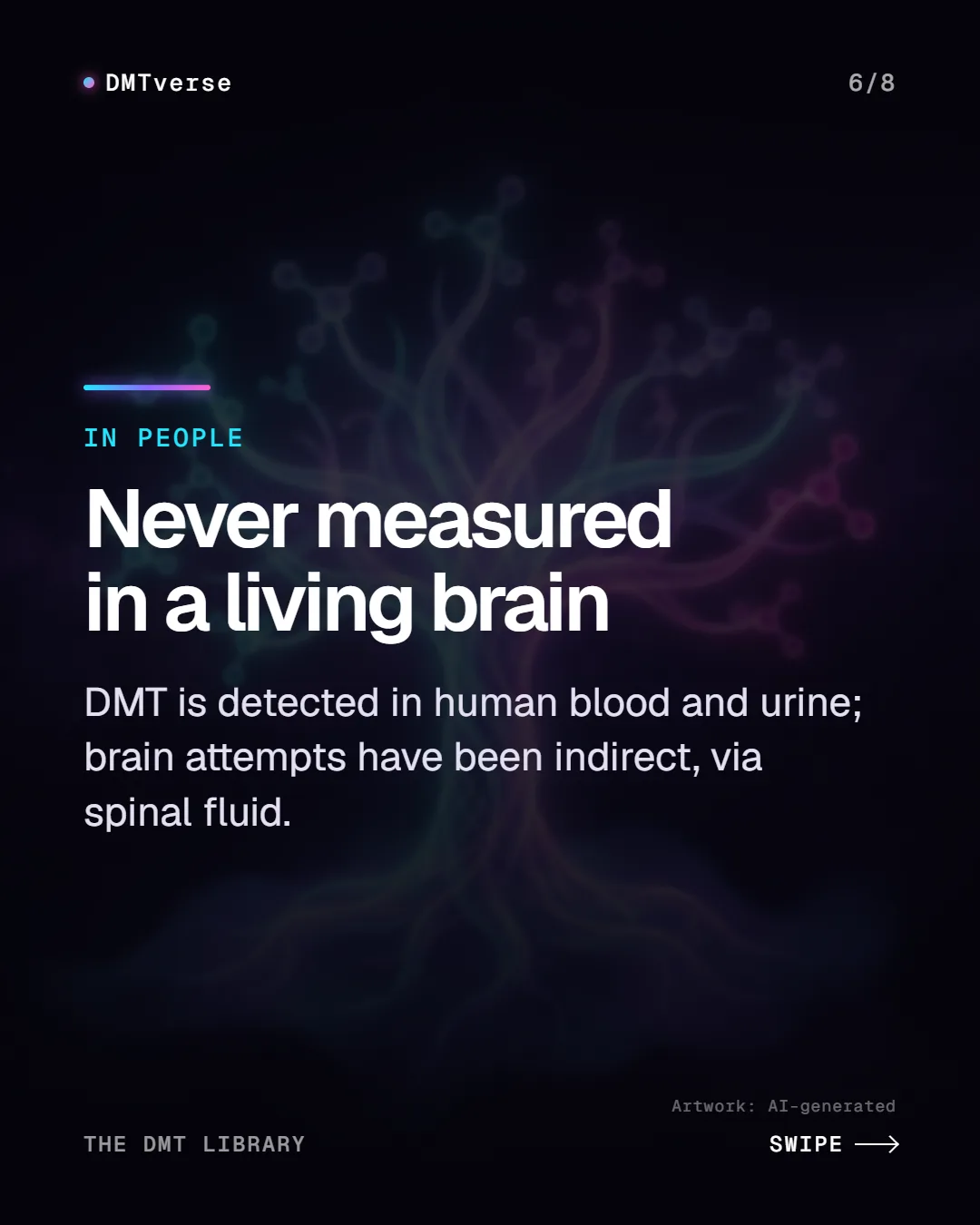
In people, DMT has been detected and measured in blood and urine. Only a handful of studies have tried to detect it in the human brain, and only indirectly, through cerebrospinal fluid (Barker, 2022). Human autopsy tissue carries the genetic message for INMT in the cortex, pineal gland and choroid plexus (Dean et al., 2019). Whether a living human brain makes meaningful amounts is unknown; see does the brain make DMT. Evidence: established that DMT is detectable in people; brain production is unresolved.
Even where the body does make DMT, its job is unclear. A 2018 review calls DMT’s biological function in human physiology “a mystery” (Cameron and Olson, 2018). Another stresses the need to separate any natural role of the body’s own DMT from the effects seen when DMT is given from outside, which are what most studies measure (Barker, 2018). Evidence: unresolved.
How is DMT different from 5-MeO-DMT and bufotenine in animal secretions?
Toad secretions are a mixture, not pure DMT. The skin and parotid glands of certain toads accumulate a mix of compounds, including toxic steroids and three related tryptamines: DMT, 5-MeO-DMT (5-methoxy-DMT) and bufotenine, in varying amounts depending on the species (Chen et al., 2023). The three differ by one group on the indole ring: none for DMT, a methoxy group for 5-MeO-DMT and a hydroxyl group for bufotenine, also called 5-OH-DMT (Rick et al., 2025). Evidence: established.
Small structural differences matter. 5-MeO-DMT binds most strongly at the 5-HT1A serotonin receptor, while DMT acts mainly at 5-HT2A, and 5-MeO-DMT is reported to produce fewer visual effects (Ermakova et al., 2022). The same review finds no conclusive historical evidence of Indigenous use of desert toad secretions before a 1984 booklet popularized them. Our 5-MeO-DMT vs DMT guide compares the two in depth. Evidence: established for receptor preference; preliminary for experiential differences.
| Compound | Extra group on the indole ring | Main receptor reported |
|---|---|---|
| DMT | None | 5-HT2A |
| 5-MeO-DMT | Methoxy (5-position) | 5-HT1A (highest affinity) |
| Bufotenine (5-OH-DMT) | Hydroxyl (5-position) | Not compared in the sources used here |
What does archaeology show about traditional use?
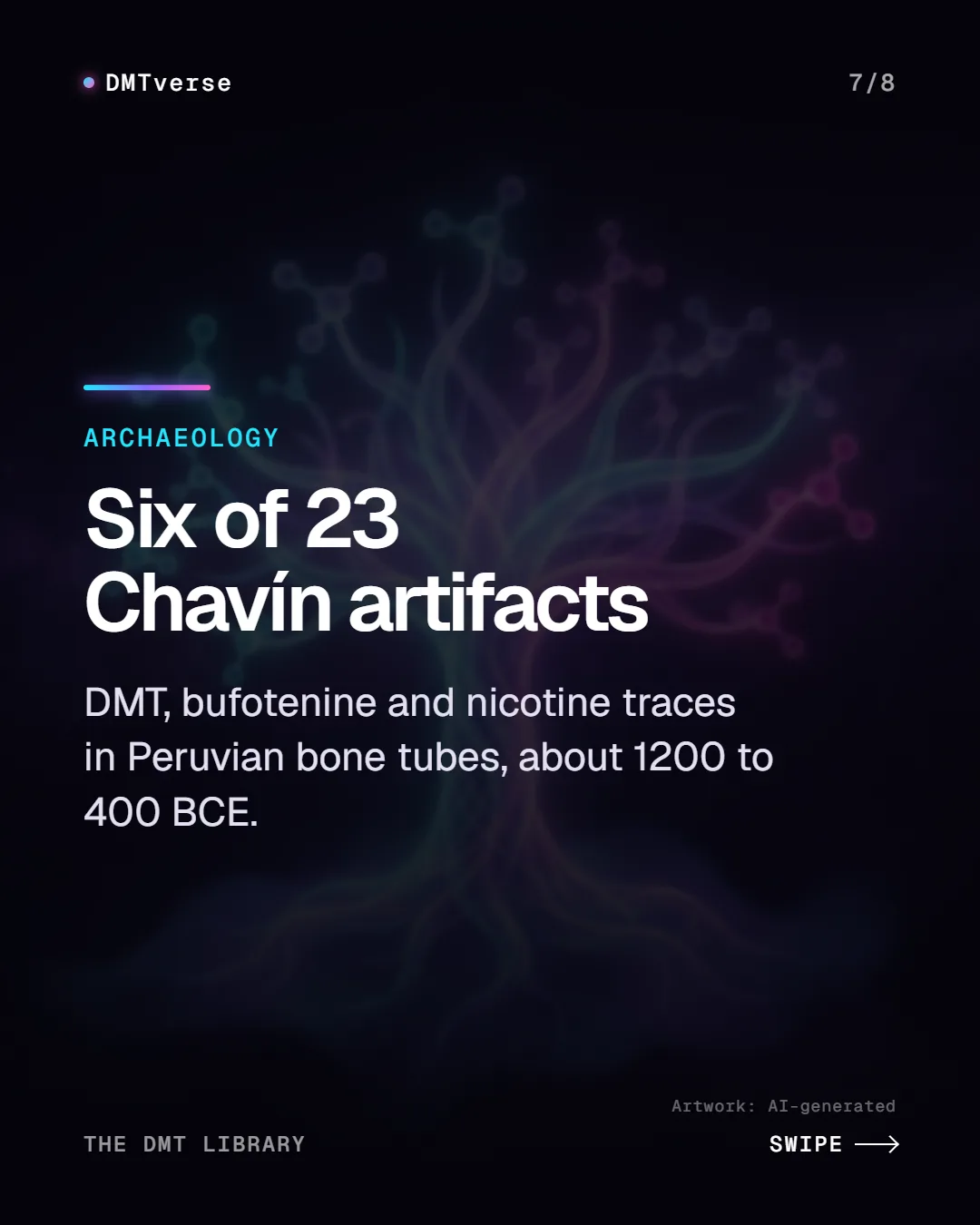
The oldest direct chemical evidence is from the Andes, and it is evidence of snuffing. At Chavín de Huántar, a Peruvian ritual centre of the Middle–Late Formative Period (about 1200–400 BCE), residue analysis found DMT, bufotenine and nicotine in six of 23 bone tubes and similar artifacts (Rick et al., 2025). Evidence: established.
In southwestern Bolivia, a ritual bundle radiocarbon dated to about 1,000 CE held traces of bufotenine, DMT, harmine and cocaine. The authors note it is the first documented ritual bundle with both harmine and DMT, the two main ingredients now associated with ayahuasca (Miller et al., 2019). Evidence: established.
The plants that contain these compounds come from distant ecological zones, which the authors read as evidence that such plants moved across long distances. That shows the compounds were present together, not that anyone drank a brew. For more, see ancient DMT snuffs and archaeology. Evidence: established for the chemistry; how the contents were used is unresolved.
Chavín de Huántar snuff tubes
DMT, bufotenine and nicotine detected in six of 23 artifacts at a Peruvian ritual centre (Rick et al., 2025).
Bolivian ritual bundle
Traces of bufotenine, DMT, harmine and cocaine in one bundle (Miller et al., 2019).
DMT reported in plants
Oswaldo Gonçalves de Lima reports DMT’s natural occurrence in plants (Barker, 2018).
DMT measured in rat brain
Microdialysis finds DMT in living rat cortex at serotonin-like levels (Dean et al., 2019).
Toad enzyme and INMT doubts
A toad methyltransferase is described (Chen et al., 2023), and INMT-knockout rats still methylate tryptamine without making DMT (Glynos et al., 2023).
Plant pathway rebuilt
Plant TDC and methyltransferase enzymes identified and the full DMT pathway rebuilt in a laboratory plant (Berman et al., 2026).
Archaeological dates are approximate; BCE dates are shown as negative years on the axis.
Why doesn’t this article list plants that contain DMT?
Because a list of species is the first step of a sourcing guide, and this site is an educational resource, not one. It would also add nothing to the science above. In Canada, N,N-dimethyltryptamine and any salt of it is item 7 of Schedule III of the Controlled Drugs and Substances Act, and the entry makes no exception for DMT that occurs naturally (Justice Laws, CDSA). This is general information, not legal advice; see is DMT legal in Canada. Evidence: established.
What we still don’t know
- What DMT does for the plants that make it; no study we found has tested a defence role.
- Whether all DMT-producing plants use the same enzymes as the two species studied in 2026.
- Which enzyme or enzymes make DMT in mammals, now that INMT knockouts still make related compounds.
- Whether the living human brain makes meaningful amounts of DMT.
- How the people who used Andean snuff tubes and bundles understood the compounds in them.
Common questions
Where does DMT come from?
In nature, DMT is made by living things from tryptophan, a common amino acid. Tryptophan is converted to tryptamine, which gains two methyl groups to become DMT. Reviews describe DMT as produced by a wide variety of plant and animal species, including mammals.
Is DMT in every plant?
No. Reviews describe DMT as widespread across many unrelated species, but that does not mean every plant makes it or makes it in meaningful amounts. We deliberately do not list which plants contain it.
Why do plants make DMT?
Nobody knows. Plants make many compounds that defend them against herbivores and microbes, and some researchers argue that drug-like plant compounds evolved as deterrents. No study we found has tested whether DMT itself serves that purpose.
Do humans make DMT?
DMT has been detected in human blood and urine, and human brain tissue carries the genetic message for an enzyme thought to make it. But DMT has never been measured in a living human brain, and knockout studies in rodents suggest the enzyme long credited with making it may not be the main one.
Is toad DMT the same as DMT?
Certain toads secrete a mix that can include DMT, 5-MeO-DMT and bufotenine. These are related but distinct molecules: 5-MeO-DMT acts most strongly at the 5-HT1A receptor, while DMT acts mainly at 5-HT2A.
How old is human use of DMT?
The oldest direct chemical evidence comes from Andean snuff tubes at Chavín de Huántar in Peru, from the Middle–Late Formative Period (about 1200–400 BCE), which held traces of DMT, bufotenine and nicotine. A Bolivian ritual bundle from about 1,000 CE held DMT alongside harmine.
Is natural DMT legal in Canada?
No. DMT and its salts are item 7 of Schedule III of the Controlled Drugs and Substances Act, and the entry makes no exception for DMT that occurs in nature. This is general information, not legal advice.
Shroomverse sells mushroom products. This article is general information about the natural history and biosynthesis of DMT. It is not medical, legal or purchasing advice, and it does not recommend any product.
SOURCES
- Dark Classics in Chemical Neuroscience: N,N-Dimethyltryptamine (DMT) (Cameron LP, Olson DE, ACS Chemical Neuroscience 9(10):2344–2357, 2018), American Chemical Society (peer-reviewed). Accessed . Abstract read via Europe PMC. DMT “ubiquitous, being produced by a wide variety of plant and animal species”; one of the few psychedelics produced by mammals; function in human physiology a mystery.
- N,N-Dimethyltryptamine (DMT), an Endogenous Hallucinogen: Past, Present, and Future Research to Determine Its Role and Function (Barker SA, Frontiers in Neuroscience 12:536, 2018), Frontiers (peer-reviewed, open access); PMC6088236. Accessed . Full text read. 1946 report of DMT in plants by Gonçalves de Lima; mammalian pathway via AADC and INMT; MAO-A breakdown.
- Complete biosynthesis of psychedelic tryptamines from three kingdoms in plants (Berman P, et al., Science Advances 12(14), 2026), American Association for the Advancement of Science (peer-reviewed, open access); PMC13041772. Accessed . Abstract and full text read. Proposed TDC then N-methylation route; two TDC–NMT enzyme pairs identified from two ritually used plant species (species deliberately not named here); promiscuous NMTs; pathways for DMT, psilocybin, bufotenin and 5-MeO-DMT rebuilt in a laboratory plant.
- A cane toad (Rhinella marina) N-methyltransferase converts primary indolethylamines to tertiary psychedelic amines (Chen X, et al., Journal of Biological Chemistry 299(10):105231, 2023), Elsevier / ASBMB (peer-reviewed, open access); PMC10570959. Accessed . Abstract and full text read. Toad skin and parotid glands accumulate toxic alkaloids, steroids and DMT, 5-MeO-DMT and bufotenin in species-dependent amounts; novel toad NMT; frog homologs inactive.
- Modes of Action of Herbal Medicines and Plant Secondary Metabolites (Wink M, Medicines 2(3):251–286, 2015), MDPI (peer-reviewed, open access); PMC5456217. Accessed . Abstract read via Europe PMC. Secondary metabolites as defences against herbivores, microbes and other plants, and as signals; alkaloids optimized on neurotransmitter receptors. Not DMT-specific.
- Revealing the paradox of drug reward in human evolution (Sullivan RJ, Hagen EH, Hammerstein P, Proceedings of the Royal Society B 275(1640):1231–1241, 2008), The Royal Society (peer-reviewed); PMC2367444. Accessed . Abstract read via Europe PMC. Most commonly used drugs are plant neurotoxins that evolved to punish consumption by herbivores. Not DMT-specific.
- Biosynthesis and Extracellular Concentrations of N,N-dimethyltryptamine (DMT) in Mammalian Brain (Dean JG, et al., Scientific Reports 9, 2019), Springer Nature (peer-reviewed, open access); PMC6597727. Accessed . Abstract read via Europe PMC. INMT mRNA in rat and human cortex, pineal and choroid plexus; rat cortical DMT comparable to monoamine neurotransmitters, with or without pineal; rise after cardiac arrest.
- Indolethylamine N-methyltransferase (INMT) is not essential for endogenous tryptamine-dependent methylation activity in rats (Glynos NG, et al., Scientific Reports 13, 2023), Springer Nature (peer-reviewed, open access); PMC9822953. Accessed . Abstract read via Europe PMC. INMT-knockout rats: equal tryptamine-dependent activity, products neither NMT nor DMT; suggests an alternative pathway.
- Indolethylamine N-Methyltransferase Deletion Impacts Mouse Behavior without Disrupting Endogenous Psychedelic Tryptamine Production (Hatzipantelis CJ, et al., ACS Chemical Neuroscience 16(20):4011–4024, 2025), American Chemical Society (peer-reviewed); PMC12626434. Accessed . Abstract read via Europe PMC. INMT-knockout mice: no obvious decrease in endogenous psychedelic levels; alternative pathways suggested.
- Administration of N,N-dimethyltryptamine (DMT) in psychedelic therapeutics and research and the study of endogenous DMT (Barker SA, Psychopharmacology 239(6):1749–1763, 2022), Springer (peer-reviewed, open access); PMC8782705. Accessed . Full text read (relevant sections). Detection and quantitation of DMT in human blood and urine; only a handful of indirect attempts to detect it in human brain, via cerebrospinal fluid.
- A narrative synthesis of research with 5-MeO-DMT (Ermakova AO, Dunbar F, Rucker J, Johnson MW, Journal of Psychopharmacology 36(3):273–294, 2022), SAGE (peer-reviewed, open access); PMC8902691. Accessed . Abstract and full text read. 5-MeO-DMT produced by a variety of plant and animal species; highest affinity at 5-HT1A; relative lack of visual effects; no conclusive historical evidence of Indigenous use of desert toad secretions before a 1984 booklet.
- Chemical evidence for the use of multiple psychotropic plants in a 1,000-year-old ritual bundle from South America (Miller MJ, et al., PNAS 116(23):11207–11212, 2019), National Academy of Sciences (peer-reviewed); PMC6561276. Accessed . Abstract read via Europe PMC. Bundle dated to about 1,000 CE, southwestern Bolivia; bufotenine, DMT, harmine, cocaine and benzoylecgonine; first bundle with both harmine and DMT.
- Pre-Hispanic ritual use of psychoactive plants at Chavín de Huántar, Peru (Rick JW, et al., PNAS 122(19), 2025), National Academy of Sciences (peer-reviewed); PMC12088378. Accessed . Abstract and full text read. Middle–Late Formative Period (ca. 1200–400 BCE) centre; 23 artifacts; DMT, bufotenine (5-OH-DMT) and nicotine in six.
- Controlled Drugs and Substances Act (S.C. 1996, c. 19), full text, Schedule III, Government of Canada, Justice Laws Website. Accessed . Schedule III item 7: N,N-dimethyltryptamine (DMT) and any salt thereof, with no exception for natural occurrence. Consolidation current to 2026-09-30, last amended 2026-07-18.
CHANGES
- : Linked glossary definitions.
- : Published. Sources opened and checked on this date via Europe PMC, Crossref and Justice Laws.



