
THE SHROOMVERSE JOURNAL ✳ 16 MIN READ
What is ego death? The meaning, where the term came from, and what research says
Topic: DMT
Published
Short answer, checked 21 October 2026
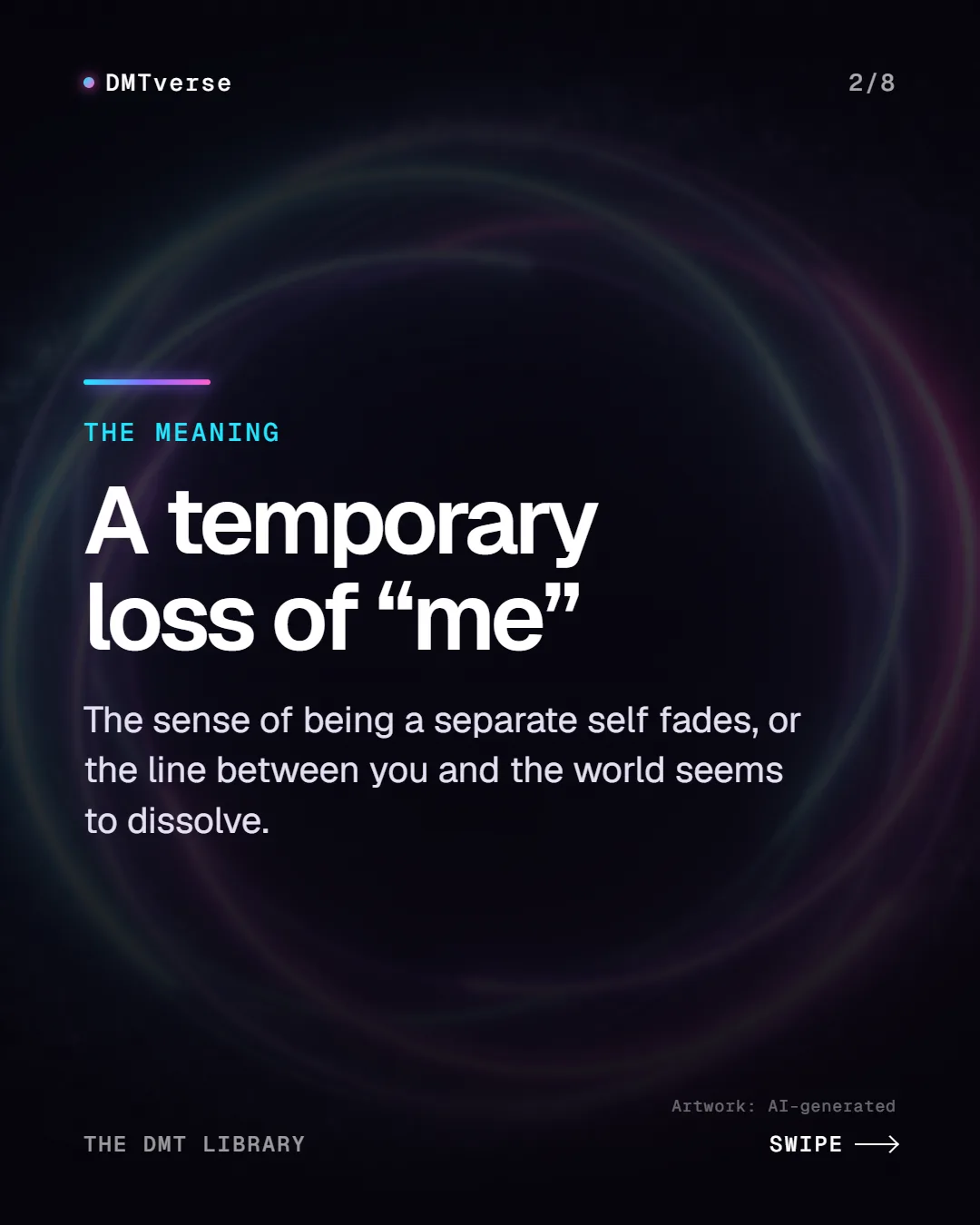
Ego death is a popular name for a temporary loss of the ordinary sense of being a separate self: the feeling that “I” has dissolved, or that the line between you and the world has gone. Researchers call it ego dissolution. It has been reported with psychedelics such as psilocybin and LSD, with some other drug classes, in deep meditation and in near-death experiences. It is not physical death and it is not permanent by definition. It can feel peaceful or terrifying, and research gives no basis for treating it as a goal. Much about it, including whether it is one experience or several, is still unknown.
THE SHORT VERSION · SWIPE
On this page 10 sections
“Ego death” turns up in song titles, forum threads and books, usually without a definition. This guide explains what it means, where the phrase came from, how researchers study it, why it can be frightening, and what nobody knows yet. For DMT specifically, our article on DMT and ego death covers the DMT studies, including a 2026 EEG analysis linking changes in brain rhythms to ratings of a disintegrating self, and a trial in which the anxious form of ego dissolution rose at the highest infusion rate. Those findings are not repeated here.
Education only, not guidance
This article describes published research and history. It gives no amounts, no instructions and no advice on use, and it does not present ego death as a goal or a benefit. In an emergency, call 911. Evidence labels used below: established (shown in peer-reviewed studies and not seriously disputed), preliminary (early, small, self-selected or indirect) and unresolved (an open question).
What is ego death, in simple terms?
In simple terms, ego death is the feeling that your sense of being “you” has switched off for a while. Most of us constantly feel like a someone: a person with a name, a body and a point of view, separate from everything else. In ego death, people report that this feeling fades or disappears. A 2015 study describes it as feeling that one’s “self”, “ego” or “I” is disintegrating, or that the border between self and world is dissolving (Lebedev et al., 2015). Evidence: established as a commonly reported experience.
The “ego” here is not the everyday sense of arrogance. The researchers who built the most used scale define ego dissolution simply as a compromised sense of “self” (Nour et al., 2016). So the term describes an experience, not a personality change: it says nothing about someone becoming humbler or kinder. Evidence: established as a research definition.
Ego dissolution vs ego death: is there a difference?
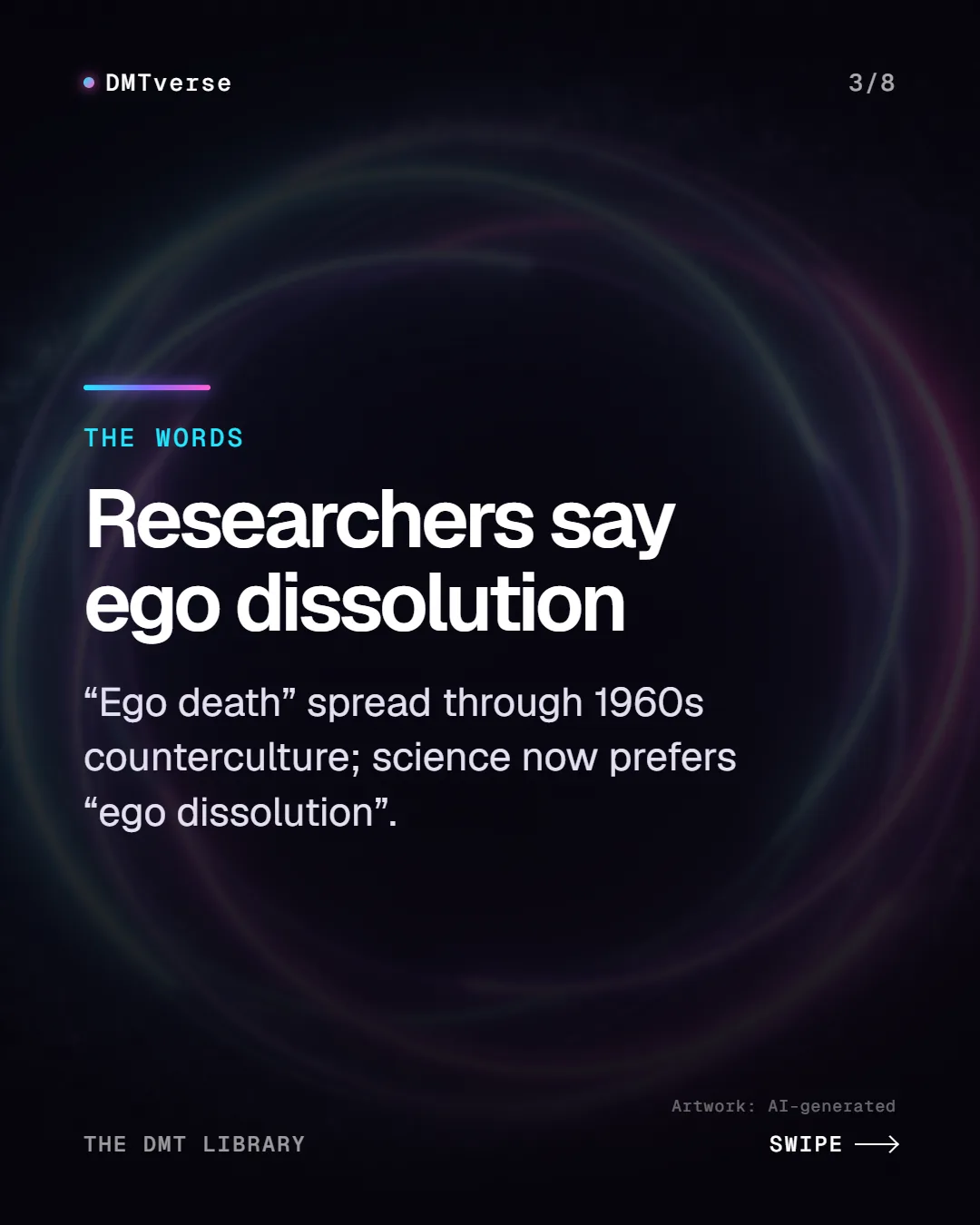
Mostly it is a difference of register. The same compromised sense of self has been called ego death, ego loss, ego disintegration and ego dissolution in the research literature (Nour et al., 2016). A 2017 review notes that “ego death” became widely known in the 1960s counterculture, while recent scientific papers prefer “ego dissolution” (Millière, 2017). Some people use “ego death” for the most complete form and “ego dissolution” for milder loosening, but that split is informal, not a research standard. Evidence: established for the terminology.
Where does the term “ego death” come from?
The word “ego” in this sense comes from psychoanalysis. Sigmund Freud introduced the ego in his 1923 work The Ego and the Id, as one of three agencies of the mind (Buchborn et al., 2023). The same 2023 review argues that the ego construct is still used ambiguously in psychedelic research, which is one reason “ego death” can mean different things to different writers. Evidence: established for the history; the ambiguity is the review authors’ assessment.
Descriptions of the experience predate the phrase. According to a 2017 review, “ego dissolution” seems to have emerged in the 1950s to describe effects seen with LSD and mescaline; “ego disintegration”, “ego loss” and “ego death” followed in the late 1950s and 1960s. The review lists Alnæs (1964), McGlothlin (1964), Pahnke (1969) and Grof (1970) as early uses of “ego death”, and Leary and colleagues (1964) for “ego loss” (Millière, 2017). Evidence: established from the review’s literature survey.
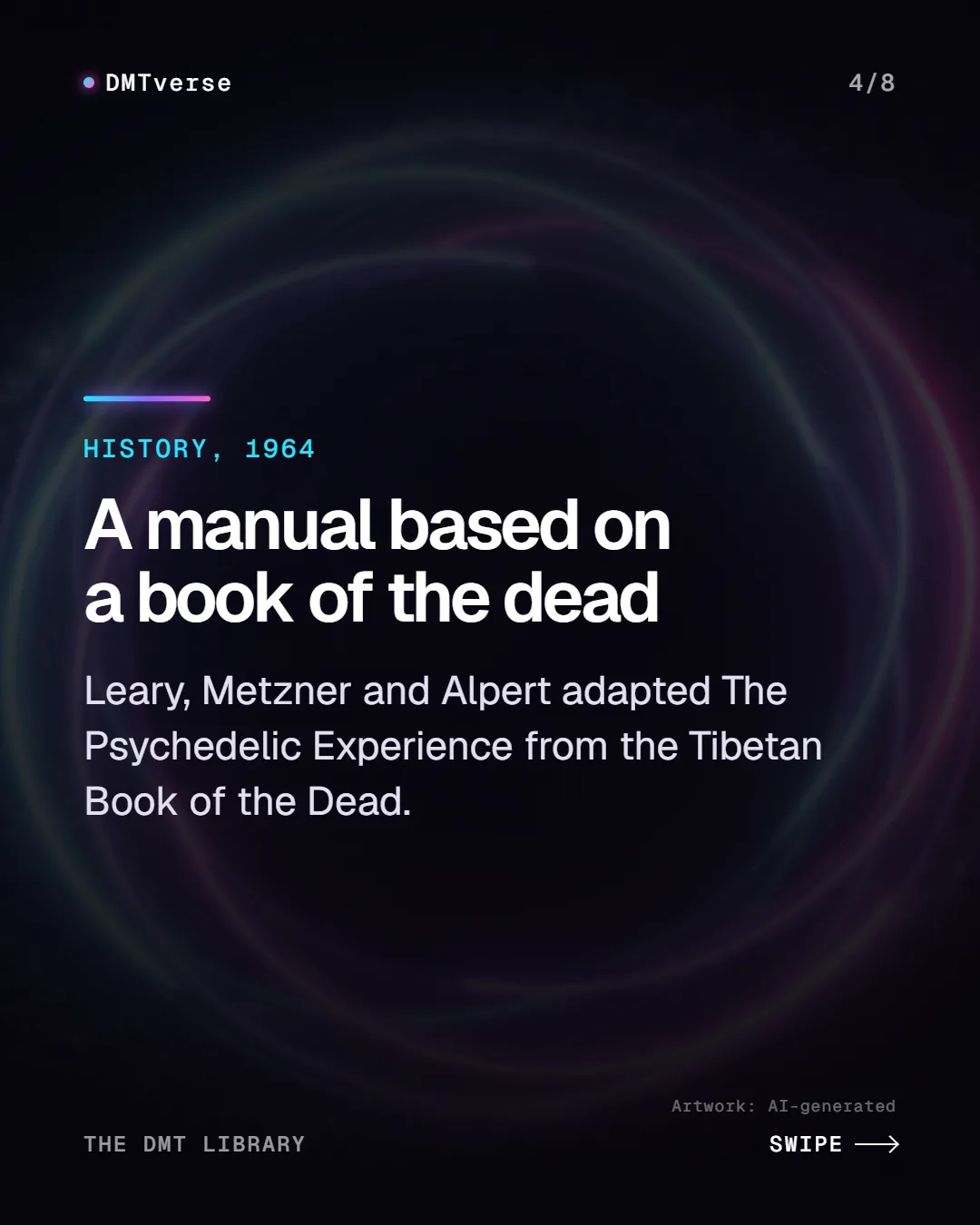
The 1964 book by Timothy Leary, Ralph Metzner and Richard Alpert, The Psychedelic Experience, was adapted from the Tibetan Book of the Dead, a Western interpretation of a Tibetan Buddhist text meant to be read aloud to guide the consciousness of the dead (Kruger et al., 2025). A 2017 review credits Leary’s publications with making “ego death” widely known (Millière, 2017). We did not read the book itself. Evidence: established for the book’s basis; the cultural influence is a review’s judgement.
So who coined the term? The sources we opened do not name a single originator, and early uses appear at about the same time in several authors. Later, the psychiatrist Stanislav Grof, an LSD therapy pioneer, saw ego death and the loss of boundaries between subject and world as the main objective of psychedelic therapy, according to a 2023 review (Buchborn et al., 2023). That was one school’s view, and it is not how current research frames the experience. Evidence: unresolved for who coined it.
- 1923Freud introduces the ego as one agency of the mind in The Ego and the IdSource Buchborn et al., 2023
- 1950s“Ego dissolution” used to describe effects of LSD and mescalineSource Millière, 2017
- 1964Leary, Metzner and Alpert publish The Psychedelic Experience, adapted from the Tibetan Book of the Dead; “ego loss” and early uses of “ego death” appearSource Kruger et al., 2025; Millière, 2017
- 1960s–1970s“Ego death” spreads through the counterculture; Grof treats it as central to psychedelic therapySource Millière, 2017; Buchborn et al., 2023
- 2016The 8-item Ego Dissolution Inventory is published as a validated questionnaireSource Nour et al., 2016
- 2018A review compares self-loss in meditation and psychedelic states and finds several formsSource Millière et al., 2018
What does ego death feel like?
Reports vary, and researchers increasingly think “ego death” covers several experiences. A 2018 review argues that self-consciousness has several layers, and that “self-loss” can take several forms (Millière et al., 2018). One useful split, used in a 2013 meditation study, is between the narrative self (your life story, memories, plans and self-judgements) and the minimal self (the moment-to-moment sense of being the one who acts and feels) (Dor-Ziderman et al., 2013). Evidence: preliminary (conceptual).
What people describe, in their own reports, includes the following. In a detailed case study, a meditator with about 40 years of practice described what changed as his sense of boundaries dissolved: the sense of inside versus outside, of time, of location, of self, of control, of owning his experience, and of a bodily centre. Touch and some bodily feelings did not fade completely (Ataria et al., 2015). Evidence: preliminary (a single case, self-report).
- Losing the life story: name, history and plans seem to drop away while awareness continues (narrative self).
- Losing the sense of being a doer or an owner: thoughts and actions seem to happen without a “me” behind them.
- Losing the boundary: no clear line between self and surroundings, sometimes described as unity or oneness.
- Losing the bodily centre: no felt point from which the world is seen.
These forms can come apart: someone might lose their sense of a story while still feeling a body, or the reverse (Millière et al., 2018). Feelings about the experience vary just as widely. Meditators who reported a merging of self and world described responses ranging from neutral curiosity to bliss to fear and terror (Lindahl et al., 2017). Evidence: preliminary (interviews and reports).
What do studies say about ego death and psychedelics?
Ego dissolution is closely tied to classic psychedelics, the drugs that act mainly on the 5-HT2A receptor, a serotonin receptor. When the Ego Dissolution Inventory was validated in an online survey of 691 people, ego dissolution scores rose with the reported dose for psychedelics, but not for cocaine or alcohol (Nour et al., 2016). A 2017 review adds that, on self-report questionnaires, three drug classes can produce it: classic psychedelics, dissociative anaesthetics such as ketamine, and drugs acting on the kappa opioid receptor (Millière, 2017). Evidence: established as an association, from self-selected and questionnaire data.
Brain imaging has tried to find what changes. In a placebo-controlled study of 15 healthy people given psilocybin, the compound in magic mushrooms, ego dissolution was linked to reduced connectivity between the medial temporal lobe (a memory hub) and high-level cortex, and to a breakdown of the salience network (Lebedev et al., 2015). In an LSD imaging study, increased global connectivity across normally separate brain networks correlated with reported ego dissolution (Tagliazucchi et al., 2016). Evidence: preliminary (small samples, correlations).
Theories differ. A 2022 review interprets ego dissolution through predictive coding, the idea that the brain constantly predicts its own experience, and suggests that 5-HT2A receptors at the top of the brain’s processing hierarchy may have a particularly powerful effect on consciousness (Stoliker et al., 2022). Two philosophers argue that the self is a useful model the brain builds to bind experience together, and that ego dissolution shows this model at work (Letheby & Gerrans, 2017). These are interpretations, not findings. Evidence: unresolved.
For how ketamine compares with DMT, including the “ego death” question, see DMT vs ketamine. For how mindset and surroundings shape psychedelic experiences in general, see set and setting.
Can ego death happen in meditation or without drugs?
Yes, people report it. A 2018 review notes that many contemplative traditions explicitly aim at dissolving the sense of self, and that both meditation and psychedelics can disrupt self-consciousness (Millière et al., 2018). In a 2013 study of 12 long-term mindfulness meditators, the reported experience of selflessness was linked to reduced beta-band brain activity in a region called the right inferior parietal lobule (Dor-Ziderman et al., 2013). Evidence: preliminary (small samples).
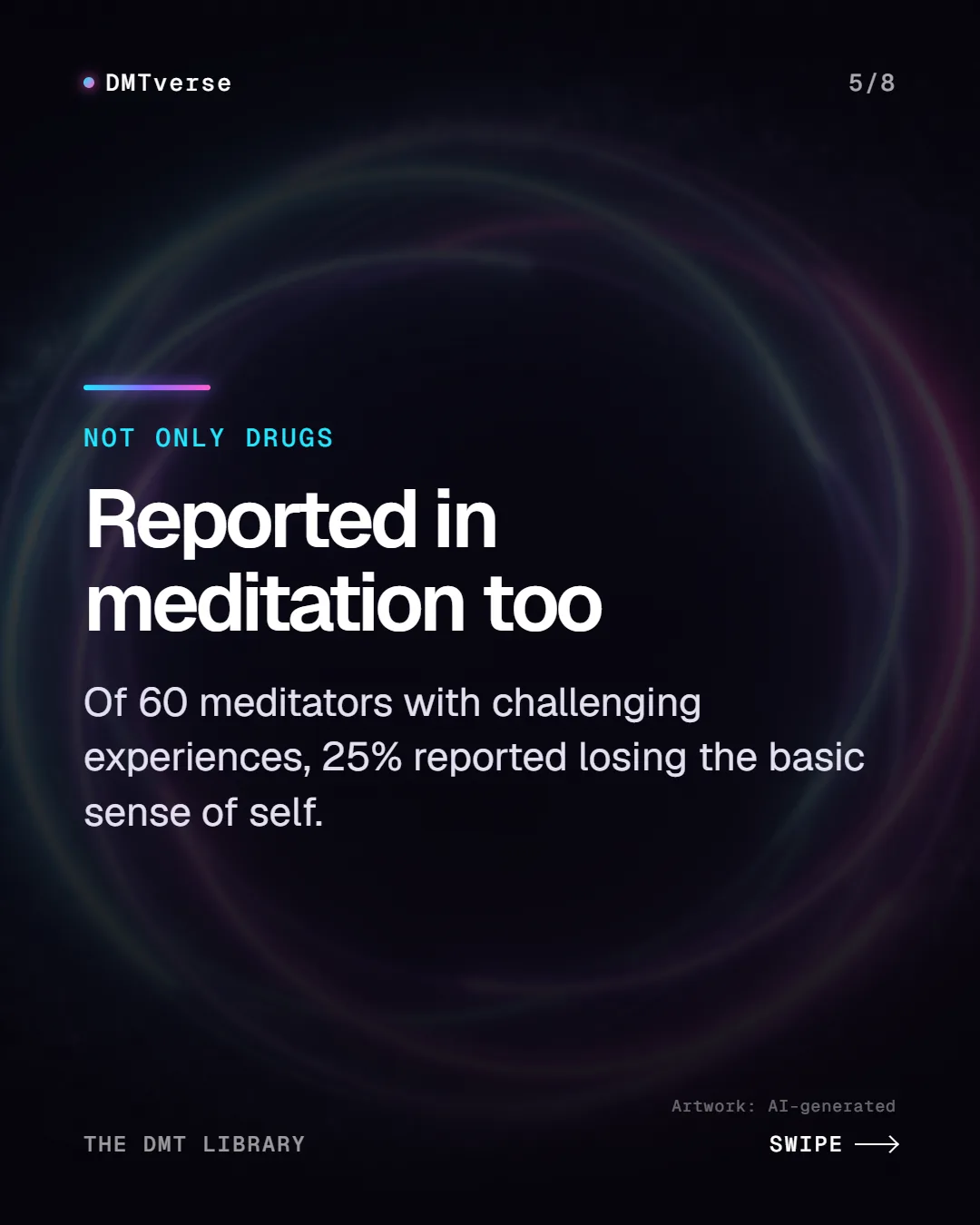
Meditation is not always gentle. In interviews with 60 Western Buddhist meditators who reported challenging experiences, 53% described changes in the boundary between self and others or self and world, and 25% a loss of the basic sense of self. The impact ranged from minimal and passing to severe and lasting (Lindahl et al., 2017). The sample was chosen for difficulties, so these are not rates for meditators in general. Evidence: preliminary.
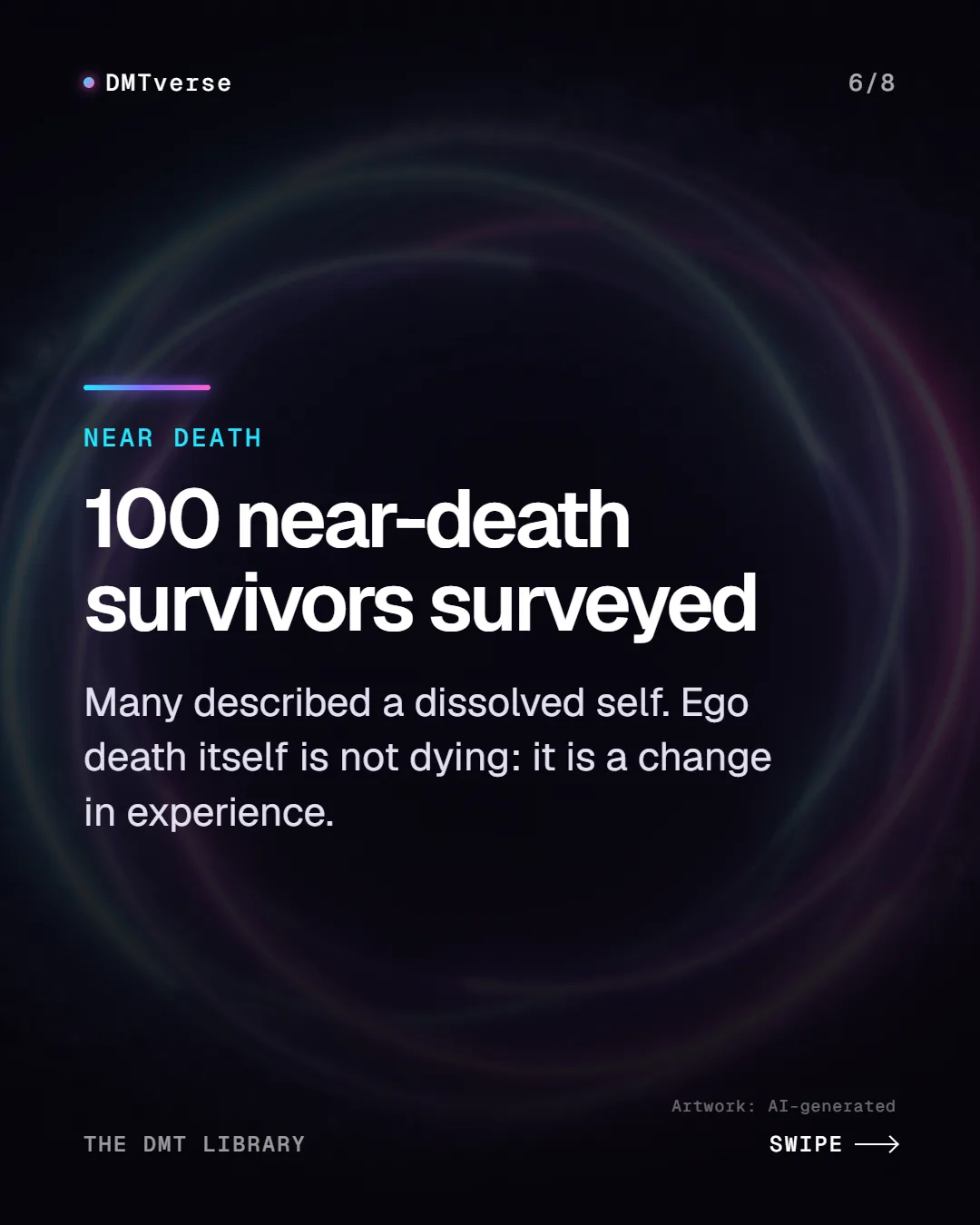
It also appears in near-death experiences. In a survey of 100 people who had had a near-death experience, scores on the Ego Dissolution Inventory were higher than on a matching ego-inflation scale, and higher ego dissolution went with stronger out-of-body and unity features (Martial et al., 2021). Disturbances of the self are also described in psychosis (Lebedev et al., 2015). On the popular idea that breathing or meditation works by releasing DMT, see can breathwork or meditation release DMT?. Evidence: preliminary.
Is ego death dangerous? Why can it be so scary?
Losing the sense of a self can feel like losing control, going mad or dying, and those fears appear in research on difficult psychedelic experiences. A questionnaire built from a survey of challenging psilocybin experiences identified seven factors: grief, fear, death, insanity, isolation, physical distress and paranoia (Barrett et al., 2016). The questionnaire measures difficult experiences in general, not ego death alone. Evidence: established as a validated description of challenging experiences.
Difficult experiences can have consequences. In an online survey of 1,993 people describing their single most challenging psilocybin mushroom experience, 39% ranked it among the five most challenging experiences of their life, 2.7% received medical help, and 7.6% of those whose experience was over a year earlier had sought treatment for lasting psychological symptoms (Carbonaro et al., 2016). The respondents were self-selected. Evidence: preliminary.
Some people struggle afterwards with what the experience seemed to show. In interviews with 26 people who reported existential distress after psychedelic experiences, participants described lasting confusion about their existence and purpose, with emotional, social and bodily effects (Argyri et al., 2025). A lasting sense that the self or the world is unreal is different again: depersonalisation-derealisation disorder is covered in our DMT and ego death article. Evidence: preliminary (qualitative).
Not a goal to aim for
Popular writing often treats ego death as a peak to reach. The research summarised here records it as an experience that some people find peaceful and others find terrifying, and that can be followed by distress. It gives no basis for seeking it, through drugs or any other practice. Supervised lab studies screened and supported their volunteers, and their results do not transfer to anyone else.
If someone is in danger
Call 911 for immediate danger or urgent medical help, including if someone is unconscious, not breathing or having a seizure. In Ontario, the Ontario Poison Centre is at 1-800-268-9017; every province has a poison centre, listed by SickKids (AboutKidsHealth). If you or someone you know is thinking about suicide, call or text 9-8-8, 24 hours a day (Government of Canada). See also our safety page and how to help someone having a bad trip. If the world or your sense of self has felt unreal for weeks after any experience, speak to a doctor.
Is ego death the same as dying?
No. Ego death describes a change in experience, not in the body: the definitions used in research are about a compromised sense of self, and the person remains alive (Nour et al., 2016). The confusion is understandable. “Death” is one of the seven factors of challenging psychedelic experiences, so feeling as if one is dying can be part of a difficult episode (Barrett et al., 2016), and the 1964 manual borrowed its framework from a text about the dead (Kruger et al., 2025). Evidence: established.
The overlap with near-death experiences runs one way: many people who came close to death report a dissolved self (Martial et al., 2021), but that does not mean ego dissolution is a sign of dying. Whether the brain releases DMT at death is a separate question, covered in does the brain release DMT when you die?, and the DMT comparison in DMT and near-death experiences. Evidence: preliminary.
Does ego death go away?
As researchers use the term, ego dissolution is a temporary state that is rated after the experience ends (Nour et al., 2016). What can last is the aftermath: distress, existential confusion or a persistent feeling of unreality, described above. A 2018 review also warns against confusing a temporary state of self-loss with “selflessness” as a lasting trait (Millière et al., 2018). Whether experiences change people over time is discussed in does DMT change you?. Evidence: established for the temporary state; unresolved for lasting change.
Is ego death good or important?
Research does not answer that, and we do not frame it as either. Some reviewers suggest ego dissolution may play a part in proposed therapeutic effects of psychedelics, but they describe it as surmised, not shown (Stoliker et al., 2022). Grof’s view of it as the aim of therapy was a historical position (Buchborn et al., 2023). The same experience is reported in distress, in meditation crises and in psychosis. Evidence: unresolved.
What we still don’t know
- Whether ego death is one experience or several (narrative, bodily, boundary loss) that happen to share a name (preliminary evidence for several).
- Whether drug-induced, meditative and near-death forms share a common core. One review calls this an open question (unresolved).
- Why the same loss of self is peaceful for some people and terrifying for others (unresolved).
- What brain changes cause it rather than accompany it. Imaging studies so far show correlations in small groups (unresolved).
- Who is most likely to have lasting difficulties afterwards, and why (unresolved).
- Who first used the phrase “ego death”. Early uses appear in several authors at about the same time (unresolved).
The fair summary: ego death is a popular name for a real, widely reported experience, the temporary loss of the sense of being a separate self. It appears with several drug classes, in meditation and in near-death experiences, and it can be frightening. It is not death, and it is not a reward. For the DMT side of the story, read DMT and ego death; for the basics of DMT, start with what is DMT.
Common questions
What is ego death in simple terms?
A temporary loss of the ordinary feeling of being a separate “me”: the sense of self fades, or the line between you and the world seems to disappear. Researchers call it ego dissolution.
What is the difference between ego death and ego dissolution?
They describe the same experience. “Ego death” became widely known through 1960s counterculture; scientific papers now prefer “ego dissolution”. Some people reserve “ego death” for the most complete form, but that is informal.
Who coined the term ego death?
No single originator is established in the sources we checked. A 2017 review lists several authors using “ego death” in the 1960s and credits Timothy Leary’s publications with popularising the idea; Leary, Metzner and Alpert wrote of “ego loss” in 1964.
Is ego death the same as dying?
No. It is a change in experience, not in the body. Feeling as if one is dying is a recognised part of some difficult psychedelic experiences, and many near-death experiencers report a dissolved self, but ego dissolution is not a sign of dying.
Can meditation cause ego death?
Meditators report losses of the sense of self, and many contemplative traditions aim at it. In a study of 60 meditators with challenging experiences, 25% reported a loss of the basic sense of self, with effects ranging from brief to severe and lasting.
Do magic mushrooms cause ego death?
Ego dissolution is reported with psilocybin, the compound in magic mushrooms. In a placebo-controlled study of 15 people, it was linked to changes in brain connectivity. It can be calm or frightening, and it is not a goal to aim for.
Is ego death dangerous?
It can be part of a challenging experience. In a self-selected survey of 1,993 people about their hardest psilocybin experience, 2.7% received medical help and some sought treatment for lasting symptoms. In an emergency in Canada, call 911.
Is ego death permanent?
As researchers define it, ego dissolution is temporary. What can last is the aftermath, such as distress or a persistent feeling of unreality. If that lasts for weeks, speak to a doctor.
Shroomverse sells mushroom products. This article is general information about the meaning, history and research of ego death. It is not medical, legal or purchasing advice, and it does not recommend any product.
SOURCES
- Ego-Dissolution and Psychedelics: Validation of the Ego-Dissolution Inventory (EDI) (Nour MM, Evans L, Nutt D, Carhart-Harris RL, Frontiers in Human Neuroscience 10:269, 2016), Frontiers (peer-reviewed, open access); full text via Europe PMC, PMC4906025. Accessed . Abstract and introduction read. Supports the definition as a compromised sense of self; the alternative names ego-death, ego-loss, ego-disintegration and ego-dissolution; 691 participants; dose correlation for psychedelics but not cocaine or alcohol. Doses not reproduced.
- Looking for the Self: Phenomenology, Neurophysiology and Philosophical Significance of Drug-induced Ego Dissolution (Millière R, Frontiers in Human Neuroscience 11:245, 2017), Frontiers (peer-reviewed, open access); full text via Europe PMC, PMC5441112. Accessed . Full text read (history section and footnote 1). Supports “ego dissolution” emerging in the 1950s with LSD and mescaline; later terms with their cited authors (Alnæs, McGlothlin, Pahnke, Grof for ego death; Leary et al. 1964 for ego loss); ego death widely known in 1960s counterculture after Leary’s publications; science now prefers ego dissolution; three drug classes on self-report (classic psychedelics, dissociatives, kappa opioid agonists); whether drug, psychosis and meditation forms share a common core is open.
- Psychedelics, Meditation, and Self-Consciousness (Millière R, Carhart-Harris RL, Roseman L, Trautwein FM, Berkovich-Ohana A, Frontiers in Psychology 9:1475, 2018), Frontiers (peer-reviewed, open access); PMC6137697. Accessed . Abstract read via Europe PMC. Supports: many contemplative traditions aim at dissolving the sense of self; both meditation and psychedelics can disrupt self-consciousness; self-loss takes several forms (narrative and embodied aspects affected differently); caution against conflating temporary self-loss with selflessness as a trait.
- Finding the self by losing the self: Neural correlates of ego-dissolution under psilocybin (Lebedev AV, Lövdén M, Rosenthal G, Feilding A, Nutt DJ, Carhart-Harris RL, Human Brain Mapping 36(8):3137–3153, 2015), Wiley (peer-reviewed); PMC6869189. Accessed . Abstract read via Europe PMC. Supports the description of the self disintegrating or the self–world border dissolving; ego disturbances in schizophrenia research; 15 healthy subjects, placebo-controlled; reduced medial temporal lobe–cortex connectivity and salience-network disintegration. Dose and route not reproduced.
- Increased Global Functional Connectivity Correlates with LSD-Induced Ego Dissolution (Tagliazucchi E, et al., Current Biology 26(8):1043–1050, 2016), Cell Press (peer-reviewed). Accessed . Abstract read via Europe PMC. Supports increased global connectivity under LSD, integration between normally distinct networks, and its correlation with reported ego dissolution.
- Neural Mechanisms and Psychology of Psychedelic Ego Dissolution (Stoliker D, Egan GF, Friston KJ, Razi A, Pharmacological Reviews 74(4):876–917, 2022), American Society for Pharmacology and Experimental Therapeutics (peer-reviewed review). Accessed . Abstract read via Europe PMC. Supports the predictive-coding interpretation, the role of 5-HT2A receptors at the apex of the cortical hierarchy, and that ego dissolution is “surmised” to underwrite subjective and therapeutic effects.
- Self unbound: ego dissolution in psychedelic experience (Letheby C, Gerrans P, Neuroscience of Consciousness 2017(1):nix016), Oxford University Press (peer-reviewed, open access); PMC6007152. Accessed . Abstract read via Europe PMC. Supports the philosophical argument that the self-model binds cognitive processing and that ego dissolution reveals this function.
- The ego in psychedelic drug action – ego defenses, ego boundaries, and the therapeutic role of regression (Buchborn T, Kettner HS, Kärtner L, Meinhardt MW, Frontiers in Neuroscience 17:1232459, 2023), Frontiers (peer-reviewed, open access); full text via Europe PMC, PMC10587586. Accessed . Abstract and relevant full-text sections read. Supports Freud introducing the ego in The Ego and the Id (1923); the ego construct remaining ambiguous in psychedelic literature; Grof viewing ego death and loss of subject–world boundaries as the main objective of psychedelic therapy.
- Best practices for first psychedelic experiences: harm reduction advice from the psychedelic community (Kruger DJ, et al., Harm Reduction Journal 22:191, 2025), BioMed Central (peer-reviewed, open access); full text via Europe PMC, PMC12648905. Accessed . One passage of the full text read, used for history only. Supports Leary, Metzner and Alpert’s The Psychedelic Experience (University Books, 1964) being adapted from the Tibetan Book of the Dead, a Western interpretation of a Tibetan Buddhist text meant to be read aloud to guide the consciousness of the deceased. None of its advice is used here.
- Mindfulness-induced selflessness: a MEG neurophenomenological study (Dor-Ziderman Y, Berkovich-Ohana A, Glicksohn J, Goldstein A, Frontiers in Human Neuroscience 7:582, 2013), Frontiers (peer-reviewed, open access); PMC3781350. Accessed . Abstract read via Europe PMC. Supports the narrative versus minimal self distinction; 12 long-term mindfulness meditators; selflessness linked to beta-band attenuation in the right inferior parietal lobule.
- How does it feel to lack a sense of boundaries? A case study of a long-term mindfulness meditator (Ataria Y, Dor-Ziderman Y, Berkovich-Ohana A, Consciousness and Cognition 37:133–147, 2015), Elsevier (peer-reviewed); Crossref record checked. Accessed . Abstract read via Europe PMC; bibliographic details confirmed on Crossref. Supports one meditator with about 40 years of practice; the seven senses that altered (internal vs external, time, location, self, agency, ownership, centre); touch and bodily feelings did not fade completely.
- The varieties of contemplative experience: A mixed-methods study of meditation-related challenges in Western Buddhists (Lindahl JR, Fisher NE, Cooper DJ, Rosen RK, Britton WB, PLoS One 12(5):e0176239, 2017), PLOS (peer-reviewed, open access); full text via Europe PMC, PMC5443484. Accessed . Abstract, Table 4 and the sense-of-self section read. Supports 60 practitioners; changes in self-other or self-world boundaries 53%; loss of sense of basic self 25%; responses from neutral curiosity to bliss to fear and terror; impact from minimal and transient to severe and enduring.
- Losing the Self in Near-Death Experiences: The Experience of Ego-Dissolution (Martial C, et al., Brain Sciences 11(7):929, 2021), MDPI (peer-reviewed, open access); PMC8307473. Accessed . Abstract read via Europe PMC. Supports 100 NDE experiencers; EDI scores higher than ego-inflation scores; EDI correlated with NDE scale, out-of-body intensity and unity.
- The Challenging Experience Questionnaire: Characterization of challenging experiences with psilocybin mushrooms (Barrett FS, Bradstreet MP, Leoutsakos JS, Johnson MW, Griffiths RR, Journal of Psychopharmacology 30(12):1279–1295, 2016), SAGE (peer-reviewed); PMC5549781. Accessed . Abstract read via Europe PMC. Supports the seven factors: grief, fear, death, insanity, isolation, physical distress and paranoia.
- Survey study of challenging experiences after ingesting psilocybin mushrooms: Acute and enduring positive and negative consequences (Carbonaro TM, et al., Journal of Psychopharmacology 30(12):1268–1278, 2016), SAGE (peer-reviewed); PMC5551678. Accessed . Abstract read via Europe PMC. Supports 1,993 respondents; 39% top-five most challenging of their lifetime; 2.7% received medical help; 7.6% of those with experiences over a year earlier sought treatment for enduring psychological symptoms.
- Navigating groundlessness: An interview study on dealing with ontological shock and existential distress following psychedelic experiences (Argyri EK, et al., PLoS One 20(5):e0322501, 2025), PLOS (peer-reviewed, open access); PMC12052184. Accessed . Abstract read via Europe PMC. Supports 26 interviewees with existential distress; persistent confusion about existence and purpose; emotional, social and bodily impact.
- Mental health support: get help, Government of Canada, Public Health Agency of Canada. Accessed . Page read 21 October 2026. Supports calling 9-1-1 in immediate danger or for urgent medical support, and calling or texting 9-8-8, 24 hours a day, 7 days a week.
- Poison information centres in Canada, AboutKidsHealth, The Hospital for Sick Children (SickKids). Accessed . Page read 21 October 2026. Supports Ontario toll-free 1-800-268-9017 and calling 911 if someone is unconscious, not breathing or having a seizure.
CHANGES
- : Published. Sources opened and checked on this date.



