
THE SHROOMVERSE JOURNAL ✳ 13 MIN READ
Golden Teacher mushrooms: what the name and the research establish
Topic: Mushroom names and species
Published Updated
Listen: the 3-minute version
AI-narrated summary of this article
Short answer, checked 4 October 2026
Golden Teacher is an informal name, not a species. In a 2025 study, one sample carrying the label was assigned to Psilocybe cubensis by ITS DNA sequence. That supports the link for that sample, not for every mushroom sold or shared under the name. The sources we opened give no first discoverer, first-use date or unbroken chain from an original specimen, and none tested what the name predicts about human effects.
On this page 11 sections
Golden Teacher mushrooms are among the best-known names in cultivated magic mushrooms. The name is easy to repeat and hard to pin down. This article asks a narrower question than most pages on the topic: what do dated, checkable records say about the label, and where do they stop? It is about names, not a profile of what any mushroom does. For the wider picture, see our guide to magic mushroom names, species, strains and varieties and the pillar guide to magic mushrooms.
How we label the evidence
Documented: a source we opened says it directly. Limited: one sample, one study or an indirect link. Not established: we found no source for it, so we do not state it.
Watching the film? A guide to its chapters
This article is the written companion to our Golden Teacher documentary. The film covers more ground than this page: it also looks at brain imaging and clinical research, which other guides on this site cover in depth. Each row below links a film chapter, at its start time, to the section or guide that goes with it.
Is Golden Teacher a species, a variety or just a label?
Documented: Psilocybe cubensis is the accepted scientific name of the species; GBIF records it as Psilocybe cubensis (Earle) Singer, published in 1948 (GBIF). Golden Teacher is not a scientific name. GBIF’s list of common names for the species, drawn from the Catalogue of Life, includes “Golden Teachers”, alongside other labels such as “Cubes” and “Penis Envy” (GBIF).
A label can help a laboratory trace material. It is not by itself a formal variety name, and it is not proof that everything carrying it is one genetically uniform population. Our guide to Psilocybe cubensis taxonomy covers the species; this article stays with the label.
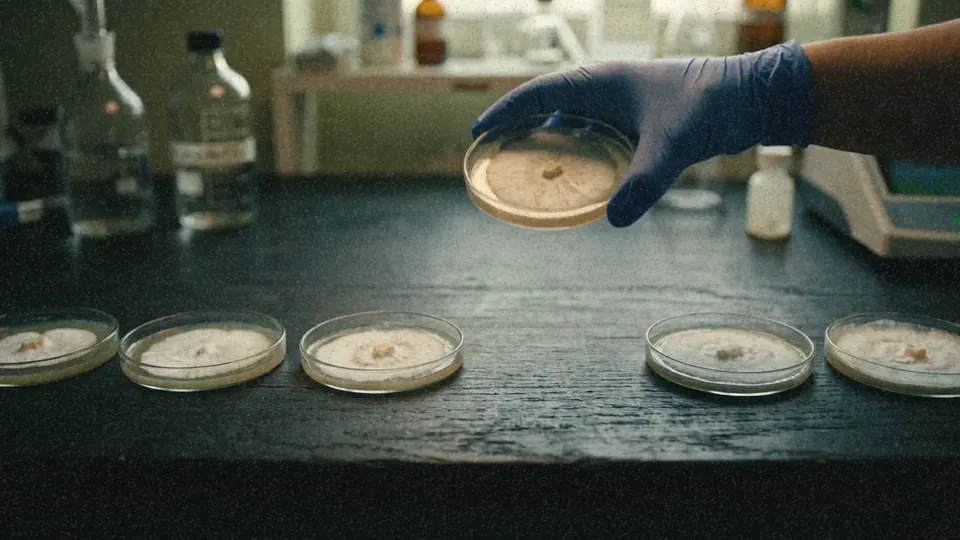
What did the 2025 DNA study show about a Golden Teacher sample?
Documented, for one sample. Cohen and colleagues studied 42 psilocybin-producing fungal strains. Each was identified by appearance and then cross-checked by ITS sequencing, because, as they note, species identification by appearance can be unreliable (Cohen et al., 2025). ITS is a short stretch of ribosomal DNA used to place a fungus in a species.
Row 18 of their Table 1 lists a strain labelled Golden Teacher, with an ITS classification of Psilocybe cubensis, 99.73% identity over 97% of the query sequence, and GenBank accession PV069796. The mushrooms were grown by PsygaBio, an Israeli company, under controlled conditions (Cohen et al., 2025).
Read it carefully. The result places that sample in the species. It does not tell you which cultivar line the sample came from, because ITS works at species level. The same table gives the identical 99.73% and 97% figures for rows labelled B+ and PE, and calls many other labelled rows P. cubensis too. A species-level match is shared by many labels, so it cannot tell one label from another (Cohen et al., 2025).
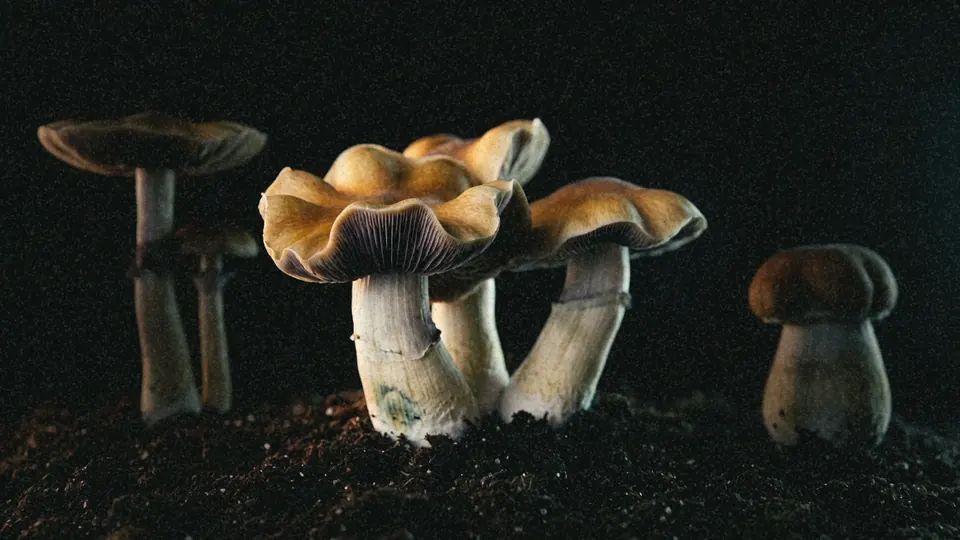
Two further points matter for fairness. The study was funded by PsygaBio, and three authors are employees of the company, which the paper discloses (Cohen et al., 2025). And the same table shows that labels and species can disagree: six rows whose species name includes natalensis were classified as cubensis by ITS, and the authors report that chemical clustering followed the ITS result better than the appearance-based one (Cohen et al., 2025). See also our article on natalensis and ochraceocentrata names.
The paper also reports a compound it calls putative hydroxypsilocybin in its Golden Teacher sample, which it presents as an example of what the method can discover (Cohen et al., 2025). Putative means not confirmed. It is a finding about one extract, not a trait of a name.
What does a “Golden Teacher population” in a genome study mean?
Documented, with a caution about wording. McTaggart and colleagues sequenced 38 genomes from wild-growing mushrooms in Australia and compared them with 86 genomes of commercially available cultivars. The cultivar genomes fell into five groups defined by a statistical method, and the authors named one of them Golden Teacher. That group held 37 genomes, the largest of the five (McTaggart et al., 2023).
Think of it as a grouping, not a pedigree. The authors say the provenance and pedigrees of cultivars “exist in lore but are not authenticated” (McTaggart et al., 2023). They report that many cultivars sit in the Golden Teacher group as close relatives, and that cultivar names which may suggest a place, such as Amazon, Burma, Cambodia, Ecuador, Maui, Puerto Rico and Thailand, appear in the Golden Teacher and Blue Magnolia groups. Their reading is open: those cultivars may have been collected from several natural populations, may have been founded from closely related genotypes, or the names may not indicate provenance at all (McTaggart et al., 2023).
So a genome in the group is related to others in it. That does not mean it descends from an original mushroom called Golden Teacher, and a genome carrying another name can sit in the group. The same paper found the group among the least heterozygous, consistent with clonal propagation or selfing, and four individuals could not be placed clearly in either it or Blue Magnolia (McTaggart et al., 2023). The Amazonian name raises the same problem: see our film Amazonian.
What do other studies say about samples labelled Golden Teacher?
Not much that can be generalized. A search of Europe PMC for the exact phrase on 4 October 2026 returned 13 records, several unrelated to mushrooms. In those we opened, the label appears as one sample among several, never as the subject of a controlled comparison. This is a limited search, not a systematic review.
- A 2025 Uruguayan study analysed six samples: five donated by users and one grown from a wild collection. One donated sample carried the name Golden Teacher as stated by the donor, and the samples were identified as P. cubensis by macroscopic and microscopic examination (Rodríguez et al., 2025).
- The same study cites others in noting that even well-known strain labels are often misapplied and chemically inconsistent, and says storage conditions may affect the alkaloids measured (Rodríguez et al., 2025).
- A 2026 study grew 14 strains under identical conditions. The only Golden Teacher entry is a hybrid label, “Jack Frost × Golden Teacher” (Sharchaton et al., 2026).
- A 2025 review of cubensis strains says its strain descriptions are predominantly sourced from non-academic, community-based reports (Kurzbaum et al., 2025).
| Source | What it did | What it cannot tell you |
|---|---|---|
| Cohen et al., 2025 | ITS-sequenced one labelled sample; classified as P. cubensis | Anything about other samples or about a cultivar line |
| McTaggart et al., 2023 | Named one of five genome groups of cultivars Golden Teacher (37 genomes) | That a sample in the group descends from an original; the history of the name |
| Rodríguez et al., 2025 | Measured one donor-labelled sample, identified by microscopy | Whether the donor’s label was right, or what the name predicts |
| Kurzbaum et al., 2025 | Reviewed strain descriptions, mostly from community reports | Measured differences between names |
Where did the name Golden Teacher come from?
Not established. The sources we opened document present-day use of the name in research and in donated material. None names a first discoverer, a first-use date or an unbroken chain from one original specimen to everything now carrying the name. We do not assign a decade, a place or a person.
A plausible story can become familiar long before anyone checks its records. A publication date shows only that the name was in use by that date, not that it began then. Our guide on how to research magic mushroom origin stories explains the checks we apply to origin claims.
Does the word “Teacher” say anything about effects?
No. The word is part of a name, not a measured outcome. To show that a named material produces a particular experience, researchers would have to define the outcome, identify the material and compare it under suitable conditions. We found no study that did this for Golden Teacher.
One 2025 paper does describe a Golden Teacher sample as a strain known for strong effects. That sentence is a statement of reputation. The study itself measured chemistry in one donated sample and did not test effects (Rodríguez et al., 2025). Anecdotes can report what someone experienced. They cannot isolate the cause, or show that a commercial name predicts it.
Can Golden Teacher be recognized from appearance?
This article gives no visual checklist, and none should be trusted. Colour words in a name are not a diagnostic standard. A properly documented photograph can illustrate one sample. It cannot certify another sample’s identity, ancestry or safety.
Not an identification guide
Nothing here can identify an unknown mushroom. Wild mushrooms can be mistaken for dangerous look-alikes, and a label proves nothing about what is in front of you. If someone may have eaten an unidentified mushroom, call 911 or your local poison centre now, and see our safety page.
How should you read a Golden Teacher test result?
Start with the sample identifier, not a ranking. Ask whether the analysis covers one fruiting body, a pooled sample, several independent collections or repeated measurements of one preparation. Then check how the sample was identified, how it was stored, and what compounds, units and uncertainty were reported.

A result can be valid for its sample and still be useless for the whole label. Storage matters: the Uruguayan study says storage conditions may affect the alkaloids it measured (Rodríguez et al., 2025), and Cohen and colleagues conclude that the strains they studied vary too much to be addressed as one cohesive group (Cohen et al., 2025). That is why we do not present Golden Teacher as a fixed low, medium or high category. For the difference between lab evidence and claims about human effects, see what lab studies establish about potency claims.
What we still don’t know
- Who first used the name, when and where (not established).
- Whether samples sold or shared under the name today are genetically alike (limited: one genome group is named for it, but names and groups do not map neatly).
- Whether the name predicts any measurable difference in chemistry, or in human effects (not established; no controlled comparison found).
- How a Golden Teacher sample differs from other cubensis labels when grown side by side (not found).
Compare names by the evidence attached to each, not by ranking experiences. Our piece on Penis Envy and the guide to what cubensis names can compare show how. This article is not legal advice, and the law differs between countries and changes over time.
Common questions
Is Golden Teacher a separate species?
No. In the evidence we opened it is a label associated with Psilocybe cubensis. A 2025 study assigned one Golden Teacher-labelled sample to that species by ITS DNA sequence, which supports that sample only.
Is Golden Teacher a strain or a variety?
It is informally called a strain or cultivar; GBIF lists it only as a common name for the species. A 2023 genome study named one group of cultivars after it, which describes statistical relatedness, not a documented lineage.
Where did Golden Teacher come from?
That is not established. The sources we opened document present-day use of the name and give no first discoverer, first-use date or unbroken chain from an original specimen. The 2023 genome study says cultivar pedigrees exist in lore but are not authenticated.
Does the name Golden Teacher mean anything about effects?
No study we found tests that. The word is part of a name, not a measured outcome. Reports of experience are anecdotes and cannot show that a commercial name predicts an effect.
Can Golden Teacher be identified by how it looks?
No. Appearance cannot confirm a name, an ancestry or safety. A documented photograph illustrates one sample. For wild mushrooms, mistaken identity can be dangerous: see our safety page.
Can Golden Teacher be compared with Penis Envy?
Only by the evidence attached to each name, such as what each label was shown to be in a given study. A universal ranking of experiences would need different evidence, which we did not find.
What does a lab result for a Golden Teacher sample show?
It describes that sample, as identified, stored and measured in that study. It cannot describe every mushroom carrying the label, so a single result is not a low, medium or high rating for the name.
Shroomverse sells mushroom products. This article is general information about mushroom names and taxonomy. It is not medical, legal or purchasing advice, and it does not recommend any product.
SOURCES
- Comprehensive analysis of 42 psilocybin-producing fungal strains reveals metabolite diversity and species-specific clusters (Cohen J, Sulimani L, Procaccia S, et al., Scientific Reports 15:13822, published 22 April 2025), Springer Nature (peer-reviewed, open access); full text read via PubMed Central, PMC12015540. Accessed . Table 1 row 18 (Golden Teacher: ITS classification P. cubensis, 99.73% identity, 97% query cover, GenBank PV069796); the ITS method; cultivation by PsygaBio; funding and competing-interest statements; the putative hydroxypsilocybin; natalensis-labelled rows classified as cubensis; B+ and PE rows with the same identity and cover figures.
- Domestication through clandestine cultivation constrained genetic diversity in magic mushrooms relative to naturalized populations (McTaggart AR, McLaughlin S, Slot JC, et al., Current Biology 33(23):5147–5159.e7, 4 December 2023), Cell Press (peer-reviewed); abstract via Europe PMC, full text read in a copy hosted by the University of Michigan. Accessed . 38 Australian and 86 cultivar genomes; five cultivar groups, one named Golden Teacher (37 genomes, Table 1); pedigrees “exist in lore but are not authenticated”; the discussion of cultivar names such as Amazon and Thailand; low heterozygosity and clonality of the group. The live publisher page returned 403 to us.
- Novel qNMR Method to Quantify Psilocybin and Psilocin in Psychedelic Mushrooms (Rodríguez L, Morera G, Lupo S, et al., ACS Omega 10(46):55725–55732, 10 November 2025), American Chemical Society (peer-reviewed, open access); full text via PubMed Central, PMC12658598. Accessed . Six samples, five donated by users; one labelled Golden Teacher by the donor; identification by macroscopic and microscopic examination; comments on misapplied strain labels and storage; the sentence describing the strain’s reputation for effects. We report no concentration from this paper.
- Exploring Psilocybe cubensis Strains: Cultivation Techniques, Psychoactive Compounds, Genetics and Research Gaps (Kurzbaum E, Páleníček T, Sharchaton A, et al., Journal of Fungi 11(2):99, 2025), MDPI (peer-reviewed review, open access); full text via PubMed Central, PMC11856550. Accessed . Cited only for its statement that its strain descriptions are predominantly sourced from non-academic, community-based reports.
- Surprising Variability in Tryptamine Profiles of Psilocybe cubensis Fruiting Bodies: Inter- and Intra-Strain Differences Across 14 Strains Cultivated Under Controlled Conditions (Sharchaton A, et al., Journal of Fungi 12(7):486, 2026), MDPI (peer-reviewed, open access); full text via PubMed Central, PMC13412672. Accessed . Cited only for the hybrid label “Jack Frost × Golden Teacher” among its 14 strains. We report none of its numbers.
- Psilocybe cubensis (Earle) Singer: vernacular names (GBIF backbone taxonomy, key 5242510), GBIF, data from the Catalogue of Life. Accessed . Accepted name and 1948 publication details; “Golden Teachers”, “Cubes” and “Penis Envy” listed as English common names.
CHANGES
- : Published.
- : Added a link to the Golden Teacher documentary on the films page.
- : Added a guide that links each chapter of the documentary to the matching section or guide. The article text was not changed.



