
THE SHROOMVERSE JOURNAL ✳ 15 MIN READ
Penis Envy mushroom history: the true story behind the name
Topic: Mushrooms: history and science
Published Updated
Listen: the 3-minute version
AI-narrated summary of this article
Short answer, checked 4 October 2026
Penis Envy is an informal name for a cultivated line of Psilocybe cubensis, not a species. The McKennas’ 1971 Amazon trip and Steven Pollock’s 1981 murder are documented, but their links to this mushroom are not. The earliest dated use of the name we found is from 2005. A 2026 lab study found wide variation between strains.
On this page 11 sections
Few mushroom names travel as fast as this one. Penis Envy mushroom history, as it is usually told, runs from an Amazon cattle pasture to an unsolved murder in Texas, with a famous psychedelic explorer in between. It is a great story. The trouble is that most of it was never written down anywhere you can check.
We went looking for the paperwork while making our documentary, Penis Envy: The Mushroom Behind the Myth. Here is what we found: where the name comes from, which parts of the legend are documented, why the mushroom looks the way it does, and what a recent lab comparison measured.
Each finding carries a label. Established means primary records, or independent sources that agree, show it directly. Preliminary means it rests on one study, one person’s account or unmeasured reports. Unresolved means the evidence conflicts or does not exist.
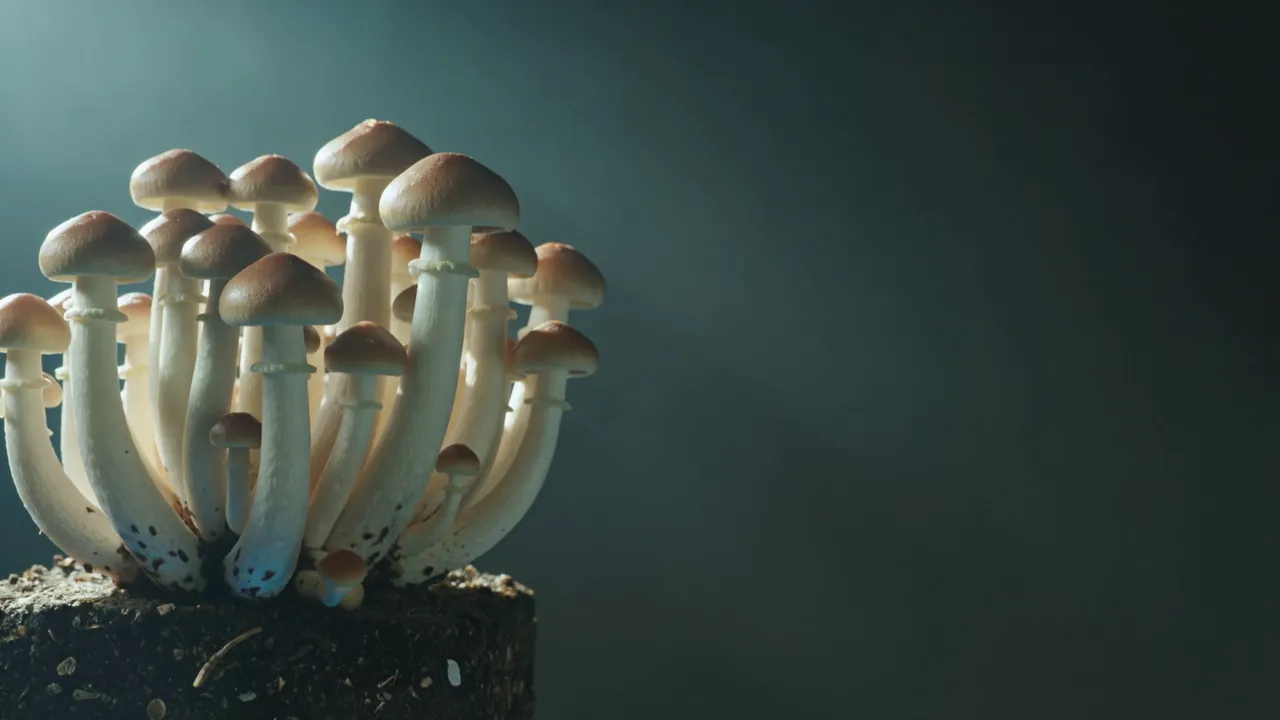
What is the Penis Envy mushroom’s scientific name?
Its scientific name is Psilocybe cubensis, the same species as most cultivated magic mushrooms. It was first described from Cuba in 1906 as Stropharia cubensis, and the GBIF database records its transfer to the genus Psilocybe in 1948 (GBIF; Bradshaw et al., 2026).
“Penis Envy” has no formal standing: it is neither a species nor a botanically named variety. GBIF lists it only as a common name for P. cubensis, alongside Golden Teachers and Cubes. It is closer to a dog breed than a new organism. Evidence: established.
Why is it called Penis Envy?
The phrase is older than the mushroom. “Penis envy” is an idea from Sigmund Freud’s psychoanalysis. Britannica calls it a “highly controversial assumption”, and later analysts, including Karen Horney, rejected it (Britannica, Freud; Britannica, Horney).

How it ended up on a mushroom is less clear. The obvious answer is shape: a thick stem and a cap that hugs it. In 2009 the journalist Hamilton Morris called the mushroom “about as natural as a cocker spaniel”: a line shaped by people, not found in the wild (Morris, Vice, 2009).
The only first-hand account of the naming comes from the cultivator who says he developed the line. He told Morris it began as a joke in 1977. He showed a bag of his mushrooms, then known as “Amazons”, to some exotic dancers. They laughed at the shape, and he asked if they had penis envy (DoubleBlind; Leafly, 2022). No document from 1977 backs this up. Evidence: preliminary.
The Penis Envy origin story everyone repeats
The popular version goes like this. Terence McKenna brings spores back from the Amazon. A Texas doctor named Steven Pollock grows them and finds a strange, thick-stemmed form. Just before he is murdered, Pollock mails a spore print labelled “Penis” to a grower in Washington State, who keeps the line alive. Years later, a spore company sells it under the name Penis Envy.
Morris set out that chain in Vice in February 2009 (full text in Vice’s Portuguese edition). For years it served as the standard history (Leafly, 2022), and magazines were still retelling it in 2021 (MEL Magazine, 2021). Each link deserves its own look.
1971: the McKenna brothers at La Chorrera
This part comes from someone who was there. In early 1971, Terence and Dennis McKenna travelled to La Chorrera, a remote settlement in the Colombian Amazon, in search of an obscure preparation containing DMT. Instead, in Dennis McKenna’s words, “robust clusters of P. cubensis sprouted from nearly every cow pie” in the pastures around the mission (McKenna, 2021).

He also writes that they carefully collected the spores and brought them home. Whether any of them became Penis Envy is another matter. Evidence: preliminary for the find (one first-hand account); unresolved for the link.
Steven Pollock: a real scientist and an unsolved murder
Steven Hayden Pollock was a San Antonio physician who published on psilocybin mushrooms in the Journal of Psychedelic Drugs in the mid-1970s (Pollock, 1975). In 1977, during a mycology congress in Tampa, Florida, he and the mycologist Gary Lincoff found a mushroom that Pollock came to realize was new (Harper's gives the month as August, while the 1978 description dates the type collection to 3 September 1977: Guzmán and Pollock, 1978) (Morris, Harper’s, 2013). He and the taxonomist Gastón Guzmán described it as Psilocybe tampanensis in 1978 (GBIF).
On 31 January 1981, Pollock was found shot dead in San Antonio. He was 33. Three suspects were never charged, and the murder remains unsolved (Harper’s, 2013; MEL Magazine, 2021).
Here is the striking part. Morris’s own long investigation of the murder, published in Harper’s in 2013, never mentions Penis Envy in the text we read. We found no document from Pollock’s lifetime that connects him to the strain. Evidence: established for his life and death; unresolved for any link to Penis Envy.
2009: the article that stitched it together
Morris wrote his 2009 story as a comic, first-person adventure, and it holds the strongest clue against itself. When he phoned Dennis McKenna, McKenna said the strain was news to him and that he had never heard of it (Vice, 2009).
Morris later returned to the subject. The notes to his podcast episode “The True Story of the Penis Envy Mushroom”, released publicly on 1 April 2022, admit that “many apocryphal origin stories have been disseminated (sometimes by me)” (The Hamilton Morris Podcast, 2022).
The Rich Gee account: a grower tells his side
That episode is a long interview with a cultivator who wrote under the pen name Rich Gee. Gee co-wrote a 1977 book on psilocybin mushrooms with Jule Stevens, published in Seattle (Wellcome Collection). In 2009, Morris had tried and failed to find him, and learned the name was a pseudonym (Vice, 2009).
Two commercial outlets, the psychedelics publisher DoubleBlind and the cannabis marketplace Leafly, reported the interview. In their telling, Gee says the spores did come from McKenna’s Amazon collection, but reached him through his co-author Stevens and a friend who had them from McKenna, not through Pollock. One of Gee’s cultures showed a mutation: caps that would not stand up, and many stunted mushrooms (DoubleBlind; Leafly, 2022).
He says he cloned it repeatedly, picking large mushrooms that bruised strongly blue, and that the phallic shape was a side effect. He says he met Pollock but never discussed cubensis strains with him. He called the mailed-print story “baloney from the very beginning”, and said Pollock never even knew where he lived (DoubleBlind).
Is it true? It may be. DoubleBlind found Gee’s photographs and background convincing but called the account hard to verify. It is one witness, recalling events more than four decades later, with no document from the time to check it against. Evidence: preliminary.
Penis Envy mushroom history: what is documented and what is repeated
| Claim | What the record shows | Label |
|---|---|---|
| The McKennas found P. cubensis at La Chorrera in 1971 | Dennis McKenna’s own account | Preliminary |
| Pollock was a mushroom researcher murdered in 1981 | Journal records; Harper’s; case unsolved | Established |
| Pollock bred Penis Envy from McKenna’s spores | First written in Vice, 2009; Gee denies it | Unresolved |
| Pollock mailed a “Penis” spore print before his death | Vice only; Gee calls it “baloney” | Unresolved |
| Rich Gee developed the line and named it in 1977 | Gee’s own interview | Preliminary |
| The name was in use by 2005 | A dated forum thread | Established |
| Penis Envy is a separate species or variety | GBIF lists it as a common name only | Established that it is not |
When was the name Penis Envy first used?
We could not find the name in any document from the 1970s or 1980s. The earliest dated use we could verify is a Shroomery forum thread of 16 November 2005, “Penis Envy 6..whats the real deal?”. Its posters discuss PE and a hybrid, PE6, as known strains, so the name was already familiar to the people posting (Shroomery, 2005).
By 30 January 2008, a strain guide on the same forum said the McKenna brothers found Penis Envy in the Colombian Amazon, citing “various sources” (Shroomery, 2008). It does not link Pollock to Penis Envy. He appears only under a different strain, also sold as “Amazonian”, which the post traces to a Mexican village. The earliest Pollock link we found is the Vice article a year later.
The same guide adds a Gee: it says many thought the strain lost until a forum member found a seller, named as “Rick Gee”, offering it. It does not say whether he is the 1977 co-author. DoubleBlind also reports that Morris and others found “the first recorded photograph of the then-unnamed Penis Envy mushroom” in Gee’s 1995 book, Cubensis Aquarium Gardening, which we could not find in library catalogues. Evidence: unresolved who the seller was; preliminary for the photograph.
So the timeline runs backwards from the paperwork: a reported photograph in 1995, the name by 2005, McKenna and a seller called Gee by 2008, Pollock by 2009, and Gee’s 1977 naming story by 2021. Evidence: established for the dated documents; unresolved for the true starting date.
Why does Penis Envy look different?
Wild P. cubensis looks fairly ordinary. A 2025 description from northeastern Argentina gives caps 40 to 80 mm across that open out flat, a lasting white ring on the stem and a blackish-blue spore print (Batista et al., 2025).
Penis Envy is described differently, and consistently: a thick stem, a cap that barely opens and hardly reaches past the stem, and few or no spores (DoubleBlind; Leafly, 2022). DoubleBlind notes that a mushroom dropping so few spores would soon die out in the wild, which fits a line kept going by people.
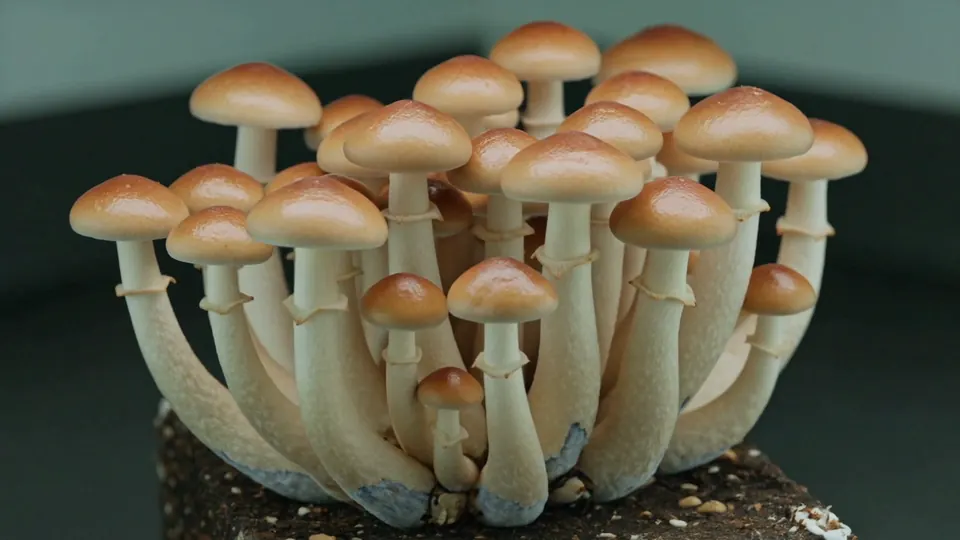
Two peer reviewers in British Columbia summed up the lore in 2021: “a towering fruiting body with a pale cap and missing partial veil”, kept going by cloning. They called the story “anecdotal at best” (McKernan et al., 2021, peer review).
No study we found measures these traits. A 2025 review shows photos of Penis Envy types but says its strain notes come mostly from “non-academic, community-based reports” (Kurzbaum et al., 2025). Even the 2026 lab study below checked its strains partly by appearance. Evidence: consistent but unmeasured, so preliminary.
What the genes say
Genetics offers firmer ground. In 2021, Kevin McKernan and colleagues sequenced a P. cubensis genome from dried stems labelled “P.envy”, obtained in Somerville, Massachusetts, noting that “The strain name is anecdotal” (McKernan et al., 2021). They found an extra stretch of DNA, about 4,600 letters long, in a gene the mushroom uses to make psilocybin. What it does is still unknown.
In 2023, a larger study compared 86 commercial cultivar genomes, sequenced by McKernan’s group, with 38 wild ones from Australia. McKernan was a co-author, so the two findings are not independent. One genetic cluster held six cultivars, five of them labelled Penis Envy, including the 2021 genome. Those five “were homozygous across most chromosomes, which suggests they have been highly inbred” (McTaggart et al., 2023). The authors suggest such lines may come from one parent mushroom, or from cloning.
That fits the story of a line kept alive by copying itself. It does not show who did the copying, or when. No study has yet shown which gene, if any, causes the Penis Envy shape. Evidence: preliminary (one study for each finding, from overlapping teams); unresolved on the cause of the shape.
What a side-by-side lab comparison found
In July 2026, researchers in Israel and the Czech Republic published what they call the first methodologically controlled comparison of multiple P. cubensis strains in an academic context (Sharchaton et al., 2026).
It was not the first study to include this strain, at least by its initials. A 2025 study from Israel grew 42 strains under the same conditions, including a cubensis strain labelled simply “PE”, though the paper does not discuss it on its own (Cohen et al., 2025).
The 2026 team grew 14 named strains, each in its own chamber under identical conditions, then freeze-dried them and measured six related compounds. Psilocybin led in every strain, but totals differed widely.
| Measure | Result |
|---|---|
| Range across all 14 strains | 2.62 to 20.65 mg/g (over 7.8-fold) |
| Sample labelled Penis Envy | 17.59 mg/g, including 1.77 mg/g of psilocin |
Psilocin is psilocybin with its phosphate group removed (Lenz et al., 2020). The figures show how far strains grown alike can differ, not that a name predicts a result. Evidence: preliminary, because this is one batch per strain from one laboratory.
What the study cannot tell you
- Each strain was grown as one batch and measured as one pooled powder sample, so a good or poor batch cannot be told apart from the strain.
- Single mushrooms differed. In six strains tested one by one, psilocybin varied by 12.8% to 23.4% (coefficient of variation). Penis Envy was not among them. As the authors note, an average “can shift depending on which fruiting bodies are sampled”.
- DNA barcodes were nearly identical across all 14 strains. They confirm the species, not the strain.
- The authors conclude that species identification alone “cannot reliably predict the psychoactive compound content”.
A measurement, not a recommendation
These figures are not a guide to choosing, comparing or using any mushroom. Psilocybin and psilocin are listed in Schedule III of Canada’s Controlled Drugs and Substances Act, and Health Canada states that producing, selling and possessing magic mushrooms is illegal. Our safety page explains the risks.
Why the legend outgrew the evidence
If the record is this thin, why does everyone know the story? Part of it is the name, which Reggie Harris, founder of the mushroom-testing group Oakland Hyphae, called “brilliant marketing, period” (Leafly, 2022).
Part of it is repetition. Psychologists call it the illusory truth effect: statements we have heard before feel truer than new ones, even when we know better (Fazio et al., 2015). Nearly two decades of retelling on forums and in magazines gives a story that kind of weight.
And part of it is the gaps. Collecting and breeding happened in secret, so key people used pen names and the history moved by word of mouth. As the 2023 genome study puts it, cultivar pedigrees “exist in lore but are not authenticated” (McTaggart et al., 2023). Every gap left room for a better story.
Watch the film
Our documentary Penis Envy: The Mushroom Behind the Myth follows this trail in about ten minutes, with every claim labelled on screen. Watch it on YouTube or browse all our films.
Next, read our history of magic mushrooms, from Mesoamerica to the 1957 Life article, see why magic mushrooms turn blue, or try our surprising stories of psychedelic Toronto. Stay curious, and check the date on this page: we will update it if new records turn up.
Common questions
Who discovered the Penis Envy mushroom?
No one can show it. Dennis McKenna says he and his brother collected Psilocybe cubensis spores in the Colombian Amazon in 1971, but no record shows they found Penis Envy. Rich Gee says he developed the line from those spores; that is a single, unverified recollection.
Why is it called Penis Envy?
Most likely its shape: a thick stem and a cap that stays close to it. The phrase comes from Freud. The only first-hand account is Rich Gee’s: he says he coined it as a joke in 1977. The earliest dated use we could verify is from 2005.
Did Steven Pollock create Penis Envy?
We found no evidence that he did. Pollock was a real physician and mushroom researcher, murdered in 1981 in a case never solved. The idea that he bred Penis Envy first appears, in the records we found, in a 2009 Vice article; the grower named in it calls it baloney.
What is the Penis Envy mushroom’s scientific name?
Psilocybe cubensis. Penis Envy is an informal name for a cultivated line of that species, not a separate species or a formally named variety.
When was the name Penis Envy first used?
That is unresolved. The earliest dated use we could verify is a Shroomery forum thread from 16 November 2005, which already treats it as a familiar strain. The 1977 naming story rests on one person’s memory, not on documents.
What did a 2026 lab comparison find?
Mainly that strains vary. In 14 cubensis strains grown under identical conditions, totals ranged from 2.62 to 20.65 mg per gram; the Penis Envy sample measured 17.59. Each strain was one batch, so that figure is a snapshot, not a rule for every mushroom sold under the name.
Shroomverse sells mushroom products. This article is general information about history and science. It is not medical, legal or purchasing advice, and it does not recommend any product.
SOURCES
- A new bluing species of Psilocybe from Florida, U.S.A. (Guzmán and Pollock, 1978), Mycotaxon (copy hosted by the MAPS bibliography). Accessed . Dates the type collection of Psilocybe tampanensis to 3 September 1977 near Tampa, Florida.
- Surprising Variability in Tryptamine Profiles of Psilocybe cubensis Fruiting Bodies: Inter- and Intra-Strain Differences Across 14 Strains Cultivated Under Controlled Conditions (Sharchaton A, et al., Journal of Fungi 12(7):486, 2026), MDPI (peer-reviewed); full text via Europe PMC, PMC13412672. Accessed . Primary study. Table 1 for strain totals; Table 2 for variation between individual mushrooms. The authors call it the first methodologically controlled multi-strain comparison “in an academic context”.
- Comprehensive analysis of 42 psilocybin-producing fungal strains reveals metabolite diversity and species-specific clusters (Cohen J, et al., Scientific Reports 15:13822, 2025), Springer Nature (peer-reviewed); full text via Europe PMC, PMC12015540. Accessed . Primary study. Table 1 lists a strain labelled “Psilocybe cubensis PE”. Competing interests declared: one author co-founded Cannasoul Analytics, a shareholder in PsygaBio, and three are PsygaBio employees.
- Domestication through clandestine cultivation constrained genetic diversity in magic mushrooms relative to naturalized populations (McTaggart AR, et al., Current Biology 33:5147–5159, 2023), Cell Press (peer-reviewed). Accessed . Primary study. Its 86 cultivar genomes were sequenced by McKernan’s group, and McKernan is a co-author. The authors declare competing interests: two own a company that grows psilocybin mushrooms for medicine, and one founded Medicinal Genomics.
- A draft reference assembly of the Psilocybe cubensis genome (McKernan K, et al., F1000Research 10:281, 2021), with open peer-review reports, F1000Research; full text via PubMed Central, PMC8220353. Accessed . Primary study. The “towering fruiting body” description is from a reviewer’s report (Goncalves da Silva and Henry, 21 May 2021), not the authors’ findings.
- Exploring Psilocybe cubensis Strains: Cultivation Techniques, Psychoactive Compounds, Genetics and Research Gaps (Kurzbaum E, et al., Journal of Fungi 11(2):99, 2025), MDPI (peer-reviewed review). Accessed .
- Discovery of the closest free-living relative of the domesticated ‘magic mushroom’ Psilocybe cubensis in Africa (Bradshaw AJ, et al., Proceedings of the Royal Society B 293:20252270, 2026), The Royal Society (peer-reviewed). Accessed .
- Injury-Triggered Blueing Reactions of Psilocybe “Magic” Mushrooms (Lenz C, et al., Angewandte Chemie International Edition 59(4):1450–1454, 2020), Wiley (peer-reviewed); full text via PubMed Central, PMC7004109. Accessed .
- Knowledge does not protect against illusory truth (Fazio LK, et al., Journal of Experimental Psychology: General 144(5):993–1002, 2015), American Psychological Association (peer-reviewed). Accessed .
- The Psilocybin Mushroom Pandemic (Pollock SH, Journal of Psychedelic Drugs 7(1):73–84, 1975), Taylor & Francis. Accessed . Bibliographic record checked in Crossref.
- Psilocybe cubensis (Earle) Singer: species record and common names, Global Biodiversity Information Facility (GBIF). Accessed . Record data checked through GBIF’s public API.
- Psilocybe tampanensis Guzmán & S.H.Pollock, Mycotaxon 7(2): 373 (1978): species record, Global Biodiversity Information Facility (GBIF). Accessed . Record data checked through GBIF’s public API.
- Psilocybe cubensis y Panaeolus cyanescens, dos especies de hongos alucinógenos en el NE de Argentina (Batista AJ, et al., Boletín de la Sociedad Argentina de Botánica 60(1), 2025), Zenodo (taxonomic treatment record). Accessed . Description of wild P. cubensis, in Spanish.
- The experiment at La Chorrera: a 50-year retrospective (Dennis McKenna, published 17 February 2021, updated 15 May 2026), McKenna Academy. Accessed . First-hand account by one of the two brothers. We quote only his first-person text, not the page’s editorial summaries.
- Blood Spore (Hamilton Morris, July 2013), Harper’s Magazine. Accessed . Investigation of Pollock’s life and murder. The text we read does not mention Penis Envy.
- A Nice, Thick, Uncut 12-inch Shroom (Hamilton Morris, 1 February 2009), Vice. Accessed . The English page is truncated. The full text was read in Vice’s 2014 Portuguese translation: https://www.vice.com/pt/article/belo-e-grosso-um-cogumelo-sem-cortes/. Its author later said some origin stories he spread were apocryphal.
- The True Story of the Penis Envy Mushroom (episode notes, 1 April 2022), The Hamilton Morris Podcast, Apple Podcasts. Accessed . We read the episode notes; claims about the interview itself come from DoubleBlind and Leafly.
- Penis Envy Mushrooms: A Potent Shroom’s Complex History (Dr. K Mandrake; dated 22 February 2021, updated 27 March 2024), DoubleBlind. Accessed . A psychedelics media company that also sells cultivation courses and carries sponsored content. Reports Rich Gee’s interview, which it says first appeared on Morris’s Patreon in June 2021.
- Are Penis Envy mushrooms actually 2-3x more potent than other strains? (Max Savage Levenson, updated 9 August 2022), Leafly. Accessed . The news section of Leafly, a cannabis marketplace. Reports Rich Gee’s interview and quotes the founder of Oakland Hyphae.
- The Mystery of the ‘Penis Envy’ Magic Mushroom Murder (Zaron Burnett III, 25 October 2021), MEL Magazine. Accessed . Cited for the date of Pollock’s death and as an example of the legend being retold; its Penis Envy claims are not supported by documents.
- How to identify and grow psilocybin mushrooms, by Jule Stevens and Rich Gee (Seattle: Sun Magic Publishing, 1977), Wellcome Collection catalogue. Accessed . Cited only to confirm the book and its authors exist.
- Penis Envy 6..whats the real deal? (forum thread, first post 16 November 2005), Shroomery forum. Accessed . Forum post, cited only as dated evidence that the name was in use.
- Strain Discussion Thread (strain guide post, 30 January 2008), Shroomery forum. Accessed . Forum post, cited only as dated evidence of the McKenna attribution, a seller named “Rick Gee”, and Pollock’s link to a different strain.
- Sigmund Freud: Sexuality and development (Martin Evan Jay), Encyclopaedia Britannica. Accessed . The live site blocks automated access; we read the Internet Archive copy of 22 September 2026.
- Karen Horney, Encyclopaedia Britannica. Accessed . The live site blocks automated access; we read the Internet Archive copy of 30 September 2026.
- Controlled Drugs and Substances Act, Schedule III (current to 21 September 2026), Justice Laws Website, Government of Canada. Accessed .
- Psilocybin and psilocin (magic mushrooms) (page modified 20 October 2026), Health Canada. Accessed .
CHANGES
- : First published. Every source opened and checked on this date, and the draft revised after an independent fact-check; the claims sheet is kept with our editorial notes.
- : Re-read Health Canada’s psilocybin page, updated on 20 October 2026, and corrected its date here. The statements this article cites from it are unchanged.



