THE SHROOMVERSE JOURNAL ✳ 17 MIN READ
Why do magic mushrooms turn blue? The chemistry of the bruise
Topic: Mushrooms: history and science
Published Updated
Listen: the 3-minute version
AI-narrated summary of this article
Short answer, checked 4 October 2026
Why do magic mushrooms turn blue? Damage lets two enzymes act on psilocybin. One strips off its phosphate, making psilocin. The other oxidizes psilocin, and the units link into blue pairs and chains. The blue marks psilocin being used up. Early evidence suggests it is no guide to strength, and other mushrooms bruise blue through different chemistry.
On this page 10 sections
Press the stem of a fresh Psilocybe cubensis and the spot can turn an inky blue almost at once. So why do magic mushrooms turn blue? For decades, chemists could only guess. The answer, worked out by a team in Jena, Germany, is stranger than a bruise: the mushroom is taking apart its own psychedelic compound (Lenz et al., 2020).
We ran into this question while making Tidal Wave, our documentary about one headline-making lab result from a 2021 contest. This guide covers what the chemistry shows, what it does not, and why the colour is a poor guide to strength, identity or safety.
How we label the evidence
Established: shown in peer-reviewed studies and not seriously disputed. Preliminary: early, small, indirect or not yet peer reviewed. Unresolved: an open question, where the data are missing or point different ways.
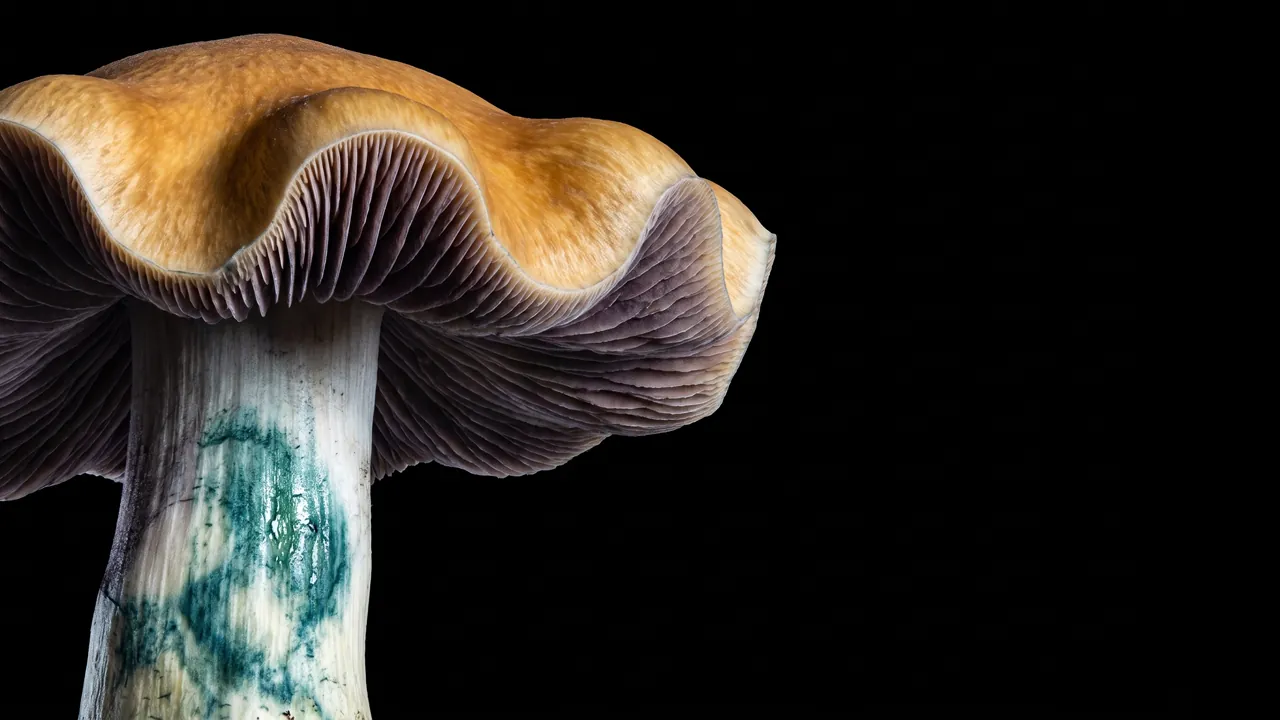
Why do magic mushrooms turn blue when cut or bruised?
It starts with psilocybin, the compound these mushrooms store. Psilocybin carries a phosphate group, a small chemical tag. When a person eats the mushroom, the body removes that tag and makes psilocin, the form that acts on serotonin receptors (Lenz et al., 2020).
The mushroom can do the same thing to itself. A team led by Dirk Hoffmeister at Friedrich Schiller University Jena and the Leibniz-HKI institute found the two enzymes that do it in Psilocybe cubensis. Their paper came out online in December 2019 and in print in January 2020 (Lenz et al., 2020; Leibniz-HKI, 2020).
- Damage. A cut, a squeeze or a bruise breaks open the mushroom’s cells.
- Step one, PsiP. An enzyme called PsiP (a phosphatase) strips the phosphate from psilocybin, leaving psilocin.
- Step two, PsiL. A second enzyme, PsiL (a laccase), oxidizes psilocin into a reactive form.
- Pairs and chains. The reactive psilocin units bond into pairs and longer chains (mostly 3 to 13 units in the 2020 measurements). Together they give the blue.
Evidence: established for P. cubensis. The enzymes were pinned down in that one species. But genes like PsiL turned up in every psilocybin-making fungus whose genome was available, so the same system is likely widespread (Lenz et al., 2020).
Why doesn’t an intact mushroom turn blue? The authors suggest the enzymes are kept apart from psilocybin until damage mixes them. The enzyme sequences hint that PsiL works outside the cell and PsiP inside a lysosome, a small compartment within it. They also argue the phosphate tag works like a safety cap, keeping a reactive molecule stable until it is needed (Lenz et al., 2020). Evidence: preliminary.
What is the blue pigment, exactly?
There is no single blue molecule. The Jena team found a mixed set of linked psilocin units and wrote that “no single blue compound exists” in these mushrooms (Lenz et al., 2020).
Then the science corrected itself, which is how it should work. The 2020 paper suggested the blue came mainly from pairs of units joined at one position. A 2021 follow-up tested this with altered psilocin units that could pair up but not form chains. The main early blue product turned out to be a pair joined at a different position; the first kind adds a greenish tint (Lenz et al., 2021).
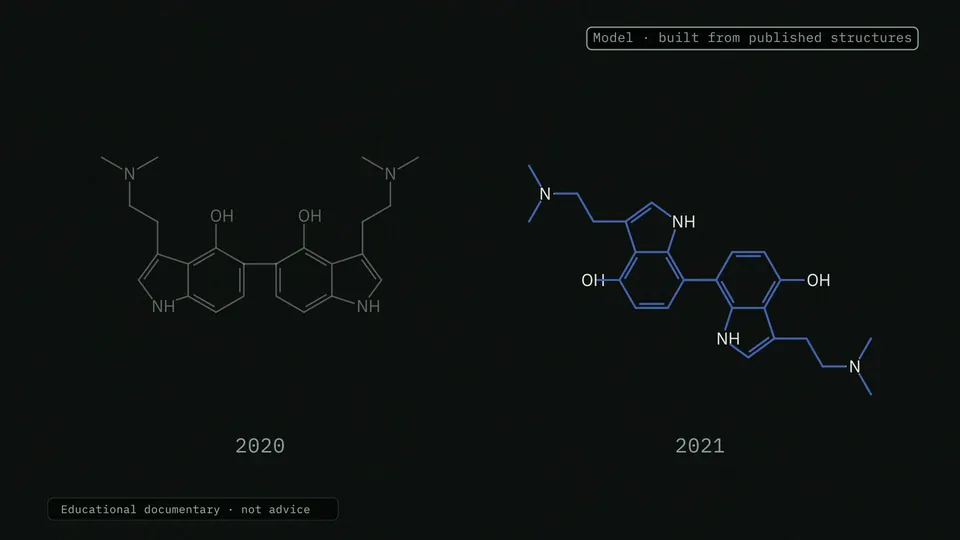
The shade also depends on conditions. In test tubes, strong oxidation gave blue, while slow oxidation by air gave greenish, taupe or brown. After about 30 to 60 minutes, one blue mixture faded and slowly turned light brown (Lenz et al., 2020). Evidence: established, from lab chemistry.
A puzzle older than the answer
People noticed the colour long before anyone explained it. Species names such as Psilocybe cyanescens and Psilocybe azurescens point to it (Lenz et al., 2020), and cyanescens simply means “becoming blue” (Zhang et al., 2022).
In 1958, Hofmann and colleagues described psilocybin from the Mexican mushroom Psilocybe mexicana (Hofmann et al., 1958). Chemists found that psilocin, but not psilocybin, turns blue when oxidized. The pigment puzzled chemists for decades before the enzymes were found (Lenz et al., 2020). The wider story is in our history of magic mushrooms.
Why would a mushroom turn itself blue?
Evidence: unresolved. The leading idea is defence. The Jena team noted that the blue chains resemble tannin-like compounds that can harm insect guts. They proposed the chains “may serve a defense function” (Lenz et al., 2020).
A 2024 study of the genus notes that the blue psilocin chains are “invariably connected” to making psilocybin, even in lineages that gained it separately. The authors read this as support for the idea that the blue polymer, not the psychedelic effect, is what matters to the fungus (Bradshaw et al., 2024).
The first experiments on the defence idea used whole mushroom extracts, not the blue pigment itself. In a 2026 study, fruit fly larvae fed P. cubensis extracts survived less well and moved less. Yet flies lacking the serotonin receptor that psilocybin acts on in humans reacted the same way. The extracts held many compounds, so the authors could not confirm what caused the effects (Matthews Nicholass et al., 2026).
Does blue mean a magic mushroom is stronger?
Many people ask whether blue shrooms are stronger. The limited evidence points to no, for three reasons.
1. The blue is psilocin being used up
Evidence: established. The pigment is made from psilocin. In the Jena experiments, psilocin was “gradually consumed” as the blue formed (Lenz et al., 2020). A blue patch marks psilocin that has already been turned into something else. Our film puts it plainly: the stain is psilocin being consumed.
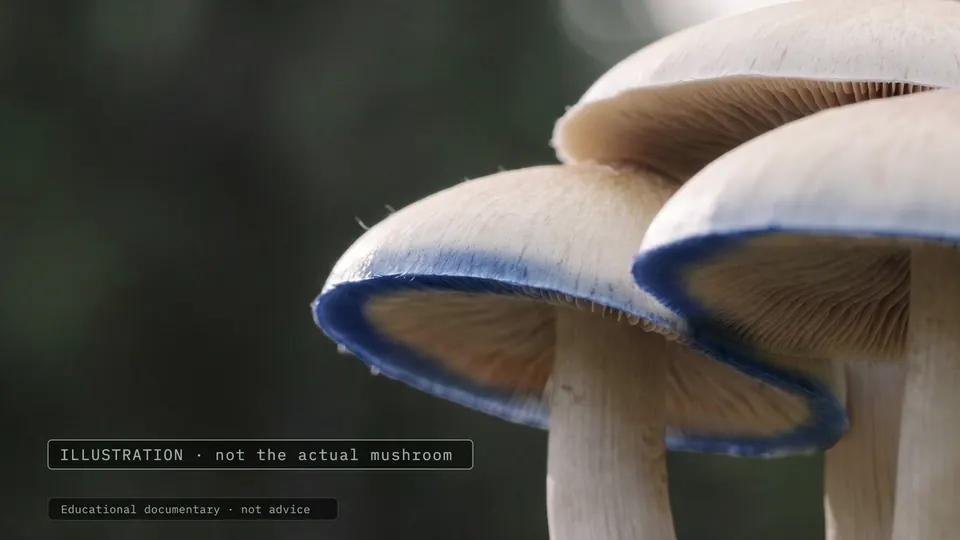
2. Colour and content don’t track each other
Evidence: preliminary. We found no study designed to measure bruise colour against psilocybin content. The observations that exist point one way. In a 2025 study, lab-grown mushrooms frozen for 24 hours turned deep blue on thawing. The authors wrote that this bluing “does not necessarily correlate with psilocin levels,” and that more experiments are needed (Windsor et al., 2025).
Some species in that study gained a lot of psilocin with only slight bluing. Psilocybe zapotecorum went intensely blue while holding only marginal psilocin. In the same species, psilocybin fell from 1.29% in fresh freeze-dried samples to 0.08% in freezer-stored ones. The intense blue came with a large loss, not a gain (Windsor et al., 2025).
In another survey, two mushrooms from one Gymnopilus collection “strongly turned blue-green” when picked. Yet they held much less psilocybin than earlier reports for their genus (Gotvaldová et al., 2022). Results in this genus vary from one collection to the next; see what tests found in the laughing gym.
3. Strength varies for reasons you can’t see
Evidence: established. Psilocybin levels swing widely, even between mushrooms that share a name. A 1982 study of cultivated P. cubensis found psilocybin varied by a factor of four across harvests, and by over ten times between samples from outside sources (Bigwood and Beug, 1982).
A 2026 study grew 14 strains under the same lab conditions. Total tryptamines (psilocybin and its chemical relatives) still varied more than 7.8-fold between strains, and single mushrooms within a strain differed too (Sharchaton et al., 2026).
Time matters as well. These compounds break down in storage, and some old museum specimens held none that could be detected (Gotvaldová et al., 2021; Bradshaw et al., 2022). A colour cannot show any of this.
What does it mean when a mushroom turns blue?
In a mushroom that makes psilocybin, a blue bruise most likely means psilocin chemistry is under way where the tissue was damaged (Lenz et al., 2020). In many other mushrooms, the same colour comes from unrelated pigments (Velíšek and Cejpek, 2011). Here is what the colour can and can’t tell you.
| Question | What the evidence says | Evidence |
|---|---|---|
| Is psilocin chemistry happening? | In Psilocybe, yes. The blue is oxidized psilocin, linked into pairs and longer chains. | Established |
| Does the mushroom contain psilocybin? | Not by colour alone. Boletes bruise blue through other chemistry, and one blue-tinged Inocybe has repeatedly tested negative. | Established |
| How strong is it? | In the few observations so far, bruise colour and measured content did not track each other. | Preliminary |
| Is it safe to eat? | Colour says nothing about toxins, and deadly look-alikes exist. | Established |
| Why does the mushroom do it? | Possibly chemical defence. Not yet shown. | Unresolved |
Do all magic mushrooms turn blue?
Not an identification guide
Bruising cannot tell you whether a wild mushroom is psychedelic, harmless or deadly. The Ontario Poison Centre says only a mushroom expert, a mycologist, can tell poisonous and non-poisonous mushrooms apart (Ontario Poison Centre). See why colour is no safety test.
Most do: the flesh typically turns blue or blue-green when bruised (Gotvaldová et al., 2022). But not all do, and not always strongly. Health Canada says there are over 200 species of magic mushrooms (Health Canada). In Psilocybe, counted in the broad sense, a 2022 study puts the number with a blue reaction to damage at 144, out of roughly 277 to 326 known species (Bradshaw et al., 2022).
The same study notes that psilocybin has been confirmed by testing in only about 45 accepted Psilocybe species, roughly a third of the blue-bruising ones. For the rest, it is assumed rather than measured. Most non-bluing species in that broad count probably belong in another genus, Deconica, though many have not been formally moved. None of them are known to make psilocybin (Bradshaw et al., 2022). Evidence: established.
Psilocybe is not the only genus with psilocybin. In Panaeolus, species with psilocybin are “often, but not always” recognized by a strong blue stain (Strauss et al., 2023).
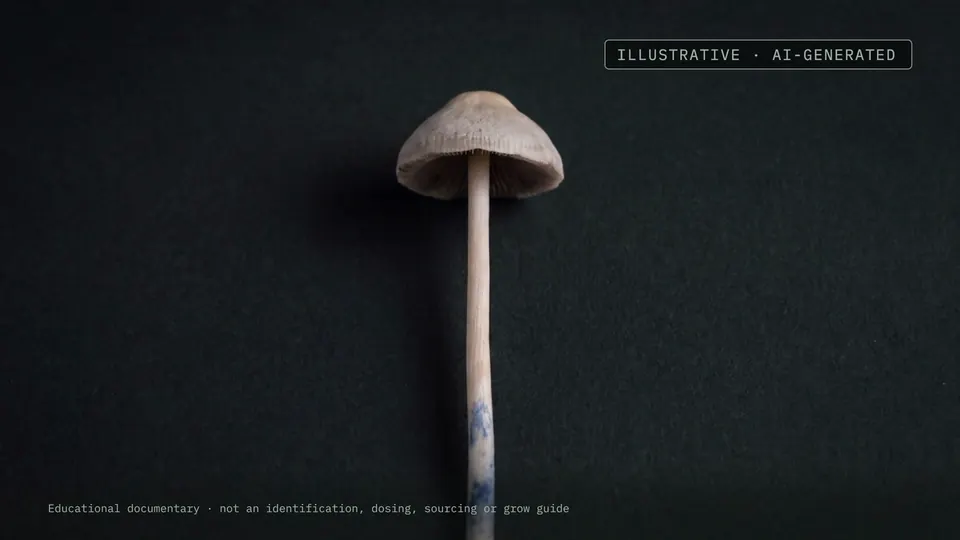
Blue can also appear without a fresh injury. Psilocybe specimens may turn blue as they age (Lenz et al., 2020), and frozen mushrooms in one lab turned deep blue on thawing (Windsor et al., 2025). Both fit damaged cells letting the enzymes reach psilocybin, though neither study tested that directly.
Which other mushrooms bruise blue?
Plenty. The Jena team notes that instant blue on injury is seen in other mushrooms too (Lenz et al., 2020). Many are boletes, mushrooms with pores under the cap instead of gills, and their blue comes from different molecules.
In many boletes, the blue comes from pulvinic acid derivatives, the yellow pigments typical of the bolete order. Two of them, variegatic and xerocomic acids, turn into blue forms when oxidized (Velíšek and Cejpek, 2011). Evidence: established.
The Jena paper traces the blue of the dotted stem bolete and the cornflower bolete to pulvinic acid derivatives or their close relatives, the diarylcyclopentenones (Lenz et al., 2020). The cornflower bolete, Gyroporus cyanescens, owes its blue to gyrocyanin, one of those relatives, described in 1973 (Besl et al., 1973; Velíšek and Cejpek, 2011).
A 2024 study of two Chinese boletes found pulvinic acid derivatives at work and called them “the major bluing compounds in Boletaceae.” It also notes that the pigments behind bluing often differ between families in the bolete order (Wang et al., 2024). Same colour, unrelated chemistry.
A blue bolete linked to hallucinations, apparently without psilocybin
One bolete makes the point vividly. Lanmaoa asiatica is a prized food mushroom in Yunnan, China. Its local name, Jian Shou Qing, means “see-hand-blue/green,” because it bruises at a touch. Its blue comes from pulvinic acid derivatives, mostly variegatic acid (Wang et al., 2024; Guo et al., 2025).
It is also linked to hallucinations. In a 2025 study of 20 people poisoned by it, 75% had hallucinations, and the authors wrote that the toxic mechanism “remains unclear” (Dai et al., 2025). A 2026 genome study found none of the known psilocybin genes, which suggests another compound is at work (Domnauer and Dentinger, 2026). Evidence: the pigment is established; the toxin is unresolved.
Do poisonous mushrooms turn blue? Why colour is no safety test
If someone may have eaten a poisonous mushroom
Call the Ontario Poison Centre at 1-800-268-9017, 24 hours a day, or 911 in an emergency. Do not wait for symptoms: the centre advises calling before the person feels sick (Ontario Poison Centre). Our safety page keeps these numbers.
Health Canada notes that many species look alike, and warns that “it is possible for people to consume poisonous mushrooms, mistaking them for magic mushrooms” (Health Canada).
Some of the most dangerous look-alikes are small and brown. Some species of Galerina, a genus of “little brown mushrooms,” carry amatoxins at levels equal to the death cap. Serious illness has followed when Galerina was mistaken for edible or hallucinogenic mushrooms (Landry et al., 2021). Evidence: established.
The delay adds to the danger. By the time serious symptoms appear, two to four days after eating, the liver and other organs are already badly damaged (Landry et al., 2021). The Ontario Poison Centre also warns that illness can take many hours to start, and says to call right away (Ontario Poison Centre).
Even museum collections get names wrong. When researchers DNA-tested 94 specimens labelled Psilocybe, 13 turned out to belong to other genera. In public DNA databases, at least one sequence labelled P. cubensis actually came from Galerina. The authors wrote that field features are often not enough, “resulting in rampant misidentification” (Bradshaw et al., 2022). Evidence: established.
A 2026 preprint adds a twist. It reports that Galerina indica, nicknamed the “dark magic mushroom,” makes both psilocybin and amatoxins, the first species shown to carry both (Kunik et al., 2026, preprint). Evidence: preliminary, not yet peer reviewed. If it holds up, psilocybin chemistry and deadly toxins can share a single mushroom.
What the Tidal Wave film found
Our documentary Tidal Wave (watch it on YouTube) follows one bag of dried mushrooms entered in the Oakland Hyphae Psilocybin Cup, a 2021 potency contest in Oakland, California. Tidal Wave is an informal cultivar label for a line of P. cubensis, usually described as a cross of B+ and Penis Envy. As the film notes, such names have no formal registry.
As reported by the website Tripsitter, the winning sample measured 3.82%: 2.26% psilocybin and 1.56% psilocin. The reported averages across 138 samples in the 2021 contests were 0.75% psilocybin and 0.14% psilocin (Tripsitter, archived). We could not access the organizers’ own data to check them. Evidence: preliminary, from one secondary report.
These figures describe one sample. They are not a guide to choosing, comparing or using any mushroom, including any labelled Tidal Wave.
The film’s blue chapter (watch from 4:43 on YouTube) uses this chemistry to explain why the psilocin figure stood out. As the film explains, psilocin is the fragile half of the pair. It is what the mushroom uses up when it bruises, and it breaks down with handling, air, drying and storage.
Studies back the air and storage parts. In the lab, air alone oxidized psilocin (Lenz et al., 2020), and these compounds decay in storage (Gotvaldová et al., 2021).
In a classic 1982 study, psilocybin was “nearly always at least twice the level of psilocin” (Bigwood and Beug, 1982). In the winning sample, psilocybin was less than twice its psilocin, and the psilocin sat far above the reported average. The film does not call that an error. It argues the number reflects how that one sample was grown, dried, packed and stored, as much as its genetics.
That is the same lesson the blue teaches. One lab number describes one bag. One bruise describes one moment of chemistry. Neither can tell you what the next mushroom with the same name holds.
What we still don’t know
- Why mushrooms make the blue at all. Defence is the leading idea, but it has not been shown (unresolved).
- Whether every psilocybin mushroom uses PsiP and PsiL. The genes look widespread, but the enzymes were worked out in P. cubensis (preliminary).
- How much psilocin a bruise costs. We found no study that measures stain size against psilocin lost in whole mushrooms (unresolved).
- Which blue-bruising Psilocybe species truly contain psilocybin. Most have never been confirmed by testing (unresolved).
- What makes Lanmaoa asiatica hallucinogenic. The compound has not been identified (unresolved).
Here is the odd part: the blue is the mushroom’s own chemistry at work, possibly a defence built from the very molecule people know it for. Stay curious, and check the date on this page. Next, read our history of magic mushrooms or, closer to home, surprising stories of psychedelic Toronto. Both documentaries are on our films page.
Common questions
Why do magic mushrooms turn blue?
When the mushroom is damaged, an enzyme called PsiP strips the phosphate from psilocybin to make psilocin. A second enzyme, PsiL, oxidizes psilocin, and the units link into pairs and chains that look blue. Researchers in Jena, Germany, showed this in Psilocybe cubensis in a paper published online in late 2019.
Does blue bruising mean magic mushrooms are stronger?
Not reliably. The blue is psilocin being used up, and early lab observations (preliminary) suggest bruise colour does not track psilocin levels. Strength varies between strains, between single mushrooms and with storage, and the colour reveals none of this.
Do all magic mushrooms turn blue?
Most psilocybin mushrooms bruise blue, but not all do so strongly or reliably. In Panaeolus, bluing is described as present often but not always, and psilocybin has been confirmed by testing in only about a third of blue-bruising Psilocybe species.
Are all mushrooms that bruise blue magic mushrooms?
No. Many boletes bruise blue through unrelated pigments such as variegatic acid. One blue-bruising bolete, Lanmaoa asiatica, is linked to hallucinations. A genome study found none of the known psilocybin genes in it, so another compound is suspected (unresolved).
Do poisonous mushrooms turn blue?
Some blue-bruising mushrooms cause poisoning. Colour says nothing about deadly toxins such as the amatoxins in some Galerina species. Never use bruising to judge whether a wild mushroom is safe. In Ontario, call the Poison Centre at 1-800-268-9017, 24 hours a day, without waiting for symptoms.
Why do magic mushrooms turn blue after picking or freezing?
Cutting and handling damage cells and let the enzymes reach psilocybin. Freezing probably does the same, and Psilocybe can also turn blue as they age. In one lab study, frozen mushrooms turned deep blue on thawing. The colour means psilocin is being oxidized, not that the mushroom has gained strength.
Shroomverse sells mushroom products. This article is general information about mushroom chemistry and natural history. It is not medical, legal or identification advice, and it does not recommend any product.
SOURCES
- Injury-Triggered Blueing Reactions of Psilocybe “Magic” Mushrooms (Lenz C, Wick J, Braga D, et al., Angewandte Chemie International Edition 59(4):1450–1454; online 4 December 2019, issue January 2020), Wiley (peer-reviewed, open access); full text via PubMed Central, PMC7004109. Accessed .
- Structure Elucidation and Spectroscopic Analysis of Chromophores Produced by Oxidative Psilocin Dimerization (Lenz C, Dörner S, Sherwood A, Hoffmeister D, Chemistry – A European Journal 27(47):12166–12171, 2021), Wiley (peer-reviewed, open access); full text via PubMed Central, PMC8457229. Accessed .
- When magic mushrooms turn blue (press release, 28 January 2020), Leibniz Institute for Natural Product Research and Infection Biology (Leibniz-HKI), Jena. Accessed .
- DNA Authentication and Chemical Analysis of Psilocybe Mushrooms Reveal Widespread Misdeterminations in Fungaria and Inconsistencies in Metabolites (Bradshaw AJ, et al., Applied and Environmental Microbiology 88(24):e01498-22, 2022), American Society for Microbiology (peer-reviewed); full text via PubMed Central, PMC9764976. Accessed .
- Phylogenomics of the psychoactive mushroom genus Psilocybe and evolution of the psilocybin biosynthetic gene cluster (Bradshaw AJ, et al., PNAS 121(3):e2311245121, 2024), Proceedings of the National Academy of Sciences (peer-reviewed); full text via PubMed Central, PMC10801892. Accessed .
- Wherefore the Magic? The Evolutionary Role of Psilocybin in Nature (Matthews Nicholass KJ, et al., Ecology and Evolution 16(4):e73522, 2026), Wiley (peer-reviewed, open access); full text via PubMed Central, PMC13103472. Accessed .
- Development of Psilocybe Mushroom Species Reference Material—Cultivation Parameters and Chemical Profiles (Windsor C, et al., Journal of AOAC International 109(1):37–50; online February 2025), Oxford University Press (peer-reviewed); full text via PubMed Central, PMC12733971. Accessed .
- Extensive Collection of Psychotropic Mushrooms with Determination of Their Tryptamine Alkaloids (Gotvaldová K, et al., International Journal of Molecular Sciences 23(22):14068, 2022), MDPI (peer-reviewed, open access); full text via PubMed Central, PMC9693126. Accessed .
- Stability of psilocybin and its four analogs in the biomass of the psychotropic mushroom Psilocybe cubensis (Gotvaldová K, et al., Drug Testing and Analysis 13(2):439–446, 2021), Wiley (peer-reviewed). Accessed . Abstract consulted; full text not open.
- Variation of psilocybin and psilocin levels with repeated flushes (harvests) of mature sporocarps of Psilocybe cubensis (Earle) Singer (Bigwood J, Beug MW, Journal of Ethnopharmacology 5(3):287–291, 1982), Elsevier (peer-reviewed); record on PubMed, PMID 7201054. Accessed . Abstract consulted; full text not open.
- Surprising Variability in Tryptamine Profiles of Psilocybe cubensis Fruiting Bodies: Inter- and Intra-Strain Differences Across 14 Strains Cultivated Under Controlled Conditions (Sharchaton A, et al., Journal of Fungi 12(7):486, 2026), MDPI (peer-reviewed, open access); full text via PubMed Central, PMC13412672. Accessed .
- Global species diversity and distribution of the psychedelic fungal genus Panaeolus (Strauss D, Ghosh S, Murray Z, Gryzenhout M, Heliyon 9(6):e16338, 2023), Cell Press (peer-reviewed review, open access); full text via PubMed Central, PMC10238702. Accessed .
- New insights into the genus Gyroporus (Gyroporaceae, Boletales), with establishment of four new sections and description of five new species from China (Zhang M, et al., Mycology 13(3):223–242, 2022), Taylor & Francis (peer-reviewed, open access); full text via PubMed Central, PMC9354645. Accessed .
- Psilocybin, ein psychotroper Wirkstoff aus dem mexikanischen Rauschpilz Psilocybe mexicana Heim (Hofmann A, Heim R, Brack A, Kobel H, Experientia 14(3):107–109, 1958), Springer (peer-reviewed). Accessed . Bibliographic record consulted; cited only for its date and subject.
- Pigments of higher fungi: a review (Velíšek J, Cejpek K, Czech Journal of Food Sciences 29(2):87–102, 2011), Czech Academy of Agricultural Sciences (peer-reviewed review, open access). Accessed .
- Pilzpigmente, XVII. Über Gyrocyanin, das blauende Prinzip des Kornblumenröhrlings (Gyroporus cyanescens), und eine oxidative Ringverengung des Atromentins (Besl H, Bresinsky A, Steglich W, Zipfel K, Chemische Berichte 106(10):3223–3229, 1973), Wiley (peer-reviewed). Accessed . Bibliographic record consulted; cited for its date and subject, gyrocyanin as the bluing compound of the cornflower bolete. Cited by Lenz et al., 2020 (reference 6).
- Pulvinic Acid Derivative Pigments in Lanmaoa asiatica and L. macrocarpa (Wang Y, et al., Chemistry & Biodiversity 21(5):e202301996, 2024), Wiley (peer-reviewed). Accessed . Abstract consulted; full text not open.
- Geographic Provenances Outweigh Tissue Compartments in Bacteriome Assembly of the Ectomycorrhizal, Edible, and Hallucinogenic if Undercooked, Lanmoa asiatica (Boletaceae, Boletales) Mushroom from Yunnan China (Guo M, et al., Microorganisms 13(11):2431, 2025), MDPI (peer-reviewed, open access); full text via PubMed Central, PMC12654045. Accessed . Cited for the local name and the bluing pigments.
- Untargeted Metabolomic Analysis Using UPLC–MS/MS Reveals Metabolic Changes Associated With Lanmaoa asiatica Poisoning (Dai R, Duan Z, Han B, et al., Food Science & Nutrition 13(7):e70583, 2025), Wiley (peer-reviewed, open access); full text via PubMed Central, PMC12237617. Accessed .
- Phylogenomic systematics of Lanmaoa (Boletaceae) reveals cryptic diversity, resolves global evolutionary relationships, and suggests a novel psychoactive lineage (Domnauer C, Dentinger BTM, Mycologia 118(4):732–742, 2026), Taylor & Francis (peer-reviewed); record on PubMed, PMID 42247306. Accessed . Abstract consulted; full text not open.
- Phylogenetic analysis of the distribution of deadly amatoxins among the little brown mushrooms of the genus Galerina (Landry B, et al., PLOS ONE 16(2):e0246575, 2021), PLOS (peer-reviewed, open access); full text via PubMed Central, PMC7875387. Accessed .
- The “dark magic mushroom” co-produces amatoxins and psilocybin (Kunik AR, et al., posted 22 July 2026), bioRxiv (preprint, not peer reviewed). Accessed . Preprint: abstract consulted. Findings may change in peer review.
- Psilocybin and psilocin (magic mushrooms), Health Canada. Accessed . The live page did not load for us on 3 or 4 October 2026. Wording checked in the Internet Archive capture of 3 October 2026: https://web.archive.org/web/20261003072650/https://www.canada.ca/en/health-canada/services/substance-use/controlled-illegal-drugs/magic-mushrooms.html
- Mushrooms (public information page), Ontario Poison Centre, operated by The Hospital for Sick Children (SickKids), Toronto. Accessed .
- Ontario Poison Centre: get help, Ontario Poison Centre. Accessed . Source for the 24-hour, toll-free number 1-800-268-9017.
- What Is the Psilocybin Cup? (Cup Winners & Strongest Strains 2021 & 2022) (McElroy C, last updated 16 January 2024; Internet Archive copy of 28 February 2026), Tripsitter (secondary report). Accessed . Secondary source for the 2021 Psilocybin Cup figures; the organizers’ data could not be checked. The live page no longer loads.
- The Strongest Magic Mushroom Ever Tested? Tidal Wave Mushroom (documentary, 10:41), Shroomverse on YouTube. Accessed .
CHANGES
- : First published after a separate fact-check. Every source opened and checked on this date; the claims sheet is kept with our editorial notes.
- : Added a link to the new laughing gym article.



