THE SHROOMVERSE JOURNAL ✳ 12 MIN READ
Mushroom potency claims: what laboratory studies of psilocybin content do and do not show
Topic: Mushroom names and species
Published
Listen: the 3-minute version
AI-narrated summary of this article
Short answer, checked 4 October 2026
A laboratory result describes the material tested, with the method used, and nothing more. Studies of psilocybin-producing mushrooms report different compounds in different units on different bases, and they find large differences between mushrooms of the same species, between named strains grown side by side, and between single fruiting bodies of one strain. Names, colour and reputation are not measurements. No study we found shows that a name predicts strength, and this guide does not rank any.
On this page 8 sections
A laboratory number looks like a fact about a kind of mushroom. It is a fact about one sample, measured one way. Whether it says anything wider depends on what was measured, in which units, on which material, how that material was identified and handled, and how many independent mushrooms stand behind it.
This guide is about reading mushroom potency evidence, not about any particular result. It quotes no concentration as a typical or target value, ranks no names, and gives no use guidance. Where it describes what a study found, it says which study and prefers ratios and ranges of variation to single figures. For the chemistry of the colour change that people sometimes read as a strength signal, see why magic mushrooms turn blue.
How we label the evidence
Established: shown in the peer-reviewed studies cited and not seriously disputed. Preliminary: early, small, indirect or from a single study. Unresolved: an open question, where the data are missing or point different ways.
What does a mushroom potency figure actually measure?
The word potency can hide several different measurements. A report may give psilocybin alone, psilocin alone, a sum of several compounds, or a calculated equivalent. The substances a laboratory measured are called analytes, and the first check on any figure is which analytes it covers and how any total was defined. The studies below measured different sets: one quantified six tryptamines, another five, another psilocybin and psilocin with three more identified but not quantified (Sharchaton et al., 2026; Gotvaldová et al., 2022; Windsor et al., 2025). Totals built from different lists are not interchangeable.
The units and the denominator matter just as much. Of those three studies, two report milligrams per gram and one reports a percentage (a 2021 stability study cited below uses weight per cent), and the analytical methods differ too: liquid chromatography with mass spectrometry in one, liquid chromatography with optical detection in another, thin-layer chromatography in a third. A percentage and a milligrams-per-gram figure can be converted, but only if both describe the same material on the same basis.
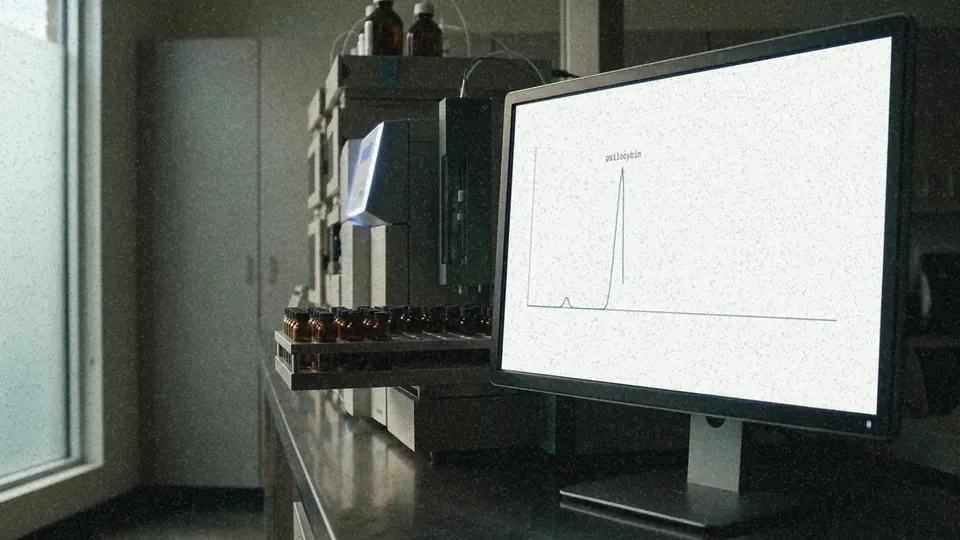
That basis is the denominator. The three studies above measured dried, powdered fruiting bodies, so their figures are per amount of dried material. A figure per amount of fresh material, or for an extract, answers a different question and cannot be set beside them without stating the difference. If a report does not say what the figure is per, the comparison is not ready to be repeated. Evidence: established, as a matter of measurement practice.
Is one tested sample representative of a strain or species?
Two kinds of replication are easy to confuse. Repeated measurements of the same prepared powder show how consistent the instrument and method are (technical replicates). Separate mushrooms show how much living material varies (biological replicates). Ten instrument readings of one ground sample are not ten mushrooms.
A 2026 study shows why the difference matters. It grew 14 named strains of Psilocybe cubensis in individual chambers under identical laboratory conditions, with the same substrate, drying and extraction. Total tryptamines still varied by more than 7.8-fold between strains. For six randomly selected strains, the authors then analyzed five separate fruiting bodies each, harvested together from the same chamber at the same stage. Psilocybin varied between those individual mushrooms with coefficients of variation of roughly 13 to 23 per cent across the six strains. The authors concluded that single-mushroom sampling has real limits for characterizing a strain (Sharchaton et al., 2026). Evidence: preliminary, from one study of one species under one set of conditions, but it separates the kinds of replication the question needs.
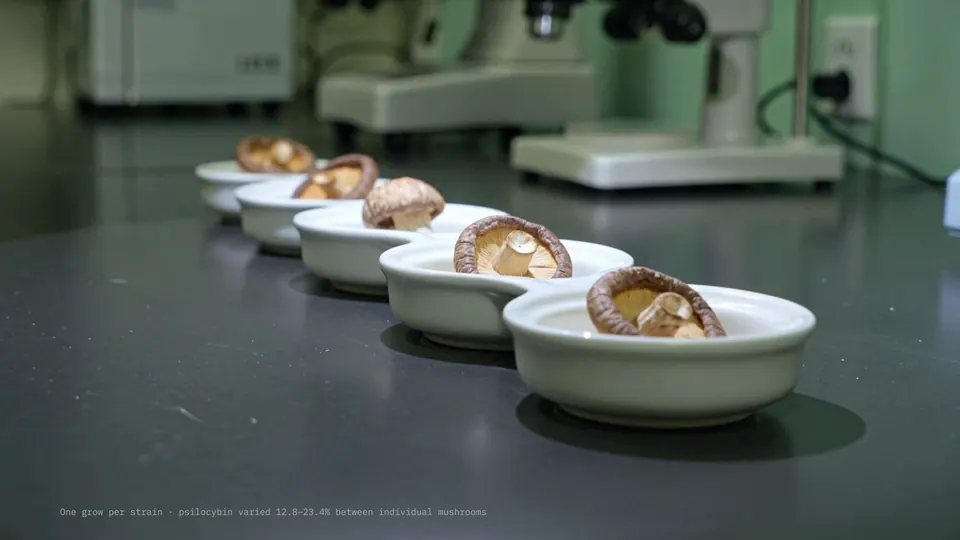
Older and wider work points the same way. A 1982 study of cultivated P. cubensis found psilocybin varied by a factor of four across successive harvests from the same culture, and by over a factor of ten between samples obtained from outside sources (Bigwood and Beug, 1982). A 2022 survey of 226 fruiting bodies from 82 collections in seven genera called the concentrations extremely variable, found no tryptamines in two of the Psilocybe collections, and said it could not explain striking variation among samples probably from the same mycelium (Gotvaldová et al., 2022). Evidence: established that variability is large; what drives it is unresolved.
Does the name on a label identify the material that was tested?
A label is a starting point, not a sample record. The useful questions are whether there is a specimen voucher or accession number, who identified the material and how, and whether the material tested is the same material that was identified. If those links are missing, a precise chemical result may answer a narrower question than its headline suggests.
The 14-strain study is open about this. It obtained its cultures from two commercial suppliers, confirmed by DNA sequencing that all fourteen belong to P. cubensis, and then checked each strain’s appearance against its declared designation and public descriptions. The authors note that no comprehensive genetic reference database exists for these strains, so strain identity rested on the declared name and the look of the mushrooms. The sequencing established the species, not the strain (Sharchaton et al., 2026). That is a careful design by a published group, and it still shows the limit: within the cultivated-strain world, a name is a declared label.
The 226-fruiting-body survey took a different route: most collections were documented by fungarium specimens, DNA sequences or both, and the species were identified by a mycologist among the authors (Gotvaldová et al., 2022). Even so, identity is not a solved problem in this field. A 2022 re-examination of 94 museum specimens labelled Psilocybe found that 13 of them clustered with other genera by DNA, and the authors described published chemical studies as largely inconsistent, citing missing vouchers and varying methods (Bradshaw et al., 2022). Evidence: established. For how names are used across cultivated material, see what can and cannot be compared between cubensis names.
How do handling and storage change a result?
Psilocybin and especially psilocin are unstable, so the history of a sample is part of the result. A 2021 study that monitored freshly cultivated P. cubensis found that the amount of tryptamines depended on how fruiting bodies were stored and processed, with the greatest loss in fresh mushrooms frozen at minus 80 degrees Celsius and the least in dried material kept dark at room temperature (Gotvaldová et al., 2021). A 2025 study of cultivated Psilocybe species reported that freezing fresh mushrooms before freeze-drying drastically reduced psilocybin and increased psilocin (Windsor et al., 2025).
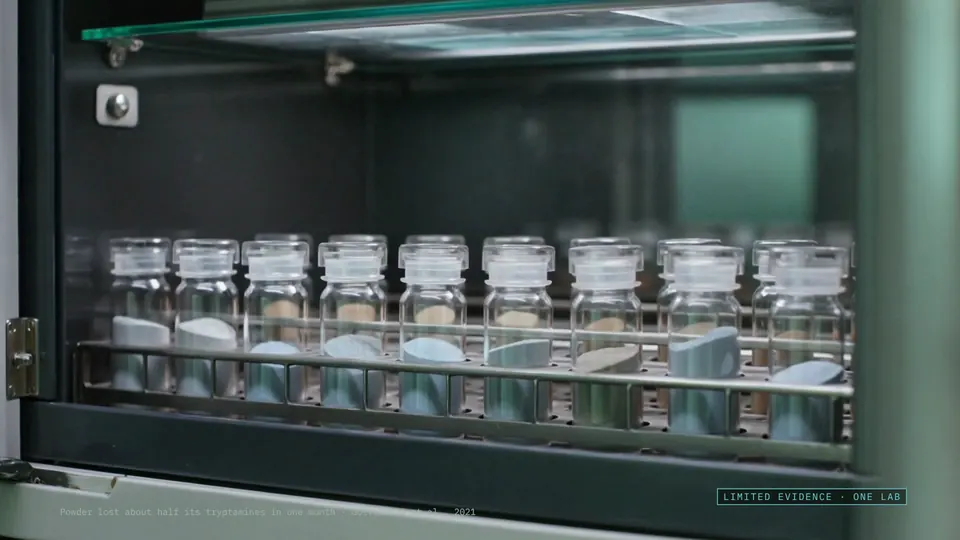
Time does the same on the shelf. In the museum-specimen study, psilocybin and psilocin decayed in a way that depended on both the species and the specimen’s age, and some specimens had no detectable amount of either (Bradshaw et al., 2022). The authors of the 226-fruiting-body survey acknowledged that sample processing and storage before analysis can distort results, and that mushrooms harvested by volunteers could not be handled identically (Gotvaldová et al., 2022).
The consequence for readers is practical but limited to interpretation: two samples with the same name can differ because of how they were grown, dried, stored and tested, not only because of what they are. A report that does not record handling and time before analysis cannot attribute a difference to genetics. Evidence: established for the direction of these effects.
| Check | What to look for | What it protects against |
|---|---|---|
| Identity | The exact label, the species determination, and a specimen or accession identifier | Carrying a result over to unrelated material |
| Measurement | Which compounds, in what units, per what amount, and how any total was defined | Comparing unlike quantities |
| Sampling | Independent collections or individual mushrooms, separate from repeat readings of one powder | Overstating how much biological evidence exists |
| History | How the material was grown or collected, dried and stored, and the time before analysis | Attributing every difference to genetics |
| Uncertainty | A range, the variation between samples, and the method’s limits | Presenting one number as a permanent property |
| Claim | The narrow conclusion this design can support | Turning chemistry into a promise about people |
Can colour, reputation or a contest result stand in for a measurement?
Colour is not an assay. Research on the blue bruising of Psilocybe mushrooms identified a chemical reaction in which psilocin is oxidized into a heterogeneous mixture of linked units (Lenz et al., 2020). That describes a process, not a calibrated scale. In the 2025 cultivation study, frozen mushrooms turned deep blue on thawing, and the authors noted that this bluing does not necessarily track psilocin levels: one species turned intensely blue while holding only marginal psilocin (Windsor et al., 2025). Evidence: preliminary, but consistent with the chemistry. A blue photograph is not a measurement.
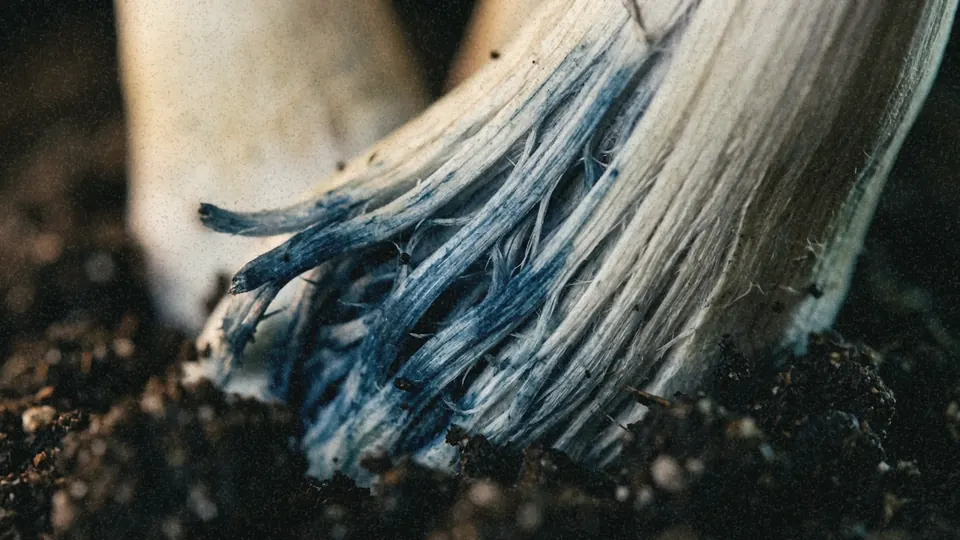
Words such as legendary, gentle or advanced are not analytical units either. A familiar reputation may explain why people search for a name; it does not supply the missing sample records.
A contest result has the same limits. It can show how submitted samples placed under that event’s rules. It cannot stand for all material carrying the same label, or for material that was never submitted, and a single placing is one sample. Our documentary Tidal Wave follows one reported contest result; the evidence-limited reading of that case is in Tidal Wave mushrooms: documented labels and what competitions cannot show.
Does a chemical difference mean two names produce different experiences?
No study cited here tested that. A chemically different sample could justify a new research question; it does not by itself show that two named mushrooms produce reliably different subjective experiences. Answering that would need a human study with authenticated material, comparable conditions, defined outcomes and attention to expectation and bias. The authors of the 226-fruiting-body survey also point out that the mixture of tryptamines in a whole mushroom differs from pure psilocybin, which complicates how results from one can be read for the other (Gotvaldová et al., 2022). Evidence: unresolved.
The same care applies in reverse. When a clinical trial tests a standardized preparation with professional support, describe that preparation as it was. Do not silently substitute a commercial mushroom name for what the researchers actually gave. This guide is chemistry and sampling only; it makes no health claim, and it is not a guide to using, buying, growing or identifying anything.
Not an identification or safety guide
A laboratory result cannot tell you what an unknown mushroom is, and no study in this guide makes a wild mushroom safe to eat. Misidentification is a real poisoning risk. See our safety page for emergency and poison-help contacts.
What we still don’t know
- What drives the variation between single mushrooms of one strain grown side by side. The 14-strain study showed it exists; the 226-collection survey could not explain it for samples probably from one mycelium (unresolved).
- How far results for named cultivated strains carry across growers, substrates and years. The study that compared strains used one protocol, and the authors note its conditions may not suit every strain (preliminary).
- Whether strain names map onto distinct, heritable genetics. The 14-strain study noted that no comprehensive genetic reference database exists for these strains (unresolved).
- Whether any named material differs reliably in human experience. We found no study that tests this (unresolved).
For the wider picture of what these mushrooms are, start with what are magic mushrooms, and for the molecule itself, what is psilocybin.
Common questions
Does this mean laboratory testing of mushrooms is useless?
No. A well-documented result can be very informative about the sample it measured. The mistake is stretching it to every mushroom with the same name, or to people, without evidence.
Why do potency figures from different studies not line up?
They may measure different compounds, define totals differently, use different methods, and report in different units or on different bases, such as dried versus fresh material. They also test different mushrooms with different handling histories.
Do mushrooms of the same species or strain have the same psilocybin content?
Not in the studies we read. Content differed between collections, between named strains grown under identical conditions, and between single fruiting bodies of the same strain from the same chamber.
Does the blue colour show how strong a mushroom is?
No calibrated link has been shown. Blue bruising reflects psilocin being oxidized, and one cultivation study found bluing did not necessarily track psilocin levels. See the guide on why mushrooms turn blue.
Can a contest result show which mushroom is strongest?
It can describe how submitted samples placed under that event’s rules. It cannot represent all material with the same label or material never submitted, and it is one sample.
Why doesn’t Shroomverse publish a ranking of names?
Combining incompatible methods, identities and sampling designs would make the order look more certain than the evidence is. This site compares evidence quality and scope, not strength.
Shroomverse sells mushroom products. This article is general information about mushroom laboratory analysis and the limits of potency claims. It is not medical, legal or identification advice, and it does not recommend any product.
SOURCES
- Surprising Variability in Tryptamine Profiles of Psilocybe cubensis Fruiting Bodies: Inter- and Intra-Strain Differences Across 14 Strains Cultivated Under Controlled Conditions (Sharchaton A, et al., Journal of Fungi 12(7):486, 2026), MDPI (peer-reviewed, open access); abstract and full text read via Europe PMC, PMC13412672. Accessed . Supports: six tryptamines quantified in dried material and reported in mg per g; 14 strains grown under identical conditions with total tryptamines varying more than 7.8-fold; five fruiting bodies each for six randomly selected strains, with psilocybin coefficients of variation of 12.81 to 23.39 per cent; strains obtained from two suppliers, species confirmed by ITS sequencing, strain identity checked phenotypically against the declared name because no comprehensive genetic reference database exists; the authors' point about single-specimen sampling.
- Extensive Collection of Psychotropic Mushrooms with Determination of Their Tryptamine Alkaloids (Gotvaldová K, et al., International Journal of Molecular Sciences 23(22):14068, 2022), MDPI (peer-reviewed, open access); abstract and full text read via Europe PMC, PMC9693126. Accessed . Supports: 226 fruiting bodies, 82 collections, seven genera; five tryptamines by UHPLC-MS/MS; most collections documented by fungarium specimens and/or sequencing; no tryptamines detected in two Psilocybe collections; variability called extremely variable; unexplained variation among samples probably from the same mycelium; the processing, storage and volunteer-handling limitations; the point about the tryptamine mixture versus pure psilocybin.
- Stability of psilocybin and its four analogs in the biomass of the psychotropic mushroom Psilocybe cubensis (Gotvaldová K, et al., Drug Testing and Analysis 13(2):439–446, 2021), Wiley (peer-reviewed); abstract read via Europe PMC. Accessed . Supports: dependence of measured tryptamines on storage and processing conditions, greatest degradation in fresh mushrooms stored at minus 80 degrees Celsius, least in dried biomass kept dark at room temperature; results in weight per cent. Abstract only; full text not read.
- Development of Psilocybe Mushroom Species Reference Material: Cultivation Parameters and Chemical Profiles (Windsor C, et al., Journal of AOAC International, 2026; online 2025), Oxford University Press (peer-reviewed); abstract and full text read via Europe PMC, PMC12733971. Accessed . Supports: HPTLC method with psilocybin and psilocin quantified and three other tryptamines identified; results in per cent; freezing fresh mushrooms before freeze-drying reduced psilocybin and increased psilocin; bluing on thawing does not necessarily correlate with psilocin levels, with a species that turned intensely blue holding only marginal psilocin.
- DNA Authentication and Chemical Analysis of Psilocybe Mushrooms Reveal Widespread Misdeterminations in Fungaria and Inconsistencies in Metabolites (Bradshaw AJ, et al., Applied and Environmental Microbiology 88(24):e01498-22, 2022), American Society for Microbiology (peer-reviewed); abstract and full text read via Europe PMC, PMC9764976. Accessed . Supports: 94 fungarium specimens re-examined by DNA barcoding, 13 clustering outside Psilocybe in other genera; taxon- and time-dependent decay of psilocybin and psilocin with some specimens having none detectable; the authors' criticism of earlier chemical studies for missing vouchers and inconsistent methods.
- Injury-Triggered Blueing Reactions of Psilocybe “Magic” Mushrooms (Lenz C, et al., Angewandte Chemie International Edition 59(4):1450–1454, 2020), Wiley (peer-reviewed); abstract read via Europe PMC. Accessed . Supports: blue colour arises from enzymatic dephosphorylation of psilocybin to psilocin and oxidative oligomerization, giving a heterogeneous mixture of linked units. Abstract only; the article makes no claim of a colour-to-concentration scale.
- Variation of psilocybin and psilocin levels with repeated flushes (harvests) of mature sporocarps of Psilocybe cubensis (Earle) Singer (Bigwood J, Beug MW, Journal of Ethnopharmacology 5(3):287–291, 1982), Elsevier (peer-reviewed); record on PubMed, PMID 7201054, abstract read via Europe PMC. Accessed . Supports: psilocybin variable over a factor of four across harvests from one culture, and by over a factor of ten between samples from outside sources. Abstract only; full text not read.
CHANGES
- : Published. Revised from a supplied draft; every source reopened and each claim checked against it on this date.



