
THE SHROOMVERSE JOURNAL ✳ 14 MIN READ
Golden Teacher vs Penis Envy and other cubensis names: what can actually be compared?
Topic: Mushroom names and species
Published Updated
Listen: the 3-minute version
AI-narrated summary of this article
Short answer, checked 4 October 2026
You can compare how each cubensis name is documented, not the mushrooms themselves. In the records we read, Golden Teacher and B+ each appear as a DNA-sequenced study sample assigned to Psilocybe cubensis, Penis Envy appears on a public genome record, and Tidal Wave and Amazonian appear as entries in a dated competition report. Those are different kinds of record and carry different weight. None of them ranks the names, shows what any name does for a person, or shows two names to be the same or different material.
On this page 10 sections
People who search for “golden teacher vs penis envy” usually want a verdict. This article does not give one, and it explains why. The fairest comparison starts with the evidence attached to each name. A sequence-linked sample, a genome record and a competition entry are different kinds of record, and putting them in one table should not make them look equally authenticated.
So this guide compares claims before it compares mushrooms. It does not rank the names or treat a shared species as proof that two labels are the same. For the vocabulary, see our guide to magic mushroom names; for the species, Psilocybe cubensis.
How we label the evidence
Documented: a source we opened says it directly. Limited: one sample, one study or an indirect link. Not established: we found no source for it, so we do not state it.
Can you compare Golden Teacher and Penis Envy?
At the level of records, yes. At the level of the mushrooms, not on the evidence we found. Three comparisons are out of reach: ranking the names by any measured property, saying what a name means for a person, and saying that two names are the same material or different material.
The last point is easy to miss. “Not shown to differ” and “shown to be the same” are different statements: a missing record of a distinctive property does not establish biological equivalence. The reverse holds too, because a different name does not prove different material.
What kinds of record sit behind a cubensis name?
Five different things get called “the evidence” for a name. Keeping them apart is the method here.
- Taxonomic record. A scientific name for a species. GBIF lists Psilocybe cubensis (Earle) Singer as an accepted species name (GBIF). It places a mushroom in a species. It cannot say which labelled line a sample came from.
- Sequence-linked study sample. A labelled sample whose DNA was sequenced and deposited. In the 2025 study by Cohen and colleagues, the strains labelled Golden Teacher and B+ each have an ITS sequence in GenBank, classified as Psilocybe cubensis (Cohen et al., 2025).
- Genome record. A public dataset of a sequenced genome. The CoGe record we read is labelled “Penis Envy” in its version field (CoGe, genome 60487).
- Laboratory sample in a competition table. A sample an entrant submitted for chemical analysis, listed with fields the entrant supplied (Hyphae Cup report).
- Commercial label. A name used when material is sold or shared. The sources we read describe no registry that authenticates such names, and one study calls cultivar provenance and pedigrees “lore” that is “not authenticated” (more below).
What the two study-sample records show
Documented. Cohen and colleagues studied 42 strains grown by an Israeli company, PsygaBio, under controlled conditions. The authors identified each by appearance, then cross-checked it by sequencing the ITS region of its ribosomal DNA, because species identification by appearance “may be unreliable” (Cohen et al., 2025). ITS is a short DNA stretch used to place a fungus in a species.
Table 1 lists a strain labelled Golden Teacher (row 18) and one labelled B+ (row 14), both classified as Psilocybe cubensis. The GenBank records give the sample as a fruiting body from PsygaBio in Israel, collected in January 2024 (Golden Teacher record; B+ record).
Limited, and worth reading closely. The table gives the same match figures, 99.73% identity over 97% of the query sequence, to the Golden Teacher row, the B+ row and a row labelled PE, which the paper does not spell out. So this record places samples in the species but cannot tell the labels apart. The study was funded by PsygaBio and three authors are its employees, as the paper discloses (Cohen et al., 2025).
What the genome record shows
Documented. CoGe genome ID 60487 is a Psilocybe cubensis assembly named “Psilocybe cubensis P.envy” with version “Penis Envy”. Its source is listed as Medicinal Genomics, and it was created by Kevin McKernan on 10 February 2021. It is described as a long-read assembly in 32 contigs of about 46 million bases (CoGe, genome 60487). That ID is CoGe’s own, not an accession in the international sequence databases, so we call it a genome record.
Not established: complete ancestry, the source of the underlying material, or whether any other sample matches this assembly. An assembly is a reference point for comparison, not a pedigree for every mushroom sold under the same name.
What the competition report shows
Documented. The Fall 2022 Hyphae Cup report is a table of submitted samples with columns for submitter, sample name, “Species of Origin” and “Cultviar” (spelled so in the report), followed by compound measurements. Two entries carry the cultivar field “Tidalwave”: CUP290, sample name “TW3 MMF”, and CUP302, “Tidal Wave Bob”. One entry, CUP278, is named “Amazonian SM”, with the cultivar field “South American Landrace - Amazonian”. All three have Psilocybe cubensis in the species field (Hyphae Cup report).
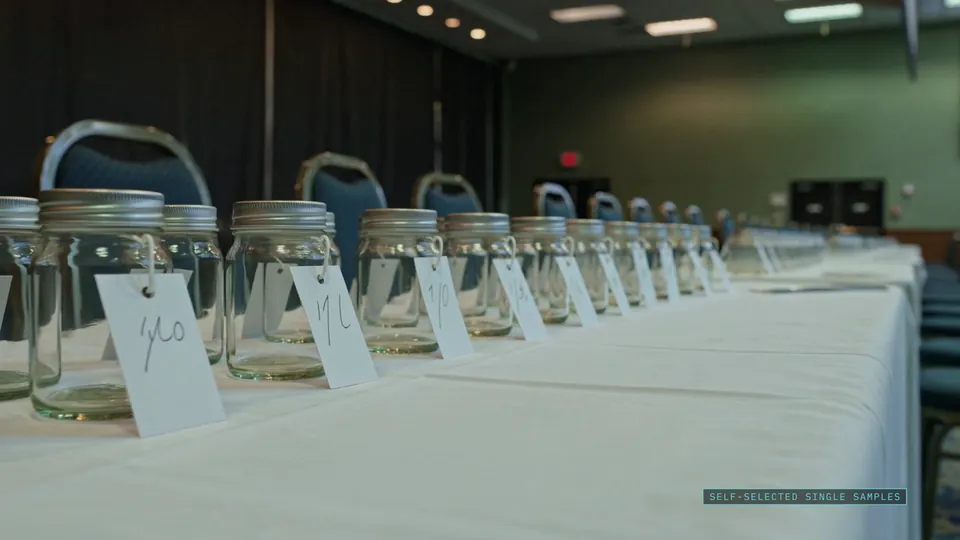
Limited. The pages we read give no statement that the species or cultivar fields were independently verified, and some entries carry the report’s own “NEEDS CONFIRMATION” flag. A field records how an entry was labelled, not a confirmed identity. The geographic words in CUP278’s cultivar field are a label too: no collection record sits behind them here.
A version note. Oakland Hyphae’s post offers the full report as a file named Fall22HC_v3, dated 2 January 2023 and updated 16 January 2023. It says the update corrected table order errors, added late entrants and corrected name errors (Oakland Hyphae). The PDF we read is titled “Fall 2022 Hyphae Cup Awards Announcement” and its embedded creation date is 17 December 2022, so we cannot confirm from the files alone that it is the v3 file. Anyone citing a row should name the version used.
What does each name’s record support?
| Name | Record used here (type) | What it supports | What stays unresolved |
|---|---|---|---|
| Golden Teacher | Study sample, Cohen et al. 2025, Table 1 row 18 (GenBank PV069796.1) | One labelled sample was placed in P. cubensis by ITS sequence | Whether all material under the name is uniform; earliest origin; any name-specific property in people |
| Penis Envy | Genome record, CoGe 60487 (version “Penis Envy”) | A public P. cubensis genome record carries the label | Complete ancestry; whether another sample matches this assembly |
| B+ | Study sample, Cohen et al. 2025, Table 1 row 14 (GenBank PV069792.1) | One labelled sample was placed in P. cubensis by ITS sequence | Broader lineage history; any universal characteristic |
| Tidal Wave | Competition entries CUP290 and CUP302, Fall 2022 Hyphae Cup report | The label appeared with P. cubensis in the species field of a dated report | Independent identity verification; documented parentage |
| Amazonian | Competition entry CUP278, Fall 2022 Hyphae Cup report | The label and the phrase “South American Landrace - Amazonian” appeared in a dated report | Geographic provenance; continuous history of the name |
A sample with a DNA check, a genome dataset and a field in a submission table are not equal. Each name has its own article: Golden Teacher, Penis Envy, Tidal Wave and Amazonian. The film Tidal Wave follows one competition result.
Is the same name in two records the same mushroom?
Not on the evidence we read. The competition report has two entries with “Golden Teacher” in the cultivar field, from two different submitters, CUP297 and CUP306. It has three with “Penis Envy” in that field, from three submitters, CUP300, CUP271 and CUP286, plus others with longer labels that contain the words. The two Tidal Wave entries are also from different submitters (Hyphae Cup report). Each is a separate sample with its own result, so “Golden Teacher” in the report is not one object. We have not checked whether any record above is the same material as another, and nothing we read says so.
Genome work points the same way. McTaggart and colleagues sequenced 38 wild isolates from Australia and compared them with 86 genomes of commercially available cultivars. They sorted the cultivar genomes into five statistical groups. One group was named Golden Teacher (37 genomes) and another P-envy (6 genomes). The authors write that the provenance and pedigrees of cultivars “exist in lore but are not authenticated” (McTaggart et al., 2023).
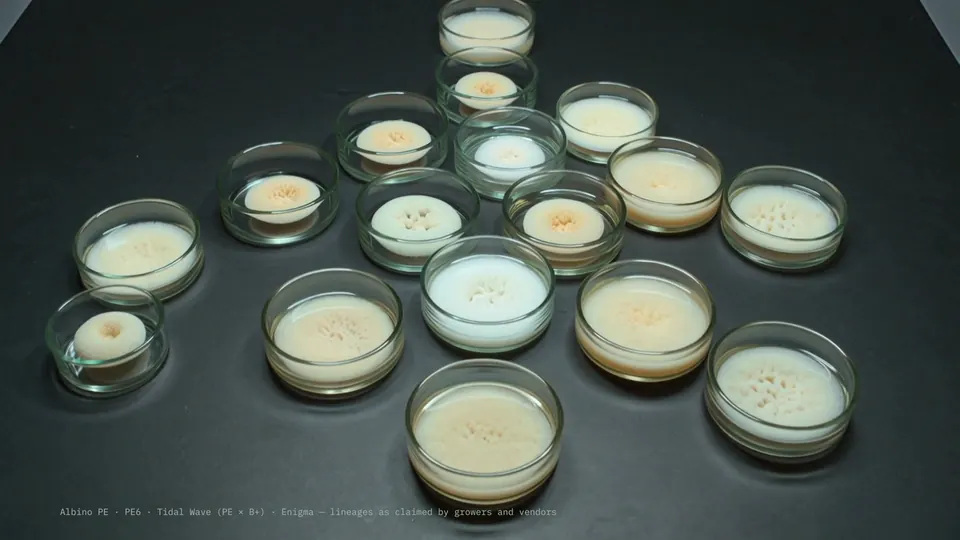
Two readings follow, and both matter. First, a shared name is not a shared genome: the paper summarises earlier genome work as finding that cultivars sold under similar commercial names were not genetically similar among different US-based spore providers (McTaggart et al., 2023). Second, a different name is not a different lineage: their kinship analysis shows most cultivars were founded from related populations. Cultivar names that may suggest a place, such as Amazon, Burma and Cambodia, sit in the Golden Teacher and Blue Magnolia groups. The authors say such names suggest collection from several natural populations. But given how related those populations are, they offer other readings: the cultivars were founded from closely related genotypes, lost diversity through domestication, or the names do not indicate provenance (McTaggart et al., 2023). That is a cultivar called Amazon in a genome study, not the Amazonian label in the competition report, and we do not equate them.
Species is no shortcut either. Cohen and colleagues report diversity in metabolites within as well as between the nine species they sampled (Cohen et al., 2025). One species label does not mean a shared chemical profile, and it does not mean named material is identical.
Why is there no effects column?
A column of “visual”, “spiritual”, “gentle” or “energetic” would look useful and would imply evidence this article does not have. A name-by-name comparison would need appropriately identified material, a defined outcome and a design able to separate differences in the material from every other influence. We found no source that does this for these names.
A laboratory concentration does not directly supply a human outcome, and a report of an experience does not authenticate the named material. Even the genetic side is open: McTaggart and colleagues call the extent to which genetic differences among cultivars affect psilocybin production “untested” (McTaggart et al., 2023).
What would a fair potency comparison need?
The competition report does give measurements, in mg/g, for several compounds per entry (Hyphae Cup report). We quote none and rank no name by them. A useful comparison would start with comparable material and methods: the compounds measured, consistent units, fresh or dry material stated, and independent biological samples kept apart from repeated measurements.
That last point is easy to lose. Oakland Hyphae says its numbers are the mean of replicates (Oakland Hyphae). Replicates tighten the measurement of one submitted sample. They do not widen the number of biological samples behind a name. A defensible conclusion would be modest, about the sampled material under stated conditions. Extending it to every mushroom with a commercial label would need a much broader evidence base. Our guide to reading laboratory potency claims sets out the checks.
Why is Blue Meanies handled separately?
A comparison turns misleading if a name can point to different species. iNaturalist lists “Blue Meanies” as the common name of Panaeolus cyanescens (iNaturalist). Separately, Table 1 of the 2025 study has a strain called Blue Meanies that it assigns to Psilocybe cubensis (Cohen et al., 2025), and the competition report has an entry named “Blue Meanie RL” with P. cubensis in the species field (Hyphae Cup report). Each is documented, and none settles what the name means in general. Our article on why the Blue Meanies name is ambiguous works through it; the Panaeolus side is in Panaeolus cyanescens, and our film Blue Meanie: one nickname, two mushrooms covers both. Resolve that before treating the name as one more row in a cubensis comparison.
Can this comparison help identify a mushroom?
Not an identification guide
This comparison covers records and terminology. It gives no diagnostic traits and cannot identify an unknown mushroom, and nothing here is a basis for eating one. Mistaking a poisonous mushroom for a psychoactive one is a real hazard. Read our safety page, which keeps the poison-help contacts.
We also do not treat a seller’s use of a name, including our own, as a record. Several of these names are used commercially, and a product label is not evidence about what is in the package. Nothing here describes any product.
What we still don’t know
- Whether samples carrying one name are uniform. We found no source that tests this for these names (not established).
- Whether any two records above describe related material. We did not check, and nothing we read says so (not established).
- Where any of the names began, or who first used them (not established).
- Whether the species and cultivar fields in competition reports were independently verified (limited: not stated in the pages we read).
- Whether genetic differences among cultivars matter for chemistry at all (the authors call this untested).
Next: the directory of magic mushroom species and names, how to research magic mushroom origin stories and the Penis Envy story. The pillar guide to magic mushrooms covers the basics.
Common questions
What is the difference between Golden Teacher and Penis Envy?
This article compares records, not mushrooms. In the records we used, Golden Teacher appears as a DNA-sequenced study sample assigned to Psilocybe cubensis, and Penis Envy appears on a public genome record of P. cubensis. Neither shows that the names describe the same or different material, and neither is evidence about strength or effects.
Does one species mean all named material is identical?
No. A species assignment and variation within material are different questions. A 2025 study reported diversity in metabolites within as well as between species. This comparison proves neither complete sameness nor a fixed set of differences.
Is B+ the same as Golden Teacher?
Not shown either way. In a 2025 study each appears as its own labelled sample, placed in Psilocybe cubensis. The table gives the same sequence-match figures to rows with other labels too, so that record cannot tell the labels apart or show them to be related.
Can mushroom names be ranked by strength or effects?
Not on the evidence we found. A laboratory result describes one sample measured one way, and a report of an experience does not authenticate the named material. See our guide to reading potency claims. No ranking is offered here.
Why does B+ have a row rather than its own article?
The sources we verified support a short explanation, so B+ sits in this comparison. A standalone page should wait until it can answer a distinct question with substantial evidence.
Is a competition entry proof of what a name is?
No. It is a dated record that a sample was submitted with certain labels. The pages we read do not say the species or cultivar fields were independently verified, and the report itself flags some entries as needing confirmation.
Can this table help identify a mushroom?
No. It compares records and terminology, not diagnostic traits, and it is not a safe-consumption identification service. See our safety page for the poison-help contacts.
Shroomverse sells mushroom products. This article is general information about mushroom names and taxonomy. It is not medical, legal or identification advice, and it does not recommend any product.
SOURCES
- Comprehensive analysis of 42 psilocybin-producing fungal strains reveals metabolite diversity and species-specific clusters (Cohen J, Sulimani L, Procaccia S, et al., Scientific Reports 15:13822, 2025), Springer Nature (peer-reviewed, open access); full text via PubMed Central, PMC12015540. Accessed . Table 1 (strains labelled Golden Teacher, row 18, and B+, row 14, ITS-classified as Psilocybe cubensis; the same identity and query-cover figures appear for rows with other labels); appearance-based identification described as potentially unreliable; strains grown by PsygaBio; funding and competing-interest statements; metabolite diversity within and between nine species; the Blue Meanies row.
- Psilocybe cubensis isolate Golden Teacher ITS2 partial sequence, GenBank PV069796.1, NCBI GenBank. Accessed . The sequence record behind row 18: isolate label, fruiting-body source, PsygaBio in Israel, collection date January 2024, Sanger sequencing.
- Psilocybe cubensis isolate B+ ITS2 partial sequence, GenBank PV069792.1, NCBI GenBank. Accessed . The sequence record behind row 14: isolate label B+, fruiting-body source, PsygaBio in Israel, collection date January 2024.
- CoGe genome record 60487, Psilocybe cubensis P.envy (version “Penis Envy”), CoGe (genomevolution.org). Accessed . Genome name, version field “Penis Envy”, source Medicinal Genomics, creation by Kevin McKernan on 2021-02-10, assembly description, 32 contigs and length. It is a CoGe identifier, not an international sequence-database accession.
- Fall 2022 Hyphae Cup Awards Announcement (PDF), Oakland Hyphae. Accessed . Rows CUP290 (TW3 MMF) and CUP302 (Tidal Wave Bob), cultivar field “Tidalwave”; CUP278 (Amazonian SM), cultivar field “South American Landrace - Amazonian”; the Golden Teacher, Penis Envy and Blue Meanie entries; column headings, units and “NEEDS CONFIRMATION” flags. PDF metadata: creation date 17 December 2022.
- Fall 2022 Hyphae Cup Full Report (post, 2 January 2023, updated 16 January 2023), Oakland Hyphae. Accessed . The v3 file name, the corrections made (table order, late entrants, name errors), and the statement that numbers are the mean of replicates.
- Domestication through clandestine cultivation constrained genetic diversity in magic mushrooms relative to naturalized populations (McTaggart AR, et al., Current Biology 33:5147–5159, 2023), Cell Press (peer-reviewed). Accessed . 38 Australian isolates compared with 86 cultivar genomes; five statistical cultivar groups including Golden Teacher (37) and P-envy (6); pedigrees “exist in lore but are not authenticated”; similarly named cultivars from different US-based providers not genetically similar (summarising earlier work); most cultivars founded from related populations; place-named cultivars and the alternative readings; genetic effects on psilocybin production called untested.
- Psilocybe cubensis (Earle) Singer, species match (GBIF Backbone Taxonomy), Global Biodiversity Information Facility. Accessed . Psilocybe cubensis (Earle) Singer is an accepted species name in the GBIF backbone.
- Panaeolus cyanescens (iNaturalist taxon 179100), iNaturalist. Accessed . “Blue Meanies” is the preferred common name for Panaeolus cyanescens on iNaturalist.
CHANGES
- : Published.
- : Linked our Blue Meanie film, which covers both uses of the name.



