THE SHROOMVERSE JOURNAL ✳ 11 MIN READ
Does DMT shut down the default mode network? What the scans actually show
Topic: DMT
Published Updated
Short answer, checked 20 October 2026
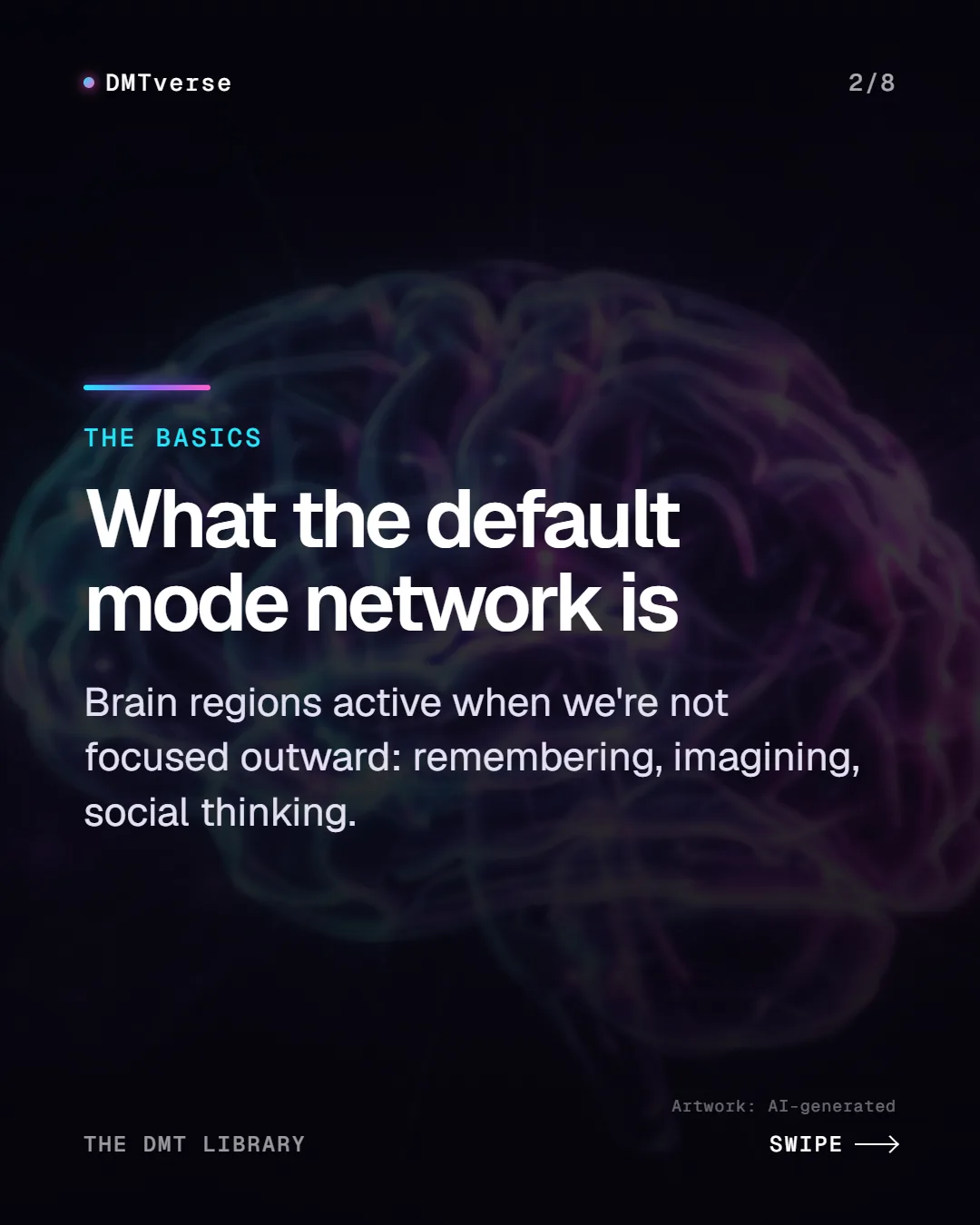
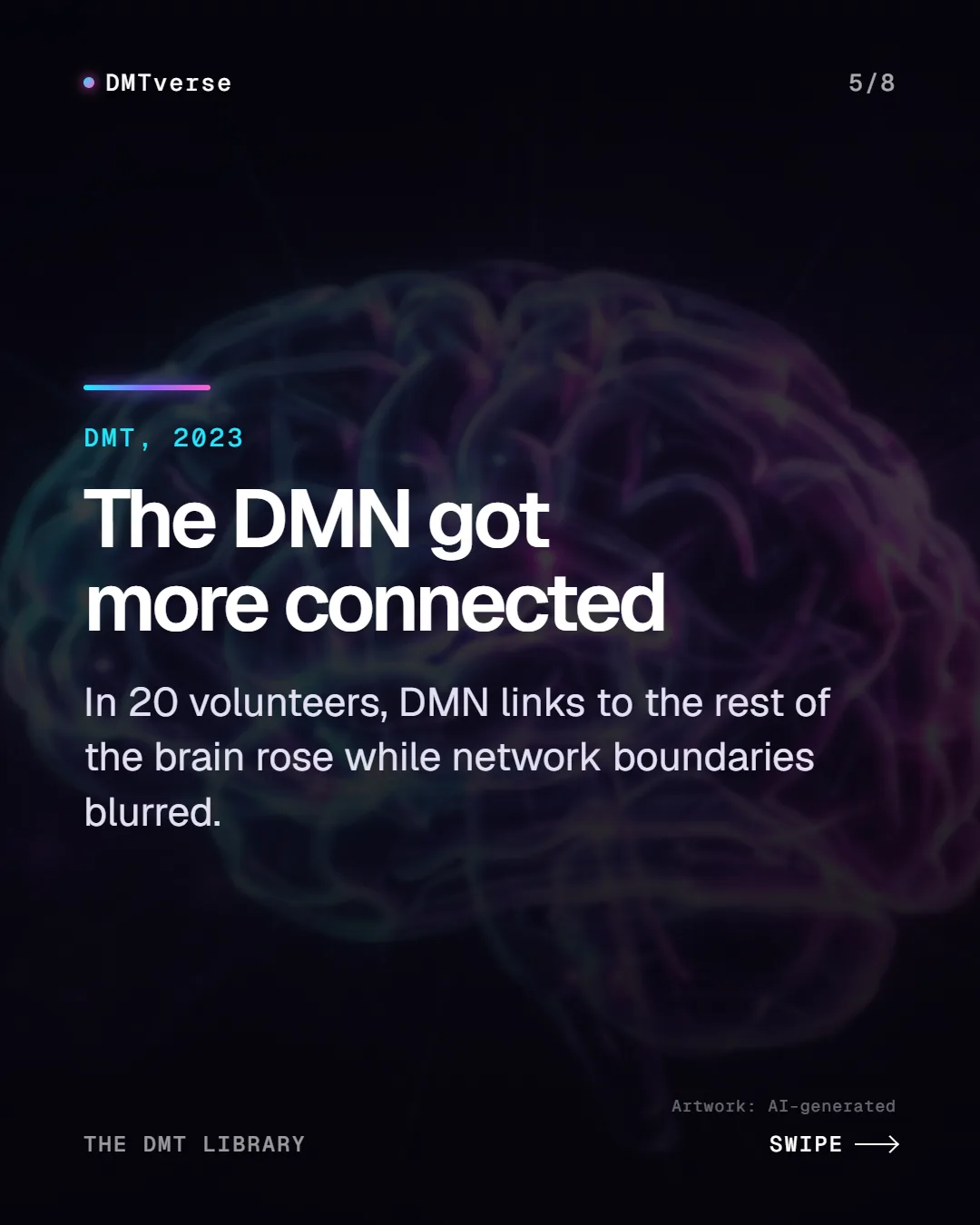
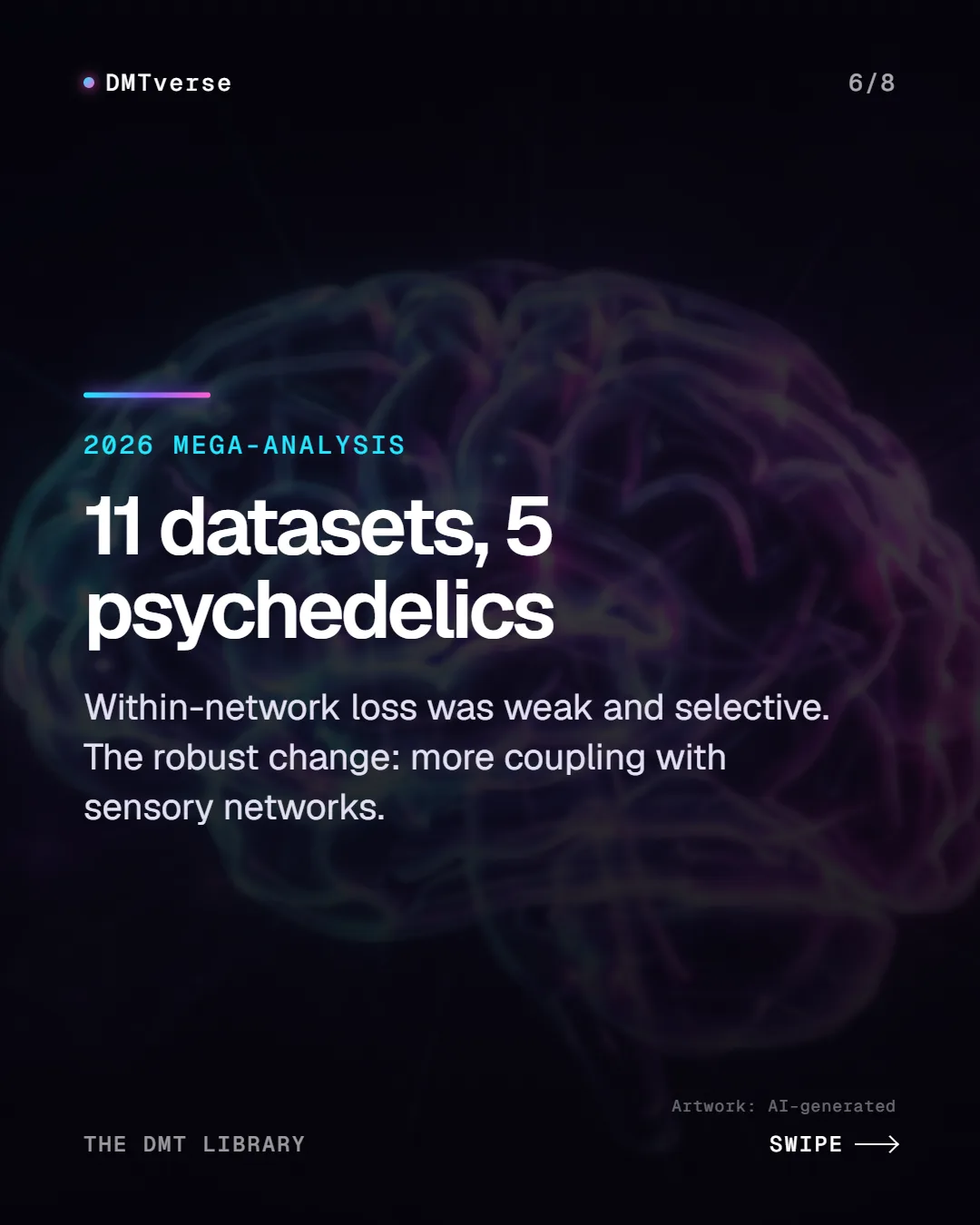
No, not in the way the slogan suggests. In the one detailed brain-scan study of DMT, the default mode network (DMN) became more connected with the rest of the brain, not quieter, while the boundaries between networks blurred. A 2026 analysis pooling 11 psychedelic datasets found only weak, selective drops inside networks; the robust change was more coupling between high-level and sensory networks. The DMN is a set of regions most active when we are not focused on an outside task, linked to remembering, imagining and thinking about ourselves. The ‘dissolving’ idea came from early psilocybin and ayahuasca scans.
THE SHORT VERSION · SWIPE
On this page 8 sections
“DMT switches off the default mode network” is one of the most repeated claims about the drug. It packs a real research thread into a phrase that the evidence does not support. This article explains what the network is, what the studies measured, and why the most recent pooled evidence tells a more modest story. For the wider picture of DMT brain research, see what happens in the brain on DMT.
Education only, not guidance
This article describes published research. It gives no amounts, no instructions and no advice on use, and it does not describe any effect as a benefit. Routes of use appear only to describe how a named study was designed. DMT is a controlled substance in Canada. Evidence labels: established (shown in peer-reviewed studies and not seriously disputed), preliminary (early, small, animal-only or indirect) and unresolved (an open question).
What is the default mode network?
The idea began with a puzzle in brain-imaging data. Certain regions consistently became less active whenever people started a task, compared with resting quietly. In 2001, a team at Washington University proposed that these regions reflect a “baseline” or default state of the resting brain, rather than noise (Raichle et al., 2001). Evidence: established.
Two decades on, a major review describes the default network as regions spread through the association cortex that are suppressed during tasks demanding outside attention, and active during remembering, envisioning the future and making social inferences (Buckner and DiNicola, 2019). A systematic review of psychedelic studies adds that the DMN has been the focus of work on self-reference, mind wandering and autobiographical memory, and that altered DMN connectivity has been associated with conditions such as depression and anxiety (Gattuso et al., 2023). Its best-known hubs are the posterior cingulate cortex and precuneus at the back of the brain’s midline and the medial prefrontal cortex at the front (Palhano-Fontes et al., 2015). Evidence: established.
Two words that cause confusion
‘Activity’ in fMRI means the size of a blood-oxygen signal in a region. ‘Connectivity’ means how closely two regions’ signals rise and fall together. A network can show less internal connectivity and more connectivity with other networks at the same time, which is exactly what several psychedelic studies report.
Where did the idea that psychedelics switch off the DMN come from?
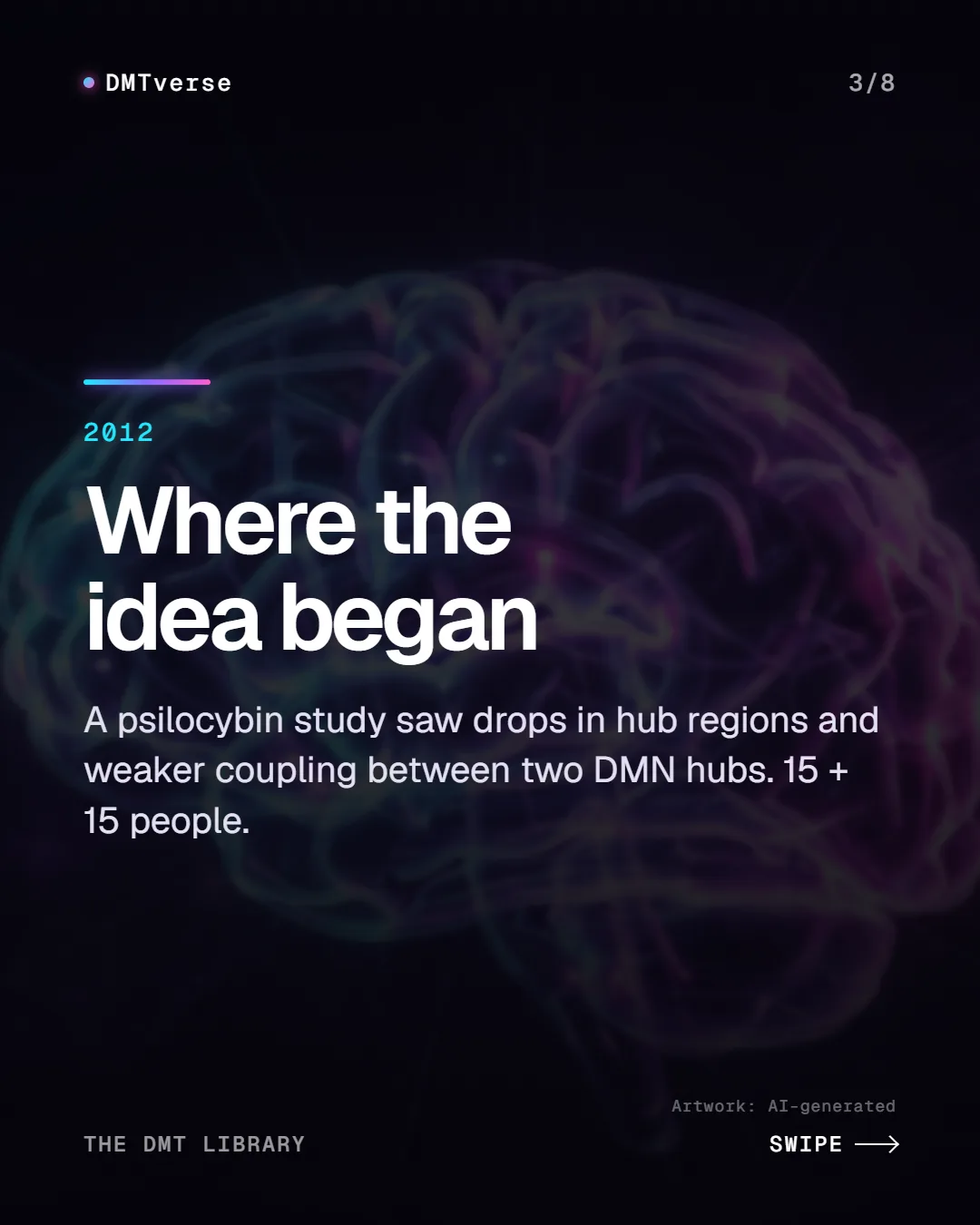
A 2012 London study scanned volunteers given intravenous psilocybin: 15 for blood flow and a separate 15 for the blood-oxygen signal. Contrary to the team’s expectation of increases, they saw only decreases, largest in hub regions such as the thalamus and the anterior and posterior cingulate cortex. A bigger decrease in the medial prefrontal region predicted stronger subjective effects, and coupling between the medial prefrontal cortex and the posterior cingulate, two DMN hubs, weakened (Carhart-Harris et al., 2012). Evidence: preliminary, from small samples.
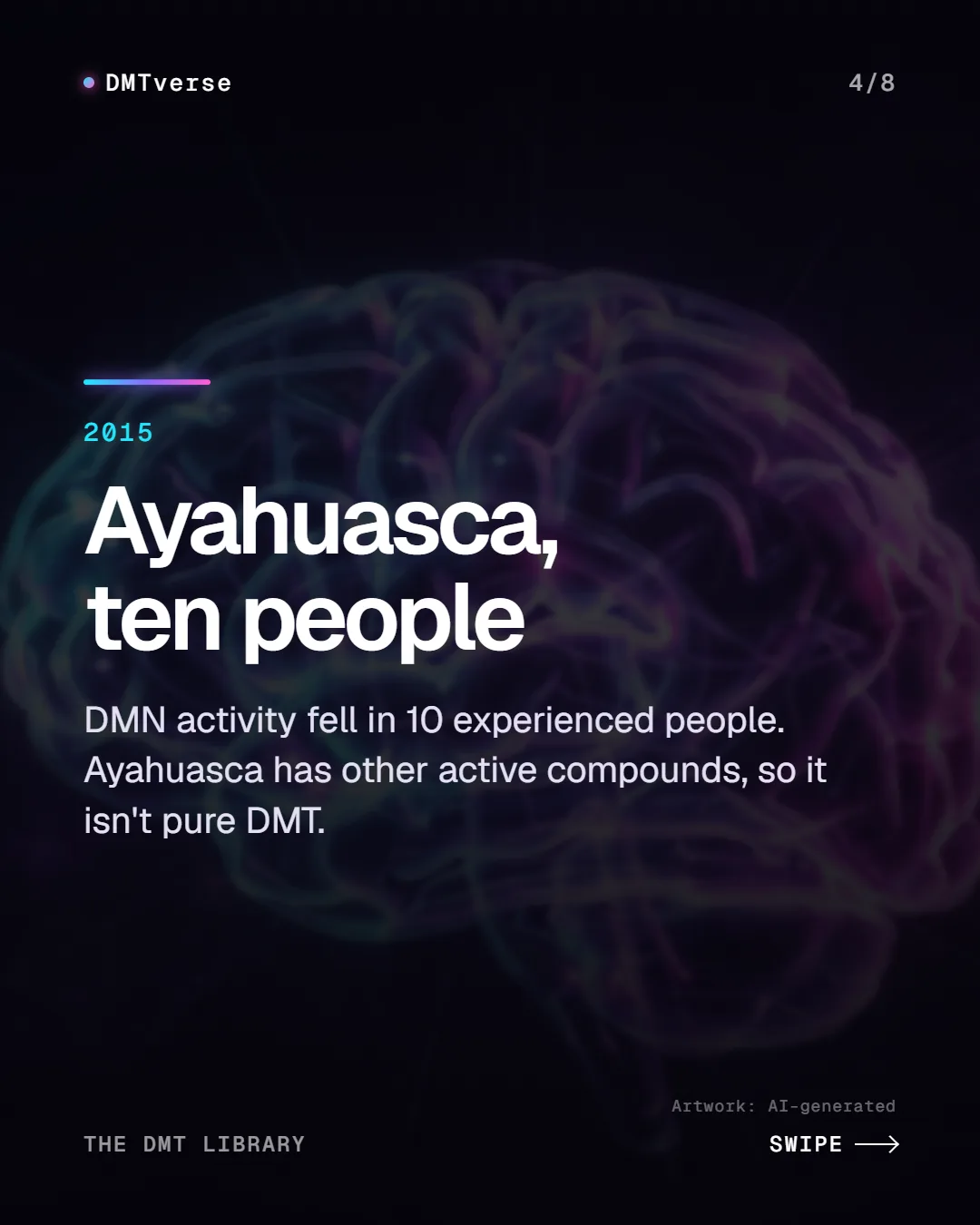
In 2015, a Brazilian team scanned ten experienced people during the effects of ayahuasca, a brew whose main psychedelic component is DMT. Ayahuasca decreased activity through most of the DMN, including its main hubs, and connectivity within the posterior cingulate and precuneus fell (Palhano-Fontes et al., 2015). Ayahuasca contains other active compounds, so this is not a pure DMT result; see ayahuasca vs DMT. Evidence: preliminary.
By 2023, a systematic review of the field concluded that, across LSD, psilocybin and ayahuasca, there is “consistent acute disruption” of resting connectivity within the DMN and increased connectivity between the brain’s main networks. The same review cautioned that it is unclear how central the DMN is to any therapeutic potential (Gattuso et al., 2023). Evidence: preliminary.
What did the DMT brain-scan study actually find?
Only one study has scanned pure DMT with fMRI in detail. In 2023, an Imperial College team recorded EEG and fMRI together in 20 healthy volunteers given intravenous DMT and, separately, placebo, in a single-blind design. They reported increases in global functional connectivity that were significant in the salience, frontoparietal and default-mode networks, together with “network disintegration and desegregation”: networks became less internally cohesive and less separate from one another (Timmermann et al., 2023). Evidence: preliminary.
So in the DMT data, the DMN did not go quiet. It became more strongly linked to the rest of the brain, especially in the first minutes after the injection, while the usual boundaries between networks blurred. The researchers tie this to the brain’s “transmodal” high-level regions, which are also where the 5-HT2A receptor is densest (Timmermann et al., 2023). For how DMT acts on that receptor, see DMT and the 5-HT2A receptor. Evidence: preliminary.
Where the DMN sits in the bigger picture
The 2023 study framed its results around the brain’s “principal gradient”, an axis of organization that runs from sensory and motor regions at one end to high-level association regions, including the DMN, at the other. Under DMT this gradient was compressed: the high-level end became less segregated from, and more integrated with, the rest of the cortex. The authors describe this transmodal pole as evolutionarily recent cortex associated with human-specific abilities such as language and semantic processing (Timmermann et al., 2023). On this reading, the DMN matters under DMT less as a network that switches off and more as one end of a hierarchy that flattens. Evidence: preliminary.
Scanning DMT is also technically hard. Its effects in the lab rise and fall within minutes, so the most intense period covers only a short stretch of scan time, and people tend to move more under DMT. The 2023 team re-ran key analyses in two subsamples of participants without significant head-motion problems and reported consistent findings (Timmermann et al., 2023). That strengthens the result, but it also shows how much care small DMT samples need. Evidence: established for the limitation.
| Study | Drug and design | What it reported about the DMN |
|---|---|---|
| Carhart-Harris et al., 2012 | Psilocybin; 15 + 15 volunteers | Decreased activity in hubs; weaker coupling between two DMN hubs |
| Palhano-Fontes et al., 2015 | Ayahuasca; 10 experienced people | Decreased activity across most of the DMN; lower connectivity within one hub |
| Gattuso et al., 2023 | Systematic review of 3 drugs | Consistent acute disruption within the DMN; more between-network connectivity |
| Timmermann et al., 2023 | DMT; 20 volunteers, single-blind | Global connectivity up in DMN and other transmodal networks; networks less segregated |
| Girn et al., 2026 | Mega-analysis, 11 datasets, 5 drugs | Within-network reductions weak and selective; DMN couples more with sensory networks |
What held up when 11 datasets were pooled?
In 2026, researchers from groups on three continents pooled 11 resting-state fMRI datasets covering psilocybin, LSD, mescaline, DMT and ayahuasca, and analysed them all the same way. The most prominent shared signature was increased connectivity between transmodal networks, including the default network, and sensory networks such as the visual and somatomotor networks. Within-network reductions were “weak-to-moderate and selective”, with substantial variability across drugs and networks, “in contrast to several single-site reports”. In their discussion, the authors write that their results challenge previous claims of widespread within-network disintegration (Girn et al., 2026). Evidence: preliminary, but the strongest pooled evidence so far.
DMT was one dataset of 16 people. Its pattern resembled an amplified version of the average across drugs, but its estimates were among the least certain because they came from a single, small study (Girn et al., 2026). In other words, the DMT-specific picture is still thin. Evidence: preliminary.
Does DMT really dissolve the default mode network?
Six reasons the slogan overstates the evidence:
- The pooled data do not show it. Within-network loss was weak and selective across 11 datasets; the robust finding was more cross-talk between networks (Girn et al., 2026).
- The DMT study itself reported the DMN becoming more connected with the rest of the brain, not switched off (Timmermann et al., 2023).
- fMRI measures blood, not neurons. Psilocybin lowered global brain blood flow by about 11.6% in 28 people (Larsen et al., 2025), and in mice a psychedelic made neuronal and blood-based connectivity change in different ways (Padawer-Curry et al., 2025). No DMT-specific study of this exists that we found.
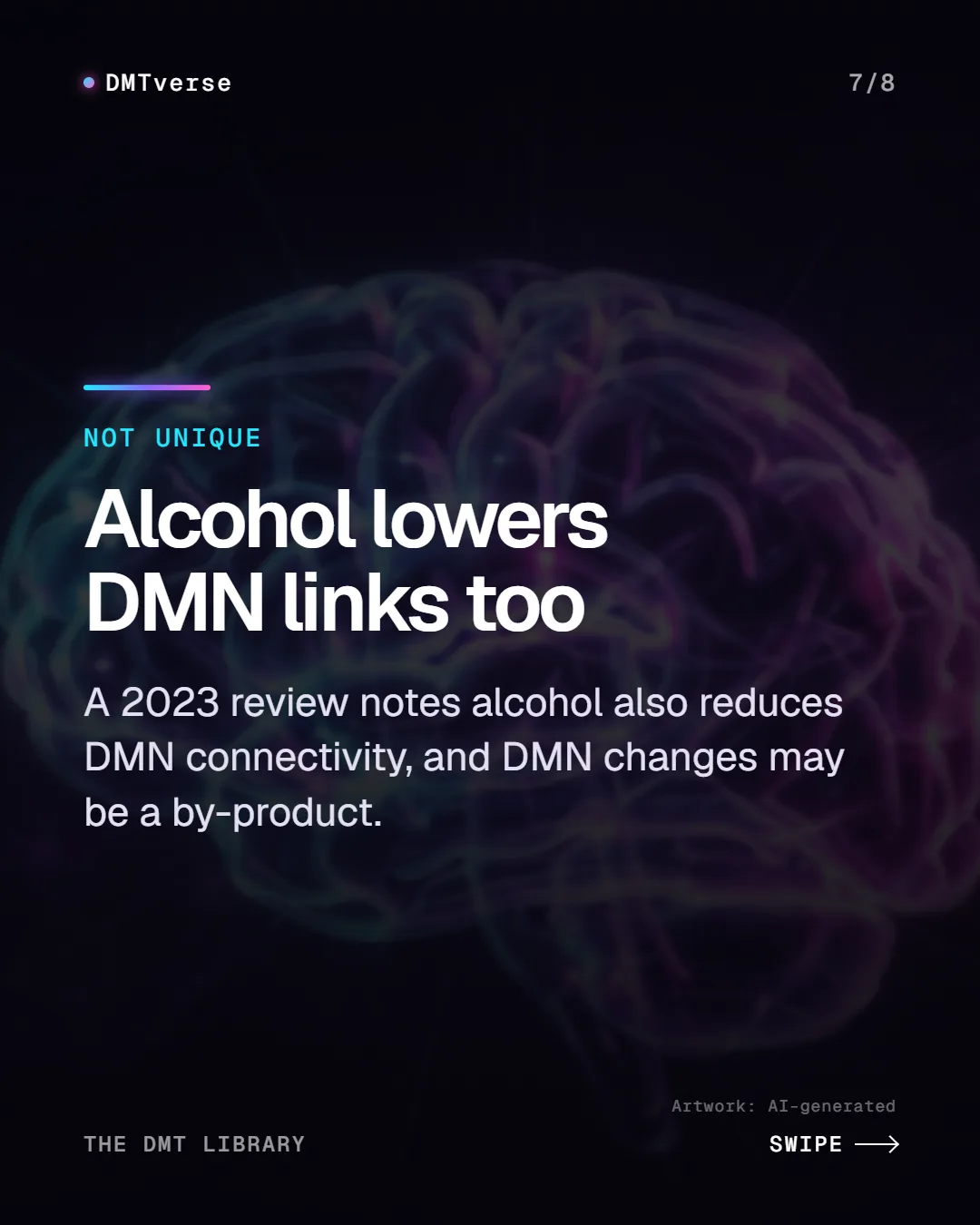
- It is not a unique signature. Alcohol also lowers connectivity within the DMN, according to the 2023 systematic review (Gattuso et al., 2023).
- Correlation is not cause. The same review says it is unclear whether DMN changes drive the psychological effects or are a by-product (Gattuso et al., 2023).
- The samples are small and blinding is hard. The DMT data come from 16 to 20 people in one lab, and the mega-analysis notes that psychedelics’ strong effects make true blinding difficult (Girn et al., 2026).
A fairer one-line summary is: under psychedelics, including DMT, the brain’s high-level networks, the DMN among them, appear to talk more with sensory networks, and the boundaries between networks loosen somewhat. Evidence: preliminary.
Is the DMN where ‘ego dissolution’ happens?
Because the DMN is linked to self-referential thinking, it is tempting to treat it as the seat of the self that seems to dissolve in strong psychedelic experiences. The DMT evidence does not yet support that step. In the 2023 EEG-fMRI study, global connectivity tracked overall intensity, but the authors found “few correlations” between imaging measures and specific subjective effects (Timmermann et al., 2023). Evidence: unresolved.
The closest DMT-specific link to self-dissolution so far comes from EEG, not the DMN. A 2026 study found that DMT shifted brain rhythms away from “criticality”, the balance point between order and disorder, and that the size of the shift correlated with ratings of self-dissolution (Irrmischer et al., 2026). The ratings were made afterwards, and the measure says nothing about which network is involved. Our article on DMT and ego death covers the experience side. Evidence: preliminary.
What is still unknown?
- Whether the DMT network findings replicate in a second, independent lab with a larger sample (unresolved).
- How much of the DMN change under DMT reflects altered blood flow rather than neural activity (unresolved).
- Whether any DMN change maps onto a specific part of the DMT experience, such as loss of self (unresolved).
- What, if anything, DMN changes during the acute state predict afterwards; for psilocybin, see our look at whether psilocybin rewires the brain (unresolved).
The default mode network is a real and important brain system, and psychedelics clearly change how it relates to the rest of the brain. “Dissolves” is the part to drop. Evidence: preliminary. For more on DMT itself, return to what is DMT.
Common questions
What is the default mode network?
A set of brain regions, including the posterior cingulate cortex, precuneus and medial prefrontal cortex, that are most active when attention is not on an outside task. They are linked to remembering, imagining the future, social thinking and thinking about oneself.
Does DMT turn off the default mode network?
The evidence does not show that. The one detailed DMT fMRI study found the DMN became more connected with the rest of the brain while network boundaries loosened. A 2026 mega-analysis found within-network reductions across psychedelics were only weak and selective.
Where did the claim that psychedelics ‘dissolve’ the DMN come from?
From early small studies: a 2012 psilocybin study found decreased activity in hub regions and weaker coupling between two DMN hubs, and a 2015 ayahuasca study of ten people found decreased DMN activity. A 2023 review described consistent acute disruption within the DMN.
What did the 2026 mega-analysis find?
Pooling 11 fMRI datasets from five psychedelics, it found that the most robust change was more coupling between high-level networks, including the default network, and sensory networks. Reductions within networks were weak-to-moderate and selective, contrary to several single-site reports.
Is ayahuasca DMN research the same as DMT research?
No. Ayahuasca contains DMT plus other active compounds, so its results cannot be credited to DMT alone.
Is the default mode network the ‘ego’?
No study has shown that. The DMN is linked to self-referential thinking, but in the DMT imaging study very few brain measures correlated with specific experiences. An EEG study linked self-dissolution ratings to a different measure, a shift in brain criticality.
Can fMRI really see the DMN switching off?
fMRI tracks blood-oxygen signals, not neurons directly, and psychedelics also affect blood vessels. Psilocybin reduced global brain blood flow in one human study, so changes in connectivity need careful interpretation.
Shroomverse sells mushroom products. This article is general information about DMT and the brain’s default mode network. It is not medical, legal or purchasing advice, and it does not recommend any product.
SOURCES
- A default mode of brain function (Raichle ME, et al., PNAS 98(2):676–682, 2001), National Academy of Sciences (peer-reviewed); PMC14647. Accessed . Abstract read via Europe PMC. Identifies a baseline state of the resting adult brain; source for the origin of the default-mode concept.
- The brain's default network: updated anatomy, physiology and evolving insights (Buckner RL, DiNicola LM, Nature Reviews Neuroscience 20(10):593–608, 2019), Springer Nature (peer-reviewed). Accessed . Abstract read via Europe PMC. Default network as association-cortex regions suppressed during externally focused tasks and active during remembering, envisioning the future and social inference.
- Default Mode Network Modulation by Psychedelics: A Systematic Review (Gattuso JJ, et al., International Journal of Neuropsychopharmacology 26(3):155–188, 2023), Oxford University Press (peer-reviewed, open access); PMC10032309. Accessed . Full text read via Europe PMC. DMN and self-reference, mind wandering, autobiographical memory; consistent acute within-DMN disruption and increased between-network connectivity across LSD, psilocybin and ayahuasca; alcohol also reduces functional connectivity within the DMN; unclear whether DMN changes are a by-product or a mediator, so causal conclusions should be tentative; unclear centrality to therapeutic potential.
- Neural correlates of the psychedelic state as determined by fMRI studies with psilocybin (Carhart-Harris RL, et al., PNAS 109(6):2138–2143, 2012), National Academy of Sciences (peer-reviewed); PMC3277566. Accessed . Abstract read via Europe PMC. 15 volunteers for blood flow and 15 for BOLD; only decreases, maximal in thalamus and anterior and posterior cingulate; medial prefrontal decrease predicted intensity; decreased mPFC–PCC coupling.
- The psychedelic state induced by ayahuasca modulates the activity and connectivity of the default mode network (Palhano-Fontes F, et al., PLoS One 10(2):e0118143, 2015), PLOS (peer-reviewed, open access); PMC4334486. Accessed . Abstract read via Europe PMC. Ten experienced subjects; decreased activity through most of the DMN including PCC/precuneus and mPFC; decreased connectivity within PCC/precuneus; no change in DMN–task-positive network orthogonality.
- Human brain effects of DMT assessed via EEG-fMRI (Timmermann C, et al., PNAS 120(13):e2218949120, 2023), National Academy of Sciences (peer-reviewed); full text via Europe PMC, PMC10068756. Accessed . Full text read. 20 healthy volunteers, single-blind, placebo-controlled; significant global connectivity increases in salience, frontoparietal and default-mode networks, greatest in the first minutes; network disintegration and desegregation; overlap with 5-HT2A maps; few correlations with specific subjective effects.
- An international mega-analysis of psychedelic drug effects on brain circuit function (Girn M, et al., Nature Medicine 32(4):1543–1554, 2026), Springer Nature (peer-reviewed); full text via Europe PMC, PMC13099416. Accessed . Full text read. 11 datasets, five drugs; robust transmodal (default, frontoparietal, limbic) to unimodal coupling; weak-to-moderate selective within-network reductions; results challenge previous claims of widespread within-network disintegration; DMT one dataset, n = 16, wide posteriors; blinding and scanner heterogeneity limits.
- Acute psilocybin and ketanserin effects on cerebral blood flow: 5-HT2AR neuromodulation in healthy humans (Larsen K, et al., Journal of Cerebral Blood Flow and Metabolism 45(7):1385–1401, 2025), SAGE (peer-reviewed, open access); PMC11863199. Accessed . Abstract read via Europe PMC. 28 participants; global cerebral blood flow about 11.6% lower at peak; internal carotid artery narrowed 10.5%. Psilocybin, not DMT.
- Psychedelic 5-HT2A receptor agonism alters neurovascular coupling and differentially affects neuronal and hemodynamic measures of brain function (Padawer-Curry JA, et al., Nature Neuroscience 28(11):2330–2343, 2025), Springer Nature (peer-reviewed); PMC12699989. Accessed . Abstract read via Europe PMC. In mice, DOI produced discordant neuronal versus haemodynamic connectivity. Not DMT.
- DMT-Induced Shifts in Criticality Correlate with Self-Dissolution (Irrmischer M, et al., Journal of Neuroscience 46(2):e0344252025, 2026), Society for Neuroscience (peer-reviewed); PMC12809620. Accessed . Abstract read via Europe PMC. DMT shifted oscillations away from criticality toward subcritical regimes; shifts in alpha and theta correlated with self-dissolution ratings.
CHANGES
- : Linked glossary definitions.
- : Published. Each study re-checked against its Europe PMC record (full text for Timmermann 2023 and Girn 2026) on this date.
- : Editorial review: summary now answers with the DMT finding first; meta description completed; H2s rewritten as questions, one carrying the primary keyword; list introduced.



