
THE SHROOMVERSE JOURNAL ✳ 13 MIN READ
What is bufotenin? The 5-hydroxy cousin of DMT and psilocin, explained
Topic: DMT
Published
Listen: the 3-minute version
AI-narrated summary of this article
Short answer, checked 21 October 2026
Bufotenin (also spelled bufotenine) is 5-hydroxy-N,N-dimethyltryptamine, or 5-HO-DMT: the DMT molecule with a hydroxyl group at position 5 of its ring, which also makes it N,N-dimethylserotonin. It has the same formula as psilocin, the active compound of magic mushrooms, differing only in where that hydroxyl sits. Named for the Bufo toads in which it was studied, it has been debated since its discovery in 1893. It binds the serotonin receptors classic psychedelics act on, but whether it is psychedelic in people is still unresolved. In the United States it is a Schedule I substance; Canada’s Controlled Drugs and Substances Act does not name it, which is not the same as permission to sell or use it.
THE SHORT VERSION · SWIPE

On this page 9 sections
Bufotenin is one of the most argued-about molecules in the tryptamine family. It shares a skeleton with DMT, serotonin and psilocin, it has turned up in ancient snuff tubes and in toad secretions, and for decades researchers looked for it in the urine of psychiatric patients. This article explains what it is, what is and isn’t known about its effects, and where it stands in law. For the parent molecule, start with our pillar, what is DMT.
Education only, not guidance
This article describes published research. It gives no amounts, no instructions and no advice on use, and it does not present any effect as a benefit. Evidence labels used below: established (shown in peer-reviewed studies and not seriously disputed), preliminary (early, small, self-selected or indirect) and unresolved (an open question).
What is bufotenin?
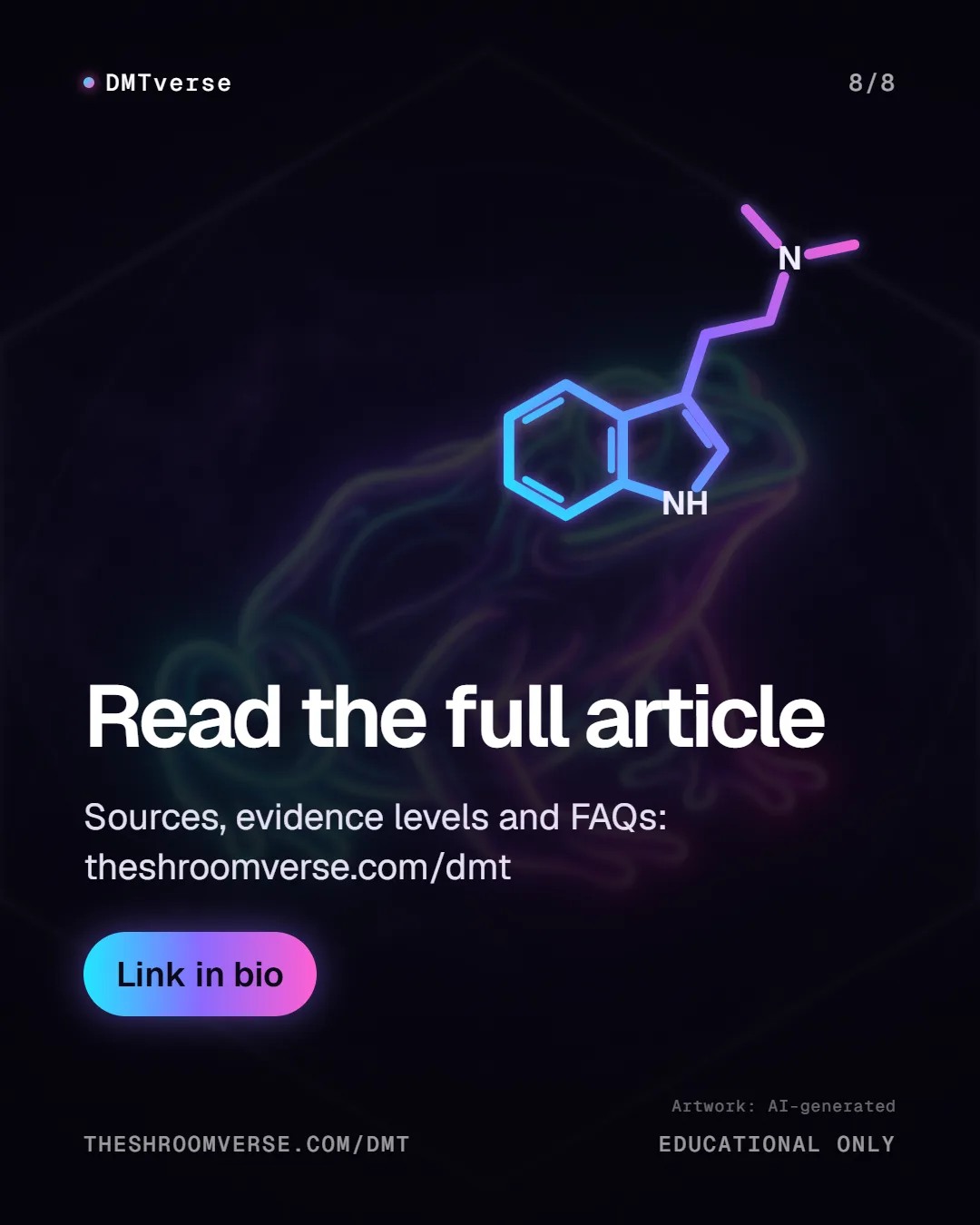
Chemically, bufotenin is a tertiary amine made of N,N-dimethyltryptamine bearing an extra hydroxy (–OH) group at position 5 of the indole ring, the two-ring core shared by all tryptamines (PubChem, bufotenine). Its formula is C12H16N2O and its systematic name is 3-[2-(dimethylamino)ethyl]-1H-indol-5-ol. Other names in official listings include 5-hydroxy-N,N-dimethyltryptamine, N,N-dimethylserotonin and mappine (eCFR, 21 CFR 1308.11). Both spellings, bufotenin and bufotenine, are used in the scientific literature. Evidence: established.
Its name points to *Bufo*, the toad genus whose skin and glands contain it. A 1996 review of the toad’s history and chemistry says bufotenine has been at the centre of a scientific debate since its discovery in 1893 (Lyttle et al., 1996). In 1961 Julius Axelrod reported an enzyme, found mainly in rabbit lung, that adds methyl groups to serotonin and tryptamine to make bufotenine and DMT, which he called “psychotomimetic metabolites” (Axelrod, 1961). That enzyme is now known as INMT. Evidence: established.
How is bufotenin related to DMT, serotonin and psilocin?
Think of DMT as the base shape. Add a hydroxyl at position 5 and you get bufotenin. Serotonin, the body’s own messenger, also has that 5-hydroxyl, but carries no methyl groups on its nitrogen, so bufotenin is serotonin with two methyls added. Put the hydroxyl at position 4 instead and you get psilocin; PubChem lists psilocin and bufotenin with the identical formula C12H16N2O, differing only in the ring position: 1H-indol-4-ol versus 1H-indol-5-ol (PubChem, psilocin; PubChem, serotonin; PubChem, DMT). Molecules like this are called positional isomers. Our guide to DMT’s chemical structure draws the whole family. Evidence: established.
| Molecule | Also called | Group on the ring | Formula |
|---|---|---|---|
| DMT | N,N-dimethyltryptamine | None | C12H16N2 |
| Bufotenin | 5-HO-DMT, N,N-dimethylserotonin | Hydroxyl at position 5 | C12H16N2O |
| Psilocin | 4-HO-DMT | Hydroxyl at position 4 | C12H16N2O |
| 5-MeO-DMT | O-methylbufotenine | Methoxy at position 5 | C13H18N2O |
| Serotonin | 5-hydroxytryptamine | Hydroxyl at position 5, no N-methyls | C10H12N2O |
Because the two isomers weigh the same, forensic labs have to prove which one they have. A 2020 study from Israel’s police forensic laboratory made all four ring isomers (4-, 5-, 6- and 7-hydroxy-DMT) and showed routine methods can tell them apart, so a suspected mushroom sample can be confirmed as psilocin with bufotenin ruled out (Mishraki-Berkowitz et al., 2020). That answers a common search: magic mushrooms are known for psilocybin and psilocin, not bufotenin. See is there DMT in magic mushrooms? and psilocin vs psilocybin. Evidence: established.
Bufotenin vs 5-MeO-DMT
5-MeO-DMT differs from bufotenin by one methyl group: a methoxy (–OCH3) where bufotenin has a hydroxyl. PubChem’s record for 5-MeO-DMT even lists it under the title O-methylbufotenine (PubChem, 5-MeO-DMT). The link is also metabolic: in the body, the liver enzyme CYP2D6 removes that methyl from 5-MeO-DMT to produce bufotenine as an active metabolite, which binds the 5-HT2A receptor more strongly than its parent (Reckweg et al., 2022). For the 5-MeO-DMT and DMT comparison itself, read 5-MeO-DMT vs DMT. Evidence: established.
Is bufotenin psychedelic in humans?
Nobody has settled it. At the receptor level, a 2000 review summarised experiments showing bufotenine acts like LSD, psilocin and 5-MeO-DMT at the 5-HT2A and 5-HT2C receptors linked to psychedelic effects. The author argued that the reported lack of classic effects in human experiments is best explained by bufotenine’s poor ability to cross the blood–brain barrier, the filter between the bloodstream and the brain, rather than by a lack of receptor activity, while stating that direct human evidence of hallucinogenic activity “seems lacking” (McBride, 2000). Evidence: unresolved.
The human record is thin and conflicting. In 1956, Howard Fabing and J. Robert Hawkins published a short report in Science on intravenous bufotenine injections in people (Fabing and Hawkins, 1956). A later review notes that these first reports of hallucinogenic activity were not replicated in a 1959 study by Turner and Merlis, and that bufotenine’s status as a hallucinogen “has remained a matter of controversy” (Winter et al., 2011). In 1985, a single medically trained volunteer given bufotenine intravenously had profound but short perceptual and emotional changes, and the compound left the blood quickly (McLeod and Sitaram, 1985). Doses are not reproduced here. Evidence: unresolved.
In 2001, the ethnobotanist Jonathan Ott published a series of uncontrolled self-experiments in which he concluded that bufotenine’s visionary activity “has been established” (Ott, 2001). One author testing on himself, with no blinding or placebo, is a report, not proof. Animal work leans the other way: mice trained to recognise 5-MeO-DMT did not treat bufotenine as similar, while a more fat-soluble version of it gave an intermediate response, consistent with the brain-entry explanation (Winter et al., 2011). Evidence: unresolved (self-report and animal data).
Its effects outside the brain are better documented. In a 2023 lab study, bufotenin increased the force of contraction of human heart-muscle tissue from the atrium through the serotonin 5-HT4 receptor, and did the same in mouse hearts engineered to carry that human receptor (Neumann et al., 2023). That was tissue in a dish, not people, but it is one reason researchers describe bufotenin as active on the body as well as being debated as a psychedelic. Evidence: preliminary.
- 1893Discovery of bufotenine, the start of a long scientific debateSource Lyttle et al., 1996
- 1956Fabing and Hawkins report intravenous bufotenine injections in people (dose not reproduced here)Source Science record
- 1959Turner and Merlis do not replicate the reported hallucinogenic effectsSource Winter et al., 2011
- 1961Axelrod finds an enzyme that makes bufotenine and DMT from serotonin and tryptamineSource Science
- 1961“A bufotenin-like substance in the urine of schizophrenics” publishedSource J Nerv Ment Dis record
- 1985One volunteer study reports short, profound perceptual changesSource Acta Psychiatr Scand
- 1991Chemical analysis of pre-Hispanic snuff powders from San Pedro de Atacama, ChileSource Current Anthropology record
- 2000Review argues poor brain entry, not receptor inactivity, explains mixed human resultsSource J Psychoactive Drugs
- 2025Bufotenine traces found in bone tubes at Chavín de Huántar, Peru (about 800–350 BCE)Source PNAS
- 2025Systematic review: too early to call urinary bufotenine a biomarker of mental illnessSource Cureus
Where does bufotenin appear in archaeology?
Mostly in South American snuff equipment. At Chavín de Huántar in Peru, chemical analysis of 23 artifacts, mostly bone tubes, from a sealed underground gallery found traces of bufotenine in four of them, alongside nicotine and, in one, DMT; the researchers treat bufotenine and DMT as molecular markers of vilca (*Anadenanthera*), and also found its microscopic plant remains (Rick et al., 2025). An earlier landmark was Torres and colleagues’ 1991 chemical and contextual analysis of snuff powders from pre-Hispanic San Pedro de Atacama in Chile (Torres et al., 1991). Our ancient DMT snuffs article covers these finds and their limits in depth. Evidence: established for the detections.
A residue shows which molecules touched an object, not who used it, how, or what they experienced, so these finds say nothing by themselves about bufotenin’s effects. Evidence: established as a limit of residue chemistry.
What is the bufotenin toad connection?
Two toads are usually meant. The Sonoran Desert toad, *Incilius alvarius*, secretes mainly 5-MeO-DMT, together with bufotenine (Reckweg et al., 2022); our Bufo alvarius article covers its biology, conservation and the “toad licking” myth. The cane toad, *Rhinella marina* (formerly *Bufo marinus*), is mainly a poisoning risk: oral exposure to its secretions can be fatal to dogs without early treatment, with drooling, gut, breathing and nerve signs and sometimes severe heart rhythm problems (Johnnides et al., 2016). Evidence: established.
Toad secretions are poisonous
Toad secretions can be poisonous: in dogs, cane toad exposure can cause severe heart rhythm problems and can be fatal without early treatment. If a dog or a child mouths a toad, treat it as a poisoning and call for help straight away. This article does not describe any use of toads or their secretions.
Is bufotenine found in the human body?
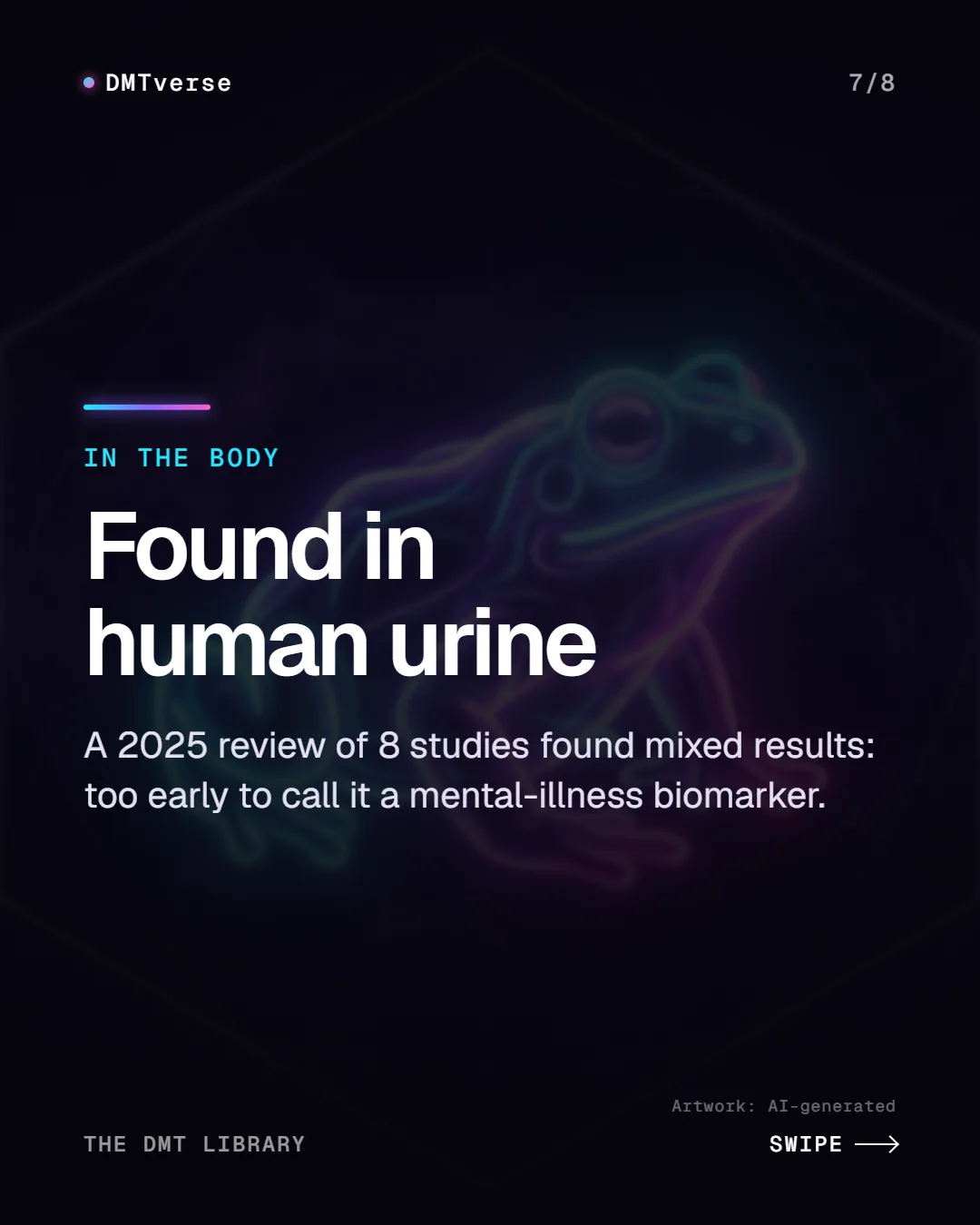
Yes, in small amounts. A 2005 Finnish study using sensitive mass spectrometry notes that, in mammals, endogenous bufotenine and DMT had been identified only in human urine. It found large amounts of bufotenine in stools, only small amounts in body or nerve tissue, and none in blood. The authors suggest that urinary and faecal bufotenine come from cells of the kidney and gut, without ruling out gut bacteria (Kärkkäinen et al., 2005). Evidence: established for the detections; preliminary for where it comes from. For DMT itself, see does the brain make DMT?.
The old schizophrenia hypothesis
Axelrod’s 1961 finding fed the transmethylation hypothesis: the idea that the body might make psychosis-like compounds from its own serotonin. The same year, a paper reported “a bufotenin-like substance in the urine of schizophrenics” (Fischer et al., 1961). In 1995 a Japanese team detected urinary bufotenine in 13 of 15 people with schizophrenia, 15 of 18 with depression and most autistic patients tested, but in only 2 of 200 healthy controls (Takeda et al., 1995). Evidence: preliminary (small, older studies).
A 2025 systematic review pooled eight studies. Bufotenine was detected in the urine of 226 of 275 patients with a mental illness (82%) and 92 of 318 controls (29%), but the results were heterogeneous: one study found none in anyone, and two found large overlap between groups. The author concludes it is too early to propose bufotenine as a biomarker (Clarke, 2025). Finding a molecule in urine does not show that it causes symptoms. Evidence: unresolved.
Is bufotenin legal in Canada and the US?
In Canada, it is not named. We read Schedule III of the Controlled Drugs and Substances Act on 21 October 2026, in the consolidation current to 30 September 2026. Item 7 reads “N,N–Dimethyltryptamine (DMT) (3–[(2–dimethylamino) ethyl]indole) and any salt thereof”, and items 11 and 12 list psilocin and psilocybin, but bufotenine does not appear anywhere in the Act’s text (Justice Laws, CDSA). Not named does not mean legal to sell or safe, and laws change. In the United States, federal regulations list bufotenine in Schedule I, item (d)(17), DEA code 7433 (eCFR, 21 CFR 1308.11). See is DMT legal in Canada. This is not legal advice. Evidence: established for what the texts say.
If someone is in danger
Call 911 for immediate danger or urgent medical help, including if someone is unconscious, not breathing or having a seizure. In Ontario, the Ontario Poison Centre is at 1-800-268-9017; every province has a poison centre, listed by SickKids (AboutKidsHealth). If you or someone you know is thinking about suicide, call or text 9-8-8, 24 hours a day (Government of Canada). See also our safety page and how to help someone having a bad trip. Unknown substances and toad exposures are poisonings until proven otherwise.
What we still don’t know
- Whether bufotenin is psychedelic in people at all. Human data are a few old, small or uncontrolled reports that disagree (unresolved).
- How much of it reaches the human brain, the core of the blood–brain barrier explanation (unresolved).
- Whether the body’s own bufotenine has any job, or any link to mental illness. Urine studies conflict (unresolved).
- Where the bufotenine in human urine and stools comes from: our own cells or gut bacteria (preliminary).
- How ancient snuff users experienced preparations that contained it. Residues cannot tell us (unresolved).
The fair summary: bufotenin is a well-characterised molecule, a positional isomer of psilocin and a close relative of DMT, serotonin and 5-MeO-DMT, with a long and argumentative research history. Its chemistry is established; its effects on the human mind are not. For how DMT itself turns up in living things, read where does DMT come from in nature?. Evidence: established for the chemistry, unresolved for the psychoactivity.
Common questions
What is bufotenin?
Bufotenin, also spelled bufotenine, is 5-hydroxy-N,N-dimethyltryptamine (5-HO-DMT): DMT with a hydroxyl group at position 5 of the ring. It is also N,N-dimethylserotonin, and has been debated by scientists since its discovery in 1893.
What is the difference between bufotenin and DMT?
One hydroxyl group. Bufotenin is DMT with an –OH at ring position 5 (C12H16N2O versus C12H16N2). A 2000 review argued that this change makes it cross poorly into the brain, and the evidence that it is psychedelic in people is unresolved, unlike DMT’s.
Is bufotenine the same as psilocin?
No, but they are positional isomers: both are C12H16N2O. Psilocin has its hydroxyl at position 4 (4-HO-DMT), bufotenine at position 5 (5-HO-DMT). Forensic labs can tell them apart, and magic mushrooms are known for psilocin, not bufotenine.
What is the difference between bufotenine and 5-MeO-DMT?
5-MeO-DMT has a methoxy group where bufotenine has a hydroxyl. The body converts some 5-MeO-DMT into bufotenine through the liver enzyme CYP2D6. The Sonoran Desert toad’s secretion contains mainly 5-MeO-DMT, with bufotenine alongside it.
Is bufotenin psychedelic?
Unresolved. It acts at the same serotonin receptors as classic psychedelics, but 1950s human reports were not replicated, later evidence is one volunteer and one author’s self-experiments, and a 2000 review says direct human evidence seems lacking. Poor brain entry is the leading explanation.
What does bufotenine do in the body?
It binds several serotonin receptors. In a 2023 lab study it increased the contraction force of human heart-muscle tissue through the 5-HT4 receptor. Its effects on the mind in people are unresolved.
Is bufotenine found in human urine?
Yes. It has been detected in human urine and stools. Older studies linked higher urinary levels to schizophrenia and autism, but a 2025 systematic review found heterogeneous results and concluded it is too early to use it as a biomarker.
Is bufotenin legal in Canada?
As read on 21 October 2026, bufotenine is not named in the Controlled Drugs and Substances Act, whose Schedule III lists DMT as item 7. In the United States it is a Schedule I substance. Not named does not mean legal to sell or safe. This is not legal advice.
Shroomverse sells mushroom products. This article is general information about bufotenin’s chemistry, research history and legal status. It is not medical, legal or purchasing advice, and it does not recommend any product.
SOURCES
- Bufotenine, compound summary (CID 10257), U.S. National Library of Medicine, PubChem. Accessed . Record read through the PubChem REST interface. Formula C12H16N2O; IUPAC name 3-[2-(dimethylamino)ethyl]-1H-indol-5-ol; ChEBI description as N,N-dimethyltryptamine bearing a hydroxy substituent at position 5, a tertiary amine and tryptamine alkaloid.
- Psilocin, compound summary (CID 4980), U.S. National Library of Medicine, PubChem. Accessed . Record read through the PubChem REST interface. Formula C12H16N2O; IUPAC name 3-[2-(dimethylamino)ethyl]-1H-indol-4-ol (the positional isomer comparison).
- Serotonin, compound summary (CID 5202), U.S. National Library of Medicine, PubChem. Accessed . Record read through the PubChem REST interface. Formula C10H12N2O; IUPAC name 3-(2-aminoethyl)-1H-indol-5-ol.
- N,N-Dimethyltryptamine, compound summary (CID 6089), U.S. National Library of Medicine, PubChem. Accessed . Record read through the PubChem REST interface. Formula C12H16N2.
- O-Methylbufotenine (5-MeO-DMT), compound summary (CID 1832), U.S. National Library of Medicine, PubChem. Accessed . Record read through the PubChem REST interface. Title O-Methylbufotenine; formula C13H18N2O; IUPAC name with a 5-methoxy indole.
- The Psilocin (4-hydroxy-N,N-dimethyltryptamine) and Bufotenine (5-hydroxy-N,N-dimethyltryptamine) Case: Ensuring the Correct Isomer has Been Identified (Mishraki-Berkowitz T, et al., Journal of Forensic Sciences 65(5):1450–1457, 2020), Wiley (peer-reviewed). Accessed . Abstract read via Europe PMC. Psilocin (4-HO-DMT) and bufotenine (5-HO-DMT) as isomers; 6- and 7-HO-DMT synthesised for comparison; routine TLC, FTIR and GC-MS differentiated all four; suspected mushroom specimens confirmed as psilocin with other isomers ruled out. Israel Police forensic laboratory.
- Bufo toads and bufotenine: fact and fiction surrounding an alleged psychedelic (Lyttle T, Goldstein D, Gartz J, Journal of Psychoactive Drugs 28(3):267–290, 1996), Taylor & Francis (peer-reviewed). Accessed . Abstract read via Europe PMC. Supports bufotenine as contained in the skin and glands of the Bufo toad; at the centre of a scientific debate since its discovery in 1893; 1960s countercultural myths of licking or smoking secretions.
- Enzymatic formation of psychotomimetic metabolites from normally occurring compounds (Axelrod J, Science 134(3475):343, 1961), American Association for the Advancement of Science (peer-reviewed). Accessed . Abstract read via Europe PMC. An enzyme, highly localised in rabbit lung, N-methylates serotonin and tryptamine to bufotenine and DMT, called psychotomimetic metabolites.
- Intravenous Bufotenine Injection in the Human Being (Fabing HD, Hawkins JR, Science 123(3203):886–887, 1956), American Association for the Advancement of Science (peer-reviewed). Accessed . Bibliographic record checked on Crossref (no abstract available to us; publisher page behind a bot check). Cited for its existence, authors, title and date only. Who the participants were could not be verified from a source opened today, so it is not stated. Doses not reproduced.
- Stimulus control by 5-methoxy-N,N-dimethyltryptamine in wild-type and CYP2D6-humanized mice (Winter JC, Amorosi DJ, Rice KC, Cheng K, Yu AM, Pharmacology Biochemistry and Behavior 99(3):311–315, 2011), Elsevier (peer-reviewed); author manuscript PMC3129464. Accessed . Abstract read via Europe PMC; full text read via PMC. Mice trained on 5-MeO-DMT showed no 5-MeO-DMT-appropriate responding to bufotenine and intermediate responding to the more lipid-soluble acetylbufotenine. Discussion: initial human reports (Fabing 1956; Fabing and Hawkins 1956) not replicated by Turner and Merlis 1959; bufotenine as a hallucinogen remains a matter of controversy; low lipid solubility.
- Bufotenine reconsidered (McLeod WR, Sitaram BR, Acta Psychiatrica Scandinavica 72(5):447–450, 1985), Wiley (peer-reviewed). Accessed . Abstract read via Europe PMC. One medically trained volunteer; intravenous bufotenine correlated with profound, short perceptual and emotional changes; rapid disappearance from blood and quick appearance of urinary metabolites. Dose not reproduced.
- Bufotenine: toward an understanding of possible psychoactive mechanisms (McBride MC, Journal of Psychoactive Drugs 32(3):321–331, 2000), Taylor & Francis (peer-reviewed review). Accessed . Abstract read via Europe PMC. Activity similar to LSD, psilocin and 5-MeO-DMT at 5-HT2A and 5-HT2C; argument that the reported lack of classic effects in human experiments reflects poor blood–brain barrier penetration; direct human evidence of hallucinogenic activity “seems lacking”.
- Pharmañopo-psychonautics: human intranasal, sublingual, intrarectal, pulmonary and oral pharmacology of bufotenine (Ott J, Journal of Psychoactive Drugs 33(3):273–281, 2001), Taylor & Francis. Accessed . Abstract read via Europe PMC. Cited only for the fact that it reports the author’s own uncontrolled self-experiments (“psychonautic bioassays”) and his conclusion that visionary activity “has been established”. Routes, doses, combinations and the preparation details in the paper are deliberately not reproduced.
- Cardiovascular effects of bufotenin on human 5-HT4 serotonin receptors in cardiac preparations of transgenic mice and in human atrial preparations (Neumann J, et al., Naunyn-Schmiedeberg’s Archives of Pharmacology 396(7):1471–1485, 2023), Springer (peer-reviewed, open access); PMC10244282. Accessed . Abstract read via Europe PMC. Bufotenin increased force of contraction via human 5-HT4 receptors in transgenic mouse heart preparations and in isolated human atrial preparations. Concentrations not reproduced.
- The clinical pharmacology and potential therapeutic applications of 5-methoxy-N,N-dimethyltryptamine (5-MeO-DMT) (Reckweg JT, et al., Journal of Neurochemistry 162(1):128–146, 2022), Wiley (peer-reviewed, open access); full text via Europe PMC, PMC9314805. Accessed . Full text read. 5-MeO-DMT as the primary psychoactive component of the Incilius alvarius parotoid secretion, which also contains bufotenine; CYP2D6 O-demethylation of 5-MeO-DMT to the active metabolite bufotenine, which binds 5-HT2A with higher affinity than 5-MeO-DMT. Amounts not reproduced.
- Potentially hallucinogenic 5-hydroxytryptamine receptor ligands bufotenine and dimethyltryptamine in blood and tissues (Kärkkäinen J, et al., Scandinavian Journal of Clinical and Laboratory Investigation 65(3):189–199, 2005), Taylor & Francis (peer-reviewed). Accessed . Abstract read via Europe PMC. Bufotenine and DMT formed by INMT; in mammals endogenous bufotenine and DMT identified only in human urine; large amounts of bufotenine in stools; small amounts in somatic or neural tissues and none in blood; suggested kidney and intestinal origin, bacterial synthesis not excluded.
- A bufotenin-like substance in the urine of schizophrenics (Fischer E, Fernandez Lagravere TA, Vazquez AJ, Di Stefano AO, Journal of Nervous and Mental Disease 133:441–444, 1961), Lippincott Williams & Wilkins (peer-reviewed). Accessed . Bibliographic record checked via Europe PMC (no abstract). Cited only for its existence, title and date as part of the research history.
- Bufotenine reconsidered as a diagnostic indicator of psychiatric disorders (Takeda N, Ikeda R, Ohba K, Kondo M, Neuroreport 6(17):2378–2380, 1995), Lippincott Williams & Wilkins (peer-reviewed). Accessed . Abstract read via Europe PMC. Urinary bufotenine in all 18 autistic patients with mental retardation and epilepsy, 32 of 47 autistic patients with mental retardation, 15 of 18 with depression, 13 of 15 with schizophrenia, and 2 of 200 healthy controls.
- Elevated Endogenous Psychedelic Bufotenine in the Urine of Patients Diagnosed With a Mental Illness: A Systematic Review (Clarke AJ, Cureus 17(5):e84510, 2025), Cureus (peer-reviewed, open access); full text via Europe PMC, PMC12179411. Accessed . Abstract and full text read. Eight studies; detection in 226 of 275 patients (82%) vs 92 of 318 controls (29%); heterogeneous findings, one study detecting none, two with large overlap; too early to propose as a biomarker. Introduction describes the transmethylation hypothesis and bufotenine as an isomer of psilocin.
- Pre-Hispanic ritual use of psychoactive plants at Chavín de Huántar, Peru (Rick JW, et al., PNAS 122(19):e2425125122, 2025), National Academy of Sciences (peer-reviewed, open access); full text via Europe PMC, PMC12088378. Accessed . Abstract and full text read. 23 artifacts from sealed gallery deposits, mostly bone tubes; six positive: bufotenine in four, DMT in one, nicotine in others; DMT and bufotenine treated as markers of Anadenanthera (vilca); vilca and Nicotiana microremains; Middle–Late Formative context.
- Snuff Powders from Pre-Hispanic San Pedro de Atacama: Chemical and Contextual Analysis (Torres CM, Repke DB, Chan K, McKenna D, Llagostera A, Schultes RE, Current Anthropology 32(5):640–649, 1991), University of Chicago Press (peer-reviewed). Accessed . Bibliographic record checked on Crossref (no abstract available to us). Cited only for its existence, authors, title and date; its findings are not described here.
- Toad Intoxication in the Dog by Rhinella marina: The Clinical Syndrome and Current Treatment Recommendations (Johnnides S, Green T, Eubig P, Journal of the American Animal Hospital Association 52(4):205–211, 2016), American Animal Hospital Association (peer-reviewed). Accessed . Abstract read via Europe PMC. Rhinella marina formerly Bufo marinus; oral exposure can carry a high fatality rate without early treatment; ptyalism with gastrointestinal, respiratory and neurologic signs; severe arrhythmias less often.
- Controlled Drugs and Substances Act (S.C. 1996, c. 19), full text, Schedule III, Government of Canada, Justice Laws Website. Accessed . Consolidation current to 2026-09-30, read 21 October 2026. Schedule III item 7 quoted (DMT and any salt thereof); items 11 (psilocin) and 12 (psilocybin). The full text was searched for “bufot”, “5-hydroxy” and tryptamine names: bufotenine is not listed; the only tryptamines named in Schedule III are DET (item 6), DMT (item 7) and etryptamine (item 28).
- 21 CFR 1308.11, Schedule I (hallucinogenic substances, paragraph (d)), U.S. Government, Electronic Code of Federal Regulations (eCFR). Accessed . Read through the eCFR versioner API (version dated 2026-10-09). Item (d)(17) Bufotenine, DEA code 7433, with other names 3-(β-dimethylaminoethyl)-5-hydroxyindole, 3-(2-dimethylaminoethyl)-5-indolol, N,N-dimethylserotonin, 5-hydroxy-N,N-dimethyltryptamine and mappine.
- Mental health support: get help, Government of Canada, Public Health Agency of Canada. Accessed . Page read 21 October 2026 (page details dated 2026-01-14). Supports calling 9-1-1 in immediate danger or for urgent medical support, and 9-8-8 support available 24 hours a day, 7 days a week.
- Poison information centres in Canada, AboutKidsHealth, The Hospital for Sick Children (SickKids). Accessed . Page read 21 October 2026. Supports Ontario toll-free 1-800-268-9017 and calling 911 if someone is unconscious, not breathing or having a seizure.
CHANGES
- : Published. Sources opened and checked on this date.



