THE SHROOMVERSE JOURNAL ✳ 14 MIN READ
Ancient DMT: what snuff tubes, ritual bundles and residue chemistry really show
Topic: DMT
Published Updated
Short answer, checked 20 October 2026
The strongest evidence for ancient DMT use comes from the Andes, and it is evidence of snuffing, not drinking. At Chavín de Huántar in Peru, bone tubes from a sealed underground gallery dated to about 800–350 BCE carried traces of bufotenine, nicotine and, in one artifact, DMT, consistent with vilca and wild tobacco. In southwestern Bolivia, a leather ritual bundle dated to about 1,000 years ago held a pouch with traces of DMT, bufotenine, harmine and cocaine. Older finds from northwest Argentina and northern Chile push the snuff and pipe tradition back thousands of years. Residue chemistry can show which compounds touched an object. It cannot, on its own, show who used it, how, how often, or whether a drink like ayahuasca existed.
THE SHORT VERSION · SWIPE




On this page 8 sections
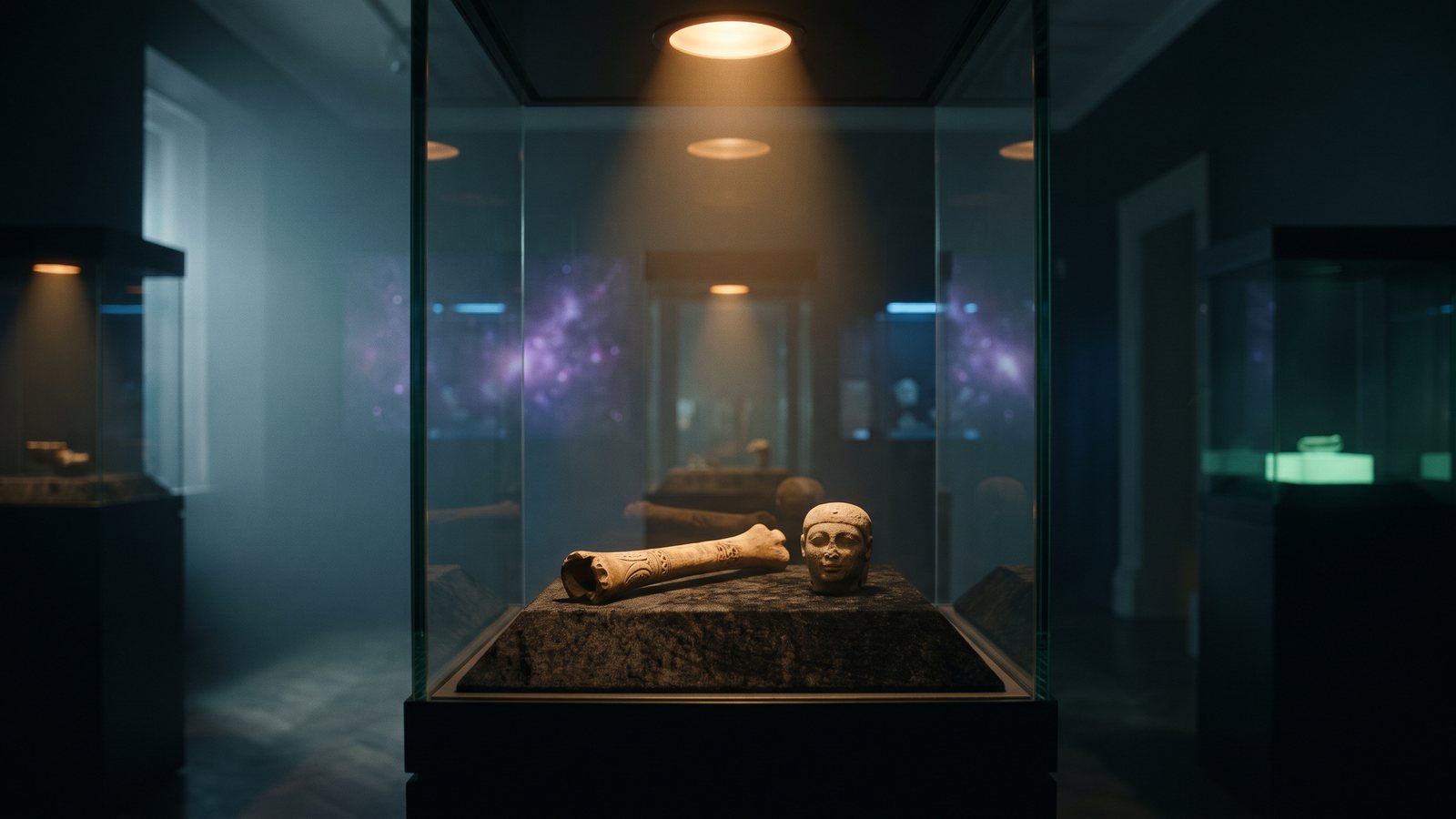
Online claims about “ancient DMT” are often attached to a single image of a carved snuff tray or a mummy. The archaeology underneath is real, but narrower than the headlines. Below are the best documented finds, what each one does and does not establish, and why researchers still argue about how to read a trace of a molecule on a thousand-year-old pouch.
Education only, not guidance
This article describes published archaeology. It names plants only where the excavation papers name them, to identify finds, and gives no preparation, amounts or instructions. Nothing here is a recommendation. Evidence labels used below: established (shown in peer-reviewed studies and not seriously disputed), preliminary (early, small, single-site or indirect) and unresolved (an open question).
What counts as evidence of ancient DMT use?
Archaeologists have four main kinds of evidence. Iconography: carvings and pottery that may depict plants or people in altered states. Paraphernalia: tubes, trays, spoons and pouches shaped like objects used for snuffing in recorded Indigenous practice. Plant remains: seeds or microscopic starch grains that can be identified to a plant. And chemical residues: molecules extracted from the surface of an object and identified with mass spectrometry. The Chavín team stresses that for centuries the first two were all anyone had at that site: neither psychoactive plant remains nor chemical traces had been identified there before their study (Rick et al., 2025). Evidence: established.
Most of the direct evidence involves vilca (also called cebil), a tree the excavation papers identify from plant remains. In those papers its chemical marker is bufotenine (5-hydroxy-DMT), not DMT; the Bolivian bundle authors describe bufotenine as its primary tryptamine (Miller et al., 2019). That matters: a find described as “ancient DMT” is often, chemically, mostly a bufotenine find. Evidence: established.
What was found at Chavín de Huántar?
Chavín de Huántar, in the north-central highlands of Peru, is a monumental temple complex of the first millennium BCE, long interpreted as a centre of public ritual. In 2017–2018 excavators opened Gallery 3, a small underground chamber about 7 metres long, which had been sealed from shortly after the Chavín period until excavation. Deposits linked to the gallery’s use were dated by radiocarbon and Bayesian modelling to roughly 800–350 BCE (Rick et al., 2025). Evidence: established.
The gallery held 23 artifacts of forms associated elsewhere with consuming psychoactive plants: 22 made of bone, mostly bird wing bones shaped into short tubes, and one shell. Each was tested by gas chromatography–mass spectrometry, and 11 were also examined under the microscope, by an analyst working blind to the chemical results (Rick et al., 2025). In summary:
- Six bone artifacts tested positive for at least one diagnostic alkaloid: nicotine, bufotenine or DMT.
- DMT was identified in one artifact, a broken bone semicylinder, together with bufotenine. Bufotenine was found in four artifacts and nicotine in five.
- Four of the six positive artifacts also held microscopic starch grains, crystals and plant hairs matching vilca and wild tobacco (Nicotiana).
- No combustion products of the alkaloids were detected, which the authors read as support for inhalation rather than smoking.
- Several tubes carried evidence of both plants, which the authors interpret as likely mixed vilca and tobacco powders, the oldest such evidence they know of in the Americas.
Each item above comes from the paper’s results and discussion (Rick et al., 2025). The authors call these finds the northernmost direct evidence of vilca and tobacco use in the pre-Hispanic Andes. Because most tubes were found in restricted-access galleries rather than middens, they argue that consumption was organized and perhaps controlled, part of institutional ritual rather than individual practice. Evidence: established for the chemistry and context; the social interpretation is the authors’ argument, and preliminary.
How other researchers responded
The paper drew two published responses. A commentary in the same journal calls the botanical identification groundbreaking, and notes an open question: similar bone tubes also turn up in household areas at Chavín, so it is unclear whether they were made by craft specialists for temple use or used in smaller domestic rituals (Nesbitt, 2025). Evidence: an open question raised in a commentary.
A letter from an archaeologist at Memorial University of Newfoundland asks why the two plants were combined. He suggests tobacco’s own enzyme-inhibiting compounds might have changed vilca’s effects, and argues this complicates claims of prehistoric ayahuasca that rest only on detecting harmala compounds (Whitridge, 2025). Evidence: the letter’s pharmacological idea is a hypothesis, untested on these artifacts.
What was in the 1,000-year-old Bolivian ritual bundle?
Cueva del Chileno is a rock shelter at about 3,890 metres in the Lípez highlands of southwestern Bolivia, excavated in 2008 and 2010. Among what the excavators call “ritual trash” was a well-preserved leather bag. Inside were two carved wooden snuffing tablets, a snuffing tube with human hair braids attached, two camelid-bone spatulas, a woven headband, two small pieces of plant material on strings, and a pouch made of three fox snouts stitched together. The leather was radiocarbon dated to about 905–1170 CE (Miller et al., 2019). Evidence: established.
The team scraped a tiny sample from inside the fox-snout pouch and took a surface sample from one plant fragment, then analysed both with liquid chromatography–tandem mass spectrometry. The pouch yielded cocaine and its breakdown product benzoylecgonine, harmine, bufotenine, DMT, and a peak that might correspond to psilocin. The plant fragment yielded cocaine, benzoylecgonine and bufotenine (Miller et al., 2019). Evidence: established for the detections; the psilocin peak was not in the original screen and is a possibility, not an identification.
How the authors read it is careful. They link cocaine to coca leaf and bufotenine to vilca seeds. They link harmine to the vine used in ayahuasca. They are explicit that DMT is confounding, because it occurs in small amounts in vilca and so could come from the same material as the bufotenine, or from a separate source. They conclude that ayahuasca, or a combined snuff, “must be considered”, but that the result is not conclusive evidence of ayahuasca as drunk today. No human remains were associated with the bundle, so there is no direct evidence of consumption (Miller et al., 2019). Evidence: established that harmine and DMT traces sat in one pouch; whether they were ever combined in a drink is unresolved.
How old is the Andean snuff tradition?
The southern Andes have the longest direct record. A 2024 review of vilca use by a researcher at Argentina’s national research council (CONICET) states that the earliest evidence, about 4,000 years old, is vilca seeds found with pipes in northwest Argentina, and that remains have since been found in pipes, enema syringes, leather bags, tubes and trays, all confined to the Andean area: northern Chile, northwest Argentina, central and southern Peru, and Bolivia (Lema, 2024). The Chavín paper, which shares that author, dates the combined presence of vilca and tobacco in Argentine pipes to as early as 2500 BCE (Rick et al., 2025). Evidence: established for the existence of the finds; exact earliest dates vary between sources.
One of the classic Argentine studies examined two mummified bodies from the Alero I (La Matanza) site in the Puna of Jujuy, found with snuffing equipment. Using light, petrographic and scanning electron microscopes, the team identified the powder in one of the tubes as vilca by comparison with reference material, confirming a link that had until then rested on ethnographic sources (Pochettino et al., 1999). Evidence: established.
Across the border in Chile, chemical and contextual analysis of snuff powders from pre-Hispanic San Pedro de Atacama in Chile was published in 1991 (Torres et al., 1991); the Chavín paper cites wooden snuff trays from San Pedro dated about 500–1500 CE as the only earlier evidence of mixed vilca and tobacco snuff (Rick et al., 2025). Evidence: established.
Human tissue adds a different kind of evidence. The Bolivian bundle paper summarises hair studies of mummies from the Azapa Valley in northern Chile: bufotenine in the hair of two individuals dated about 500–1100 CE, and harmine in the hair of an infant and an adult from about 400–900 CE. The original hair-study authors read harmine alone as possibly medicinal rather than visionary, since harmine is not itself a classic hallucinogen (Miller et al., 2019). We report the hair studies only as Miller and colleagues summarise them; we did not open the originals. Evidence: preliminary.
Vilca was not only snuffed. At Quilcapampa, a Middle Horizon site in southern Peru (about 600–1000 CE), excavators argue that vilca was consumed alongside a fermented fruit drink at shared events, and that this reinforced the power of the Wari state (Biwer et al., 2022). Evidence: the plant identification is the authors’; the political interpretation is preliminary.
- c. 2000 BCE (about 4,000 years ago)Vilca seeds with pipes, the earliest direct evidence citedWhere Northwest ArgentinaSource Lema, 2024
- c. 800–350 BCEBone tubes with bufotenine, nicotine and, in one, DMT; vilca and tobacco microremainsWhere Chavín de Huántar, PeruSource Rick et al., 2025
- c. 500–1500 CEWooden snuff trays with mixed vilca and tobacco residuesWhere San Pedro de Atacama, ChileSource Rick et al., 2025; Torres et al., 1991
- c. 600–1000 CEVilca consumed alongside a fermented fruit drinkWhere Quilcapampa, PeruSource Biwer et al., 2022
- c. 905–1170 CELeather ritual bundle; pouch with DMT, bufotenine, harmine and cocaine tracesWhere Cueva del Chileno, BoliviaSource Miller et al., 2019
- Undated in the abstractTube powder identified as vilca by microscopy, with two mummiesWhere Alero I (La Matanza), Jujuy, ArgentinaSource Pochettino et al., 1999
What can residue chemistry prove, and what can’t it?
Mass spectrometry is very good at one thing: confirming that a specific molecule is present in a sample, by matching its mass, fragments and retention time to a reference. The Bolivian team required two fragment transitions per compound and a fixed ratio between them before calling a result positive (Miller et al., 2019). The Chavín team matched peaks against spectral databases, reference standards and published retention data, and ran an independent, blinded microscopy check in parallel (Rick et al., 2025). When two independent methods agree, as at Chavín, the identification is strong. Evidence: established.
What a positive result does not tell you is just as important. Drawing only on the papers above, the main limits are:
- Contact is not use. The Bolivian plant fragment carried cocaine, which its authors attribute to coca leaves rubbing against it inside the pouch, not to the plant itself (Miller et al., 2019).
- One molecule can have several sources. DMT occurs in trace amounts in vilca, so a DMT trace beside bufotenine does not prove a second plant (Miller et al., 2019).
- Absence is ambiguous. At Chavín, tubes with no detectable residue may have held something else, or the residue may simply not have survived (Rick et al., 2025).
- A kit is not a person. Without associated human remains, a residue shows what an object held, not who took it or how often (Miller et al., 2019).
- Harmine is not a drink. A 2024 review concludes that archaeological, botanical, biochemical and analytical considerations make the origin of harmine and harmaline in ancient mummies and artifacts uncertain, and that the evidence does not convincingly prove ancient ayahuasca use (Greco et al., 2024).
That last point is the sharpest live debate. Some authors have treated harmine in Andean finds as a trace of the ayahuasca vine and dated its use to at least 500 CE; the 2024 review argues those readings are not secure (Greco et al., 2024). The Chavín letter adds that tobacco itself contains harmala-type compounds, which further complicates reading harmine as ayahuasca (Whitridge, 2025). For how ayahuasca differs from DMT taken on its own, see ayahuasca vs DMT. Evidence: unresolved.
Common claims about ancient DMT, checked
| Claim | What the evidence shows | Label |
|---|---|---|
| Ancient Andeans snorted DMT | They inhaled vilca-based snuffs in which bufotenine is the main tryptamine and DMT a trace; at Chavín, tobacco was often mixed in. | Established |
| Ayahuasca has been drunk for 1,000+ years | One Bolivian pouch held harmine and DMT traces together; its authors call this possible, not conclusive, and a 2024 review doubts harmine-based claims. | Unresolved |
| Chavín priests used psychedelics | Six tubes from a restricted gallery carried vilca and tobacco residues; who used them is inferred from context. | Established (residues); preliminary (who) |
| The evidence is all from iconography | Not any more: Chavín (2025) and Cueva del Chileno (2019) give direct chemical evidence. | Established |
What we still don’t know
- Whether a drink combining harmine and DMT, like modern ayahuasca, existed before the colonial era (unresolved).
- Where the DMT trace in the Bolivian pouch came from: vilca itself or a separate plant (unresolved).
- Whether the bone tubes found in Chavín households were used for snuff too; their residues have not been tested (unresolved).
- How the plants reached highland sites: trade, travel or local gathering. The Chavín team argues both plants could be reached within about a day’s walk; the commentary points to links with the upper Marañón (preliminary).
- What these substances meant to the people who used them. Chemistry identifies molecules; meaning comes from context and, cautiously, from later ethnography (unresolved).
The fair summary: there is solid chemical evidence that people in the Andes used vilca-based snuffs, containing bufotenine and traces of DMT, for at least two and a half thousand years at Chavín and longer in the south. The leap from that to “ancient ayahuasca” or “ancient DMT trips” is bigger than the evidence. For how the story continues from the Andes into the laboratory, see the history of DMT; for the modern science of the molecule, start with what is DMT; for how a mushroom history was built from similar kinds of evidence, see the history of magic mushrooms.
Common questions
Is there archaeological evidence of ancient DMT use?
Yes, in a limited form. Bone snuff tubes from Chavín de Huántar in Peru (about 800–350 BCE) carried traces of DMT in one artifact and bufotenine and nicotine in others, and a 1,000-year-old Bolivian ritual bundle held a pouch with DMT, bufotenine, harmine and cocaine traces. These show snuffing kits held DMT-related plant material; they do not show individual use directly.
What was found at Chavín de Huántar?
In a sealed underground gallery, 23 bone and shell artifacts were tested. Six bone artifacts carried diagnostic alkaloids, and four of them also held microscopic remains matching vilca and wild tobacco. The 2025 study calls it the first direct evidence of psychoactive plants in bone tubes used as inhalers at the site.
What is the Cueva del Chileno ritual bundle?
A leather bag found in a Bolivian rock shelter and dated to about 905–1170 CE. It held snuffing tablets, a snuffing tube, spatulas and a fox-snout pouch. Residue from the pouch contained cocaine, benzoylecgonine, harmine, bufotenine and DMT, and possibly psilocin.
Does the Bolivian bundle prove ancient ayahuasca?
No. Its authors say ayahuasca or a combined snuff must be considered, but that the find is not conclusive evidence of ayahuasca as drunk today. The bundle was a snuffing kit, no human remains were associated with it, and a 2024 review argues harmine traces alone do not convincingly prove ancient ayahuasca.
Why do archaeologists talk about bufotenine rather than DMT?
Because vilca, the plant most often identified in Andean snuff finds, contains bufotenine (5-hydroxy-DMT) as its main tryptamine, with DMT only in trace amounts. Bufotenine is the more reliable chemical marker for that plant.
How old is the Andean snuff tradition?
A 2024 review dates the earliest direct evidence, vilca seeds found with pipes in northwest Argentina, to about 4,000 years ago. Snuffing equipment and residues have since been found across northern Chile, northwest Argentina, Peru and Bolivia.
Can residue analysis tell us how people used these plants?
Only partly. It can confirm which molecules were on an object. It cannot by itself say who used the object, how often, in what amounts or with what meaning, and traces can come from contact with other items or from several possible plants.
Shroomverse sells mushroom products. This article is general information about the archaeology of DMT-related plant use. It is not medical, legal or purchasing advice, and it does not recommend any product.
SOURCES
- Pre-Hispanic ritual use of psychoactive plants at Chavín de Huántar, Peru (Rick JW, Lema VS, Echeverría J, Valverde GA, Contreras DA, Arias Espinoza O, Rosenfeld SA, Sayre MP; PNAS 122(19):e2425125122, 2025), National Academy of Sciences (peer-reviewed, open access); full text via Europe PMC, PMC12088378. Accessed . Full text read. Supports Gallery 3 sealed until excavation in 2017–2018; dates of about 800–350 BCE; 22 bone artifacts and one shell; GC-MS of all, blind microbotanical analysis of 11; six positive artifacts, DMT in one (CH6562 #2), bufotenine in four, nicotine in five; vilca and wild Nicotiana microremains in four; no combustion products; mixed powders; restricted-access context; Argentine pipes as early as 2500 BCE and San Pedro de Atacama trays c. 500–1500 CE as earlier evidence. Preparation details in the paper deliberately not reproduced.
- Psychoactive plants and secret rituals in ancient Peru (Nesbitt J, PNAS 122(24):e2509867122, 2025), National Academy of Sciences (commentary); full text via Europe PMC, PMC12184634. Accessed . Full text read. Commentary on Rick et al.: botanical identification called groundbreaking; bone tubes also found in domestic contexts, raising the open question of household use; possible exchange with the upper Marañón.
- Did the vilca/tobacco snuff combination at Chavín aim for an “ayahuasca effect”? (Whitridge P, PNAS 122(38):e2521671122, 2025), National Academy of Sciences (letter); full text via Europe PMC, PMC12478186. Accessed . Full text read. Letter proposing that tobacco’s harmala-type and MAO-inhibiting compounds may have altered vilca’s effects, and that this further problematizes claims of prehistoric ayahuasca based only on harmine or harmaline. A hypothesis, not tested on the artifacts.
- Chemical evidence for the use of multiple psychotropic plants in a 1,000-year-old ritual bundle from South America (Miller MJ, Albarracin-Jordan J, Moore C, Capriles JM; PNAS 116(23):11207–11212, 2019), National Academy of Sciences (peer-reviewed); full text via PubMed Central, PMC6561276. Accessed . Full text read on PubMed Central. Supports the site (about 3,890 m, Lípez, excavated 2008 and 2010), bundle contents, dating (cal. 905–1170 CE), LC-MS/MS detections in the pouch and plant fragment, the possible psilocin peak, bufotenine as Anadenanthera’s primary component with DMT in trace amounts, DMT as confounding, ayahuasca ‘must be considered’ but not conclusive, no associated human remains, and the summary of Azapa Valley hair studies. Methods detail deliberately not reproduced.
- Hallucinogenic snuff from Northwestern Argentina: microscopical identification of Anadenanthera colubrina var. cebil (Fabaceae) in powdered archaeological material (Pochettino M, Cortella A, Ruiz M; Economic Botany 53(2):127–132, 1999), Springer (peer-reviewed). Accessed . Abstract read on the publisher’s page; record checked on Crossref. Supports two mummified bodies from Alero I (La Matanza), Puna of Jujuy, with snuffing paraphernalia, and identification of a tube’s powder as cebil by light, petrographic and scanning electron microscopy.
- Snuff Powders from Pre-Hispanic San Pedro de Atacama: Chemical and Contextual Analysis (Torres C, Repke D, Chan K, McKenna D, Llagostera A, Schultes R; Current Anthropology 32(5):640–649, 1991), University of Chicago Press (peer-reviewed). Accessed . Bibliographic record checked on Crossref (no abstract available to us). Cited only for its existence, title and date; its findings are not described here beyond what Rick et al. 2025 report about San Pedro de Atacama.
- Contemporary Uses of Vilca (Anadenanthera colubrina var. cebil): A Major Ritual Plant in the Andes (Lema VS, Plants 13(17):2398, 2024), MDPI (peer-reviewed, open access); full text via Europe PMC, PMC11397254. Accessed . Full text read (introduction and archaeology sections only cited). Supports earliest evidence of about 4,000 years ago (seeds with pipes, northwest Argentina) and the range of artifact types and regions. Its ethnographic preparation descriptions are deliberately not reproduced.
- Archaeology of psychotropic substances: The problem of analytical detection of ayahuasca (Greco E, Rivier L, Samorini G, D’Arienzo A; Archaeometry 66(6):1328–1342, 2024), Wiley (peer-reviewed). Accessed . Abstract read via Crossref. Supports the review’s conclusion that the origin of harmine and harmaline in ancient mummies and artifacts is uncertain and that archaeological evidence does not convincingly prove ancient ayahuasca use; notes the claim of use back to at least 500 CE.
- Hallucinogens, alcohol and shifting leadership strategies in the ancient Peruvian Andes (Biwer ME, Álvarez WY, Bautista SL, Jennings J; Antiquity 96(385):142–158, 2022), Antiquity Publications (peer-reviewed). Accessed . Abstract read via Crossref. Supports Quilcapampa data, Middle Horizon (AD 600–1000) combination of Schinus molle beer with Anadenanthera colubrina, and the authors’ argument about Wari state power.
CHANGES
- : Linked glossary definitions.
- : Published. All sources opened and checked on this date; Chavín, Bolivian bundle and vilca-review details read in full text.
- : Editorial review: summary leads with the primary keyword; H2s rewritten as questions; long paragraphs split, with a sub-heading for the published responses; Latin plant names and a named drink ingredient removed from the prose so no plant reads as a source; hype word cut; sibling and glossary links added.



