THE SHROOMVERSE JOURNAL ✳ 15 MIN READ
Bufo alvarius: the Sonoran Desert toad, its secretion, its conservation and the law
Topic: DMT
Published Updated
Listen: the 3-minute version
AI-narrated summary of this article
Short answer, checked 20 October 2026
Bufo alvarius is the old scientific name of the Sonoran Desert toad, now classified as Incilius alvarius. It lives in the Sonoran Desert of the southwestern United States and northwestern Mexico, and it is the only animal known to secrete 5-MeO-DMT as a chemical defence. Its secretion also holds bufotenine and heart-active toxins. Neither 5-MeO-DMT nor bufotenine is the N,N-DMT of most DMT research. Researchers have raised concerns about poaching and the toads’ welfare, and dogs that mouth these toads can be poisoned.
THE SHORT VERSION · SWIPE
On this page 10 sections
The Sonoran Desert toad is a large, nocturnal desert amphibian that has become famous for one molecule in its skin. This guide covers the animal itself, the chemistry of what it secretes, why “toad DMT” is a misleading phrase, the conservation and welfare concerns researchers have published, how it differs from the cane toad, and where 5-MeO-DMT and bufotenine stand in Canadian law. Each factual paragraph ends with an evidence label.
Education only, not guidance
This article describes biology, chemistry, conservation research and law. It does not describe how to find, handle or collect toads, how to obtain or use their secretion, or any amounts, and it does not present any effect as a benefit. The secretion contains toxins. In an emergency, call 911. Evidence labels: established (shown in peer-reviewed studies and not seriously disputed), preliminary (early, small, single-study or indirect) and unresolved (an open question).
What is Bufo alvarius?
Bufo alvarius is the name under which the Sonoran Desert toad appears in older papers, including a well-known 1994 study (Weil and Davis, 1994). Current research uses Incilius alvarius (Luccioni et al., 2025), and reviews often give both, as in “Bufo alvarius (Incilius alvarius)” (Reckweg et al., 2022). A veterinary study calls it the Colorado river toad (Wilkins et al., 2026). All of these names refer to one species. Evidence: established.
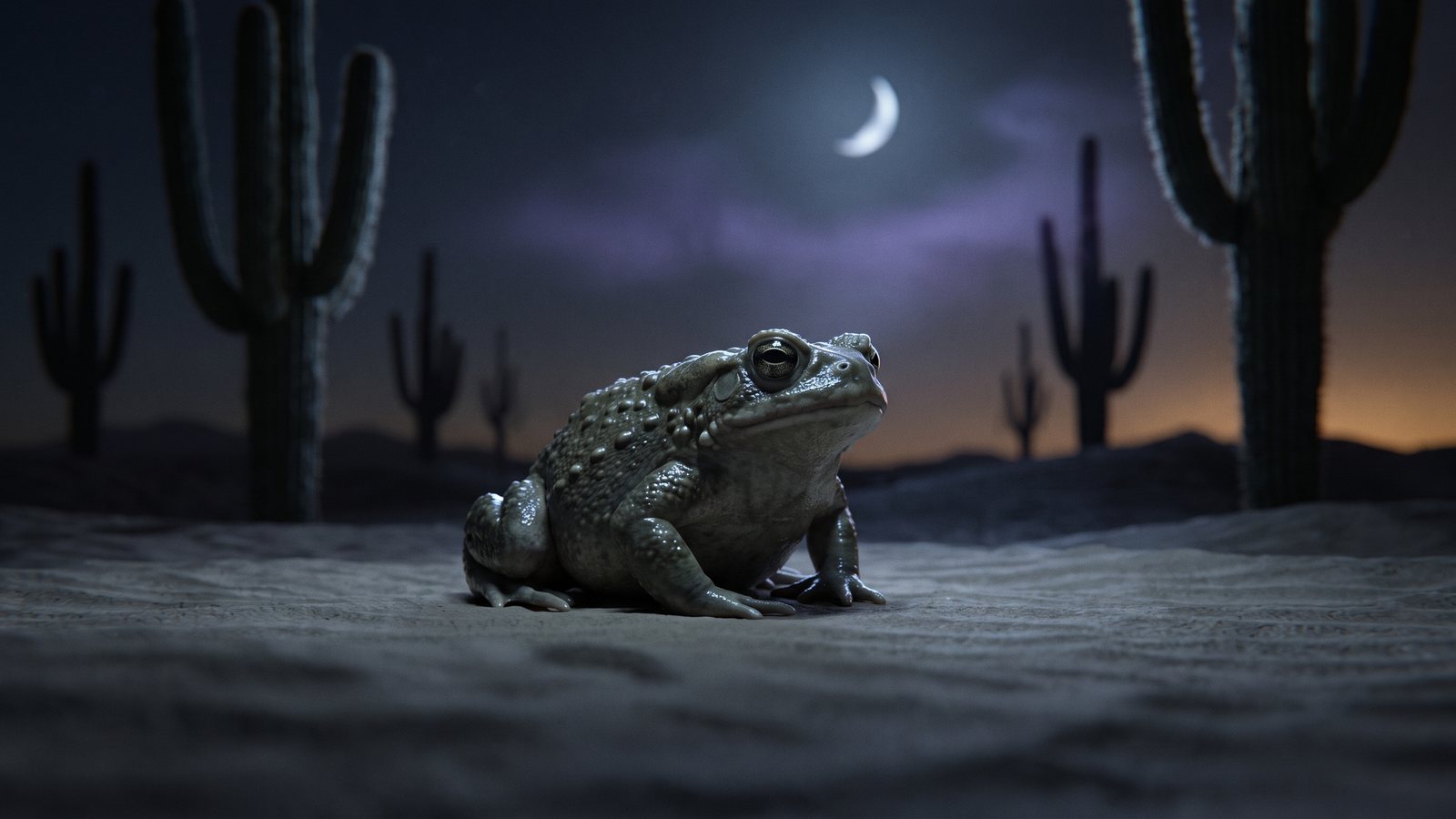
It is found mainly in the Sonoran Desert region of southern Arizona in the United States and Sonora in Mexico. These are large toads, native to the United States, that eat a variety of invertebrates and occasionally vertebrates. When approached by a predator, they sit and puff themselves up (Luccioni et al., 2025). Evidence: established.
A 2021 overview on Chacruna, a psychedelic-education site, adds more natural history. It describes the species as the largest native toad in the United States, reaching up to 20 cm long, with a white wart at each corner of the mouth. The toads are active from late May to September, mostly in the summer rainy season, nocturnal in the hot months, and underground for the rest of the year. Mating is triggered by rain, and they may live at least 10 years (Ermakova, 2021). This is an expert essay, not a peer-reviewed paper. Evidence: preliminary.
What is in “toad venom”, chemically?
Like other toads, the Sonoran Desert toad releases a mix of toxins from its parotoid glands, the large glands behind the eyes, and from other glands when threatened (Luccioni et al., 2025). The secretion is often called toad venom, though strictly a venom is injected and this is not. Its best-known component is 5-MeO-DMT (5-methoxy-N,N-dimethyltryptamine). A 2025 study describes the species as the only animal known to secrete it as a chemical defence; the other toads sampled alongside it did not (Luccioni et al., 2025). Evidence: established.
It is a mixture, not one compound. A 2022 review lists heart-active toxins called bufadienolides, adrenaline and noradrenaline, serotonin, bufotenine and several related indole compounds, plus sterols. Whether any of these add to or change the effects of 5-MeO-DMT is unknown (Reckweg et al., 2022). Evidence: established for the list; unresolved for how the parts interact.
5-MeO-DMT was first described in the toad’s skin in the 1960s, in work by Erspamer and colleagues (Villa, 2023). How the toad comes to have it is still unknown. A 2025 field study in Arizona found it in every Sonoran Desert toad sampled and not in the other toads living alongside them. Their diets were similar, so the authors argue the toad makes it itself or with help from a microbe (Luccioni et al., 2025). Evidence: preliminary, from one study.
Is it a “DMT toad”? 5-MeO-DMT and bufotenine vs DMT
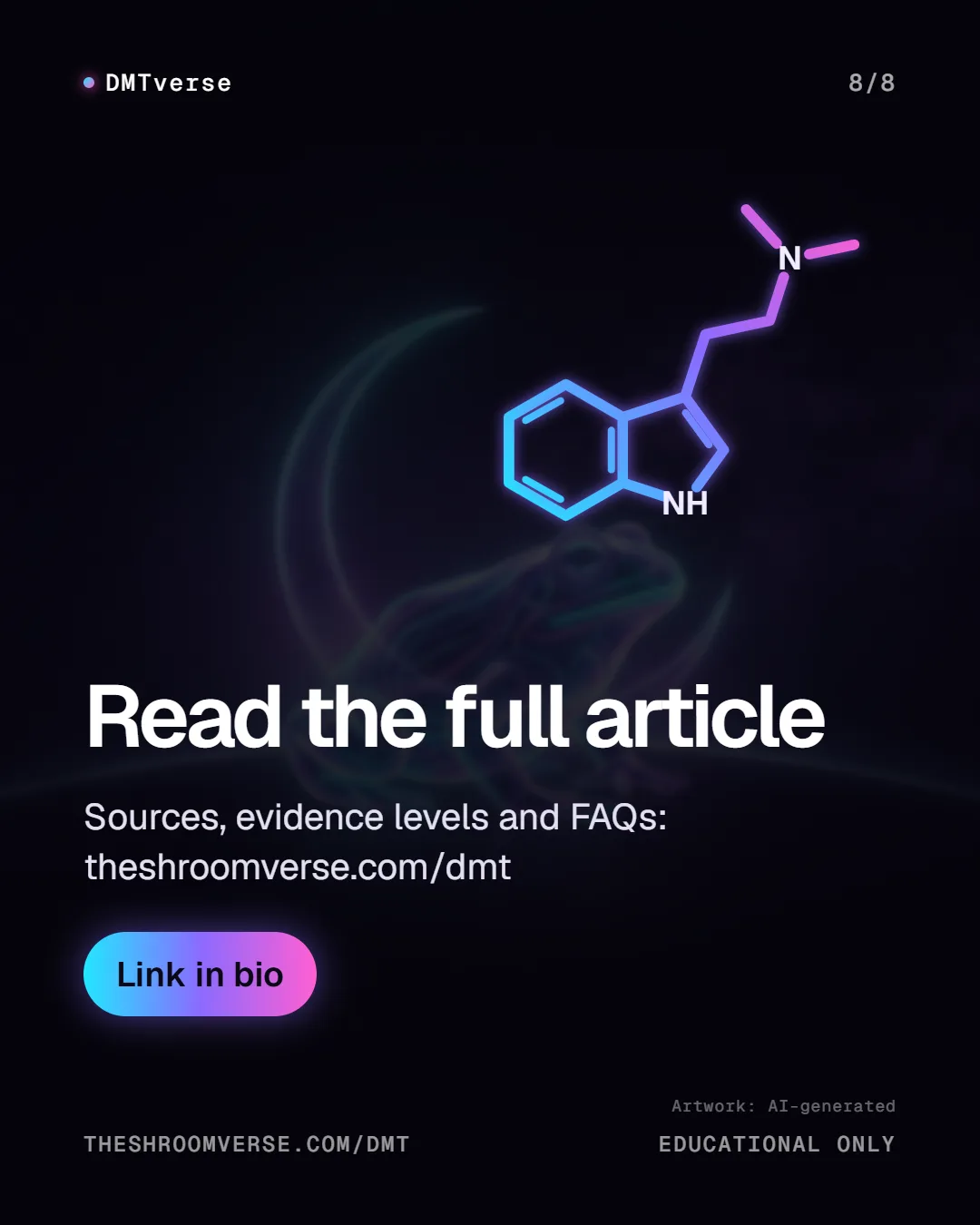
No. All three molecules are tryptamines, and they share one skeleton: an indole ring (a fused pair of carbon rings, one containing nitrogen) with a two-carbon chain ending in a nitrogen that carries two methyl groups. They differ by one group at position 5 of the ring. N,N-DMT has nothing there and its formula is C12H16N2 (PubChem, DMT). Bufotenine has a hydroxyl group there, C12H16N2O (PubChem, bufotenine). 5-MeO-DMT has a methoxy group, C13H18N2O (PubChem, 5-MeO-DMT). Evidence: established.
| Molecule | Also called | Group at ring position 5 | Formula |
|---|---|---|---|
| N,N-DMT | DMT, N,N-dimethyltryptamine | None | C12H16N2 |
| Bufotenine | Bufotenin, 5-hydroxy-DMT (5-OH-DMT) | Hydroxyl (–OH) | C12H16N2O |
| 5-MeO-DMT | 5-methoxy-DMT, O-methylbufotenine | Methoxy (–OCH3) | C13H18N2O |
The small change matters in the body. 5-MeO-DMT binds most strongly at the serotonin 5-HT1A receptor, while DMT acts mainly at 5-HT2A, and reviews describe 5-MeO-DMT as producing relatively few visual effects (Ermakova et al., 2022). The body converts some 5-MeO-DMT into bufotenine through the liver enzyme CYP2D6 (Reckweg et al., 2022). Our 5-MeO-DMT vs DMT guide compares the two in depth. Evidence: established.
So why does “DMT toad” circulate? Partly because toad secretions as a group are linked with all three. A 2023 study states, in general terms, that the skin and parotoid glands of certain toads accumulate DMT, 5-MeO-DMT and bufotenine, along with poisonous steroids; its abstract does not say which species hold which compound (Chen et al., 2023). For the Sonoran Desert toad, the defining compound is 5-MeO-DMT. For where N,N-DMT itself turns up in nature, see where does DMT come from in nature. Evidence: established.
How did the toad become famous?
Recently, and through print. Reviews trace its popularity to a 1984 booklet, Bufo alvarius: The Psychedelic Toad of the Sonoran Desert, and find no conclusive historical evidence of Indigenous use of these toads for psychoactive purposes before it (Ermakova et al., 2022). A 2023 paper argues that commercial “spirituality, wellness, and adventurism” around the toad have spread mistaken or exploitative stories of ancient Indigenous use (Villa, 2023). Evidence: established that no conclusive evidence of earlier use exists.
- 1965–1967Erspamer and colleagues report 5-MeO-DMT in the toad’s skin.Source Villa, 2023
- 1984A booklet popularises the toad’s secretion as a psychedelic.Source Ermakova et al., 2022; Villa, 2023
- 1988–1992A media wave about “toad licking” spreads misinformation in the US, Canada and elsewhere.Source Lyttle, 1993
- 1994Weil and Davis publish on Bufo alvarius in the Journal of Ethnopharmacology.Source Weil and Davis, 1994
- 2004Date of the IUCN Red List assessment that later reviews still rely on.Source Reckweg et al., 2022
- 20095-MeO-DMT placed in US Schedule I.Source Ermakova et al., 2022
- 2023A paper reviews the toad’s biocultural history and conservation challenges.Source Villa, 2023
- 2025A field study finds diet does not explain the toad’s 5-MeO-DMT.Source Luccioni et al., 2025
- 2026A review of 208 dogs with suspected exposure is published.Source Wilkins et al., 2026
The 1994 paper by Weil and Davis had a historical question. Anthropologists had speculated that ancient Mesoamerican peoples used the cane toad as a ritual intoxicant. The authors rejected the cane toad because its venom is too toxic, proposed the Sonoran Desert toad as a more likely candidate, and noted that its venom is known to be toxic when swallowed. Their experiments, by a different route, are not described here (Weil and Davis, 1994). Evidence: established for what the paper reports; the ancient-use idea is unresolved.
Is the Sonoran Desert toad endangered?
Not on paper, but the paper is old. A 2022 review notes the toad is not listed as endangered on the IUCN Red List, the global register of threatened species, but that this rests on an assessment from 2004. The authors argue that demand for the secretion could harm the species through habitat invasion, excessive handling of toads, amphibian trafficking and black-market dynamics (Reckweg et al., 2022). We could not open the IUCN record itself. Evidence: preliminary; this is the authors’ argument.
Field researchers report the pressure directly. The 2025 diet study states that growing demand has resulted in “widespread illegal toad poaching”, and it published its site locations only approximately “due to conservation concerns”. That team worked under state scientific collecting licences, released every toad where it was found, and killed none (Luccioni et al., 2025). Evidence: established for the authors’ statements; the scale of poaching is unmeasured.
Welfare is a separate concern from numbers. The Chacruna overview argues that taking secretion from a toad, even when it is released alive, is a stressful event that leaves it without its chemical defence, and that stress can affect reproduction, immune function and growth. It adds that moving toads away from where they were found could be fatal (Ermakova, 2021). The 2023 paper notes that few conservation-focused studies of the toad exist, and most were crowdfunded (Villa, 2023). Evidence: preliminary.
Researchers have also proposed taking the animal out of the research picture. The 2022 review argues that using synthetic 5-MeO-DMT in research would protect the toad and give full control over the substance studied, whereas the secretion is a variable mixture (Reckweg et al., 2022). Our 5-MeO-DMT vs DMT article covers the clinical research. Evidence: established for the review’s argument.
How is it different from the cane toad, and is cane toad poison dangerous?
The cane toad, Rhinella marina, was formerly called Bufo marinus. It is a different species. In tropical Australia it is an invasive animal whose toxins fatally poison native predators such as freshwater crocodiles (Aiyer et al., 2022). Its poison contains cardiac glycosides called bufadienolides (Santos et al., 2022). It is also the toad that Weil and Davis rejected as an ancient intoxicant because of its toxicity (Weil and Davis, 1994). Evidence: established.
| Sonoran Desert toad | Cane toad | |
|---|---|---|
| Scientific name | Incilius alvarius (formerly Bufo alvarius) | Rhinella marina (formerly Bufo marinus) |
| Best known for | The only animal known to secrete 5-MeO-DMT | Toxic secretion; an invasive species in some regions |
| Risk to dogs | Intoxication documented in 208 dogs in one Arizona review | Can be highly fatal without early treatment, per a veterinary review |
| Research on its enzymes | Source of 5-MeO-DMT unknown | A 2023 study described an enzyme that makes tertiary tryptamines |
Dogs are the main documented victims. A veterinary review says that a dog’s mouth contact with cane toad secretion can carry a high fatality rate without early, appropriate treatment. Signs appear almost at once: heavy drooling with gut, breathing and nervous-system signs, and less often severe heart-rhythm problems (Johnnides et al., 2016). Evidence: established.
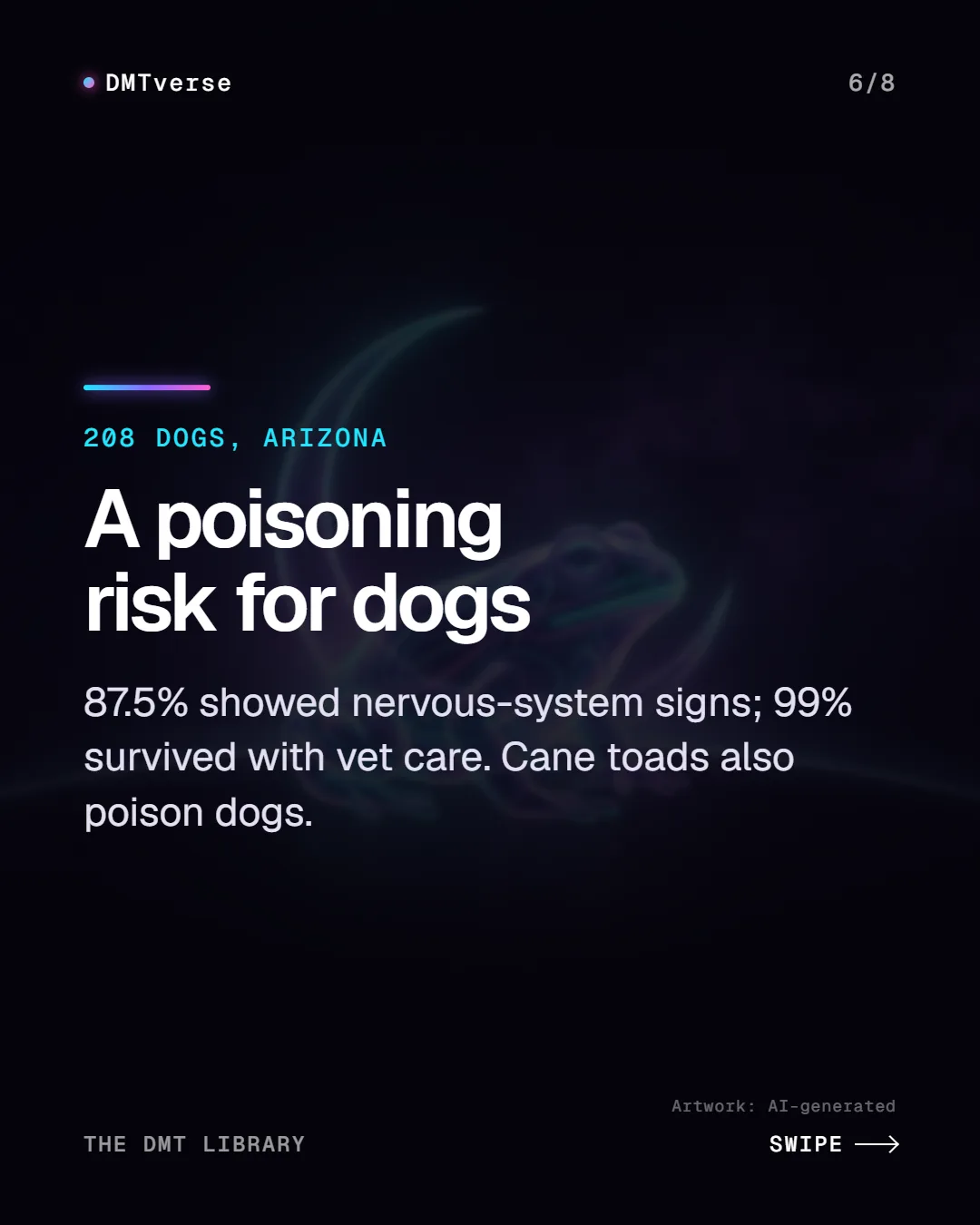
The Sonoran Desert toad poisons dogs too. A 2026 study reviewed 208 dogs seen at four emergency veterinary hospitals in Arizona between 2007 and 2010 for suspected exposure. Most cases happened in summer, and 75% during a monsoon. Nervous-system signs appeared in 87.5% of dogs, breathing signs in 76.9% and heart signs in 74.5%. With veterinary care, 206 of the 208 survived. The authors describe the syndrome as similar to cane toad poisoning and stress starting treatment as soon as possible (Wilkins et al., 2026). Evidence: established, from one retrospective study.
Neurologic signs
Seen in 182 of 208 dogs (Wilkins et al., 2026).
Respiratory signs
Seen in 160 of 208 dogs (Wilkins et al., 2026).
Cardiac signs
Seen in 155 of 208 dogs (Wilkins et al., 2026).
Survival to discharge
206 of 208 dogs survived with veterinary care (Wilkins et al., 2026).
Percentages of dogs showing each type of sign, from one retrospective review (Wilkins et al., 2026). A dog could show more than one.
If a person or a pet may have been poisoned
If a dog has mouthed or bitten a toad, contact a veterinarian or an emergency veterinary clinic right away; the veterinary studies above stress early treatment. For a person, call 911 if someone is unconscious, not breathing or having a seizure. For poisoning advice, call the Canada-wide Poison Control line, 1-844-POISON-X (1-844-764-7669); in Ontario, the Ontario Poison Centre is at 1-800-268-9017 (AboutKidsHealth). If you or someone you know is thinking about suicide, call or text 9-8-8, 24 hours a day (Government of Canada). See also our safety page.
Do people really lick toads? The myth
“Toad licking” is mostly a media creation. A 1993 paper describes a wave of coverage between 1988 and 1992, across the United States, Canada, Central and South America and Australia, that created “a frenzy of misinformation” about a supposed drug craze. The author argues that media exposure helped turn a fairly obscure activity into a perceived epidemic (Lyttle, 1993). Evidence: established for the media analysis.
The chemistry is no reassurance either. Toad secretions contain heart-active toxins (Reckweg et al., 2022), the Sonoran Desert toad’s venom is described as toxic when swallowed (Weil and Davis, 1994), and cane toad secretion can kill dogs that mouth it (Johnnides et al., 2016). Putting any toad in or near the mouth is a poisoning risk, not a shortcut to anything. Evidence: established.
Are 5-MeO-DMT and bufotenine legal in Canada?
They are not named in the main schedule. We read Schedule III of the Controlled Drugs and Substances Act on 20 October 2026, in the consolidation current to 30 September 2026. It lists N,N-DMT and its salts as item 7, and psilocin and psilocybin as items 11 and 12, but neither 5-MeO-DMT nor bufotenine appears there by name. Neither appears elsewhere in the Act’s text we searched (Justice Laws, CDSA). Evidence: established for what the text says.
The restricted-drug schedule of the newer Controlled Substances Regulations lists DMT but not 5-MeO-DMT or bufotenine (Justice Laws, SOR/2025-242). Health Canada’s drug-surveillance site uses 5-MeO-DMT as its example of a “new psychoactive substance”: not currently controlled under the Act, with its sale regulated under the Food and Drugs Act (Health Canada, Health Infobase; page modified 19 March 2026). Evidence: established.
“Not named” does not mean legal to sell, tested or safe. We found no published Health Canada position on bufotenine, and laws change; check the official texts. In the United States, 5-MeO-DMT has been in Schedule I since 2009 (Ermakova et al., 2022). Wildlife and trafficking laws that protect the toad are outside this article. For DMT itself, see is DMT legal in Canada. This is general information, not legal advice. Evidence: unresolved for bufotenine’s status in practice.
What is still unknown?
- How the Sonoran Desert toad makes 5-MeO-DMT: by itself, through a microbe, or some other way (Luccioni et al., 2025).
- How large its populations are now; the IUCN assessment that reviews cite dates from 2004 (Reckweg et al., 2022).
- How much poaching is actually happening, and with what effect on local populations.
- Whether the other compounds in the secretion change the effects of 5-MeO-DMT (Reckweg et al., 2022).
- Whether anyone used these toads for their psychoactive properties before 1984; reviews find no conclusive evidence (Ermakova et al., 2022).
For the wider family of molecules, start with what is DMT. For the mushroom side of the same chemistry, read is there DMT in magic mushrooms?.
Common questions
What is Bufo alvarius?
Bufo alvarius is the older scientific name of the Sonoran Desert toad, now called Incilius alvarius and also known as the Colorado river toad. It lives mainly in southern Arizona and Sonora, Mexico. It is the only animal known to secrete 5-MeO-DMT as a chemical defence.
Does the Sonoran Desert toad contain DMT?
Its defining compound is 5-MeO-DMT, not the N,N-DMT of most DMT research, and its secretion also holds bufotenine. The three are related tryptamines that differ by one group on the ring. 5-MeO-DMT acts most strongly at the 5-HT1A receptor, DMT mainly at 5-HT2A.
What is bufotenine?
Bufotenine, also spelled bufotenin, is 5-hydroxy-DMT: the DMT skeleton with a hydroxyl group at position 5 of the ring. It occurs in the Sonoran Desert toad’s secretion, and the body also forms it from 5-MeO-DMT through the liver enzyme CYP2D6.
Is the Sonoran Desert toad endangered?
It is not listed as endangered on the IUCN Red List, but reviews point out that the listing rests on a 2004 assessment. Researchers report widespread illegal poaching driven by demand for the secretion and have raised welfare concerns. Its current population status is not well measured.
Is cane toad poison dangerous to dogs?
Yes. A veterinary review says cane toad (Rhinella marina) secretion can carry a high fatality rate in dogs without early treatment. The Sonoran Desert toad also poisons dogs: in a review of 208 Arizona cases, most dogs showed nervous-system signs and 99% survived with veterinary care. Contact a veterinarian right away.
Do people really lick toads?
The idea spread mainly through a 1988–1992 media wave that one researcher called a frenzy of misinformation. Toad secretions contain heart-active toxins, and the Sonoran Desert toad’s venom is described as toxic when swallowed. Putting a toad near the mouth is a poisoning risk.
Is 5-MeO-DMT legal in Canada?
As read on 20 October 2026, neither 5-MeO-DMT nor bufotenine is named in the Controlled Drugs and Substances Act schedules. Health Canada describes 5-MeO-DMT as a new psychoactive substance not controlled under the Act, whose sale is regulated under the Food and Drugs Act. This is not legal advice.
Shroomverse sells mushroom products. This article is general information about the Sonoran Desert toad’s natural history, chemistry, conservation and legal status. It is not medical, legal or purchasing advice, and it does not recommend any product.
SOURCES
- Diet and chemical defenses of the Sonoran Desert toad (Luccioni MD, Wyman JT, Espinoza EO, O'Connell LA, PLOS One, 2025), PLOS (peer-reviewed, open access); full text via Europe PMC, PMC12599970. Accessed . Full text read. Only animal known to secrete 5-MeO-DMT; range mainly southern Arizona and Sonora; large toads native to the US eating invertebrates and occasionally vertebrates; parotoid and other glands; puff defence; 5-MeO-DMT in all I. alvarius sampled and not in sympatric toads; diet similar; endogenous or symbiont hypotheses; “widespread illegal toad poaching”; approximate site locations “due to conservation concerns”; Arizona Game and Fish collecting licences; toads released, none killed.
- Toad in the road: Biocultural history and conservation challenges of the Sonoran Desert Toad (Villa RA, Journal of Psychedelic Studies 7(S1):68–79, 2023), Akadémiai Kiadó (peer-reviewed, open access). Accessed . Abstract read via Crossref. 5-MeO-DMT first reported in I. alvarius in 1965 and 1967 (Erspamer et al.); popular use after the 1984 booklet; for-profit use driving erroneous narratives of ancient Indigenous use; few conservation studies, mostly crowdfunded.
- The clinical pharmacology and potential therapeutic applications of 5-methoxy-N,N-dimethyltryptamine (5-MeO-DMT) (Reckweg JT, et al., Journal of Neurochemistry 162:128–146, 2022), Wiley (peer-reviewed, open access); full text via Europe PMC, PMC9314805. Accessed . Full text read. Bufo alvarius (Incilius alvarius) naming; secretion components (bufadienolides, catecholamines, serotonin, bufotenine and other indolealkylamines, sterols) and unknown interactions; CYP2D6 conversion of 5-MeO-DMT to bufotenine; IUCN status based on a 2004 assessment; habitat invasion, excessive handling, trafficking and black-market concerns; argument for synthetic 5-MeO-DMT. Concentration figures deliberately not reproduced.
- A narrative synthesis of research with 5-MeO-DMT (Ermakova AO, Dunbar F, Rucker J, Johnson MW, Journal of Psychopharmacology 36(3):273–294, 2022), SAGE (peer-reviewed, open access); full text via Europe PMC, PMC8902691. Accessed . Full text read. Highest affinity at 5-HT1A; relative lack of visual effects; popularity of toad secretions traceable to the 1984 booklet; no conclusive historical evidence of Indigenous use of I. alvarius before it; US Schedule I since 2009.
- Toad Conservation (Ermakova A, 16 April 2021), Chacruna Institute for Psychedelic Plant Medicines (not peer reviewed). Accessed . Read in full. Natural history (largest native US toad, up to 20 cm, white mouth warts, active late May to September, nocturnal in summer, rain-triggered mating, lifespan at least 10 years); IUCN least concern with a 2004 assessment; welfare argument that taking secretion is stressful and removes the toad’s defence, and that relocation might be fatal. Collection details in the essay deliberately not reproduced.
- Bufo alvarius: a potent hallucinogen of animal origin (Weil AT, Davis W, Journal of Ethnopharmacology 41(1-2):1–8, 1994), Elsevier (peer-reviewed). Accessed . Abstract read via Europe PMC. Cane toad rejected as an ancient intoxicant because of venom toxicity; Sonoran Desert toad proposed instead; its venom known to be toxic when consumed orally. The route used in the authors’ experiments is deliberately not described.
- Misuse and legend in the “toad licking” phenomenon (Lyttle T, International Journal of the Addictions 28(6):521–538, 1993), Taylor & Francis (peer-reviewed). Accessed . Abstract read via Europe PMC. 1988–1992 media wave in the US, Canada, Central and South America and Australia; “frenzy of misinformation”; media exposure turning an obscure activity into a potential epidemic.
- A cane toad (Rhinella marina) N-methyltransferase converts primary indolethylamines to tertiary psychedelic amines (Chen X, et al., Journal of Biological Chemistry 299(10):105231, 2023), Elsevier / ASBMB (peer-reviewed, open access); PMC10570959. Accessed . Abstract read via Europe PMC. Skin and parotid glands of certain toads accumulate poisonous steroids and DMT, 5-MeO-DMT and bufotenin (stated generally, without naming species); a cane toad enzyme that makes tertiary tryptamines. Abstract re-read on 2026-10-20 in editorial review.
- Clinical review of Colorado river toad (Incilius alvarius) intoxication in dogs in Arizona: clinical signs, treatments, and outcomes (Wilkins A, Cagle L, Wells R, Granfone M, Journal of the American Veterinary Medical Association, 2026), American Veterinary Medical Association (peer-reviewed). Accessed . Abstract read via Europe PMC. Retrospective review of 208 dogs at four emergency hospitals, July 2007 to October 2010; 84% in summer, 75% during a monsoon; neurologic 87.5%, respiratory 76.9%, cardiac 74.5%; 206 of 208 survived; syndrome similar to Rhinella marina; early treatment recommended.
- Toad Intoxication in the Dog by Rhinella marina: The Clinical Syndrome and Current Treatment Recommendations (Johnnides S, Green T, Eubig P, Journal of the American Animal Hospital Association 52(4):205–211, 2016), American Animal Hospital Association (peer-reviewed). Accessed . Abstract read via Europe PMC. Rhinella marina formerly Bufo marinus; high fatality rate without early treatment; drooling, gastrointestinal, respiratory and neurologic signs, less often severe arrhythmias. Bibliographic details checked on Crossref.
- Vasoconstrictor and hemodynamic effects of a methanolic extract from Rhinella marina toad poison (Santos CVD, et al., Toxicon 218:57–65, 2022), Elsevier (peer-reviewed); PMC9832923. Accessed . Abstract read via Europe PMC. Cited only for Rhinella marina poison containing cardiac glycosides called bufadienolides. The study's rat doses are deliberately not reproduced.
- Shifts in the foraging tactics of crocodiles following invasion by toxic prey (Aiyer A, Shine R, Somaweera R, Bell T, Ward-Fear G, Scientific Reports 12, 2022), Springer Nature (peer-reviewed, open access); PMC8786828. Accessed . Abstract read via Europe PMC. Cane toads (Rhinella marina) invasive in tropical Australia; freshwater crocodiles often fatally poisoned when they ingest them.
- Controlled Drugs and Substances Act (S.C. 1996, c. 19), full text, Schedule III, Government of Canada, Justice Laws Website. Accessed . Act current to 2026-09-30, last amended 2026-07-18. Schedule III items 7 (DMT), 11 (psilocin) and 12 (psilocybin). The full text was searched for bufotenine, 5-hydroxy and 5-methoxy tryptamine names: neither bufotenine nor 5-MeO-DMT is listed.
- Controlled Substances Regulations (SOR/2025-242), full text, Schedule 4, Government of Canada, Justice Laws Website. Accessed . Consolidation current to 2026-09-30. Schedule 4 (restricted drugs) lists DMT and its salts; bufotenine and 5-MeO-DMT not found when searched.
- Canadian Drugs and Substances Watch: understanding the data, Health Canada, Health Infobase. Accessed . Page modified 2026-03-19. New psychoactive substances are not currently controlled under the CDSA and their sale is regulated under the Food and Drugs Act; 5-MeO-DMT given as the example.
- N,N-Dimethyltryptamine, compound summary (CID 6089), U.S. National Library of Medicine, PubChem. Accessed . Formula C12H16N2, read through the PubChem REST interface.
- Bufotenine, compound summary (CID 10257), U.S. National Library of Medicine, PubChem. Accessed . Formula C12H16N2O; IUPAC name 3-[2-(dimethylamino)ethyl]-1H-indol-5-ol (hydroxyl at position 5), read through the PubChem REST interface.
- O-Methylbufotenine (5-MeO-DMT), compound summary (CID 1832), U.S. National Library of Medicine, PubChem. Accessed . Formula C13H18N2O; IUPAC name 2-(5-methoxy-1H-indol-3-yl)-N,N-dimethylethanamine, read through the PubChem REST interface.
- Poison information centres in Canada, AboutKidsHealth, The Hospital for Sick Children (SickKids). Accessed . Source for 1-844-POISON-X (1-844-764-7669), the Ontario Poison Centre toll-free line 1-800-268-9017, and calling 911 if someone is unconscious, not breathing or having a seizure.
- Mental health support: get help, Government of Canada, Public Health Agency of Canada. Accessed . Source for calling 9-1-1 in immediate danger and the 9-8-8 line (call or text, 24 hours a day, 7 days a week).
CHANGES
- : Linked glossary definitions.
- : Published. Sources opened and checked on this date, including the CDSA and Controlled Substances Regulations consolidations current to 30 September 2026. The IUCN Red List record and AmphibiaWeb could not be opened (verification pages), so the 2004 assessment is cited from Reckweg et al. 2022 and Chacruna 2021.
- : Editorial review: “only animal known” claim attributed to Luccioni et al. and limited to the toads they sampled; Chen et al. 2023 sentence trimmed to what its abstract says (no species-level amounts); tryptamine skeleton wording clarified; unsourced claim about the synthetic formulation used in clinical trials removed. Luccioni, Chen, Wilkins and Lyttle abstracts re-checked on Europe PMC.



