THE SHROOMVERSE JOURNAL ✳ 16 MIN READ
Is DMT addictive? Dependence, tolerance and what bad DMT trips look like in research
Topic: Safety and risk
Published Updated
Listen: the 3-minute version
AI-narrated summary of this article
Short answer, checked 20 October 2026
The research we found does not show DMT to be addictive in the usual sense, but the evidence is thin. Monkeys self-administered it only sporadically, a large online survey found a low urge to use more, and lab studies found no tolerance to its psychological effects. In those studies DMT raised heart rate and blood pressure, and higher amounts brought more fear and anxiety. Combining it with MAO inhibitors or other serotonergic drugs is a recognised danger. This is general information, not medical advice.
THE SHORT VERSION · SWIPE
On this page 11 sections
DMT (N,N-dimethyltryptamine) is a short-acting psychedelic; our what is DMT guide covers the basics. People who ask whether it is addictive usually want to know two things: whether it can trap someone in a pattern of use, and whether one experience can go badly wrong. This guide takes both in turn, using lab studies, surveys and case reports, and says plainly where the evidence runs out.
For the same questions about mushrooms, see are magic mushrooms addictive? For what official Canadian sources say to do when someone is in distress, see how to help someone having a bad trip.
If someone may be in danger now
Call 911 if the person is unconscious, not breathing or having a seizure; Canada’s poison centres give those three signs (infopoison.ca). For advice on a possible poisoning in Ontario, call the Ontario Poison Centre at 1-800-268-9017, 24 hours a day. Most other provinces use 1-844-POISON-X (1-844-764-7669); Québec uses 1-800-463-5060. For a suicide or mental-health crisis, call or text 9-8-8. Our safety page keeps these numbers.
Is DMT addictive, and what would that mean?
Researchers break addiction into separate questions. Abuse potential asks whether a drug is rewarding enough that people or animals keep taking it. Tolerance asks whether repeated use weakens the effect. Dependence asks whether stopping causes withdrawal or a felt need for the drug. A drug can score low on one and higher on another, so each is worth looking at on its own.
The Centre for Addiction and Mental Health (CAMH) lists DMT among the hallucinogens. For the group as a whole, it says stopping hallucinogens “does not usually cause symptoms of withdrawal”, but that people can develop psychological dependence, in which they feel they need the drug (CAMH). That is a statement about hallucinogens in general, not a finding about DMT in particular. We found no Canadian study of DMT dependence. Evidence: established as public-health guidance.
We label the strength of each finding. Established: several studies or official sources agree. Preliminary: small, old, single, self-selected or case-level data. Unresolved: not yet answered.
Do animals keep taking DMT when they can?
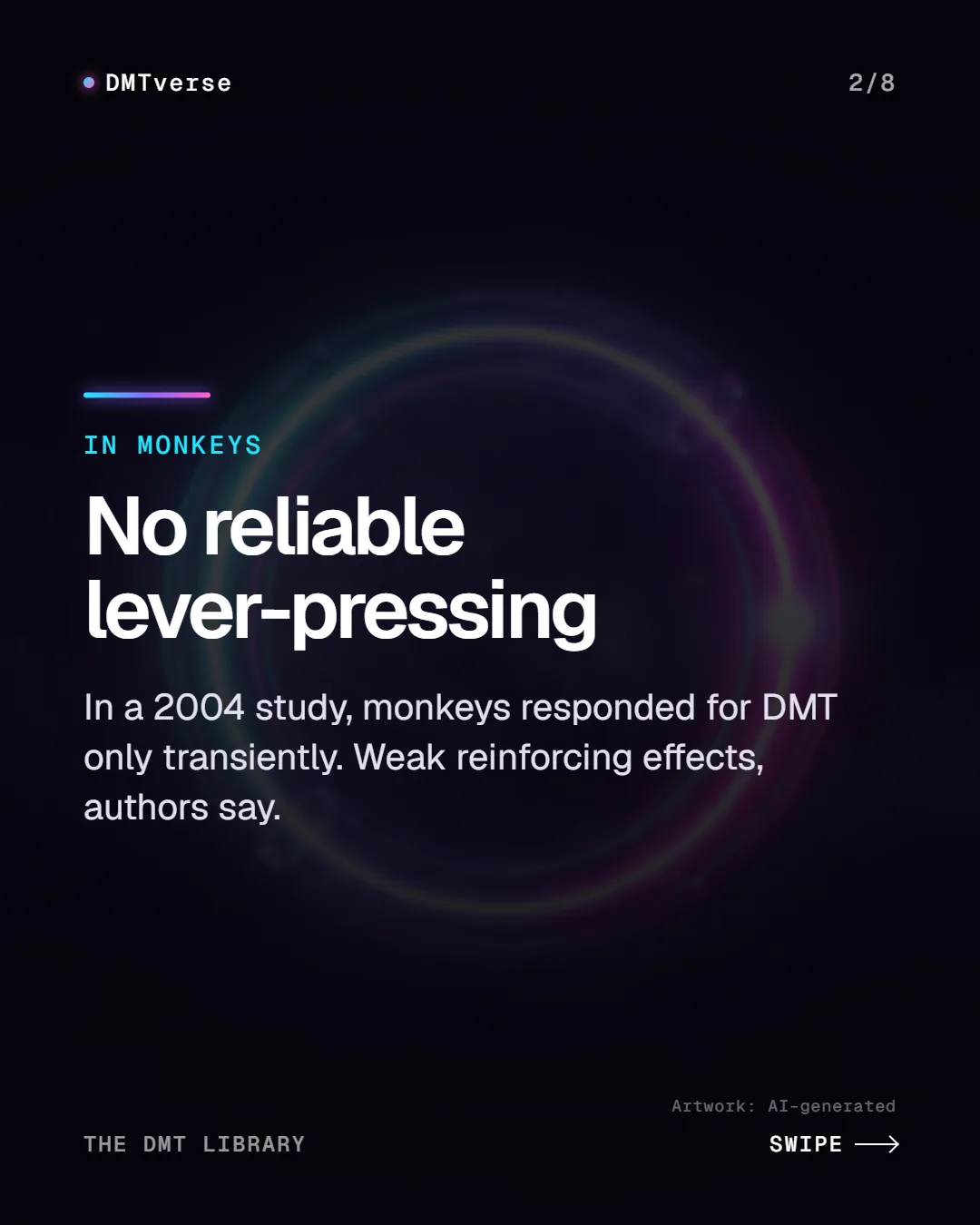
Self-administration studies let animals press a lever for a drug; drugs with high abuse potential keep animals responding reliably. In a 2004 study, rhesus monkeys that had already learned to self-administer MDMA were offered several hallucinogens, DMT among them (Fantegrossi et al., 2004).
No compound produced reliable responding. Three of four monkeys did respond in one or more sessions when DMT, mescaline or psilocybin was available, but the pattern was transient, and the authors suggested these drugs have weak reinforcing effects, or a mix of rewarding and aversive ones (Fantegrossi et al., 2004).
A 2007 risk assessment of the DMT-containing brew ayahuasca found no laboratory animal models that had tested its abuse potential at all (Gable, 2007). Evidence: preliminary. There are very few animal studies, the groups are small, and animal results are a model of human behaviour, not proof of it.
What do surveys of people who use DMT show?
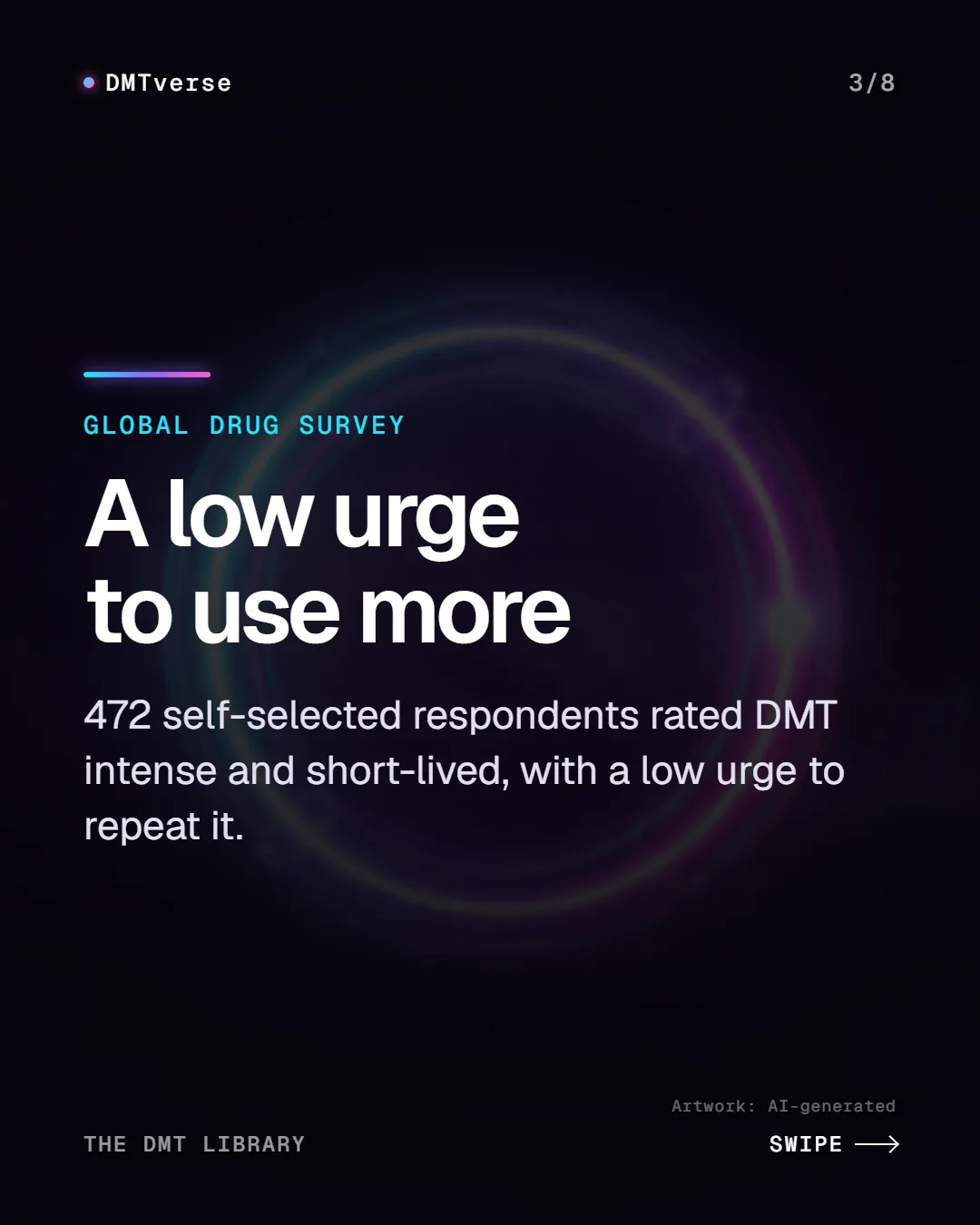
The largest data set we found comes from the Global Drug Survey, an anonymous online survey. Its 2012 round had 22,289 responses. Lifetime DMT use was 8.9% and past-year use 5.0%. The researchers compared ratings from 472 people who named DMT as the last new drug they had tried with ratings for magic mushrooms, LSD and ketamine (Winstock et al., 2014).
Respondents described a strong, intense, short-lived experience with relatively few negative effects or “come down”. The authors’ conclusion cuts both ways: DMT “seems to have a very desirable effect profile indicating a high abuse liability that maybe offset by a low urge to use more” (Winstock et al., 2014). In other words, people liked it, which is one warning sign, but they did not report feeling driven to repeat it, which is another sign that matters more for addiction.
Two limits. The survey recruits people online who choose to answer, many of whom use drugs, so it does not describe the general population. And it measures how people rate a drug, not whether they went on to develop a disorder. Evidence: preliminary.
Lab and ritual-use data point the same way. A small 2022 hospital study of DMT given into a vein, in three healthy volunteers and seven people with treatment-resistant depression, found “no dose-related differences in measures of drug reinforcement and abuse liability” (D’Souza et al., 2022). Gable’s review of ceremonial ayahuasca found no evidence of “substantial or persistent abuse potential” and called the dependence potential of oral DMT minimal (Gable, 2007). Evidence: preliminary, from small or selected samples.
Does tolerance build up to DMT?
This is where DMT looks unusual. Tolerance means a repeated dose has less effect than the first. Our mushroom addiction guide covers how it works for psilocybin. With DMT, the human studies we found mostly did not see tolerance to the psychological effects, which is the origin of a popular myth covered in DMT myths, fact-checked.
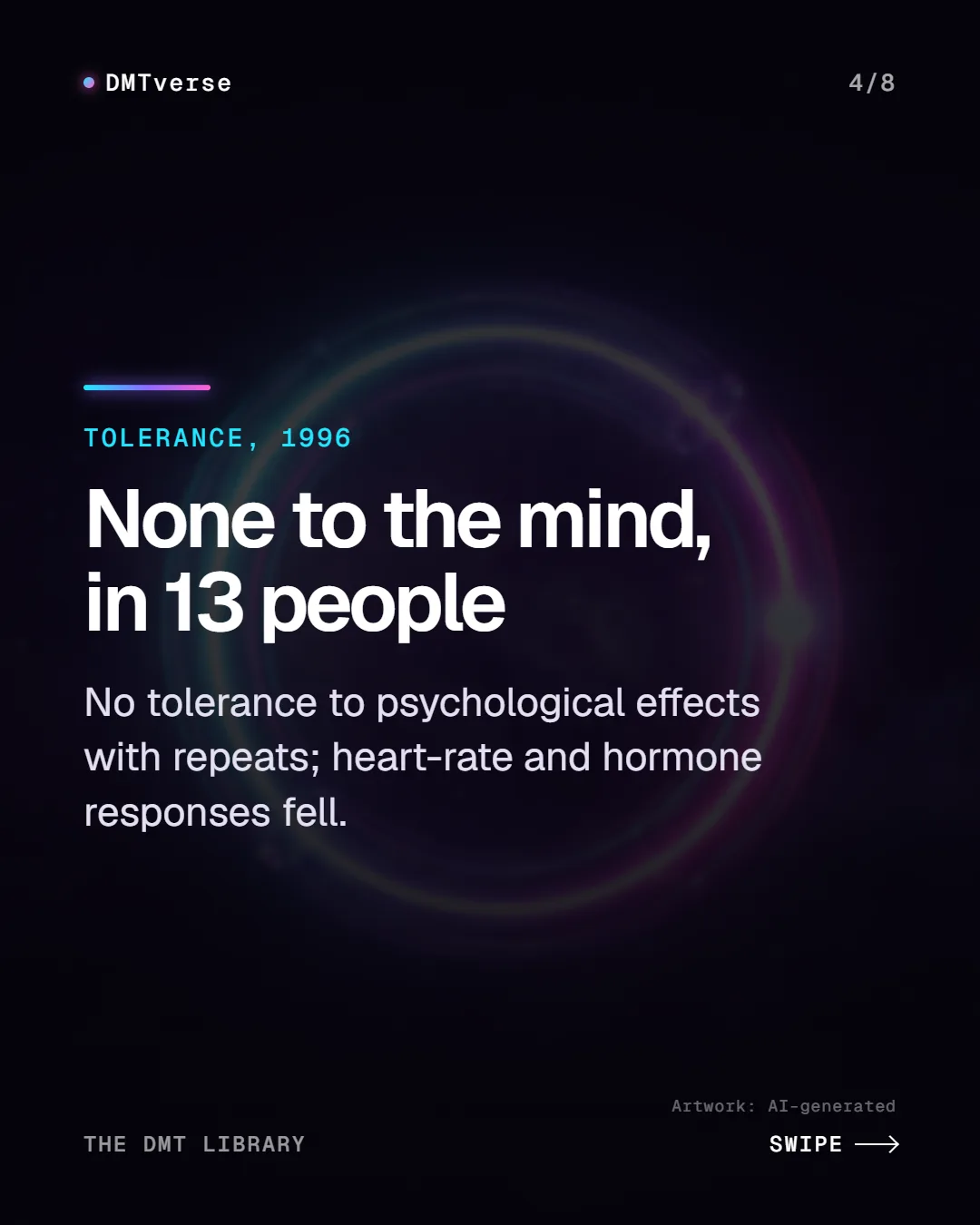
In 1996, Strassman and colleagues gave 13 experienced hallucinogen users intravenous DMT or saline four times, 30 minutes apart, on two separate days, in a randomized, double-blind design. Tolerance to the psychedelic effects “did not occur”, judged by clinical interview and by the Hallucinogen Rating Scale. Some bodily responses did fade: heart rate and the stress hormones ACTH, prolactin and cortisol rose less with each repeat, although blood pressure did not (Strassman et al., 1996). Evidence: preliminary, from one small study.
Strassman’s summary of his programme calls DMT unique among classic hallucinogens in its “inability to induce tolerance to its psychological effects” (Strassman, 1996).
Newer work mostly agrees. A 2026 randomized trial gave healthy volunteers several intravenous doses about an hour apart in one session and found that ratings stayed similar at the same dose with repeated dosing: “No tolerance was observed to acute effects of DMT” (Erne et al., 2026). Evidence: preliminary.
A 2024 study, which kept DMT running as a slow infusion for 30 minutes in 11 volunteers, found something slightly different: blood levels kept rising while the psychological effects levelled off, which the authors read as a sign of acute psychological tolerance within a single session (Luan et al., 2024). A 2024 review also reports older animal studies, in cats and squirrel monkeys, that found no tolerance (White et al., 2024).
| Study | Design | People | Tolerance finding |
|---|---|---|---|
| Strassman et al., 1996 | Four repeats 30 minutes apart, randomized, double-blind, placebo | 13 experienced hallucinogen users | None to psychological effects; heart rate and hormone responses fell; blood pressure did not |
| Erne et al., 2026 | Repeated doses about an hour apart, randomized, double-blind, placebo | 20 healthy volunteers (plus 16 open-label) | None to acute effects |
| Luan et al., 2024 | Bolus then 30-minute infusion, placebo-controlled | 11 healthy volunteers | Effects plateaued as blood levels rose: possible acute psychological tolerance |
Why does this matter? Fast-building tolerance can act as a natural brake on repeated use. DMT does not seem to have that brake, at least over hours. That is not evidence that DMT is addictive, but it means one possible reassurance does not carry over. Evidence: established that tolerance to the psychological effects is weak or absent over short periods, from small studies; unresolved for repeated use over days or weeks, which no study we found tested in people.
What physical effects have studies measured?
The cardiovascular effects are consistent. In Strassman’s 1994 placebo-controlled study of 11 experienced users, DMT raised blood pressure, heart rate, pupil size and body temperature in a dose-dependent way, along with several stress hormones. Peak blood levels and effects came within 2 minutes and were negligible by 30 minutes (Strassman and Qualls, 1994).
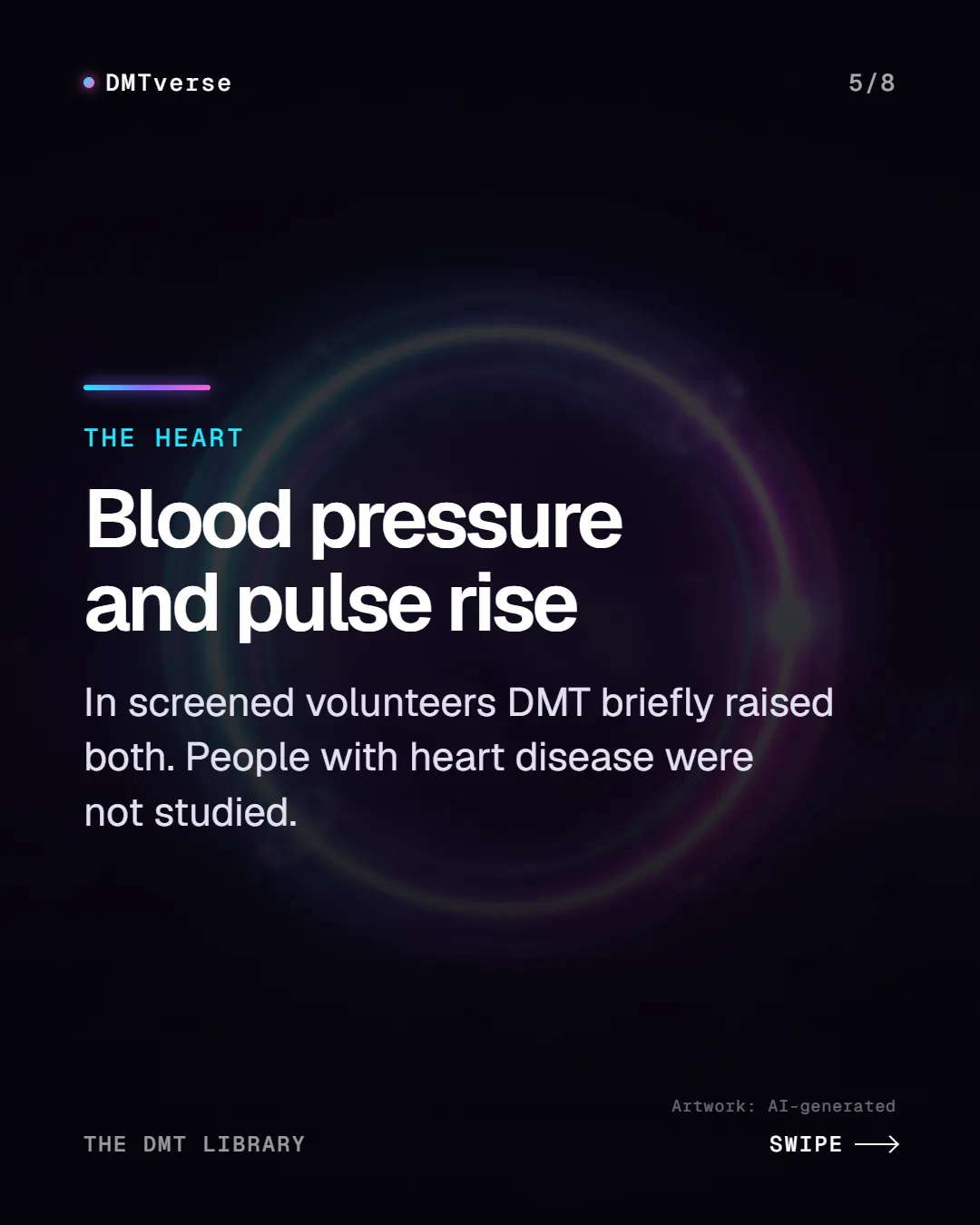
The 2026 trial found that DMT dose-dependently increased systolic and diastolic blood pressure. Frequent complaints were headache, impaired concentration, a feeling of weakness and palpitations (Erne et al., 2026). Evidence: established.
In the 2022 hospital study, DMT increased blood pressure, heart rate and anxiety, all of which resolved within 20 to 30 minutes. The most common adverse events were short-lived anxiety, headache and raised blood pressure. One serious adverse event occurred: a participant had a markedly slow heart rate and low blood pressure without symptoms, which staff treated without lasting effects (D’Souza et al., 2022). Evidence: preliminary, from 10 people.
These volunteers were screened and monitored, with medical staff on hand. The 2026 trial excluded anyone with a personal or close-family history of major psychiatric disorders (Erne et al., 2026). People with heart conditions, or anyone outside a lab, were not studied. Evidence: established that DMT raises heart rate and blood pressure briefly in healthy volunteers; unknown for people with heart disease.
What is a bad DMT trip like, according to research?
The phrase “bad trip” is not a scientific term, but lab studies do record frightening and distressing effects. Strassman’s volunteers described an almost immediate, brief but overwhelming “rush” and a loss of control that led to a dissociated state, “where euphoria alternated or coexisted with anxiety”. Effects peaked within about two minutes and had almost resolved by 30 minutes (Strassman et al., 1994). Evidence: established. For the full range of reported experiences, see what does DMT feel like.
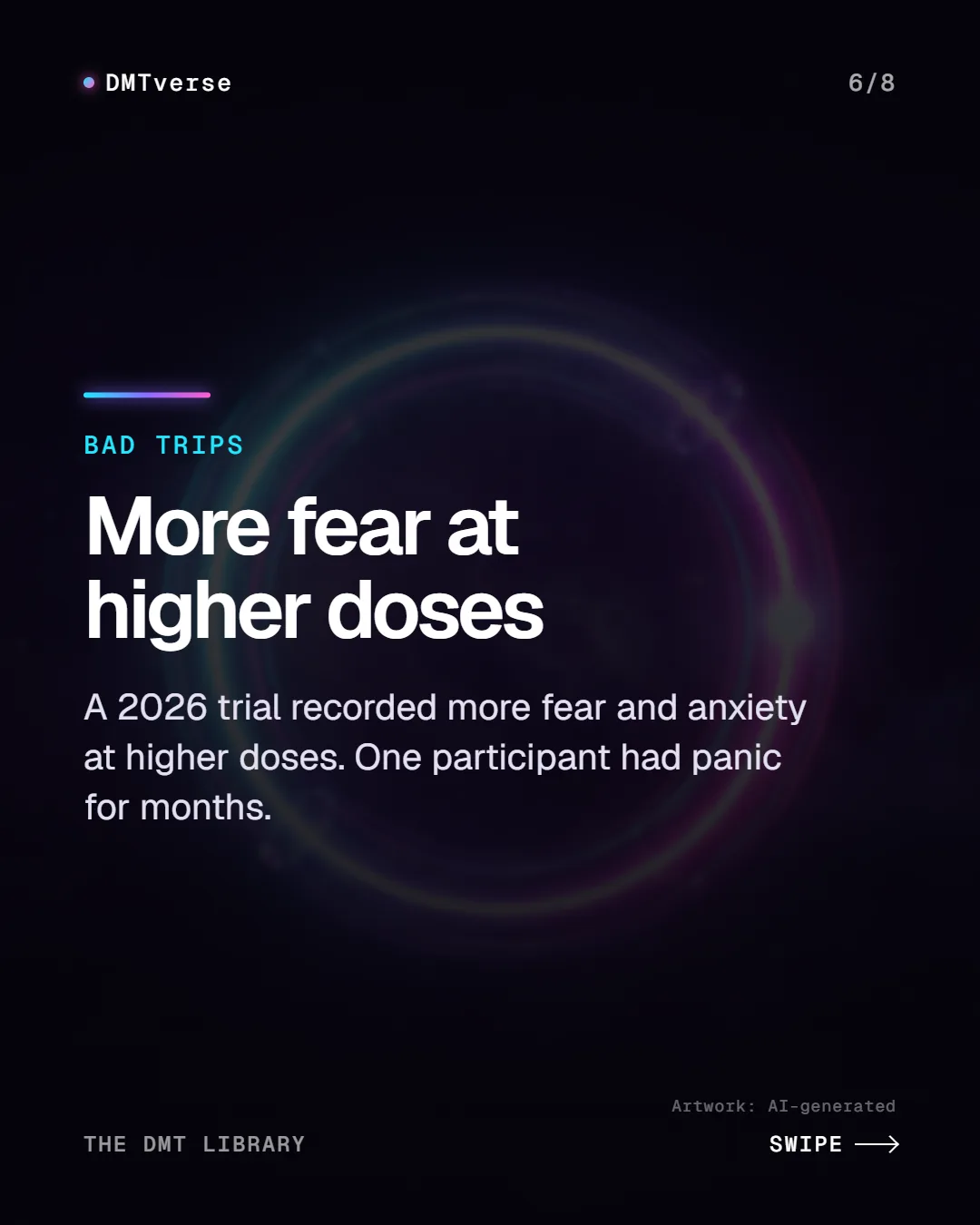
The 2026 trial measured the negative side directly. At its higher doses, participants scored higher on “anxious ego dissolution”, anxiety, “impaired control and cognition” and “distressing experience”, and rated “bad drug effect” and fear higher (Erne et al., 2026). Evidence: preliminary.
Participants described the opening moments as “simultaneously intense, good, bad, and anxiety-inducing”. In the open-label arm, where people could choose whether to go on to the next step, six of 16 stopped before the top step (Erne et al., 2026). Expectation mattered: negative ratings were lower when participants knew what they were getting.
Most distress was brief, but not always. One participant in that trial needed follow-up from the study psychiatrist for anxiety and panic attacks that began shortly after the session; they eased within two months, returned three months later, and the person has since been treated with psychotherapy and medication (Erne et al., 2026).
A review of ritual use notes that DMT can cause “aversive psychological reactions or transient psychotic episodes that resolve spontaneously in a few hours” (Gable, 2007). Evidence: established that intense fear and anxiety can occur; preliminary on how often distress lasts.
Not medical advice
This section describes what was recorded in supervised studies. It cannot predict how anyone will react, and it is not a guide to managing an experience. If anxiety, panic or low mood continues after any drug use, talk to a doctor; in a crisis, call or text 9-8-8.
Can DMT cause psychosis or lasting problems?
It appears to be rare, but it has been reported. A 2017 systematic review of case reports found three case series and two case reports of psychotic episodes linked with ayahuasca, and three case reports linked with DMT. Several people had a personal or possible family history of psychosis or mania, or had used other drugs as well, but some did not. The authors judged such episodes rare and found that psychiatric screening in research settings seems to reduce the risk considerably (dos Santos et al., 2017).
One published case shows what this can look like. A 42-year-old man with no significant psychiatric history was brought to an emergency department by police with disinhibited behaviour, elevated mood, disorganized thinking and delusions, after recent repeated DMT use and long-term cannabis use. Tests also showed signs of muscle breakdown (rhabdomyolysis). He recovered with about three weeks of hospital treatment and was symptom-free six months later (Paterson et al., 2015).
One case cannot show cause, and cannabis may have contributed, as a later review points out (White et al., 2024).
For who is at higher risk of psychosis after psychedelics in general, see can magic mushrooms cause psychosis? Visual changes that persist after hallucinogen use are covered in our guide to HPPD. Evidence: preliminary, from case reports.
Which combinations are dangerous?
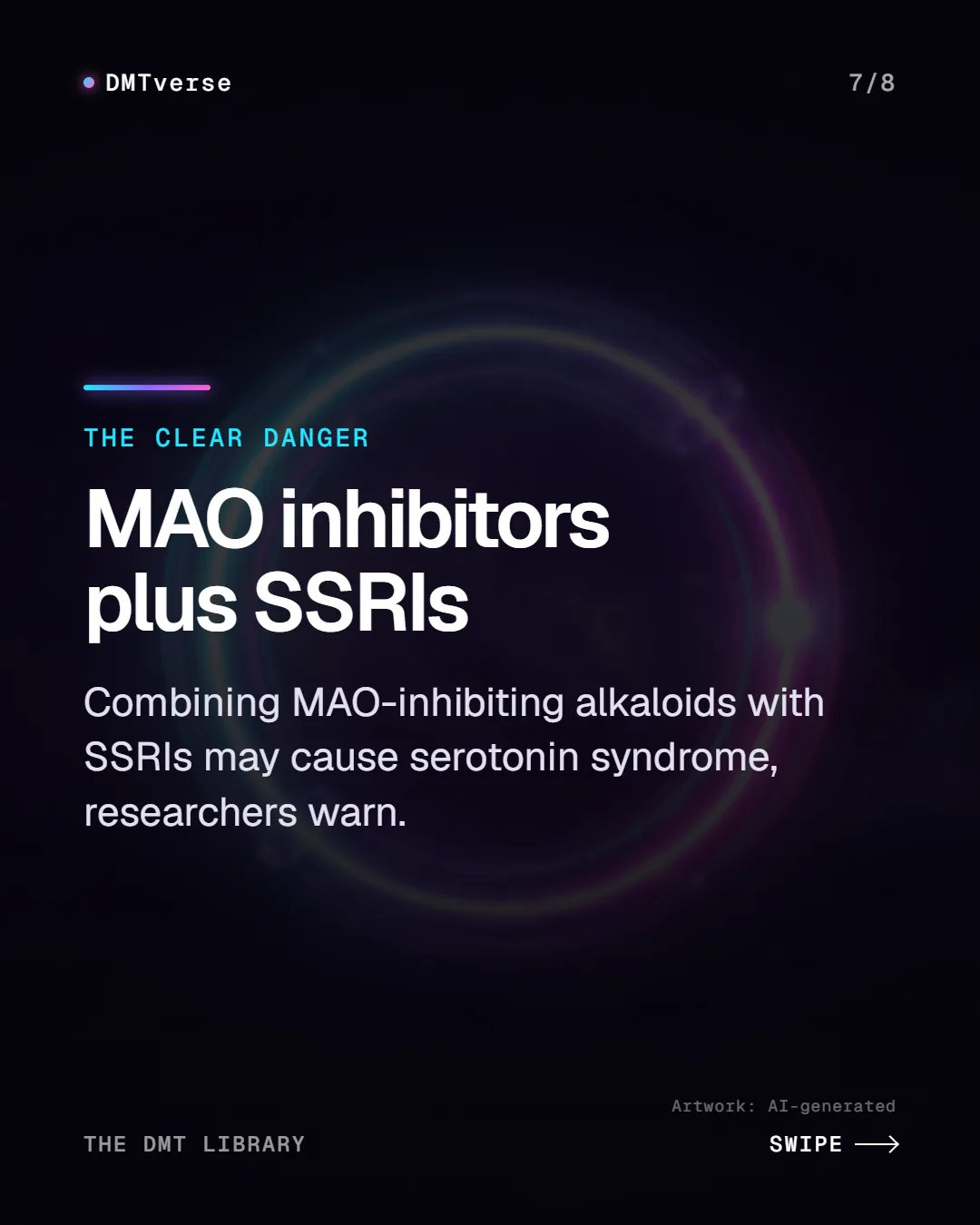
The clearest danger involves monoamine oxidase inhibitors (MAOIs). Ayahuasca brews contain harmala alkaloids that block this enzyme, and some antidepressants are MAOIs too (Halman et al., 2024). A 1998 paper warned that combining the MAO-inhibiting alkaloids in ayahuasca with SSRI antidepressants “may induce a serotonin syndrome with potentially grave outcome” (Callaway and Grob, 1998). Serotonin syndrome is a potentially life-threatening excess of serotonin activity; a 2024 review lists confusion, nausea and vomiting, which can be followed by convulsions, tremors and loss of consciousness (White et al., 2024).
The same review notes a second hazard: MAOIs stop the body breaking down tyramine and other monoamines, and dangerously high tyramine levels can cause a hypertensive crisis, a dangerous spike in blood pressure (White et al., 2024). Gable’s risk assessment also warns that adverse health effects may occur “particularly when serotonergic substances are used in conjunction” (Gable, 2007).
| Combination | Reported danger | Strength of evidence | Source |
|---|---|---|---|
| MAO-inhibiting alkaloids (as in ayahuasca) with SSRI antidepressants | Serotonin syndrome, potentially grave | Mechanism and case reports | Callaway and Grob, 1998; Halman et al., 2024 |
| MAOIs with tyramine | Hypertensive crisis | Established pharmacology for MAOIs | White et al., 2024 |
| DMT or ayahuasca with other serotonergic substances | Adverse health effects | Review judgment | Gable, 2007 |
| DMT with cannabis or other drugs | Seen in several psychosis case reports | Case reports; cause unclear | dos Santos et al., 2017; Paterson et al., 2015 |
How often serious reactions happen is not well measured. A 2024 systematic review of interactions found only three studies on DMT and one on ayahuasca. It describes a report of ayahuasca taken with the SSRI fluoxetine that produced sweating, shivering, tremors, confusion, severe nausea, vomiting and disorientation lasting four hours, similar to serotonin toxicity (Halman et al., 2024). Evidence: preliminary.
White and colleagues found no clear, confirmed case of serotonin syndrome from ayahuasca in the literature (White et al., 2024). Rare does not mean safe: the reason confirmed cases are few may be that the danger is well known. For antidepressants and psychedelics more broadly, see magic mushrooms and antidepressants. Anyone taking prescription medicine who has questions should ask a pharmacist or doctor.
There is also the problem of what is actually in an unregulated drug. CAMH warns that most hallucinogens are illegal and unregulated, and may contain toxins or not contain the drug they are sold as (CAMH).
Where can you get help in Canada?
These services were listed on the official pages we opened on 20 October 2026.
- Emergency: call 911 if the person is unconscious, not breathing or having a seizure (infopoison.ca).
- Poison advice in Ontario: the Ontario Poison Centre, 1-800-268-9017, toll-free, 24 hours a day, every day of the year.
- Poison advice elsewhere: the Canadian poison centres’ site lists 1-844-POISON-X (1-844-764-7669) and, for Québec, 1-800-463-5060. Poison centres are staffed by registered nurses and pharmacists trained in toxicology (infopoison.ca).
- Suicide or mental-health crisis: call or text 9-8-8, 24 hours a day. The site says to call 9-1-1 right away if your safety is at risk.
- Substance-use support in Ontario: ConnexOntario, free and 24/7, at 1-866-531-2600, or text CONNEX to 247247.
When in doubt, call
A poison centre can advise on what to watch for; it is not an ambulance. If someone is unconscious, not breathing or having a seizure, call 911 first.
What is still not known?
- Rates of problem use or DMT use disorder. We found no study that measured them directly, in Canada or elsewhere.
- Tolerance over days or weeks. The human studies tested repeats over minutes or hours.
- Effects outside the lab. Almost all physical data come from screened, monitored volunteers given DMT intravenously.
- Risks for people with heart disease or a history of psychosis, who are excluded from trials.
- How often lasting anxiety or psychosis follows. The evidence is case reports and single trial participants.
Common questions
Can DMT help with addiction?
That is not known. On 20 October 2026 we found one registered DMT trial in an addiction-related condition: a Yale phase 1, randomized, double-masked trial in 63 people with alcohol use disorder (target), listed as recruiting with primary completion planned for August 2027. It has no published results, so there is no evidence either way yet. See our page on DMT research today for the other registered trials.
Is DMT addictive?
The research we found does not show it to be addictive in the usual sense, but the evidence is thin. Monkeys self-administered it only sporadically, a large online survey found a low urge to use more, and a small hospital study found no dose-related differences in abuse-liability measures. CAMH says people can develop psychological dependence on hallucinogens as a group.
Do you build a tolerance to DMT?
Lab studies mostly found no tolerance to its psychological effects when doses were repeated within minutes or hours. One 2024 infusion study saw effects level off as blood levels rose, a possible sign of short-term tolerance. Some bodily responses, such as heart rate, did fade with repeats.
What is a bad DMT trip like?
Lab volunteers have described an overwhelming rush, loss of control, and anxiety that alternated or coexisted with euphoria. At higher doses, a 2026 trial recorded more fear, anxiety and distress. Most effects passed within about half an hour, but one participant had panic attacks for months afterwards.
Is DMT dangerous for your heart?
In studies of healthy volunteers, DMT briefly raised heart rate and blood pressure, and one participant in a 2022 study had a serious drop in heart rate and blood pressure that staff treated. People with heart conditions have not been studied.
Is it dangerous to combine DMT with antidepressants or MAOIs?
Yes, sources describe it as a danger. Combining MAO-inhibiting alkaloids, as found in ayahuasca, with SSRI antidepressants may cause serotonin syndrome, and MAOIs with tyramine can cause a hypertensive crisis. Ask a pharmacist or doctor about any medicine you take.
Can DMT cause psychosis?
Rarely, according to a 2017 systematic review of case reports. Many cases involved a personal or family history of psychosis or mania, or other drug use, but not all.
Who can I call in Ontario if something goes wrong?
Call 911 if someone is unconscious, not breathing or having a seizure. The Ontario Poison Centre is at 1-800-268-9017, 24 hours a day. For a mental-health crisis, call or text 9-8-8. ConnexOntario, 1-866-531-2600, helps with substance-use services.
Shroomverse sells mushroom products. This article is general information about what research and official sources say about DMT, dependence, tolerance and risk. It is not medical, legal or purchasing advice, it does not encourage anyone to use drugs, and it does not recommend any product.
SOURCES
- The Potential Therapeutic Effects of Psychedelic, N,N-dimethyltryptamine (DMT), on Alcohol Use Disorder (AUD) (NCT06070649), ClinicalTrials.gov. Accessed . Registry record read via the API: Yale University; phase 1; randomized, parallel, double-masked; 63 estimated; recruiting; start 2025-08-04; primary completion 2027-08-01; last update 2026-09-10. Supports the FAQ answer on addiction treatment only.
- Differential tolerance to biological and subjective effects of four closely spaced doses of N,N-dimethyltryptamine in humans (Strassman, Qualls and Berg), Biological Psychiatry 39:784–795, 1996. Accessed . Abstract read via Europe PMC. 13 experienced users, four repeats 30 minutes apart, randomized double-blind; no tolerance to psychedelic effects; heart rate and hormone responses fell, blood pressure did not.
- Human psychopharmacology of N,N-dimethyltryptamine (Strassman), Behavioural Brain Research 73:121–124, 1996. Accessed . Abstract read via Europe PMC. Summary of the programme: DMT unique in its inability to induce tolerance to psychological effects.
- Dose-response study of N,N-dimethyltryptamine in humans. I. Neuroendocrine, autonomic, and cardiovascular effects (Strassman and Qualls), Archives of General Psychiatry 51:85–97, 1994. Accessed . Abstract read via Europe PMC. 11 users, placebo-controlled; dose-dependent rises in blood pressure, heart rate, pupil size, temperature and stress hormones; peak within 2 minutes.
- Dose-response study of N,N-dimethyltryptamine in humans. II. Subjective effects and preliminary results of a new rating scale (Strassman, Qualls, Uhlenhuth and Kellner), Archives of General Psychiatry 51:98–108, 1994. Accessed . Abstract read via Europe PMC. Rush, loss of control, euphoria alternating or coexisting with anxiety; time course.
- Dimethyltryptamine (DMT): prevalence, user characteristics and abuse liability in a large global sample (Winstock, Kaar and Borschmann), Journal of Psychopharmacology 28:49–54, 2014. Accessed . Abstract read via Europe PMC. Global Drug Survey 2012, 22,289 responses; lifetime 8.9%, past year 5.0%; 472 raters; desirable profile offset by low urge to use more.
- Transient reinforcing effects of phenylisopropylamine and indolealkylamine hallucinogens in rhesus monkeys (Fantegrossi, Woods and Winger), Behavioural Pharmacology 15:149–157, 2004. Accessed . Abstract read via Europe PMC. No reliable self-administration; transient responding for DMT, mescaline or psilocybin in 3 of 4 monkeys.
- Dose-dependent pharmacokinetics and acute effects of intravenous bolus N,N-dimethyltryptamine (Erne et al.), Translational Psychiatry 16:213, 2026. Accessed . Full text read (PMC13039932). No tolerance with repeated dosing; blood pressure rises; headache, palpitations; fear, anxiety and distress at higher doses; one participant with later panic attacks; exclusion criteria; six of 16 stopped escalation early.
- Psychological and physiological effects of extended DMT (Luan et al.), Journal of Psychopharmacology 38:56–67, 2024. Accessed . Abstract read via Europe PMC. 11 volunteers, 30-minute infusion; low anxiety; heart rate habituated; plateau suggesting acute psychological tolerance.
- Exploratory study of the dose-related safety, tolerability, and efficacy of dimethyltryptamine (DMT) in healthy volunteers and major depressive disorder (D’Souza et al.), Neuropsychopharmacology 47:1854–1862, 2022. Accessed . Full text read (PMC9372173). 3 healthy, 7 depressed, open-label; raised blood pressure, heart rate, anxiety; no dose-related differences in abuse-liability measures; one serious event (bradycardia and hypotension).
- Ayahuasca and dimethyltryptamine adverse events and toxicity analysis: a systematic thematic review (White et al.), International Journal of Toxicology 43:327–339, 2024. Accessed . Full text read (PMC11088222). Generally safe in controlled settings; MAOI–tyramine hypertensive crisis; serotonin syndrome symptoms; no confirmed ayahuasca cases; animal tolerance studies; cannabis in the Paterson case.
- Ayahuasca, dimethyltryptamine, and psychosis: a systematic review of human studies (dos Santos, Bouso and Hallak), Therapeutic Advances in Psychopharmacology 7:141–157, 2017. Accessed . Abstract read via Europe PMC. Case series and reports of psychotic episodes; risk factors; rare; screening reduces risk.
- N,N-Dimethyltryptamine-induced psychosis (Paterson, Darby and Sandhu), Clinical Neuropharmacology 38:141–143, 2015. Accessed . Abstract read via Europe PMC. Single case: 42-year-old man, repeated DMT plus long-term cannabis, rhabdomyolysis, recovery.
- Risk assessment of ritual use of oral dimethyltryptamine (DMT) and harmala alkaloids (Gable), Addiction 102:24–34, 2007. Accessed . Abstract read via Europe PMC. No animal abuse-potential models; aversive reactions or transient psychotic episodes; risk with serotonergic substances; minimal dependence potential.
- Ayahuasca preparations and serotonin reuptake inhibitors: a potential combination for severe adverse interactions (Callaway and Grob), Journal of Psychoactive Drugs 30:367–369, 1998. Accessed . Abstract read via Europe PMC. MAO-inhibiting alkaloids plus SSRIs may cause serotonin syndrome with potentially grave outcome.
- Drug–drug interactions involving classic psychedelics: a systematic review (Halman, Kong, Sarris and Perkins), Journal of Psychopharmacology 38:3–18, 2024. Accessed . Full text read (PMC10851641). Three DMT studies and one ayahuasca report; fluoxetine with ayahuasca causing serotonin-toxicity-like effects for four hours.
- Hallucinogens, Centre for Addiction and Mental Health (CAMH). Accessed . Lists DMT among hallucinogens; no usual withdrawal; psychological dependence possible; unregulated drugs may contain toxins.
- Contact us, Ontario Poison Centre. Accessed . 1-800-268-9017 (toll-free); available by phone 24 hours a day, every day of the year.
- Canadian Association of Poison Centres and Clinical Toxicology, infopoison.ca. Accessed . 1-844-POISON-X (1-844-764-7669); Québec 1-800-463-5060; call 911 if unconscious, not breathing or having a seizure; staffed by nurses and pharmacists.
- 9-8-8: Suicide Crisis Helpline, 988.ca. Accessed . Call or text 9-8-8, 24 hours a day, every day of the year; call 9-1-1 if safety is at risk.
- ConnexOntario, ConnexOntario. Accessed . Free 24/7 mental health, addiction and problem gambling information; 1-866-531-2600; text CONNEX to 247247.
CHANGES
- : Linked glossary definitions.
- : Keyword pass: added an FAQ answering “can DMT help with addiction” (the most-searched form of this question), from the ClinicalTrials.gov record.
- : Published.
- : Editorial review: put the primary question in the first H2; replaced the non-house “limited” evidence label with “preliminary”; removed two unsourced claims about psilocybin and LSD tolerance; defined tolerance; split long paragraphs and added evidence labels; added links to the pillar, the experience guide and the myths article.



