THE SHROOMVERSE JOURNAL ✳ 14 MIN READ
The history of DMT: from Andean snuff tubes to modern clinical trials
Topic: DMT
Published Updated
Listen: the 3-minute version
AI-narrated summary of this article
Short answer, checked 20 October 2026
The history of DMT in Western science starts in 1931, when the Canadian chemist Richard Manske first made it without testing what it did. Oswaldo Gonçalves de Lima reported it in a plant in 1946, and Stephen Szára first reported its effects in people in 1956. DMT entered Schedule I of the 1971 UN Convention, where it still sits. Much earlier, Andean snuff tubes from about 800–350 BCE carried traces of DMT and related compounds. Rick Strassman's University of New Mexico studies (1990–95) restarted US human research, and the first placebo-controlled depression trial of DMT alone was published in 2026.
THE SHORT VERSION · SWIPE
On this page 13 sections
Much of what people believe about DMT’s past traces back to a few sources: one chemist, one Hungarian psychiatrist, one American study in the 1990s and the popular book that followed it. This timeline sets out what the primary sources say, in order, and flags where the popular story and the record part ways.
Education only, not guidance
This article describes history, published research and law. It gives no amounts, no instructions and no advice on use, and it does not describe any effect as a benefit. DMT is a controlled substance in Canada. Evidence labels used below: established (shown in peer-reviewed studies or primary records and not seriously disputed), preliminary (early, small, animal-only or indirect) and unresolved (an open question).
The history of DMT at a glance
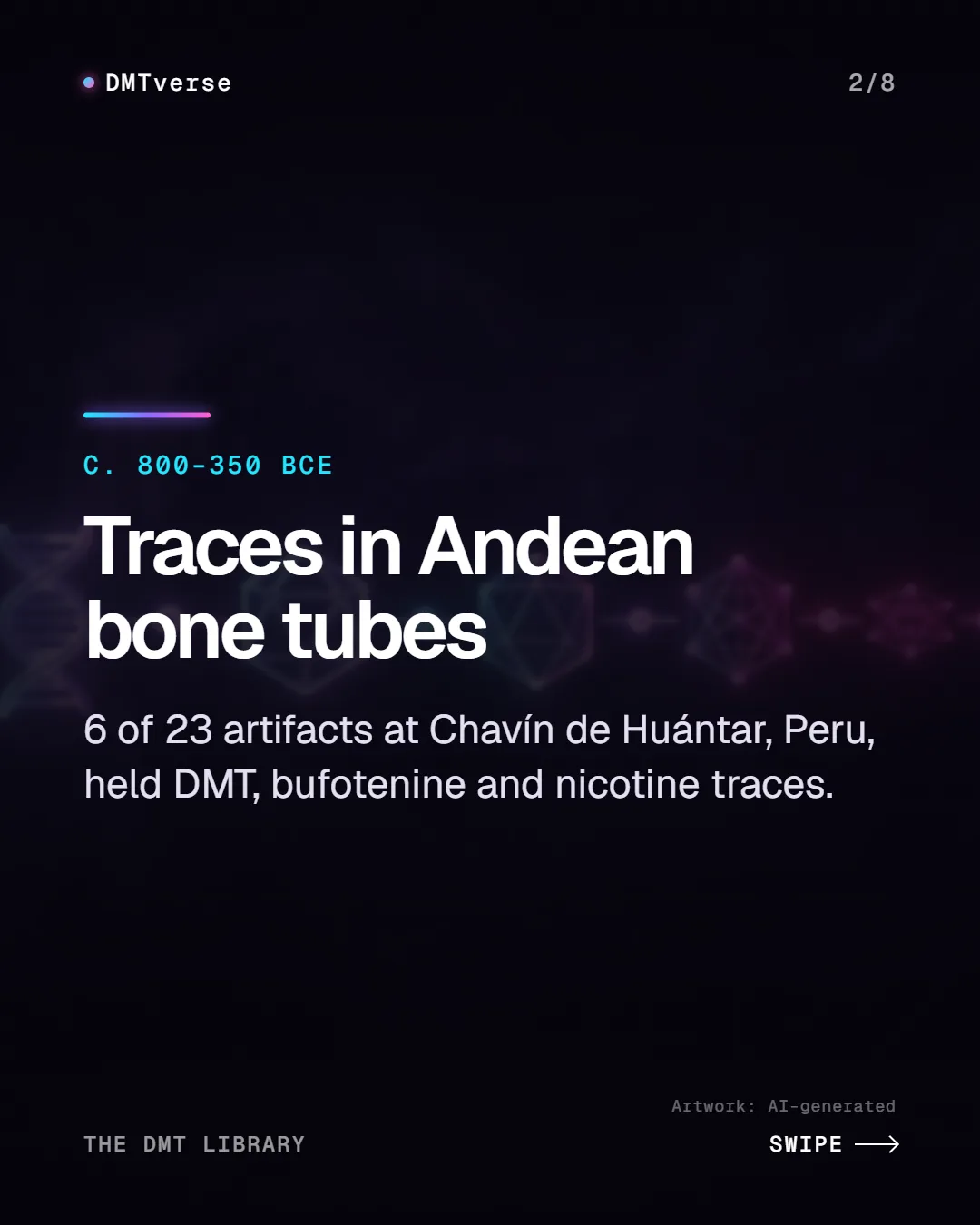
- c. 800–350 BCEBone tubes at Chavín de Huántar, Peru, carry traces of bufotenine, nicotine and, in one artifact, DMT.Source Rick et al., 2025
- c. 1000 CEA ritual bundle from a Bolivian rock shelter holds traces of DMT, bufotenine, harmine and cocaine.Source Miller et al., 2019
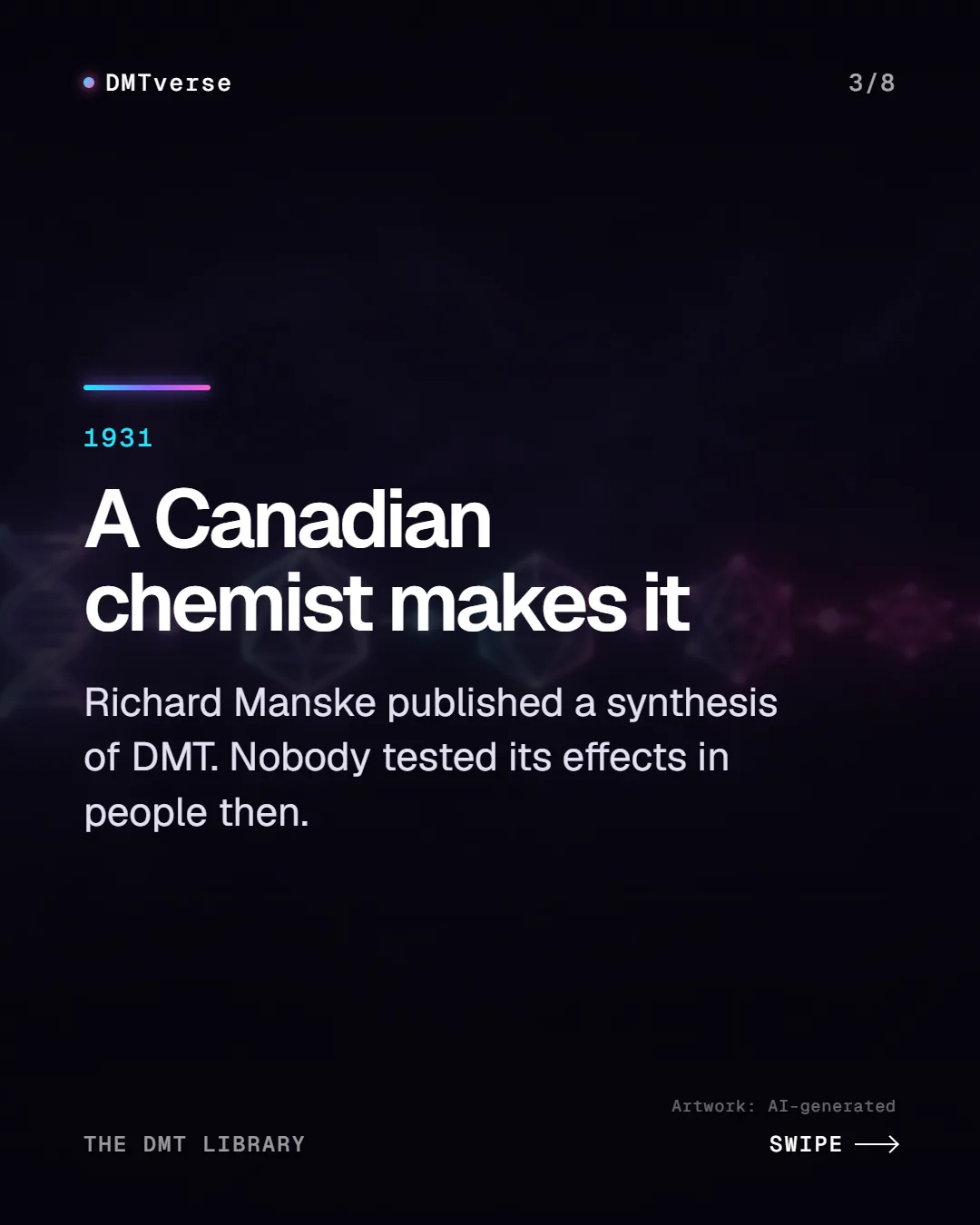
- 1931Richard Manske publishes a synthesis of the methyltryptamines in the Canadian Journal of Research.Source Manske, 1931; Barker, 2018
- 1946Oswaldo Gonçalves de Lima reports DMT occurring naturally in a plant; a 1959 chemistry paper by Pachter and colleagues reports indole alkaloids from the same plant.Source Barker, 2018; Pachter et al., 1959
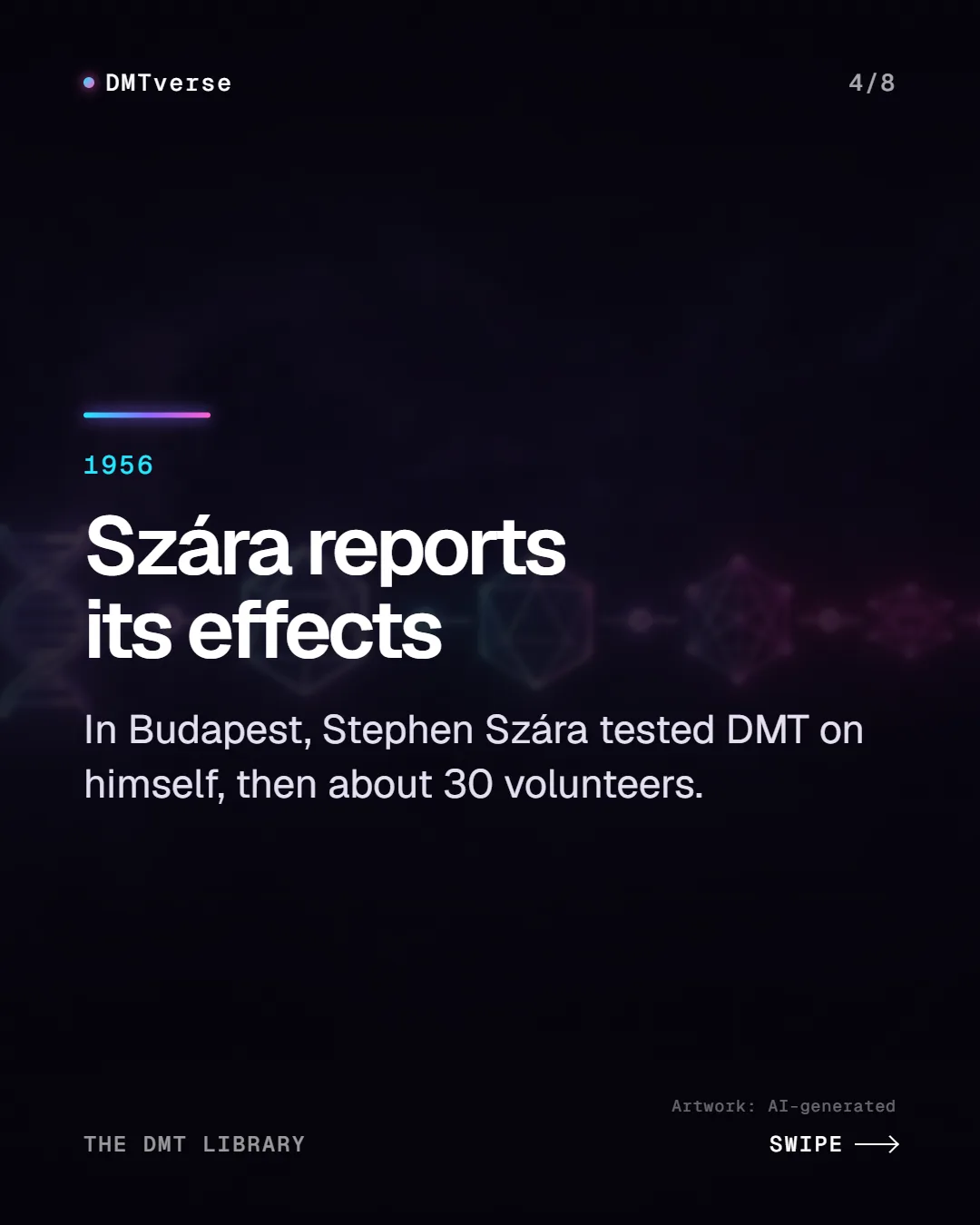
- 1956Stephen Szára reports DMT’s effects in people, from Budapest, in Experientia.Source Szára, 1956; Wirz-Justice, 2021
- 1958Szára and a colleague publish DMT experiments with psychiatric patients.Source Böszörményi and Szára, 1958
- 1950s–1970sThe transmethylation era: researchers look for a body-made hallucinogen behind schizophrenia.Source Barker, 2018
- 1970The US Controlled Substances Act lists DMT in Schedule I.Source Barker, 2018; 21 U.S.C. 812
- 1971DMT is listed in Schedule I of the UN Convention on Psychotropic Substances, adopted in Vienna.Source UN, 1971; INCB Green List
- 1990–1995Rick Strassman’s University of New Mexico studies: about 400 doses given to about 60 volunteers, by his own count.Source Strassman, 1991, 1994, 1996; Strassman’s own account
- 2000Strassman’s book DMT: The Spirit Molecule is published; a documentary follows in 2010.Source Strassman’s own account
- 2006Gonzales v. O Centro Espírita: a narrow US Supreme Court ruling for one church’s sacramental tea.Source 546 U.S. 418
- 2019DMT measured in living rat cortex, with or without a pineal gland.Source Dean et al., 2019
- 2026First placebo-controlled trial of DMT alone in depression published; a review counts 26 registered trials.Source Erritzoe et al., 2026; Stojanović et al., 2026
How old is human use of DMT?
The oldest direct evidence comes from Chavín de Huántar, a monumental ritual centre in the Peruvian highlands. In 2025, a team analysed 23 artifacts, mostly bone tubes, from sealed deposits in an underground gallery. Six held traces of nicotine, bufotenine (a close chemical relative of DMT) or both; DMT itself was found in one of them. Microscopic plant remains matched vilca and wild tobacco. The layers tied to the gallery’s use date to roughly 800–350 BCE (Rick et al., 2025). The authors call these the first direct evidence of psychoactive plants in archaeological bone tubes used as inhalers in that region. Evidence: established.
Further south, a ritual bundle radiocarbon-dated to about 1000 CE was excavated from a rock shelter in the Lípez Altiplano of southwestern Bolivia. Residue analysis found bufotenine, DMT, harmine and cocaine. The authors note that DMT and harmine are the two main ingredients now associated with ayahuasca (Miller et al., 2019). That is not proof that anyone drank ayahuasca 1,000 years ago: the bundle’s contents point to snuffing paraphernalia, and how old ayahuasca drinking is remains debated among historians. Evidence: established for the residues; unresolved for what they say about drinking.
Two cautions. Bufotenine appears alongside DMT in both finds, so “ancient DMT use” is only part of the chemical story. And these are traces from objects, not records of what people experienced or believed. For the full archaeology, see ancient DMT snuffs: what archaeology shows. Evidence: established.
Who first made DMT, and when was it found in nature?
Western science first met DMT in a Canadian chemistry journal. Richard Manske’s paper “A synthesis of the methyltryptamines and some derivatives” appeared in the Canadian Journal of Research in November 1931 (Manske, 1931). A later review notes that DMT was not assessed for effects in people at the time (Barker, 2018). Manske made a molecule; he did not discover a psychedelic. Evidence: established.
In 1946 the microbiologist Oswaldo Gonçalves de Lima reported DMT’s natural occurrence in a plant, according to a 2018 review (Barker, 2018). In 1959 Irwin Pachter and colleagues published a chemistry paper on the indole alkaloids of the same plant and others (Pachter et al., 1959). We checked that paper’s record, not its full text, so we do not describe its findings further. Evidence: established that DMT occurs naturally in plants; the details of the 1946 identification are unresolved from the sources we read.
Who first tested DMT in people?
DMT’s effects in people were first described by Stephen Szára, a Hungarian chemist and psychiatrist. An obituary in Neuropsychopharmacology records that he turned to DMT after Sandoz declined to send LSD behind the Iron Curtain, then recruited 30 volunteers, mostly young physician colleagues (Wirz-Justice, 2021). His report appeared in Experientia in November 1956, under a title linking DMT’s “psychotic effect” to serotonin metabolism (Szára, 1956). Weeks after the Hungarian uprising, he left the country, later joining the US National Institute of Mental Health (Wirz-Justice, 2021). Evidence: established.
Sources disagree on how Szára obtained his DMT: his 2021 obituary in Neuropsychopharmacology says he synthesized it (Wirz-Justice, 2021), while a 2018 review says he extracted it from a plant (Barker, 2018). The Budapest work also included experiments on psychiatric patients, published in 1958 (Böszörményi and Szára, 1958). That was ordinary practice in 1950s “model psychosis” research and would not pass ethics review today. Our Stephen Szára article covers both. Evidence: established for the 1958 paper; how he obtained his DMT is unresolved.
The transmethylation era: looking for a madness molecule
The 1950s discovery of several hallucinogens led researchers to ask whether schizophrenia might come from an error of metabolism that made such compounds in the brain, an idea traced to Humphry Osmond and John Smythies in 1952. When the search began, the only known hallucinogens found in the body were tryptamines such as DMT (Barker, 2018). In 1961 Julius Axelrod found an enzyme in rat brain able to methylate tryptamine, and in 1972 Juan Saavedra and Axelrod showed DMT forming in living rat brain (as described by Barker, 2018). Evidence: established as history.
The core hypothesis did not hold. More than 60 studies tried to link DMT in blood or urine to a psychiatric diagnosis, and none found a clear, repeatable link (Barker, 2018). Szára himself later wrote that DMT had not proved to be a “schizotoxin” (Szára, 2007). The question of what DMT does in the body did not go away; it moved to new methods, including a 2019 rat study that measured DMT in living cortex with or without a pineal gland (Dean et al., 2019). Evidence: established that the schizophrenia link failed; unresolved what DMT does in humans.
When did DMT become illegal?
In the United States, the Controlled Substances Act of 1970 placed DMT in Schedule I, alongside the other major hallucinogens (Barker, 2018). The US Code still lists dimethyltryptamine among the hallucinogenic substances of Schedule I(c) (21 U.S.C. 812). Internationally, the Convention on Psychotropic Substances, adopted in Vienna on 21 February 1971, lists DMT in its Schedule I (UN, 1971). We checked the current position: the International Narcotics Control Board’s Green List, 36th edition (2025), still lists DMT in Schedule I (INCB Green List). Evidence: established.
Scheduling slowed human research for two decades. A 2018 review argues that hallucinogen research in the US was impeded for at least 50 years by these laws (Barker, 2018), and Szára wrote that DMT had a difficult first 50 years in medicine primarily for legal reasons (Szára, 2007). Those are the views of two researchers in the field. Canada lists DMT in Schedule III of its own law; see is DMT legal in Canada. Evidence: established for the laws; the effect on research is the authors’ judgment.
1990–1995: Rick Strassman restarts human research
In 1990 the psychiatrist Rick Strassman began giving DMT to volunteers at the University of New Mexico in Albuquerque, after a long approval process he described in a 1991 paper (Strassman, 1991). In his own account, he gave about 400 doses to about 60 volunteers over five years (Strassman, book page). Evidence: these totals are his own figures, not counts from a paper.
His first 1994 paper, a double-blind, placebo-controlled study of 11 experienced users, found effects peaking within 2 minutes and negligible by 30 (Strassman and Qualls, 1994). A 1996 study of 13 people found no tolerance to the subjective effects of closely spaced doses, while hormone and heart-rate responses declined (Strassman et al., 1996). Evidence: established for these small published studies.
The work ended in 1995. In a 1995 newsletter he named his family’s move to Victoria, British Columbia as the main factor (MAPS, 1995); his later book adds institutional strain and pressure from his Buddhist community. No source we read says the government shut the studies down. See Rick Strassman’s DMT study for the full account. Evidence: these are his own reports.
2000–2010: the book, the film and the mainstream
Strassman’s book DMT: The Spirit Molecule (2000) mixed the research with what he himself calls highly speculative ideas, among them that the pineal gland might release DMT at birth and death (Strassman, book page). A documentary of the same name followed in 2010. Later research did not support the pineal story: in rats, brain DMT did not depend on the pineal gland (Dean et al., 2019). Our article on DMT: The Spirit Molecule weighs what each made of the evidence. Evidence: established for the dates; the pineal idea is unsupported in humans.
2006: a Supreme Court case about a church tea
In Gonzales v. O Centro Espírita Beneficente União do Vegetal, decided 21 February 2006, the US Supreme Court considered a church whose members receive communion by drinking hoasca, a tea that contains DMT. The government argued that barring the tea served compelling interests, including compliance with the 1971 Convention. The Court, with all participating justices joining, held that the government had not shown a compelling interest at the preliminary-injunction stage, under the Religious Freedom Restoration Act (Gonzales v. O Centro, 546 U.S. 418). It was a narrow ruling about one church’s religious use. It did not make ayahuasca legal in the United States. Evidence: established.
2016 to today: infusions and clinical trials
Modern research has moved in two directions. One is longer DMT states: in 2016, Andrew Gallimore and Strassman proposed using target-controlled infusion, a technology from anaesthesia, to hold the DMT state steady long enough to study it (Gallimore and Strassman, 2016). The other is clinical trials. A 2026 scoping review counted 26 registered trials of DMT and ayahuasca, mostly phase I studies in healthy volunteers focused on safety (Stojanović et al., 2026). Evidence: established.
The first placebo-controlled trial of DMT alone in major depression was published in 2026: 34 participants, a single infusion with psychological support, and a significantly larger drop in depression scores than placebo at two weeks (Erritzoe et al., 2026). It was small, and its three-month follow-up was open-label, with no placebo group. In Basel, a trial named DMT4D, recruiting since 2025 with an estimated 112 participants, tests whether any effect survives when the experience is masked by anaesthesia; completion is estimated for 2029 (ClinicalTrials.gov, NCT06927076). For the evidence in detail, see DMT therapy research. Evidence: preliminary.
Manske’s synthesis
Richard Manske publishes a synthesis of the methyltryptamines in the Canadian Journal of Research; DMT is not tested in people (Manske, 1931).
DMT in a plant
Gonçalves de Lima reports DMT occurring naturally in a plant (Barker, 2018); a 1959 paper reports indole alkaloids from the same plant (Pachter et al., 1959).
Szára’s report
Stephen Szára reports DMT’s effects in people from Budapest (Szára, 1956).
An enzyme in the brain
Julius Axelrod finds an enzyme in rat brain able to methylate tryptamine (Barker, 2018).
US Schedule I
The Controlled Substances Act places DMT in Schedule I (21 U.S.C. 812).
UN Schedule I
The UN Convention on Psychotropic Substances lists DMT in Schedule I, where it remains (INCB Green List).
Strassman begins
The University of New Mexico studies begin: about 400 doses to about 60 volunteers by 1995, by his account (Strassman, book page).
Gonzales v. O Centro
A narrow Supreme Court ruling for one church’s sacramental tea (546 U.S. 418).
First depression RCT
34 participants; a larger two-week drop in depression scores than placebo (Erritzoe et al., 2026).
Each panel restates the sourced paragraphs above. Filter by group to follow chemistry, human research or law.
Popular claims versus the record
| Popular claim | What the record shows |
|---|---|
| Manske discovered a psychedelic in 1931. | He made the molecule; nobody tested its effects then. |
| Gonçalves de Lima discovered DMT in 1946. | He reported it in a plant in 1946; Manske had already made it in a lab in 1931. |
| Szára extracted DMT from a plant. | Sources disagree: his 2021 obituary says he synthesized it; a 2018 review says he extracted it from a plant. |
| Strassman gave DMT to 400 volunteers. | About 400 doses to about 60 people, by his own count. |
| The government shut Strassman down. | His own accounts give personal, institutional and spiritual reasons. |
| Gonzales made ayahuasca legal in the US. | A narrow religious-freedom ruling for one church at the preliminary-injunction stage. |
| A 1,000-year-old bundle proves ancient ayahuasca drinking. | It held DMT and harmine traces; drinking is not shown. |
What historians and scientists still debate
- How old ayahuasca drinking is, as distinct from snuff use (unresolved).
- How Gonçalves de Lima identified DMT in 1946, and how Szára obtained his DMT in Budapest (unresolved from the sources we read).
- What DMT does in the human body, after the schizophrenia hypothesis failed (unresolved).
- Whether the 2026 depression result holds in larger, longer placebo-controlled trials (unresolved).
Common questions
Who discovered DMT?
The Canadian chemist Richard Manske first synthesized DMT in 1931, without testing its effects. Oswaldo Gonçalves de Lima reported it in a plant in 1946, and the Hungarian chemist and psychiatrist Stephen Szára first described its effects in people in 1956. People in the Andes used snuffs containing DMT-related compounds long before any of them.
How old is human use of DMT?
The oldest direct chemical evidence we found comes from bone tubes at Chavín de Huántar in Peru, dated to roughly 800–350 BCE. They held traces of bufotenine and nicotine, and one held DMT. A Bolivian ritual bundle from about 1000 CE also held DMT traces.
When did DMT become illegal?
In the United States, the Controlled Substances Act of 1970 placed DMT in Schedule I. Internationally, it is in Schedule I of the 1971 UN Convention on Psychotropic Substances, and the current INCB Green List still lists it there. In Canada it is in Schedule III of the Controlled Drugs and Substances Act.
Why did scientists study DMT in the 1950s and 1960s?
Partly because of the transmethylation hypothesis: the idea that schizophrenia might come from the body making its own hallucinogens. More than 60 studies looked for a link between DMT and psychiatric diagnoses, and none found a clear, repeatable one.
What did Rick Strassman do?
Between 1990 and 1995, at the University of New Mexico, he ran federally approved human studies of DMT, which he describes as the first new US human psychedelic research in over 20 years. By his own count he gave about 400 doses to about 60 volunteers, and he published dose-response and tolerance studies.
Did the Gonzales case legalize ayahuasca in the US?
No. Gonzales v. O Centro Espírita (2006) was a narrow religious-freedom ruling at the preliminary-injunction stage, allowing one church to continue its sacramental use of a DMT-containing tea while the case continued.
Is DMT being tested as a medicine today?
Yes, in early trials. A 2026 review counted 26 registered DMT and ayahuasca trials, mostly early safety studies. The first placebo-controlled trial of DMT alone in depression, with 34 participants, was published in 2026. That is preliminary evidence, not an approved treatment.
Shroomverse sells mushroom products. This article is general information about the history of DMT. It is not medical, legal or purchasing advice, and it does not recommend any product.
SOURCES
- Pre-Hispanic ritual use of psychoactive plants at Chavín de Huántar, Peru (Rick JW, et al., PNAS 122(19):e2425125122, 2025), National Academy of Sciences (peer-reviewed, open access); full text via Europe PMC, PMC12088378. Accessed . Full text read. 23 artifacts analysed; six held DMT, bufotenine and/or nicotine, with DMT in one artifact (per Table 1, as summarised in our ancient DMT article); microremains of vilca and Nicotiana; gallery layers dated approximately 800–350 BCE; described as direct evidence in bone tubes used as inhalers.
- Chemical evidence for the use of multiple psychotropic plants in a 1,000-year-old ritual bundle from South America (Miller MJ, et al., PNAS 116(23):11207–11212, 2019), National Academy of Sciences (peer-reviewed); PMC6561276. Accessed . Abstract read via Europe PMC. Bundle radiocarbon-dated to about 1,000 CE, Lípez Altiplano, Bolivia; bufotenine, DMT, harmine and cocaine traces; DMT and harmine are the two main ayahuasca ingredients. No claim about drinking is made here.
- A synthesis of the methyltryptamines and some derivatives (Manske RHF, Canadian Journal of Research 5(5):592–600, 1931), Canadian Science Publishing (NRC Research Press). Accessed . Bibliographic record checked on Crossref (title, journal, November 1931). Content not described beyond the title.
- Indole alkaloids of four plant species (Pachter IJ, Zacharias DE, Ribeiro O, Journal of Organic Chemistry 24(9):1285–1287, 1959); full title shortened here, American Chemical Society. Accessed . Bibliographic record only, re-checked on Crossref on this date (September 1959; Pachter, Zacharias, Ribeiro). Cited only as a 1959 paper on the indole alkaloids of the plant Gonçalves de Lima studied; its full text was not read and its findings are not described.
- N,N-Dimethyltryptamine (DMT), an Endogenous Hallucinogen: Past, Present, and Future Research to Determine Its Role and Function (Barker SA, Frontiers in Neuroscience 12:536, 2018), Frontiers (peer-reviewed, open access); full text via Europe PMC, PMC6088236. Accessed . Full text read. Source for Manske 1931 untested in people; Gonçalves de Lima 1946; Osmond and Smythies 1952 and the schizotoxin search; more than 60 studies without a repeatable diagnostic link; Axelrod 1961 and Saavedra and Axelrod 1972; Controlled Substances Act 1970 Schedule I and the author’s view that regulation impeded research. Its statement that Szára extracted DMT from a plant conflicts with Wirz-Justice 2021.
- Dimethyltryptamin: its metabolism in man; the relation of its psychotic effect to the serotonin metabolism (Szára S, Experientia 12(11):441–442, 1956), Springer (peer-reviewed). Accessed . Bibliographic record checked on Crossref (title, November 1956). Content described from Wirz-Justice 2021 and Barker 2018.
- In memoriam: Stephen I. Szára, D.Sc., M.D. (1923–2021) (Wirz-Justice A, Neuropsychopharmacology 47(2):614–615, 2022), Springer Nature (open access); full text via Europe PMC, PMC8674227. Accessed . Full text read (re-checked 20 October 2026). Says he synthesized DMT after Sandoz declined to send LSD; 30 volunteers, mostly young physician colleagues; left Hungary weeks after the 1956 uprising; NIMH from 1957; NIDA from 1974; died 1 August 2021.
- Dimethyltryptamine Experiments with Psychotics (Böszörményi Z, Szára S, Journal of Mental Science 104(435):445–453, 1958), Cambridge University Press (Royal College of Psychiatrists). Accessed . Crossref record and opening paragraph read: title, date and the paper’s framing within experimental (model) psychosis research. Supports that the Budapest work included experiments on psychiatric patients.
- DMT at fifty (Szára S, Neuropsychopharmacologia Hungarica 9(4):201–205, 2007), Hungarian Association of Psychopharmacology; Europe PMC record MED/18510265. Accessed . Abstract read via Europe PMC. Szára’s own account: a difficult first 50 years primarily for legal reasons; DMT did not prove to be a schizotoxin.
- Convention on Psychotropic Substances, 1971 (Final Act and text with schedules), United Nations / UNODC. Accessed . PDF read. Adopted in Vienna, 21 February 1971; DMT, 3-[2-(dimethylamino)ethyl]indole, in the list of substances in Schedule I.
- Green List: List of Psychotropic Substances under International Control, 36th edition (2025), International Narcotics Control Board. Accessed . Page and English PDF (2510307E) read. DMT is listed among substances in Schedule I of the 1971 Convention in the current edition.
- 21 U.S. Code § 812, Schedules of controlled substances, Legal Information Institute, Cornell Law School. Accessed . Read. Dimethyltryptamine is item (6) of the hallucinogenic substances in Schedule I(c).
- Human hallucinogenic drug research in the United States: a present-day case history and review of the process (Strassman RJ, Journal of Psychoactive Drugs 23(1):29–38, 1991), Taylor & Francis (peer-reviewed). Accessed . Abstract read via Europe PMC. His application for and receipt of federal permission to give DMT to people, and the regulatory process.
- Dose-response study of N,N-dimethyltryptamine in humans. I. Neuroendocrine, autonomic, and cardiovascular effects (Strassman RJ, Qualls CR, Archives of General Psychiatry 51(2):85–97, 1994), American Medical Association (peer-reviewed). Accessed . Abstract read via Europe PMC. Double-blind, saline placebo-controlled, randomized; 11 experienced hallucinogen users; peak blood levels and effects within 2 minutes, negligible at 30. Doses not reproduced here.
- Differential tolerance to biological and subjective effects of four closely spaced doses of N,N-dimethyltryptamine in humans (Strassman RJ, Qualls CR, Berg LM, Biological Psychiatry 39(9):784–795, 1996), Elsevier (peer-reviewed). Accessed . Abstract read via Europe PMC. Randomized, double-blind; 13 experienced users; no tolerance to subjective effects; ACTH, prolactin, cortisol and heart-rate responses declined; blood pressure did not.
- DMT: The Spirit Molecule (book page and chapter summaries), Rick Strassman MD (author’s website). Accessed . Read, with the chapter-summaries page. Author’s own account: research began 1990; approximately 400 doses to 60 volunteers over five years at UNM; speculative pineal ideas; problems inside and outside the research led to the end of the studies in 1995.
- University of New Mexico Update (Strassman R, MAPS Newsletter 6(1), Autumn 1995), Multidisciplinary Association for Psychedelic Studies. Accessed . Read. Strassman’s 1995 account: leaving UNM at the end of August 1995; the move to Victoria, British Columbia named as the primary factor.
- Gonzales v. O Centro Espírita Beneficente União do Vegetal, 546 U.S. 418 (2006), syllabus, Legal Information Institute, Cornell Law School. Accessed . Syllabus read. Decided 21 February 2006; hoasca containing DMT; RFRA; government failed to show a compelling interest at the preliminary-injunction stage; opinion joined by all members except Alito, J., who took no part.
- Biosynthesis and Extracellular Concentrations of N,N-dimethyltryptamine (DMT) in Mammalian Brain (Dean JG, et al., Scientific Reports 9:9333, 2019), Springer Nature (peer-reviewed, open access). Accessed . Abstract read via Europe PMC. DMT measured in the cortex of living rats, with or without the pineal gland, at levels similar to canonical monoamine neurotransmitters.
- Registered Clinical Trials of Ayahuasca and DMT: A Scoping Review (Stojanović T, et al., Clinical Pharmacology & Therapeutics 120(1):94–108, 2026), Wiley (peer-reviewed); PMC13264465. Accessed . Abstract read via Europe PMC. 26 eligible registered trials on ClinicalTrials.gov; mostly phase I; healthy cohorts; safety-focused primary outcomes.
- A short-acting psychedelic intervention for major depressive disorder: a phase IIa randomized placebo-controlled trial (Erritzoe D, et al., Nature Medicine 32(2):591–598, 2026), Springer Nature (peer-reviewed); PMC12920121. Accessed . Abstract read via Europe PMC. 34 randomized; double-blind, placebo-controlled; significant MADRS difference at 2 weeks; the 3-month follow-up was open-label. Dose not reproduced here.
- DMT4D: Antidepressant Response of DMT Masked With Propofol (NCT06927076), ClinicalTrials.gov, U.S. National Library of Medicine. Accessed . Registry record read via the ClinicalTrials.gov API. University Hospital Basel; recruiting; started 5 August 2025; estimated enrolment 112; estimated completion March 2029.
- A Model for the Application of Target-Controlled Intravenous Infusion for a Prolonged Immersive DMT Psychedelic Experience (Gallimore AR, Strassman RJ, Frontiers in Pharmacology 7:211, 2016), Frontiers (peer-reviewed, open access); PMC4944667. Accessed . Abstract read via Europe PMC. Proposes target-controlled intravenous infusion, a technology from anaesthesia, to maintain a stable, prolonged DMT state for research; modelling paper, no participants.
CHANGES
- : Linked glossary definitions.
- : Published. Every source opened and checked on this date, including the current INCB Green List for DMT’s Schedule I status under the 1971 Convention.
- : Editorial review: summary now leads with the core dates; H2s rewritten as questions; Chavín finding corrected to DMT in one artifact; the Szára synthesis-versus-extraction conflict stated as unresolved, matching our other DMT articles; 1946/1959 wording no longer claims more than the sources show; Strassman totals marked as his own; Strassman FAQ attributed; glossary link added.



